Chapter: 8
Over The Counter (OTC) Medications
By: Mr. Vinay D. Gaikwad
S.P.M.S. College of Pharmacy (Poly), Akluj.
Contents:
 Definition, need and role of Pharmacists in OTC medication dispensing
 OTC medications in India, counseling for OTC products
 Self-medication and role of pharmacists in promoting the safe practices during self-
medication
 Responding to symptoms, minor ailments, and advice for self-care in conditions such
as –
 Pain management,
 Cough,
 Cold,
 Diarrhea,
 Constipation,
 Vomiting,
 Fever,
 Sore throat,
 Skin disorders,
 Oral health (mouth ulcers, dental pain, gum swelling)
15Hrs.
Introduction:
Medications are broadly classified in to two types
1. Prescription controlled medications
2. Prescription uncontrolled medications
 Prescription controlled medications: this class
involves the drugs and medicines which needed a
signified prescription of eligible authority that is physician
or a registered medical practitioner.
 Prescription uncontrolled medications: this class
involves all the drugs and medicines which do not require
a written prescription of a physician or a medical
practitioner. Such medications can be directly purchases
over the chemist, so those drugs are called as an over
the counter drugs or non prescribed drugs.
Definition:
 “OTC Medications are those medications that can be
obtained over the counter or from the chemist bench
without prescription of a RMP and consultation with a
physician. It can be suggested that those having little
significant pharmacological activity and therefore the
physician need not to be very much concerned about
these use by the patient themselves.”
 “Over-the-counter medicine is also known as OTC or
nonprescription medicine. All these terms refer
to medicine that you can buy without a prescription. They
are safe and effective when you follow the directions on
the label and as directed by your health care
professional.”
Examples include analgesics (pain relievers), such as
aspirin and acetaminophen.
OTC Medication History:
 In 1860s the preparation of remedies at home was
replaced by purchasing of patient medicines.
 By 1905 the market of the patent drugs was at its peak.
 1920 due to intense economical and political struggle
changed preference care, resulted in decline in public
demand and use of patient medicines.
Need & Benefits of OTC Medicine:
 Over-the-counter (OTC) medicines are drugs you can
buy without a prescription. Some OTC medicines relieve
aches, pains, and itches. Some prevent or cure diseases,
like tooth decay and athlete's foot. Others help manage
recurring problems, like migraines and allergies.
 OTC medicines are a critical component in advancing
consumer health because they allow people to treat or
manage many health conditions conveniently and
successfully. Because they enable people to self-treat,
OTC medicines save health systems valuable resources
and can save consumers time and money.
OTC Medications Reasons:
 Shortage of time and comfort
 Cheaper in price
 Availability
 Level of literacy and awareness
 Self care
 Advertisement
1. Shortage of Time Comfort:
Usually people in cities and towns due to their
busy schedule don't get proper time for visiting
the physician for getting proper medications but
OTC medications are available in very less time
or less consuming time and easily available.
2. Cheaper in Price:
In our country like India where more than 55% of
total population is just near the poverty line
people majority are weak to visit physician for
small health problems and hence prefer non-
prescribed drugs comparatively cheaper.
3. Availability:
Most of the NPDS are easily available at all places.
Due to the availabilities, there is easily preferred by
common people for daily health problems.
4. Level of Literacy and Awareness:
Many of the people have either very low awareness
due to which they don't prefer to visit a physician.
5. Self Care:
Now a day's people with high literacy and awareness
are preferred to use of OTC medications. This is
because self caring people that they can take care of
their own help.
Role of Pharmacists in OTC Medication
Dispensing:
The pharmacists play a vital role in controlling the number of
medications being dispensed as OTC drugs. They can also counsel
and advise the consumers regarding OTC medications.
 Carefully read and follow all directions on the medicine bottle and
box.
 Dispense the minimum effective dose.
 Call your doctor if you think you are having a problem with your
medicine.
 Do not give a medicine if patient have had an allergic reaction to it in
the past.
 Inform patient to take the medicine exactly as directed.
 Pharmacist has to be careful when dispensing more than one drug.
 Keep your doctor informed.
OTC Medications in India:
 In India, the medicines are listed under different
schedules in the Drugs and Cosmetics Act and Drugs
and Cosmetics Rule. Drugs listed in Schedules H, H1,
and X should carry a label stating that these drugs are to
be sold by retail only on prescription of a registered
medical practitioner.
 It has to be stressed that in India, the phrase “OTC” has
no legal recognition. Here, the term OTC is used for the
way drugs are used (self-medication without prescription
or allowed to be sold by pharmacists without the
prescription of a Registered Medical Practitioner) rather
than being a recognized official category of medicines
unlike other countries.
 Schedule K of the Drug and Cosmetics Act and its Rules
includes household remedies such as paracetamol, liquid
paraffin, eucalyptus oil, tincture iodine, and various
formulations for the treatment of cough and cold and are
the potential OTC drugs.
 Currently, nondrug-licensed stores (e.g., nonpharmacists)
can sell a few medicines classified as “Household
Remedies” in Schedule K of the D and C Rules in
villages whose population is below 1000 subject to
certain other conditions. Under the provision of the Drugs
and Magic Remedies (Objectionable Advertisements)
Act, 1954 and Rules, 1955, the advertising and
misleading promotion of some drugs/classes is kept
under control to avoid self-medication by people. Topical
or external use of certain schedule G and H category
drugs (except ophthalmic and ear/nose preparations
containing antibiotics and/or steroids) is exempt from the
schedule. For example, topical diclofenac is not a
schedule H drug though diclofenac is included in
schedule H.
 The medicines which do not fall under the category
of schedule H, H1, and X can be given without
prescription through pharmacists and drugstores in
India. Moreover, it is a common observation that
prescription drugs are also sold without a
prescription akin to over the counter medicines.
Ayurvedic drugs and traditional medicines are
manufactured under a manufacturing licence issued
by the State Licensing Authorities. These drugs are
sold over the counter freely by non-pharmacists.
Thus, till date, there are no specific unifying
regulations related to use and sale of OTC products
and this impacts both the accessibility to better
health care and patients' safety due to inappropriate
use.
Counseling for OTC Products:
 Patients’ use of OTC products carries both benefits
and risks.
 When pharmacists proactively counsel patients on
OTC product selection and use, the risks virtually
disappear.
 Pharmacists should have to counsel every patient on
the safe and effective use of OTC products.
 The involvement of pharmacists in nonprescription
medication counseling will increase the public
stability to understand the risks and benefits of OTC
remedies.
 It has been well documented that interactions by
pharmacists through consultation and effective
assessment strategies can enhance patient
outcomes.
 In order to counsel patients efficiently, pharmacists
must be able to communicate.
 The first step in achieving optimal communication is
setting the stage.
 By identifying potential barriers in the pharmacy that
can impede good communication, pharmacists can
actively take steps to overcome them.
 It is important to remove distractions or barriers that
may affect interactions with patients.
The mnemonic QuEST means:
Quickly and accurately assess the patient;
Establish that the patient is an appropriate self-care
candidate;
Suggest appropriate self-care strategies to the patient;
Talk with the patient about these strategies.
Another helpful mnemonic is SCHOLAR-MAC:
Symptoms;
Characteristics of symptoms;
History of symptoms;
Onset;
Location;
Aggravating factors;
Remitting factors;
Medications (prescription, OTC, herbal, dietary
supplements);
Allergies;
Conditions (medical).
Self-medication:
Fundamentally, the concept “self-care” puts
responsibility on individuals for their own health and
well-being. Many authors have described what
constitutes self-care, and whilst no universally
agreed definition exists, it is clear that self-care is
seen as a broad concept that encompasses activities
to establish and maintain health, through to
preventing ill health.
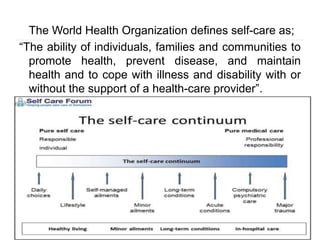
The World Health Organization defines self-care as;
“The ability of individuals, families and communities to
promote health, prevent disease, and maintain
health and to cope with illness and disability with or
without the support of a health-care provider”.
What is Self Medication?
“Self-medication” is just one element of self-care and
can be defined as the selection and use of
medicines by individuals to treat self-recognized
illness or symptoms.
How these medicines are made available to the
public varies from country to country but all have
been approved by regulatory agencies as safe and
effective for people to select and use without the
need for medical supervision or intervention.
Self-selection medicines are commonly referred to
as “over-the-counter” medicines or “nonprescription”
medicines. In this review, the term “nonprescription”
will be adopted since different markets place varying
restrictions on their availability, but all fall under the
umbrella term of “nonprescription”.
Role of Pharmacists in Promoting the
Safe Practices during Self-Medication:
Pharmacies are often the first place a person visits
when faced with an ailment. Pharmacists are highly
skilled and trained professionals with vast knowledge
about products and different conditions. They guide
and advise individuals, helping them to avoid
possible interactions of medicines and warning them
of possible side effects.
As a communicator:
 The pharmacist should initiate dialogue with the patient.
 In order to address the condition of the patient appropriately.
(e.g. how to take the medicines and how to deal with safety
issues)
 The pharmacist must be prepared and adequately equipped to
perform a proper screening for specific conditions and
diseases, without interfering with the prescriber’s authority.
 The pharmacist must provide objective information about
medicines.
 The pharmacist must be able to use and interpret additional
sources of information to satisfy the needs of the patient.
 The pharmacist should be able to help the patient.
 The pharmacist must ensure confidentiality concerning details
of the patient’s condition.
As a quality drug supplier:
 The pharmacist must ensure that the products he/she
purchases are from reputable sources and of good
quality.
 The pharmacist must ensure the proper storage of these
products.
As a trainer and supervisor:
 To ensure up-to-date quality service, the pharmacist must
be encouraged to participate in continuing professional
development activities such as continuing education.
 The pharmacist is often assisted by non-pharmacist staff
and must ensure that the services rendered by these
auxiliaries correspond to established standards of
practice.
As a collaborator:
 It is imperative that pharmacists develop quality
collaborative relationships with:
 Other health care professionals
 National professional associations
 The pharmaceutical industry
 Governments (local/national)
 Patients and the general public
 In so doing, opportunities to tap into resources and
expertise, and to share data and experiences, in order to
improve self-care and self-medication, will be enhanced.
As a health promoter:
As a member of the health-care team, the pharmacist
must:
 Participate in health screening to identify health problems
and those at risk in the community
 Participate in health promotion campaigns to raise
awareness of health issues and disease prevention
 Provide advice to individuals to help them make informed
health choices
Responding to symptoms, minor
ailments, and advice for self-care:
1. Pain management:
Pain is a very common condition. The occurrence of
pain rises as people get older, and women are more
likely to experience pain than men.
Pain may be anything from a dull ache to a sharp
stab and can range from mild to extreme. You may
feel pain in one part of your body or it may be
widespread.
Types of pain
There are 2 main types of pain:
 Acute pain – a normal response to an injury or
medical condition. It starts suddenly and is usually
short-lived.
 Chronic pain – continues beyond the time expected
for healing. It generally lasts for longer than 3
months.
Pain management strategies
Studies suggest that a person’s emotional
wellbeing can impact the experience of pain.
Understanding the cause and learning effective ways
to cope with your pain can improve your quality of
life. Key pain management strategies include:
 Pain medicines
 Physical therapies (such as heat or cold
packs, massage, hydrotherapy and exercise)
 Psychological therapies (such as cognitive
behavioral therapy, relaxation techniques
and meditation)
 Mind and body techniques (such as acupuncture)
 Community support groups.
Managing pain without medicines
Many non-medicine treatments are available to help you
manage your pain. A combination of treatments and
therapies is often more effective than just one.
Some non-medicine options include:
 Heat or cold – use ice packs immediately after an injury to
reduce swelling. Heat packs are better for relieving chronic
muscle or joint injuries.
 Physical therapies – such as walking, stretching,
strengthening or aerobic exercises may help reduce pain,
keep you mobile and improve your mood.
 Massage – this is another physical therapy.
 Relaxation and stress management techniques –
including meditation and yoga.
 Acupuncture – a component of traditional Chinese
medicine.
Pain medicines
Many people will use a pain medicine (analgesic) at
some time in their lives.
The main types of pain medicines are:
 Paracetamol – often recommended as the first
medicine to relieve short-term pain.
 Aspirin – for short-term relief of fever and mild-to-
moderate pain (such as period pain or headache).
 Non-steroidal anti-inflammatory drugs (NSAIDs),
such as ibuprofen – these medicines relieve pain
and reduce inflammation (redness and swelling).
2. Cough and Cold:
Non-medication treatment for cough or cold:
 Get plenty of rest and drink plenty of fluids.
 Try to breathe moist air. Use a humidifier or take a
steamy shower.
 Consume warm fluids (soup or tea) to provide relief
for a stuffy nose and to loosen phlegm.
 Eat a well-balanced diet. If you cannot, ensure you
are getting enough nutrients by taking a daily
multivitamin.
 Avoid dairy products, as they can thicken phlegm.
 Avoid alcohol, as it impairs your body’s immune
system.
Contact your doctor if you experience
any of the following:
 High fever (Temperature > 101F for > 72 hrs)
 Ear pain
 Sinus-type headache
 Unusually severe cold symptoms
 Cough that gets worse while other cold symptoms
improve
 Flare up of any chronic lung problem, such as
asthma
 No improvement in symptoms for more than 10 days
Recommended non-prescription
medications by symptom:
Cough, Non-productive (not coughing up phlegm)
 Cough suppressant containing dextromethorphan
(TusQ-DX Syrup)
Cough, Productive (coughing up phlegm)
 Cough suppressant (see above)
 Expectorant: Cof Q tablets or plain guaifenesin
syrup, also known as (Zedex Plus Syrup)
Fever/Headache/Muscle Aches
 Acetaminophen (Ultracet/Calpol)
 Non-Steroidal Anti-Inflammatory Drugs (NSAIDs)
such as ibuprofen (Combilam) or naproxen
(Naxdom)
Nasal Stuffiness
 Saline nasal spray or a Neti Pot.
 Nasal steroid sprays: Fluticone-FT or Solvin Nasal
Spray
 Decongestants:
 Topical spray: Oxymetazoline (Sinarest New Nasal Spray);
limit to 3-4 days maximum
 Oral medication: Pseudoephedrine (Ambrodil-Plus RF
Runny and/or Itchy Nose/Sneezing
 Nasal steroid sprays: Flonase® or Nasacort®
 Antihistamine: Benadryl®, which will likely cause
drowsiness, or Loratadine (Alavert®), which is not as
likely to cause drowsiness
Sore Throat Pain Relief
 Suck on throat lozenges, hard candy or popsicles
 Gargle with warm salt water (1/4 tsp. salt per 8 oz. of
water); and eat soft, bland foods.
 Take acetaminophen (Tylenol®) or ibuprofen
(Advil®).
 Try throat sprays (Chloraseptic®).
3. Vomiting and Diarrhea:
Vomiting and diarrhea can make you feel awful. Your
stomach and bowels are reacting to an irritant. This
might be food, medicine, or a virus.
Vomiting and diarrhea are 2 ways your body tries to
remove the problem from your system. Nausea is a
symptom that prevents you from eating. This can
give your stomach and bowels time to recover. Self-
care can help to ease your discomfort.
Drink liquids
 Drink or sip liquids so you don't lose too much fluid
(dehydration). To do this:
 Choose clear liquids such as water or broth.
 Don't have drinks with a lot of sugar in them. This
includes juice and soda. These can make diarrhea
worse.
 If you have severe vomiting or diarrhea, don't drink
sports drinks or electrolyte drinks. These don't have
the right mix of water, sugar, and minerals. They can
make the symptoms worse. Try an oral rehydration
solution.
 Suck on ice chips if nausea makes it hard for you to
Medicines
 When considering medicines:
 Don't use medicines to stop diarrhea or vomiting unless
your healthcare provider tells you to do so. Vomiting and
diarrhea can help your body get rid of harmful
substances.
 Some medicines can cause vomiting and diarrhea. Talk
with your provider about all medicines you take. Ask
which ones may cause these symptoms
 Any medicine with aspirin can bother your stomach. So
don't use them when you have an upset stomach.
 Some OTC antihistamines can help control nausea.
Other medicines can help soothe an upset stomach. Ask
your healthcare provider which medicines may help you.
When to call your healthcare provider
Call your healthcare provider care right away if you have
any of these:
 Bloody or black vomit or stools
 Severe, steady belly pain
 Vomiting with a severe headache or stiff neck
 Vomiting after a head injury
 Vomiting and diarrhea together for more than 1 hour
 Can't sip liquids after more than 12 hours
 Vomiting that lasts more than 24 hours
 Severe diarrhea that lasts more than 2 days
 Fever of 100.4°F (38.0°C) or higher, or as advised
 Yellowish color to your skin or the whites of your eyes
 Can't urinate
4. Constipation:
Constipation is when you do not pass stool as often
as you normally do. Your stool may become hard
and dry, and it can be difficult to pass.
Signs, Symptoms, and Causes
 You might feel bloated and have pain, or you might
have to strain when you try to go.
 Some medicines, and even some vitamins, can
make you constipated. You can get constipated if
you do not get enough fiber, drink enough water, or
get enough exercise. You can also get constipated if
you put off going to the bathroom even though you
have the urge to go.
 Try to get to know your normal bowel movement
pattern, so that you can prevent constipation and
keep it from getting worse.
How to Relieve Constipation
 Exercise regularly. Drink more water and eat more
fiber. Try to walk, swim, or do something active at
least 3 or 4 times a week.
 If you feel the urge to go to the bathroom, go. Do not
wait or hold it in.
 You can also train your bowels to be more regular. It
may help to go to the bathroom every day at the
same time. For many people, this is after breakfast
or dinner.
Laxatives, Stool Softeners, and Other
Products
 You can buy stool softeners at any pharmacy. They will help
you pass stool more easily.
 Your provider may prescribe a laxative to relieve your
constipation. It may be a pill or liquid. Do not take it if you have
severe stomach pain, nausea, or vomiting. Do not take it for
more than 1 week without consulting your provider. It should
start to work in 2 to 5 days.
 Only take a laxative as often as your provider recommends.
Most laxatives are taken with meals or at bedtime.
 You can mix powder laxatives with milk or fruit juice to make
them taste better.
 Always drink plenty of water (8 to 10 cups, or 2 to 2.5 L a day)
when you are using laxatives.
 Store your laxative medicine safely in a medicine cabinet,
where children cannot get to it.
 Do not take any other laxatives or medicines before talking
with your provider. This includes mineral oil.
5. Fever:
For healthy human beings, the body temperature should
be around 98.4°F (37°C).
Any rise in temperature above one degree more than the
normal is considered as fever.
However, fever by itself may not be something to worry
about until the temperature reaches very high levels and
fever episodes occur often, but it always requires medical
attention to find and treat the cause.
Infections are one of the main causes of fever, but fever
is mostly a body response to fight off these infections.
However, you can manage it with some self care
treatment tips for fever at home before consulting the
doctor.
Symptoms:
Body temperature ranging from 100 to 102°F (37.8 to
39°C) is considered as low-grade fever, whereas body
temperature of more than that is considered as high-
grade fever. In either condition, some major associated
symptoms are:
 Chills
 Sweating
 Headache
 Muscle ache
 Appetite loss
 Fatigue
 Lethargy
 Sometimes, a very high fever can cause seizures.
Causes:
 Severe physical exertion
 Infection (bacteria, virus, parasites, and fungi)
 Heat exhaustion
 Autoimmune disorders
 Inflammatory disorders
 A malignant tumor
 Blood pressure and seizure medications
 Some immunization vaccines,
like diphtheria, tetanus, and pneumococcal vaccine
 Drug abuse or side-effect of medications
 Hormone disorders
Home Remedies for Fever:
 Fever causes continuous unease, but some self-help
remedies can quickly give you relief. Follow the following
home remedies and tips:
 Drink a lot of water/hydrate well: With a fever, our body
needs more water to compensate for the high
temperature because there is more water loss in the
body. It is called dehydration. Drinking lots of water can
help in rehydrating the body. Along with water, have
coconut water, orange juice, lime juice, and oral
rehydration solution(ORS).
 Rest: Our body requires a lot of energy to fight off fever.
A person having a fever should take an adequate amount
of rest until the fever is gone. Any physical stress can
have ill effects.
 Have a warm bath: Have a bath with lukewarm water as
it is soothing and relieves the pain in the muscles and
Use OTC medicines:
Over-The-Counter (OTC) medicines are available to
relieve fever. Some of them are ibuprofen and
paracetamol. However, for infants or children, give
medicines according to a doctor’s prescription.
When to See a Doctor?
If you feel feverish and do not subside even after
following the home remedies mentioned above or
any other concerns, consult your doctor for further
diagnosis and treatment.
6. Skin disorders:
Skin diseases are conditions that affect your skin.
These diseases may cause rashes, inflammation,
itchiness or other skin changes.
Some skin conditions may be genetic, while lifestyle
factors may cause others.
Skin disease treatment may include medications,
creams or ointments, or lifestyle changes.
What are skin diseases?
 Your skin is the large organ that covers and protects
your body. Your skin has many functions. It works to:
 Hold in fluid and prevent dehydration.
 Help you feel sensations, such as temperature or
pain.
 Keep out bacteria, viruses and other causes of
infection.
 Stabilize your body temperature.
 Synthesize (create) vitamin D in response to sun
exposure.
How are skin diseases treated?
Many skin diseases respond well to treatment.
Depending on the condition, a dermatologist (doctor
specializing in skin) or other healthcare provider may
recommend:
 Antibiotics.
 Antihistamines.
 Laser skin resurfacing.
 Medicated creams, ointments or gels.
 Moisturizers.
 Oral medications (taken by mouth).
 Steroid pills, creams or injections.
 Surgical procedures.
You may also reduce symptoms of skin conditions by
making lifestyle changes:
 Avoid or limit certain foods, such as sugar or dairy, if
your healthcare provider suggests it.
 Manage stress.
 Practice good hygiene, including proper skin care.
 Avoid excessive alcohol use and smoking.
7. Oral health:
 Dental and oral health is an essential part of your
overall health and well-being. Poor oral hygiene can
lead to dental cavities and gum disease, and has
also been linked to heart disease, cancer, and
diabetes.
 Maintaining healthy teeth and gums is a lifelong
commitment. The earlier you learn proper oral
hygiene habits — such as brushing, flossing, and
limiting your sugar intake — the easier it’ll be to
avoid costly dental procedures and long-term health
issues.
Types of dental and oral diseases:
 Cavities
 Gum disease (gingivitis)
 Periodontitis
 Cracked or broken teeth
 Sensitive teeth
 Oral cancer
Treating dental and oral problems:
 Cleanings
 Fluoride treatments
 Antibiotics
 Fillings, crowns, and sealants
 Root canal
 Probiotics
 Changing daily habits

Chapter 8_Over The Counter (OTC) Medications.pptx

  • 1.
    Chapter: 8 Over TheCounter (OTC) Medications By: Mr. Vinay D. Gaikwad S.P.M.S. College of Pharmacy (Poly), Akluj.
  • 2.
    Contents:  Definition, needand role of Pharmacists in OTC medication dispensing  OTC medications in India, counseling for OTC products  Self-medication and role of pharmacists in promoting the safe practices during self- medication  Responding to symptoms, minor ailments, and advice for self-care in conditions such as –  Pain management,  Cough,  Cold,  Diarrhea,  Constipation,  Vomiting,  Fever,  Sore throat,  Skin disorders,  Oral health (mouth ulcers, dental pain, gum swelling) 15Hrs.
  • 3.
    Introduction: Medications are broadlyclassified in to two types 1. Prescription controlled medications 2. Prescription uncontrolled medications  Prescription controlled medications: this class involves the drugs and medicines which needed a signified prescription of eligible authority that is physician or a registered medical practitioner.  Prescription uncontrolled medications: this class involves all the drugs and medicines which do not require a written prescription of a physician or a medical practitioner. Such medications can be directly purchases over the chemist, so those drugs are called as an over the counter drugs or non prescribed drugs.
  • 4.
    Definition:  “OTC Medicationsare those medications that can be obtained over the counter or from the chemist bench without prescription of a RMP and consultation with a physician. It can be suggested that those having little significant pharmacological activity and therefore the physician need not to be very much concerned about these use by the patient themselves.”  “Over-the-counter medicine is also known as OTC or nonprescription medicine. All these terms refer to medicine that you can buy without a prescription. They are safe and effective when you follow the directions on the label and as directed by your health care professional.” Examples include analgesics (pain relievers), such as aspirin and acetaminophen.
  • 5.
    OTC Medication History: In 1860s the preparation of remedies at home was replaced by purchasing of patient medicines.  By 1905 the market of the patent drugs was at its peak.  1920 due to intense economical and political struggle changed preference care, resulted in decline in public demand and use of patient medicines.
  • 6.
    Need & Benefitsof OTC Medicine:  Over-the-counter (OTC) medicines are drugs you can buy without a prescription. Some OTC medicines relieve aches, pains, and itches. Some prevent or cure diseases, like tooth decay and athlete's foot. Others help manage recurring problems, like migraines and allergies.  OTC medicines are a critical component in advancing consumer health because they allow people to treat or manage many health conditions conveniently and successfully. Because they enable people to self-treat, OTC medicines save health systems valuable resources and can save consumers time and money.
  • 7.
    OTC Medications Reasons: Shortage of time and comfort  Cheaper in price  Availability  Level of literacy and awareness  Self care  Advertisement
  • 8.
    1. Shortage ofTime Comfort: Usually people in cities and towns due to their busy schedule don't get proper time for visiting the physician for getting proper medications but OTC medications are available in very less time or less consuming time and easily available. 2. Cheaper in Price: In our country like India where more than 55% of total population is just near the poverty line people majority are weak to visit physician for small health problems and hence prefer non- prescribed drugs comparatively cheaper.
  • 9.
    3. Availability: Most ofthe NPDS are easily available at all places. Due to the availabilities, there is easily preferred by common people for daily health problems. 4. Level of Literacy and Awareness: Many of the people have either very low awareness due to which they don't prefer to visit a physician. 5. Self Care: Now a day's people with high literacy and awareness are preferred to use of OTC medications. This is because self caring people that they can take care of their own help.
  • 10.
    Role of Pharmacistsin OTC Medication Dispensing: The pharmacists play a vital role in controlling the number of medications being dispensed as OTC drugs. They can also counsel and advise the consumers regarding OTC medications.  Carefully read and follow all directions on the medicine bottle and box.  Dispense the minimum effective dose.  Call your doctor if you think you are having a problem with your medicine.  Do not give a medicine if patient have had an allergic reaction to it in the past.  Inform patient to take the medicine exactly as directed.  Pharmacist has to be careful when dispensing more than one drug.  Keep your doctor informed.
  • 11.
    OTC Medications inIndia:  In India, the medicines are listed under different schedules in the Drugs and Cosmetics Act and Drugs and Cosmetics Rule. Drugs listed in Schedules H, H1, and X should carry a label stating that these drugs are to be sold by retail only on prescription of a registered medical practitioner.  It has to be stressed that in India, the phrase “OTC” has no legal recognition. Here, the term OTC is used for the way drugs are used (self-medication without prescription or allowed to be sold by pharmacists without the prescription of a Registered Medical Practitioner) rather than being a recognized official category of medicines unlike other countries.
  • 12.
     Schedule Kof the Drug and Cosmetics Act and its Rules includes household remedies such as paracetamol, liquid paraffin, eucalyptus oil, tincture iodine, and various formulations for the treatment of cough and cold and are the potential OTC drugs.
  • 13.
     Currently, nondrug-licensedstores (e.g., nonpharmacists) can sell a few medicines classified as “Household Remedies” in Schedule K of the D and C Rules in villages whose population is below 1000 subject to certain other conditions. Under the provision of the Drugs and Magic Remedies (Objectionable Advertisements) Act, 1954 and Rules, 1955, the advertising and misleading promotion of some drugs/classes is kept under control to avoid self-medication by people. Topical or external use of certain schedule G and H category drugs (except ophthalmic and ear/nose preparations containing antibiotics and/or steroids) is exempt from the schedule. For example, topical diclofenac is not a schedule H drug though diclofenac is included in schedule H.
  • 14.
     The medicineswhich do not fall under the category of schedule H, H1, and X can be given without prescription through pharmacists and drugstores in India. Moreover, it is a common observation that prescription drugs are also sold without a prescription akin to over the counter medicines. Ayurvedic drugs and traditional medicines are manufactured under a manufacturing licence issued by the State Licensing Authorities. These drugs are sold over the counter freely by non-pharmacists. Thus, till date, there are no specific unifying regulations related to use and sale of OTC products and this impacts both the accessibility to better health care and patients' safety due to inappropriate use.
  • 15.
    Counseling for OTCProducts:  Patients’ use of OTC products carries both benefits and risks.  When pharmacists proactively counsel patients on OTC product selection and use, the risks virtually disappear.  Pharmacists should have to counsel every patient on the safe and effective use of OTC products.
  • 16.
     The involvementof pharmacists in nonprescription medication counseling will increase the public stability to understand the risks and benefits of OTC remedies.  It has been well documented that interactions by pharmacists through consultation and effective assessment strategies can enhance patient outcomes.  In order to counsel patients efficiently, pharmacists must be able to communicate.
  • 17.
     The firststep in achieving optimal communication is setting the stage.  By identifying potential barriers in the pharmacy that can impede good communication, pharmacists can actively take steps to overcome them.  It is important to remove distractions or barriers that may affect interactions with patients.
  • 18.
    The mnemonic QuESTmeans: Quickly and accurately assess the patient; Establish that the patient is an appropriate self-care candidate; Suggest appropriate self-care strategies to the patient; Talk with the patient about these strategies.
  • 19.
    Another helpful mnemonicis SCHOLAR-MAC: Symptoms; Characteristics of symptoms; History of symptoms; Onset; Location; Aggravating factors; Remitting factors; Medications (prescription, OTC, herbal, dietary supplements); Allergies; Conditions (medical).
  • 20.
    Self-medication: Fundamentally, the concept“self-care” puts responsibility on individuals for their own health and well-being. Many authors have described what constitutes self-care, and whilst no universally agreed definition exists, it is clear that self-care is seen as a broad concept that encompasses activities to establish and maintain health, through to preventing ill health.
  • 21.
    The World HealthOrganization defines self-care as; “The ability of individuals, families and communities to promote health, prevent disease, and maintain health and to cope with illness and disability with or without the support of a health-care provider”.
  • 22.
    What is SelfMedication? “Self-medication” is just one element of self-care and can be defined as the selection and use of medicines by individuals to treat self-recognized illness or symptoms. How these medicines are made available to the public varies from country to country but all have been approved by regulatory agencies as safe and effective for people to select and use without the need for medical supervision or intervention.
  • 23.
    Self-selection medicines arecommonly referred to as “over-the-counter” medicines or “nonprescription” medicines. In this review, the term “nonprescription” will be adopted since different markets place varying restrictions on their availability, but all fall under the umbrella term of “nonprescription”.
  • 24.
    Role of Pharmacistsin Promoting the Safe Practices during Self-Medication: Pharmacies are often the first place a person visits when faced with an ailment. Pharmacists are highly skilled and trained professionals with vast knowledge about products and different conditions. They guide and advise individuals, helping them to avoid possible interactions of medicines and warning them of possible side effects.
  • 25.
    As a communicator: The pharmacist should initiate dialogue with the patient.  In order to address the condition of the patient appropriately. (e.g. how to take the medicines and how to deal with safety issues)  The pharmacist must be prepared and adequately equipped to perform a proper screening for specific conditions and diseases, without interfering with the prescriber’s authority.  The pharmacist must provide objective information about medicines.  The pharmacist must be able to use and interpret additional sources of information to satisfy the needs of the patient.  The pharmacist should be able to help the patient.  The pharmacist must ensure confidentiality concerning details of the patient’s condition.
  • 26.
    As a qualitydrug supplier:  The pharmacist must ensure that the products he/she purchases are from reputable sources and of good quality.  The pharmacist must ensure the proper storage of these products.
  • 27.
    As a trainerand supervisor:  To ensure up-to-date quality service, the pharmacist must be encouraged to participate in continuing professional development activities such as continuing education.  The pharmacist is often assisted by non-pharmacist staff and must ensure that the services rendered by these auxiliaries correspond to established standards of practice.
  • 28.
    As a collaborator: It is imperative that pharmacists develop quality collaborative relationships with:  Other health care professionals  National professional associations  The pharmaceutical industry  Governments (local/national)  Patients and the general public  In so doing, opportunities to tap into resources and expertise, and to share data and experiences, in order to improve self-care and self-medication, will be enhanced.
  • 29.
    As a healthpromoter: As a member of the health-care team, the pharmacist must:  Participate in health screening to identify health problems and those at risk in the community  Participate in health promotion campaigns to raise awareness of health issues and disease prevention  Provide advice to individuals to help them make informed health choices
  • 30.
    Responding to symptoms,minor ailments, and advice for self-care: 1. Pain management: Pain is a very common condition. The occurrence of pain rises as people get older, and women are more likely to experience pain than men. Pain may be anything from a dull ache to a sharp stab and can range from mild to extreme. You may feel pain in one part of your body or it may be widespread.
  • 31.
    Types of pain Thereare 2 main types of pain:  Acute pain – a normal response to an injury or medical condition. It starts suddenly and is usually short-lived.  Chronic pain – continues beyond the time expected for healing. It generally lasts for longer than 3 months.
  • 32.
    Pain management strategies Studiessuggest that a person’s emotional wellbeing can impact the experience of pain. Understanding the cause and learning effective ways to cope with your pain can improve your quality of life. Key pain management strategies include:  Pain medicines  Physical therapies (such as heat or cold packs, massage, hydrotherapy and exercise)  Psychological therapies (such as cognitive behavioral therapy, relaxation techniques and meditation)  Mind and body techniques (such as acupuncture)  Community support groups.
  • 33.
    Managing pain withoutmedicines Many non-medicine treatments are available to help you manage your pain. A combination of treatments and therapies is often more effective than just one. Some non-medicine options include:  Heat or cold – use ice packs immediately after an injury to reduce swelling. Heat packs are better for relieving chronic muscle or joint injuries.  Physical therapies – such as walking, stretching, strengthening or aerobic exercises may help reduce pain, keep you mobile and improve your mood.  Massage – this is another physical therapy.  Relaxation and stress management techniques – including meditation and yoga.  Acupuncture – a component of traditional Chinese medicine.
  • 34.
    Pain medicines Many peoplewill use a pain medicine (analgesic) at some time in their lives. The main types of pain medicines are:  Paracetamol – often recommended as the first medicine to relieve short-term pain.  Aspirin – for short-term relief of fever and mild-to- moderate pain (such as period pain or headache).  Non-steroidal anti-inflammatory drugs (NSAIDs), such as ibuprofen – these medicines relieve pain and reduce inflammation (redness and swelling).
  • 35.
    2. Cough andCold: Non-medication treatment for cough or cold:  Get plenty of rest and drink plenty of fluids.  Try to breathe moist air. Use a humidifier or take a steamy shower.  Consume warm fluids (soup or tea) to provide relief for a stuffy nose and to loosen phlegm.  Eat a well-balanced diet. If you cannot, ensure you are getting enough nutrients by taking a daily multivitamin.  Avoid dairy products, as they can thicken phlegm.  Avoid alcohol, as it impairs your body’s immune system.
  • 36.
    Contact your doctorif you experience any of the following:  High fever (Temperature > 101F for > 72 hrs)  Ear pain  Sinus-type headache  Unusually severe cold symptoms  Cough that gets worse while other cold symptoms improve  Flare up of any chronic lung problem, such as asthma  No improvement in symptoms for more than 10 days
  • 37.
    Recommended non-prescription medications bysymptom: Cough, Non-productive (not coughing up phlegm)  Cough suppressant containing dextromethorphan (TusQ-DX Syrup) Cough, Productive (coughing up phlegm)  Cough suppressant (see above)  Expectorant: Cof Q tablets or plain guaifenesin syrup, also known as (Zedex Plus Syrup)
  • 38.
    Fever/Headache/Muscle Aches  Acetaminophen(Ultracet/Calpol)  Non-Steroidal Anti-Inflammatory Drugs (NSAIDs) such as ibuprofen (Combilam) or naproxen (Naxdom) Nasal Stuffiness  Saline nasal spray or a Neti Pot.  Nasal steroid sprays: Fluticone-FT or Solvin Nasal Spray  Decongestants:  Topical spray: Oxymetazoline (Sinarest New Nasal Spray); limit to 3-4 days maximum  Oral medication: Pseudoephedrine (Ambrodil-Plus RF
  • 39.
    Runny and/or ItchyNose/Sneezing  Nasal steroid sprays: Flonase® or Nasacort®  Antihistamine: Benadryl®, which will likely cause drowsiness, or Loratadine (Alavert®), which is not as likely to cause drowsiness Sore Throat Pain Relief  Suck on throat lozenges, hard candy or popsicles  Gargle with warm salt water (1/4 tsp. salt per 8 oz. of water); and eat soft, bland foods.  Take acetaminophen (Tylenol®) or ibuprofen (Advil®).  Try throat sprays (Chloraseptic®).
  • 40.
    3. Vomiting andDiarrhea: Vomiting and diarrhea can make you feel awful. Your stomach and bowels are reacting to an irritant. This might be food, medicine, or a virus. Vomiting and diarrhea are 2 ways your body tries to remove the problem from your system. Nausea is a symptom that prevents you from eating. This can give your stomach and bowels time to recover. Self- care can help to ease your discomfort.
  • 41.
    Drink liquids  Drinkor sip liquids so you don't lose too much fluid (dehydration). To do this:  Choose clear liquids such as water or broth.  Don't have drinks with a lot of sugar in them. This includes juice and soda. These can make diarrhea worse.  If you have severe vomiting or diarrhea, don't drink sports drinks or electrolyte drinks. These don't have the right mix of water, sugar, and minerals. They can make the symptoms worse. Try an oral rehydration solution.  Suck on ice chips if nausea makes it hard for you to
  • 42.
    Medicines  When consideringmedicines:  Don't use medicines to stop diarrhea or vomiting unless your healthcare provider tells you to do so. Vomiting and diarrhea can help your body get rid of harmful substances.  Some medicines can cause vomiting and diarrhea. Talk with your provider about all medicines you take. Ask which ones may cause these symptoms  Any medicine with aspirin can bother your stomach. So don't use them when you have an upset stomach.  Some OTC antihistamines can help control nausea. Other medicines can help soothe an upset stomach. Ask your healthcare provider which medicines may help you.
  • 43.
    When to callyour healthcare provider Call your healthcare provider care right away if you have any of these:  Bloody or black vomit or stools  Severe, steady belly pain  Vomiting with a severe headache or stiff neck  Vomiting after a head injury  Vomiting and diarrhea together for more than 1 hour  Can't sip liquids after more than 12 hours  Vomiting that lasts more than 24 hours  Severe diarrhea that lasts more than 2 days  Fever of 100.4°F (38.0°C) or higher, or as advised  Yellowish color to your skin or the whites of your eyes  Can't urinate
  • 44.
    4. Constipation: Constipation iswhen you do not pass stool as often as you normally do. Your stool may become hard and dry, and it can be difficult to pass.
  • 45.
    Signs, Symptoms, andCauses  You might feel bloated and have pain, or you might have to strain when you try to go.  Some medicines, and even some vitamins, can make you constipated. You can get constipated if you do not get enough fiber, drink enough water, or get enough exercise. You can also get constipated if you put off going to the bathroom even though you have the urge to go.  Try to get to know your normal bowel movement pattern, so that you can prevent constipation and keep it from getting worse.
  • 46.
    How to RelieveConstipation  Exercise regularly. Drink more water and eat more fiber. Try to walk, swim, or do something active at least 3 or 4 times a week.  If you feel the urge to go to the bathroom, go. Do not wait or hold it in.  You can also train your bowels to be more regular. It may help to go to the bathroom every day at the same time. For many people, this is after breakfast or dinner.
  • 47.
    Laxatives, Stool Softeners,and Other Products  You can buy stool softeners at any pharmacy. They will help you pass stool more easily.  Your provider may prescribe a laxative to relieve your constipation. It may be a pill or liquid. Do not take it if you have severe stomach pain, nausea, or vomiting. Do not take it for more than 1 week without consulting your provider. It should start to work in 2 to 5 days.  Only take a laxative as often as your provider recommends. Most laxatives are taken with meals or at bedtime.  You can mix powder laxatives with milk or fruit juice to make them taste better.  Always drink plenty of water (8 to 10 cups, or 2 to 2.5 L a day) when you are using laxatives.  Store your laxative medicine safely in a medicine cabinet, where children cannot get to it.  Do not take any other laxatives or medicines before talking with your provider. This includes mineral oil.
  • 48.
    5. Fever: For healthyhuman beings, the body temperature should be around 98.4°F (37°C). Any rise in temperature above one degree more than the normal is considered as fever. However, fever by itself may not be something to worry about until the temperature reaches very high levels and fever episodes occur often, but it always requires medical attention to find and treat the cause. Infections are one of the main causes of fever, but fever is mostly a body response to fight off these infections. However, you can manage it with some self care treatment tips for fever at home before consulting the doctor.
  • 49.
    Symptoms: Body temperature rangingfrom 100 to 102°F (37.8 to 39°C) is considered as low-grade fever, whereas body temperature of more than that is considered as high- grade fever. In either condition, some major associated symptoms are:  Chills  Sweating  Headache  Muscle ache  Appetite loss  Fatigue  Lethargy  Sometimes, a very high fever can cause seizures.
  • 50.
    Causes:  Severe physicalexertion  Infection (bacteria, virus, parasites, and fungi)  Heat exhaustion  Autoimmune disorders  Inflammatory disorders  A malignant tumor  Blood pressure and seizure medications  Some immunization vaccines, like diphtheria, tetanus, and pneumococcal vaccine  Drug abuse or side-effect of medications  Hormone disorders
  • 51.
    Home Remedies forFever:  Fever causes continuous unease, but some self-help remedies can quickly give you relief. Follow the following home remedies and tips:  Drink a lot of water/hydrate well: With a fever, our body needs more water to compensate for the high temperature because there is more water loss in the body. It is called dehydration. Drinking lots of water can help in rehydrating the body. Along with water, have coconut water, orange juice, lime juice, and oral rehydration solution(ORS).  Rest: Our body requires a lot of energy to fight off fever. A person having a fever should take an adequate amount of rest until the fever is gone. Any physical stress can have ill effects.  Have a warm bath: Have a bath with lukewarm water as it is soothing and relieves the pain in the muscles and
  • 52.
    Use OTC medicines: Over-The-Counter(OTC) medicines are available to relieve fever. Some of them are ibuprofen and paracetamol. However, for infants or children, give medicines according to a doctor’s prescription.
  • 53.
    When to Seea Doctor? If you feel feverish and do not subside even after following the home remedies mentioned above or any other concerns, consult your doctor for further diagnosis and treatment.
  • 54.
    6. Skin disorders: Skindiseases are conditions that affect your skin. These diseases may cause rashes, inflammation, itchiness or other skin changes. Some skin conditions may be genetic, while lifestyle factors may cause others. Skin disease treatment may include medications, creams or ointments, or lifestyle changes.
  • 55.
    What are skindiseases?  Your skin is the large organ that covers and protects your body. Your skin has many functions. It works to:  Hold in fluid and prevent dehydration.  Help you feel sensations, such as temperature or pain.  Keep out bacteria, viruses and other causes of infection.  Stabilize your body temperature.  Synthesize (create) vitamin D in response to sun exposure.
  • 56.
    How are skindiseases treated? Many skin diseases respond well to treatment. Depending on the condition, a dermatologist (doctor specializing in skin) or other healthcare provider may recommend:  Antibiotics.  Antihistamines.  Laser skin resurfacing.  Medicated creams, ointments or gels.  Moisturizers.  Oral medications (taken by mouth).  Steroid pills, creams or injections.  Surgical procedures.
  • 57.
    You may alsoreduce symptoms of skin conditions by making lifestyle changes:  Avoid or limit certain foods, such as sugar or dairy, if your healthcare provider suggests it.  Manage stress.  Practice good hygiene, including proper skin care.  Avoid excessive alcohol use and smoking.
  • 58.
    7. Oral health: Dental and oral health is an essential part of your overall health and well-being. Poor oral hygiene can lead to dental cavities and gum disease, and has also been linked to heart disease, cancer, and diabetes.  Maintaining healthy teeth and gums is a lifelong commitment. The earlier you learn proper oral hygiene habits — such as brushing, flossing, and limiting your sugar intake — the easier it’ll be to avoid costly dental procedures and long-term health issues.
  • 59.
    Types of dentaland oral diseases:  Cavities  Gum disease (gingivitis)  Periodontitis  Cracked or broken teeth  Sensitive teeth  Oral cancer
  • 60.
    Treating dental andoral problems:  Cleanings  Fluoride treatments  Antibiotics  Fillings, crowns, and sealants  Root canal  Probiotics  Changing daily habits