

Third-­‐Party	
  Payer	
  Track:	
  
Using	
  Data	
  to	
  Limit	
  Misuse	
  and	
  Abuse	
  
Presenters:	
  	
  
Phillip	
  Walls,	
  RPh,	
  Chief	
  Clinical	
  and	
  Compliance	
  Officer,	


  myMatrixx	
  
Jo-­‐Ellen	
  Abou	
  Nader,	
  CFE,	
  CIA,	
  CRMA,	
  Sr.	
  Director	
  of	
  Fraud,	
  Waste	
  &	
  Abuse	
  Services	


  Express	
  Scripts	
  
Moderator:	
  	
  
Michelle	
  C.	
  Landers,	
  ExecuOve	
  Vice	
  President	
  &	
  General	
  Counsel,	


  Kentucky	
  Employers’	
  Mutual	
  Insurance	
  
Disclosures:	
  
•  Phillip	
  Walls	
  has	
  disclosed	
  no	
  relevant,	
  real	
  or	
  apparent	
  personal	
  or	
  
professional	
  financial	
  relaOonships.	
  
•  Jo-­‐Ellen	
  Abou	
  Nader	
  has	
  disclosed	
  no	
  relevant,	
  real	
  or	
  apparent	
  personal	
  or	
  
professional	
  financial	
  relaOonships.	
  
Learning	
  ObjecOves:	
  
1.  Define	
  how	
  prescripOon	
  drug	
  data	
  is	
  currently	
  being	
  used.	


2.  Demonstrate	
  an	
  understanding	
  of	
  strategies	
  for	
  mining	
  the	
  data	
  to	
  manage	
  
drug	
  abuse.	


3.  IdenOfy	
  otherwise	
  easy	
  to	
  miss	
  cases	
  uOlizing	
  geomapping	
  and	
  recognizing	
  
pa[erns	
  of	
  behavior.	


4.  Organize	
  collaboraOon	
  with	
  private	
  and	
  public	
  agencies	
  to	
  end	
  the	
  epidemic	
  of	
  
prescripOon	
  drug	
  abuse.	
  
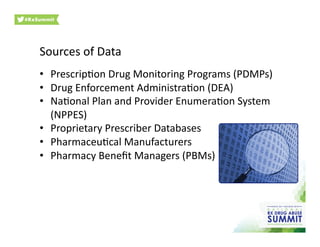
Sources	
  of	
  Data	
  
•  PrescripOon	
  Drug	
  Monitoring	
  Programs	
  (PDMPs)	
  
•  Drug	
  Enforcement	
  AdministraOon	
  (DEA)	
  
•  NaOonal	
  Plan	
  and	
  Provider	
  EnumeraOon	
  System	
  
(NPPES)	
  
•  Proprietary	
  Prescriber	
  Databases	
  
•  PharmaceuOcal	
  Manufacturers	
  
•  Pharmacy	
  Benefit	
  Managers	
  (PBMs)	
  
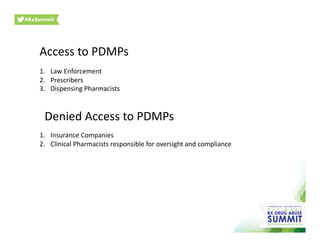
Access	
  to	
  PDMPs	
  
1.  Law	
  Enforcement	
  
2.  Prescribers	
  
3.  Dispensing	
  Pharmacists	
  
Denied	
  Access	
  to	
  PDMPs	
  
1.  Insurance	
  Companies	
  
2.  Clinical	
  Pharmacists	
  responsible	
  for	
  oversight	
  and	
  compliance	
  
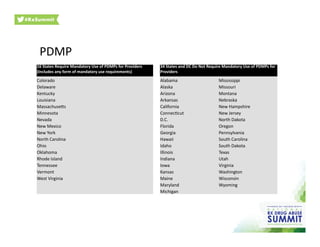
PDMP	
  
16	
  States	
  Require	
  Mandatory	
  Use	
  of	
  PDMPs	
  for	
  Providers	
  	
  
(Includes	
  any	
  form	
  of	
  mandatory	
  use	
  requirements)	
  
Colorado	
  
Delaware	
  
Kentucky	
  
Louisiana	
  
Massachuse[s	
  
Minnesota	
  
Nevada	
  
New	
  Mexico	
  
New	
  York	
  
North	
  Carolina	
  
Ohio	
  
Oklahoma	
  
Rhode	
  Island	
  
Tennessee	
  
Vermont	
  
West	
  Virginia	
  
34	
  States	
  and	
  DC	
  Do	
  Not	
  Require	
  Mandatory	
  Use	
  of	
  PDMPs	
  for	
  
Providers	
  
Alabama	
   Mississippi	
  
Alaska	
   Missouri	
  
Arizona	
   Montana	
  
Arkansas	
   Nebraska	
  
California	
   New	
  Hampshire	
  
ConnecOcut	
   New	
  Jersey	
  
D.C.	
   North	
  Dakota	
  
Florida	
   Oregon	
  
Georgia	
   Pennsylvania	
  
Hawaii	
   South	
  Carolina	
  
Idaho	
   South	
  Dakota	
  
Illinois	
   Texas	
  
Indiana	
   Utah	
  
Iowa	
   Virginia	
  
Kansas	
   Washington	
  
Maine	
   Wisconsin	
  
Maryland	
   Wyoming	
  
Michigan	
  
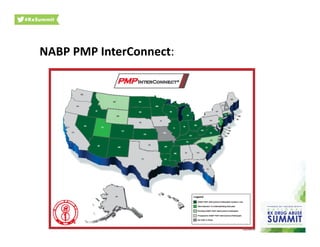
NABP	
  PMP	
  InterConnect:	
  
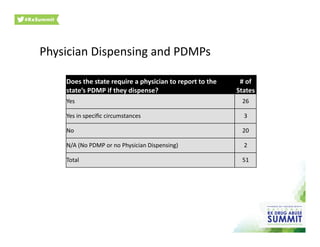
Physician	
  Dispensing	
  and	
  PDMPs	
  
Does	
  the	
  state	
  require	
  a	
  physician	
  to	
  report	
  to	
  the	
  
state’s	
  PDMP	
  if	
  they	
  dispense?	
  
#	
  of	
  
States	
  
Yes	
   26	
  
Yes	
  in	
  specific	
  circumstances	
   3	
  
No	
   20	
  
N/A	
  (No	
  PDMP	
  or	
  no	
  Physician	
  Dispensing)	
   2	
  
Total	
   51	
  
DEA	
  
1.  AutomaOon	
  of	
  Reports	
  and	
  Consolidated	
  Orders	
  System	
  (ARCOS)	
  
2.  Controlled	
  Substances	
  Ordering	
  System	
  (CSOS)	
  
3.  Electronic	
  PrescripOons	
  for	
  Controlled	
  Substances	
  
4.  Criminal	
  Cases	
  Against	
  Doctors	
  
5.  AdministraOve	
  AcOons	
  Against	
  Doctors	
  
6.  DATA	
  Waived	
  Physicians	
  (Drug	
  Addiciton	
  and	
  Treatment	
  Act)	
  
a.  DEA	
  number	
  
b.  DATA	
  2000	
  waiver	
  ID	
  number	
  or	
  "X"	
  number	
  
NaOonal	
  Plan	
  and	
  Provider	
  EnumeraOon	
  
System	
  (NPPES)	
  
• The	
  AdministraOve	
  SimplificaOon	
  provisions	
  of	
  the	
  Health	
  Insurance	
  Portability	
  
and	
  Accountability	
  Act	
  of	
  1996	
  (HIPAA)	
  mandated	
  the	
  adopOon	
  of	
  standard	
  
unique	
  idenOfiers	
  for	
  health	
  care	
  providers	
  and	
  health	
  plans	
  
• The	
  Centers	
  for	
  Medicare	
  &	
  Medicaid	
  Services	
  (CMS)	
  has	
  developed	
  the	
  
NaIonal	
  Plan	
  and	
  Provider	
  EnumeraIon	
  System	
  (NPPES)	
  to	
  assign	
  these	
  
unique	
  idenOfiers.	
  
• Unique	
  idenOfer	
  is	
  known	
  as	
  the	
  NaOonal	
  Provider	
  IdenOfier	
  (NPI)	
  
• The	
  NPI	
  is	
  a	
  unique	
  idenOficaOon	
  number	
  for	
  covered	
  health	
  care	
  providers.	
  
Covered	
  health	
  care	
  providers	
  and	
  all	
  health	
  plans	
  and	
  health	
  care	
  
clearinghouses	
  must	
  use	
  the	
  NPIs	
  in	
  the	
  administraOve	
  and	
  financial	
  
transacOons	
  adopted	
  under	
  HIPAA.	
  The	
  NPI	
  is	
  a	
  10-­‐posiOon,	
  intelligence-­‐free	
  
numeric	
  idenOfier	
  (10-­‐digit	
  number).	
  
Proprietary	
  Prescriber	
  Databases	
  
1.  NaOonal	
  Council	
  on	
  PrescripOon	
  Drug	
  Programs	
  (NCPDP)	
  HCIdea	
  
a.  Type	
  1	
  prescribers,	
  including	
  medical	
  doctors,	
  doctors	
  of	
  osteopathic	
  
medicine,	
  naturopaths,	
  chiropractors,	
  denOsts,	
  nurse	
  pracOOoners,	
  
physician	
  assistants,	
  optometrists,	
  podiatrists	
  and	
  other	
  allied	
  healthcare	
  
professionals	
  who	
  are	
  authorized	
  to	
  prescribe	
  medicaOons,	
  supplies	
  or	
  
medical	
  devices.	
  
b.  NPI	
  to	
  DEA	
  crosswalk	
  
c.  Surescripts	
  Provider	
  IdenOfier	
  (SPI)	
  ePrescribing	
  number	
  
2.  Health	
  Market	
  Science	
  
a.  Also	
  includes	
  state	
  medical	
  board	
  sancOons	
  
b.  OIG	
  sancOons	
  
PharmaceuOcal	
  Manufacturers	
  
OxyContin maker closely guards its
list of suspect doctors
Purdue Pharma has privately identified about 1,800 doctors
who may have recklessly prescribed the painkiller to addicts
and dealers, yet it has done little to alert authorities.
August 11, 2013|By Scott Glover and Lisa Girion
Over the last decade, the maker of the potent painkiller
OxyContin has compiled a database of hundreds of doctors
suspected of recklessly prescribing its pills to addicts and
drug dealers, but has done little to alert law enforcement or
medical authorities.
Despite its suspicions, Purdue Pharma continued to profit
from prescriptions written by these physicians, many of
whom were prolific prescribers of OxyContin. The company
has sold more than $27 billion worth of the drug since its
introduction in 1996.	
  	
  
Purdue has promoted the idea that the country's epidemic
of prescription drug deaths was fueled largely by pharmacy
robberies, doctor-shopping patients and teens raiding home
medicine cabinets. The database suggests that Purdue has
long known that physicians also play a significant role in the
crisis.
Purdue Pharma has sold more
than $27 billion worth of the
powerful painkiller… (Liz O.
Baylen, Los Angeles…)
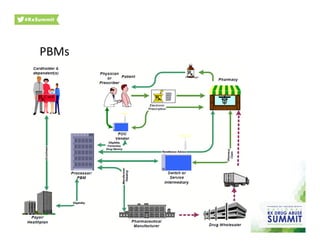
PBMs	
  
1. U.S. Centers for Disease Control and Prevention. Feb 2012. http://www.cdc.gov/Features/VitalSigns/PainkillerOverdoses/
2. US. Substance Abuse and Mental Health Services Administration. Dec 2010. http://www.oas.samhsa.gov/2k10/DAWN034/
EDHighlights.htm
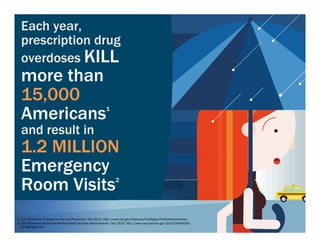
Each year,
prescription drug
overdoses KILL
more than
15,000
Americans1
and result in
1.2 MILLION
Emergency
Room Visits2
	
  
1U.S. Centers for Disease Control and Prevention. Feb 2012. http://www.cdc.gov/Features/VitalSigns/PainkillerOverdoses/
2U.S. Substance Abuse and Mental Health Services Administration. Dec 2010. http://www.oas.samhsa.gov/2k10/DAWN034/EDHighlights.htm
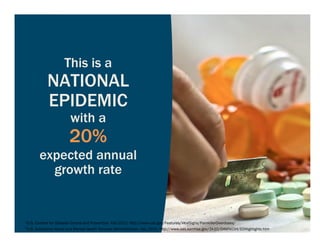
This is a
NATIONAL
EPIDEMIC
with a
20%
expected annual
growth rate
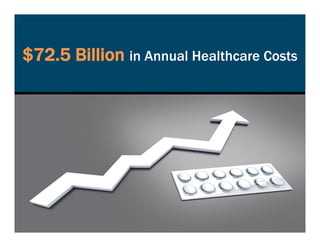
$72.5 Billion in Annual Healthcare Costs
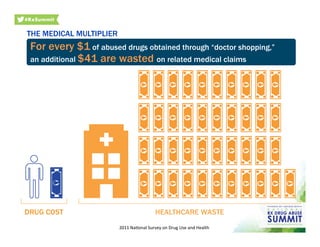
THE MEDICAL MULTIPLIER
2011	
  NaOonal	
  Survey	
  on	
  Drug	
  Use	
  and	
  Health	
  
For every $1 of abused drugs obtained through “doctor shopping,”
an additional $41 are wasted on related medical claims
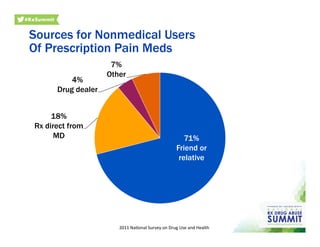
Sources for Nonmedical Users
Of Prescription Pain Meds
71%
Friend or
relative
18%
Rx direct from
MD
4%
Drug dealer
7%
Other
2011	
  NaOonal	
  Survey	
  on	
  Drug	
  Use	
  and	
  Health	
  
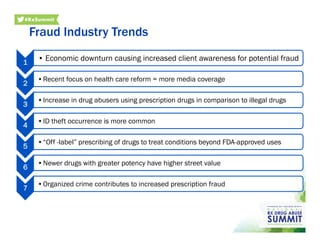
Fraud Industry Trends
1
• Economic downturn causing increased client awareness for potential fraud
2
• Recent focus on health care reform = more media coverage
3
• Increase in drug abusers using prescription drugs in comparison to illegal drugs
4
• ID theft occurrence is more common
5
• “Off -label” prescribing of drugs to treat conditions beyond FDA-approved uses
6
• Newer drugs with greater potency have higher street value
7
• Organized crime contributes to increased prescription fraud
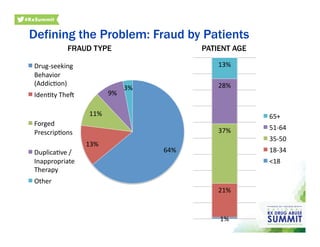
Defining the Problem: Fraud by Patients
64%	
  
13%	
  
11%	
  
9%	
  
3%	
  
Drug-­‐seeking	
  
Behavior	
  
(AddicOon)	
  
IdenOty	
  Thel	
  
Forged	
  
PrescripOons	
  
DuplicaOve	
  /	
  
Inappropriate	
  
Therapy	
  
Other	
  
1%	
  
21%	
  
37%	
  
28%	
  
13%	
  
65+	
  
51-­‐64	
  
35-­‐50	
  
18-­‐34	
  
<18	
  
FRAUD TYPE PATIENT AGE
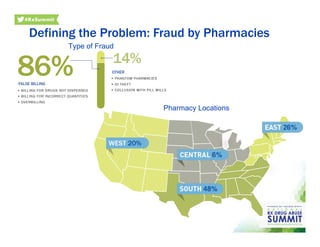
Type of Fraud
Pharmacy Locations
Defining the Problem: Fraud by Pharmacies
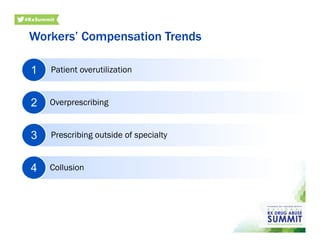
Workers’ Compensation Trends
Patient overutilization1
Overprescribing2
Prescribing outside of specialty3
Collusion4
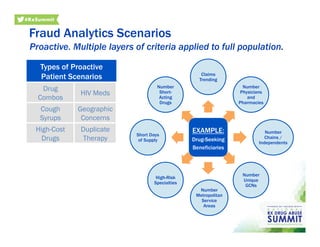
EXAMPLE:
Drug-Seeking
Beneficiaries
Claims
Trending
Number
Physicians
and
Pharmacies
Number
Chains /
Independents
Number
Unique
GCNs
Number
Metropolitan
Service
Areas
High-Risk
Specialties
Short Days
of Supply
Number
Short-
Acting
Drugs
Fraud Analytics Scenarios
Types of Proactive
Patient Scenarios
Drug
Combos
HIV Meds
Cough
Syrups
Geographic
Concerns
High-Cost
Drugs
Duplicate
Therapy
Proactive. Multiple layers of criteria applied to full population.
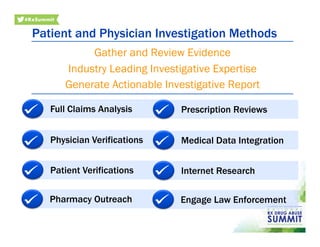
Patient and Physician Investigation Methods
Full Claims Analysis
Physician Verifications
Patient Verifications
Pharmacy Outreach
Prescription Reviews
Medical Data Integration
Internet Research
Engage Law Enforcement
Gather and Review Evidence
Industry Leading Investigative Expertise
Generate Actionable Investigative Report
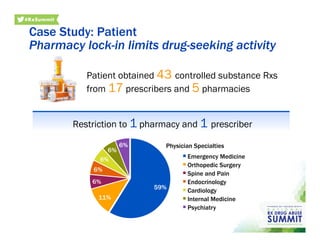
Case Study: Patient
Pharmacy lock-in limits drug-seeking activity
Patient obtained 43 controlled substance Rxs
from 17 prescribers and 5 pharmacies
59%
11%
6%
6%
6%
6%
6% Physician Specialties
Emergency Medicine
Orthopedic Surgery
Spine and Pain
Endocrinology
Cardiology
Internal Medicine
Psychiatry
Restriction to 1 pharmacy and 1 prescriber
Case Study: Patient
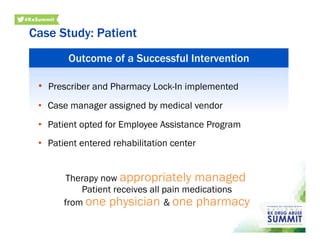
Therapy now appropriately managed.
Patient receives all pain medications
from one physician & one pharmacy
Outcome of a Successful Intervention
•  Prescriber and Pharmacy Lock-In implemented
•  Case manager assigned by medical vendor
•  Patient opted for Employee Assistance Program
•  Patient entered rehabilitation center
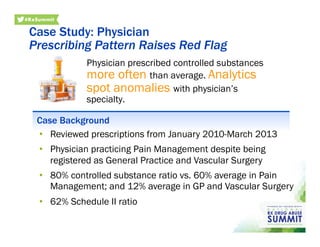
Physician prescribed controlled substances
more often than average. Analytics
spot anomalies with physician’s
specialty.
Case Background
•  Reviewed prescriptions from January 2010-March 2013
•  Physician practicing Pain Management despite being
registered as General Practice and Vascular Surgery
•  80% controlled substance ratio vs. 60% average in Pain
Management; and 12% average in GP and Vascular Surgery
•  62% Schedule II ratio
Case Study: Physician
Prescribing Pattern Raises Red Flag
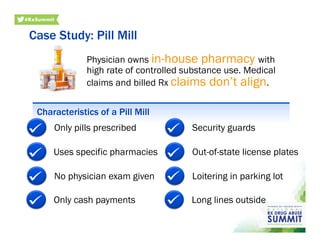
Physician owns in-house pharmacy with
high rate of controlled substance use. Medical
claims and billed Rx claims don’t align.
Characteristics of a Pill Mill
Only pills prescribed
Uses specific pharmacies
No physician exam given
Only cash payments
Security guards
Out-of-state license plates
Loitering in parking lot
Long lines outside
Case Study: Pill Mill
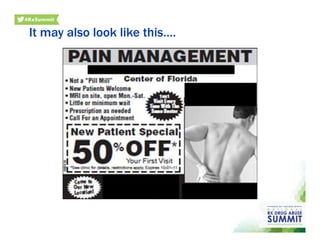
It may also look like this….
They may react like this…
“Stop sending me this! I do not have time
and cannot pay staff to stop working and
do your paperwork….”
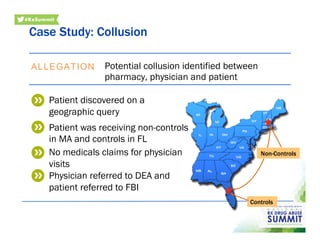
Case Study: Collusion
Potential collusion identified between
pharmacy, physician and patient
ALLEGATION	
  
Patient discovered on a
geographic query
Patient was receiving non-controls
in MA and controls in FL
No medicals claims for physician
visits
Physician referred to DEA and
patient referred to FBI
Controls
Non-Controls
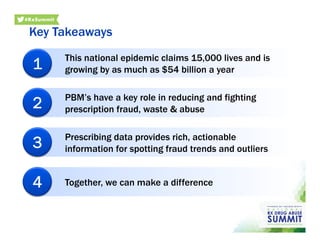
Key Takeaways
This national epidemic claims 15,000 lives and is
growing by as much as $54 billion a year1
PBM’s have a key role in reducing and fighting
prescription fraud, waste & abuse2
Prescribing data provides rich, actionable
information for spotting fraud trends and outliers3
Together, we can make a difference4
Thank	
  you!	
  

Tpp 1 walls abou_nader

  • 1.
    Third-­‐Party  Payer  Track:   Using  Data  to  Limit  Misuse  and  Abuse   Presenters:     Phillip  Walls,  RPh,  Chief  Clinical  and  Compliance  Officer,                myMatrixx   Jo-­‐Ellen  Abou  Nader,  CFE,  CIA,  CRMA,  Sr.  Director  of  Fraud,  Waste  &  Abuse  Services                    Express  Scripts   Moderator:     Michelle  C.  Landers,  ExecuOve  Vice  President  &  General  Counsel,      Kentucky  Employers’  Mutual  Insurance  
  • 2.
    Disclosures:   •  Phillip  Walls  has  disclosed  no  relevant,  real  or  apparent  personal  or   professional  financial  relaOonships.   •  Jo-­‐Ellen  Abou  Nader  has  disclosed  no  relevant,  real  or  apparent  personal  or   professional  financial  relaOonships.  
  • 3.
    Learning  ObjecOves:   1. Define  how  prescripOon  drug  data  is  currently  being  used.       2.  Demonstrate  an  understanding  of  strategies  for  mining  the  data  to  manage   drug  abuse.       3.  IdenOfy  otherwise  easy  to  miss  cases  uOlizing  geomapping  and  recognizing   pa[erns  of  behavior.       4.  Organize  collaboraOon  with  private  and  public  agencies  to  end  the  epidemic  of   prescripOon  drug  abuse.  
  • 4.
    Sources  of  Data   •  PrescripOon  Drug  Monitoring  Programs  (PDMPs)   •  Drug  Enforcement  AdministraOon  (DEA)   •  NaOonal  Plan  and  Provider  EnumeraOon  System   (NPPES)   •  Proprietary  Prescriber  Databases   •  PharmaceuOcal  Manufacturers   •  Pharmacy  Benefit  Managers  (PBMs)  
  • 5.
    Access  to  PDMPs   1.  Law  Enforcement   2.  Prescribers   3.  Dispensing  Pharmacists   Denied  Access  to  PDMPs   1.  Insurance  Companies   2.  Clinical  Pharmacists  responsible  for  oversight  and  compliance  
  • 6.
    PDMP   16  States  Require  Mandatory  Use  of  PDMPs  for  Providers     (Includes  any  form  of  mandatory  use  requirements)   Colorado   Delaware   Kentucky   Louisiana   Massachuse[s   Minnesota   Nevada   New  Mexico   New  York   North  Carolina   Ohio   Oklahoma   Rhode  Island   Tennessee   Vermont   West  Virginia   34  States  and  DC  Do  Not  Require  Mandatory  Use  of  PDMPs  for   Providers   Alabama   Mississippi   Alaska   Missouri   Arizona   Montana   Arkansas   Nebraska   California   New  Hampshire   ConnecOcut   New  Jersey   D.C.   North  Dakota   Florida   Oregon   Georgia   Pennsylvania   Hawaii   South  Carolina   Idaho   South  Dakota   Illinois   Texas   Indiana   Utah   Iowa   Virginia   Kansas   Washington   Maine   Wisconsin   Maryland   Wyoming   Michigan  
  • 7.
  • 8.
    Physician  Dispensing  and  PDMPs   Does  the  state  require  a  physician  to  report  to  the   state’s  PDMP  if  they  dispense?   #  of   States   Yes   26   Yes  in  specific  circumstances   3   No   20   N/A  (No  PDMP  or  no  Physician  Dispensing)   2   Total   51  
  • 9.
    DEA   1.  AutomaOon  of  Reports  and  Consolidated  Orders  System  (ARCOS)   2.  Controlled  Substances  Ordering  System  (CSOS)   3.  Electronic  PrescripOons  for  Controlled  Substances   4.  Criminal  Cases  Against  Doctors   5.  AdministraOve  AcOons  Against  Doctors   6.  DATA  Waived  Physicians  (Drug  Addiciton  and  Treatment  Act)   a.  DEA  number   b.  DATA  2000  waiver  ID  number  or  "X"  number  
  • 10.
    NaOonal  Plan  and  Provider  EnumeraOon   System  (NPPES)   • The  AdministraOve  SimplificaOon  provisions  of  the  Health  Insurance  Portability   and  Accountability  Act  of  1996  (HIPAA)  mandated  the  adopOon  of  standard   unique  idenOfiers  for  health  care  providers  and  health  plans   • The  Centers  for  Medicare  &  Medicaid  Services  (CMS)  has  developed  the   NaIonal  Plan  and  Provider  EnumeraIon  System  (NPPES)  to  assign  these   unique  idenOfiers.   • Unique  idenOfer  is  known  as  the  NaOonal  Provider  IdenOfier  (NPI)   • The  NPI  is  a  unique  idenOficaOon  number  for  covered  health  care  providers.   Covered  health  care  providers  and  all  health  plans  and  health  care   clearinghouses  must  use  the  NPIs  in  the  administraOve  and  financial   transacOons  adopted  under  HIPAA.  The  NPI  is  a  10-­‐posiOon,  intelligence-­‐free   numeric  idenOfier  (10-­‐digit  number).  
  • 11.
    Proprietary  Prescriber  Databases   1.  NaOonal  Council  on  PrescripOon  Drug  Programs  (NCPDP)  HCIdea   a.  Type  1  prescribers,  including  medical  doctors,  doctors  of  osteopathic   medicine,  naturopaths,  chiropractors,  denOsts,  nurse  pracOOoners,   physician  assistants,  optometrists,  podiatrists  and  other  allied  healthcare   professionals  who  are  authorized  to  prescribe  medicaOons,  supplies  or   medical  devices.   b.  NPI  to  DEA  crosswalk   c.  Surescripts  Provider  IdenOfier  (SPI)  ePrescribing  number   2.  Health  Market  Science   a.  Also  includes  state  medical  board  sancOons   b.  OIG  sancOons  
  • 12.
    PharmaceuOcal  Manufacturers   OxyContinmaker closely guards its list of suspect doctors Purdue Pharma has privately identified about 1,800 doctors who may have recklessly prescribed the painkiller to addicts and dealers, yet it has done little to alert authorities. August 11, 2013|By Scott Glover and Lisa Girion Over the last decade, the maker of the potent painkiller OxyContin has compiled a database of hundreds of doctors suspected of recklessly prescribing its pills to addicts and drug dealers, but has done little to alert law enforcement or medical authorities. Despite its suspicions, Purdue Pharma continued to profit from prescriptions written by these physicians, many of whom were prolific prescribers of OxyContin. The company has sold more than $27 billion worth of the drug since its introduction in 1996.     Purdue has promoted the idea that the country's epidemic of prescription drug deaths was fueled largely by pharmacy robberies, doctor-shopping patients and teens raiding home medicine cabinets. The database suggests that Purdue has long known that physicians also play a significant role in the crisis. Purdue Pharma has sold more than $27 billion worth of the powerful painkiller… (Liz O. Baylen, Los Angeles…)
  • 13.
  • 14.
    1. U.S. Centersfor Disease Control and Prevention. Feb 2012. http://www.cdc.gov/Features/VitalSigns/PainkillerOverdoses/ 2. US. Substance Abuse and Mental Health Services Administration. Dec 2010. http://www.oas.samhsa.gov/2k10/DAWN034/ EDHighlights.htm Each year, prescription drug overdoses KILL more than 15,000 Americans1 and result in 1.2 MILLION Emergency Room Visits2  
  • 15.
    1U.S. Centers forDisease Control and Prevention. Feb 2012. http://www.cdc.gov/Features/VitalSigns/PainkillerOverdoses/ 2U.S. Substance Abuse and Mental Health Services Administration. Dec 2010. http://www.oas.samhsa.gov/2k10/DAWN034/EDHighlights.htm This is a NATIONAL EPIDEMIC with a 20% expected annual growth rate
  • 16.
    $72.5 Billion inAnnual Healthcare Costs
  • 17.
    THE MEDICAL MULTIPLIER 2011  NaOonal  Survey  on  Drug  Use  and  Health   For every $1 of abused drugs obtained through “doctor shopping,” an additional $41 are wasted on related medical claims
  • 18.
    Sources for NonmedicalUsers Of Prescription Pain Meds 71% Friend or relative 18% Rx direct from MD 4% Drug dealer 7% Other 2011  NaOonal  Survey  on  Drug  Use  and  Health  
  • 19.
    Fraud Industry Trends 1 • Economicdownturn causing increased client awareness for potential fraud 2 • Recent focus on health care reform = more media coverage 3 • Increase in drug abusers using prescription drugs in comparison to illegal drugs 4 • ID theft occurrence is more common 5 • “Off -label” prescribing of drugs to treat conditions beyond FDA-approved uses 6 • Newer drugs with greater potency have higher street value 7 • Organized crime contributes to increased prescription fraud
  • 21.
    Defining the Problem:Fraud by Patients 64%   13%   11%   9%   3%   Drug-­‐seeking   Behavior   (AddicOon)   IdenOty  Thel   Forged   PrescripOons   DuplicaOve  /   Inappropriate   Therapy   Other   1%   21%   37%   28%   13%   65+   51-­‐64   35-­‐50   18-­‐34   <18   FRAUD TYPE PATIENT AGE
  • 22.
    Type of Fraud PharmacyLocations Defining the Problem: Fraud by Pharmacies
  • 23.
    Workers’ Compensation Trends Patientoverutilization1 Overprescribing2 Prescribing outside of specialty3 Collusion4
  • 24.
    EXAMPLE: Drug-Seeking Beneficiaries Claims Trending Number Physicians and Pharmacies Number Chains / Independents Number Unique GCNs Number Metropolitan Service Areas High-Risk Specialties Short Days ofSupply Number Short- Acting Drugs Fraud Analytics Scenarios Types of Proactive Patient Scenarios Drug Combos HIV Meds Cough Syrups Geographic Concerns High-Cost Drugs Duplicate Therapy Proactive. Multiple layers of criteria applied to full population.
  • 25.
    Patient and PhysicianInvestigation Methods Full Claims Analysis Physician Verifications Patient Verifications Pharmacy Outreach Prescription Reviews Medical Data Integration Internet Research Engage Law Enforcement Gather and Review Evidence Industry Leading Investigative Expertise Generate Actionable Investigative Report
  • 26.
    Case Study: Patient Pharmacylock-in limits drug-seeking activity Patient obtained 43 controlled substance Rxs from 17 prescribers and 5 pharmacies 59% 11% 6% 6% 6% 6% 6% Physician Specialties Emergency Medicine Orthopedic Surgery Spine and Pain Endocrinology Cardiology Internal Medicine Psychiatry Restriction to 1 pharmacy and 1 prescriber
  • 27.
    Case Study: Patient Therapynow appropriately managed. Patient receives all pain medications from one physician & one pharmacy Outcome of a Successful Intervention •  Prescriber and Pharmacy Lock-In implemented •  Case manager assigned by medical vendor •  Patient opted for Employee Assistance Program •  Patient entered rehabilitation center
  • 28.
    Physician prescribed controlledsubstances more often than average. Analytics spot anomalies with physician’s specialty. Case Background •  Reviewed prescriptions from January 2010-March 2013 •  Physician practicing Pain Management despite being registered as General Practice and Vascular Surgery •  80% controlled substance ratio vs. 60% average in Pain Management; and 12% average in GP and Vascular Surgery •  62% Schedule II ratio Case Study: Physician Prescribing Pattern Raises Red Flag
  • 29.
    Physician owns in-housepharmacy with high rate of controlled substance use. Medical claims and billed Rx claims don’t align. Characteristics of a Pill Mill Only pills prescribed Uses specific pharmacies No physician exam given Only cash payments Security guards Out-of-state license plates Loitering in parking lot Long lines outside Case Study: Pill Mill
  • 30.
    It may alsolook like this….
  • 31.
    They may reactlike this… “Stop sending me this! I do not have time and cannot pay staff to stop working and do your paperwork….”
  • 32.
    Case Study: Collusion Potentialcollusion identified between pharmacy, physician and patient ALLEGATION   Patient discovered on a geographic query Patient was receiving non-controls in MA and controls in FL No medicals claims for physician visits Physician referred to DEA and patient referred to FBI Controls Non-Controls
  • 33.
    Key Takeaways This nationalepidemic claims 15,000 lives and is growing by as much as $54 billion a year1 PBM’s have a key role in reducing and fighting prescription fraud, waste & abuse2 Prescribing data provides rich, actionable information for spotting fraud trends and outliers3 Together, we can make a difference4
  • 34.