NEONATAL SEPSIS
DR. MUHAMMAD BABAR AHMED
PEADS UNIT 2
 A 2 week old infant presents with irritability, fever, poor feeding and grunting.
Examination reveals a bulging fontanel, delayed capillary refill and tachypnea
 What is the diagnosis?
Definition
 It is defined as a clinical syndrome of Systemic Illness resulting from metabolic
and circulatory collapse from infection in newborns.
 It is an important cause of mortality and morbidity in newborns especially in
LBW babies and preterm infants
 Early onset presents within 3 days of life
 Late onset occurs between 4 days up to one month of age
Epidemiology
 The Incidence in Pakistan is about 1-10/1000 live births and even rises to 22/1000
live births in developing countries.
 80% neonatal deaths are reported to be from sepsis
 In Pakistan the infant mortality Rate is 78/1000 and perinatal mortality rate
is 60/1000
 But If Diagnosed early and with the start of appropriate antibiotics sepsis can be
saved
Pathogenesis
 When pathogenic bacteria gain access into the bloodstream, they may cause an
array of overwhelming infection ( septicemia)
 The common sites of localization for these bacteria are either the lungs (
pneumonia) or the meninges ( Meningitis)
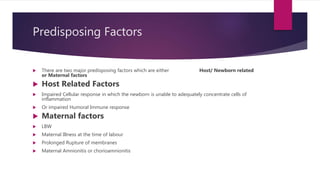
Predisposing Factors
 There are two major predisposing factors which are either Host/ Newborn related
or Maternal factors
 Host Related Factors
 Impaired Cellular response in which the newborn is unable to adequately concentrate cells of
inflammation
 Or impaired Humoral Immune response
 Maternal factors
 LBW
 Maternal Illness at the time of labour
 Prolonged Rupture of membranes
 Maternal Amnionitis or chorioamnionitis
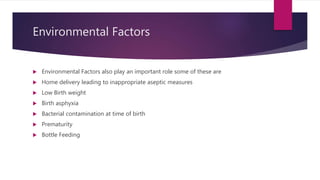
Environmental Factors
 Environmental Factors also play an important role some of these are
 Home delivery leading to inappropriate aseptic measures
 Low Birth weight
 Birth asphyxia
 Bacterial contamination at time of birth
 Prematurity
 Bottle Feeding
Etiology
 E. Coli
 Klebsiella
 Psuedomonas
 Group B streptococcus
 Staphylococcus
 Proteus
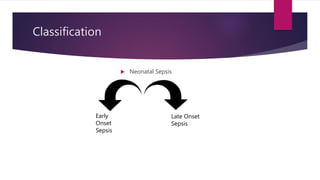
Classification
 Neonatal Sepsis
Early
Onset
Sepsis
Late Onset
Sepsis
Early Onset Sepsis
 It mainly occurs due to bacteria occurred before and during delivery that is mainly
caused by the organisms mainly prevalent in the genital and the urinary tract
 It is mostly caused by Gram –ve bacteria eg. E. Coli,
Klebsiella, Enterobacter, Group b Streptococci
 And majority of these patients present with Respiratory Distress due to
intrauterine pneumonia
Late Onset Sepsis
 It is caused by organisms of the external environment, either acquired from the
hospital or from the home
 Often transmitted through the hands of the people handling or the health care
providers
 Is also caused by Gram –ve organisms, Gram +ve organisms are also involved
 May present with septicemia, pneumonia or meningitis
Clinical Symptoms
 The Clinical spectrum at the beginning of the disease is Usually non specific
 Generally it starts as
 Refusal to feed
 Lethargy
 Poor temprature control
 Poor peripheral perfusion
 Tachycardia or Bradycardia
 Hypotonia or bulging of fontanelle
 Irritability
 Seizures
 Vomiting or diarrhea
 Jaundice purpura or impetigo
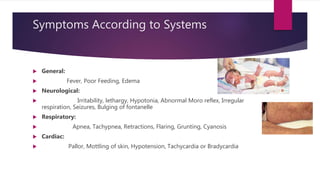
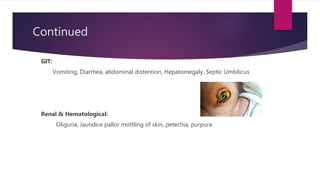
Symptoms According to Systems
 General:
 Fever, Poor Feeding, Edema
 Neurological:
 Irritability, lethargy, Hypotonia, Abnormal Moro reflex, Irregular
respiration, Seizures, Bulging of fontanelle
 Respiratory:
 Apnea, Tachypnea, Retractions, Flaring, Grunting, Cyanosis
 Cardiac:
 Pallor, Mottling of skin, Hypotension, Tachycardia or Bradycardia
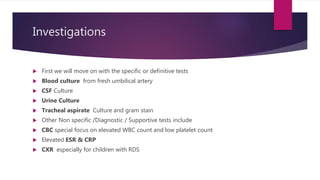
Continued
GIT:
Vomiting, Diarrhea, abdominal distention, Hepatomegaly, Septic Umbilicus
Renal & Hematological:
Oliguria, Jaundice pallor mottling of skin, petechia, purpura
Investigations
 First we will move on with the specific or definitive tests
 Blood culture from fresh umbilical artery
 CSF Culture
 Urine Culture
 Tracheal aspirate Culture and gram stain
 Other Non specific /Diagnostic / Supportive tests include
 CBC special focus on elevated WBC count and low platelet count
 Elevated ESR & CRP
 CXR especially for children with RDS
Evaluation of the extent of Disease
 Evaluation of the extent of the disease is done on the basis of
 LP to evaluate for meningitis
 Urine examination to evaluate for UTI
 CXR to evaluate for pneumonia
 Stool Occult for GI Bleeds
Management
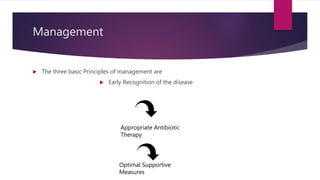
 The three basic Principles of management are
 Early Recognition of the disease
Optimal Supportive
Measures
Appropriate Antibiotic
Therapy
Management Of Early Onset Sepsis
 First Line drugs used for sepsis are Ampicillin (100mg/kg/day) in 8 hourly doses
the dose is doubled for meningitis
 Amikacin(15mg/kg/day) OD if the neonate is of less than 7 days and BD if older
than 7 days
 Gentamycin (7.5mg/kg/day) divided in 8 or 12 hourly doses
 The choice of antibiotics is always according to the blood culture and sensitivity
once the results are available. Empirical therapy is then stopped
 Resistant strains are treated with Vancomycin
 Duration of treatment is for almost 10 days for bacteremia
Supportive Measures
 Nursing care with ambient temperature
 Appropriate IV fluids according to the requirements
 Correct hypoglycemia with dextrose water
 Vitamin K twice a week Until enteral feed is started
 Bicarbonates to treat metabolic acidosis
 If in state of shock treat with dopamine (7-15 ug/kg) and volume expanders
 Corticosteroids to treat adrenal insufficeincy
 Phototherapy if hyperbilirubenemia is present
 Appropriate anti epileptics for seizures
 If Bleeding tendency is present then FFP, Platelets or fresh blood transfusion according to indices
Late onset sepsis
 In Late onset sepsis the drugs of choice are
 Vancomycin and Aminoglycoside
 Vancomycin (15mg/kg/day) given 8 hourly
 Amikacin ( 15mg/kg/day) divided in 12 hourly doses
 Duration depends on the culture report, pathogen and site of infection
 If fungal infection are suspected then Amphotericin B is given
 Ceftazidime is given for Psuedomonas Coverage
 Supportive measures are according to the requirements
Newer Therapies
 IVIG is a new mode of therapy studies are undergoing but there has been no
proven benefit till yet
 GM-CSF can be used as a modality of therapy or prevention to
Complication of Sepsis
 Endocarditis
 Septic emboli
 Septic joints
 Osteomyelitis
 DIC
 Organ failure
Prevention
 Maternal vaccination against vaccine preventable diseases like rubella and
vericella
 Aggressive management of chorioamnionitis with appropriate antibiotics
 As for the prognosis case fatality rate is 20-50%
Questions
A full term one weel old infant presents with fever, poor feeding and a bulging
fontanel. Mother has history of prolonged rupture of membranes and a low grade
fever. Spinal Fluid of infant demonstrates Gram positive cocci. CSF is turbid and
examination shows a low glucose.
Give the diagnosis?
Is it early or late onset sepsis?
How will you manage the patient?

Neonatal Sepsis

  • 1.
    NEONATAL SEPSIS DR. MUHAMMADBABAR AHMED PEADS UNIT 2
  • 2.
     A 2week old infant presents with irritability, fever, poor feeding and grunting. Examination reveals a bulging fontanel, delayed capillary refill and tachypnea  What is the diagnosis?
  • 3.
    Definition  It isdefined as a clinical syndrome of Systemic Illness resulting from metabolic and circulatory collapse from infection in newborns.  It is an important cause of mortality and morbidity in newborns especially in LBW babies and preterm infants  Early onset presents within 3 days of life  Late onset occurs between 4 days up to one month of age
  • 4.
    Epidemiology  The Incidencein Pakistan is about 1-10/1000 live births and even rises to 22/1000 live births in developing countries.  80% neonatal deaths are reported to be from sepsis  In Pakistan the infant mortality Rate is 78/1000 and perinatal mortality rate is 60/1000  But If Diagnosed early and with the start of appropriate antibiotics sepsis can be saved
  • 5.
    Pathogenesis  When pathogenicbacteria gain access into the bloodstream, they may cause an array of overwhelming infection ( septicemia)  The common sites of localization for these bacteria are either the lungs ( pneumonia) or the meninges ( Meningitis)
  • 6.
    Predisposing Factors  Thereare two major predisposing factors which are either Host/ Newborn related or Maternal factors  Host Related Factors  Impaired Cellular response in which the newborn is unable to adequately concentrate cells of inflammation  Or impaired Humoral Immune response  Maternal factors  LBW  Maternal Illness at the time of labour  Prolonged Rupture of membranes  Maternal Amnionitis or chorioamnionitis
  • 7.
    Environmental Factors  EnvironmentalFactors also play an important role some of these are  Home delivery leading to inappropriate aseptic measures  Low Birth weight  Birth asphyxia  Bacterial contamination at time of birth  Prematurity  Bottle Feeding
  • 8.
    Etiology  E. Coli Klebsiella  Psuedomonas  Group B streptococcus  Staphylococcus  Proteus
  • 9.
  • 10.
    Early Onset Sepsis It mainly occurs due to bacteria occurred before and during delivery that is mainly caused by the organisms mainly prevalent in the genital and the urinary tract  It is mostly caused by Gram –ve bacteria eg. E. Coli, Klebsiella, Enterobacter, Group b Streptococci  And majority of these patients present with Respiratory Distress due to intrauterine pneumonia
  • 11.
    Late Onset Sepsis It is caused by organisms of the external environment, either acquired from the hospital or from the home  Often transmitted through the hands of the people handling or the health care providers  Is also caused by Gram –ve organisms, Gram +ve organisms are also involved  May present with septicemia, pneumonia or meningitis
  • 12.
    Clinical Symptoms  TheClinical spectrum at the beginning of the disease is Usually non specific  Generally it starts as  Refusal to feed  Lethargy  Poor temprature control  Poor peripheral perfusion  Tachycardia or Bradycardia  Hypotonia or bulging of fontanelle  Irritability  Seizures  Vomiting or diarrhea  Jaundice purpura or impetigo
  • 13.
    Symptoms According toSystems  General:  Fever, Poor Feeding, Edema  Neurological:  Irritability, lethargy, Hypotonia, Abnormal Moro reflex, Irregular respiration, Seizures, Bulging of fontanelle  Respiratory:  Apnea, Tachypnea, Retractions, Flaring, Grunting, Cyanosis  Cardiac:  Pallor, Mottling of skin, Hypotension, Tachycardia or Bradycardia
  • 14.
    Continued GIT: Vomiting, Diarrhea, abdominaldistention, Hepatomegaly, Septic Umbilicus Renal & Hematological: Oliguria, Jaundice pallor mottling of skin, petechia, purpura
  • 15.
    Investigations  First wewill move on with the specific or definitive tests  Blood culture from fresh umbilical artery  CSF Culture  Urine Culture  Tracheal aspirate Culture and gram stain  Other Non specific /Diagnostic / Supportive tests include  CBC special focus on elevated WBC count and low platelet count  Elevated ESR & CRP  CXR especially for children with RDS
  • 16.
    Evaluation of theextent of Disease  Evaluation of the extent of the disease is done on the basis of  LP to evaluate for meningitis  Urine examination to evaluate for UTI  CXR to evaluate for pneumonia  Stool Occult for GI Bleeds
  • 17.
    Management  The threebasic Principles of management are  Early Recognition of the disease Optimal Supportive Measures Appropriate Antibiotic Therapy
  • 18.
    Management Of EarlyOnset Sepsis  First Line drugs used for sepsis are Ampicillin (100mg/kg/day) in 8 hourly doses the dose is doubled for meningitis  Amikacin(15mg/kg/day) OD if the neonate is of less than 7 days and BD if older than 7 days  Gentamycin (7.5mg/kg/day) divided in 8 or 12 hourly doses  The choice of antibiotics is always according to the blood culture and sensitivity once the results are available. Empirical therapy is then stopped  Resistant strains are treated with Vancomycin  Duration of treatment is for almost 10 days for bacteremia
  • 19.
    Supportive Measures  Nursingcare with ambient temperature  Appropriate IV fluids according to the requirements  Correct hypoglycemia with dextrose water  Vitamin K twice a week Until enteral feed is started  Bicarbonates to treat metabolic acidosis  If in state of shock treat with dopamine (7-15 ug/kg) and volume expanders  Corticosteroids to treat adrenal insufficeincy  Phototherapy if hyperbilirubenemia is present  Appropriate anti epileptics for seizures  If Bleeding tendency is present then FFP, Platelets or fresh blood transfusion according to indices
  • 20.
    Late onset sepsis In Late onset sepsis the drugs of choice are  Vancomycin and Aminoglycoside  Vancomycin (15mg/kg/day) given 8 hourly  Amikacin ( 15mg/kg/day) divided in 12 hourly doses  Duration depends on the culture report, pathogen and site of infection  If fungal infection are suspected then Amphotericin B is given  Ceftazidime is given for Psuedomonas Coverage  Supportive measures are according to the requirements
  • 21.
    Newer Therapies  IVIGis a new mode of therapy studies are undergoing but there has been no proven benefit till yet  GM-CSF can be used as a modality of therapy or prevention to
  • 22.
    Complication of Sepsis Endocarditis  Septic emboli  Septic joints  Osteomyelitis  DIC  Organ failure
  • 23.
    Prevention  Maternal vaccinationagainst vaccine preventable diseases like rubella and vericella  Aggressive management of chorioamnionitis with appropriate antibiotics  As for the prognosis case fatality rate is 20-50%
  • 24.
    Questions A full termone weel old infant presents with fever, poor feeding and a bulging fontanel. Mother has history of prolonged rupture of membranes and a low grade fever. Spinal Fluid of infant demonstrates Gram positive cocci. CSF is turbid and examination shows a low glucose. Give the diagnosis? Is it early or late onset sepsis? How will you manage the patient?