Background Subtraction


12/8/2011                            1
Background Subtraction
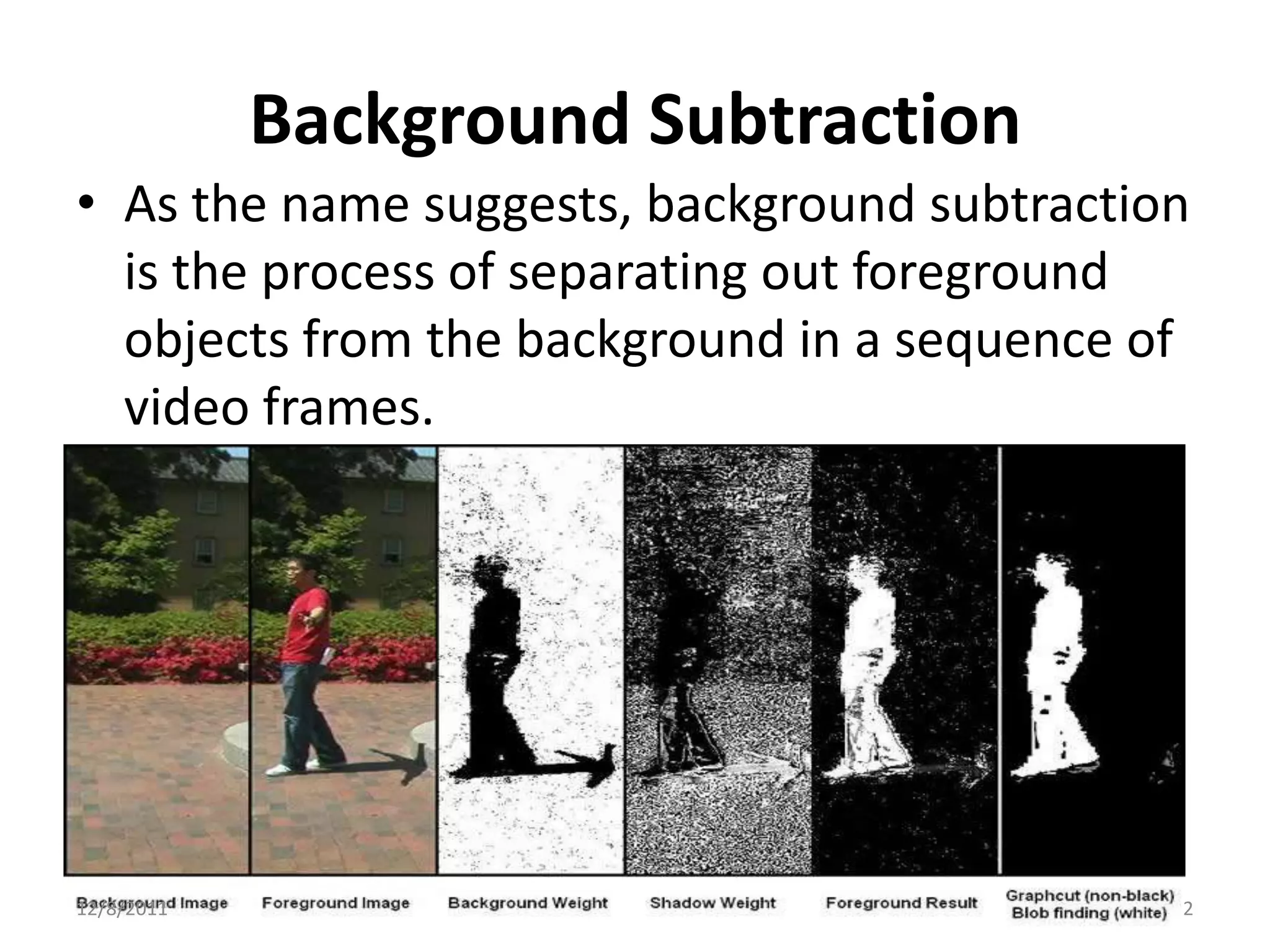
• As the name suggests, background subtraction
  is the process of separating out foreground
  objects from the background in a sequence of
  video frames.


12/8/2011                                    2
Background Subtraction
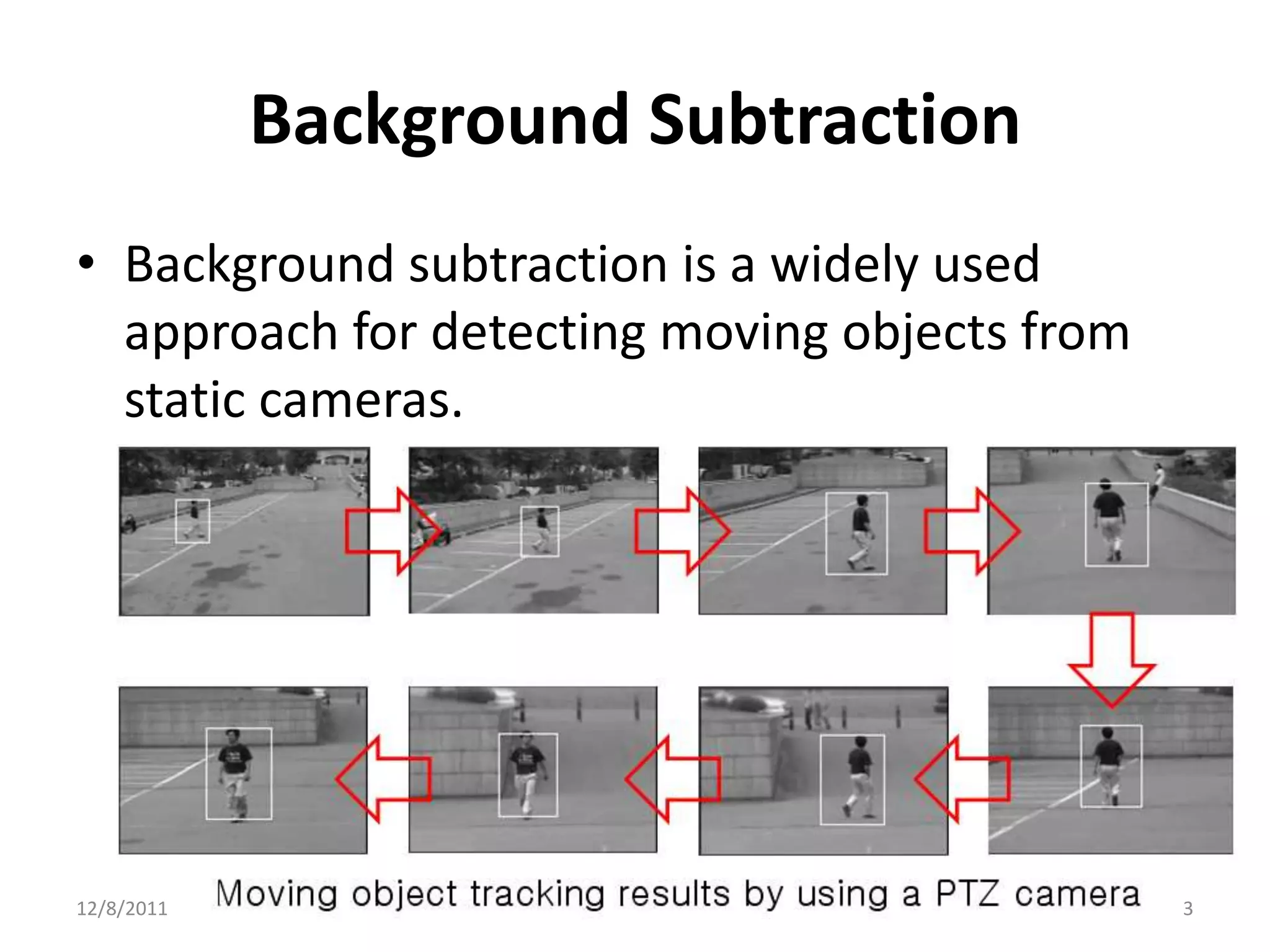
• Background subtraction is a widely used
  approach for detecting moving objects from
  static cameras.


12/8/2011                                      3
Fundamental Logic
• Fundamental logic for detecting moving
  objects from the difference between the
  current frame and a reference frame, called
  “background image” and this method is
  known as FRAME DIFFERENCE METHOD


12/8/2011                                   4
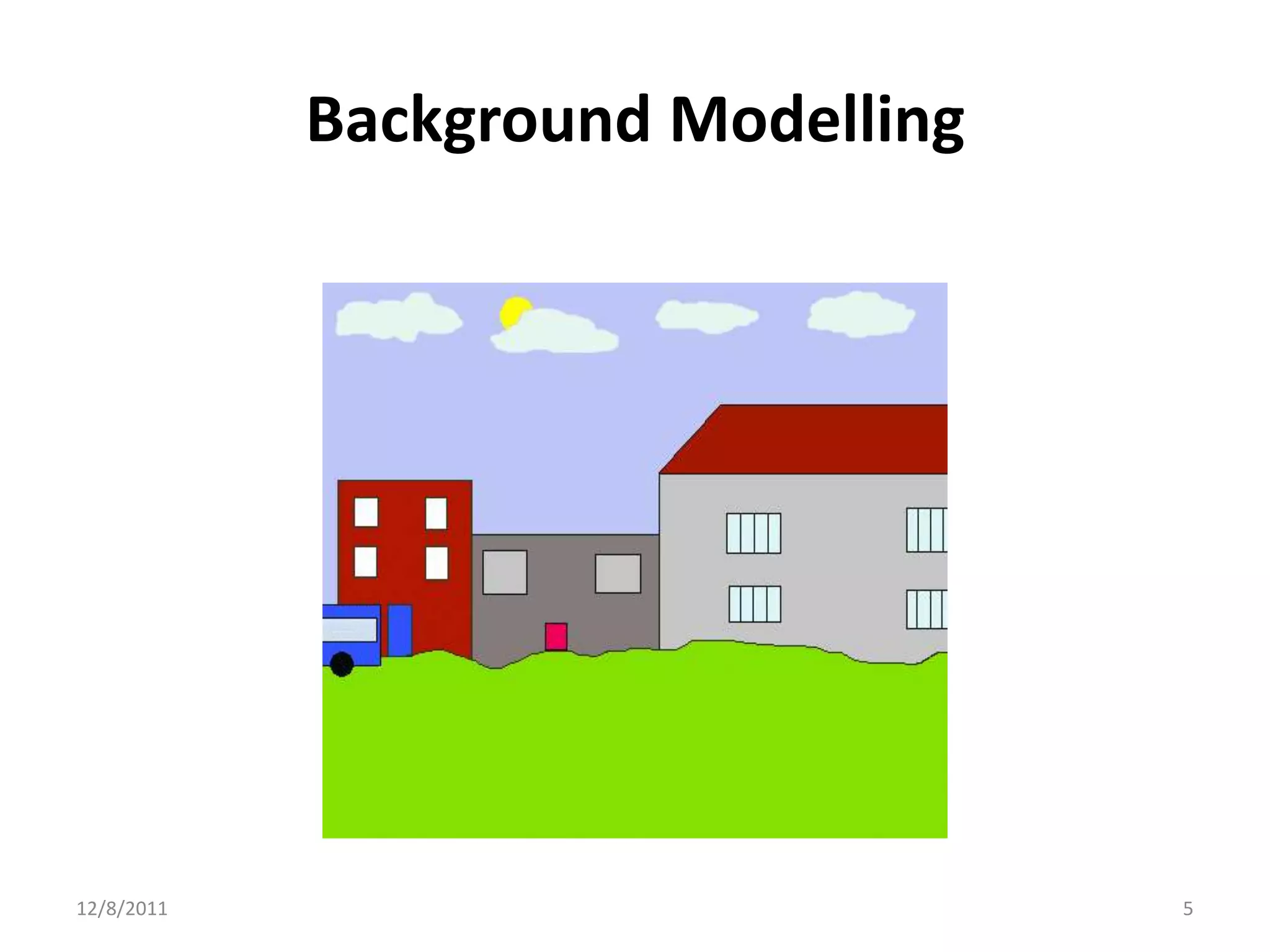
Background Modelling


12/8/2011                          5
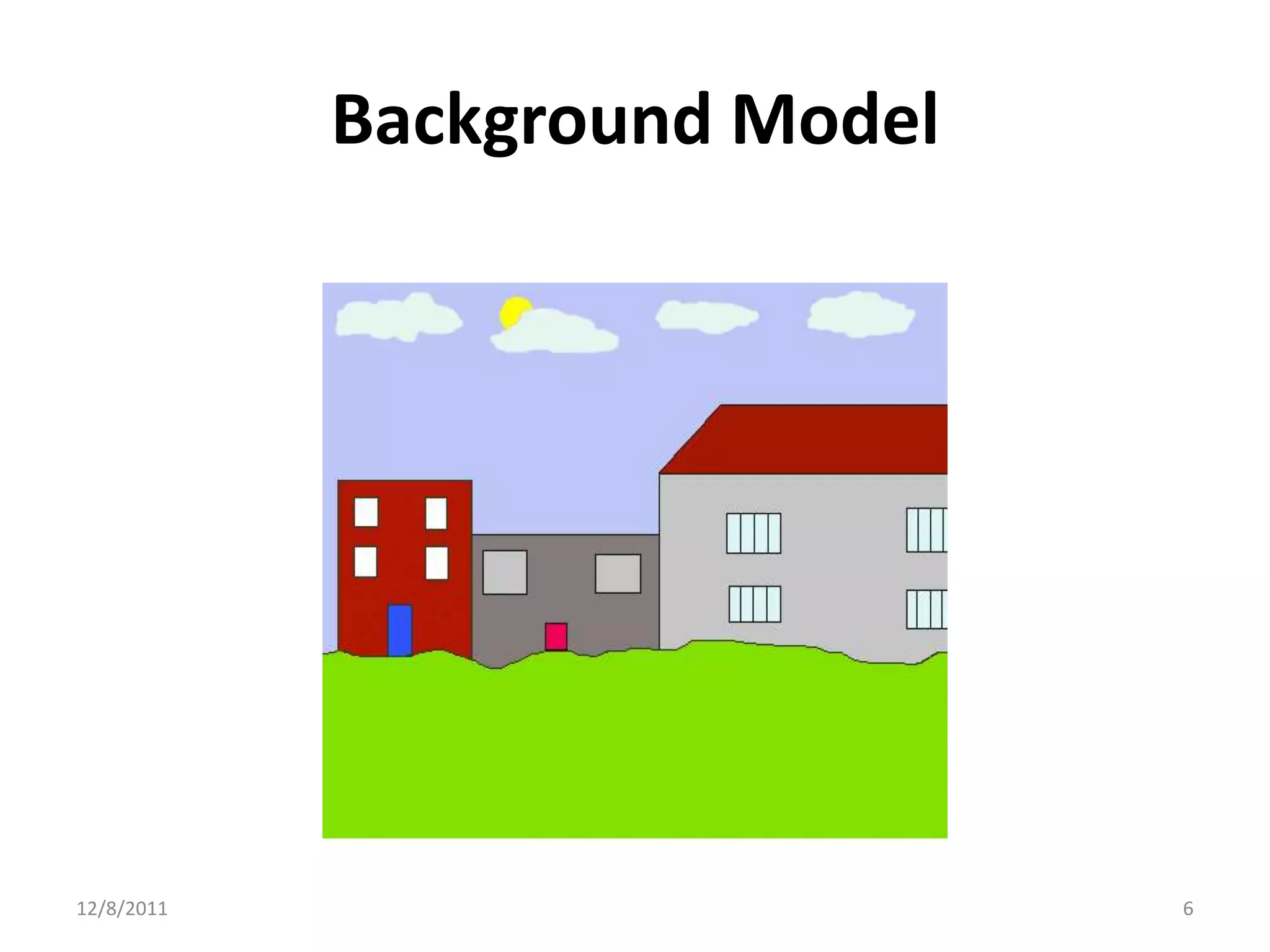
Background Model


12/8/2011                      6
After Background Filtering…


12/8/2011                                 7
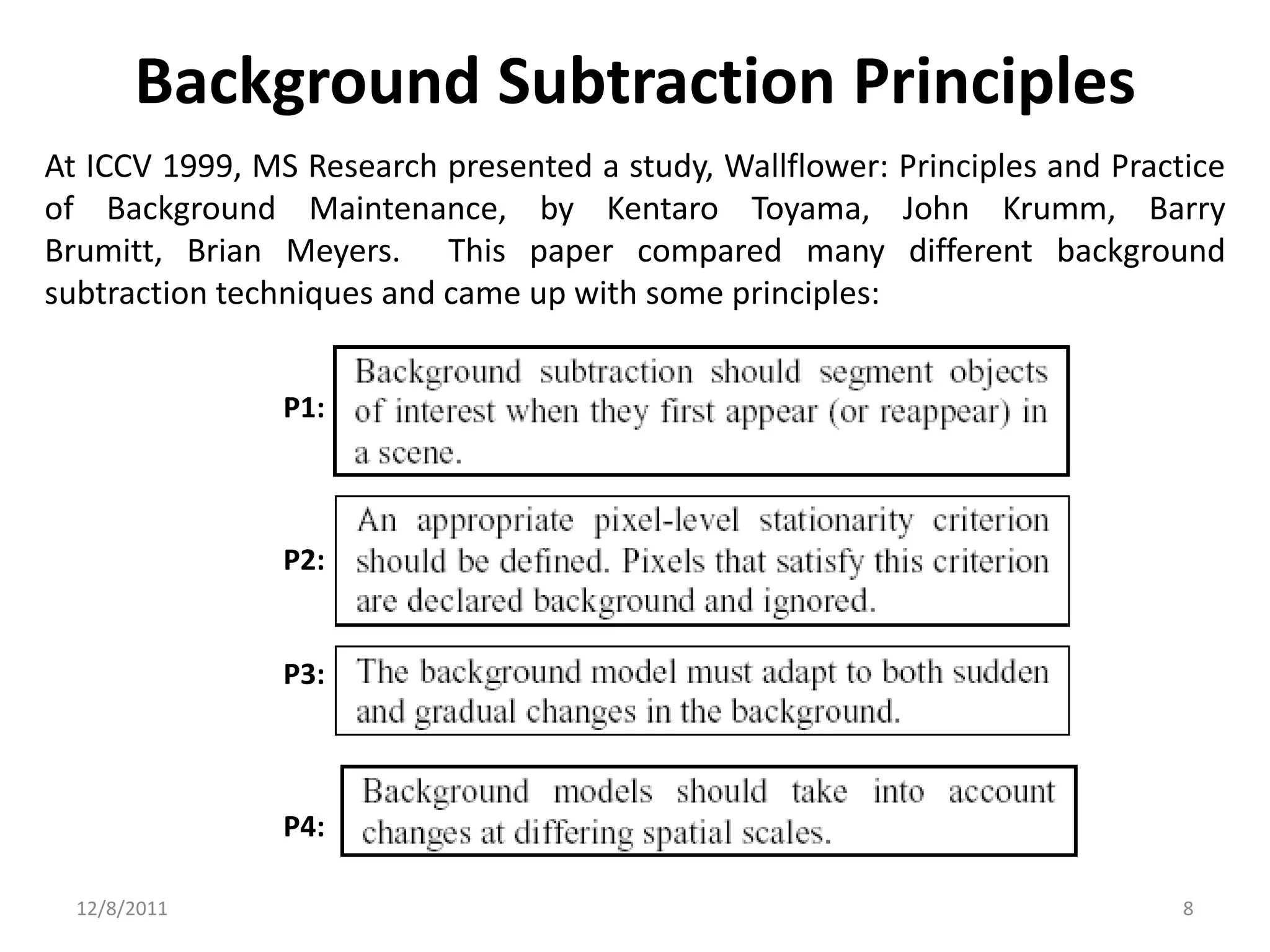
Background Subtraction Principles
At ICCV 1999, MS Research presented a study, Wallflower: Principles and Practice
of Background Maintenance, by Kentaro Toyama, John Krumm, Barry
Brumitt, Brian Meyers. This paper compared many different background
subtraction techniques and came up with some principles:


                P1:


                P2:


                P3:


                P4:

  12/8/2011                                                                  8
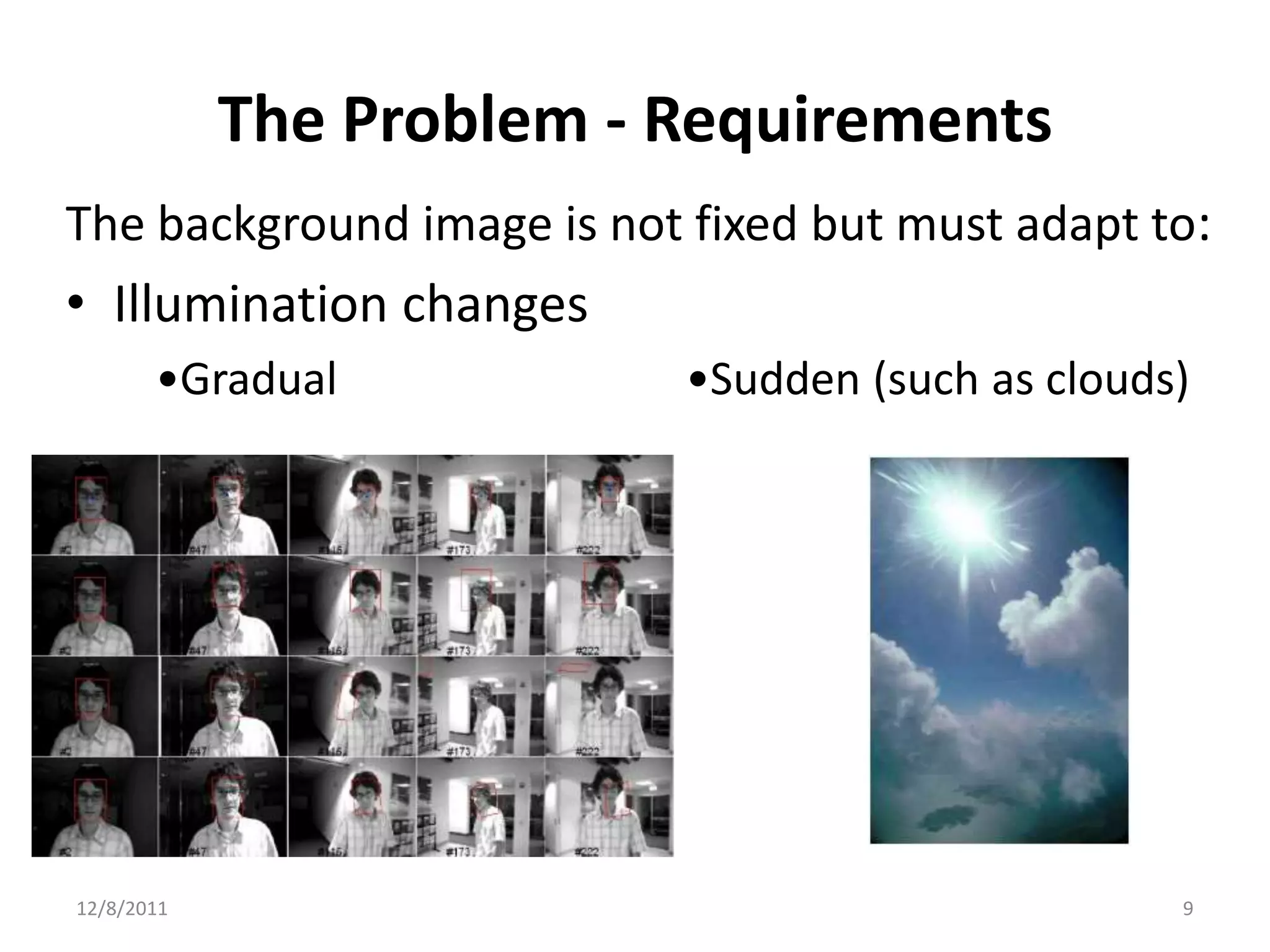
The Problem - Requirements
The background image is not fixed but must adapt to:
• Illumination changes
       •Gradual             •Sudden (such as clouds)


12/8/2011                                          9
• Motion changes
      •Camera oscillations • High-frequencies background
                           objects    (such    as    tree
                           branches, sea waves, and
                           similar)


12/8/2011                                             10
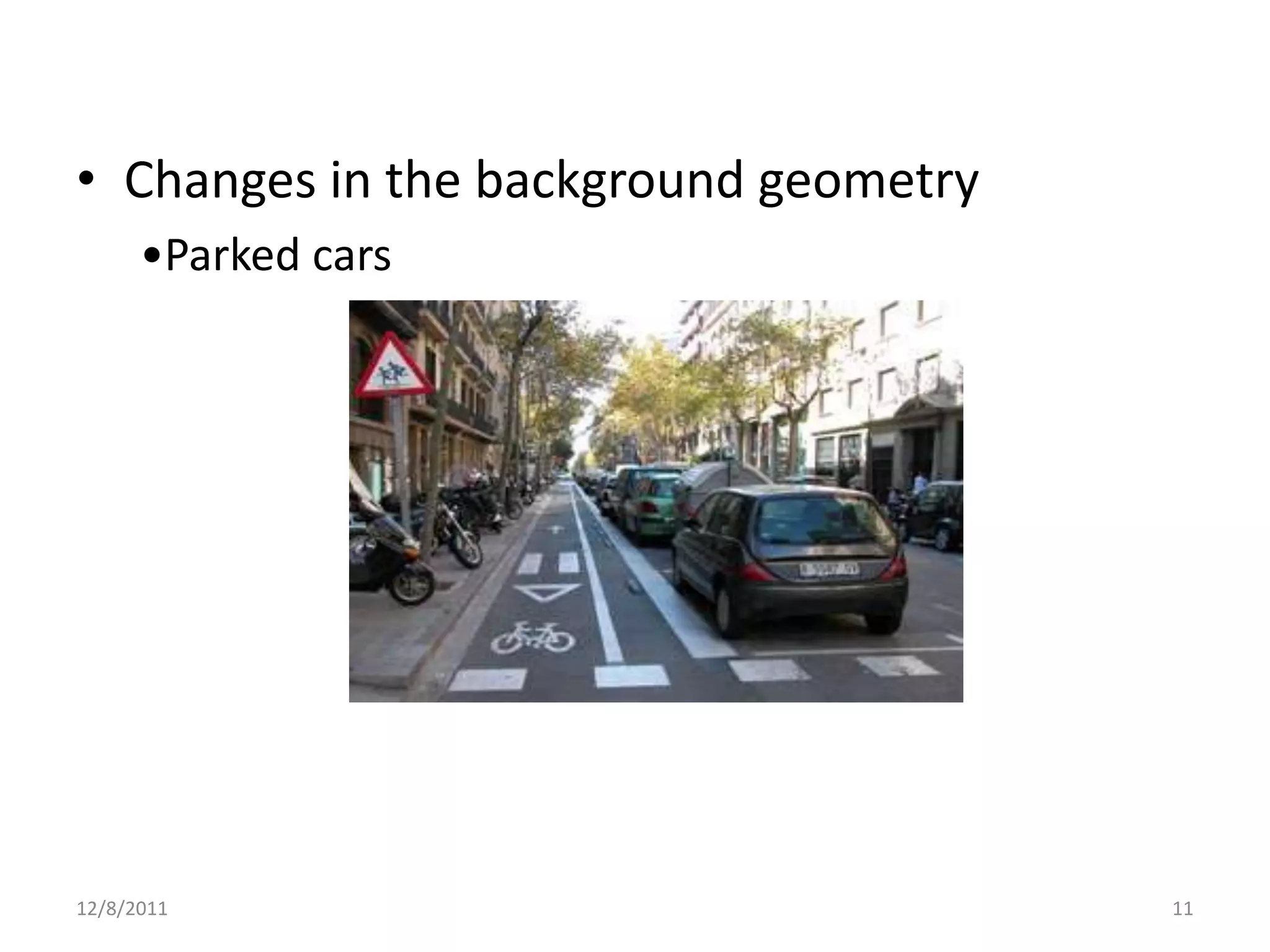
• Changes in the background geometry
      •Parked cars


12/8/2011                              11
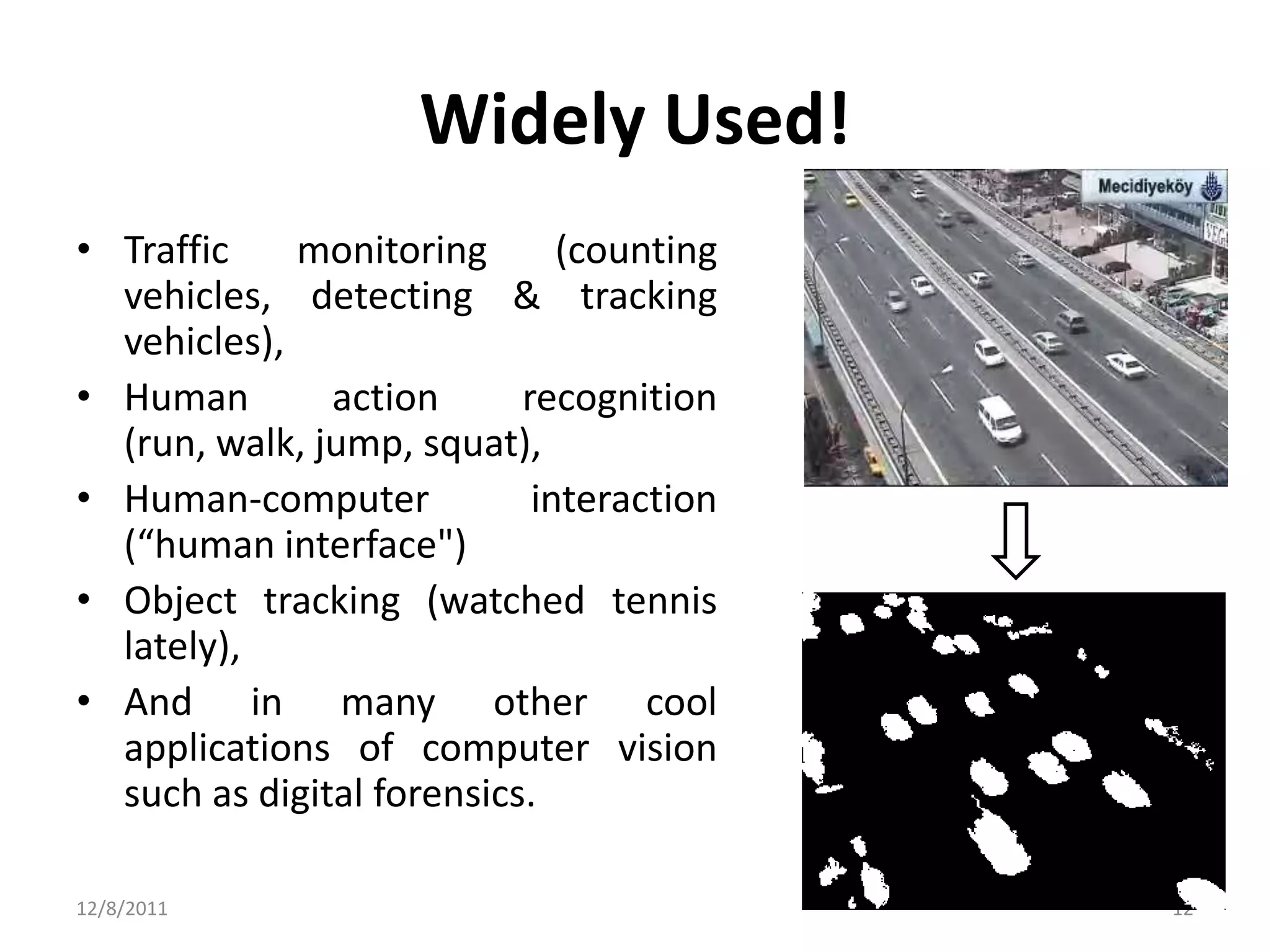
Widely Used!
• Traffic    monitoring       (counting
  vehicles, detecting & tracking
  vehicles),
• Human        action      recognition
  (run, walk, jump, squat),
• Human-computer            interaction
  (“human interface")
• Object tracking (watched tennis
  lately),
• And in many other cool
  applications of computer vision
  such as digital forensics.

12/8/2011                                 12
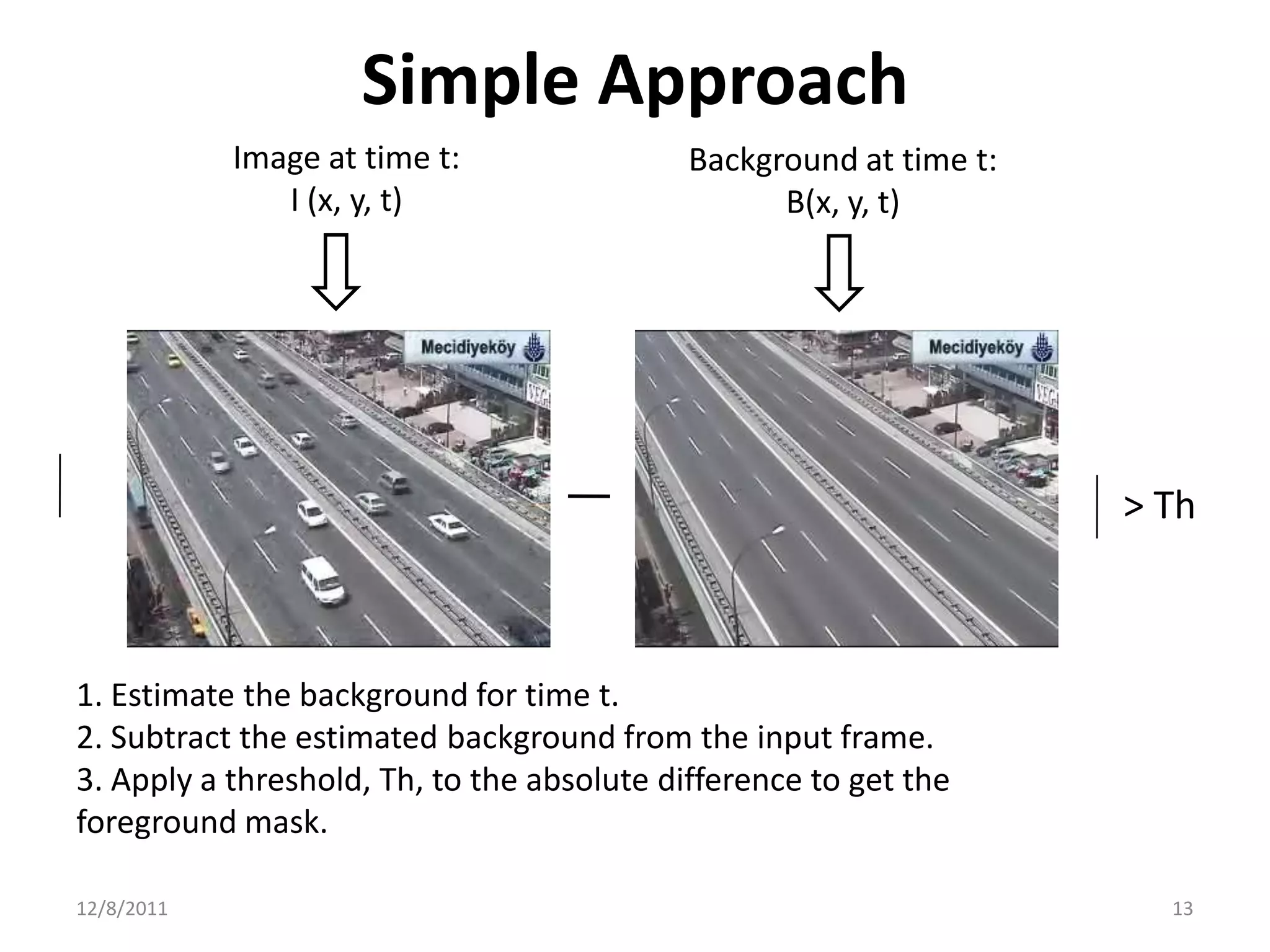
Simple Approach
            Image at time t:                Background at time t:
               I (x, y, t)                        B(x, y, t)


                                                                    > Th


1. Estimate the background for time t.
2. Subtract the estimated background from the input frame.
3. Apply a threshold, Th, to the absolute difference to get the
foreground mask.

12/8/2011                                                             13
The basic methods
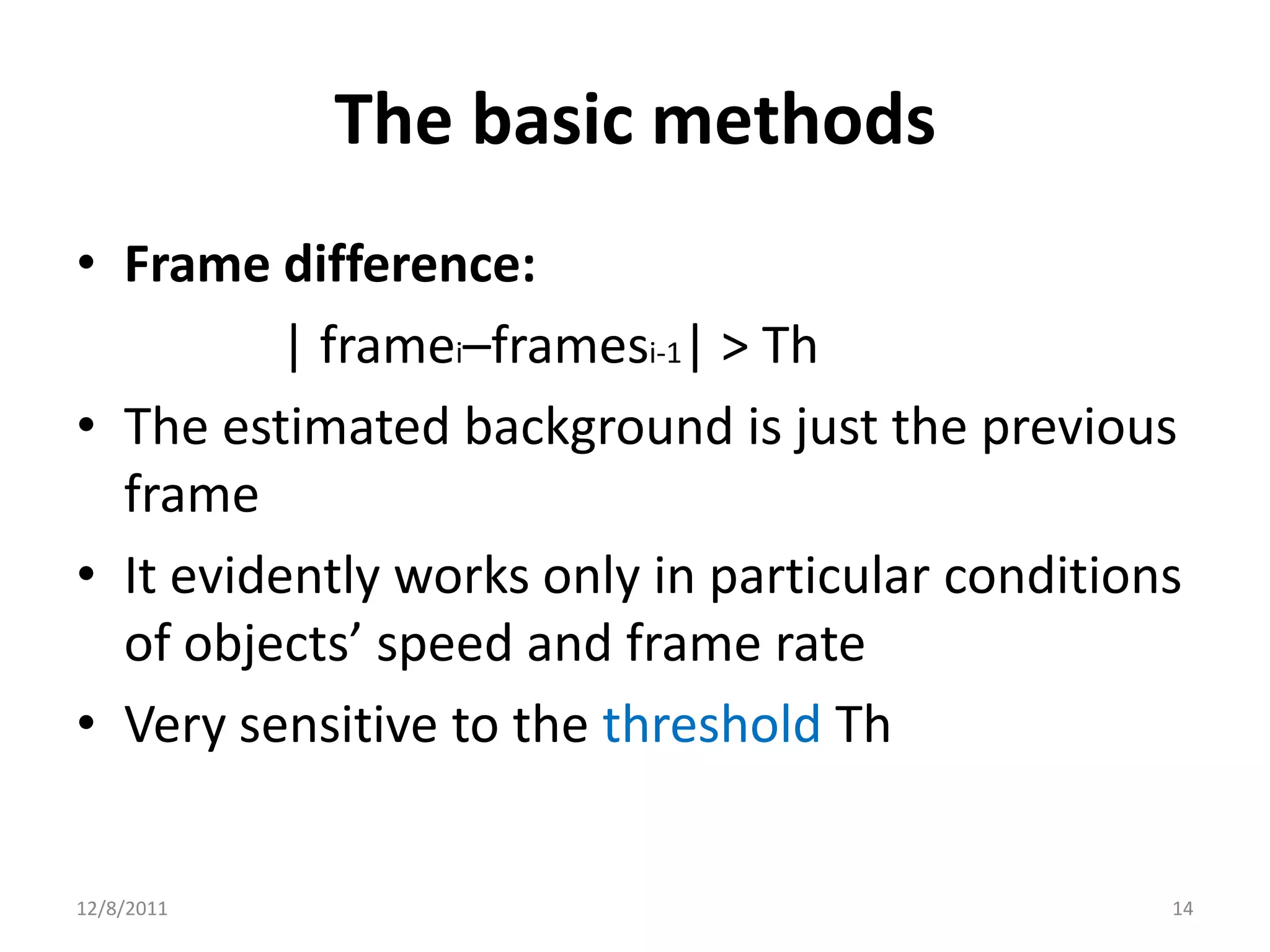
• Frame difference:
          | framei–framesi-1| > Th
• The estimated background is just the previous
  frame
• It evidently works only in particular conditions
  of objects’ speed and frame rate
• Very sensitive to the threshold Th


12/8/2011                                        14
Frame Differencing
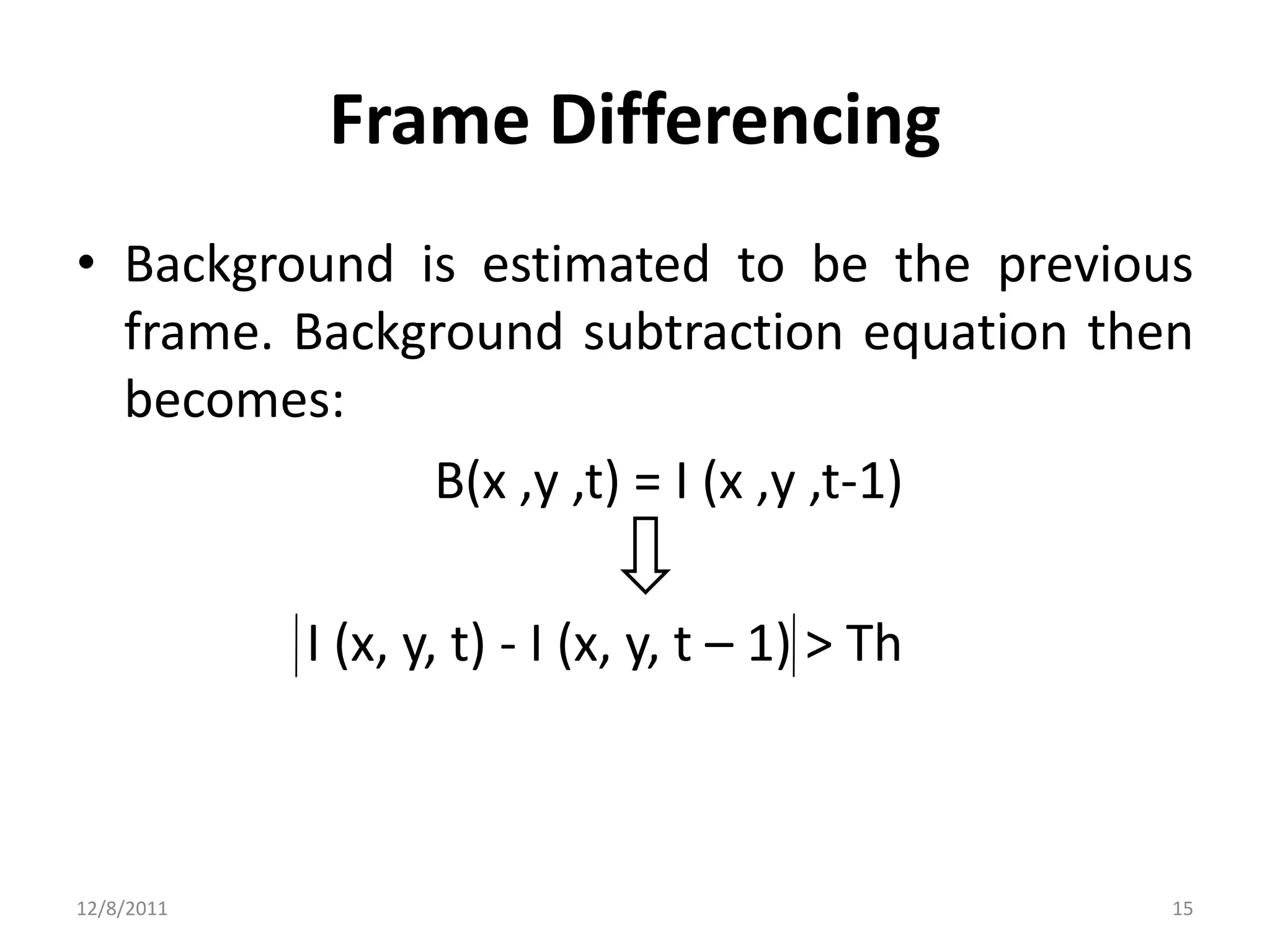
• Background is estimated to be the previous
  frame. Background subtraction equation then
  becomes:
              B(x ,y ,t) = I (x ,y ,t-1)

            I (x, y, t) - I (x, y, t – 1) > Th


12/8/2011                                        15
Frame Differencing
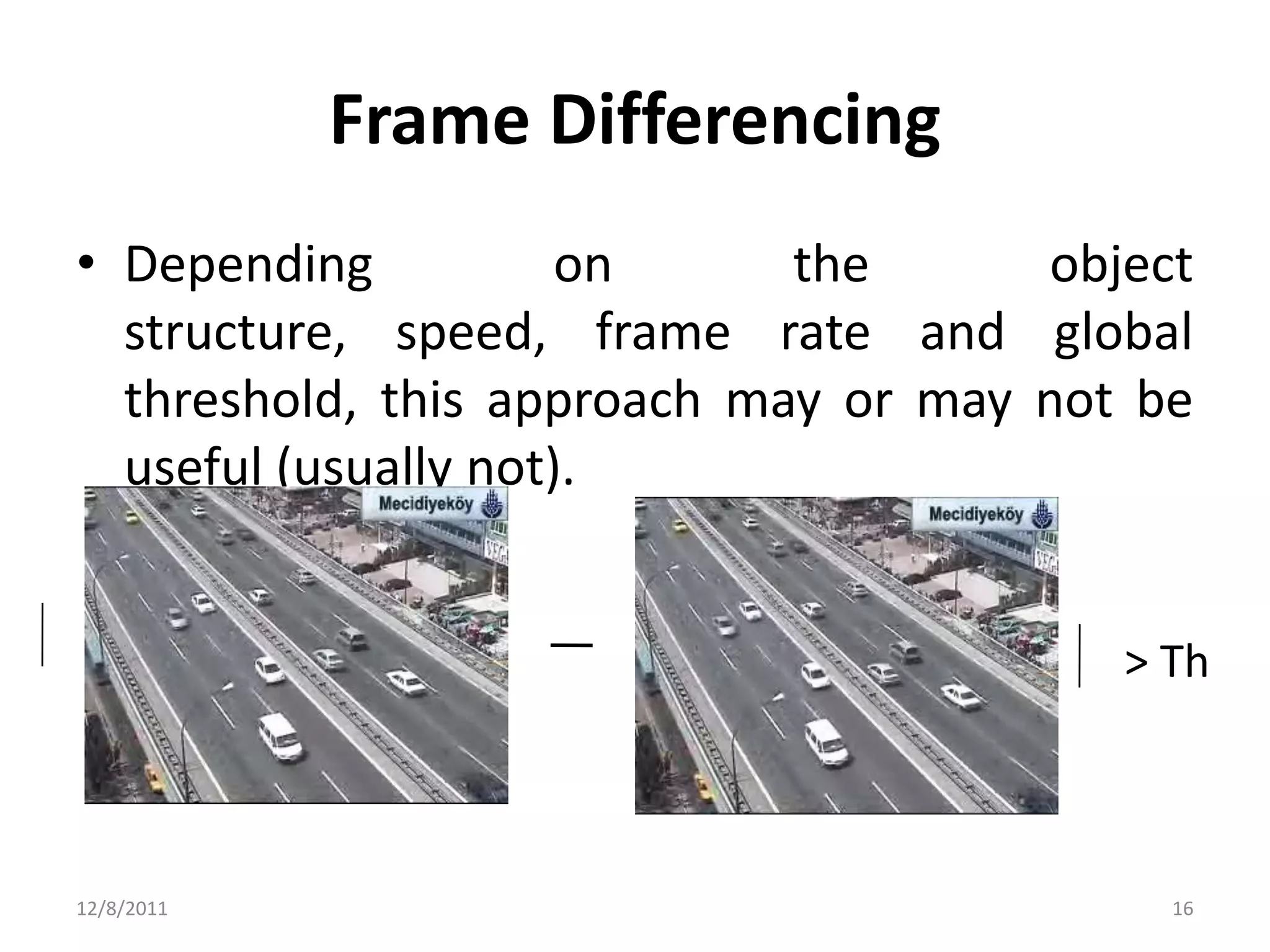
• Depending           on     the      object
  structure, speed, frame rate and global
  threshold, this approach may or may not be
  useful (usually not).


                                         > Th


12/8/2011                                  16
Frame Differencing
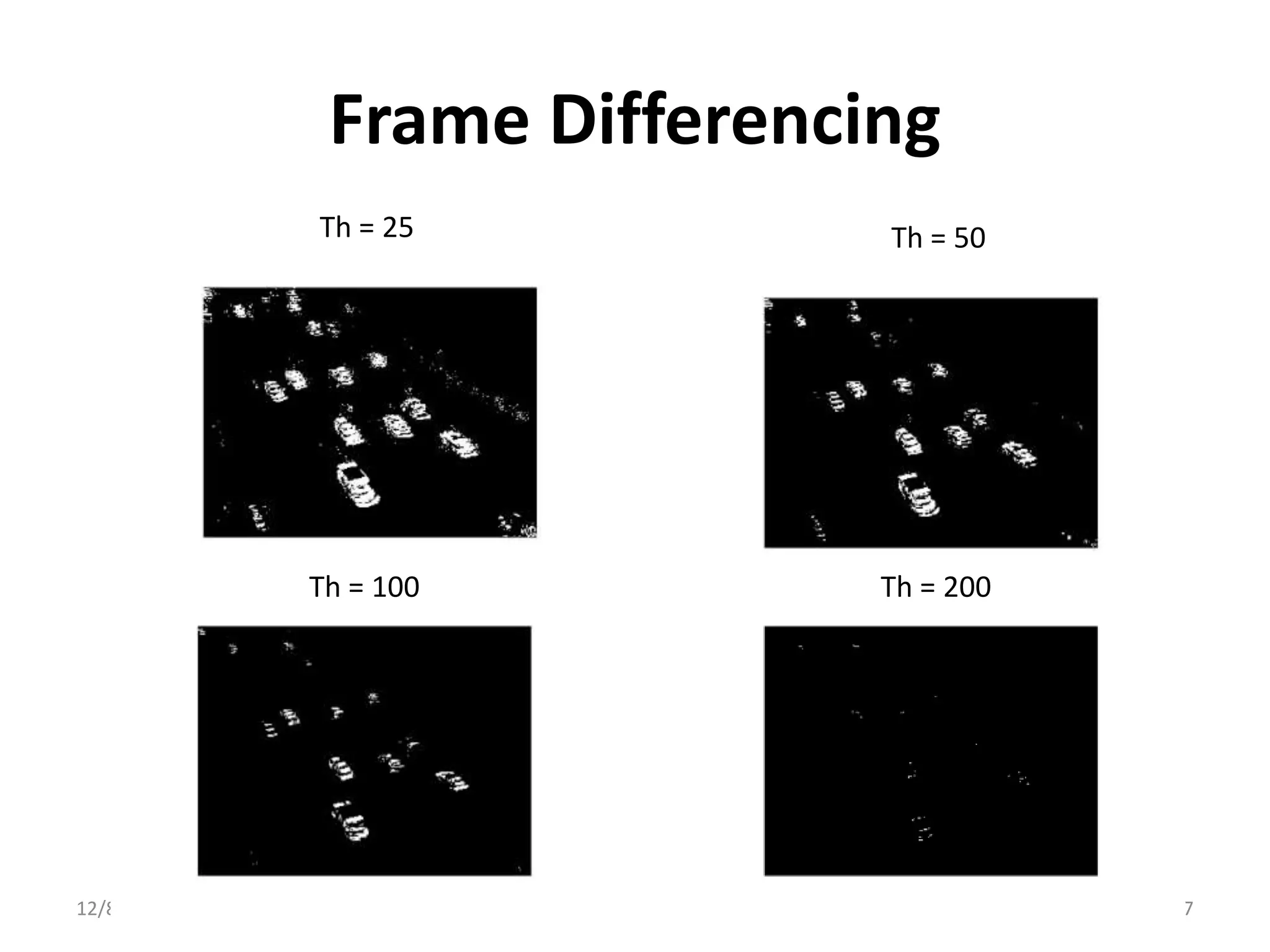
            Th = 25          Th = 50


            Th = 100         Th = 200


12/8/2011                               17
Thresholding
• The key parameter in the thresholding process is the
  choice of the threshold value.


• Several different methods for choosing a threshold
  exist,
      – Users can manually choose a threshold value, or
      – A thresholding algorithm can compute a value
        automatically, which is known as automatic thresholding


12/8/2011                                                    18
Motivation
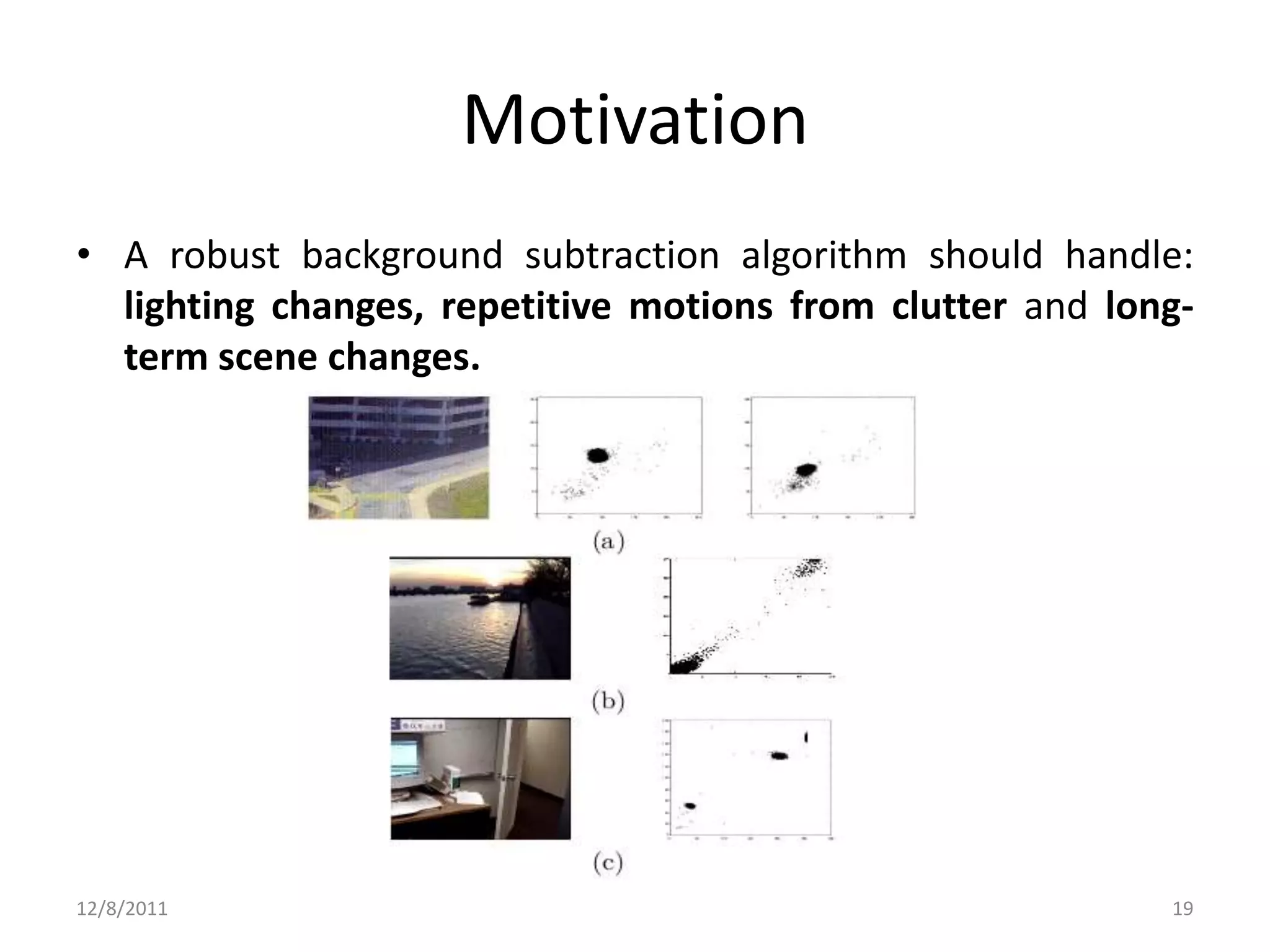
• A robust background subtraction algorithm should handle:
  lighting changes, repetitive motions from clutter and long-
  term scene changes.


12/8/2011                                                  19
Algorithm Overview
• The values of a particular pixel is modeled as a mixture of adaptive
  Gaussians.
      – Why mixture? Multiple surfaces appear in a pixel.
      – Why adaptive? Lighting conditions change.

• At each iteration Gaussians are evaluated using a simple heuristic to
  determine which ones are mostly likely to correspond to the
  background.

• Pixels that do not match with the “background Gaussians” are
  classified as foreground.

• Foreground pixels are grouped using 2D connected component
  analysis.


12/8/2011                                                            20
Advantages vs. Shortcomings
• Advantages:
      – A different “threshold” is selected for each pixel.
      – These pixel-wise “thresholds" are adapting by time.
      – Objects are allowed to become part of the background
        without destroying the existing background model.
      – Provides fast recovery.

• Disadvantages:
      – Cannot deal with sudden, drastic lighting changes.
      – Initializing the Gaussians is important (median filtering).
      – There are relatively many parameters, and they should be
        selected intelligently.

12/8/2011                                                        21
Challenges background subtraction
                 Algorithm
• It must be robust against changes in illumination.

• It should avoid detecting non-stationary background
  objects such as swinging leaves, rain, snow ,and
  shadow cast by moving objects.

• Finally, its internal background model should react
  quickly to changes in background such as starting
  and stopping of vehicles.

12/8/2011                                              22
BACKGROUND SUBTRACTION
                    ALGORITHMS


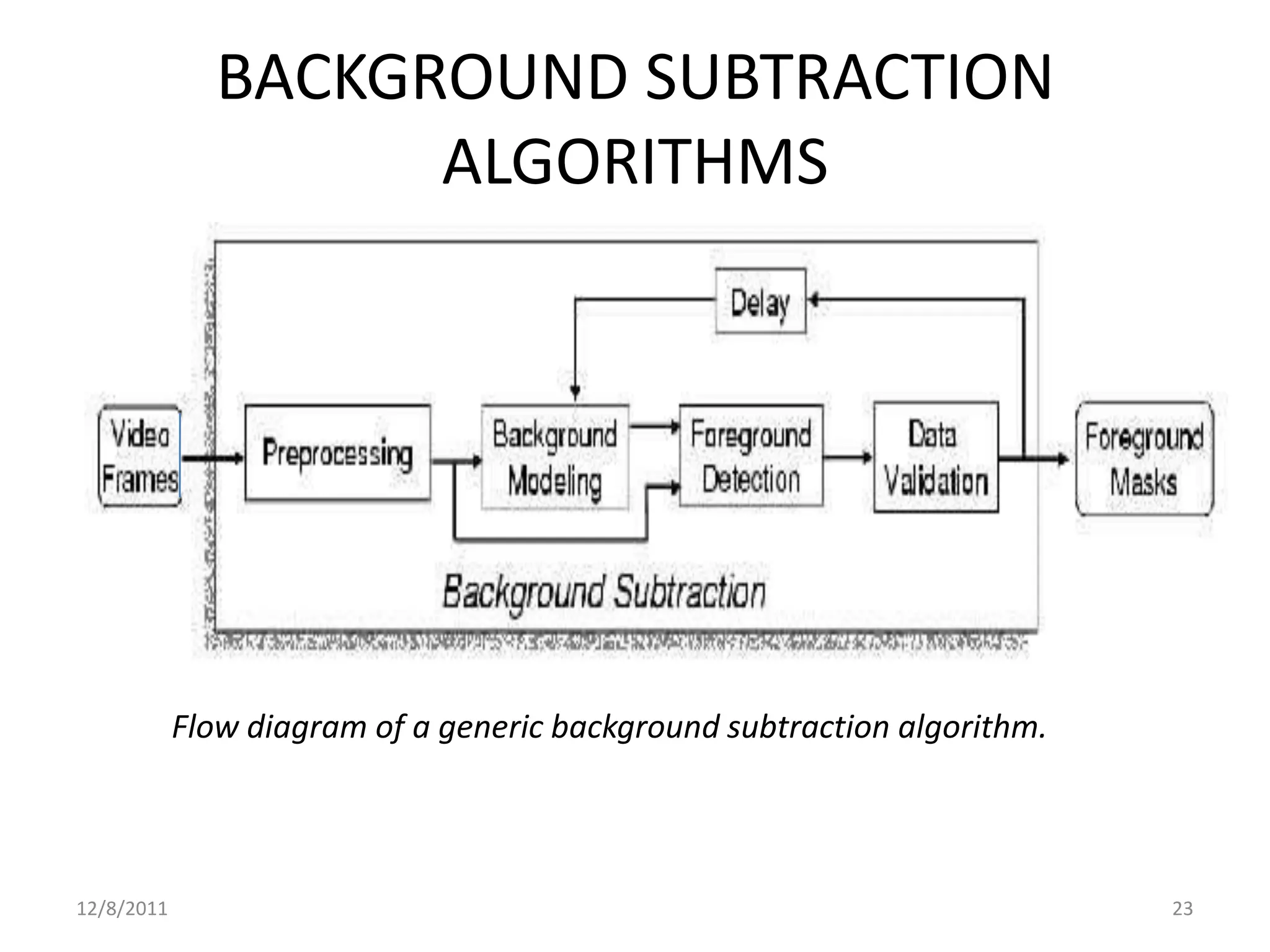
            Flow diagram of a generic background subtraction algorithm.


12/8/2011                                                                 23
Background subtraction Algorithms
• The four major steps in a background
  subtraction algorithm are:

     1.     Preprocessing,
     2.     Background modeling,
     3.     Foreground detection, and
     4.     Data validation.


12/8/2011                               24
Background Modeling
• Background modeling is at the heart of any
  background subtraction algorithm.

• Background model is that which robust
  against environmental changes in the
  background, but sensitive enough to identify
  all moving objects of interest.


12/8/2011                                    25
Background Modeling
• We classify background modeling techniques
  into two broad categories

      – Non-recursive and


      – Recursive


12/8/2011                                      26
Non-recursive Techniques
• A non-recursive technique uses a sliding
  window approach for background estimation.

• Non-recursive techniques are highly adaptive
  as they do not depend on the history beyond
  those frames stored in the buffer.


12/8/2011                                    27
Non-recursive Techniques
• Some of the commonly-used non-recursive
  techniques are:-
      – Frame differencing
      – Median filter
      – Mean filter


12/8/2011                                   28
Frame differencing


This we have studied in earlier slide


12/8/2011                               29
Median filter
• The background estimate is defined to be the
  median at each pixel location of all the frames
  in the buffer.

• The assumption is that the pixel stays in the
  background for more than half of the frames
  in the buffer.


12/8/2011                                       30
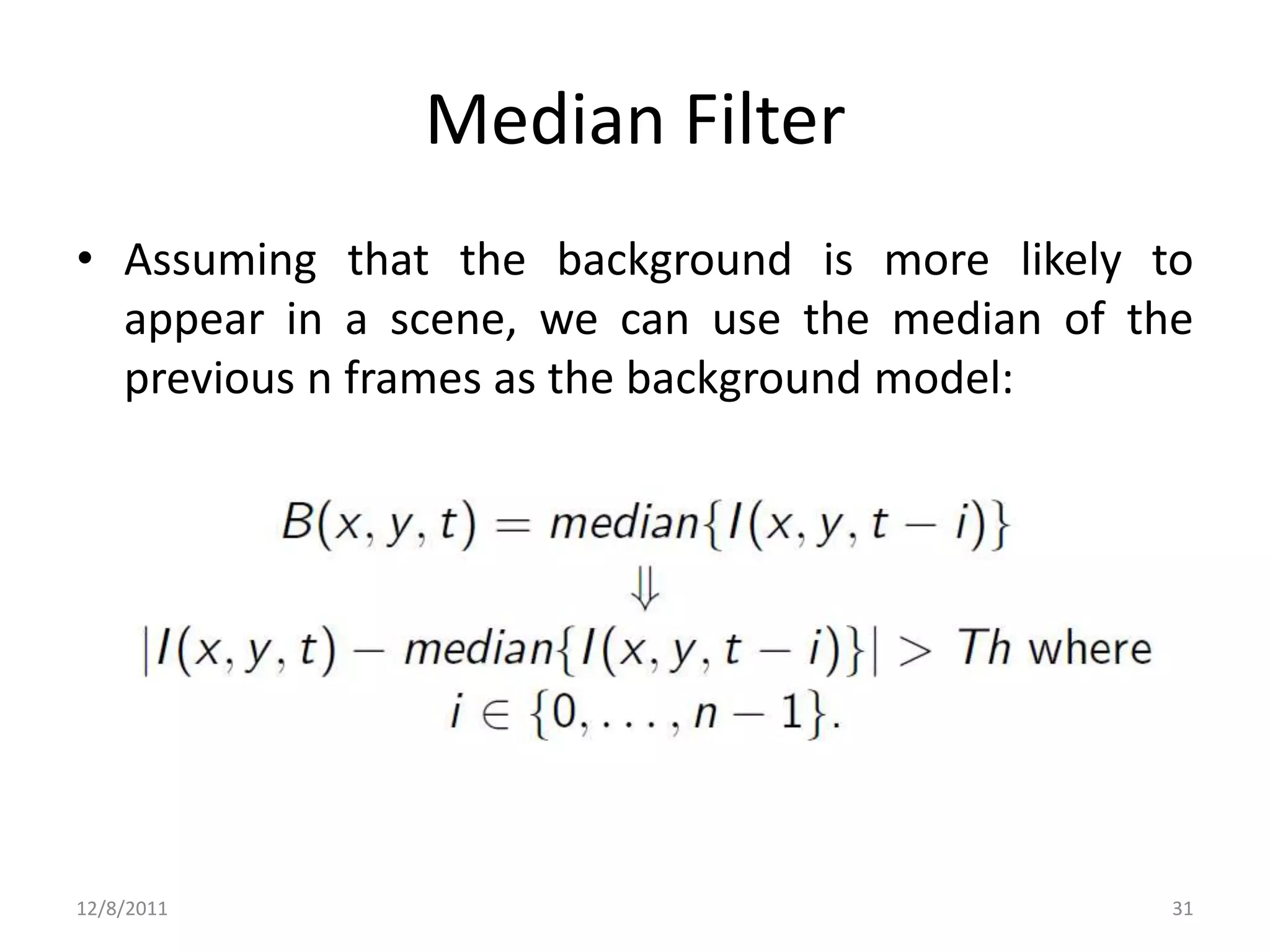
Median Filter
• Assuming that the background is more likely to
  appear in a scene, we can use the median of the
  previous n frames as the background model:


12/8/2011                                       31
12/8/2011   32
12/8/2011   33
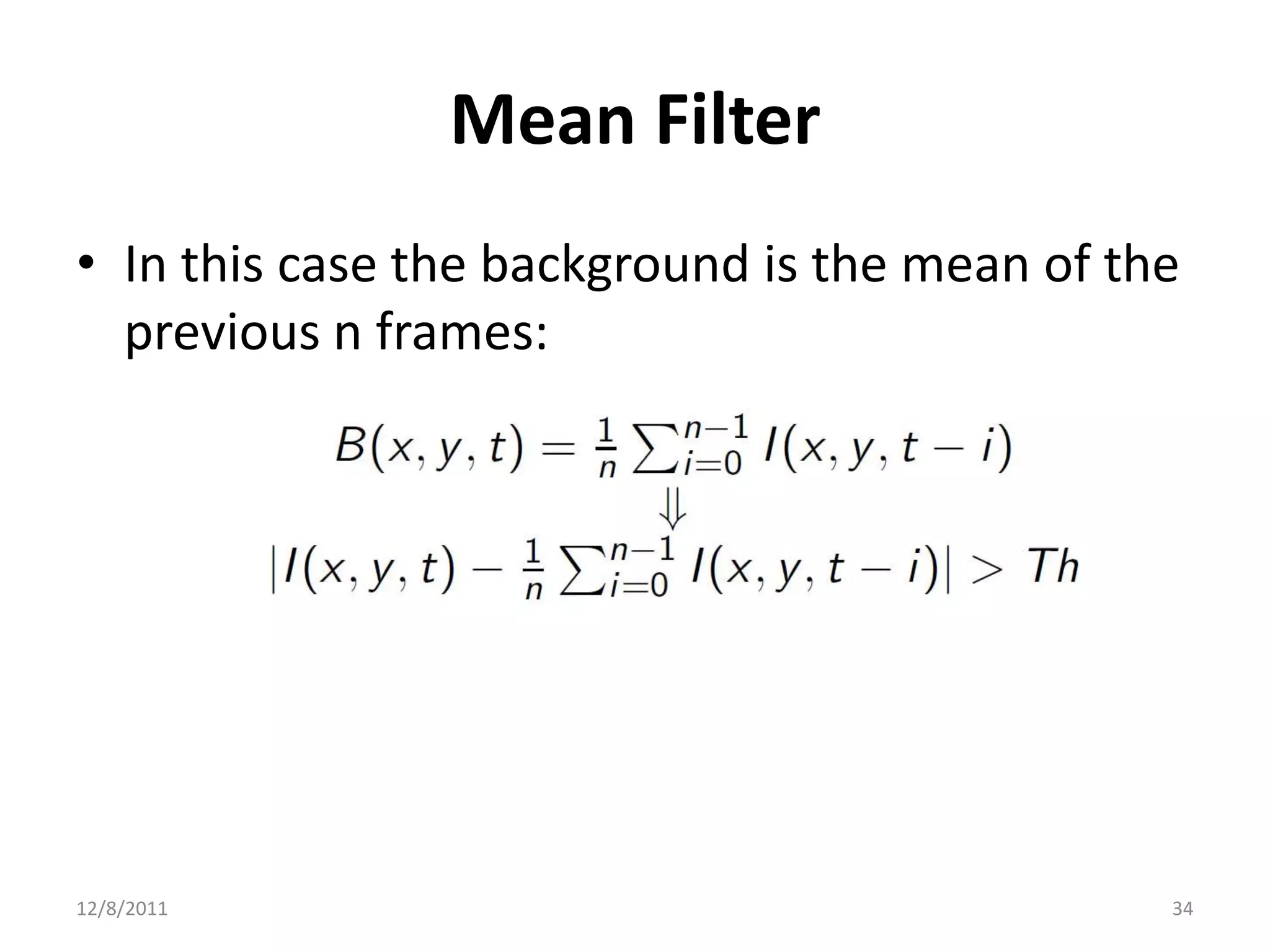
Mean Filter
• In this case the background is the mean of the
  previous n frames:


12/8/2011                                      34
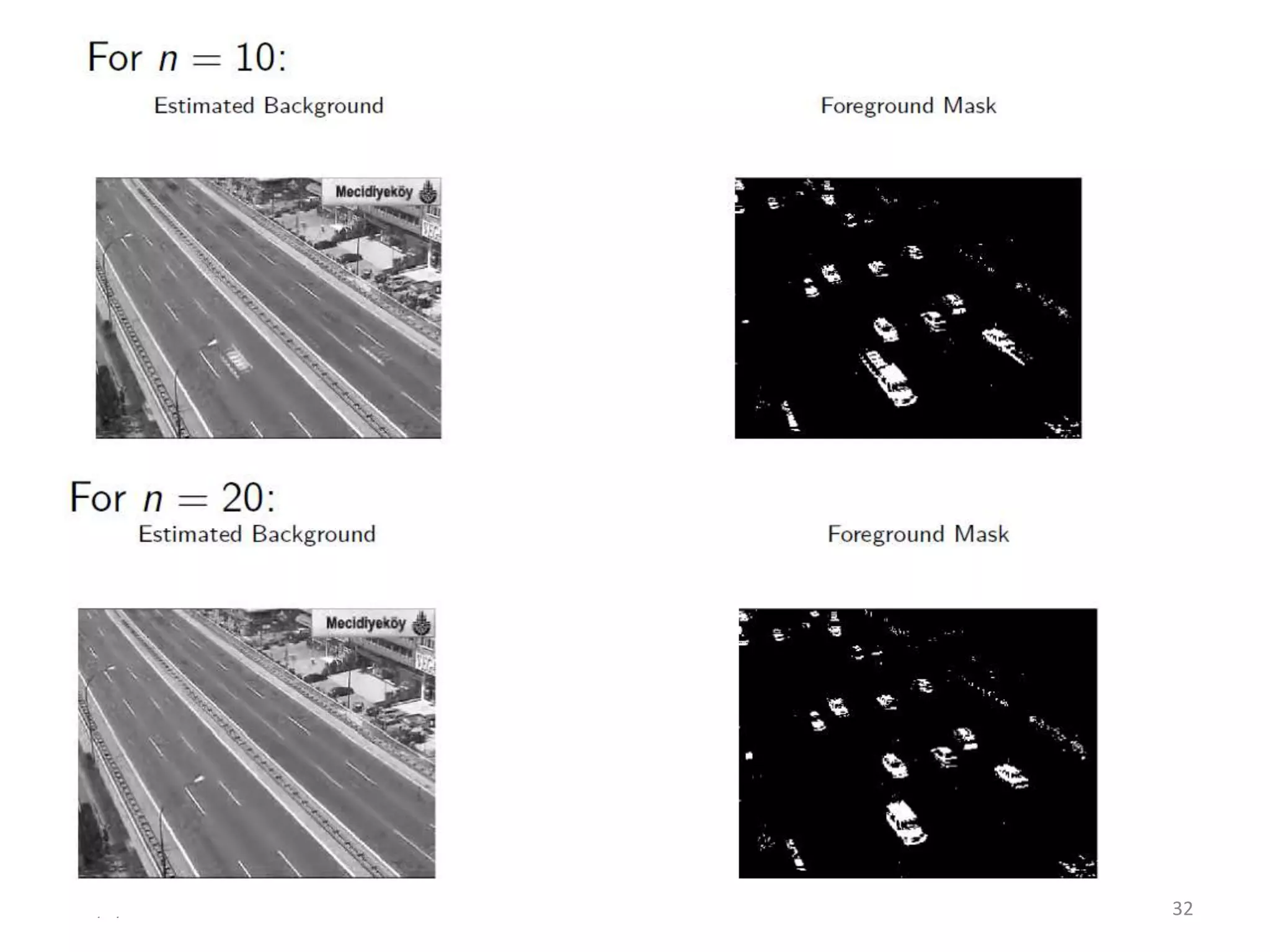
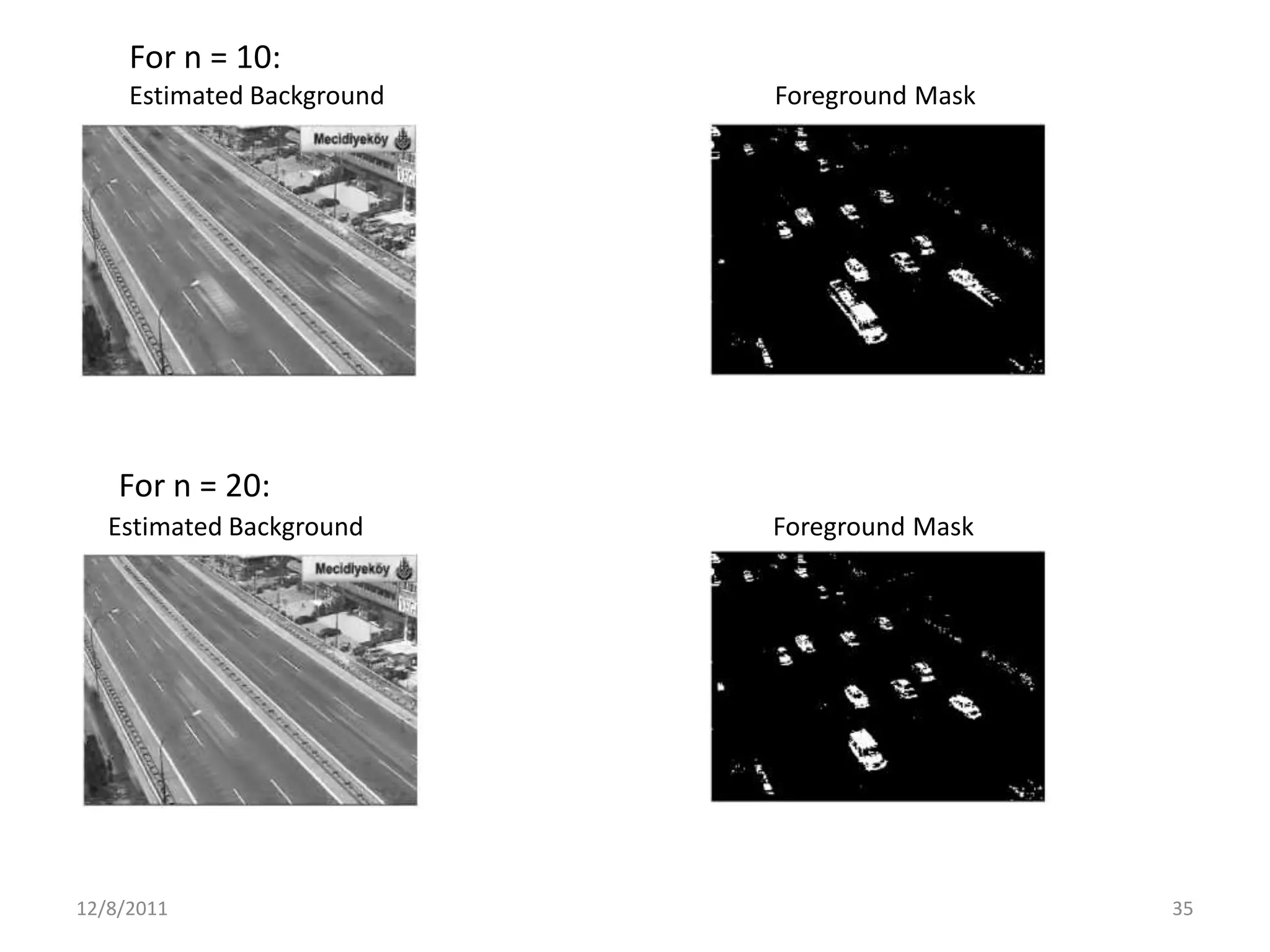
For n = 10:
     Estimated Background   Foreground Mask


    For n = 20:
   Estimated Background     Foreground Mask


12/8/2011                                     35
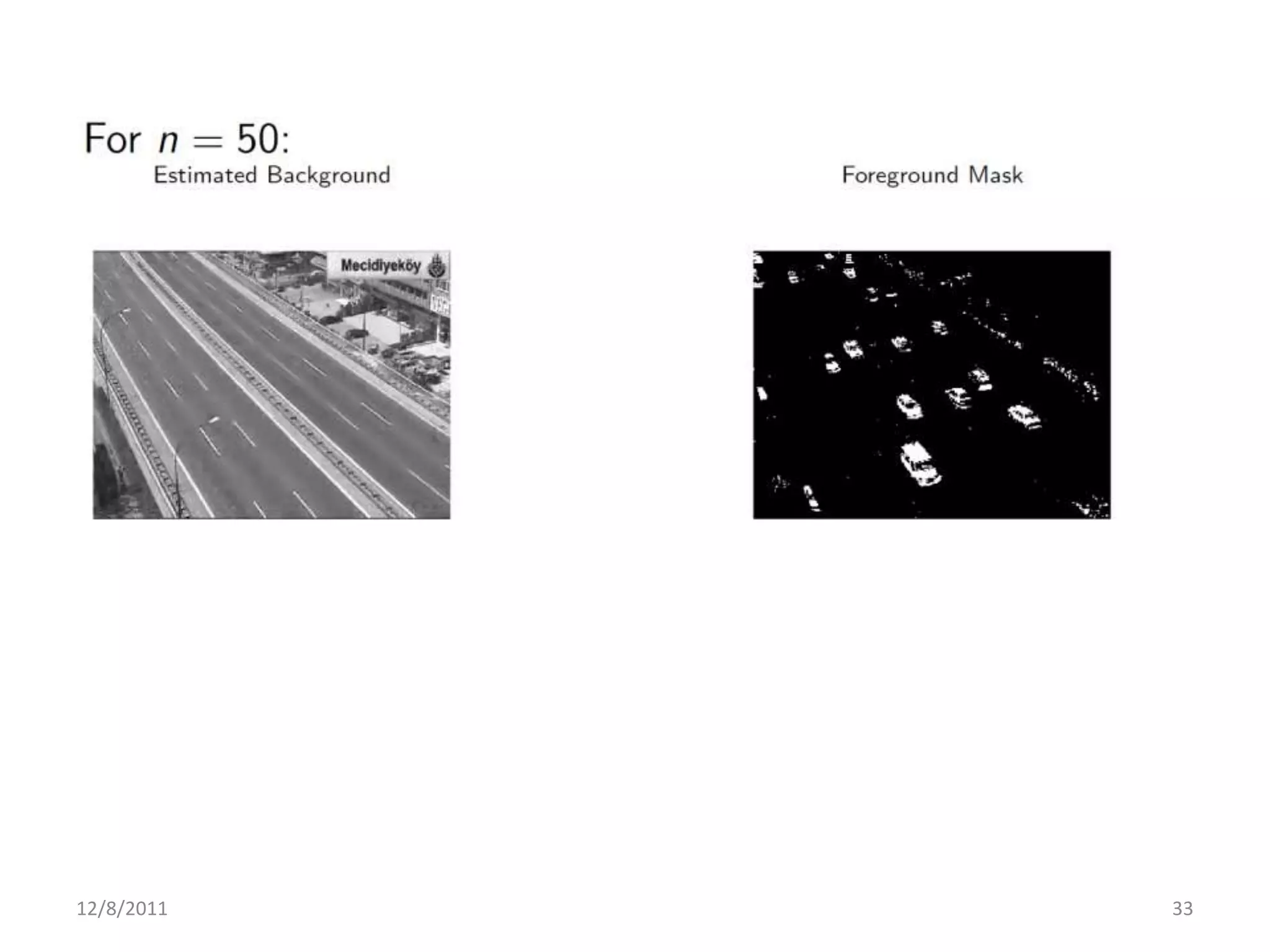
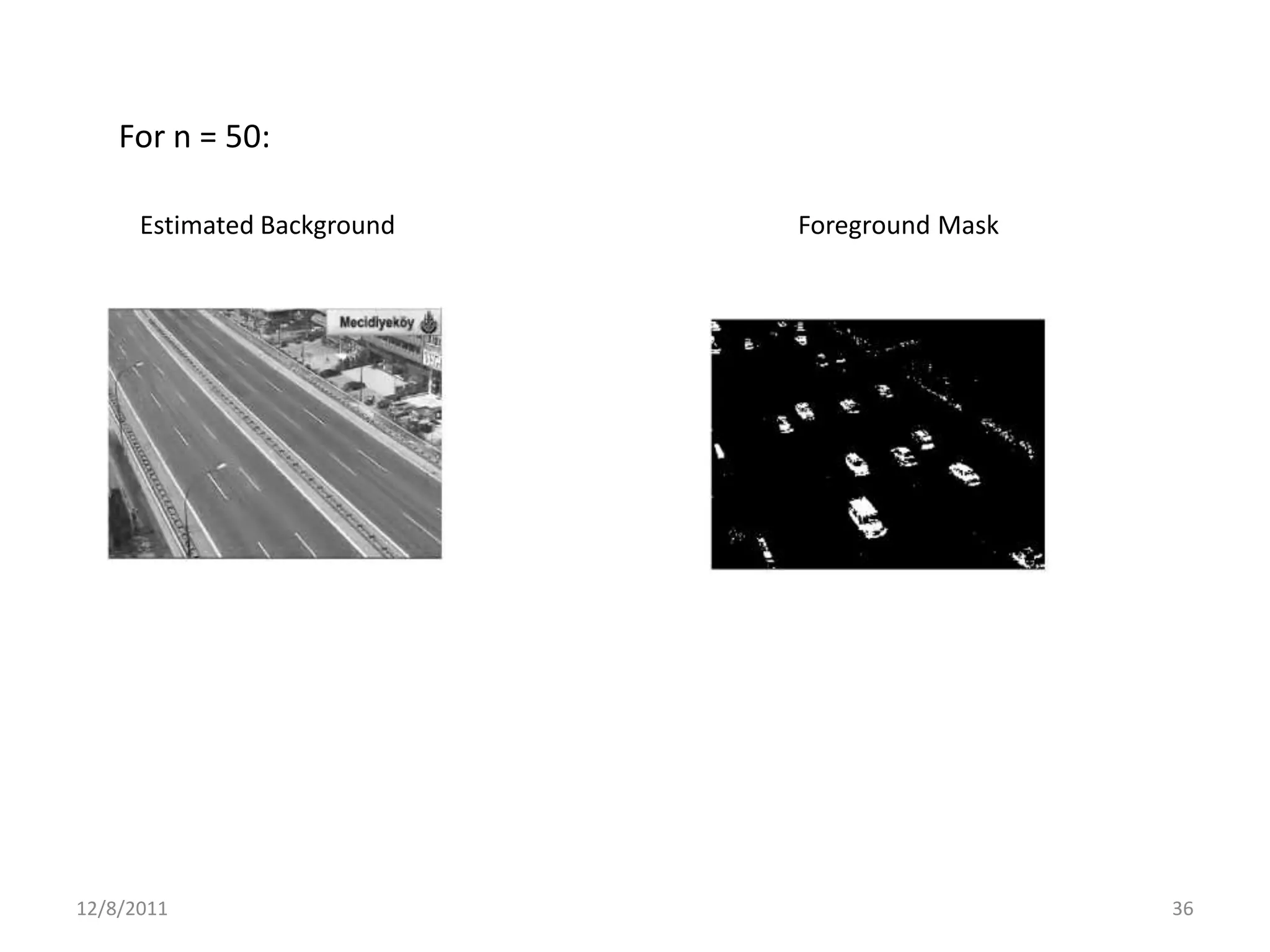
For n = 50:

      Estimated Background   Foreground Mask


12/8/2011                                      36
Kalman filter
• Kalman filter is a widely-used recursive
  technique for tracking linear dynamical
  systems under Gaussian noise. Many different
  versions have been proposed for background
  modeling, differing mainly in the state spaces
  used for tracking.


12/8/2011                                      37
Mixture of Gaussians (MoG)
• Unlike Kalman filter which tracks the evolution of a single
  Gaussian, the MoG method tracks multiple Gaussian
  distributions simultaneously.

• MoG maintains a density function for each pixel.

• It is capable of handling multi-modal background
  distributions.

• Since MoG is parametric, the model parameters can be
  adaptively updated without keeping a large buffer of video
  frames.

12/8/2011                                                      38
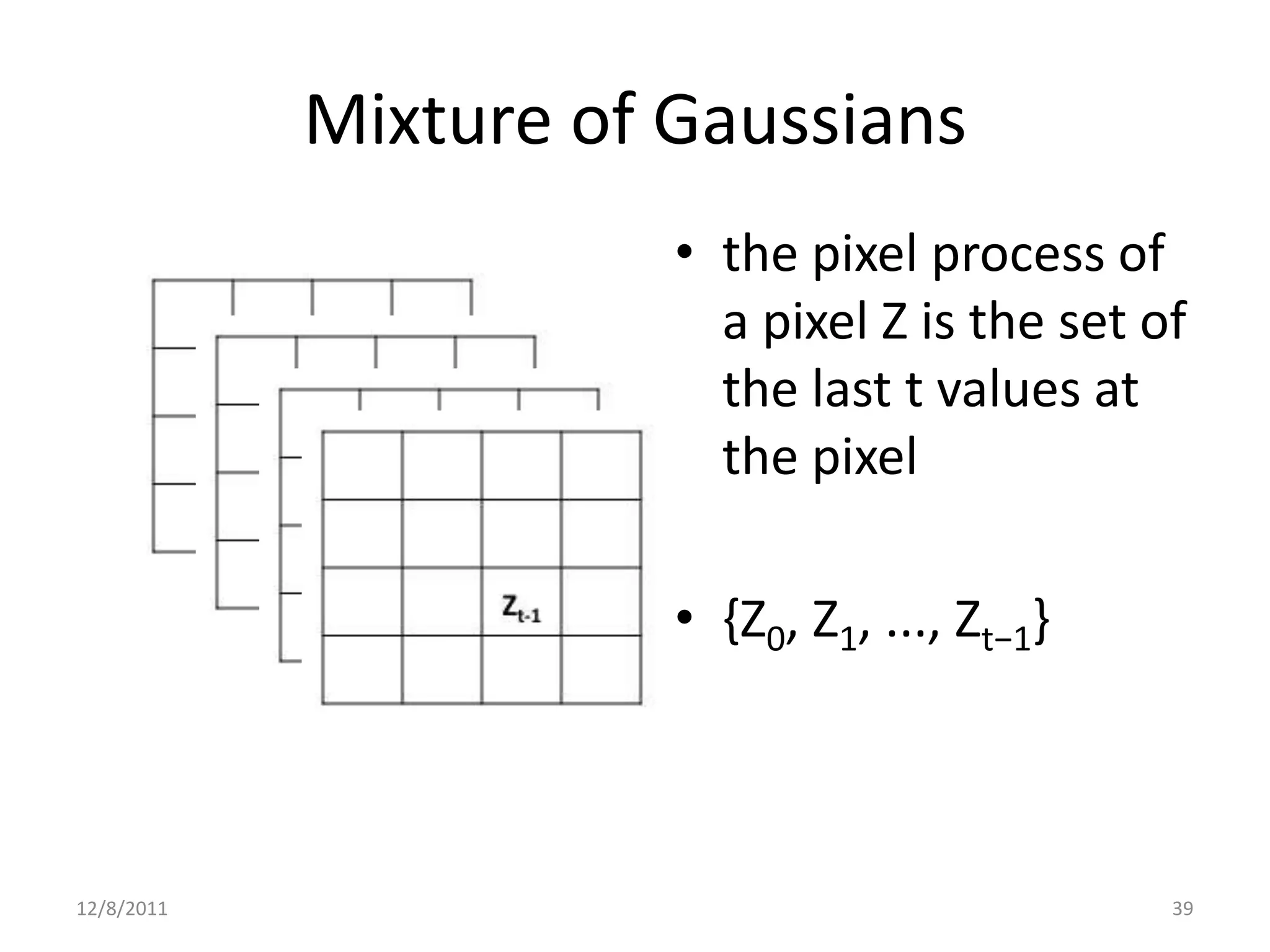
Mixture of Gaussians
                       • the pixel process of
                         a pixel Z is the set of
                         the last t values at
                         the pixel

                       • {Z0, Z1, ..., Zt−1}


12/8/2011                                      39
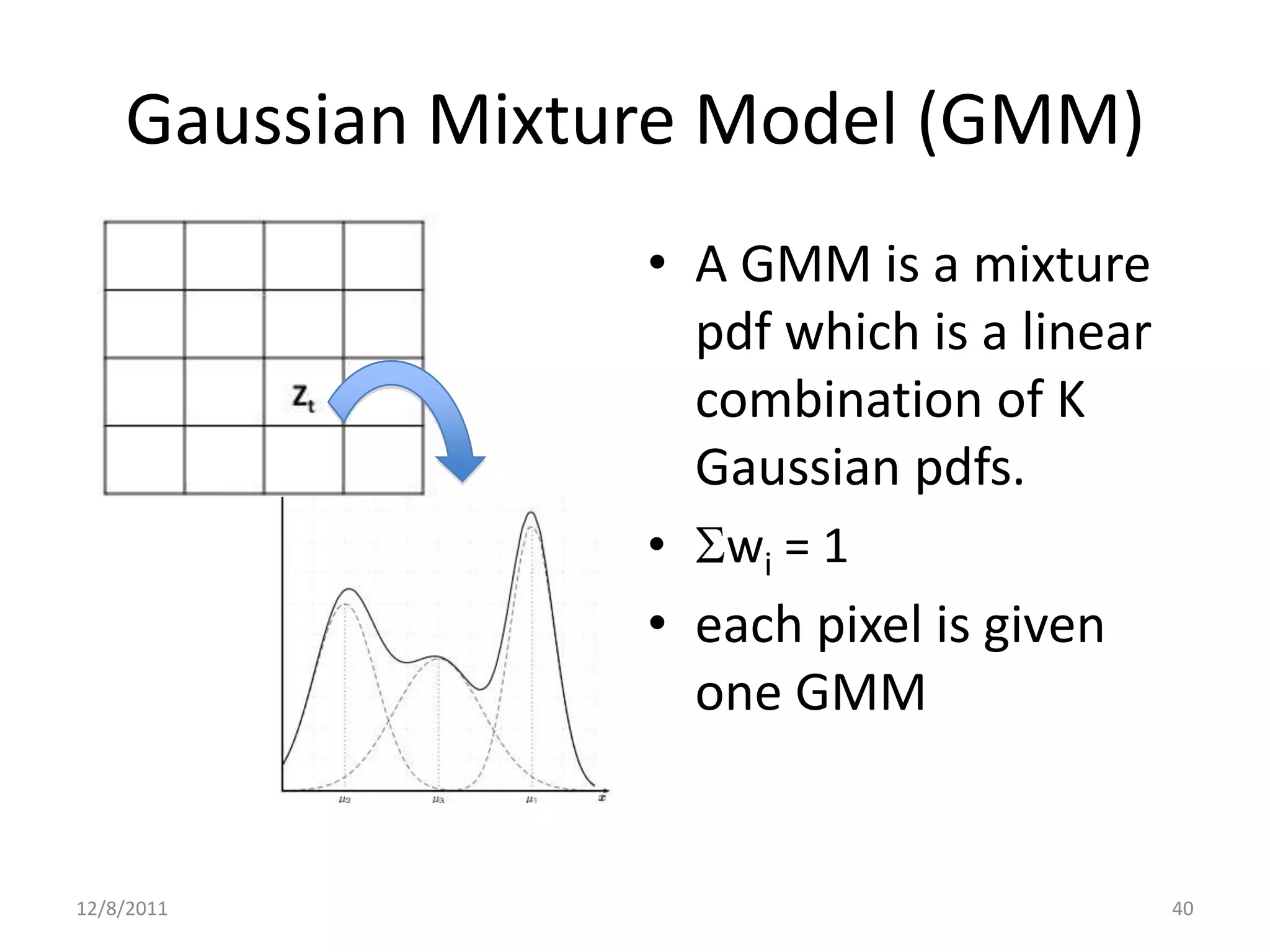
Gaussian Mixture Model (GMM)
                  • A GMM is a mixture
                    pdf which is a linear
                    combination of K
                    Gaussian pdfs.
                  •   wi = 1
                  • each pixel is given
                    one GMM


12/8/2011                                   40
Background/Foreground Detection
• There are two types of B/F detection methods:

      – Non-adaptive: It depend on certain numbers of video
        frames and do not maintain a background model in the
        algorithm.
            • B/F detection based on two frames
            • B/F detection based on three frames


      – Adaptive: It maintain a background model and the
        parameters of the background model evolve over time.
            • Adaptive B/F detection Statistical
            • B/F detection based on Gaussian model

12/8/2011                                                      41
Drawback of non-adaptive methods
• The non-adaptive methods are useful only in

      – high-supervised,
      – short-term      tracking    applications    without
        significant changes in the video scene.
      – When errors happen, it requires manual re-
        initialization.
      – Without re-initialization, errors in the background
        accumulate over time.

12/8/2011                                                42
Adaptive Background/Foreground
                  Detection
 • Adaptive B/F detection is chosen for more and
   more VCA applications because of the limitation
   of non-adaptive methods. A standard adaptive
   B/F detection method maintains a background
   model within the system.


12/8/2011                                            43
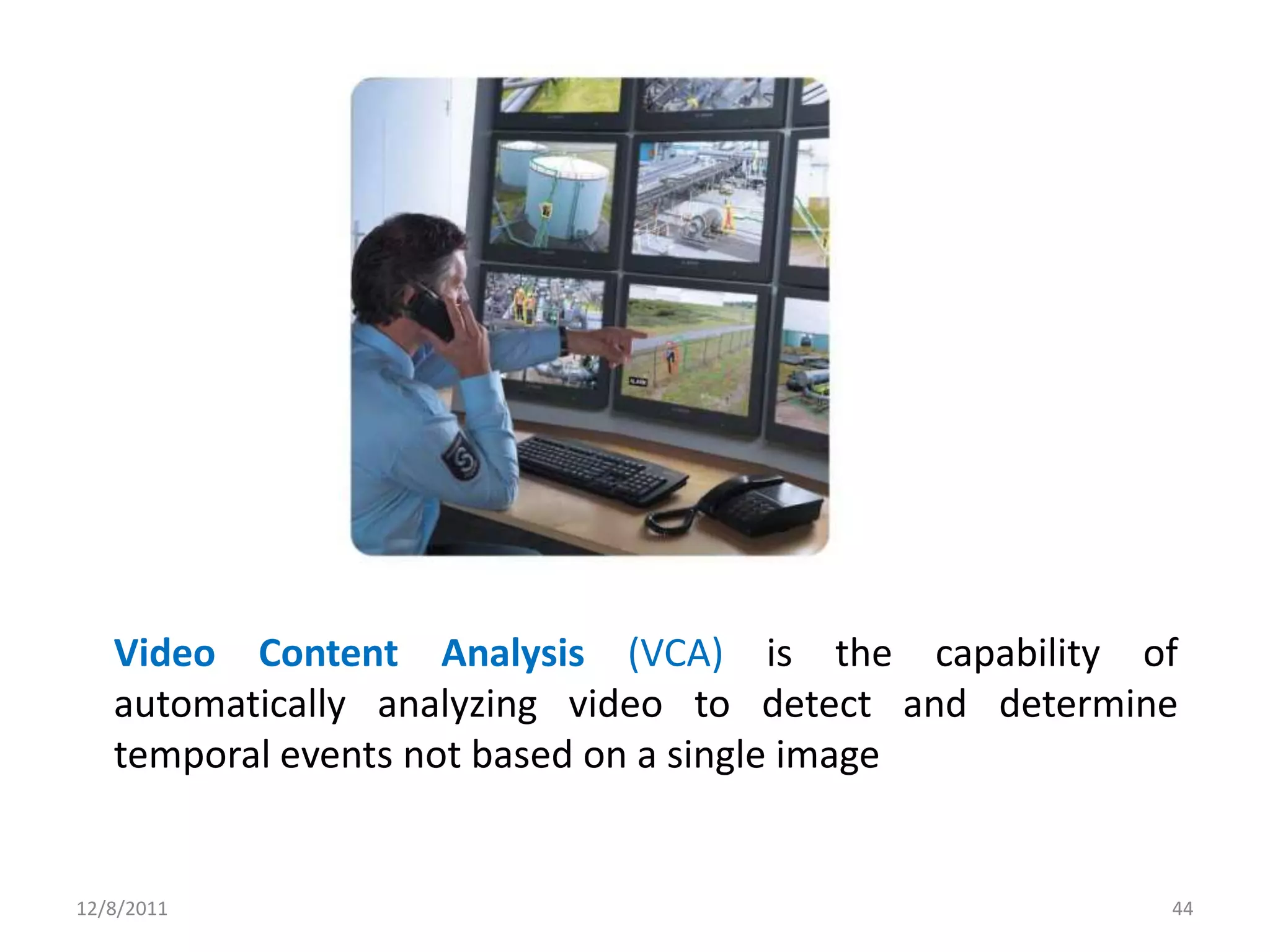
Video Content Analysis (VCA) is the capability of
   automatically analyzing video to detect and determine
   temporal events not based on a single image


12/8/2011                                              44
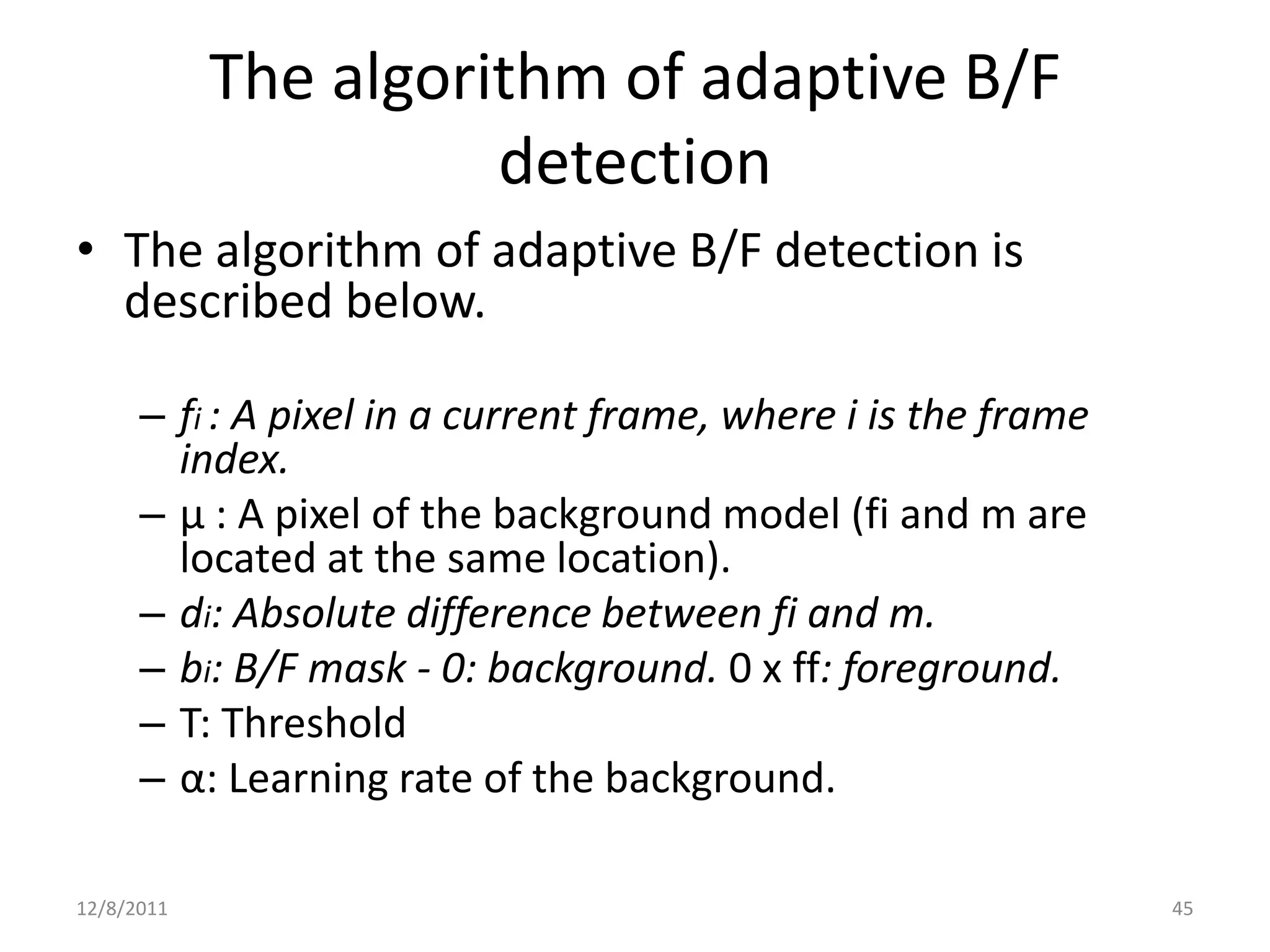
The algorithm of adaptive B/F
                      detection
• The algorithm of adaptive B/F detection is
  described below.

      – fi : A pixel in a current frame, where i is the frame
        index.
      – µ : A pixel of the background model (fi and m are
        located at the same location).
      – di: Absolute difference between fi and m.
      – bi: B/F mask - 0: background. 0 x ff: foreground.
      – T: Threshold
      – α: Learning rate of the background.

12/8/2011                                                       45
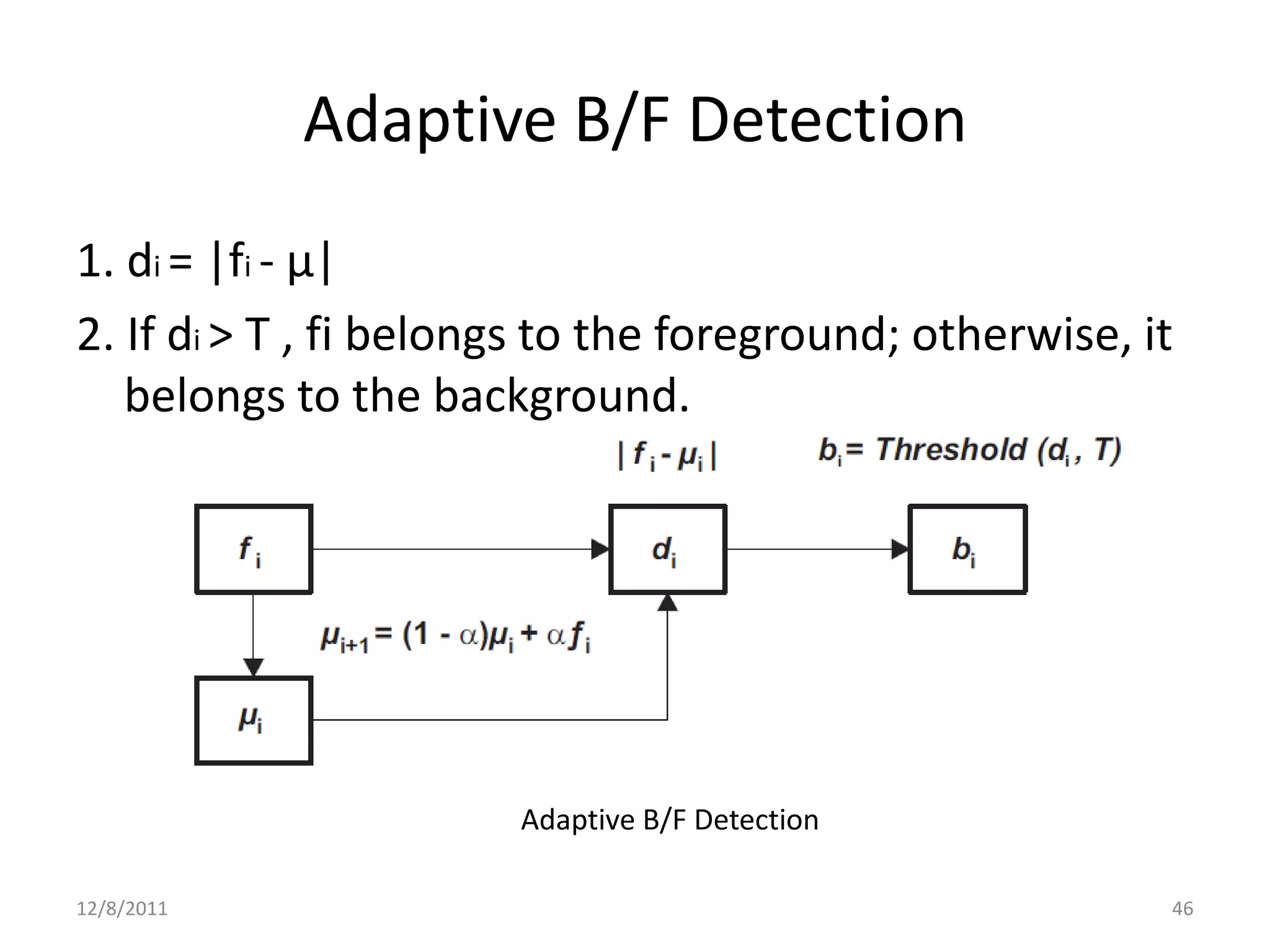
Adaptive B/F Detection
1. di = |fi - µ|
2. If di > T , fi belongs to the foreground; otherwise, it
   belongs to the background.


                       Adaptive B/F Detection

12/8/2011                                                46
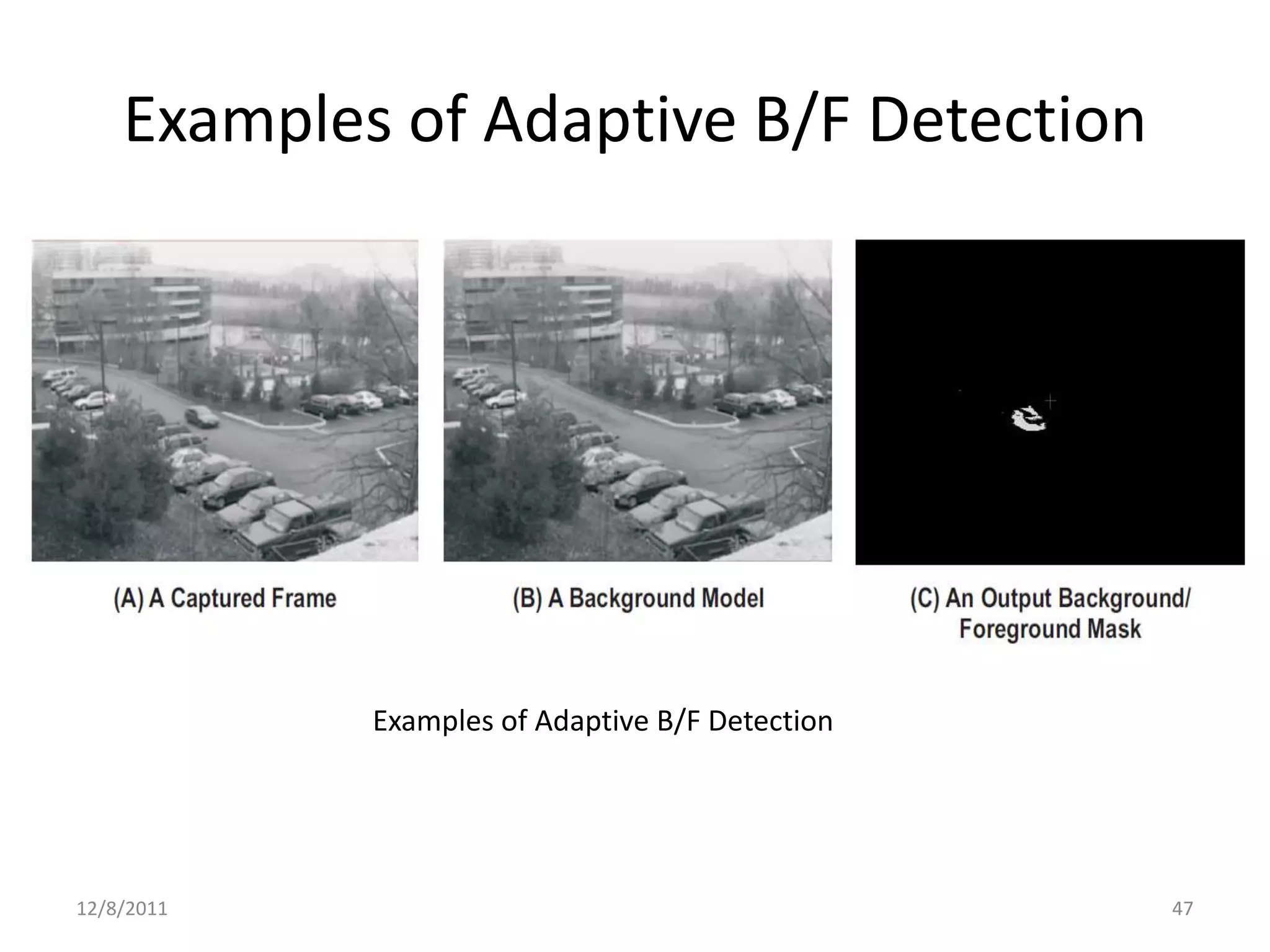
Examples of Adaptive B/F Detection


            Examples of Adaptive B/F Detection


12/8/2011                                        47
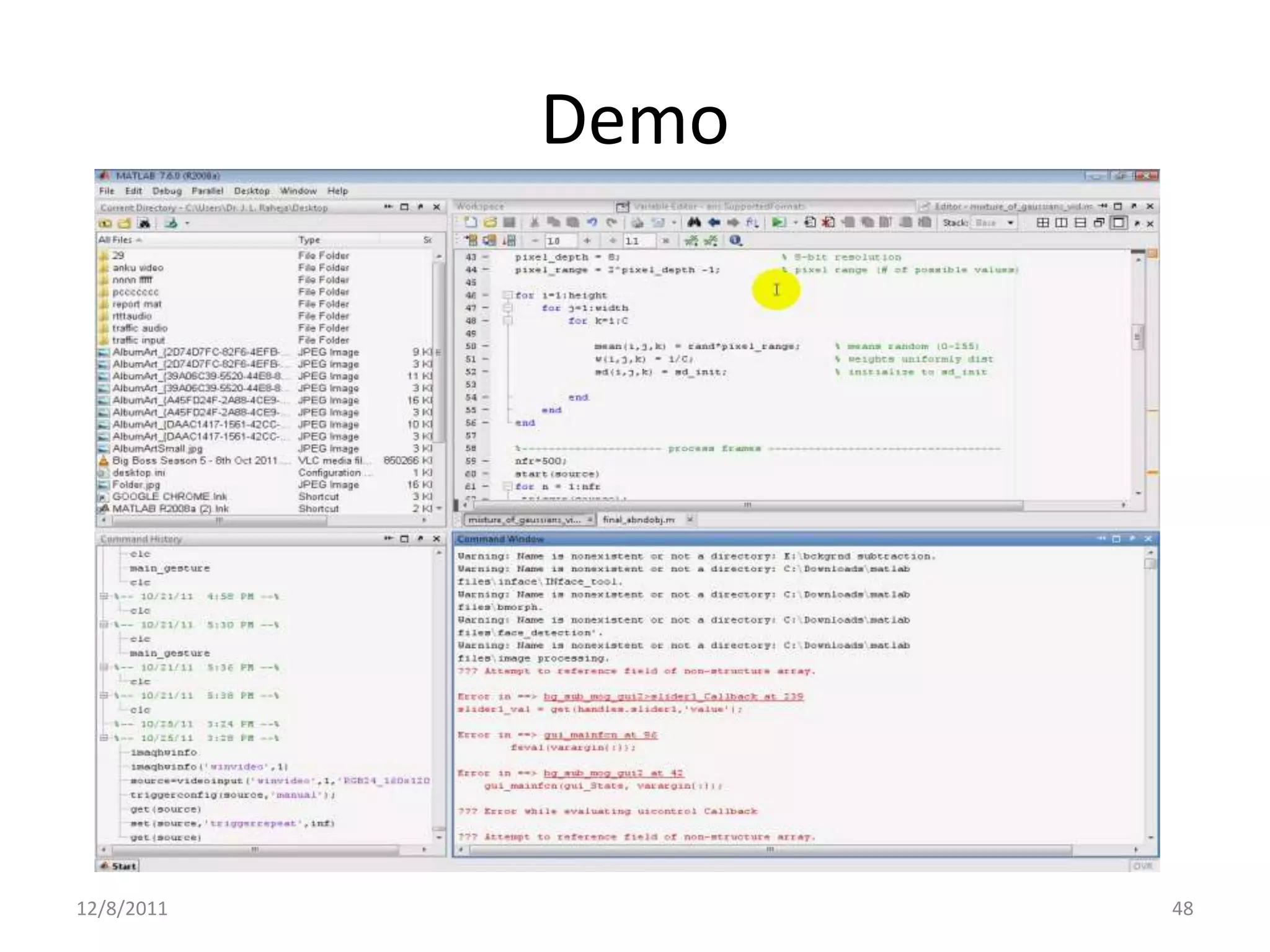
Demo


12/8/2011          48
THANK YOU

12/8/2011               49

Background subtraction

  • 1.
  • 2.
    Background Subtraction • Asthe name suggests, background subtraction is the process of separating out foreground objects from the background in a sequence of video frames. 12/8/2011 2
  • 3.
    Background Subtraction • Backgroundsubtraction is a widely used approach for detecting moving objects from static cameras. 12/8/2011 3
  • 4.
    Fundamental Logic • Fundamentallogic for detecting moving objects from the difference between the current frame and a reference frame, called “background image” and this method is known as FRAME DIFFERENCE METHOD 12/8/2011 4
  • 5.
  • 6.
  • 7.
  • 8.
    Background Subtraction Principles AtICCV 1999, MS Research presented a study, Wallflower: Principles and Practice of Background Maintenance, by Kentaro Toyama, John Krumm, Barry Brumitt, Brian Meyers. This paper compared many different background subtraction techniques and came up with some principles: P1: P2: P3: P4: 12/8/2011 8
  • 9.
    The Problem -Requirements The background image is not fixed but must adapt to: • Illumination changes •Gradual •Sudden (such as clouds) 12/8/2011 9
  • 10.
    • Motion changes •Camera oscillations • High-frequencies background objects (such as tree branches, sea waves, and similar) 12/8/2011 10
  • 11.
    • Changes inthe background geometry •Parked cars 12/8/2011 11
  • 12.
    Widely Used! • Traffic monitoring (counting vehicles, detecting & tracking vehicles), • Human action recognition (run, walk, jump, squat), • Human-computer interaction (“human interface") • Object tracking (watched tennis lately), • And in many other cool applications of computer vision such as digital forensics. 12/8/2011 12
  • 13.
    Simple Approach Image at time t: Background at time t: I (x, y, t) B(x, y, t) > Th 1. Estimate the background for time t. 2. Subtract the estimated background from the input frame. 3. Apply a threshold, Th, to the absolute difference to get the foreground mask. 12/8/2011 13
  • 14.
    The basic methods •Frame difference: | framei–framesi-1| > Th • The estimated background is just the previous frame • It evidently works only in particular conditions of objects’ speed and frame rate • Very sensitive to the threshold Th 12/8/2011 14
  • 15.
    Frame Differencing • Backgroundis estimated to be the previous frame. Background subtraction equation then becomes: B(x ,y ,t) = I (x ,y ,t-1) I (x, y, t) - I (x, y, t – 1) > Th 12/8/2011 15
  • 16.
    Frame Differencing • Depending on the object structure, speed, frame rate and global threshold, this approach may or may not be useful (usually not). > Th 12/8/2011 16
  • 17.
    Frame Differencing Th = 25 Th = 50 Th = 100 Th = 200 12/8/2011 17
  • 18.
    Thresholding • The keyparameter in the thresholding process is the choice of the threshold value. • Several different methods for choosing a threshold exist, – Users can manually choose a threshold value, or – A thresholding algorithm can compute a value automatically, which is known as automatic thresholding 12/8/2011 18
  • 19.
    Motivation • A robustbackground subtraction algorithm should handle: lighting changes, repetitive motions from clutter and long- term scene changes. 12/8/2011 19
  • 20.
    Algorithm Overview • Thevalues of a particular pixel is modeled as a mixture of adaptive Gaussians. – Why mixture? Multiple surfaces appear in a pixel. – Why adaptive? Lighting conditions change. • At each iteration Gaussians are evaluated using a simple heuristic to determine which ones are mostly likely to correspond to the background. • Pixels that do not match with the “background Gaussians” are classified as foreground. • Foreground pixels are grouped using 2D connected component analysis. 12/8/2011 20
  • 21.
    Advantages vs. Shortcomings •Advantages: – A different “threshold” is selected for each pixel. – These pixel-wise “thresholds" are adapting by time. – Objects are allowed to become part of the background without destroying the existing background model. – Provides fast recovery. • Disadvantages: – Cannot deal with sudden, drastic lighting changes. – Initializing the Gaussians is important (median filtering). – There are relatively many parameters, and they should be selected intelligently. 12/8/2011 21
  • 22.
    Challenges background subtraction Algorithm • It must be robust against changes in illumination. • It should avoid detecting non-stationary background objects such as swinging leaves, rain, snow ,and shadow cast by moving objects. • Finally, its internal background model should react quickly to changes in background such as starting and stopping of vehicles. 12/8/2011 22
  • 23.
    BACKGROUND SUBTRACTION ALGORITHMS Flow diagram of a generic background subtraction algorithm. 12/8/2011 23
  • 24.
    Background subtraction Algorithms •The four major steps in a background subtraction algorithm are: 1. Preprocessing, 2. Background modeling, 3. Foreground detection, and 4. Data validation. 12/8/2011 24
  • 25.
    Background Modeling • Backgroundmodeling is at the heart of any background subtraction algorithm. • Background model is that which robust against environmental changes in the background, but sensitive enough to identify all moving objects of interest. 12/8/2011 25
  • 26.
    Background Modeling • Weclassify background modeling techniques into two broad categories – Non-recursive and – Recursive 12/8/2011 26
  • 27.
    Non-recursive Techniques • Anon-recursive technique uses a sliding window approach for background estimation. • Non-recursive techniques are highly adaptive as they do not depend on the history beyond those frames stored in the buffer. 12/8/2011 27
  • 28.
    Non-recursive Techniques • Someof the commonly-used non-recursive techniques are:- – Frame differencing – Median filter – Mean filter 12/8/2011 28
  • 29.
    Frame differencing This wehave studied in earlier slide 12/8/2011 29
  • 30.
    Median filter • Thebackground estimate is defined to be the median at each pixel location of all the frames in the buffer. • The assumption is that the pixel stays in the background for more than half of the frames in the buffer. 12/8/2011 30
  • 31.
    Median Filter • Assumingthat the background is more likely to appear in a scene, we can use the median of the previous n frames as the background model: 12/8/2011 31
  • 32.
  • 33.
  • 34.
    Mean Filter • Inthis case the background is the mean of the previous n frames: 12/8/2011 34
  • 35.
    For n =10: Estimated Background Foreground Mask For n = 20: Estimated Background Foreground Mask 12/8/2011 35
  • 36.
    For n =50: Estimated Background Foreground Mask 12/8/2011 36
  • 37.
    Kalman filter • Kalmanfilter is a widely-used recursive technique for tracking linear dynamical systems under Gaussian noise. Many different versions have been proposed for background modeling, differing mainly in the state spaces used for tracking. 12/8/2011 37
  • 38.
    Mixture of Gaussians(MoG) • Unlike Kalman filter which tracks the evolution of a single Gaussian, the MoG method tracks multiple Gaussian distributions simultaneously. • MoG maintains a density function for each pixel. • It is capable of handling multi-modal background distributions. • Since MoG is parametric, the model parameters can be adaptively updated without keeping a large buffer of video frames. 12/8/2011 38
  • 39.
    Mixture of Gaussians • the pixel process of a pixel Z is the set of the last t values at the pixel • {Z0, Z1, ..., Zt−1} 12/8/2011 39
  • 40.
    Gaussian Mixture Model(GMM) • A GMM is a mixture pdf which is a linear combination of K Gaussian pdfs. • wi = 1 • each pixel is given one GMM 12/8/2011 40
  • 41.
    Background/Foreground Detection • Thereare two types of B/F detection methods: – Non-adaptive: It depend on certain numbers of video frames and do not maintain a background model in the algorithm. • B/F detection based on two frames • B/F detection based on three frames – Adaptive: It maintain a background model and the parameters of the background model evolve over time. • Adaptive B/F detection Statistical • B/F detection based on Gaussian model 12/8/2011 41
  • 42.
    Drawback of non-adaptivemethods • The non-adaptive methods are useful only in – high-supervised, – short-term tracking applications without significant changes in the video scene. – When errors happen, it requires manual re- initialization. – Without re-initialization, errors in the background accumulate over time. 12/8/2011 42
  • 43.
    Adaptive Background/Foreground Detection • Adaptive B/F detection is chosen for more and more VCA applications because of the limitation of non-adaptive methods. A standard adaptive B/F detection method maintains a background model within the system. 12/8/2011 43
  • 44.
    Video Content Analysis(VCA) is the capability of automatically analyzing video to detect and determine temporal events not based on a single image 12/8/2011 44
  • 45.
    The algorithm ofadaptive B/F detection • The algorithm of adaptive B/F detection is described below. – fi : A pixel in a current frame, where i is the frame index. – µ : A pixel of the background model (fi and m are located at the same location). – di: Absolute difference between fi and m. – bi: B/F mask - 0: background. 0 x ff: foreground. – T: Threshold – α: Learning rate of the background. 12/8/2011 45
  • 46.
    Adaptive B/F Detection 1.di = |fi - µ| 2. If di > T , fi belongs to the foreground; otherwise, it belongs to the background. Adaptive B/F Detection 12/8/2011 46
  • 47.
    Examples of AdaptiveB/F Detection Examples of Adaptive B/F Detection 12/8/2011 47
  • 48.
  • 49.