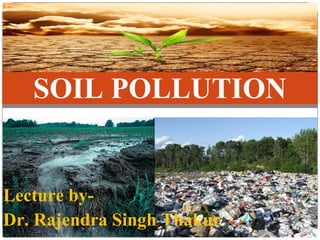
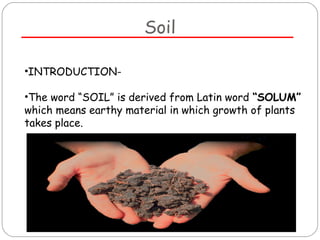
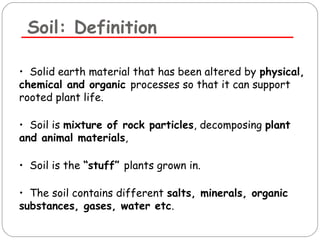
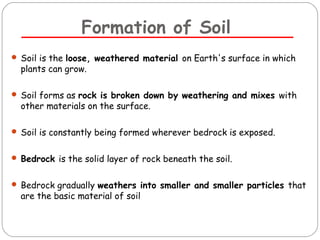
SOIL POLLUTION 
Lecture by- 
Dr. Rajendra Singh Thakur
Soil 
•INTRODUCTION- 
•The word “SOIL” is derived from Latin word “SOLUM” 
which means earthy material in which growth of plants 
takes place.
Soil: Definition 
• Solid earth material that has been altered by physical, 
chemical and organic processes so that it can support 
rooted plant life. 
• Soil is mixture of rock particles, decomposing plant 
and animal materials, 
• Soil is the “stuff” plants grown in. 
• The soil contains different salts, minerals, organic 
substances, gases, water etc.
Formation of Soil 
 Soil is the loose, weathered material on Earth's surface in which 
plants can grow. 
 Soil forms as rock is broken down by weathering and mixes with 
other materials on the surface. 
 Soil is constantly being formed wherever bedrock is exposed. 
 Bedrock is the solid layer of rock beneath the soil. 
 Bedrock gradually weathers into smaller and smaller particles that 
are the basic material of soil
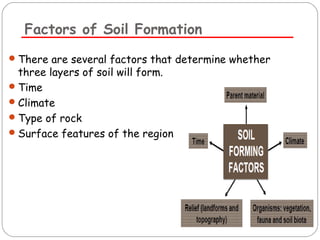
Factors of Soil Formation 
There are several factors that determine whether 
three layers of soil will form. 
Time 
Climate 
Type of rock 
Surface features of the region
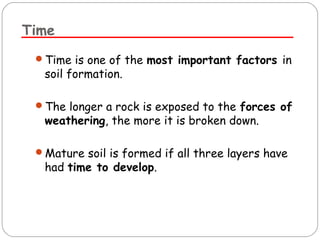
Time 
Time is one of the most important factors in 
soil formation. 
The longer a rock is exposed to the forces of 
weathering, the more it is broken down. 
Mature soil is formed if all three layers have 
had time to develop.
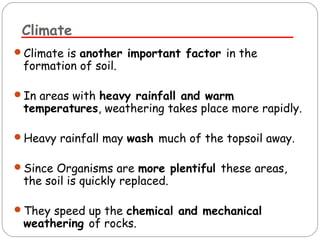
Climate 
Climate is another important factor in the 
formation of soil. 
In areas with heavy rainfall and warm 
temperatures, weathering takes place more rapidly. 
Heavy rainfall may wash much of the topsoil away. 
Since Organisms are more plentiful these areas, 
the soil is quickly replaced. 
They speed up the chemical and mechanical 
weathering of rocks.
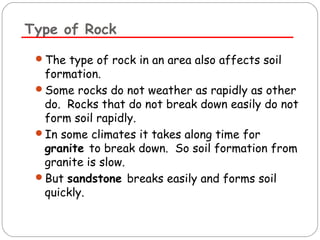
Type of Rock 
The type of rock in an area also affects soil 
formation. 
Some rocks do not weather as rapidly as other 
do. Rocks that do not break down easily do not 
form soil rapidly. 
In some climates it takes along time for 
granite to break down. So soil formation from 
granite is slow. 
But sandstone breaks easily and forms soil 
quickly.
Surface Features of Region 
The surface features of the region also 
determine the speed at which soil is formed. 
On very steep slopes, rainwater running off 
the land erodes the soil and exposes rock to 
weathering.
Soil Composition 
• Soil is a mixture of rock particles, minerals, decayed organic 
material, air and water. 
• The type of rock particles and minerals in any given soil depends on 
two factors: 
Bedrock that was weathered 
Type of weathering 
• Sand, silt, and clay make up the portion of soil that comes from 
weathered rock. 
• The decayed organic material in soil is humus. Humus is a dark-colored 
substance that forms as plant and animal remains decay. 
• Humus helps create spaces in soil for the air and water that plants 
must have
Soil Components 
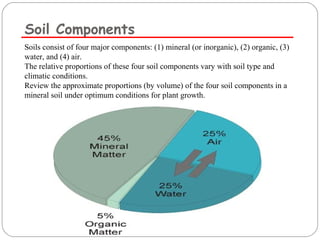
Soils consist of four major components: (1) mineral (or inorganic), (2) organic, (3) 
water, and (4) air. 
The relative proportions of these four soil components vary with soil type and 
climatic conditions. 
Review the approximate proportions (by volume) of the four soil components in a 
mineral soil under optimum conditions for plant growth.
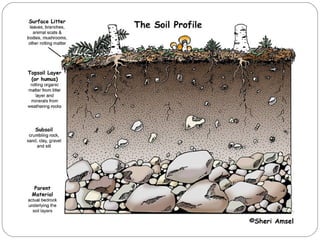
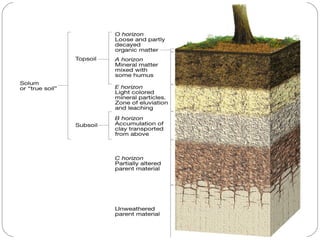
Soil Profile? 
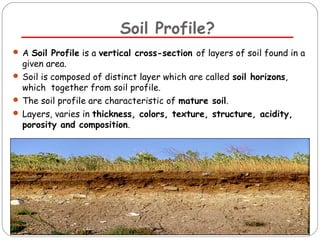
 A Soil Profile is a vertical cross-section of layers of soil found in a 
given area. 
 Soil is composed of distinct layer which are called soil horizons, 
which together from soil profile. 
 The soil profile are characteristic of mature soil. 
 Layers, varies in thickness, colors, texture, structure, acidity, 
porosity and composition.
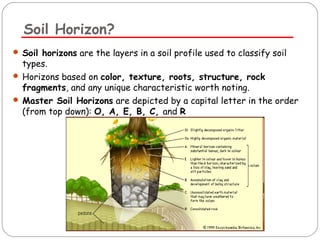
Soil Horizon? 
 Soil horizons are the layers in a soil profile used to classify soil 
types. 
 Horizons based on color, texture, roots, structure, rock 
fragments, and any unique characteristic worth noting. 
 Master Soil Horizons are depicted by a capital letter in the order 
(from top down): O, A, E, B, C, and R
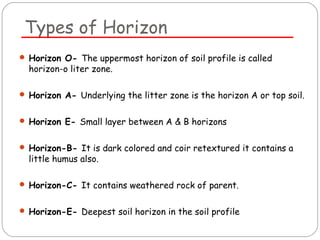
Types of Horizon 
 Horizon O- The uppermost horizon of soil profile is called 
horizon-o liter zone. 
 Horizon A- Underlying the litter zone is the horizon A or top soil. 
 Horizon E- Small layer between A & B horizons 
 Horizon-B- It is dark colored and coir retextured it contains a 
little humus also. 
 Horizon-C- It contains weathered rock of parent. 
 Horizon-E- Deepest soil horizon in the soil profile
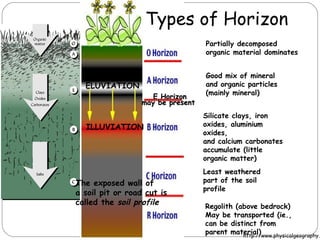
Types of Horizon 
Partially decomposed 
organic material dominates 
Good mix of mineral 
and organic particles 
(mainly mineral) 
Silicate clays, iron 
oxides, aluminium 
oxides, 
and calcium carbonates 
accumulate (little 
organic matter) 
Least weathered 
part of the soil 
profile 
Regolith (above bedrock) 
May be transported (ie., 
can be distinct from 
parent material) 
http://www.physicalgeography.net 
EE HHoorriizzoonn 
mmaayy bbee pprreesseenntt 
ELUVIATION 
ILLUVIATION 
The exposed wall of 
a soil pit or road cut is 
called the soil profile
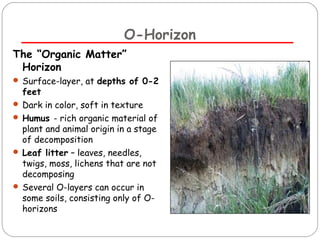
O-Horizon 
The “Organic Matter” 
Horizon 
 Surface-layer, at depths of 0-2 
feet 
 Dark in color, soft in texture 
 Humus - rich organic material of 
plant and animal origin in a stage 
of decomposition 
 Leaf litter – leaves, needles, 
twigs, moss, lichens that are not 
decomposing 
 Several O-layers can occur in 
some soils, consisting only of O-horizons
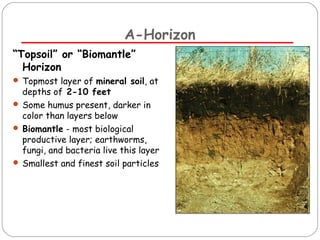
A-Horizon 
“Topsoil” or “Biomantle” 
Horizon 
 Topmost layer of mineral soil, at 
depths of 2-10 feet 
 Some humus present, darker in 
color than layers below 
 Biomantle - most biological 
productive layer; earthworms, 
fungi, and bacteria live this layer 
 Smallest and finest soil particles
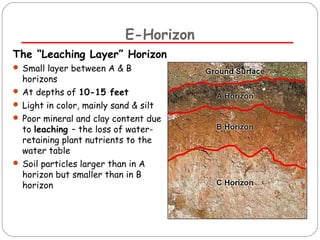
E-Horizon 
The “Leaching Layer” Horizon 
 Small layer between A & B 
horizons 
 At depths of 10-15 feet 
 Light in color, mainly sand & silt 
 Poor mineral and clay content due 
to leaching – the loss of water-retaining 
plant nutrients to the 
water table 
 Soil particles larger than in A 
horizon but smaller than in B 
horizon
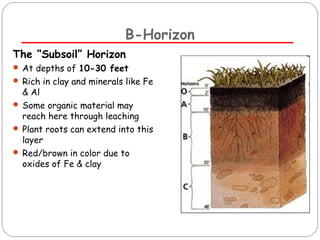
B-Horizon 
The “Subsoil” Horizon 
 At depths of 10-30 feet 
 Rich in clay and minerals like Fe 
& Al 
 Some organic material may 
reach here through leaching 
 Plant roots can extend into this 
layer 
 Red/brown in color due to 
oxides of Fe & clay
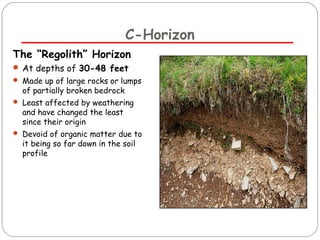
C-Horizon 
The “Regolith” Horizon 
 At depths of 30-48 feet 
 Made up of large rocks or lumps 
of partially broken bedrock 
 Least affected by weathering 
and have changed the least 
since their origin 
 Devoid of organic matter due to 
it being so far down in the soil 
profile
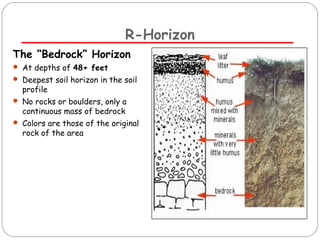
R-Horizon 
The “Bedrock” Horizon 
 At depths of 48+ feet 
 Deepest soil horizon in the soil 
profile 
 No rocks or boulders, only a 
continuous mass of bedrock 
 Colors are those of the original 
rock of the area
Soil Pollution 
Soil pollution is pollution of the earth's natural land surface 
by industrial, commercial, domestic and agricultural 
activities. 
The introduction of substances, biological organisms, or 
energy into the soil, resulting in a change of the soil quality, 
which is likely to affect the normal use of the soil or 
endangering public health and the living environment. 
Soil contaminants are spilled onto the surface through many 
different activities. 
Most of these are the result of accidents involving the 
vehicles that are transporting waste material from site of 
origin to a disposal site.
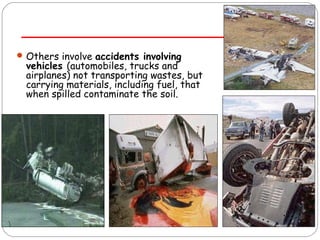
Others involve accidents involving 
vehicles (automobiles, trucks and 
airplanes) not transporting wastes, but 
carrying materials, including fuel, that 
when spilled contaminate the soil.
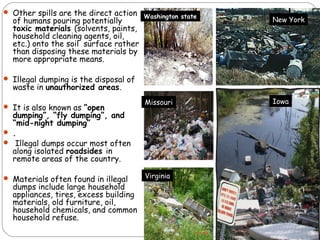
 Other spills are the direct action 
of humans pouring potentially 
toxic materials (solvents, paints, 
household cleaning agents, oil, 
etc.) onto the soil surface rather 
than disposing these materials by 
more appropriate means. 
 Illegal dumping is the disposal of 
waste in unauthorized areas. 
 It is also known as “open 
dumping”, “fly dumping”, and 
“mid-night dumping” 
 . 
 Illegal dumps occur most often 
along isolated roadsides in 
remote areas of the country. 
 Materials often found in illegal 
dumps include large household 
appliances, tires, excess building 
materials, old furniture, oil, 
household chemicals, and common 
household refuse. 
Washington state 
Missouri 
Virginia 
New York 
Iowa
Soil Pollution 
Information needed to clean up materials added to 
soil include: 
1) Kind of material - organic or inorganic - is the 
material biodegradable, is the material dangerous to 
animals and humans, 
2) how much material was added to the soil, will it 
overload the organisms in the soil; 
3) C:N ratio of the material, are additional 
nutrients needed ( N & P)
Soil Pollution 
4) Kind of Soil - will the soil be able to handle the 
material before groundwater is contaminated, 
5) Growing conditions for the soil organisms - is it 
too cold, too wet etc. 
6) How long has the material been on the site - is 
there evidence of environmental problems, is it 
undergoing decomposition. 
7) Immediate danger to people and the environment 
- Urgency of the situation.
Pollutants in Soil 
Naturally and synthetic materials affect the 
physical, chemical and biological properties of 
soil called “soil pollutants”- 
Chemical and metallic pollutants. 
Agro-chemicals. 
Radioactive material. 
Biological agents.
Pollutants in Soil 
 Chemical and metallic pollutants-hazardous 
effluent from 
 Different type industries 
 Metallic industries 
 Inorganic polluants (Fe, Cu, Co, Zn, Hg, As, Ni, Cd, 
Pb, alkalis and acid etc. 
 Agro-chemicals. 
 Pesticides, insecticides, weedicides and herbicides 
 Soil conditioners and fumigant 
 lead, arsenic, mercury, cobalt, cadmium, cyanide.
Pollutants in Soil 
 Radioactive material. 
 Nuclear devices 
 Biological agents. 
 Algae, fungi, bacteria, protozoa, viruses, 
nematodes, worm, 
 Industries waste, 
 Enter in air, water and food chain.
Sources of Soil Pollution 
 Industrial Wastes- 
 fly ash, 
 effluent i.e. organic compound, inorganic complexes, non-biodegradable 
 affects chemical and biological properties of soil. 
 Urban Waste- 
 Commercial and domestic waste 
 Solid waste- garbage and rubbish material-plastic, glasses, metallic 
cans, fibers, paper, rubbles, fuel residues, leaves, containers. 
 Radioactive Pollutants- 
 Nuclear dust and radioactive waste 
 Thorium, Uranium, Carbon (C-14) substance in soil, rock, water and air 
 Nuclear fission, heavy water (Sr-90, Cs-137) cause gama radiation.
 Agricultural Practices- 
 Pesticides, insecticides, weedicides and herbicides 
 Toxic metal-lead, arsenic, mercury, cobalt, cadmium, cyanide etc. 
 Chemical and Metallic Pollutants- 
 Different type chemical, metallic and fertilizer industries. 
 Organic and Inorganic polluants (Fe, Cu, Co, Zn, Hg, As, Ni, Cd, Pb, 
alkalis and acid etc.) 
 Affect soil texture, fertility and stabilization of soil. 
 Biological Agents- 
 Large quantity of animal, birds and human excreta cause land pollution 
 Leached in soil and cause chronic salts hazardous to plants and animal. 
 Pathogenic organism by naturally, 
 Pathogenic organism by human excreta, 
 Pathogenic organism by animal excreta.
 Soil Errosion- 
 Natural process of detachment and removal of loosened soil material by 
exothermic process (water, wind, ice or gravity). 
 Due to running of water, wind, ice or geological agent. 
 Agriculture development, construction and strip mining activities fertile top 
layer and lost & wasted soil. 
 Acid Rain- 
 Air pollution- motor vehicle, factory emission etc. cause acid rain (Nox- 
HNO3, Sox- H2SO4) 
 
 Other Sources- 
 Absorbtion of toxic metal 
 Soluble salts, Mining 
 Wastewater applied soils 
 Solid waste applied soils, 
 Food processing waste, 
 Sugarcan trash in field, 
 Muncipal garbage & composed etc.
Effect of Soil Pollution 
i) Health effects- There is a very large set of health 
consequences from exposure of soil contaminants 
especially volatile compounds. Health hazards depend on 
pollutant type, pathway of attack and vulnerability of 
the exposed population. 
ii) Ecosystem-The soil contaminants can alter 
metabolism of endemic microorganisms and arthropods 
resident in the soil environment, even at low 
concentrations and hence can affect primary food 
chain (in turn major consequences for predator or 
consumer species). Contaminants typically alter plant 
metabolism and reduce crop yield. This has given rise 
to soil erosion.
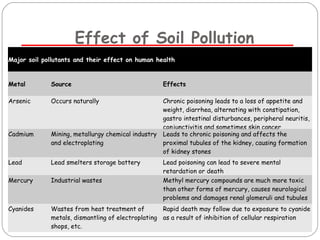
Effect of Soil Pollution 
Major soil pollutants and their effect on human health 
MMeettaall SSoouurrccee EEffffeeccttss 
Arsenic Occurs naturally Chronic poisoning leads to a loss of appetite and 
weight, diarrhea, alternating with constipation, 
gastro intestinal disturbances, peripheral neuritis, 
conjunctivitis and sometimes skin cancer 
Cadmium Mining, metallurgy chemical industry 
and electroplating 
Leads to chronic poisoning and affects the 
proximal tubules of the kidney, causing formation 
of kidney stones 
Lead Lead smelters storage battery Lead poisoning can lead to severe mental 
retardation or death 
Mercury Industrial wastes Methyl mercury compounds are much more toxic 
than other forms of mercury, causes neurological 
problems and damages renal glomeruli and tubules 
Cyanides Wastes from heat treatment of 
metals, dismantling of electroplating 
shops, etc. 
Rapid death may follow due to exposure to cyanide 
as a result of inhibition of cellular respiration
Control of Soil Pollution 
 The major concern of soil pollution is that there are many sensitive land uses 
where people are in direct contact with soil such as residence, parks, 
schools and playgrounds. Hence, it is necessary to cleanup or •remediates 
polluted soil. 
 The principal remedial strategies are: 
1. Aeration of soil at contaminated sites. 
2. Bioremediation, involving microbial digestion of certain organic chemicals, 
heavy metals and land farming, biostimulation and bioaugmentation of soil 
biota with flora. 
3. Extraction of groundwater or soil vapors with active electromechanically 
system (by using single extraction method or fractionation schemes). 
4. Excavate soil and remove it to a disposal site away from sensitive 
ecosystem contact.

Soil Pollution

  • 1.
    SOIL POLLUTION Lectureby- Dr. Rajendra Singh Thakur
  • 2.
    Soil •INTRODUCTION- •Theword “SOIL” is derived from Latin word “SOLUM” which means earthy material in which growth of plants takes place.
  • 3.
    Soil: Definition •Solid earth material that has been altered by physical, chemical and organic processes so that it can support rooted plant life. • Soil is mixture of rock particles, decomposing plant and animal materials, • Soil is the “stuff” plants grown in. • The soil contains different salts, minerals, organic substances, gases, water etc.
  • 4.
    Formation of Soil  Soil is the loose, weathered material on Earth's surface in which plants can grow.  Soil forms as rock is broken down by weathering and mixes with other materials on the surface.  Soil is constantly being formed wherever bedrock is exposed.  Bedrock is the solid layer of rock beneath the soil.  Bedrock gradually weathers into smaller and smaller particles that are the basic material of soil
  • 5.
    Factors of SoilFormation There are several factors that determine whether three layers of soil will form. Time Climate Type of rock Surface features of the region
  • 6.
    Time Time isone of the most important factors in soil formation. The longer a rock is exposed to the forces of weathering, the more it is broken down. Mature soil is formed if all three layers have had time to develop.
  • 7.
    Climate Climate isanother important factor in the formation of soil. In areas with heavy rainfall and warm temperatures, weathering takes place more rapidly. Heavy rainfall may wash much of the topsoil away. Since Organisms are more plentiful these areas, the soil is quickly replaced. They speed up the chemical and mechanical weathering of rocks.
  • 8.
    Type of Rock The type of rock in an area also affects soil formation. Some rocks do not weather as rapidly as other do. Rocks that do not break down easily do not form soil rapidly. In some climates it takes along time for granite to break down. So soil formation from granite is slow. But sandstone breaks easily and forms soil quickly.
  • 9.
    Surface Features ofRegion The surface features of the region also determine the speed at which soil is formed. On very steep slopes, rainwater running off the land erodes the soil and exposes rock to weathering.
  • 10.
    Soil Composition •Soil is a mixture of rock particles, minerals, decayed organic material, air and water. • The type of rock particles and minerals in any given soil depends on two factors: Bedrock that was weathered Type of weathering • Sand, silt, and clay make up the portion of soil that comes from weathered rock. • The decayed organic material in soil is humus. Humus is a dark-colored substance that forms as plant and animal remains decay. • Humus helps create spaces in soil for the air and water that plants must have
  • 11.
    Soil Components Soilsconsist of four major components: (1) mineral (or inorganic), (2) organic, (3) water, and (4) air. The relative proportions of these four soil components vary with soil type and climatic conditions. Review the approximate proportions (by volume) of the four soil components in a mineral soil under optimum conditions for plant growth.
  • 12.
    Soil Profile? A Soil Profile is a vertical cross-section of layers of soil found in a given area.  Soil is composed of distinct layer which are called soil horizons, which together from soil profile.  The soil profile are characteristic of mature soil.  Layers, varies in thickness, colors, texture, structure, acidity, porosity and composition.
  • 14.
    Soil Horizon? Soil horizons are the layers in a soil profile used to classify soil types.  Horizons based on color, texture, roots, structure, rock fragments, and any unique characteristic worth noting.  Master Soil Horizons are depicted by a capital letter in the order (from top down): O, A, E, B, C, and R
  • 15.
    Types of Horizon  Horizon O- The uppermost horizon of soil profile is called horizon-o liter zone.  Horizon A- Underlying the litter zone is the horizon A or top soil.  Horizon E- Small layer between A & B horizons  Horizon-B- It is dark colored and coir retextured it contains a little humus also.  Horizon-C- It contains weathered rock of parent.  Horizon-E- Deepest soil horizon in the soil profile
  • 16.
    Types of Horizon Partially decomposed organic material dominates Good mix of mineral and organic particles (mainly mineral) Silicate clays, iron oxides, aluminium oxides, and calcium carbonates accumulate (little organic matter) Least weathered part of the soil profile Regolith (above bedrock) May be transported (ie., can be distinct from parent material) http://www.physicalgeography.net EE HHoorriizzoonn mmaayy bbee pprreesseenntt ELUVIATION ILLUVIATION The exposed wall of a soil pit or road cut is called the soil profile
  • 18.
    O-Horizon The “OrganicMatter” Horizon  Surface-layer, at depths of 0-2 feet  Dark in color, soft in texture  Humus - rich organic material of plant and animal origin in a stage of decomposition  Leaf litter – leaves, needles, twigs, moss, lichens that are not decomposing  Several O-layers can occur in some soils, consisting only of O-horizons
  • 19.
    A-Horizon “Topsoil” or“Biomantle” Horizon  Topmost layer of mineral soil, at depths of 2-10 feet  Some humus present, darker in color than layers below  Biomantle - most biological productive layer; earthworms, fungi, and bacteria live this layer  Smallest and finest soil particles
  • 20.
    E-Horizon The “LeachingLayer” Horizon  Small layer between A & B horizons  At depths of 10-15 feet  Light in color, mainly sand & silt  Poor mineral and clay content due to leaching – the loss of water-retaining plant nutrients to the water table  Soil particles larger than in A horizon but smaller than in B horizon
  • 21.
    B-Horizon The “Subsoil”Horizon  At depths of 10-30 feet  Rich in clay and minerals like Fe & Al  Some organic material may reach here through leaching  Plant roots can extend into this layer  Red/brown in color due to oxides of Fe & clay
  • 22.
    C-Horizon The “Regolith”Horizon  At depths of 30-48 feet  Made up of large rocks or lumps of partially broken bedrock  Least affected by weathering and have changed the least since their origin  Devoid of organic matter due to it being so far down in the soil profile
  • 23.
    R-Horizon The “Bedrock”Horizon  At depths of 48+ feet  Deepest soil horizon in the soil profile  No rocks or boulders, only a continuous mass of bedrock  Colors are those of the original rock of the area
  • 24.
    Soil Pollution Soilpollution is pollution of the earth's natural land surface by industrial, commercial, domestic and agricultural activities. The introduction of substances, biological organisms, or energy into the soil, resulting in a change of the soil quality, which is likely to affect the normal use of the soil or endangering public health and the living environment. Soil contaminants are spilled onto the surface through many different activities. Most of these are the result of accidents involving the vehicles that are transporting waste material from site of origin to a disposal site.
  • 25.
    Others involve accidentsinvolving vehicles (automobiles, trucks and airplanes) not transporting wastes, but carrying materials, including fuel, that when spilled contaminate the soil.
  • 26.
     Other spillsare the direct action of humans pouring potentially toxic materials (solvents, paints, household cleaning agents, oil, etc.) onto the soil surface rather than disposing these materials by more appropriate means.  Illegal dumping is the disposal of waste in unauthorized areas.  It is also known as “open dumping”, “fly dumping”, and “mid-night dumping”  .  Illegal dumps occur most often along isolated roadsides in remote areas of the country.  Materials often found in illegal dumps include large household appliances, tires, excess building materials, old furniture, oil, household chemicals, and common household refuse. Washington state Missouri Virginia New York Iowa
  • 27.
    Soil Pollution Informationneeded to clean up materials added to soil include: 1) Kind of material - organic or inorganic - is the material biodegradable, is the material dangerous to animals and humans, 2) how much material was added to the soil, will it overload the organisms in the soil; 3) C:N ratio of the material, are additional nutrients needed ( N & P)
  • 28.
    Soil Pollution 4)Kind of Soil - will the soil be able to handle the material before groundwater is contaminated, 5) Growing conditions for the soil organisms - is it too cold, too wet etc. 6) How long has the material been on the site - is there evidence of environmental problems, is it undergoing decomposition. 7) Immediate danger to people and the environment - Urgency of the situation.
  • 29.
    Pollutants in Soil Naturally and synthetic materials affect the physical, chemical and biological properties of soil called “soil pollutants”- Chemical and metallic pollutants. Agro-chemicals. Radioactive material. Biological agents.
  • 30.
    Pollutants in Soil  Chemical and metallic pollutants-hazardous effluent from  Different type industries  Metallic industries  Inorganic polluants (Fe, Cu, Co, Zn, Hg, As, Ni, Cd, Pb, alkalis and acid etc.  Agro-chemicals.  Pesticides, insecticides, weedicides and herbicides  Soil conditioners and fumigant  lead, arsenic, mercury, cobalt, cadmium, cyanide.
  • 31.
    Pollutants in Soil  Radioactive material.  Nuclear devices  Biological agents.  Algae, fungi, bacteria, protozoa, viruses, nematodes, worm,  Industries waste,  Enter in air, water and food chain.
  • 32.
    Sources of SoilPollution  Industrial Wastes-  fly ash,  effluent i.e. organic compound, inorganic complexes, non-biodegradable  affects chemical and biological properties of soil.  Urban Waste-  Commercial and domestic waste  Solid waste- garbage and rubbish material-plastic, glasses, metallic cans, fibers, paper, rubbles, fuel residues, leaves, containers.  Radioactive Pollutants-  Nuclear dust and radioactive waste  Thorium, Uranium, Carbon (C-14) substance in soil, rock, water and air  Nuclear fission, heavy water (Sr-90, Cs-137) cause gama radiation.
  • 33.
     Agricultural Practices-  Pesticides, insecticides, weedicides and herbicides  Toxic metal-lead, arsenic, mercury, cobalt, cadmium, cyanide etc.  Chemical and Metallic Pollutants-  Different type chemical, metallic and fertilizer industries.  Organic and Inorganic polluants (Fe, Cu, Co, Zn, Hg, As, Ni, Cd, Pb, alkalis and acid etc.)  Affect soil texture, fertility and stabilization of soil.  Biological Agents-  Large quantity of animal, birds and human excreta cause land pollution  Leached in soil and cause chronic salts hazardous to plants and animal.  Pathogenic organism by naturally,  Pathogenic organism by human excreta,  Pathogenic organism by animal excreta.
  • 34.
     Soil Errosion-  Natural process of detachment and removal of loosened soil material by exothermic process (water, wind, ice or gravity).  Due to running of water, wind, ice or geological agent.  Agriculture development, construction and strip mining activities fertile top layer and lost & wasted soil.  Acid Rain-  Air pollution- motor vehicle, factory emission etc. cause acid rain (Nox- HNO3, Sox- H2SO4)   Other Sources-  Absorbtion of toxic metal  Soluble salts, Mining  Wastewater applied soils  Solid waste applied soils,  Food processing waste,  Sugarcan trash in field,  Muncipal garbage & composed etc.
  • 35.
    Effect of SoilPollution i) Health effects- There is a very large set of health consequences from exposure of soil contaminants especially volatile compounds. Health hazards depend on pollutant type, pathway of attack and vulnerability of the exposed population. ii) Ecosystem-The soil contaminants can alter metabolism of endemic microorganisms and arthropods resident in the soil environment, even at low concentrations and hence can affect primary food chain (in turn major consequences for predator or consumer species). Contaminants typically alter plant metabolism and reduce crop yield. This has given rise to soil erosion.
  • 36.
    Effect of SoilPollution Major soil pollutants and their effect on human health MMeettaall SSoouurrccee EEffffeeccttss Arsenic Occurs naturally Chronic poisoning leads to a loss of appetite and weight, diarrhea, alternating with constipation, gastro intestinal disturbances, peripheral neuritis, conjunctivitis and sometimes skin cancer Cadmium Mining, metallurgy chemical industry and electroplating Leads to chronic poisoning and affects the proximal tubules of the kidney, causing formation of kidney stones Lead Lead smelters storage battery Lead poisoning can lead to severe mental retardation or death Mercury Industrial wastes Methyl mercury compounds are much more toxic than other forms of mercury, causes neurological problems and damages renal glomeruli and tubules Cyanides Wastes from heat treatment of metals, dismantling of electroplating shops, etc. Rapid death may follow due to exposure to cyanide as a result of inhibition of cellular respiration
  • 37.
    Control of SoilPollution  The major concern of soil pollution is that there are many sensitive land uses where people are in direct contact with soil such as residence, parks, schools and playgrounds. Hence, it is necessary to cleanup or •remediates polluted soil.  The principal remedial strategies are: 1. Aeration of soil at contaminated sites. 2. Bioremediation, involving microbial digestion of certain organic chemicals, heavy metals and land farming, biostimulation and bioaugmentation of soil biota with flora. 3. Extraction of groundwater or soil vapors with active electromechanically system (by using single extraction method or fractionation schemes). 4. Excavate soil and remove it to a disposal site away from sensitive ecosystem contact.