UNIT 2: Classification of Composites
ME 434: Composite Materials
Course Instructor: Satadru Kashyap
satadru@tezu.ernet.in
SATADRU KASHYAP ME 434
(Mechanical Engineering, Tezpur University) (Composite Materials)
satadru@tezu.ernet.in
Department of Mechanical Engineering
Tezpur University
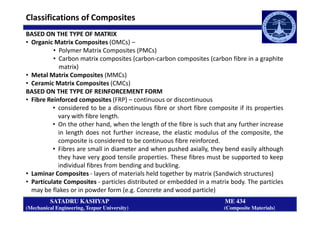
BASED ON THE TYPE OF MATRIX
• Organic Matrix Composites (OMCs) –
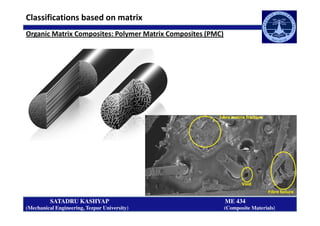
• Polymer Matrix Composites (PMCs)
• Carbon matrix composites (carbon-carbon composites (carbon fibre in a graphite
matrix)
• Metal Matrix Composites (MMCs)
• Ceramic Matrix Composites (CMCs)
BASED ON THE TYPE OF REINFORCEMENT FORM
• Fibre Reinforced composites (FRP) – continuous or discontinuous
• considered to be a discontinuous fibre or short fibre composite if its properties
vary with fibre length.
Classifications of Composites
SATADRU KASHYAP ME 434
(Mechanical Engineering, Tezpur University) (Composite Materials)
vary with fibre length.
• On the other hand, when the length of the fibre is such that any further increase
in length does not further increase, the elastic modulus of the composite, the
composite is considered to be continuous fibre reinforced.
• Fibres are small in diameter and when pushed axially, they bend easily although
they have very good tensile properties. These fibres must be supported to keep
individual fibres from bending and buckling.
• Laminar Composites - layers of materials held together by matrix (Sandwich structures)
• Particulate Composites - particles distributed or embedded in a matrix body. The particles
may be flakes or in powder form (e.g. Concrete and wood particle)
Classifications of Composites
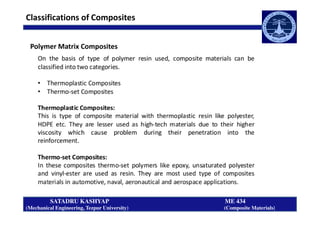
Polymer Matrix Composites
SATADRU KASHYAP ME 434
(Mechanical Engineering, Tezpur University) (Composite Materials)
Classifications of Composites
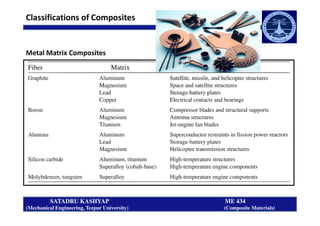
Metal Matrix Composites
SATADRU KASHYAP ME 434
(Mechanical Engineering, Tezpur University) (Composite Materials)
Classifications of Composites
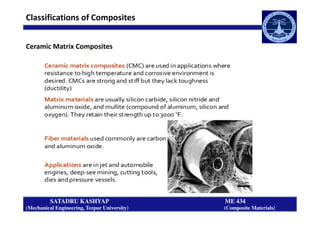
Ceramic Matrix Composites
SATADRU KASHYAP ME 434
(Mechanical Engineering, Tezpur University) (Composite Materials)
Organic Matrix Composites: Polymer Matrix Composites (PMC)
Classifications based on matrix
SATADRU KASHYAP ME 434
(Mechanical Engineering, Tezpur University) (Composite Materials)
Organic Matrix Composites: Polymer Matrix Composites (PMC)
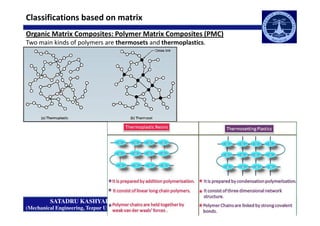
Two main kinds of polymers are thermosets and thermoplastics.
Classifications based on matrix
SATADRU KASHYAP ME 434
(Mechanical Engineering, Tezpur University) (Composite Materials)
Organic Matrix Composites: Polymer Matrix Composites (PMC)
Polymers make ideal materials as they can be processed easily, possess lightweight, and
desirable mechanical properties. Two main kinds of polymers are thermosets and
thermoplastics.
Thermosets have qualities such as a well-bonded three-dimensional molecular structure
after curing.
• They decompose instead of melting on hardening. Merely changing the basic
composition of the resin is enough to alter the conditions suitably for curing and
determine its other characteristics.
Classifications based on matrix
SATADRU KASHYAP ME 434
(Mechanical Engineering, Tezpur University) (Composite Materials)
determine its other characteristics.
• They can be retained in a partially cured condition too over prolonged periods of time,
rendering thermosets very flexible. Thus, they are most suited as matrix bases for
advanced fiber reinforced composites.
• Thermosets find wide ranging applications in the chopped fiber compositesform,
particularly, when a premixed compound with fibers happens to be the starting material
as in epoxy, polymer and phenolic polyamide resins.
• Thermoset resins are – epoxy, polyester, phenolic polyamide resins.
Polymer Matrix Composites (PMC): Thermosets
• Epoxy resins
• widely used in filament-wound composites and electrical circuit boards.
• reasonably stable to chemical attacks and are excellent adherents having slow
shrinkage during curing and no emission of volatile gases.
• These advantages make epoxies expensive.
• cannot be used above 140ºC (limiting their applications).
• Polyester resins
• easily accessible, cheap and used widely.
• stored at room temperature for long periods and the mere addition of a catalyst can
cure the matrix material within a short time.
Classifications based on matrix
SATADRU KASHYAP ME 434
(Mechanical Engineering, Tezpur University) (Composite Materials)
cure the matrix material within a short time.
• cured polyester is usually rigid or flexible and transparent.
• used in automobile and structural applications.
• withstand the variations of environment and stable against chemicals and can be
used up to about 75ºC or higher.
• compatibility with few glass fibers and can be used with variety of reinforced plastic.
• Aromatic Polyamides
• most sought after as the matrices of advanced fiber composites for structural
applications demanding long duration exposure for continuous service at around 200-
250ºC .
Polymer Matrix Composites (PMC):
Thermoplastics
• have one- or two-dimensional molecular structure and they tend to show an exaggerated
melting point at an elevated temperature.
• soften at elevated temperatures can be reversed to regain its properties during cooling,
facilitating applications of conventional techniques to mold the compounds.
• resins comprise an emerging group of composites and the main goal is to improve the
base properties of the resins which would extract the greatest functional advantages from
Classifications based on matrix
SATADRU KASHYAP ME 434
(Mechanical Engineering, Tezpur University) (Composite Materials)
base properties of the resins which would extract the greatest functional advantages from
them.
• Whether crystalline or amorphous, these resins possess the facility to alter their creep
over an extensive range of temperature.
• Reinforcement in such systems can increase the failure load as well as creep resistance.
Moreover, addition of filler raises the heat resistance.
Polymer Matrix Composites (PMC):
Thermoplastics
• Thermoplastics are: polyethylene, polystyrene, polyamides, nylons, and polypropylene.
• The advantages over thermosets -
• there are no chemical reactions involved, which often result in the release of gases or
heat.
• Manufacturing is limited by the time required for heating, shaping and cooling the
structures.
Classifications based on matrix
SATADRU KASHYAP ME 434
(Mechanical Engineering, Tezpur University) (Composite Materials)
• Thermoplastics resins are sold as molding compounds. Fiber reinforcement is apt for these
resins. Since the fibers are randomly dispersed, the reinforcement will be almost isotropic.
However, when subjected to moulding processes, they can be aligned directionally.
• Tend to lose their strength at elevated temperatures. However, their redeeming qualities
like rigidity, toughness and ability to avoid creep, place thermoplastics in the important
composite materials bracket.
• Used in automotive control panels, electronic products encasement etc.
Metal Matrix Composites (MMC)
Classifications based on matrix
SATADRU KASHYAP ME 434
(Mechanical Engineering, Tezpur University) (Composite Materials)
Metal Matrix Composites (MMC)
• Though generating a wide interest in research, are not as widely in use as plastic.
• High strength, fracture toughness and stiffness are offered by metal matrices when
compared to their polymer counterparts.
• Withstand elevated temperature in corrosive environment than polymer composites.
• Most metals and alloys - used as matrices. Hence, require reinforcement materials - stable
over a range of temperatures and non-reactive too.
• Guiding aspect for the choice depends on matrix material.
• Light metals (low strength) form the matrix while the reinforcements have high moduli.
Classifications based on matrix
SATADRU KASHYAP ME 434
(Mechanical Engineering, Tezpur University) (Composite Materials)
• Light metals (low strength) form the matrix while the reinforcements have high moduli.
• If metal matrix has high strength, they require even higher modulus reinforcements.
• Hence, light metals (Al, Ti, and Mg) are the popular matrix metals with their low density. e.g.
carbide in a metal matrix.
• The melting point, physical and mechanical properties of the composite at various
temperatures determine the service temperature of composites.
• Most metals, ceramics and compounds can be used with matrices of low melting point alloys.
As the melting points of matrix materials become high, the choice of reinforcements becomes
small.
Ceramic Matrix Composites (CMC)
• Ceramics- solid materials which exhibit strong ionic bonding (in some cases covalent bonding)
• High melting points, good corrosion resistance, stability at elevated temperatures and high
compressive strength - ceramic matrix materials used above 1500ºC (high temperature
applications). e.g. cermet, concrete.
• Most ceramic possess high modulus of elasticity and low tensile strain and hence addition of
reinforcements to improve their strength have proved futile. This is because at the stress
levels at which ceramics rupture, there is insufficient elongation of the matrix which keeps
composite from transferring an effective quantum of load to the reinforcement and the
Classifications based on matrix
SATADRU KASHYAP ME 434
(Mechanical Engineering, Tezpur University) (Composite Materials)
composite from transferring an effective quantum of load to the reinforcement and the
composite may fail unless the percentage of fiber volume is high enough. However, addition
of any high-strength fiber (as reinforcing material) to a weaker ceramic has not always been
successful and often the resultant composite has proved to be weaker.
• When ceramics have a higher thermal expansion coefficient than reinforcement materials,
the resultant composite is unlikely to have a superior level of strength. In that case, the
composite will develop stress within ceramic at the time of cooling resulting in microcracks
extending from fiber to fiber within the matrix. Microcracking can result in a composite with
lower tensile strength than that of the matrix.
Ceramic Matrix Composites (CMC)
• motivation to develop CMCs - to overcome the problems associated with the conventional
technical ceramics like alumina, silicon carbide, aluminium nitride, silicon nitride or zirconia –
they fracture easily under mechanical or thermo-mechanical loads because of cracks initiated
by small defects or scratches. The crack resistance is – like in glass – very low.
• Multi-strand fibres has drastically increased the crack resistance/ fracture toughness,
elongation and thermal shock resistance, and resulted in several new applications.
• Carbon (C), silicon carbide (SiC), alumina (Al2O3) and mullite (Al2O3–SiO2) fibres are most
widely used with the same matrix materials i.e. C, SiC, alumina and mullite.
Classifications based on matrix
SATADRU KASHYAP ME 434
(Mechanical Engineering, Tezpur University) (Composite Materials)
• CMC names include a combination of type of fibre/type of matrix. For example, C/C stands for
carbon-fibre-reinforced carbon (carbon/carbon), or C/SiC for carbon-fibre-reinforced silicon
carbide (commercially available CMCs are C/C, C/SiC, SiC/SiC and Al2O3/Al2O3).
• They differ from conventional ceramics in the following properties:
•Elongation to rupture up to 1%
•Strongly increased fracture toughness
•Extreme thermal shock resistance
•Improved dynamical load capability
•Anisotropic properties following the orientation of fibers
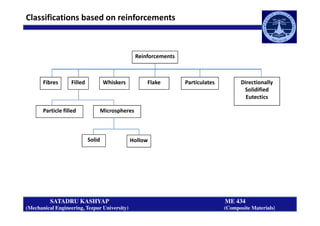
Classifications based on reinforcements
Reinforcements
Directionally
Solidified
Eutectics
Particulates
Flake
Whiskers
Filled
Fibres
Microspheres
Particle filled
SATADRU KASHYAP ME 434
(Mechanical Engineering, Tezpur University) (Composite Materials)
Hollow
Solid
Microspheres
Particle filled
What are reinforcements?
SATADRU KASHYAP ME 434
(Mechanical Engineering, Tezpur University) (Composite Materials)
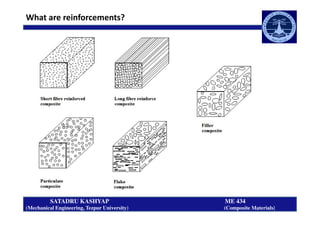
What are reinforcements?
• A strong, inert, woven and nonwoven fibrous material incorporated into the matrix to
improve its mechanical and physical properties e.g. asbestos, boron, carbon, metal or glass
or ceramic fibers, graphite, jute, sisal, whiskers, macerated fabrics, and synthetic fibers.
• reinforcement and filler difference
• reinforcement markedly improves tensile and flexural strength, whereas filler usually
does not To be effective, reinforcement must form a strong adhesive bond with resin.
• Role of the reinforcement
SATADRU KASHYAP ME 434
(Mechanical Engineering, Tezpur University) (Composite Materials)
• Role of the reinforcement
• increase the mechanical properties of the neat resin system. Different fibres have
different properties - affect the properties of the composite in different ways.
• However, individual fibres or fibre bundles can only be used on their own in a few processes
such as filament winding.
• For most other applications, the fibres need to be arranged into some form of sheet,
known as a fabric, to make handling possible.
What are reinforcements?
• Different ways for assembling fibres into sheets and the variety of fibre orientations –
• Lead to different types of fabrics, each of which has its own lead characteristics.
• Reinforcements for the composites can be fibers, fabrics particles or whiskers.
• Fibers are essentially characterized by one very long axis with other two axes either
often circular or near circular.
• Particles have no preferred orientation and so does their shape.
• Whiskers have a preferred shape but are small both in diameter and length as
SATADRU KASHYAP ME 434
(Mechanical Engineering, Tezpur University) (Composite Materials)
• Whiskers have a preferred shape but are small both in diameter and length as
compared to fibers.
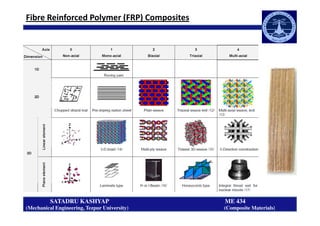
Fibre Reinforced Polymer (FRP) Composites
SATADRU KASHYAP ME 434
(Mechanical Engineering, Tezpur University) (Composite Materials)
Fibre Reinforced Polymer (FRP) Composites
• Fibres - important class of reinforcements, as they effectively transfer strength to the
matrix influencing and enhancing composite properties as desired.
• Glass fibers (earliest known reinforcing fibres)- Ceramic and metal fibers used
subsequently to make composites stiffer and more heat resistant.
• The performance of a fiber composite is judged by
• the length, shape, orientation, and composition of the fibers and the mechanical
properties of the matrix.
SATADRU KASHYAP ME 434
(Mechanical Engineering, Tezpur University) (Composite Materials)
• orientation of the fiber in the matrix (strength greatest along the longitudinal
directional & slightest shift in the angle of loading drastically reduce the strength)
• Since unidirectional loading is found in very few structures, a mix of fibre orientations is
given to withstand load from different angles (particularly more fibres in the direction
where load is expected to be the heaviest).
• Monolayer tapes consisting of continuous or discontinuous fibers can be oriented
unidirectional stacked into plies containing layers of filaments also oriented in the same
direction.
Fibre Reinforced Polymer (FRP) Composites
• Properties of angle-plied composites which are not quasi-isotropic may vary with the
number of plies and their orientations.
• Orientation of short fibers - random orientations by sprinkling on to given plane, addition
of matrix in liquid or solid state before or after the fiber deposition.
• Experience has shown that continuous fibers (or filaments) exhibit better orientation,
although it does not reflect in their performance.
• Mass production of filaments in different ways like winding, twisting, weaving and
SATADRU KASHYAP ME 434
(Mechanical Engineering, Tezpur University) (Composite Materials)
• Mass production of filaments in different ways like winding, twisting, weaving and
knitting, which exhibit the characteristics of a fabric.
• Organic and inorganic fibers are used to reinforce composites.
• Almost all organic fibers have low density, flexibility, and elasticity.
• Inorganic fibers (glass fibers, silicon carbide fibers, high silica and quartz fibers,
aluminina fibers, metal fibers and wires, graphite fibers, boron fibers, aramid fibers
and multiphase fibers) are of high modulus, high thermal stability and possess
greater rigidity than organic fibers.
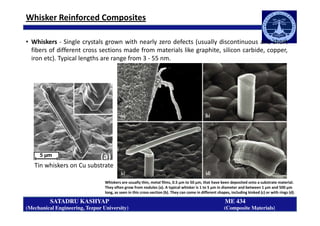
Whisker Reinforced Composites
• Whiskers - Single crystals grown with nearly zero defects (usually discontinuous and short
fibers of different cross sections made from materials like graphite, silicon carbide, copper,
iron etc). Typical lengths are range from 3 - 55 nm.
SATADRU KASHYAP ME 434
(Mechanical Engineering, Tezpur University) (Composite Materials)
Tin whiskers on Cu substrate
Whiskers are usually thin, metal films, 0.5 μm to 50 μm, that have been deposited onto a substrate material.
They often grow from nodules (a). A typical whisker is 1 to 5 μm in diameter and between 1 μm and 500 μm
long, as seen in this cross-section (b). They can come in different shapes, including kinked (c) or with rings (d).
Whisker Reinforced Composites
• Whiskers - Single crystals grown with nearly zero defects (usually discontinuous and short
fibers of different cross sections made from materials like graphite, silicon carbide, copper,
iron etc). Typical lengths are range from 3 - 55 nm.
• Whiskers differ from particles in that, whiskers have a definite length to width ratio (> 1)
with extraordinary strengths up to 7000 MPa.
• Whiskers (laboratory produced) Metal-whisker combination, strengthening the system at
high temperatures, has been demonstrated at the laboratory level.
• Since whiskers are fine, small sized materials and not easy to handle, it becomes a
hindrance in composite fabrication.
SATADRU KASHYAP ME 434
(Mechanical Engineering, Tezpur University) (Composite Materials)
hindrance in composite fabrication.
• Early research has shown that whisker strength varies inversely with effective diameter.
When whiskers were embedded in matrices, whiskers of diameter up to 2 - 10μm yielded
fairly good composites.
• Ceramic whiskers have high moduli, useful strengths and low densities. Specific strength and
specific modulus are very high and this makes them suitable for low weight structure
composites. They also resist temperature, mechanical damage and oxidation more than
metallic whiskers (which are denser than ceramic whiskers). However, they are not
commercially viable because they are damaged while handling.
Flakes Reinforced Composites
SATADRU KASHYAP ME 434
(Mechanical Engineering, Tezpur University) (Composite Materials)
Flakes Reinforced Composites
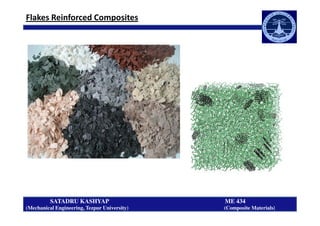
• Flakes are often used in place of fibers as they can be densely packed.
• Metal flakes that are in close contact with each other in polymer matrices can conduct
electricity or heat, while mica flakes and glass can resist both.
• Flakes are not expensive to produce and usually cost less than fibers.
• But limitations are - control of size, shape of flakes and defects in the end product.
• Glass flakes tend to have notches or cracks around the edges, which weaken the final
product. (also resistant to be lined up parallel to each other in a matrix, causing uneven
strength). They are usually set in matrices, or held together by a matrix with a glue-type
SATADRU KASHYAP ME 434
(Mechanical Engineering, Tezpur University) (Composite Materials)
strength). They are usually set in matrices, or held together by a matrix with a glue-type
binder.
• Advantages of flakes over fibers –
• Parallel flakes filled composites provide uniform mechanical properties in the same
plane as the flakes.
• While angle-plying is difficult in continuous fibers which need to approach isotropic
properties, it is not so in flakes.
• Flake composites have a higher theoretical modulus of elasticity than fiber reinforced
composites.
• They are relatively cheaper to produce and be handled in small quantities.
Filled Composites
• Addition of filer materials to plastic matrices to replace a portion of the matrix which would
enhance or change the properties of the composites. The fillers also enhance strength and
reduce weight in some cases.
• Fillers may be the main ingredient or an additional one in a composite. The filler particles
may be irregular structures, or have precise geometrical shapes like polyhedrons, short
fibers or spheres. They also occasionally impart colour or opacity to the composite which
they fill.
• As inert additives, fillers can change almost any basic resin characteristic in all directions
SATADRU KASHYAP ME 434
(Mechanical Engineering, Tezpur University) (Composite Materials)
• As inert additives, fillers can change almost any basic resin characteristic in all directions
required, to surpass many limitations of basic resins. The final composite properties can be
affected by the shape, surface treatment, blend of particle types, size of the particle in the
filler material and the size distribution.
• Filled plastics tend to behave like two different constituents. They do not alloy and accept
the bonding (they desist from interacting chemically with each other).
• Although the matrix forms the bulk of the composite, the filler material is also used in such
great quantities relatively that it becomes the rudimentary constituent.
Filled Composites
• The benefits of fillers - increase stiffness, thermal
resistance, stability, strength and abrasion resistance,
porosity and a favorable coefficient of thermal
expansion.
• Disadvantages - methods of fabrication are very limited
and the curing of some resins is greatly inhibited, shorten
the life span of some resins, weaken a few composites.
• Fillers produced from powders are also considered as
SATADRU KASHYAP ME 434
(Mechanical Engineering, Tezpur University) (Composite Materials)
• Fillers produced from powders are also considered as
particulate composite.
• In a porous or spongy composite, metal impregnates are
used to improve strength or tolerance of the matrix.
Metal casting, graphite, powder metallurgy parts and
ceramics belong to this class of filled composites.
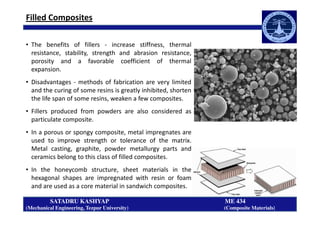
• In the honeycomb structure, sheet materials in the
hexagonal shapes are impregnated with resin or foam
and are used as a core material in sandwich composites.
Microsphere Composites
SATADRU KASHYAP ME 434
(Mechanical Engineering, Tezpur University) (Composite Materials)
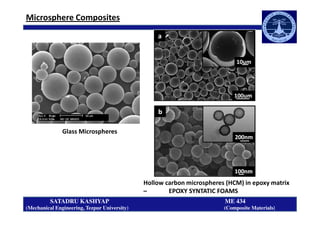
Glass Microspheres
Hollow carbon microspheres (HCM) in epoxy matrix
– EPOXY SYNTATIC FOAMS
Microsphere Composites
• Microspheres - useful fillers due to specific gravity, stable particle size, strength and
controlled density - modify products without compromising profits or physical properties.
• Solid glass microspheres are most suitable for plastics.
• Microspheres coated with a binding agent - bonds btween sphere’s surface and resin.
This increases the bonding strength and basically removes absorption of
contaminants/moisture (reduce attraction between particles).
• Solid Microspheres have relatively low density, and therefore, influence the commercial
value and weight of the finished product.
• Hollow microspheres
SATADRU KASHYAP ME 434
(Mechanical Engineering, Tezpur University) (Composite Materials)
• Hollow microspheres
• essentially silicate based, made at controlled specific gravity.
• larger than solid glass spheres, used in polymers and have wider range of particle sizes.
• Commercially, silicate-based hollow microspheres with different compositions using
organic compounds are also available. Due to this modification, they are less sensitive
to moisture (reduce attraction between particles) - vital in highly filled polymer
composites as viscosity increase constraints limit filler loading.
Microsphere Composites
• Earlier used in thermosetting resin. Now, several new strong spheres are available and they
are at least 5 times stronger than hollow microspheres in static crush strength and 4 times
long lasting in shear.
• Recently, ceramic alumino-silicate microspheres have been used in thermoplastic systems
• greater strength and higher density of this system in relation to siliceous microspheres
and their abrasion resistance make them suitable for high pressure applications.
• Hollow microspheres have a lower specific gravity than the pure resin.
• find wide applications in aerospace and automotive industries where weight reduction
SATADRU KASHYAP ME 434
(Mechanical Engineering, Tezpur University) (Composite Materials)
• find wide applications in aerospace and automotive industries where weight reduction
for energy conservation is one of the main considerations.
• Microspheres, whether solid or hollow, due to their spherical shape behave like minute ball
bearing, and hence, they give better flow properties.
• They also distribute stress uniformly throughout resin matrices.
• In spherical particles, the ratio of surface area to volume is minimal (smallest).
• In resin-rich surfaces of reinforced systems, the microspheres which are free of
orientation and sharp edges are capable of producing smooth surfaces.
Particulate reinforced Composites
• Microstructures of metal and ceramics composites, which show particles of one phase
scattered in the matrix, are known as particle reinforced composites.
• Square, triangular, irregular and round shapes of reinforcement are known, but the
particle dimensions are observed to be more or less equal.
• The size and volume concentration of the dispersant distinguishes particle reinforced
composites from dispersion strengthened composites.
• The dispersed size in particulate composites is of the order of a few microns and volume
concentration is greater than 28%.
• Particle reinforced composite - particle-matrix interaction do not occur at atomic or
SATADRU KASHYAP ME 434
(Mechanical Engineering, Tezpur University) (Composite Materials)
• Particle reinforced composite - particle-matrix interaction do not occur at atomic or
molecular level. Particles harder and stiffer than matrix – hence, tend to bear the load.
Degree of reinforcement depends on strong matrix particle bonding. e.g.. Concrete.
• Dispersion strengthened composites – particles smaller (diameter 0.01 - 0.1 x 10⁻⁶ m). Particle
matrix interactions that lead to strengthening occur on atomic level. The matrix bears the
major portion of load. While dispersed particles hinder motion of dislocations. Thus plastic
deformation is restricted such that yield and tensile strength as well as hardness improve. e.g..
thoria dispersed nickel.
• The composite’s strength depends on - diameter of the particles, the inter-particle spacing,
and the volume fraction of the reinforcement.
Cermets/Ceramal:
• Cermet – ‘ceramic’ and ‘metal’ composite.
• designed to have the optimal properties of both ceramic (high temperature resistance
and hardness) and metal (the ability to undergo plastic deformation). The metal (Ni, Mo,
Co etc.) used as a binder for an oxide, boride, carbide, or alumina.
• Cermets are usually less than 20% metal by volume – used in
• manufacture of resistors (potentiometers), capacitors etc - experience high temperatures.
• spacecraft shielding (as they resist the high velocity impacts of micrometeoroids and
orbital debris better than Al and other metals.
SATADRU KASHYAP ME 434
(Mechanical Engineering, Tezpur University) (Composite Materials)
orbital debris better than Al and other metals.
• vacuum tube coatings of solar hot water systems.
• material for fillings and prostheses.
• machining of cutting tools. Titanium nitride (TiN), titanium carbonitride (TiCN), titanium
carbide (TiC)
• Cermet are usually produced by -
• using power metallurgy techniques (ceramic and metal powder mixed and sintered).
• Impregnation of a porous ceramic structure with a metallic matrix binder.
• coating in powder form which is sprayed through a gas flame and fused to a base
material.
Directionally solidified eutectics:
• Directional solidification of alloys is adopted to produce in-situ fibers. They are really a part of
the alloy being precipitated from the melt, while the alloy is solidifying.
• This comprises eutectic alloys (Mixture of two or more components in such proportion that
their combined melting point is the lowest attainable) wherein the molten material
degenerates to form many phases at a steady temperature.
• When the reaction is carried out after ensuring the solidifying phases, directionally solidified
eutectics result.
• During the solidification of alloy, crystals nucleate from the mold or some relatively cooler
SATADRU KASHYAP ME 434
(Mechanical Engineering, Tezpur University) (Composite Materials)
• During the solidification of alloy, crystals nucleate from the mold or some relatively cooler
region. A structure with many crystalline particles or grains results from this and grows into
each other. When composites are unidirectionally solidified, random coalescing is not allowed
to occur.
• E.g. Al2O3-YSZ (Aluminium oxide – Yttria stabilized Zirconia), Al2O3-GdAlO3 (GAP)) - dental
porcelain.
• Gd - gadolinium
Role and Selection of Reinforcements:
• Compatibility with matrix material, thermal stability, density, melting temperature etc.
• Efficiency of discontinuously reinforced composites - dependent on tensile strength and
density of reinforcing phases.
• difference between the coefficients of thermal expansion of the matrix and reinforcement -
composites used in thermal cycling application.
• The manufacturing process selected and the reinforcement affects the crystal structure.
• In particulate/whisker reinforced composites, the matrix (major load bearing constituent).
Role of the reinforcement - strengthen and stiffen the composite through prevention of matrix
SATADRU KASHYAP ME 434
(Mechanical Engineering, Tezpur University) (Composite Materials)
Role of the reinforcement - strengthen and stiffen the composite through prevention of matrix
deformation by mechanical restraint. This restraint is generally a function of the ratio of inter-
particle spacing to particle diameter.
• In continuous fiber reinforced composites, the reinforcement (principal load-bearing
constituent). The matrix serves to hold the reinforcing fibers together and transfer as well as
distribute the load.
• Discontinuous fiber reinforced composites - properties between continuous fiber and
particulate reinforced composites.
• Addition of reinforcement increases the strength, stiffness and temperature capability.
• Reduce density of composite if the matrix material has high density.
Role and Selection of Matrix:
• The matrix provides support for the fibres and assists them in carrying the loads. It also
provides stability to the composite material. Resin matrix system acts as a binding agent in a
structural component in which the fibres are embedded.
• When too much resin is used, the part is classified as resin rich. On the other hand, if there is
too little resin, the part is called resin starved.
• A resin rich part is more susceptible to cracking due to lack of fibre support, whereas a
resin starved part is weaker because of void areas and the fact that fibres are not held
together and they are not well supported.
• In case of MMCs, thermodynamically stable dispersoids (particles) are essential for high
SATADRU KASHYAP ME 434
(Mechanical Engineering, Tezpur University) (Composite Materials)
• In case of MMCs, thermodynamically stable dispersoids (particles) are essential for high
temperature applications.
• done using an alloy-matrix (alloy particles in a metal matrix) system in which solid state
diffusivity, interfacial energies and elemental solubility are minimized, in turn reducing
interfacial reactions.
• Al and Mg alloys matrices widely used due to low density and high thermal conductivity.
• Additionally, composites with low alloying additions to the matrix result in attractive
combinations of ductility, toughness and strength.
• alloying elements (usually used as grain refiners)may form coarse inter-metallic
compounds during consolidation, thus, reducing the tensile properties of the composite.
Role and Selection of Matrix:
• The choice of a matrix is dictated by - continuously or discontinuously reinforced fibres.
• Continuous fibers - transfer of load to the reinforcing fibres (hence composite strength will be
governed by the fiber strength.
• The role of matrix - provide efficient transfer of load to the fibers and blunt cracks in the
event that fiber failure occurs (matrix used for toughness than strength). Hence, lower
strength, ductile, and tough matrix may be utilized in continuous reinforced composites.
• Discontinuous reinforced composites - the matrix may govern composite strength.
• Then, the choice of matrix will be influenced by consideration of the required composite
strength and higher strength matrix may be required.
SATADRU KASHYAP ME 434
(Mechanical Engineering, Tezpur University) (Composite Materials)
strength and higher strength matrix may be required.
• Choice of the matrix also include - potential reinforcement/matrix reactions (during
processing or in service - degraded composite), thermal stresses (thermal mismatch between
reinforcements and matrix), and matrix fatigue behavior under cyclic conditions.
• Thermal mismatch - a large melting temperature difference may result in matrix creep while
the reinforcements remain elastic, even at temperatures approaching the matrix melting
point.
• However, creep in both the matrix and reinforcement must be considered when there is a
small melting point difference in the composite.
Functions of Matrix:
• Holds the fibres together.
• Protects the fibres from environment.
• Distributes the loads evenly between fibres so that all fibres are subjected to the same
amount of strain.
• Enhances transverse properties of a laminate.
• Improves impact and fracture resistance of a component.
• Avoid propagation of crack growth through the fibres by providing alternate failure path along
the interface between the fibres and the matrix.
SATADRU KASHYAP ME 434
(Mechanical Engineering, Tezpur University) (Composite Materials)
the interface between the fibres and the matrix.
• Carry inter-laminar shear (design consideration for structures under bending loads); in-plane
shear strength (under torsion loads)
• Minor role - in the tensile load-carrying capacity of a composite structure.
• Provide lateral support against the possibility of fibre buckling under compression loading.
• Finally, the processing ability and defects in a composite material depend strongly on the
physical and thermal characteristics, such as viscosity, melting point, and curing temperature
of the matrix.
Desired Functions of Matrix:
• Reduced moisture absorption.
• Low shrinkage.
• Low coefficient of thermal expansion.
• Good flow characteristics so that it penetrates the fibre bundles completely and eliminates
voids during the compacting/curing process.
• Reasonable strength, modulus and elongation (elongation should be greater than fibre).
• Must be elastic to transfer load to fibres.
• Strength at elevated temperature (depending on application).
SATADRU KASHYAP ME 434
(Mechanical Engineering, Tezpur University) (Composite Materials)
• Strength at elevated temperature (depending on application).
• Low temperature capability (depending on application).
• Excellent chemical resistance (depending on application).
• Should be easily fabricated into the final composite shape.
• Dimensional stability(maintains its shape).

Classification of-composites

  • 1.
    UNIT 2: Classificationof Composites ME 434: Composite Materials Course Instructor: Satadru Kashyap satadru@tezu.ernet.in SATADRU KASHYAP ME 434 (Mechanical Engineering, Tezpur University) (Composite Materials) satadru@tezu.ernet.in Department of Mechanical Engineering Tezpur University
  • 2.
    BASED ON THETYPE OF MATRIX • Organic Matrix Composites (OMCs) – • Polymer Matrix Composites (PMCs) • Carbon matrix composites (carbon-carbon composites (carbon fibre in a graphite matrix) • Metal Matrix Composites (MMCs) • Ceramic Matrix Composites (CMCs) BASED ON THE TYPE OF REINFORCEMENT FORM • Fibre Reinforced composites (FRP) – continuous or discontinuous • considered to be a discontinuous fibre or short fibre composite if its properties vary with fibre length. Classifications of Composites SATADRU KASHYAP ME 434 (Mechanical Engineering, Tezpur University) (Composite Materials) vary with fibre length. • On the other hand, when the length of the fibre is such that any further increase in length does not further increase, the elastic modulus of the composite, the composite is considered to be continuous fibre reinforced. • Fibres are small in diameter and when pushed axially, they bend easily although they have very good tensile properties. These fibres must be supported to keep individual fibres from bending and buckling. • Laminar Composites - layers of materials held together by matrix (Sandwich structures) • Particulate Composites - particles distributed or embedded in a matrix body. The particles may be flakes or in powder form (e.g. Concrete and wood particle)
  • 3.
    Classifications of Composites PolymerMatrix Composites SATADRU KASHYAP ME 434 (Mechanical Engineering, Tezpur University) (Composite Materials)
  • 4.
    Classifications of Composites MetalMatrix Composites SATADRU KASHYAP ME 434 (Mechanical Engineering, Tezpur University) (Composite Materials)
  • 5.
    Classifications of Composites CeramicMatrix Composites SATADRU KASHYAP ME 434 (Mechanical Engineering, Tezpur University) (Composite Materials)
  • 6.
    Organic Matrix Composites:Polymer Matrix Composites (PMC) Classifications based on matrix SATADRU KASHYAP ME 434 (Mechanical Engineering, Tezpur University) (Composite Materials)
  • 7.
    Organic Matrix Composites:Polymer Matrix Composites (PMC) Two main kinds of polymers are thermosets and thermoplastics. Classifications based on matrix SATADRU KASHYAP ME 434 (Mechanical Engineering, Tezpur University) (Composite Materials)
  • 8.
    Organic Matrix Composites:Polymer Matrix Composites (PMC) Polymers make ideal materials as they can be processed easily, possess lightweight, and desirable mechanical properties. Two main kinds of polymers are thermosets and thermoplastics. Thermosets have qualities such as a well-bonded three-dimensional molecular structure after curing. • They decompose instead of melting on hardening. Merely changing the basic composition of the resin is enough to alter the conditions suitably for curing and determine its other characteristics. Classifications based on matrix SATADRU KASHYAP ME 434 (Mechanical Engineering, Tezpur University) (Composite Materials) determine its other characteristics. • They can be retained in a partially cured condition too over prolonged periods of time, rendering thermosets very flexible. Thus, they are most suited as matrix bases for advanced fiber reinforced composites. • Thermosets find wide ranging applications in the chopped fiber compositesform, particularly, when a premixed compound with fibers happens to be the starting material as in epoxy, polymer and phenolic polyamide resins. • Thermoset resins are – epoxy, polyester, phenolic polyamide resins.
  • 9.
    Polymer Matrix Composites(PMC): Thermosets • Epoxy resins • widely used in filament-wound composites and electrical circuit boards. • reasonably stable to chemical attacks and are excellent adherents having slow shrinkage during curing and no emission of volatile gases. • These advantages make epoxies expensive. • cannot be used above 140ºC (limiting their applications). • Polyester resins • easily accessible, cheap and used widely. • stored at room temperature for long periods and the mere addition of a catalyst can cure the matrix material within a short time. Classifications based on matrix SATADRU KASHYAP ME 434 (Mechanical Engineering, Tezpur University) (Composite Materials) cure the matrix material within a short time. • cured polyester is usually rigid or flexible and transparent. • used in automobile and structural applications. • withstand the variations of environment and stable against chemicals and can be used up to about 75ºC or higher. • compatibility with few glass fibers and can be used with variety of reinforced plastic. • Aromatic Polyamides • most sought after as the matrices of advanced fiber composites for structural applications demanding long duration exposure for continuous service at around 200- 250ºC .
  • 10.
    Polymer Matrix Composites(PMC): Thermoplastics • have one- or two-dimensional molecular structure and they tend to show an exaggerated melting point at an elevated temperature. • soften at elevated temperatures can be reversed to regain its properties during cooling, facilitating applications of conventional techniques to mold the compounds. • resins comprise an emerging group of composites and the main goal is to improve the base properties of the resins which would extract the greatest functional advantages from Classifications based on matrix SATADRU KASHYAP ME 434 (Mechanical Engineering, Tezpur University) (Composite Materials) base properties of the resins which would extract the greatest functional advantages from them. • Whether crystalline or amorphous, these resins possess the facility to alter their creep over an extensive range of temperature. • Reinforcement in such systems can increase the failure load as well as creep resistance. Moreover, addition of filler raises the heat resistance.
  • 11.
    Polymer Matrix Composites(PMC): Thermoplastics • Thermoplastics are: polyethylene, polystyrene, polyamides, nylons, and polypropylene. • The advantages over thermosets - • there are no chemical reactions involved, which often result in the release of gases or heat. • Manufacturing is limited by the time required for heating, shaping and cooling the structures. Classifications based on matrix SATADRU KASHYAP ME 434 (Mechanical Engineering, Tezpur University) (Composite Materials) • Thermoplastics resins are sold as molding compounds. Fiber reinforcement is apt for these resins. Since the fibers are randomly dispersed, the reinforcement will be almost isotropic. However, when subjected to moulding processes, they can be aligned directionally. • Tend to lose their strength at elevated temperatures. However, their redeeming qualities like rigidity, toughness and ability to avoid creep, place thermoplastics in the important composite materials bracket. • Used in automotive control panels, electronic products encasement etc.
  • 12.
    Metal Matrix Composites(MMC) Classifications based on matrix SATADRU KASHYAP ME 434 (Mechanical Engineering, Tezpur University) (Composite Materials)
  • 13.
    Metal Matrix Composites(MMC) • Though generating a wide interest in research, are not as widely in use as plastic. • High strength, fracture toughness and stiffness are offered by metal matrices when compared to their polymer counterparts. • Withstand elevated temperature in corrosive environment than polymer composites. • Most metals and alloys - used as matrices. Hence, require reinforcement materials - stable over a range of temperatures and non-reactive too. • Guiding aspect for the choice depends on matrix material. • Light metals (low strength) form the matrix while the reinforcements have high moduli. Classifications based on matrix SATADRU KASHYAP ME 434 (Mechanical Engineering, Tezpur University) (Composite Materials) • Light metals (low strength) form the matrix while the reinforcements have high moduli. • If metal matrix has high strength, they require even higher modulus reinforcements. • Hence, light metals (Al, Ti, and Mg) are the popular matrix metals with their low density. e.g. carbide in a metal matrix. • The melting point, physical and mechanical properties of the composite at various temperatures determine the service temperature of composites. • Most metals, ceramics and compounds can be used with matrices of low melting point alloys. As the melting points of matrix materials become high, the choice of reinforcements becomes small.
  • 14.
    Ceramic Matrix Composites(CMC) • Ceramics- solid materials which exhibit strong ionic bonding (in some cases covalent bonding) • High melting points, good corrosion resistance, stability at elevated temperatures and high compressive strength - ceramic matrix materials used above 1500ºC (high temperature applications). e.g. cermet, concrete. • Most ceramic possess high modulus of elasticity and low tensile strain and hence addition of reinforcements to improve their strength have proved futile. This is because at the stress levels at which ceramics rupture, there is insufficient elongation of the matrix which keeps composite from transferring an effective quantum of load to the reinforcement and the Classifications based on matrix SATADRU KASHYAP ME 434 (Mechanical Engineering, Tezpur University) (Composite Materials) composite from transferring an effective quantum of load to the reinforcement and the composite may fail unless the percentage of fiber volume is high enough. However, addition of any high-strength fiber (as reinforcing material) to a weaker ceramic has not always been successful and often the resultant composite has proved to be weaker. • When ceramics have a higher thermal expansion coefficient than reinforcement materials, the resultant composite is unlikely to have a superior level of strength. In that case, the composite will develop stress within ceramic at the time of cooling resulting in microcracks extending from fiber to fiber within the matrix. Microcracking can result in a composite with lower tensile strength than that of the matrix.
  • 15.
    Ceramic Matrix Composites(CMC) • motivation to develop CMCs - to overcome the problems associated with the conventional technical ceramics like alumina, silicon carbide, aluminium nitride, silicon nitride or zirconia – they fracture easily under mechanical or thermo-mechanical loads because of cracks initiated by small defects or scratches. The crack resistance is – like in glass – very low. • Multi-strand fibres has drastically increased the crack resistance/ fracture toughness, elongation and thermal shock resistance, and resulted in several new applications. • Carbon (C), silicon carbide (SiC), alumina (Al2O3) and mullite (Al2O3–SiO2) fibres are most widely used with the same matrix materials i.e. C, SiC, alumina and mullite. Classifications based on matrix SATADRU KASHYAP ME 434 (Mechanical Engineering, Tezpur University) (Composite Materials) • CMC names include a combination of type of fibre/type of matrix. For example, C/C stands for carbon-fibre-reinforced carbon (carbon/carbon), or C/SiC for carbon-fibre-reinforced silicon carbide (commercially available CMCs are C/C, C/SiC, SiC/SiC and Al2O3/Al2O3). • They differ from conventional ceramics in the following properties: •Elongation to rupture up to 1% •Strongly increased fracture toughness •Extreme thermal shock resistance •Improved dynamical load capability •Anisotropic properties following the orientation of fibers
  • 16.
    Classifications based onreinforcements Reinforcements Directionally Solidified Eutectics Particulates Flake Whiskers Filled Fibres Microspheres Particle filled SATADRU KASHYAP ME 434 (Mechanical Engineering, Tezpur University) (Composite Materials) Hollow Solid Microspheres Particle filled
  • 17.
    What are reinforcements? SATADRUKASHYAP ME 434 (Mechanical Engineering, Tezpur University) (Composite Materials)
  • 18.
    What are reinforcements? •A strong, inert, woven and nonwoven fibrous material incorporated into the matrix to improve its mechanical and physical properties e.g. asbestos, boron, carbon, metal or glass or ceramic fibers, graphite, jute, sisal, whiskers, macerated fabrics, and synthetic fibers. • reinforcement and filler difference • reinforcement markedly improves tensile and flexural strength, whereas filler usually does not To be effective, reinforcement must form a strong adhesive bond with resin. • Role of the reinforcement SATADRU KASHYAP ME 434 (Mechanical Engineering, Tezpur University) (Composite Materials) • Role of the reinforcement • increase the mechanical properties of the neat resin system. Different fibres have different properties - affect the properties of the composite in different ways. • However, individual fibres or fibre bundles can only be used on their own in a few processes such as filament winding. • For most other applications, the fibres need to be arranged into some form of sheet, known as a fabric, to make handling possible.
  • 19.
    What are reinforcements? •Different ways for assembling fibres into sheets and the variety of fibre orientations – • Lead to different types of fabrics, each of which has its own lead characteristics. • Reinforcements for the composites can be fibers, fabrics particles or whiskers. • Fibers are essentially characterized by one very long axis with other two axes either often circular or near circular. • Particles have no preferred orientation and so does their shape. • Whiskers have a preferred shape but are small both in diameter and length as SATADRU KASHYAP ME 434 (Mechanical Engineering, Tezpur University) (Composite Materials) • Whiskers have a preferred shape but are small both in diameter and length as compared to fibers.
  • 20.
    Fibre Reinforced Polymer(FRP) Composites SATADRU KASHYAP ME 434 (Mechanical Engineering, Tezpur University) (Composite Materials)
  • 21.
    Fibre Reinforced Polymer(FRP) Composites • Fibres - important class of reinforcements, as they effectively transfer strength to the matrix influencing and enhancing composite properties as desired. • Glass fibers (earliest known reinforcing fibres)- Ceramic and metal fibers used subsequently to make composites stiffer and more heat resistant. • The performance of a fiber composite is judged by • the length, shape, orientation, and composition of the fibers and the mechanical properties of the matrix. SATADRU KASHYAP ME 434 (Mechanical Engineering, Tezpur University) (Composite Materials) • orientation of the fiber in the matrix (strength greatest along the longitudinal directional & slightest shift in the angle of loading drastically reduce the strength) • Since unidirectional loading is found in very few structures, a mix of fibre orientations is given to withstand load from different angles (particularly more fibres in the direction where load is expected to be the heaviest). • Monolayer tapes consisting of continuous or discontinuous fibers can be oriented unidirectional stacked into plies containing layers of filaments also oriented in the same direction.
  • 22.
    Fibre Reinforced Polymer(FRP) Composites • Properties of angle-plied composites which are not quasi-isotropic may vary with the number of plies and their orientations. • Orientation of short fibers - random orientations by sprinkling on to given plane, addition of matrix in liquid or solid state before or after the fiber deposition. • Experience has shown that continuous fibers (or filaments) exhibit better orientation, although it does not reflect in their performance. • Mass production of filaments in different ways like winding, twisting, weaving and SATADRU KASHYAP ME 434 (Mechanical Engineering, Tezpur University) (Composite Materials) • Mass production of filaments in different ways like winding, twisting, weaving and knitting, which exhibit the characteristics of a fabric. • Organic and inorganic fibers are used to reinforce composites. • Almost all organic fibers have low density, flexibility, and elasticity. • Inorganic fibers (glass fibers, silicon carbide fibers, high silica and quartz fibers, aluminina fibers, metal fibers and wires, graphite fibers, boron fibers, aramid fibers and multiphase fibers) are of high modulus, high thermal stability and possess greater rigidity than organic fibers.
  • 23.
    Whisker Reinforced Composites •Whiskers - Single crystals grown with nearly zero defects (usually discontinuous and short fibers of different cross sections made from materials like graphite, silicon carbide, copper, iron etc). Typical lengths are range from 3 - 55 nm. SATADRU KASHYAP ME 434 (Mechanical Engineering, Tezpur University) (Composite Materials) Tin whiskers on Cu substrate Whiskers are usually thin, metal films, 0.5 μm to 50 μm, that have been deposited onto a substrate material. They often grow from nodules (a). A typical whisker is 1 to 5 μm in diameter and between 1 μm and 500 μm long, as seen in this cross-section (b). They can come in different shapes, including kinked (c) or with rings (d).
  • 24.
    Whisker Reinforced Composites •Whiskers - Single crystals grown with nearly zero defects (usually discontinuous and short fibers of different cross sections made from materials like graphite, silicon carbide, copper, iron etc). Typical lengths are range from 3 - 55 nm. • Whiskers differ from particles in that, whiskers have a definite length to width ratio (> 1) with extraordinary strengths up to 7000 MPa. • Whiskers (laboratory produced) Metal-whisker combination, strengthening the system at high temperatures, has been demonstrated at the laboratory level. • Since whiskers are fine, small sized materials and not easy to handle, it becomes a hindrance in composite fabrication. SATADRU KASHYAP ME 434 (Mechanical Engineering, Tezpur University) (Composite Materials) hindrance in composite fabrication. • Early research has shown that whisker strength varies inversely with effective diameter. When whiskers were embedded in matrices, whiskers of diameter up to 2 - 10μm yielded fairly good composites. • Ceramic whiskers have high moduli, useful strengths and low densities. Specific strength and specific modulus are very high and this makes them suitable for low weight structure composites. They also resist temperature, mechanical damage and oxidation more than metallic whiskers (which are denser than ceramic whiskers). However, they are not commercially viable because they are damaged while handling.
  • 25.
    Flakes Reinforced Composites SATADRUKASHYAP ME 434 (Mechanical Engineering, Tezpur University) (Composite Materials)
  • 26.
    Flakes Reinforced Composites •Flakes are often used in place of fibers as they can be densely packed. • Metal flakes that are in close contact with each other in polymer matrices can conduct electricity or heat, while mica flakes and glass can resist both. • Flakes are not expensive to produce and usually cost less than fibers. • But limitations are - control of size, shape of flakes and defects in the end product. • Glass flakes tend to have notches or cracks around the edges, which weaken the final product. (also resistant to be lined up parallel to each other in a matrix, causing uneven strength). They are usually set in matrices, or held together by a matrix with a glue-type SATADRU KASHYAP ME 434 (Mechanical Engineering, Tezpur University) (Composite Materials) strength). They are usually set in matrices, or held together by a matrix with a glue-type binder. • Advantages of flakes over fibers – • Parallel flakes filled composites provide uniform mechanical properties in the same plane as the flakes. • While angle-plying is difficult in continuous fibers which need to approach isotropic properties, it is not so in flakes. • Flake composites have a higher theoretical modulus of elasticity than fiber reinforced composites. • They are relatively cheaper to produce and be handled in small quantities.
  • 27.
    Filled Composites • Additionof filer materials to plastic matrices to replace a portion of the matrix which would enhance or change the properties of the composites. The fillers also enhance strength and reduce weight in some cases. • Fillers may be the main ingredient or an additional one in a composite. The filler particles may be irregular structures, or have precise geometrical shapes like polyhedrons, short fibers or spheres. They also occasionally impart colour or opacity to the composite which they fill. • As inert additives, fillers can change almost any basic resin characteristic in all directions SATADRU KASHYAP ME 434 (Mechanical Engineering, Tezpur University) (Composite Materials) • As inert additives, fillers can change almost any basic resin characteristic in all directions required, to surpass many limitations of basic resins. The final composite properties can be affected by the shape, surface treatment, blend of particle types, size of the particle in the filler material and the size distribution. • Filled plastics tend to behave like two different constituents. They do not alloy and accept the bonding (they desist from interacting chemically with each other). • Although the matrix forms the bulk of the composite, the filler material is also used in such great quantities relatively that it becomes the rudimentary constituent.
  • 28.
    Filled Composites • Thebenefits of fillers - increase stiffness, thermal resistance, stability, strength and abrasion resistance, porosity and a favorable coefficient of thermal expansion. • Disadvantages - methods of fabrication are very limited and the curing of some resins is greatly inhibited, shorten the life span of some resins, weaken a few composites. • Fillers produced from powders are also considered as SATADRU KASHYAP ME 434 (Mechanical Engineering, Tezpur University) (Composite Materials) • Fillers produced from powders are also considered as particulate composite. • In a porous or spongy composite, metal impregnates are used to improve strength or tolerance of the matrix. Metal casting, graphite, powder metallurgy parts and ceramics belong to this class of filled composites. • In the honeycomb structure, sheet materials in the hexagonal shapes are impregnated with resin or foam and are used as a core material in sandwich composites.
  • 29.
    Microsphere Composites SATADRU KASHYAPME 434 (Mechanical Engineering, Tezpur University) (Composite Materials) Glass Microspheres Hollow carbon microspheres (HCM) in epoxy matrix – EPOXY SYNTATIC FOAMS
  • 30.
    Microsphere Composites • Microspheres- useful fillers due to specific gravity, stable particle size, strength and controlled density - modify products without compromising profits or physical properties. • Solid glass microspheres are most suitable for plastics. • Microspheres coated with a binding agent - bonds btween sphere’s surface and resin. This increases the bonding strength and basically removes absorption of contaminants/moisture (reduce attraction between particles). • Solid Microspheres have relatively low density, and therefore, influence the commercial value and weight of the finished product. • Hollow microspheres SATADRU KASHYAP ME 434 (Mechanical Engineering, Tezpur University) (Composite Materials) • Hollow microspheres • essentially silicate based, made at controlled specific gravity. • larger than solid glass spheres, used in polymers and have wider range of particle sizes. • Commercially, silicate-based hollow microspheres with different compositions using organic compounds are also available. Due to this modification, they are less sensitive to moisture (reduce attraction between particles) - vital in highly filled polymer composites as viscosity increase constraints limit filler loading.
  • 31.
    Microsphere Composites • Earlierused in thermosetting resin. Now, several new strong spheres are available and they are at least 5 times stronger than hollow microspheres in static crush strength and 4 times long lasting in shear. • Recently, ceramic alumino-silicate microspheres have been used in thermoplastic systems • greater strength and higher density of this system in relation to siliceous microspheres and their abrasion resistance make them suitable for high pressure applications. • Hollow microspheres have a lower specific gravity than the pure resin. • find wide applications in aerospace and automotive industries where weight reduction SATADRU KASHYAP ME 434 (Mechanical Engineering, Tezpur University) (Composite Materials) • find wide applications in aerospace and automotive industries where weight reduction for energy conservation is one of the main considerations. • Microspheres, whether solid or hollow, due to their spherical shape behave like minute ball bearing, and hence, they give better flow properties. • They also distribute stress uniformly throughout resin matrices. • In spherical particles, the ratio of surface area to volume is minimal (smallest). • In resin-rich surfaces of reinforced systems, the microspheres which are free of orientation and sharp edges are capable of producing smooth surfaces.
  • 32.
    Particulate reinforced Composites •Microstructures of metal and ceramics composites, which show particles of one phase scattered in the matrix, are known as particle reinforced composites. • Square, triangular, irregular and round shapes of reinforcement are known, but the particle dimensions are observed to be more or less equal. • The size and volume concentration of the dispersant distinguishes particle reinforced composites from dispersion strengthened composites. • The dispersed size in particulate composites is of the order of a few microns and volume concentration is greater than 28%. • Particle reinforced composite - particle-matrix interaction do not occur at atomic or SATADRU KASHYAP ME 434 (Mechanical Engineering, Tezpur University) (Composite Materials) • Particle reinforced composite - particle-matrix interaction do not occur at atomic or molecular level. Particles harder and stiffer than matrix – hence, tend to bear the load. Degree of reinforcement depends on strong matrix particle bonding. e.g.. Concrete. • Dispersion strengthened composites – particles smaller (diameter 0.01 - 0.1 x 10⁻⁶ m). Particle matrix interactions that lead to strengthening occur on atomic level. The matrix bears the major portion of load. While dispersed particles hinder motion of dislocations. Thus plastic deformation is restricted such that yield and tensile strength as well as hardness improve. e.g.. thoria dispersed nickel. • The composite’s strength depends on - diameter of the particles, the inter-particle spacing, and the volume fraction of the reinforcement.
  • 33.
    Cermets/Ceramal: • Cermet –‘ceramic’ and ‘metal’ composite. • designed to have the optimal properties of both ceramic (high temperature resistance and hardness) and metal (the ability to undergo plastic deformation). The metal (Ni, Mo, Co etc.) used as a binder for an oxide, boride, carbide, or alumina. • Cermets are usually less than 20% metal by volume – used in • manufacture of resistors (potentiometers), capacitors etc - experience high temperatures. • spacecraft shielding (as they resist the high velocity impacts of micrometeoroids and orbital debris better than Al and other metals. SATADRU KASHYAP ME 434 (Mechanical Engineering, Tezpur University) (Composite Materials) orbital debris better than Al and other metals. • vacuum tube coatings of solar hot water systems. • material for fillings and prostheses. • machining of cutting tools. Titanium nitride (TiN), titanium carbonitride (TiCN), titanium carbide (TiC) • Cermet are usually produced by - • using power metallurgy techniques (ceramic and metal powder mixed and sintered). • Impregnation of a porous ceramic structure with a metallic matrix binder. • coating in powder form which is sprayed through a gas flame and fused to a base material.
  • 34.
    Directionally solidified eutectics: •Directional solidification of alloys is adopted to produce in-situ fibers. They are really a part of the alloy being precipitated from the melt, while the alloy is solidifying. • This comprises eutectic alloys (Mixture of two or more components in such proportion that their combined melting point is the lowest attainable) wherein the molten material degenerates to form many phases at a steady temperature. • When the reaction is carried out after ensuring the solidifying phases, directionally solidified eutectics result. • During the solidification of alloy, crystals nucleate from the mold or some relatively cooler SATADRU KASHYAP ME 434 (Mechanical Engineering, Tezpur University) (Composite Materials) • During the solidification of alloy, crystals nucleate from the mold or some relatively cooler region. A structure with many crystalline particles or grains results from this and grows into each other. When composites are unidirectionally solidified, random coalescing is not allowed to occur. • E.g. Al2O3-YSZ (Aluminium oxide – Yttria stabilized Zirconia), Al2O3-GdAlO3 (GAP)) - dental porcelain. • Gd - gadolinium
  • 35.
    Role and Selectionof Reinforcements: • Compatibility with matrix material, thermal stability, density, melting temperature etc. • Efficiency of discontinuously reinforced composites - dependent on tensile strength and density of reinforcing phases. • difference between the coefficients of thermal expansion of the matrix and reinforcement - composites used in thermal cycling application. • The manufacturing process selected and the reinforcement affects the crystal structure. • In particulate/whisker reinforced composites, the matrix (major load bearing constituent). Role of the reinforcement - strengthen and stiffen the composite through prevention of matrix SATADRU KASHYAP ME 434 (Mechanical Engineering, Tezpur University) (Composite Materials) Role of the reinforcement - strengthen and stiffen the composite through prevention of matrix deformation by mechanical restraint. This restraint is generally a function of the ratio of inter- particle spacing to particle diameter. • In continuous fiber reinforced composites, the reinforcement (principal load-bearing constituent). The matrix serves to hold the reinforcing fibers together and transfer as well as distribute the load. • Discontinuous fiber reinforced composites - properties between continuous fiber and particulate reinforced composites. • Addition of reinforcement increases the strength, stiffness and temperature capability. • Reduce density of composite if the matrix material has high density.
  • 36.
    Role and Selectionof Matrix: • The matrix provides support for the fibres and assists them in carrying the loads. It also provides stability to the composite material. Resin matrix system acts as a binding agent in a structural component in which the fibres are embedded. • When too much resin is used, the part is classified as resin rich. On the other hand, if there is too little resin, the part is called resin starved. • A resin rich part is more susceptible to cracking due to lack of fibre support, whereas a resin starved part is weaker because of void areas and the fact that fibres are not held together and they are not well supported. • In case of MMCs, thermodynamically stable dispersoids (particles) are essential for high SATADRU KASHYAP ME 434 (Mechanical Engineering, Tezpur University) (Composite Materials) • In case of MMCs, thermodynamically stable dispersoids (particles) are essential for high temperature applications. • done using an alloy-matrix (alloy particles in a metal matrix) system in which solid state diffusivity, interfacial energies and elemental solubility are minimized, in turn reducing interfacial reactions. • Al and Mg alloys matrices widely used due to low density and high thermal conductivity. • Additionally, composites with low alloying additions to the matrix result in attractive combinations of ductility, toughness and strength. • alloying elements (usually used as grain refiners)may form coarse inter-metallic compounds during consolidation, thus, reducing the tensile properties of the composite.
  • 37.
    Role and Selectionof Matrix: • The choice of a matrix is dictated by - continuously or discontinuously reinforced fibres. • Continuous fibers - transfer of load to the reinforcing fibres (hence composite strength will be governed by the fiber strength. • The role of matrix - provide efficient transfer of load to the fibers and blunt cracks in the event that fiber failure occurs (matrix used for toughness than strength). Hence, lower strength, ductile, and tough matrix may be utilized in continuous reinforced composites. • Discontinuous reinforced composites - the matrix may govern composite strength. • Then, the choice of matrix will be influenced by consideration of the required composite strength and higher strength matrix may be required. SATADRU KASHYAP ME 434 (Mechanical Engineering, Tezpur University) (Composite Materials) strength and higher strength matrix may be required. • Choice of the matrix also include - potential reinforcement/matrix reactions (during processing or in service - degraded composite), thermal stresses (thermal mismatch between reinforcements and matrix), and matrix fatigue behavior under cyclic conditions. • Thermal mismatch - a large melting temperature difference may result in matrix creep while the reinforcements remain elastic, even at temperatures approaching the matrix melting point. • However, creep in both the matrix and reinforcement must be considered when there is a small melting point difference in the composite.
  • 38.
    Functions of Matrix: •Holds the fibres together. • Protects the fibres from environment. • Distributes the loads evenly between fibres so that all fibres are subjected to the same amount of strain. • Enhances transverse properties of a laminate. • Improves impact and fracture resistance of a component. • Avoid propagation of crack growth through the fibres by providing alternate failure path along the interface between the fibres and the matrix. SATADRU KASHYAP ME 434 (Mechanical Engineering, Tezpur University) (Composite Materials) the interface between the fibres and the matrix. • Carry inter-laminar shear (design consideration for structures under bending loads); in-plane shear strength (under torsion loads) • Minor role - in the tensile load-carrying capacity of a composite structure. • Provide lateral support against the possibility of fibre buckling under compression loading. • Finally, the processing ability and defects in a composite material depend strongly on the physical and thermal characteristics, such as viscosity, melting point, and curing temperature of the matrix.
  • 39.
    Desired Functions ofMatrix: • Reduced moisture absorption. • Low shrinkage. • Low coefficient of thermal expansion. • Good flow characteristics so that it penetrates the fibre bundles completely and eliminates voids during the compacting/curing process. • Reasonable strength, modulus and elongation (elongation should be greater than fibre). • Must be elastic to transfer load to fibres. • Strength at elevated temperature (depending on application). SATADRU KASHYAP ME 434 (Mechanical Engineering, Tezpur University) (Composite Materials) • Strength at elevated temperature (depending on application). • Low temperature capability (depending on application). • Excellent chemical resistance (depending on application). • Should be easily fabricated into the final composite shape. • Dimensional stability(maintains its shape).