EL IMPERFECTO
ProlinguaUSA
The Imperfect Tense
 The imperfect describes actions that began in
the past but were ongoing or habitual.
 “I used to…”
The Imperfect Tense
 The imperfect describes actions that began in
the past but were ongoing or habitual.
 “I used to…”
How to form the imperfect tense:
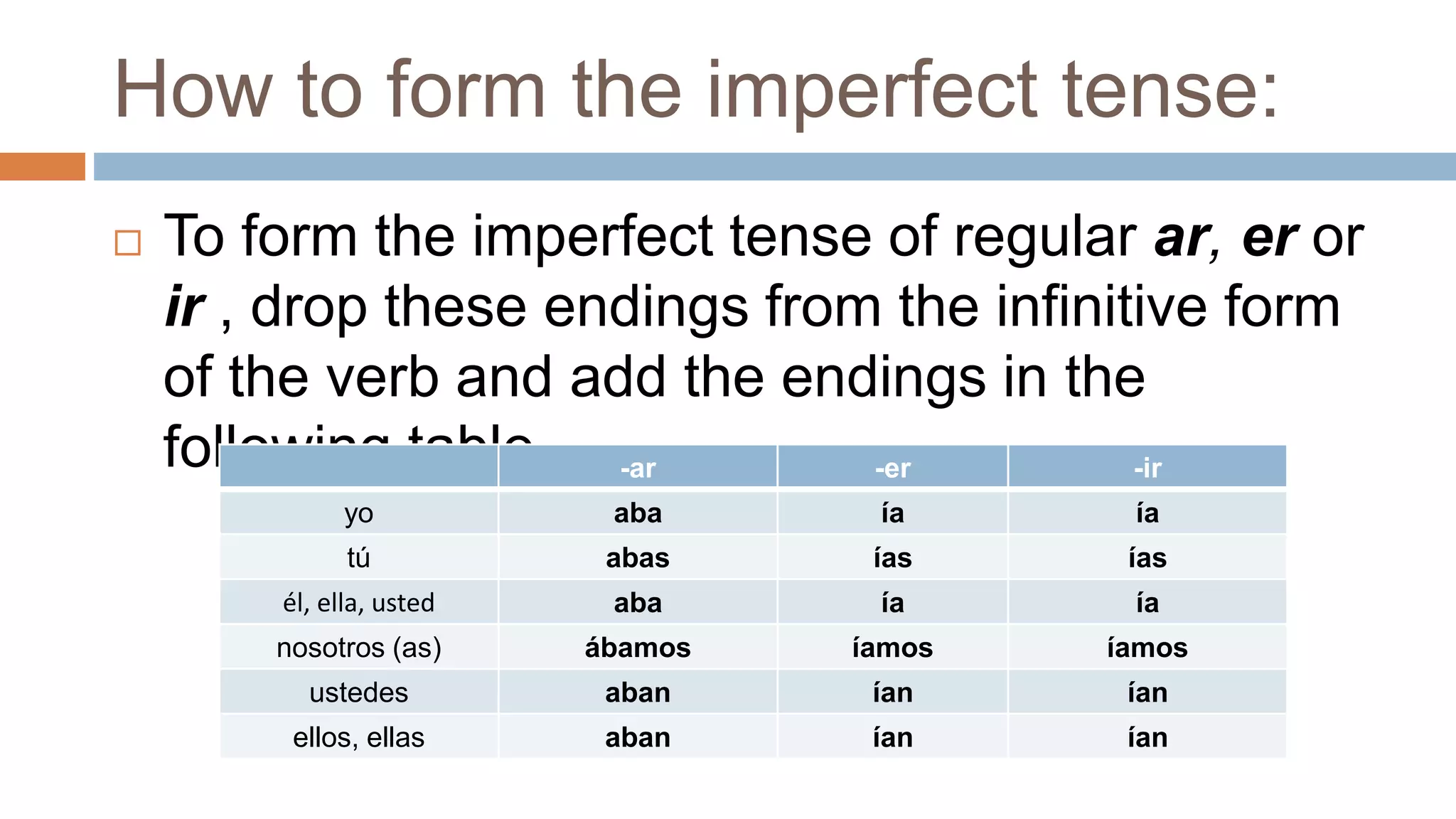
 To form the imperfect tense of regular ar, er or
ir , drop these endings from the infinitive form
of the verb and add the endings in the
following table. -ar -er -ir
yo aba ía ía
tú abas ías ías
él, ella, usted aba ía ía
nosotros (as) ábamos íamos íamos
ustedes aban ían ían
ellos, ellas aban ían ían
How to form the imperfect tense:
-ar -er -ir
yo aba ía ía
tú abas ías ías
él, ella, usted aba ía ía
nosotros/as ábamos íamos íamos
ustedes aban ían ían
ellos, ellas aban ían ían
How to form the imperfect tense:
-ar -er -ir
yo aba ía ía
tú abas ías ías
él, ella, usted aba ía ía
nosotros/as ábamos íamos íamos
ustedes aban ían ían
ellos, ellas aban ían ían
1
 While Lola was cooking, her
husband called.
 Mientras Lola cocinaba, su esposo
llamó.
1
 While Lola was cooking, her
husband called.
 Mientras Lola cocinaba, su esposo
llamó.
2
 Miguel used to clean the house
every night.
 Miguel limpiaba la casa todas las
noches.
2
 Miguel used to clean the house
every night.
 Miguel limpiaba la casa todas las
noches.
3
 My cousin bought fruits frequently.
 Mi prima compraba frutas
frecuentemente.
1. Ser (to be)
2. Ir (to go)
Two important irregular verbs in the imperfect tense:
Irregular verbs: Ser (to be)
SER ( to be)
yo era
tú eras
él, ella, usted era
nosotros, nosotras éramos
ustedes eran
ellos, ellas eran
Irregular verbs: Ser (to be)
 Nosotros éramos amigos.
 We were friends.
Irregular verbs: Ir (to go)
IR (to go)
yo iba
tú ibas
él, ella, usted iba
nosotros (as) íbamos
ustedes iban
ellos, ellas iban
Irregular verbs: Ir (to go)
 Yo iba a comer pizza, pero el restaurante
cerró .
 I was going to eat pizza but the restaurant closed.
Useful expressions to use with the
imperfect:
 Muchas veces - many times, often
 Todos los días - every day
 Cada día - each day
 Con frecuencia - often
 Siempre - always
Useful expressions to use with the
imperfect:
 Muchas veces - many times, often
 Todos los días - every day
 Cada día - each day
 Con frecuencia - often
 Siempre - always
Useful expressions to use with the
imperfect:
 Muchas veces - many times, often
 Todos los días - every day
 Cada día - each day
 Con frecuencia - often
 Siempre - always
LEARN MORE: www.udemy.com/u/nandaj/
Spanish for Beginners Spanish Survival Guide

The Imperfect Tense

  • 1.
  • 2.
    The Imperfect Tense The imperfect describes actions that began in the past but were ongoing or habitual.  “I used to…”
  • 3.
    The Imperfect Tense The imperfect describes actions that began in the past but were ongoing or habitual.  “I used to…”
  • 4.
    How to formthe imperfect tense:  To form the imperfect tense of regular ar, er or ir , drop these endings from the infinitive form of the verb and add the endings in the following table. -ar -er -ir yo aba ía ía tú abas ías ías él, ella, usted aba ía ía nosotros (as) ábamos íamos íamos ustedes aban ían ían ellos, ellas aban ían ían
  • 5.
    How to formthe imperfect tense: -ar -er -ir yo aba ía ía tú abas ías ías él, ella, usted aba ía ía nosotros/as ábamos íamos íamos ustedes aban ían ían ellos, ellas aban ían ían
  • 6.
    How to formthe imperfect tense: -ar -er -ir yo aba ía ía tú abas ías ías él, ella, usted aba ía ía nosotros/as ábamos íamos íamos ustedes aban ían ían ellos, ellas aban ían ían
  • 7.
    1  While Lolawas cooking, her husband called.  Mientras Lola cocinaba, su esposo llamó.
  • 8.
    1  While Lolawas cooking, her husband called.  Mientras Lola cocinaba, su esposo llamó.
  • 9.
    2  Miguel usedto clean the house every night.  Miguel limpiaba la casa todas las noches.
  • 10.
    2  Miguel usedto clean the house every night.  Miguel limpiaba la casa todas las noches.
  • 11.
    3  My cousinbought fruits frequently.  Mi prima compraba frutas frecuentemente.
  • 12.
    1. Ser (tobe) 2. Ir (to go) Two important irregular verbs in the imperfect tense:
  • 13.
    Irregular verbs: Ser(to be) SER ( to be) yo era tú eras él, ella, usted era nosotros, nosotras éramos ustedes eran ellos, ellas eran
  • 14.
    Irregular verbs: Ser(to be)  Nosotros éramos amigos.  We were friends.
  • 15.
    Irregular verbs: Ir(to go) IR (to go) yo iba tú ibas él, ella, usted iba nosotros (as) íbamos ustedes iban ellos, ellas iban
  • 16.
    Irregular verbs: Ir(to go)  Yo iba a comer pizza, pero el restaurante cerró .  I was going to eat pizza but the restaurant closed.
  • 17.
    Useful expressions touse with the imperfect:  Muchas veces - many times, often  Todos los días - every day  Cada día - each day  Con frecuencia - often  Siempre - always
  • 18.
    Useful expressions touse with the imperfect:  Muchas veces - many times, often  Todos los días - every day  Cada día - each day  Con frecuencia - often  Siempre - always
  • 19.
    Useful expressions touse with the imperfect:  Muchas veces - many times, often  Todos los días - every day  Cada día - each day  Con frecuencia - often  Siempre - always
  • 20.
    LEARN MORE: www.udemy.com/u/nandaj/ Spanishfor Beginners Spanish Survival Guide

Editor's Notes

  • #2 Hola, bienvenido! Welcome. In this lecture you are going to continue learning about the past tense. specifically, you will learn about the imperfect tense,
  • #3 The imperfect (or.. in spanish.. el imperecto)…. is a tense is used to express actions that began in the past BUT that have not ended or have NOT been completed. So, the imperfect tense describes the past and indicates that those past actions were ongoing or habitual.
  • #4  You can think of the equivalent in English: “ I used to…” I used to walk in the park. You see, this is something that was habitual, an action that the imperfect tense describes .
  • #5 So.. how do we form this imperfect tense? Well, the same way that we have been forming all of our tenses. You have to take the infinitive form of the verb, which will end in either AR, ER, or IR, drop the endings, and add the corresponding imperfect tense endings that you see in the screen.
  • #6 lets take a closer look at this table In the left you have the list of the subjects, and in the right, you have the corresponding endings for AR, ER, or IR verbs. Again, like any other verb, you remove the stem and you add the corresponding endings in the table. If you’d like, pause the video and take a look a these endings. ill give you a couple of seconds.
  • #7 lets take a closer look at this table In the left you have the list of the subjects, and in the right, you have the corresponding endings for AR, ER, or IR verbs. Again, like any other verb, you remove the stem and you add the corresponding endings in the table. If you’d like, pause the video and take a look a these endings. ill give you a couple of seconds.
  • #8 OK. Now I want you to take a look at the following examples and what I want you to notice is that the imperfect tense has 3 corresponding forms in English. FIRST : The imperfect tense serves to explain an action that was ongoing in the past: While Lola was cooking, her husband called.
  • #9  Remember, the verb that we are conjugating in the IMPERFECT tense ..in this example is: TO COOK ( in english.. we conjugate it by adding ing at the end…cooking). So....notice that the key word is WHILE.. WHILE lola was COOKINg, her husband called. Mientras LOLA COCINABA, su esposo llamo! This means that there was an ongoing action at the time something happened and for this we use the imperfect.
  • #10 The second thing that the imperfect does is that it describes an action in the past that occurred over an extended period of time So, in this case, it takes the form of USED TO> For example, miguel used to clean the house every night
  • #11 Miguel limpiaba la casa todas las noches. notice that the verb is still CLEAN. it is not USED TOThat, is just a phrase that we use in english to help us understand the tense. In spanish we are still conjugating the verb To clean. miguel LIMPIABA la casa todas las nocehs.
  • #12 finally, the imperefcte is a tense used to describe actions in the past that occurred frequently. my cousin bought fruits frequently mi prima compraba frutas frequentemente
  • #13 Great! Now that you know how to formteh imperfect tense of regular verbs.. lets take a look at t some exceptions. So, teher are only 3 irregular verbs in the imperfect tense: to be (ser), and to go (ir) and Let’s conjugate them!
  • #14 Ser ( to be) read slide
  • #15 for example: nosotras eramos amigas
  • #16 Ir ( to go) read slide
  • #17 for example:
  • #18 Great,l the following are some useful epressions to use with the imperfect tense. eso es todo por hoy, gracias por escuchar. Adios!
  • #19 Great,l the following are some useful epressions to use with the imperfect tense. eso es todo por hoy, gracias por escuchar. Adios!
  • #20  gracias por escuchar. Adios!