The other past tense…
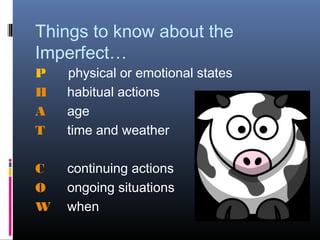
Things to know about the
Imperfect…
P physical or emotional states
H habitual actions
A age
T time and weather
 
C continuing actions
O ongoing situations
W when
P is for Physical/Emotional
 You are talking about previous mental,
physical, or emotional conditions.
 Por ejemplo:
Ella estaba cansada y muy triste.
- She was tired and very sad.
H is for Habitual actions
 The imperfect is used for actions that were
repeated habitually.
Almorzábamos juntos todos los días.
We would lunch together every day.
A if for Age and T is for Time and
Weather
 The imperfect is used for telling time and
stating one's age and for also describing
the weather in the past.
 Eran las siete de la noche.
It was seven o'clock at night.
 La niña tenía cinco años.
The little girl was five years old.
 Hacía mal tiempo. Llovía.
 It was bad we athe r. It was raining .
C is for Continuing and O
is for Ongoing…
 The imperfect tense is used to express
something that was not completed or does
not have a definite beginning or end.
 A past action or state being viewed as in
progress. In English we often use the past
progressive for this: “was/were ...-ing”.
 Mirábamos las mariposas.
 We were watching the butterflies.
W is for When...
 The imperfect is used for actions that "set
the stage" for another action.
Yo leía cuando entró mi papá.
I was reading when my papa entered.
(note that "entered" is preterite)
Las conjugaciones delLas conjugaciones del
ImperfectoImperfecto
abaaba ábamosábamos
abasabas abaisabais
abaaba abanaban
“AR” verbos
íaía íamosíamos
íasías íaisíais
íaía íanían
“ER”/”IR” verbos
Note: The accent in
the nosotros form.
Note: The accents on
all of the i´s.
““hablar”- imperfect tense…hablar”- imperfect tense…
hablabahablaba hablábamoshablábamos
hablabashablabas hablabaishablabais
hablabahablaba hablabanhablaban
hablar = to talk, to speak
Por ejemplo:
Yo siempre hablaba a mi abuela por teléfono.
I always used to talk to my grandmother on the phone.
““comer”- imperfect tense…comer”- imperfect tense…
comíacomía comíamoscomíamos
comíascomías comíaiscomíais
comíacomía comíancomían
comer= to eat
Por ejemplo:
Siempre comíamos la cena de el día de acción de gracias
a las seis de la noche.
We always used to eat dinner on Thanksgiving day at 6 at
night.
““vivir”- imperfect tense…vivir”- imperfect tense…
vivíavivía vivíamosvivíamos
vivíasvivías vivíaisvivíais
vivíavivía vivíanvivían
vivir = to live
Por ejemplo:
Yo vivía en Alabama cuando era niña.
I lived in Alabama when I was a little girl.
Solamente hay 3 especiales en el
imperfecto!!
veíaveía veíamosveíamos
veíasveías veíaisveíais
veíaveía veíanveían
eraera éramoséramos
eraseras eraiserais
eraera eraneran
ser – to be
ibaiba íbamosíbamos
ibasibas ibaisibais
ibaiba ibaniban
ir – to go
ver – to see
Tell-Tale signs of Imperfect…
 a veces - sometimes
 cada año/ cada dia -
every year/every day
 de vez en cuando -
once in a while
 todos los dias -
everyday
 muchas veces -
many times
 mucho - a lot
 por un rato - for a
while
 siempre - always
 tantas veces - so
many times
 generalmente -
usually
 frecuentemente -
frequently
Imperfect Progressive…
 This form is very similar to that of Present
Progressive (I was walking, He was
talking, etc.) in that “estar” is used with
another verb with –ando or –iendo
attached to the end of it.
 Por ejemplo:
Yo estoy caminando…
Mark está hablando….
Más de Imperfect Progressive…
 The only thing that differs is that with the
Imperfect Progressive you use the imperfect
form of estar instead of the present tense.
 Por ejemplo:
Yo estaba caminando….
Mark estaba hablando….
*”ar” verbs – ando *y changers- yendo
* “er/ir” verbs – iendo

Imperfect

  • 1.
  • 2.
    Things to knowabout the Imperfect… P physical or emotional states H habitual actions A age T time and weather   C continuing actions O ongoing situations W when
  • 3.
    P is forPhysical/Emotional  You are talking about previous mental, physical, or emotional conditions.  Por ejemplo: Ella estaba cansada y muy triste. - She was tired and very sad.
  • 4.
    H is forHabitual actions  The imperfect is used for actions that were repeated habitually. Almorzábamos juntos todos los días. We would lunch together every day.
  • 5.
    A if forAge and T is for Time and Weather  The imperfect is used for telling time and stating one's age and for also describing the weather in the past.  Eran las siete de la noche. It was seven o'clock at night.  La niña tenía cinco años. The little girl was five years old.  Hacía mal tiempo. Llovía.  It was bad we athe r. It was raining .
  • 6.
    C is forContinuing and O is for Ongoing…  The imperfect tense is used to express something that was not completed or does not have a definite beginning or end.  A past action or state being viewed as in progress. In English we often use the past progressive for this: “was/were ...-ing”.  Mirábamos las mariposas.  We were watching the butterflies.
  • 7.
    W is forWhen...  The imperfect is used for actions that "set the stage" for another action. Yo leía cuando entró mi papá. I was reading when my papa entered. (note that "entered" is preterite)
  • 8.
    Las conjugaciones delLasconjugaciones del ImperfectoImperfecto abaaba ábamosábamos abasabas abaisabais abaaba abanaban “AR” verbos íaía íamosíamos íasías íaisíais íaía íanían “ER”/”IR” verbos Note: The accent in the nosotros form. Note: The accents on all of the i´s.
  • 9.
    ““hablar”- imperfect tense…hablar”-imperfect tense… hablabahablaba hablábamoshablábamos hablabashablabas hablabaishablabais hablabahablaba hablabanhablaban hablar = to talk, to speak Por ejemplo: Yo siempre hablaba a mi abuela por teléfono. I always used to talk to my grandmother on the phone.
  • 10.
    ““comer”- imperfect tense…comer”-imperfect tense… comíacomía comíamoscomíamos comíascomías comíaiscomíais comíacomía comíancomían comer= to eat Por ejemplo: Siempre comíamos la cena de el día de acción de gracias a las seis de la noche. We always used to eat dinner on Thanksgiving day at 6 at night.
  • 11.
    ““vivir”- imperfect tense…vivir”-imperfect tense… vivíavivía vivíamosvivíamos vivíasvivías vivíaisvivíais vivíavivía vivíanvivían vivir = to live Por ejemplo: Yo vivía en Alabama cuando era niña. I lived in Alabama when I was a little girl.
  • 12.
    Solamente hay 3especiales en el imperfecto!! veíaveía veíamosveíamos veíasveías veíaisveíais veíaveía veíanveían eraera éramoséramos eraseras eraiserais eraera eraneran ser – to be ibaiba íbamosíbamos ibasibas ibaisibais ibaiba ibaniban ir – to go ver – to see
  • 13.
    Tell-Tale signs ofImperfect…  a veces - sometimes  cada año/ cada dia - every year/every day  de vez en cuando - once in a while  todos los dias - everyday  muchas veces - many times  mucho - a lot  por un rato - for a while  siempre - always  tantas veces - so many times  generalmente - usually  frecuentemente - frequently
  • 14.
    Imperfect Progressive…  Thisform is very similar to that of Present Progressive (I was walking, He was talking, etc.) in that “estar” is used with another verb with –ando or –iendo attached to the end of it.  Por ejemplo: Yo estoy caminando… Mark está hablando….
  • 15.
    Más de ImperfectProgressive…  The only thing that differs is that with the Imperfect Progressive you use the imperfect form of estar instead of the present tense.  Por ejemplo: Yo estaba caminando…. Mark estaba hablando…. *”ar” verbs – ando *y changers- yendo * “er/ir” verbs – iendo