“Photography takes an instant out of
time, altering life by holding it still.”
- Dorothea Lange
Capturing Motion in Still
Photography
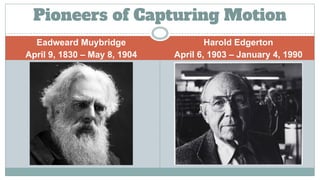
Eadweard Muybridge
April 9, 1830 – May 8, 1904
Harold Edgerton
April 6, 1903 – January 4, 1990
Pioneers of Capturing Motion
Early experiments with
photography, time, and motion
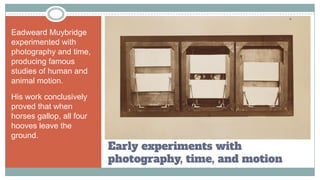
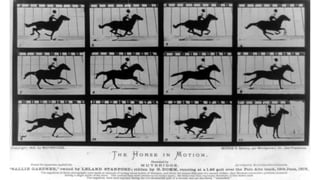
Eadweard Muybridge
experimented with
photography and time,
producing famous
studies of human and
animal motion.
His work conclusively
proved that when
horses gallop, all four
hooves leave the
ground.
Early experiments with
photography, time, and motion
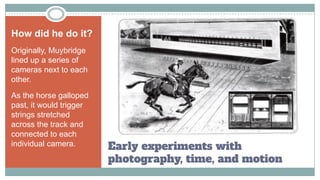
How did he do it?
Originally, Muybridge
lined up a series of
cameras next to each
other.
As the horse galloped
past, it would trigger
strings stretched
across the track and
connected to each
individual camera.
Early experiments with
photography, time, and motion
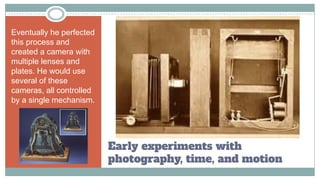
Eventually he perfected
this process and
created a camera with
multiple lenses and
plates. He would use
several of these
cameras, all controlled
by a single mechanism.
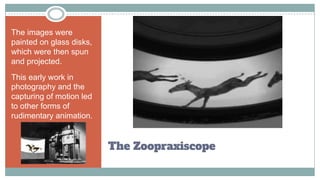
The Zoopraxiscope
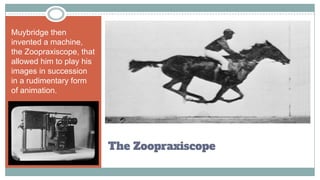
Muybridge then
invented a machine,
the Zoopraxiscope, that
allowed him to play his
images in succession
in a rudimentary form
of animation.
The Zoopraxiscope
The images were
painted on glass disks,
which were then spun
and projected.
This early work in
photography and the
capturing of motion led
to other forms of
rudimentary animation.
Kineograph/Flip Books
Created by John
Barnes Linnett (1868)
A series of drawings in
a book that appeared
to move when the
pages were quickly
flipped.
These inventions all led
to the development of
motion pictures.
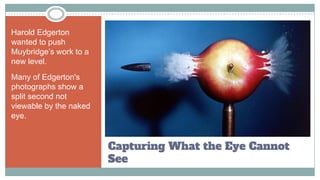
Capturing What the Eye Cannot
See
Harold Edgerton
wanted to push
Muybridge’s work to a
new level.
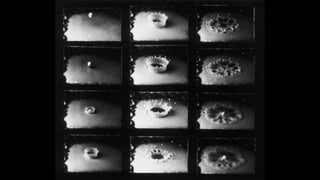
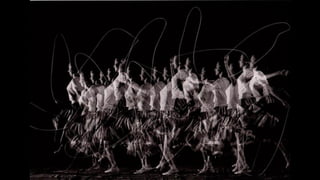
Many of Edgerton's
photographs show a
split second not
viewable by the naked
eye.
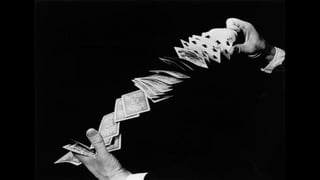
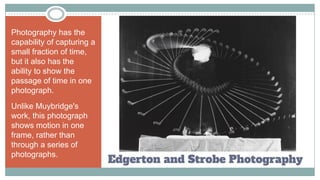
Edgerton and Strobe Photography
Photography has the
capability of capturing a
small fraction of time,
but it also has the
ability to show the
passage of time in one
photograph.
Unlike Muybridge's
work, this photograph
shows motion in one
frame, rather than
through a series of
photographs.
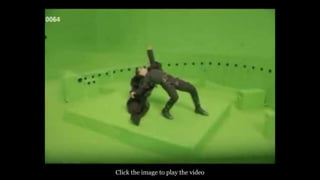
Click the image to play the video
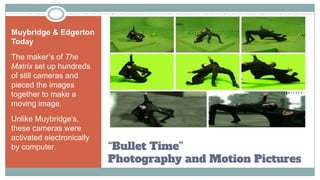
“Bullet Time”
Photography and Motion Pictures
Muybridge & Edgerton
Today
The maker’s of The
Matrix set up hundreds
of still cameras and
pieced the images
together to make a
moving image.
Unlike Muybridge’s,
these cameras were
activated electronically
by computer.
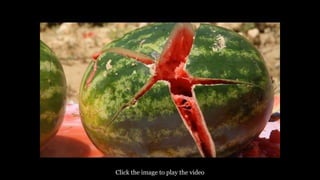
Click the image to play the video
“A still photograph is called a still photograph because
the picture doesn’t move, not because the objects in the
picture are not in motion. The photographer's mission,
should he decide to accept it, is to capture motion with
stillness.” - Vincent Versace
How to Capture Motion in
Still Photographs
Shutter Speed
● There are two things to remember:
○ The faster the shutter speed, the sharper the focus on
your subject.
○ A shutter speed slower than 1/60th of a second will blur a
moving object.
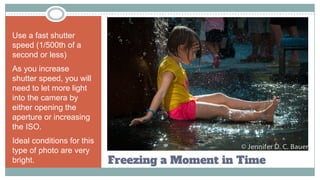
Freezing a Moment in Time
Use a fast shutter
speed (1/500th of a
second or less)
As you increase
shutter speed, you will
need to let more light
into the camera by
either opening the
aperture or increasing
the ISO.
Ideal conditions for this
type of photo are very
bright.
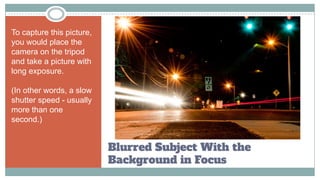
Blurred Subject With the
Background in Focus
To capture this picture,
you would place the
camera on the tripod
and take a picture with
long exposure.
(In other words, a slow
shutter speed - usually
more than one
second.)
Blurred Background With the
Subject/Foreground in Focus
Again, place the
camera on the tripod
and take a picture with
long exposure.
If your subject is a
person, make sure they
stay completely still
while you take the
picture.
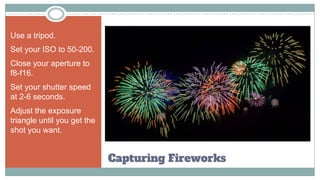
Capturing Fireworks
Use a tripod.
Set your ISO to 50-200.
Close your aperture to
f8-f16.
Set your shutter speed
at 2-6 seconds.
Adjust the exposure
triangle until you get the
shot you want.
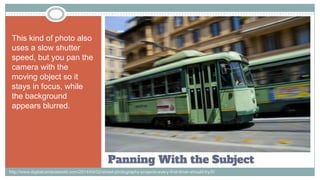
Panning With the Subject
This kind of photo also
uses a slow shutter
speed, but you pan the
camera with the
moving object so it
stays in focus, while
the background
appears blurred.
http://www.digitalcameraworld.com/2014/04/02/street-photography-projects-every-first-timer-should-try/5/
Digitally Merging Photographs
(modern-day Edgerton strobe photography)
You can take a series
of photographs and
digitally merge them
using Adobe
Photoshop, or other
photo-editing software.
To take this kind of a
picture, shoot with a
fast shutter speed, and
use a tripod so that the
background in each
picture is the same.
http://12kadrov.com/fotonastroenie/seriya-v-odnom-kadre/

Capturing Motion in Still Photography

  • 1.
    “Photography takes aninstant out of time, altering life by holding it still.” - Dorothea Lange Capturing Motion in Still Photography
  • 2.
    Eadweard Muybridge April 9,1830 – May 8, 1904 Harold Edgerton April 6, 1903 – January 4, 1990 Pioneers of Capturing Motion
  • 3.
    Early experiments with photography,time, and motion Eadweard Muybridge experimented with photography and time, producing famous studies of human and animal motion. His work conclusively proved that when horses gallop, all four hooves leave the ground.
  • 4.
    Early experiments with photography,time, and motion How did he do it? Originally, Muybridge lined up a series of cameras next to each other. As the horse galloped past, it would trigger strings stretched across the track and connected to each individual camera.
  • 6.
    Early experiments with photography,time, and motion Eventually he perfected this process and created a camera with multiple lenses and plates. He would use several of these cameras, all controlled by a single mechanism.
  • 7.
    The Zoopraxiscope Muybridge then inventeda machine, the Zoopraxiscope, that allowed him to play his images in succession in a rudimentary form of animation.
  • 8.
    The Zoopraxiscope The imageswere painted on glass disks, which were then spun and projected. This early work in photography and the capturing of motion led to other forms of rudimentary animation.
  • 9.
    Kineograph/Flip Books Created byJohn Barnes Linnett (1868) A series of drawings in a book that appeared to move when the pages were quickly flipped. These inventions all led to the development of motion pictures.
  • 10.
    Capturing What theEye Cannot See Harold Edgerton wanted to push Muybridge’s work to a new level. Many of Edgerton's photographs show a split second not viewable by the naked eye.
  • 13.
    Edgerton and StrobePhotography Photography has the capability of capturing a small fraction of time, but it also has the ability to show the passage of time in one photograph. Unlike Muybridge's work, this photograph shows motion in one frame, rather than through a series of photographs.
  • 15.
    Click the imageto play the video
  • 16.
    Click the imageto play the video
  • 17.
    “Bullet Time” Photography andMotion Pictures Muybridge & Edgerton Today The maker’s of The Matrix set up hundreds of still cameras and pieced the images together to make a moving image. Unlike Muybridge’s, these cameras were activated electronically by computer.
  • 18.
    Click the imageto play the video
  • 19.
    “A still photographis called a still photograph because the picture doesn’t move, not because the objects in the picture are not in motion. The photographer's mission, should he decide to accept it, is to capture motion with stillness.” - Vincent Versace How to Capture Motion in Still Photographs
  • 20.
    Shutter Speed ● Thereare two things to remember: ○ The faster the shutter speed, the sharper the focus on your subject. ○ A shutter speed slower than 1/60th of a second will blur a moving object.
  • 21.
    Freezing a Momentin Time Use a fast shutter speed (1/500th of a second or less) As you increase shutter speed, you will need to let more light into the camera by either opening the aperture or increasing the ISO. Ideal conditions for this type of photo are very bright.
  • 22.
    Blurred Subject Withthe Background in Focus To capture this picture, you would place the camera on the tripod and take a picture with long exposure. (In other words, a slow shutter speed - usually more than one second.)
  • 23.
    Blurred Background Withthe Subject/Foreground in Focus Again, place the camera on the tripod and take a picture with long exposure. If your subject is a person, make sure they stay completely still while you take the picture.
  • 24.
    Capturing Fireworks Use atripod. Set your ISO to 50-200. Close your aperture to f8-f16. Set your shutter speed at 2-6 seconds. Adjust the exposure triangle until you get the shot you want.
  • 25.
    Panning With theSubject This kind of photo also uses a slow shutter speed, but you pan the camera with the moving object so it stays in focus, while the background appears blurred. http://www.digitalcameraworld.com/2014/04/02/street-photography-projects-every-first-timer-should-try/5/
  • 26.
    Digitally Merging Photographs (modern-dayEdgerton strobe photography) You can take a series of photographs and digitally merge them using Adobe Photoshop, or other photo-editing software. To take this kind of a picture, shoot with a fast shutter speed, and use a tripod so that the background in each picture is the same. http://12kadrov.com/fotonastroenie/seriya-v-odnom-kadre/