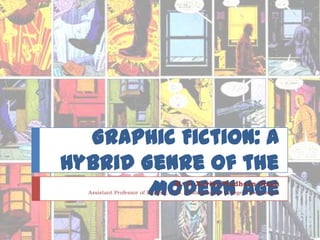
Graphic Fiction: A
Hybrid Genre of the
        Modern Age               M. S. Xavier Pradheep Singh
  Assistant Professor of English, V. O. Chidambaram College, Thoothukudi
   What is Graphic Fiction?
   How did it develop?
   What are its parts?
   Can a graphic novel be considered as literature?
   What are its unique features?
Graphic Fiction
   Meaningful interaction of words, image panels and
    typography.
   “a new hybrid form of reading that combines visual
    and verbal rhetoric”
                                 - Stephen E. Tabachnick
                         “A Comic Book World.” World Literature Today. 81.2 (2007)
Graphic Fiction
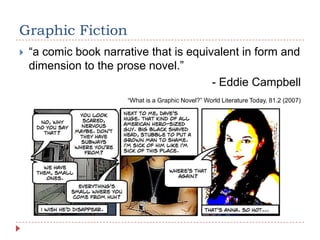
   “a comic book narrative that is equivalent in form and
    dimension to the prose novel.”
                                         - Eddie Campbell
                       “What is a Graphic Novel?” World Literature Today. 81.2 (2007)
Graphic Fiction
   Pictures are arranged
    in sequential image
    panels and words are
    given in speech
    bubbles and text
    boxes.
History of Graphic Fiction
Prehistoric Cave Paintings
   “Visual narratives of
    juxtaposed images”
                - Marie Fernandes
    “Comic Books as Literary Discourse.” New Quest. 133
                                        (1999): 427-431.

   Words were not essential
Woodcut Novel (1910s)
    It did not have any sentence.
    Used a sequence of images, “typically executed in a
     woodcut or wood-engraving technique”
                                            - Chris Lanier
    “The woodcut Novel: A Forerunner to the Graphic Novel.” World Literature Today. 81.2 (2007): 15-23.

    The effect was something like a silent film
    Famous Woodcut Novel
        God‟s Man by Lind Ward (1905-1985)
Comics (1930s)
   developed after the crash of stock market in 1929.
   Flash Gordon by Alex Raymond, Dick Tracy by
    Chester Gould, Tarzan by Hal Foster
Comics (1930s)
   Children-related themes
   evolved as part of mass culture
   Between 1940 and 1945, four hundred super-heroes
    were created based on „Superman‟s model‟.
       Batman created by Bob Kane in 1939
   1940s the magazine format of comic books
    developed
Graphic Novels (Later part of 20th century)
   Developed due to the impact of electronic media
    (films & internet) towards the end of 20th century
   Many readers have lost their habit of reading. They
    wanted a quick reading rather than thick texts. They
    are used to quick electronic perception.
Graphic Novels (Later part of 20th century)
   Graphic novels allow us to imagine and experience
    characters and places
   provides many advantages to both print and
    electronic media
Literariness of Graphic Literature
   “Comic art does possess the potential for the most
    serious and sophisticated literary and artistic
    expression, and we can only hope that future artists
    will bring the art form to full fruition”
                                             - Lawrence Abbott
                     “Comic art: Characteristics and Potentialities of a narrative medium.”
                                       Journal of Popular Culture. 19. 4 (1986): 155-176.
Literariness of Graphic Literature
   Art Spiegelman won the Pulitzer Prize for his graphic
    Novel Maus.
   Many universities, especially University of Memphis,
    offer courses on Graphic Fiction.
Uniqueness of Graphic Fiction
   Unique approach to plot, narration, and theme
   Depth and density of characters
Anatomy of Graphic Fiction
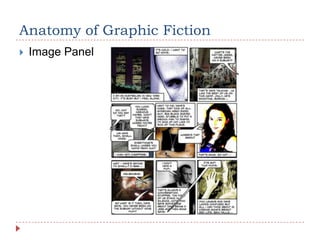
   Image Panel
Anatomy of Graphic Fiction
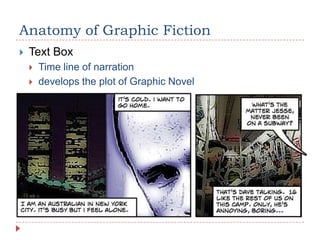
   Text Box
       Time line of narration
       develops the plot of Graphic Novel
Anatomy of Graphic Fiction
   Speech Bubble
       Words spoken by characters in a Graphic Novel
       Arranged vertically to show the order in a conversation
       either rectangular or oval in shape with a tail pointing
        towards the character that speaks those words
Anatomy of Graphic Fiction

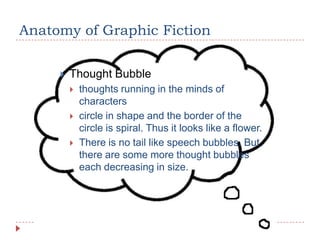
        Thought Bubble
            thoughts running in the minds of
             characters
            circle in shape and the border of the
             circle is spiral. Thus it looks like a flower.
            There is no tail like speech bubbles. But
             there are some more thought bubbles
             each decreasing in size.
Features of Graphic Novels
Features of Graphic Fiction
   Autographic Forms
       The mark of handwriting in Graphic
        Novels is an “important part of the rich
        extra-semantic information a reader
        receives.”
             - Hillary Chute & Marianne DeCoven
    “Introduction: Graphic Narrative.” Modern Fiction Studies.
                                          52.4 (2006): 767-782.
       The mark of handwriting creates an
        impact that the whole novel is a
        manuscript and thus provides a sense of
        intimacy.
Features of Graphic Fiction
   Imaginative Creativity
       The use of blank spaces between image panels makes
        readers to fill in the blanks, imagining a good deal of
        action. Thus it encourages “imaginative creativity”
       - Stephen E. Tabachnick
       “Of Maus and Memory: The Structure of Art Spiegelman‟s
        Graphic Novel of the Holocaust.” Word & Image. 9.2
        (1993): 154-162.
Features of Graphic Fiction
   Interactivity
       As the readers use their imagination to fill in the blanks
        between image panels, Graphic novels encourage
        interactivity in the minds of the readers.
Features of Graphic Fiction
   The language, syntax and meaning of a graphic
    novel spring primarily through the relationship
    between images rather than words.
   A Graphic Novelist cannot waste words and image
    panels. They are essentials of a Graphic Fiction.
   Combination of the qualities of book and screen
Important Graphic Novels
Maus by Art Spiegelman
    Won the 1991 Pulitzer Prize
    Autobiographical
    Novel of Holocaust
    Authors’ father’s story of
     survival
    Contains three separate
     genres found in verbal novels
        the Kunstleroman
        the bildungsroman, and
        the epic
In the Shadow of No Towers: 9/11 by Art
Spiegelman (2004)
    deals with the terrorist attack
     on America on 11th September
     2001 and the trauma of the
     Americans following the
     tragedy
Berlin: City of Stories by Jason Lutes
    Historical fiction focusing on Weimar-era Berlin.
Epileptic by David
    Originally published in France
    David’s memoir of growing up with an older brother who
     suffers from epilepsy
Jimmy Corrigan: The Smartest Kid on Earth
by Chris Ware
    adventures of Jimmy Corrigan as he searches for his lost
     father.
Louis Riel by Chester Brown
    Chester Brown – a Canadian Graphic Novelist
    Fictionalised History of Riel, a revolutionary and mystic of
     the 19th century who led the French / Indian population
The River of Stories by Orijit Sen
    The first Indian Graphic Novel
    narrates the story of displaced adivasis and the visit of a
     young reporter to the Rewa Dam site.
    This Graphic Novel was a vehicle for launching a critique
     of political and social inequalities.
The Barn Owl’s Wondrous Capers by
Sarnath Banerjee (2009)
    Portrays 18th century Calcutta
    Exploits the myth of the
     Wandering Jew
Harappa Files by Sarnath Banerjee
 Presents India of 1980s
Stupid Guy Goes to India by Yukichi
Yamamatsu
   Indian Manga Novel
   Understanding Comics by Scott McCloud (1993)
   only truly successful book-length comic essay
   Provides real vocabulary to discuss the medium
Conclusion
   Graphic Fiction “suits the complexity of modern life
    with its babble of signs, symbols and stimuli”
                                         - Eddie Campbell
                    “What is a Graphic Novel?” World Literature Today. 81.2 (2007): 13.

   Combines visual and verbal rhetoric and offers a
    hybrid form of reading.
Conclusion
   “Graphic Novel will continue to displace (if never
    completely replace) purely textual writing and that it
    will eventually become the most popular form of
    reading.”
                                 - Stephen E. Tabachnick
                         “A Comic Book World.” World Literature Today. 81.2 (2007).

Graphic fiction

  • 1.
    Graphic Fiction: A HybridGenre of the Modern Age M. S. Xavier Pradheep Singh Assistant Professor of English, V. O. Chidambaram College, Thoothukudi
  • 2.
    What is Graphic Fiction?  How did it develop?  What are its parts?  Can a graphic novel be considered as literature?  What are its unique features?
  • 3.
    Graphic Fiction  Meaningful interaction of words, image panels and typography.  “a new hybrid form of reading that combines visual and verbal rhetoric” - Stephen E. Tabachnick “A Comic Book World.” World Literature Today. 81.2 (2007)
  • 4.
    Graphic Fiction  “a comic book narrative that is equivalent in form and dimension to the prose novel.” - Eddie Campbell “What is a Graphic Novel?” World Literature Today. 81.2 (2007)
  • 5.
    Graphic Fiction  Pictures are arranged in sequential image panels and words are given in speech bubbles and text boxes.
  • 6.
  • 7.
    Prehistoric Cave Paintings  “Visual narratives of juxtaposed images” - Marie Fernandes “Comic Books as Literary Discourse.” New Quest. 133 (1999): 427-431.  Words were not essential
  • 8.
    Woodcut Novel (1910s)  It did not have any sentence.  Used a sequence of images, “typically executed in a woodcut or wood-engraving technique” - Chris Lanier “The woodcut Novel: A Forerunner to the Graphic Novel.” World Literature Today. 81.2 (2007): 15-23.  The effect was something like a silent film  Famous Woodcut Novel  God‟s Man by Lind Ward (1905-1985)
  • 9.
    Comics (1930s)  developed after the crash of stock market in 1929.  Flash Gordon by Alex Raymond, Dick Tracy by Chester Gould, Tarzan by Hal Foster
  • 10.
    Comics (1930s)  Children-related themes  evolved as part of mass culture  Between 1940 and 1945, four hundred super-heroes were created based on „Superman‟s model‟.  Batman created by Bob Kane in 1939  1940s the magazine format of comic books developed
  • 11.
    Graphic Novels (Laterpart of 20th century)  Developed due to the impact of electronic media (films & internet) towards the end of 20th century  Many readers have lost their habit of reading. They wanted a quick reading rather than thick texts. They are used to quick electronic perception.
  • 12.
    Graphic Novels (Laterpart of 20th century)  Graphic novels allow us to imagine and experience characters and places  provides many advantages to both print and electronic media
  • 13.
    Literariness of GraphicLiterature  “Comic art does possess the potential for the most serious and sophisticated literary and artistic expression, and we can only hope that future artists will bring the art form to full fruition” - Lawrence Abbott “Comic art: Characteristics and Potentialities of a narrative medium.” Journal of Popular Culture. 19. 4 (1986): 155-176.
  • 14.
    Literariness of GraphicLiterature  Art Spiegelman won the Pulitzer Prize for his graphic Novel Maus.  Many universities, especially University of Memphis, offer courses on Graphic Fiction.
  • 15.
    Uniqueness of GraphicFiction  Unique approach to plot, narration, and theme  Depth and density of characters
  • 16.
  • 17.
    Anatomy of GraphicFiction  Image Panel
  • 18.
    Anatomy of GraphicFiction  Text Box  Time line of narration  develops the plot of Graphic Novel
  • 19.
    Anatomy of GraphicFiction  Speech Bubble  Words spoken by characters in a Graphic Novel  Arranged vertically to show the order in a conversation  either rectangular or oval in shape with a tail pointing towards the character that speaks those words
  • 20.
    Anatomy of GraphicFiction  Thought Bubble  thoughts running in the minds of characters  circle in shape and the border of the circle is spiral. Thus it looks like a flower.  There is no tail like speech bubbles. But there are some more thought bubbles each decreasing in size.
  • 21.
  • 22.
    Features of GraphicFiction  Autographic Forms  The mark of handwriting in Graphic Novels is an “important part of the rich extra-semantic information a reader receives.” - Hillary Chute & Marianne DeCoven “Introduction: Graphic Narrative.” Modern Fiction Studies. 52.4 (2006): 767-782.  The mark of handwriting creates an impact that the whole novel is a manuscript and thus provides a sense of intimacy.
  • 23.
    Features of GraphicFiction  Imaginative Creativity  The use of blank spaces between image panels makes readers to fill in the blanks, imagining a good deal of action. Thus it encourages “imaginative creativity”  - Stephen E. Tabachnick  “Of Maus and Memory: The Structure of Art Spiegelman‟s Graphic Novel of the Holocaust.” Word & Image. 9.2 (1993): 154-162.
  • 24.
    Features of GraphicFiction  Interactivity  As the readers use their imagination to fill in the blanks between image panels, Graphic novels encourage interactivity in the minds of the readers.
  • 25.
    Features of GraphicFiction  The language, syntax and meaning of a graphic novel spring primarily through the relationship between images rather than words.  A Graphic Novelist cannot waste words and image panels. They are essentials of a Graphic Fiction.  Combination of the qualities of book and screen
  • 26.
  • 27.
    Maus by ArtSpiegelman  Won the 1991 Pulitzer Prize  Autobiographical  Novel of Holocaust  Authors’ father’s story of survival  Contains three separate genres found in verbal novels  the Kunstleroman  the bildungsroman, and  the epic
  • 28.
    In the Shadowof No Towers: 9/11 by Art Spiegelman (2004)  deals with the terrorist attack on America on 11th September 2001 and the trauma of the Americans following the tragedy
  • 29.
    Berlin: City ofStories by Jason Lutes  Historical fiction focusing on Weimar-era Berlin.
  • 30.
    Epileptic by David  Originally published in France  David’s memoir of growing up with an older brother who suffers from epilepsy
  • 31.
    Jimmy Corrigan: TheSmartest Kid on Earth by Chris Ware  adventures of Jimmy Corrigan as he searches for his lost father.
  • 32.
    Louis Riel byChester Brown  Chester Brown – a Canadian Graphic Novelist  Fictionalised History of Riel, a revolutionary and mystic of the 19th century who led the French / Indian population
  • 33.
    The River ofStories by Orijit Sen  The first Indian Graphic Novel  narrates the story of displaced adivasis and the visit of a young reporter to the Rewa Dam site.  This Graphic Novel was a vehicle for launching a critique of political and social inequalities.
  • 34.
    The Barn Owl’sWondrous Capers by Sarnath Banerjee (2009)  Portrays 18th century Calcutta  Exploits the myth of the Wandering Jew
  • 35.
    Harappa Files bySarnath Banerjee Presents India of 1980s
  • 36.
    Stupid Guy Goesto India by Yukichi Yamamatsu  Indian Manga Novel
  • 37.
    Understanding Comics by Scott McCloud (1993)  only truly successful book-length comic essay  Provides real vocabulary to discuss the medium
  • 38.
    Conclusion  Graphic Fiction “suits the complexity of modern life with its babble of signs, symbols and stimuli” - Eddie Campbell “What is a Graphic Novel?” World Literature Today. 81.2 (2007): 13.  Combines visual and verbal rhetoric and offers a hybrid form of reading.
  • 39.
    Conclusion  “Graphic Novel will continue to displace (if never completely replace) purely textual writing and that it will eventually become the most popular form of reading.” - Stephen E. Tabachnick “A Comic Book World.” World Literature Today. 81.2 (2007).