Lesson:
Unit:
 Keynes showed that Savings are a
function of Y.
 Not the rate of interest.
 If Y ↑, then S ↑.
 Savings is hoarding, money that is taken
out of the Y-stream, and kept by the HH in
the form of cash.
 This is also called as Liquidity Preference.
2
Apr 13, 2016
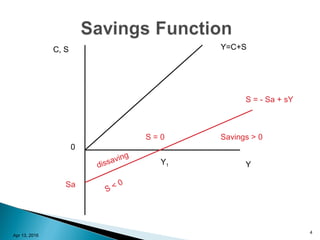
 When Y is zero, consumption cannot be
zero, consumers will have to borrow or
use their past savings.
 Therefore, when Y is zero, S < 0. This is
called Dissavings.
 As income increases, savings also
increase.
 Finally, S = 0, and then S > 0.
3
Apr 13, 2016
Apr 13, 2016
4
C, S
0
Y
Y=C+S
S = - Sa + sY
Sa
Y1dissaving
S < 0
S = 0 Savings > 0
 Average Propensity to Save: APS = S/Y
 Savings function is given by: S = − Sa + sY
 Here, Sa is the savings level when Y = 0, and it is
negative, and C > Y.
 When Y increases, C also increases but less than
Y, and C = Y. At this point S = 0.
 At higher incomes, S increases, but less than
income. So S/Y < 1, but positive.
APC + APS = 1
Apr 13, 2016
5
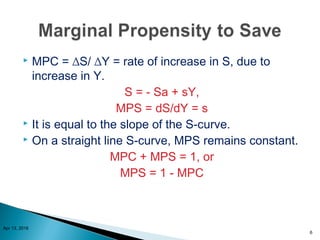
 MPC = ∆S/ ∆Y = rate of increase in S, due to
increase in Y.
S = - Sa + sY,
MPS = dS/dY = s
 It is equal to the slope of the S-curve.
 On a straight line S-curve, MPS remains constant.
MPC + MPS = 1, or
MPS = 1 - MPC
Apr 13, 2016
6
Y C S APC =
C/Y
APS =
S/Y
MPC =
∆C/∆Y
MPS =
∆S/∆Y
0 50 - 50
100 125 - 25 1.25 - 0.25 0.75 0.25
200 200 0 1 0 0.75 0.25
300 275 25 0.92 0.08 0.75 0.25
400 350 50 0.88 0.12 0.75 0.25
500 425 75 0.85 0.15 0.75 0.25
Apr 13, 2016
7
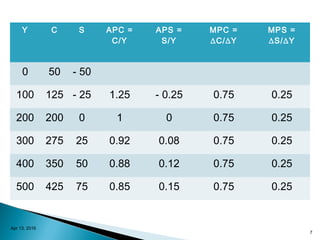
 From the table it can be seen that:
1.APC is > 1, when Y = 0, and falls as Y ↑.
2.APS is < 0, when Y = 0, and rises as Y ↑. But it is
always < 1.
3.APC + APS = 1
4.MPC is constant, since the C-function is a straight
line curve. MPC is the slope of the C-function.
5. MPS is also constant, since the S-function is a
straight line. MPS is the slope of the S-function.
6.MPC + MPS = 1
Apr 13, 2016
8

The Savings function

  • 1.
  • 2.
     Keynes showedthat Savings are a function of Y.  Not the rate of interest.  If Y ↑, then S ↑.  Savings is hoarding, money that is taken out of the Y-stream, and kept by the HH in the form of cash.  This is also called as Liquidity Preference. 2 Apr 13, 2016
  • 3.
     When Yis zero, consumption cannot be zero, consumers will have to borrow or use their past savings.  Therefore, when Y is zero, S < 0. This is called Dissavings.  As income increases, savings also increase.  Finally, S = 0, and then S > 0. 3 Apr 13, 2016
  • 4.
    Apr 13, 2016 4 C,S 0 Y Y=C+S S = - Sa + sY Sa Y1dissaving S < 0 S = 0 Savings > 0
  • 5.
     Average Propensityto Save: APS = S/Y  Savings function is given by: S = − Sa + sY  Here, Sa is the savings level when Y = 0, and it is negative, and C > Y.  When Y increases, C also increases but less than Y, and C = Y. At this point S = 0.  At higher incomes, S increases, but less than income. So S/Y < 1, but positive. APC + APS = 1 Apr 13, 2016 5
  • 6.
     MPC =∆S/ ∆Y = rate of increase in S, due to increase in Y. S = - Sa + sY, MPS = dS/dY = s  It is equal to the slope of the S-curve.  On a straight line S-curve, MPS remains constant. MPC + MPS = 1, or MPS = 1 - MPC Apr 13, 2016 6
  • 7.
    Y C SAPC = C/Y APS = S/Y MPC = ∆C/∆Y MPS = ∆S/∆Y 0 50 - 50 100 125 - 25 1.25 - 0.25 0.75 0.25 200 200 0 1 0 0.75 0.25 300 275 25 0.92 0.08 0.75 0.25 400 350 50 0.88 0.12 0.75 0.25 500 425 75 0.85 0.15 0.75 0.25 Apr 13, 2016 7
  • 8.
     From thetable it can be seen that: 1.APC is > 1, when Y = 0, and falls as Y ↑. 2.APS is < 0, when Y = 0, and rises as Y ↑. But it is always < 1. 3.APC + APS = 1 4.MPC is constant, since the C-function is a straight line curve. MPC is the slope of the C-function. 5. MPS is also constant, since the S-function is a straight line. MPS is the slope of the S-function. 6.MPC + MPS = 1 Apr 13, 2016 8