WATER BALANCE
PRECIPITATION
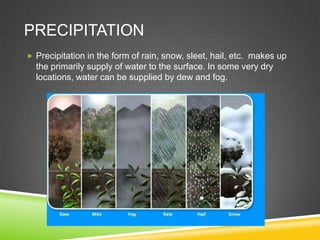
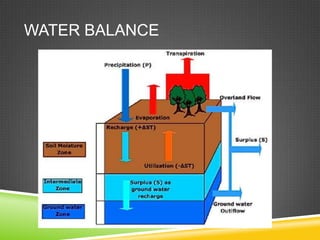
 Precipitation in the form of rain, snow, sleet, hail, etc. makes up
  the primarily supply of water to the surface. In some very dry
  locations, water can be supplied by dew and fog.
EVAPOTRANSPIRATION (EVT)
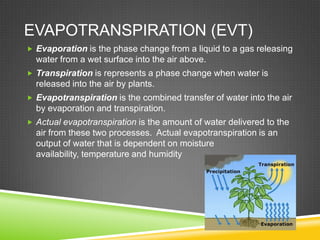
 Evaporation is the phase change from a liquid to a gas releasing
  water from a wet surface into the air above.
 Transpiration is represents a phase change when water is
  released into the air by plants.
 Evapotranspiration is the combined transfer of water into the air
  by evaporation and transpiration.
 Actual evapotranspiration is the amount of water delivered to the
  air from these two processes. Actual evapotranspiration is an
  output of water that is dependent on moisture
  availability, temperature and humidity
POTENTIAL EVAPOTRANSPIRATION
(P.EVT)
 Potential evapotranspiration is the amount of water that would be
  evaporated under an optimal set of conditions, among which is an
  unlimited supply of water.
 The water loss that would occur if there was an unlimited supply
  of water.
WATER BALANCE
WATER BALANCE
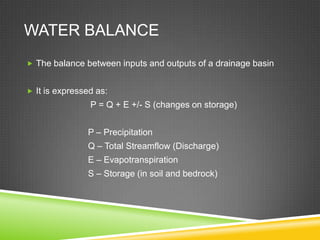
 The balance between inputs and outputs of a drainage basin


 It is expressed as:
                P = Q + E +/- S (changes on storage)


               P – Precipitation
               Q – Total Streamflow (Discharge)
               E – Evapotranspiration
               S – Storage (in soil and bedrock)
WATER BALANCE
Water balance

Water balance

  • 1.
  • 2.
    PRECIPITATION  Precipitation inthe form of rain, snow, sleet, hail, etc. makes up the primarily supply of water to the surface. In some very dry locations, water can be supplied by dew and fog.
  • 3.
    EVAPOTRANSPIRATION (EVT)  Evaporationis the phase change from a liquid to a gas releasing water from a wet surface into the air above.  Transpiration is represents a phase change when water is released into the air by plants.  Evapotranspiration is the combined transfer of water into the air by evaporation and transpiration.  Actual evapotranspiration is the amount of water delivered to the air from these two processes. Actual evapotranspiration is an output of water that is dependent on moisture availability, temperature and humidity
  • 4.
    POTENTIAL EVAPOTRANSPIRATION (P.EVT)  Potentialevapotranspiration is the amount of water that would be evaporated under an optimal set of conditions, among which is an unlimited supply of water.  The water loss that would occur if there was an unlimited supply of water.
  • 5.
  • 6.
    WATER BALANCE  Thebalance between inputs and outputs of a drainage basin  It is expressed as: P = Q + E +/- S (changes on storage) P – Precipitation Q – Total Streamflow (Discharge) E – Evapotranspiration S – Storage (in soil and bedrock)
  • 7.

Editor's Notes

  • #5 The difference between actual EVT and P.EVT is in the concept moisture availability.E.g. flower pot.
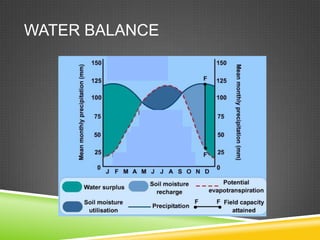
  • #8 Here are some questions and answers that will help you to learn to read the graph accurately:In which months is there a water surplus?Jan, Feb, Mar, Apr, Nov, Dec.Why is there soil moisture recharge in October?Due to the excess of evapotranspiration over precipitation in May - Sept.When is field capacity attained?November.Why is a water deficit not shown on the graph?Precipitation always far exceeds evapotranspiration.