Simple Past vs. Present   Perfect When do we use each tense in English?
Remember : Grammar has meaning! Different grammar tenses are used in different situations or contexts and they carry different meanings. For example . . .
Use the  simple past  for action that happened in the past and is: over ,  done ,  finished ! Use the  present perfect  for action that started in the past, but . . . is still true today.
The  simple past  always refers to an action or situation that is  finished . The  present perfect   connects  the past and the present. It is used to show that an action or situation in the past: -continues today, OR -might happen again
Compare the  meaning  of these two sentences: 1. Sara  lived  in Boston for 5 years. 2. Sara  has lived  in Boston for 5 years. The first sentence uses: Simple Past The second sentence uses:  Present Perfect
Sara  lived  in Boston for 5 years. Meaning:  by using the simple past tense, we mean that Sara started living in Boston 5 years ago . . . AND . . . then she  moved ! Now she lives in a different city, like Paris. Remember, the simple past is used for a situation that is  over, finished, done!
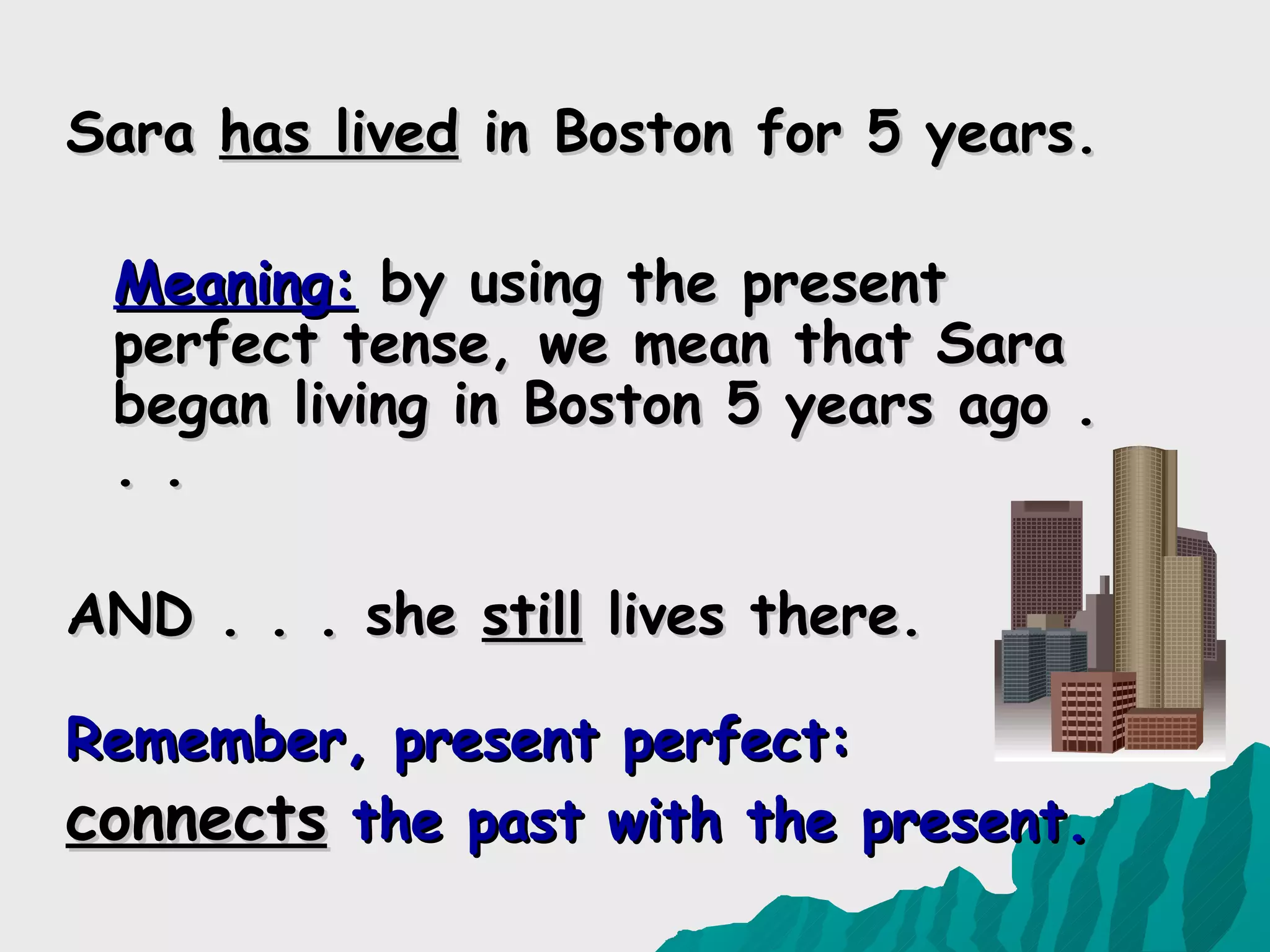
Sara  has lived  in Boston for 5 years. Meaning:  by using the present perfect tense, we mean that Sara began living in Boston 5 years ago . . . AND . . . she  still  lives there. Remember, present perfect: connects  the past with the present.
Use the  simple past  with time words like: yesterday last  Saturday, week, month, year, etc. _______ ago when I was… in 1990  (past date) Use the  present perfect  with time words like: recently/lately since … so far this  week, month, year, etc.
Additional notes about  present perfect: We often use present perfect to say that something happened sooner than expected. Example:   Jan: Don’t forget to mail that letter. Tom: I ’ve   already   mailed  it.
We often use present perfect to say that we have  never  done something at any time in the past. Example:   I  have never visited  London.  But someday, I hope to travel there.
We often use present perfect with the expression: “ This is the first time .” Example:   Leonard is nervous.  This is the first time he has flown  on an airplane!
We often use present perfect with “ever” and “never.” Example:   Patricia:  Have you ever played tennis? Linda:  No, I’ve never played before, but I would like to learn!
Remember! If you are talking about a specific time in the past (yesterday, last month, etc.), you  cannot  use the present perfect. In these cases, use the simple past.
For Affirmative He / She / It  + HAS  + Past Participle (=3rd column) I / You / We / They  +HAVE  + Past Participle (=3rd column)
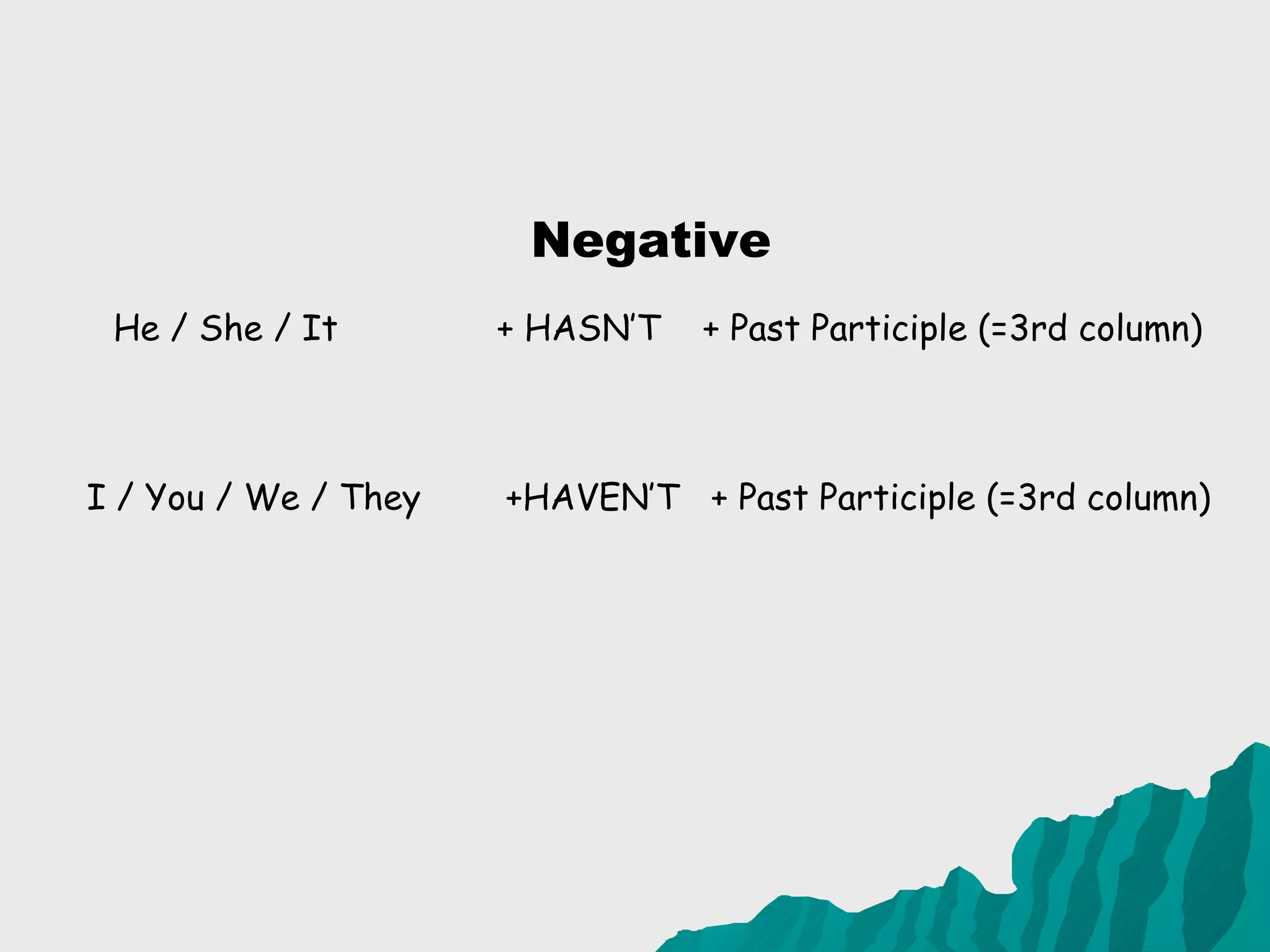
Negative He / She / It  + HASN’T  + Past Participle (=3rd column) I / You / We / They  +HAVEN’T  + Past Participle (=3rd column)
INTERROGATIVE HAS  +  HE /SHE /IT  + Past Participle (=3rd column)…? HAVE  + I / YOU / WE / THEY  + Past Participle(=3rd column)…?
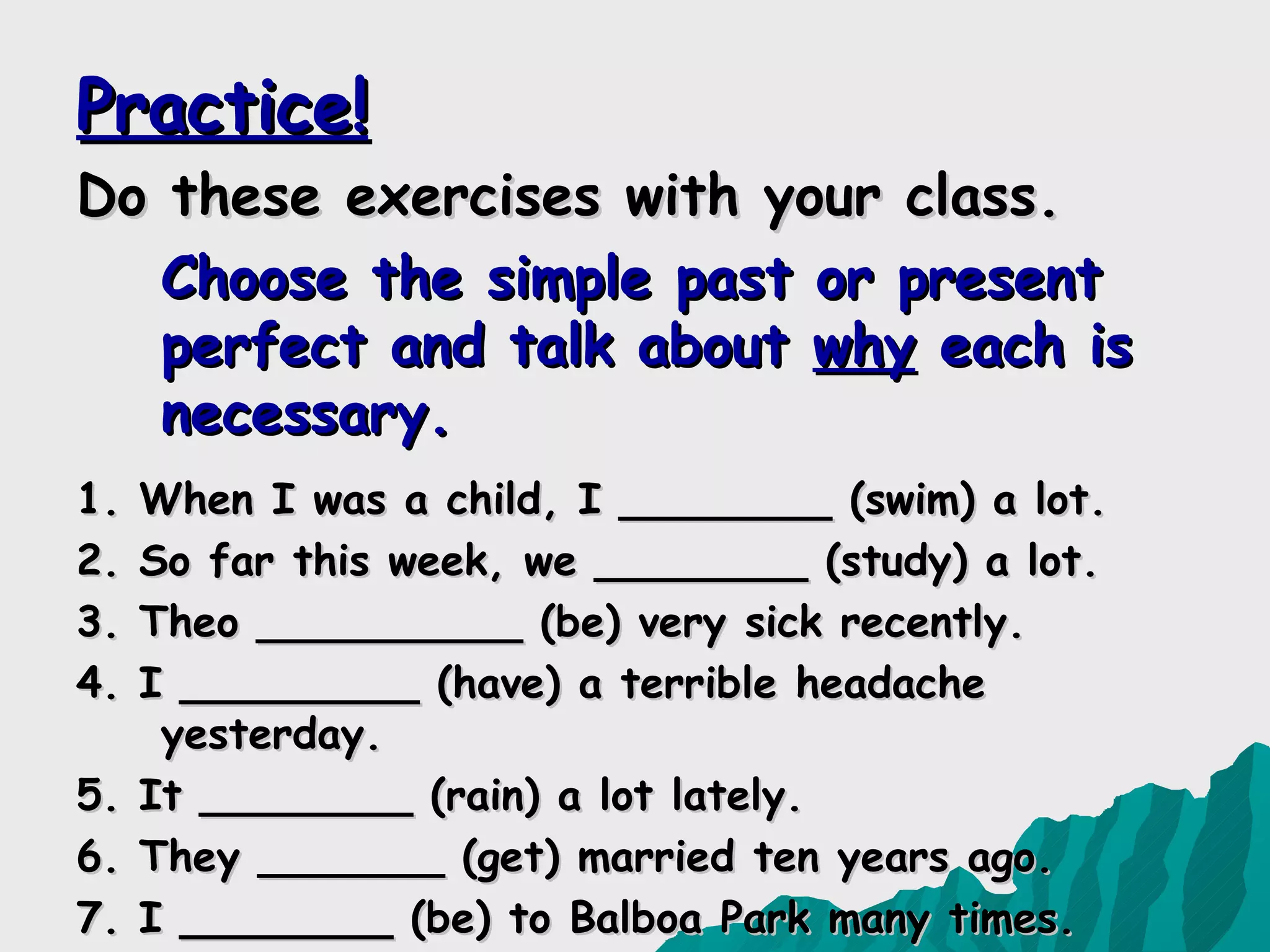
Practice! Do these exercises with your class. Choose the simple past or present perfect and talk about  why  each is necessary. 1. When I was a child, I ________ (swim) a lot. 2. So far this week, we ________ (study) a lot. 3. Theo __________ (be) very sick recently. 4. I _________ (have) a terrible headache yesterday. 5. It ________ (rain) a lot lately.  6. They _______ (get) married ten years ago. 7. I ________ (be) to Balboa Park many times. 8. My family ________ (take) a vacation last year.
Answers! 1.  When I was a child , I  swam  a lot. 2.  So far this week , we  have studied  a lot. 3. Theo  has been  very sick  recently . 4. I  had  a terrible headache  yesterday . 5. It  has rained  a lot  lately .  6. They  got  married  ten years ago . 7. I  have been  to Balboa Park  many times.  (possibly again in the future) 8. My family  took  a vacation  last year .
For more practice, 1) Go to our  class website : www.ecc6.blogspot.com 2) On the right side, click on  Grammar   Site .  Then click on  410 . 3) Click on  Grammar , and then go down the page to  Verbs .  Click on the  present perfect  for explanation and practice.

Simple past vs. present perfect tense

  • 1.
    Simple Past vs.Present Perfect When do we use each tense in English?
  • 2.
    Remember : Grammarhas meaning! Different grammar tenses are used in different situations or contexts and they carry different meanings. For example . . .
  • 3.
    Use the simple past for action that happened in the past and is: over , done , finished ! Use the present perfect for action that started in the past, but . . . is still true today.
  • 4.
    The simplepast always refers to an action or situation that is finished . The present perfect connects the past and the present. It is used to show that an action or situation in the past: -continues today, OR -might happen again
  • 5.
    Compare the meaning of these two sentences: 1. Sara lived in Boston for 5 years. 2. Sara has lived in Boston for 5 years. The first sentence uses: Simple Past The second sentence uses: Present Perfect
  • 6.
    Sara lived in Boston for 5 years. Meaning: by using the simple past tense, we mean that Sara started living in Boston 5 years ago . . . AND . . . then she moved ! Now she lives in a different city, like Paris. Remember, the simple past is used for a situation that is over, finished, done!
  • 7.
    Sara haslived in Boston for 5 years. Meaning: by using the present perfect tense, we mean that Sara began living in Boston 5 years ago . . . AND . . . she still lives there. Remember, present perfect: connects the past with the present.
  • 8.
    Use the simple past with time words like: yesterday last Saturday, week, month, year, etc. _______ ago when I was… in 1990 (past date) Use the present perfect with time words like: recently/lately since … so far this week, month, year, etc.
  • 9.
    Additional notes about present perfect: We often use present perfect to say that something happened sooner than expected. Example: Jan: Don’t forget to mail that letter. Tom: I ’ve already mailed it.
  • 10.
    We often usepresent perfect to say that we have never done something at any time in the past. Example: I have never visited London. But someday, I hope to travel there.
  • 11.
    We often usepresent perfect with the expression: “ This is the first time .” Example: Leonard is nervous. This is the first time he has flown on an airplane!
  • 12.
    We often usepresent perfect with “ever” and “never.” Example: Patricia: Have you ever played tennis? Linda: No, I’ve never played before, but I would like to learn!
  • 13.
    Remember! If youare talking about a specific time in the past (yesterday, last month, etc.), you cannot use the present perfect. In these cases, use the simple past.
  • 14.
    For Affirmative He/ She / It + HAS + Past Participle (=3rd column) I / You / We / They +HAVE + Past Participle (=3rd column)
  • 15.
    Negative He /She / It + HASN’T + Past Participle (=3rd column) I / You / We / They +HAVEN’T + Past Participle (=3rd column)
  • 16.
    INTERROGATIVE HAS + HE /SHE /IT + Past Participle (=3rd column)…? HAVE + I / YOU / WE / THEY + Past Participle(=3rd column)…?
  • 17.
    Practice! Do theseexercises with your class. Choose the simple past or present perfect and talk about why each is necessary. 1. When I was a child, I ________ (swim) a lot. 2. So far this week, we ________ (study) a lot. 3. Theo __________ (be) very sick recently. 4. I _________ (have) a terrible headache yesterday. 5. It ________ (rain) a lot lately. 6. They _______ (get) married ten years ago. 7. I ________ (be) to Balboa Park many times. 8. My family ________ (take) a vacation last year.
  • 18.
    Answers! 1. When I was a child , I swam a lot. 2. So far this week , we have studied a lot. 3. Theo has been very sick recently . 4. I had a terrible headache yesterday . 5. It has rained a lot lately . 6. They got married ten years ago . 7. I have been to Balboa Park many times. (possibly again in the future) 8. My family took a vacation last year .
  • 19.
    For more practice,1) Go to our class website : www.ecc6.blogspot.com 2) On the right side, click on Grammar Site . Then click on 410 . 3) Click on Grammar , and then go down the page to Verbs . Click on the present perfect for explanation and practice.