Pre-hospital Rapid Sequence
            Intubation


                        Dr Peter Sherren
Senior registrar Anaesthesia, Intensive Care and Pre-hospital care
   The Royal London Hospital and Greater Sydney Area HEMS
Objectives
• Why?
• Who?
• How?
• Evidence
Introduction
• Controversial/Territorial/Evocative topic!
• Early appropriate airway control central to
  good trauma care
• Why not bring a hospital level of care to the
  roadside?
Why?
• Like haemorrhage, airway compromise is a
  significant cause of preventable deaths
• Hypoxia common on scene in trauma. Stochetti et al. J
  Trauma 1997

• Hypoxia and hypercarbia associated with
  increased morbidity and mortality in TBI. Sherren PB et
  al. Curr Opin Anesthesiol 2012

• ETI is gold standard in hospital
• Patient and pathology have no respect for
  geography
How? - Intubation without drugs or
           sedation only
• Successful ETI of trauma pts without drugs ~
  mortality 99.8%. Lockey D et al. BMJ 2001.
• Low success rates in patients with reflexes
  intact (5-30%)
• ETI with sedation
     • Still a low success rate
     • ↑Secondary brain injury
     • ↑Mortality
SOLUTION = RAPID
SEQUENCE INTUBATION
       (RSI)?
Components of RSI
•   Preoxygenation
•   Premedication
•   Rapid induction of Anaesthesia
•   MILS ± Cricoid
•   Rapid onset neuromuscular relaxation
•   Ideally no BVM ventilation
•   ETI and confirmation
•   Maintenance of Anaesthesia and paralysis
Components of RSI
•   Preoxygenation definitive airway control
       Drug assisted
•   Premedication
•   Rapid induction of Anaesthesia
       Minimising time from induction to ETI
•   MILS ± Cricoid
•   Rapid onset neuromuscular relaxation
            Decreased gastric insufflation
•   Ideally no BVM ventilation
•   ETI and confirmation
      Decreased risk of hypoxia and aspiration
•   Maintenance of Anaesthesia and paralysis
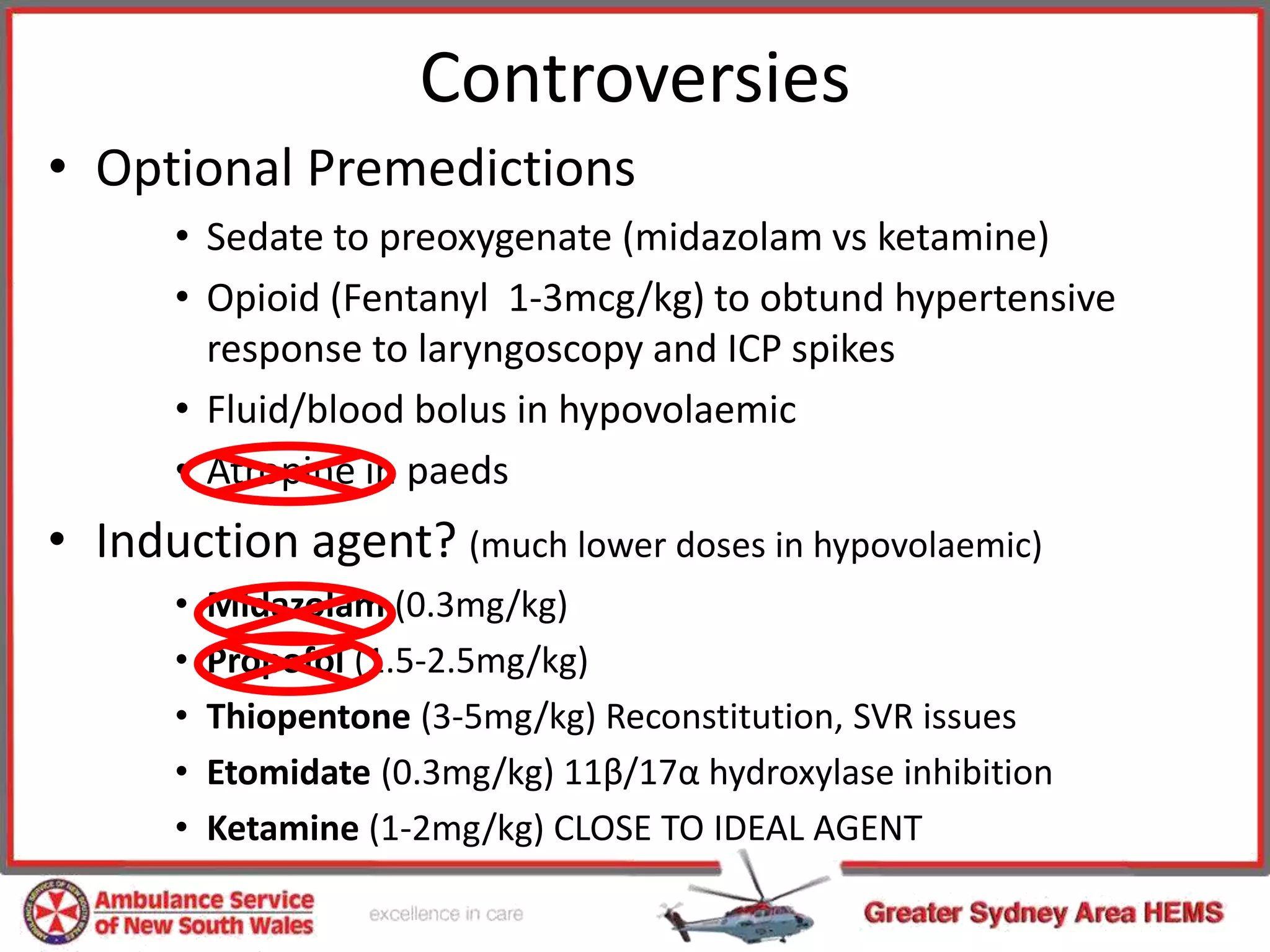
Controversies
• Optional Premedictions
      • Sedate to preoxygenate (midazolam vs ketamine)
      • Opioid (Fentanyl 1-3mcg/kg) to obtund hypertensive
        response to laryngoscopy and ICP spikes
      • Fluid/blood bolus in hypovolaemic
      • Atropine in paeds
• Induction agent? (much lower doses in hypovolaemic)
      •   Midazolam (0.3mg/kg)
      •   Propofol (1.5-2.5mg/kg)
      •   Thiopentone (3-5mg/kg) Reconstitution, SVR issues
      •   Etomidate (0.3mg/kg) 11β/17α hydroxylase inhibition
      •   Ketamine (1-2mg/kg) CLOSE TO IDEAL AGENT
Controversies
• Optional Premedictions
      • Sedate to preoxygenate (midazolam vs ketamine)
      • Opioid (Fentanyl 1-3mcg/kg) to obtund hypertensive
        response to laryngoscopy and ICP spikes
      • Fluid/blood bolus in hypovolaemic
      • Atropine in paeds
• Induction agent? (much lower doses in hypovolaemic)
      •   Midazolam (0.3mg/kg)
      •   Propofol (1.5-2.5mg/kg)
      •   Thiopentone (3-5mg/kg) Reconstitution, SVR issues
      •   Etomidate (0.3mg/kg) 11β/17α hydroxylase inhibition
      •   Ketamine (1-2mg/kg) CLOSE TO IDEAL AGENT
Controversies
• Neuromuscular blockade
     • Suxamethonium (1.5-2mg/kg) – Rapid, familiarity and
       obvious fasciculation end point but dirty drug
     • Rocuronium (1.2mg/kg) – Rapid, improved side effect
       profile and prolonged safe apnoea time


• Cricoid pressure - poor evidence & ↑ Difficult
  intubation. Harris T et al. Resuscitation 2010
Bottom line
• Generally right drug, at the right time, at the
  right dose………

• Pre-hospital=high risk → Simplified evidence
  based Standard Operating Procedures (SOP)

• Remove individual practice in high risk
  environment, improve CRM and reduce
  human error
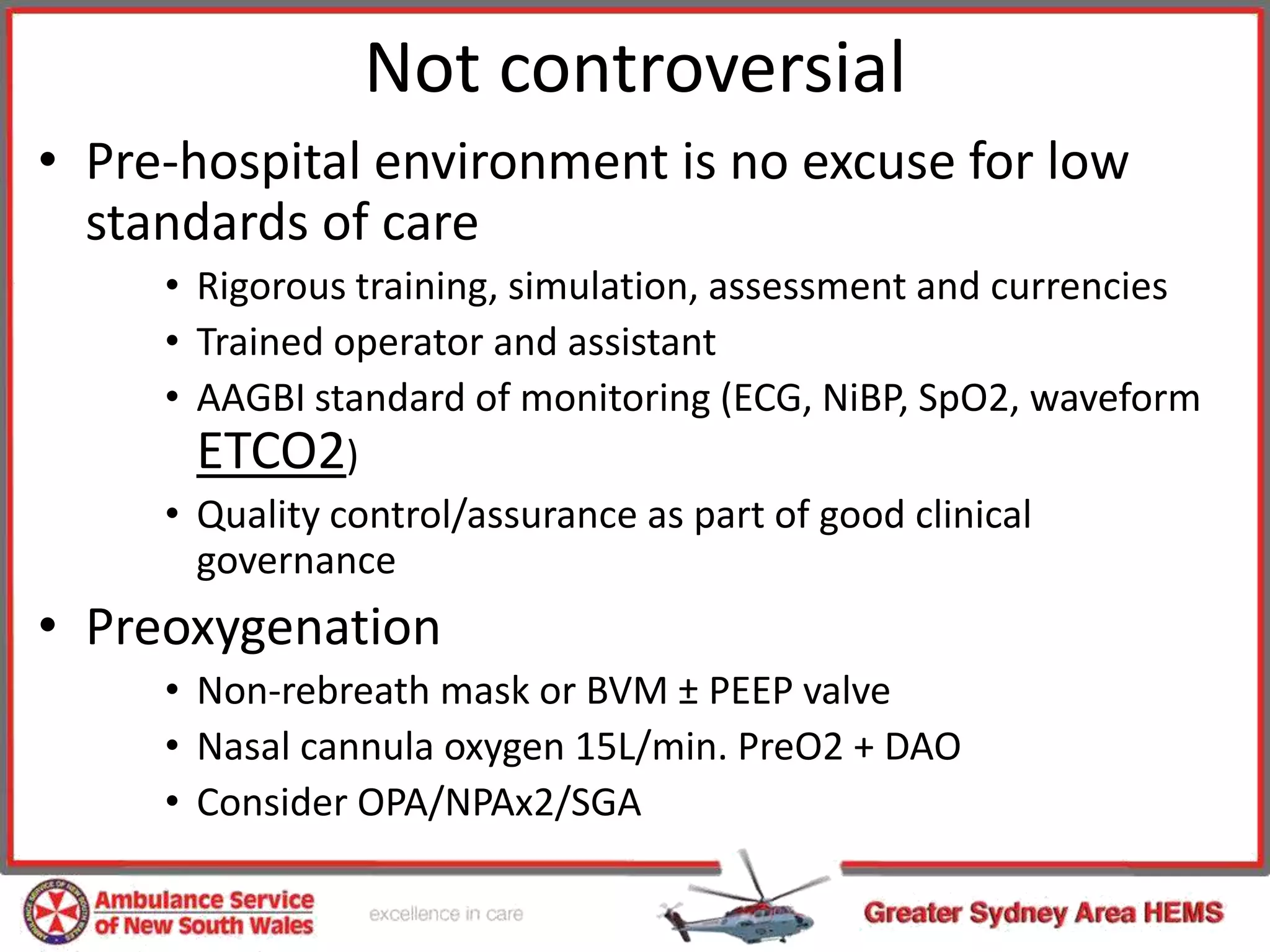
Not controversial
• Pre-hospital environment is no excuse for low
  standards of care
     • Rigorous training, simulation, assessment and currencies
     • Trained operator and assistant
     • AAGBI standard of monitoring (ECG, NiBP, SpO2, waveform
       ETCO2)
     • Quality control/assurance as part of good clinical
       governance
• Preoxygenation
     • Non-rebreath mask or BVM ± PEEP valve
     • Nasal cannula oxygen 15L/min. PreO2 + DAO
     • Consider OPA/NPAx2/SGA
Still not controversial
• MILS - remove C-collar
• Maximise 1st pass
  intubation success
   •   Control your environment
   •   360 degree access
   •   Optimise position
   •   Use bougie for all cases
   •   Standardised equipment
       and techniques
• Formalised failed
  intubation and
  oxygenation drills
Who?
• Impending or actual failure of airway patency
• Failure of airway protection
• Oxygenation or ventilation failure
• Injured patients who are unmanageable or
  severely agitated after head injury
• Humanitarian indications
• Anticipated clinical course
So we think pre-hospital RSI has a
place, but who should be doing it?

               ↓
  A TRAINED AND COMPETENT
            TEAM
Physician-paramedic team
• Good medical
  experience
• Anaesthetic
  experience
• Doctor ≠ pre-hospital
  RSI competent!
• Additional pre-hospital
  training
• Cost
• Availability
Double Paramedic or paramedic/air
              crewman
• At home in the pre-
  hospital environment
• Experienced++
• Infrastructure and
  governance needed
• Infrequent occurrence
  for those purely
  working out of hospital;
  skill maintenance issue
Do paramedics want to do it?
• 99 London HEMS paramedics were asked if
  they felt RSI should be part of experienced UK
  paramedic’s practice (courtesy of Prof D Lockey)
     • 65% said yes pre-term at London HEMS
     • Only 32% said yes on completion of their term working
       for HEMS


• Isolated to London HEMS?
Success rates of pre-hospital RSI
• Physician/paramedic team
  •   99.4% London HEMS (348/350) Mackay CA et al. Emerg Med J 2001
  •   98.8% London HEMS (397/402) Harris T et al. Resuscitation 2010
  •   99.5% GSA-HEMS (185/186) Bloomer R et al. Emerg Med J 2012
  •   99.1% SAMU France (685/691) Adnet F et al. Ann Emerg Med 1998
  •   100% Germany (342/342) Helm M et al. Br J Anaesth 2006
• Paramedic
  • 97% MICA Victoria (152/157) Bernard SA et al. Ann Surg 2010
  • 96% Auckland rescue helicopter (~280) Tony Smith
  • 86.7% San Diego (281/209) Davis DP et al. J Trauma 2003
Are failed intubations an issue?
• Yes, but....
   • Can’t Intubate Can’t Oxygenate much worse
   • Failure to detect an oesophageal intubation or misplaced
     ETT is much worse
   • Undetected oesophageal intubations during RSI should
     really be a ‘NEVER’ event
   • Continuous ETCO2 monitoring reduces UNDETECTED
     misplaced intubations from 23.3% to 0%. Silvestri S et al. Ann
     Emerg Med 2005


   Waveform capnography/ETCO2
•   209 RSI, 627 historical controls
•   Mortality - RSI vs control, 33% vs 24% (p <0.05)
•   Good outcome – RSI vs control, 57% vs 45% (p <0.01)
•   High rates of hypotension, hypoxaemia, hypercarbia
•   Low intubation success
•   Longer scene times
•   Training issue?
•   Use of ETCO2 not universal
• 312 pts RCT
• MICA paramedics with ETCO2
• Midazolam/Sux
• 97% success rate, 5 oesophageal intubations
  recognised
• Favourable outcome - 51% pre-hospital RSI compared
  39% controls (p <0.05)
• 13 lost to follow up, 1 more +ve outcome in control
  group would result in NS result
• Prospective RCT by Careflight, awaiting
  publication
• Physician/paramedic vs standard care
• 338 recruited over 6yrs, needed 510 pts
• -ve primary outcome (GOSE 6 months)
• High cross over between groups
• When ASNSW physician/paramedic team added
  to careflight team data -> improved odds of
  survival at discharge (p-0.02)
Pre-hospital RSI is here to stay, so
    how do we make it safer?
PRE-HOSPITAL RSI
               ↓
         KEEP IT SIMPLE
               ↓
     STANDARDISE PRACTICE
(equipment, techniques and drugs)
               ↓
      AVOID HUMAN ERROR
               ↓
         IMPROVE CRM
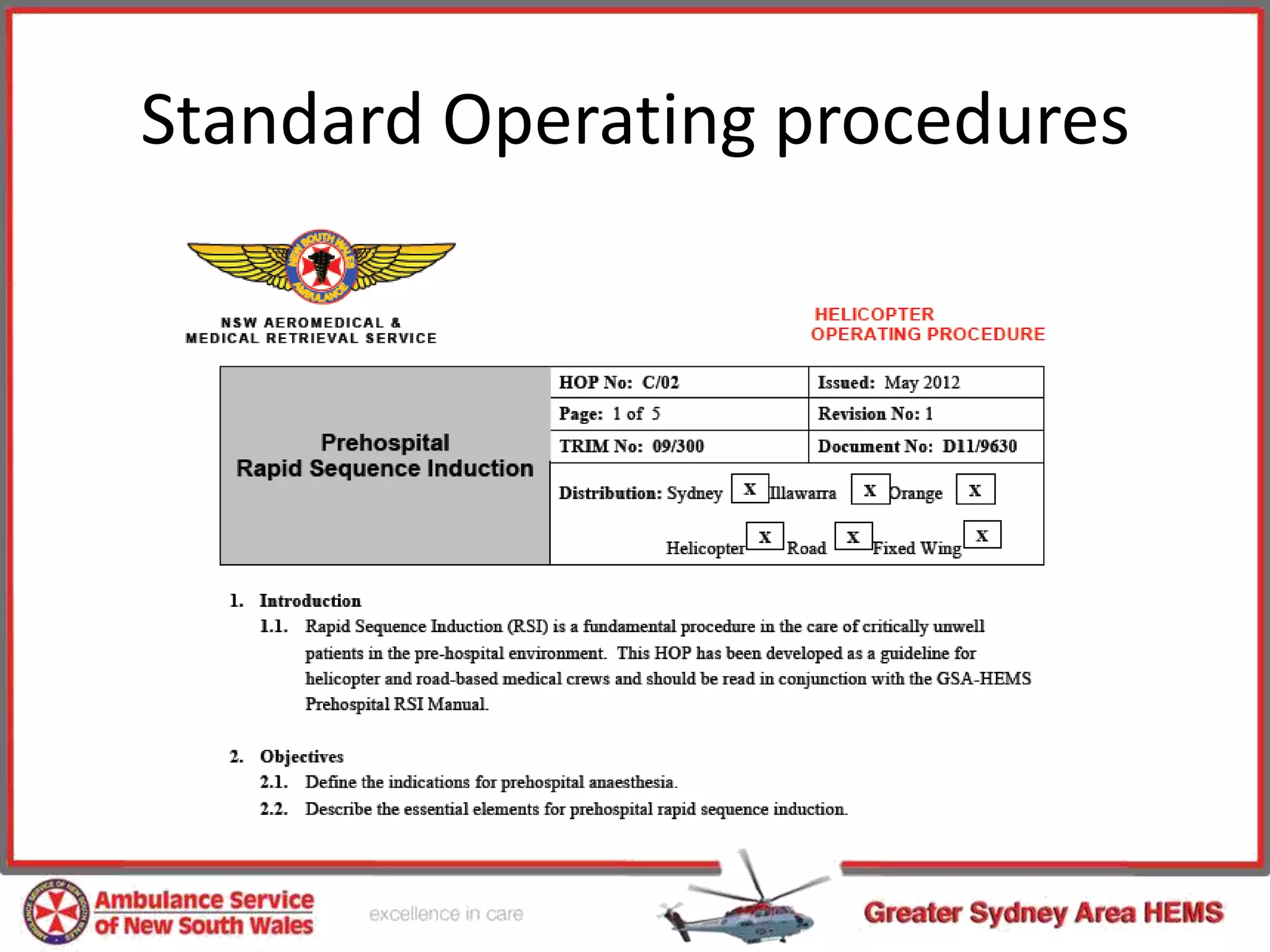
Standard Operating procedures
Standardised pre-hospital drugs
• Pre-drawn drugs
     •   Ketamine 200mg/20ml
     •   Suxamethonium 100mg/2ml (x2)
     •   Midazolam 10mg/10ml
     •   Morphine 10mg/10ml
• Spare Ampoules
     •   Rocuronium 50mg/5ml (x2)
     •   Fentanyl 500mcg/10ml (x2)
     •   Midazolam 15mg/3ml
     •   Ketamine 200mg/2ml (x5)
In hospital level of monitoring
        and Kit dump
Challenge response checklist
Quality assurance and clinical
         governance
Training and simulation
Summary
• Pre-hospital RSI is indicated in certain patients
• High risk intervention that needs to be
  delivered in a quality assured manner
• Pre-hospital RSI done badly is worse than
  standard management
• Some evidence for a morbidity and mortality
  benefit
Questions?

Pre hospital rapid sequence intubation

  • 1.
    Pre-hospital Rapid Sequence Intubation Dr Peter Sherren Senior registrar Anaesthesia, Intensive Care and Pre-hospital care The Royal London Hospital and Greater Sydney Area HEMS
  • 2.
  • 3.
    Introduction • Controversial/Territorial/Evocative topic! •Early appropriate airway control central to good trauma care • Why not bring a hospital level of care to the roadside?
  • 4.
    Why? • Like haemorrhage,airway compromise is a significant cause of preventable deaths • Hypoxia common on scene in trauma. Stochetti et al. J Trauma 1997 • Hypoxia and hypercarbia associated with increased morbidity and mortality in TBI. Sherren PB et al. Curr Opin Anesthesiol 2012 • ETI is gold standard in hospital • Patient and pathology have no respect for geography
  • 5.
    How? - Intubationwithout drugs or sedation only • Successful ETI of trauma pts without drugs ~ mortality 99.8%. Lockey D et al. BMJ 2001. • Low success rates in patients with reflexes intact (5-30%) • ETI with sedation • Still a low success rate • ↑Secondary brain injury • ↑Mortality
  • 6.
    SOLUTION = RAPID SEQUENCEINTUBATION (RSI)?
  • 7.
    Components of RSI • Preoxygenation • Premedication • Rapid induction of Anaesthesia • MILS ± Cricoid • Rapid onset neuromuscular relaxation • Ideally no BVM ventilation • ETI and confirmation • Maintenance of Anaesthesia and paralysis
  • 8.
    Components of RSI • Preoxygenation definitive airway control Drug assisted • Premedication • Rapid induction of Anaesthesia Minimising time from induction to ETI • MILS ± Cricoid • Rapid onset neuromuscular relaxation Decreased gastric insufflation • Ideally no BVM ventilation • ETI and confirmation Decreased risk of hypoxia and aspiration • Maintenance of Anaesthesia and paralysis
  • 9.
    Controversies • Optional Premedictions • Sedate to preoxygenate (midazolam vs ketamine) • Opioid (Fentanyl 1-3mcg/kg) to obtund hypertensive response to laryngoscopy and ICP spikes • Fluid/blood bolus in hypovolaemic • Atropine in paeds • Induction agent? (much lower doses in hypovolaemic) • Midazolam (0.3mg/kg) • Propofol (1.5-2.5mg/kg) • Thiopentone (3-5mg/kg) Reconstitution, SVR issues • Etomidate (0.3mg/kg) 11β/17α hydroxylase inhibition • Ketamine (1-2mg/kg) CLOSE TO IDEAL AGENT
  • 10.
    Controversies • Optional Premedictions • Sedate to preoxygenate (midazolam vs ketamine) • Opioid (Fentanyl 1-3mcg/kg) to obtund hypertensive response to laryngoscopy and ICP spikes • Fluid/blood bolus in hypovolaemic • Atropine in paeds • Induction agent? (much lower doses in hypovolaemic) • Midazolam (0.3mg/kg) • Propofol (1.5-2.5mg/kg) • Thiopentone (3-5mg/kg) Reconstitution, SVR issues • Etomidate (0.3mg/kg) 11β/17α hydroxylase inhibition • Ketamine (1-2mg/kg) CLOSE TO IDEAL AGENT
  • 11.
    Controversies • Neuromuscular blockade • Suxamethonium (1.5-2mg/kg) – Rapid, familiarity and obvious fasciculation end point but dirty drug • Rocuronium (1.2mg/kg) – Rapid, improved side effect profile and prolonged safe apnoea time • Cricoid pressure - poor evidence & ↑ Difficult intubation. Harris T et al. Resuscitation 2010
  • 12.
    Bottom line • Generallyright drug, at the right time, at the right dose……… • Pre-hospital=high risk → Simplified evidence based Standard Operating Procedures (SOP) • Remove individual practice in high risk environment, improve CRM and reduce human error
  • 13.
    Not controversial • Pre-hospitalenvironment is no excuse for low standards of care • Rigorous training, simulation, assessment and currencies • Trained operator and assistant • AAGBI standard of monitoring (ECG, NiBP, SpO2, waveform ETCO2) • Quality control/assurance as part of good clinical governance • Preoxygenation • Non-rebreath mask or BVM ± PEEP valve • Nasal cannula oxygen 15L/min. PreO2 + DAO • Consider OPA/NPAx2/SGA
  • 14.
    Still not controversial •MILS - remove C-collar • Maximise 1st pass intubation success • Control your environment • 360 degree access • Optimise position • Use bougie for all cases • Standardised equipment and techniques • Formalised failed intubation and oxygenation drills
  • 15.
    Who? • Impending oractual failure of airway patency • Failure of airway protection • Oxygenation or ventilation failure • Injured patients who are unmanageable or severely agitated after head injury • Humanitarian indications • Anticipated clinical course
  • 17.
    So we thinkpre-hospital RSI has a place, but who should be doing it? ↓ A TRAINED AND COMPETENT TEAM
  • 18.
    Physician-paramedic team • Goodmedical experience • Anaesthetic experience • Doctor ≠ pre-hospital RSI competent! • Additional pre-hospital training • Cost • Availability
  • 19.
    Double Paramedic orparamedic/air crewman • At home in the pre- hospital environment • Experienced++ • Infrastructure and governance needed • Infrequent occurrence for those purely working out of hospital; skill maintenance issue
  • 20.
    Do paramedics wantto do it? • 99 London HEMS paramedics were asked if they felt RSI should be part of experienced UK paramedic’s practice (courtesy of Prof D Lockey) • 65% said yes pre-term at London HEMS • Only 32% said yes on completion of their term working for HEMS • Isolated to London HEMS?
  • 21.
    Success rates ofpre-hospital RSI • Physician/paramedic team • 99.4% London HEMS (348/350) Mackay CA et al. Emerg Med J 2001 • 98.8% London HEMS (397/402) Harris T et al. Resuscitation 2010 • 99.5% GSA-HEMS (185/186) Bloomer R et al. Emerg Med J 2012 • 99.1% SAMU France (685/691) Adnet F et al. Ann Emerg Med 1998 • 100% Germany (342/342) Helm M et al. Br J Anaesth 2006 • Paramedic • 97% MICA Victoria (152/157) Bernard SA et al. Ann Surg 2010 • 96% Auckland rescue helicopter (~280) Tony Smith • 86.7% San Diego (281/209) Davis DP et al. J Trauma 2003
  • 22.
    Are failed intubationsan issue? • Yes, but.... • Can’t Intubate Can’t Oxygenate much worse • Failure to detect an oesophageal intubation or misplaced ETT is much worse • Undetected oesophageal intubations during RSI should really be a ‘NEVER’ event • Continuous ETCO2 monitoring reduces UNDETECTED misplaced intubations from 23.3% to 0%. Silvestri S et al. Ann Emerg Med 2005 Waveform capnography/ETCO2
  • 23.
    209 RSI, 627 historical controls • Mortality - RSI vs control, 33% vs 24% (p <0.05) • Good outcome – RSI vs control, 57% vs 45% (p <0.01) • High rates of hypotension, hypoxaemia, hypercarbia • Low intubation success • Longer scene times • Training issue? • Use of ETCO2 not universal
  • 24.
    • 312 ptsRCT • MICA paramedics with ETCO2 • Midazolam/Sux • 97% success rate, 5 oesophageal intubations recognised • Favourable outcome - 51% pre-hospital RSI compared 39% controls (p <0.05) • 13 lost to follow up, 1 more +ve outcome in control group would result in NS result
  • 25.
    • Prospective RCTby Careflight, awaiting publication • Physician/paramedic vs standard care • 338 recruited over 6yrs, needed 510 pts • -ve primary outcome (GOSE 6 months) • High cross over between groups • When ASNSW physician/paramedic team added to careflight team data -> improved odds of survival at discharge (p-0.02)
  • 26.
    Pre-hospital RSI ishere to stay, so how do we make it safer?
  • 28.
    PRE-HOSPITAL RSI ↓ KEEP IT SIMPLE ↓ STANDARDISE PRACTICE (equipment, techniques and drugs) ↓ AVOID HUMAN ERROR ↓ IMPROVE CRM
  • 29.
  • 30.
    Standardised pre-hospital drugs •Pre-drawn drugs • Ketamine 200mg/20ml • Suxamethonium 100mg/2ml (x2) • Midazolam 10mg/10ml • Morphine 10mg/10ml • Spare Ampoules • Rocuronium 50mg/5ml (x2) • Fentanyl 500mcg/10ml (x2) • Midazolam 15mg/3ml • Ketamine 200mg/2ml (x5)
  • 31.
    In hospital levelof monitoring and Kit dump
  • 32.
  • 33.
    Quality assurance andclinical governance
  • 34.
  • 35.
    Summary • Pre-hospital RSIis indicated in certain patients • High risk intervention that needs to be delivered in a quality assured manner • Pre-hospital RSI done badly is worse than standard management • Some evidence for a morbidity and mortality benefit
  • 36.