PROLINE
PRESENTED BY
NOUR ELHODA TAMIM
UNDER SUPERVISION
DR.HANY SROUR
STRUCTURE OF PROLINE
• Proline shares many properties with the aliphatic
group.
• Proline is formally NOT an amino acid, but an imino
acid. Nonetheless, it is called an amino acid
• Nonpolar.
INTRODUCTION
Proline (Pro) accumulation occurs in eubacteria, protozoa,
marine invertebrates and plants after various stresses.
 In plants, Pro accumulation has been reported to occur
after salt, drought, high temperature, low temperature,
heavy metal, pathogen infection, anaerobiosis, nutrient
deficiency, atmospheric pollution and UV irradiation.
The level of Pro accumulation in plants varies from species
to species and can be 100 times greater than in control
situation.
Osmotic stress, which include treatments lowering the
osmotic potential component of the water potential, are by
far the most studied ones because they represent a major
concern in agriculture.
Pro metabolism in plants has mainly been studied in
response to osmotic stress
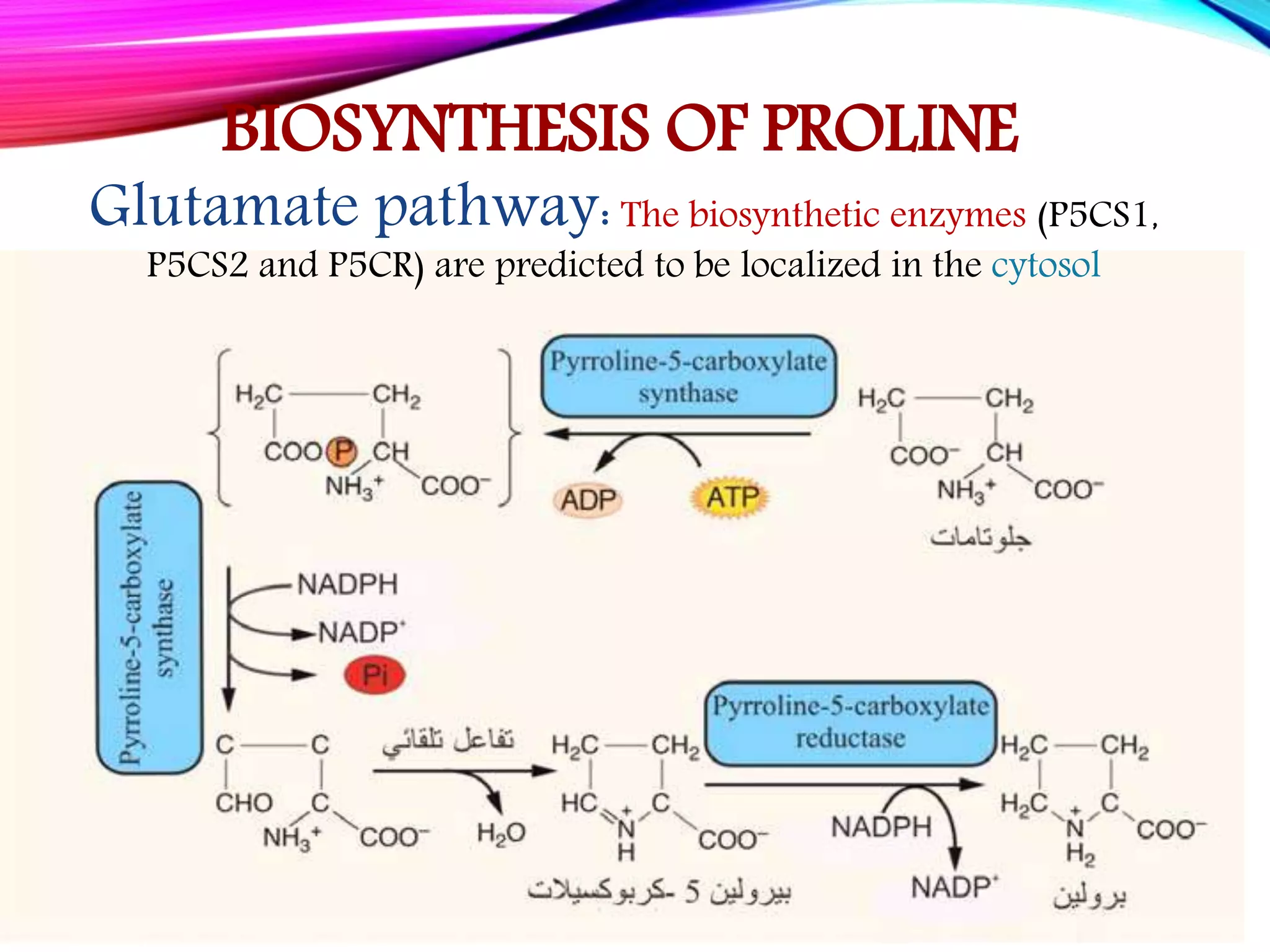
BIOSYNTHESIS OF PROLINE
In plants, proline is synthesized by two pathways:
• glutamate pathway.
• ornithine pathway.
Glutamate pathway:The biosynthetic enzymes (P5CS1,
P5CS2 and P5CR) are predicted to be localized in the cytosol
BIOSYNTHESIS OF PROLINE
•ornithine pathway:
has been suggested to be
important during seedling
development and in some
plants for stress-induced
proline accumulation.
PROLINE CATABOLISM
• Proline catabolism occurs in mitochondria by some enzymes such
as proline dehydrogenase or proline oxidase (PDH or POX)
producing P5C from proline and P5C dehydrogenase (P5CDH)
which converts P5C to glutamate.
• Proline catabolism is, therefore, an important regulator of cellular
ROS balance and can influence numerous additional regulatory
pathways.
BIOSYNTHESIS OF PROLINE
MULTIPLE FUNCTIONS OF PROLINE IN PLANTS
proline biosynthesis is important for maintaining NADP+
pools during stress
Proline is used for protein synthesis,
Proline has protective functions as an osmolyte,
Proline is contributes to the maintenance of the redox
balance,
Proline can regulate development and is a component of
metabolic signaling networks controlling mitochondrial
functions, stress relief and development.
MULTIPLE FUNCTIONS OF PROLINE IN PLANTS
 Reducing oxidation of lipid membranes
 protective proteins and enzymes such as
RUBISCO,
 scavenging the ROS (free radical scavenger),
 buffering cytosolic pH,
 balances cell redox status of the cell,
 activates specific gene expression and signaling
molecule to modulate mitochondrial functions,
 and influences cell proliferation or cell death
PROLINE ACCUMULATION AND STRESS TOLERANCE
REGULATION OF PROLINE METABOLISM
• Proline biosynthesis is controlled by the activity of, P5CS is
encoded by two genes whereas P5CR is encoded by only one in
most plant species
• Although the duplicated P5CS genes share a high level of
sequence homology in coding regions, their transcriptional
regulation is different.
• P5CS1 is induced by osmotic and salt stresses and is activated by
an abscisic acid (ABA)-dependent and ABA insensitive 1 (ABI1)-
controlled regulatory pathway and H2O2-derived signals.
• In Proline catabolism there are Two genes encode PDH, whereas
a single P5CDH gene has been identified in Arabidopsis and
tobacco.
• PDH transcription is activated by rehydration but repressed by
dehydration, thus preventing proline degradation during abiotic
stress
REGULATION OF PROLINE METABOLISM
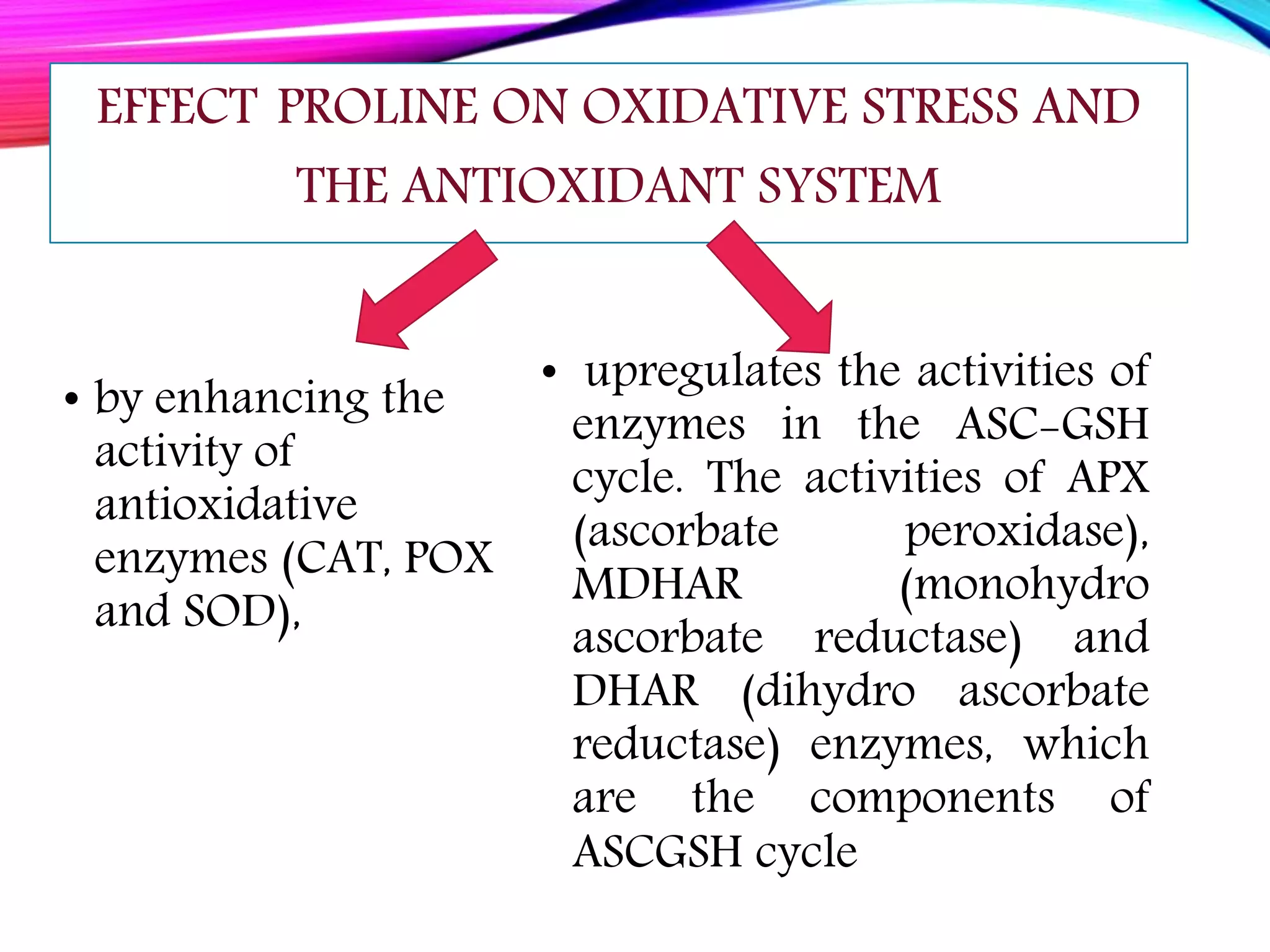
EFFECT PROLINE ON OXIDATIVE STRESS AND
THE ANTIOXIDANT SYSTEM
• by enhancing the
activity of
antioxidative
enzymes (CAT, POX
and SOD),
• upregulates the activities of
enzymes in the ASC-GSH
cycle. The activities of APX
(ascorbate peroxidase),
MDHAR (monohydro
ascorbate reductase) and
DHAR (dihydro ascorbate
reductase) enzymes, which
are the components of
ASCGSH cycle
the proline protect the enzymes against
abiotic stress
• the proline protected the enzymes against heat,
salinity or chilling stress under in vitro
conditions. This is due to the fact that the 3-D
structure of proteins is governed by
hydrophobic/hydrophilic, ionic interactions and
interactions between side chains of constituent
amino acids. Proline could interfere with these
side chain bonds and induce conformational
changes in the enzyme protein and thus affect
their activity
• proline reduces ROS levels in fungi and yeast, thus
preventing programmed cell death.
• prevents lipid peroxidation in alga cells exposed to heavy
metals.
• Pretreatment of proline also mitigated Hg2+ toxicity in rice
(Oryza sativa) through ROS scavenging, such as H2O2.
• Damaging effects of ROS on Photosystem II (PSII) can be
reduced by proline in isolated thylakoid membranes (PSII).
• Proline pretreatment also alleviated Hg2+ toxicity in rice
(Oryza sativa) through scavenging ROS, such as H2O2.
• can protect human cells against carcinogenic oxidative
stress
EXAMPLES OF PROLINE APPLICATION
Proline

Proline

  • 1.
    PROLINE PRESENTED BY NOUR ELHODATAMIM UNDER SUPERVISION DR.HANY SROUR
  • 2.
    STRUCTURE OF PROLINE •Proline shares many properties with the aliphatic group. • Proline is formally NOT an amino acid, but an imino acid. Nonetheless, it is called an amino acid • Nonpolar.
  • 3.
    INTRODUCTION Proline (Pro) accumulationoccurs in eubacteria, protozoa, marine invertebrates and plants after various stresses.  In plants, Pro accumulation has been reported to occur after salt, drought, high temperature, low temperature, heavy metal, pathogen infection, anaerobiosis, nutrient deficiency, atmospheric pollution and UV irradiation. The level of Pro accumulation in plants varies from species to species and can be 100 times greater than in control situation. Osmotic stress, which include treatments lowering the osmotic potential component of the water potential, are by far the most studied ones because they represent a major concern in agriculture. Pro metabolism in plants has mainly been studied in response to osmotic stress
  • 4.
    BIOSYNTHESIS OF PROLINE Inplants, proline is synthesized by two pathways: • glutamate pathway. • ornithine pathway.
  • 5.
    Glutamate pathway:The biosyntheticenzymes (P5CS1, P5CS2 and P5CR) are predicted to be localized in the cytosol BIOSYNTHESIS OF PROLINE
  • 6.
    BIOSYNTHESIS OF PROLINE •ornithinepathway: has been suggested to be important during seedling development and in some plants for stress-induced proline accumulation.
  • 7.
    PROLINE CATABOLISM • Prolinecatabolism occurs in mitochondria by some enzymes such as proline dehydrogenase or proline oxidase (PDH or POX) producing P5C from proline and P5C dehydrogenase (P5CDH) which converts P5C to glutamate. • Proline catabolism is, therefore, an important regulator of cellular ROS balance and can influence numerous additional regulatory pathways.
  • 8.
  • 9.
    MULTIPLE FUNCTIONS OFPROLINE IN PLANTS proline biosynthesis is important for maintaining NADP+ pools during stress Proline is used for protein synthesis, Proline has protective functions as an osmolyte, Proline is contributes to the maintenance of the redox balance, Proline can regulate development and is a component of metabolic signaling networks controlling mitochondrial functions, stress relief and development.
  • 10.
    MULTIPLE FUNCTIONS OFPROLINE IN PLANTS
  • 11.
     Reducing oxidationof lipid membranes  protective proteins and enzymes such as RUBISCO,  scavenging the ROS (free radical scavenger),  buffering cytosolic pH,  balances cell redox status of the cell,  activates specific gene expression and signaling molecule to modulate mitochondrial functions,  and influences cell proliferation or cell death PROLINE ACCUMULATION AND STRESS TOLERANCE
  • 12.
    REGULATION OF PROLINEMETABOLISM • Proline biosynthesis is controlled by the activity of, P5CS is encoded by two genes whereas P5CR is encoded by only one in most plant species • Although the duplicated P5CS genes share a high level of sequence homology in coding regions, their transcriptional regulation is different. • P5CS1 is induced by osmotic and salt stresses and is activated by an abscisic acid (ABA)-dependent and ABA insensitive 1 (ABI1)- controlled regulatory pathway and H2O2-derived signals. • In Proline catabolism there are Two genes encode PDH, whereas a single P5CDH gene has been identified in Arabidopsis and tobacco. • PDH transcription is activated by rehydration but repressed by dehydration, thus preventing proline degradation during abiotic stress
  • 13.
  • 14.
    EFFECT PROLINE ONOXIDATIVE STRESS AND THE ANTIOXIDANT SYSTEM • by enhancing the activity of antioxidative enzymes (CAT, POX and SOD), • upregulates the activities of enzymes in the ASC-GSH cycle. The activities of APX (ascorbate peroxidase), MDHAR (monohydro ascorbate reductase) and DHAR (dihydro ascorbate reductase) enzymes, which are the components of ASCGSH cycle
  • 15.
    the proline protectthe enzymes against abiotic stress • the proline protected the enzymes against heat, salinity or chilling stress under in vitro conditions. This is due to the fact that the 3-D structure of proteins is governed by hydrophobic/hydrophilic, ionic interactions and interactions between side chains of constituent amino acids. Proline could interfere with these side chain bonds and induce conformational changes in the enzyme protein and thus affect their activity
  • 17.
    • proline reducesROS levels in fungi and yeast, thus preventing programmed cell death. • prevents lipid peroxidation in alga cells exposed to heavy metals. • Pretreatment of proline also mitigated Hg2+ toxicity in rice (Oryza sativa) through ROS scavenging, such as H2O2. • Damaging effects of ROS on Photosystem II (PSII) can be reduced by proline in isolated thylakoid membranes (PSII). • Proline pretreatment also alleviated Hg2+ toxicity in rice (Oryza sativa) through scavenging ROS, such as H2O2. • can protect human cells against carcinogenic oxidative stress EXAMPLES OF PROLINE APPLICATION