Polyamine Biosynthesis For Modulation
Of Development And Abiotic Stress
Response In Plants
Submitted by
B.Sai Praharsha
BAM-18-07
M.Sc(Ag), First year
Dept of Agronomy
POLYAMINES
Polyamines are a group of polyvalent cationic organic compounds
containing two or more amino groups.
Ubiquitous bioactive compounds occurring in cells of almost all
types of organisms including micro-organisms, plants and animals.
 PAs may also function as stress messengers in plant responses to
different stress signals
Includes spermidine (Spd, a triamine), spermine (Spm, a
tetramine), and their obligate precursor putrescine (Put, a diamine)
PAs are present in all compartments of the plant cell,
including the nucleus, which indicates their participation in
diverse fundamental processes in the cell
Acid neutralizing,antioxidant properties,membrane stabilizing
abilities made them indispensable for normal functioning of
cells
Considered as plant growth regulators that mediate harmone
effects as independent signaling molecules specially under
stress conditions
Occurrence of Polyamines in Plants
The polyamines occur in plant cells in different forms:
(i) Soluble forms
(ii) Insoluble forms
(iii) Conjugated forms
(iv) Free forms
Polyamines are conjugated with some phenolic compounds such as hydroxycinnamic
acid, coumaric acid or caffeic acid.
Bound polyamines constitute significant fraction of total polyamines and may also be
functionally as important as free polyamines.
Important Physiological Effects of Polyamines in Plants:
i. In control of flowering (as component of floral stimulus).
ii. Regulation of embryogenesis.
iii. Delaying senescence of detached leaves.
iv. Stabilization of membranes and isolated protoplasts.
v. Promotion of development of some fruits.
vi. Minimize water stress of many types of cells.
• The concentrations of PAs in the plant (10-9 –10-5 M) are much higher than those
of endogenous phytohormones (10-13 –10-7M).
• Like hormones, polyamines are involved in the processes of replication,
transcription, translation, membrane stabilization, enzyme activity modulation,
cell division and elongation, plant growth and development (Galston et al. 1997;
Walden et al. 1997).
• The total PA concentration and the ratios between individual PAs vary markedly
depending on the plant species, organ, and tissue, and also on the developmental
stage.
• Major changes in PA metabolism occur in response to various abiotic stress
conditions (Bouchereau et al. 1999).
 Stress-induced PA accumulation is important in ameliorating plant responses to
abiotic stresses.
 Due to their cationic nature PAs interact with negatively charged macromolecules,
such as nucleic acids, phospholipids, and proteins.
 These ionic interactions, which are reversible, lead to the stabilization of DNA, t
RNA, membranes, and some proteins (Bachrach 2005).
POLYAMINE METABOLISM AND ITS REGULATION
Biosynthesis of polyamines:
 In plants, Put, Spd, and Spm are most abundant PAs, but the PA metabolic pathways are
regulated by a limited number of key enzymes (Tiburcio et al. 1997).
 Put is produced directly from ornithine by ornithine decarboxylase (ODC, EC 4.1.1.17) or
indirectly from arginine by arginine decarboxylase (ADC, EC 4.1.1.19) via agmatine
(Agm).
ADC, arginine decarboxylase;
AIH, agmatine iminohydrolase;
CPA, N‐carbamoylputrescine amidohydrolase;
ODC, ornithine decarboxylase;
SPDS, spermidine synthase;
SPMS, spermine synthase;
SAM, S‐adenosylmethionine;
SAMDC, S‐adenosylmethionine decarboxylase;
dcSAM, decarboxylated
S‐adenosylmethionine;
NOS, nitric oxide synthase;
ACC, 1‐aminocyclopropane‐1carboxylic acid;
CuAO, copper amine oxidase;
PAO, polyamine oxidase;
PUT, polyamine uptake transporter.
• Conversion of Agm into Put requires two distinct enzymes:
Agm iminohydrolase (EC 3.5.3.12) and
N-carbamoylputrescine amidohydrolase (EC 3.5.1) (Fig. 1).
• The formation of Put from arginine with the involvement of ADC is usually
associated with the plant responses to stresses, such as drought, salinity,
hyperthermia, potassium and sulfur deficits, etc. (Bouchereau et al. 1999; Basu et al.
2006).
 The implication of PAs in stress responses has also been revealed by genetic
approaches, most of them being used in Arabidopsis.
 Arabidopsis contains two different genes encoding ADC (ADC1 and ADC2) (Hanzawa
et al. 2000; Panicot et al. 2002).
 The occurrence of duplicated genes in Arabidopsis seems to be related to differential
regulation of gene responsiveness.

 Thus, Soyka and Heyer (1999) demonstrated the specific involvement of the ADC2
gene in hyperosmotic stress.
 Treatment of Arabidopsis leaves with 0.6 M sorbitol induced ADC2 expression, while
ADC1 transcript levels remained unaltered.
A stress-induced activation of the complete pathway of PA biosynthesis with the
accumulation of Spd and Spm is observed relatively infrequently (Tiburcio et al. 1994).
Usually, in sensitive plant species, stress induces the selective accumulation of Put.
In contrast, in tolerant plant species, for example in the salt-tolerant rice cultivar
(Krishnamurthy and Bhagwat 1989) and salt-tolerant tobacco NrEs-1 strain, salinity
induced a 10- to 15-fold accumulation of Spd as compared to control cells (Shevyakova
et al. 1984).
It is possible that, in sensitive species, stress suppresses the key enzyme of Spd and
Spm biosynthesis, SAM decarboxylase (SAMDC).
Therefore, the biosynthesis of these two PAs is retarded and their precursor, Put,
accumulates actively.
POLYAMINES AND STRESS
POLYAMINES AND PLANT TOLERANCE:
Endogenous content of polyamines in plants and tolerance
Since the time when an active Put accumulation was observed in plants in response to K+
deficit and salt shock, the investigations of stress-induced changes in PA metabolism and
their role in plant responses to abiotic stressors remain to be one of key problems of plant
adaptive strategy (KaurSawney et al. 2003).
Stress-induced accumulation of PAs often correlates with the improvement of plant
tolerance (Bouchereau et al. 1999).
In recent years, the abundance of data concerning stress-dependent PA accumulation
appeared.
PAs increase survival of various plants under salt stress (Chattopadhayay et al. 2002; Roy
and Wu 2002; Liu and Moriguchi 2006), chilling stress (Songstad et al. 1990; Shen et al.
2002), osmotic and acidic stresses (Capell et al. 2004), radiation-induced oxidative stress
(von Detsch et al. 2005), and other stresses.
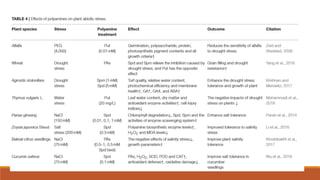
The application of exogenous PAs (spray of leaves or root treatment with 1-3 mM) has
been useful to identify the association of their stress-accumulation with plant tolerance
under abiotic stress.
If the synthesis of PA is blocked, cell growth is stopped, and treatment with exogenous PA
can restore these processes.
Effect of exogenous polyamines and polyamine biosynthesis
inhibitors on plant tolerance to abiotic stress
There were two approaches:
 one is the application of exogenous polyamines directly,
other is the use of inhibitors of enzymes involved in polyamine biosynthetic pathway indirectly
Influence of inhibitors on polyamine metabolism and tolerance :
Most widely used inhibitors of various enzymes of PA biosynthesis or catabolism are:
• difluoromethylornithine (DFMO) for ODC,
• difluormethylarginine (DFMA) for ADC,
• methylglyoxalbisguanylhydrazine (MGBG) for SAMDC,
• cyclohexamine (CHA) for SPMS,
• aminoguanidine (AG) for DAO, and others.
These inhibitors are used for switching off separate stages of PA biosynthesis (Walden et
al. 1997; Bouchereau et al. 1999).
The application of DFMA and DFMO helped to establish that ADC and ODC pathways
operates in the constitutive Put synthesis under normal conditions, whereas under stress
conditions, both ADC and seldom ODC pathways could be activated, resulting in Put
accumulation.
Plant subjected to different type of stresses show in general a rapid and massive increase
of Put levels which can inhibit by application of DFMA (Galston et al. 1997).
 Polyamines and oxidative stress:
 Stress-induced oxidative stress is one of the early responses to abiotic factors.
 Oxidative stress exerts one of the most deleterious effects of environmental stress on
plants, which is characterized by the accumulation of harmful reactive oxygen species
(ROS) in tissues: •O2-, H2O2, and OH•).
 These toxic molecules are capable of causing oxidative damage to proteins, DNA, lipids
and other molecules (Apel and Hirt 2004).
 ROS are produced in various cellular components, including chloroplasts, mitochondria,
peroxisomes, glyoxysomes, cell wall, plasma membrane, and apoplasts.
• There are several antioxidant strategies in plants.
• ROS-scavenging enzymes are superoxide dimutase (SOD), catalase (Cat), glutation
reductase (GR), and different peroxidases.
• Non-enzymatic antioxidants include various plant pigments (carotenoids,
tocopherols)
• and phenolic acids.
• The antioxidative effect of PAs is probably due to a combination of their anionic
and cationic-binding properties in radical scavenging, inhibiting properties of lipid
peroxidation, metal-catalyzed oxidative reaction, and production of H2O2 by DAO
and PAO
• Numerous reports appeared about stress-induced accumulation of free and
conjugated PAs in various plant species.
• Since the 1990s PA participation in oxyradical detoxification was studied
predominantly in relation to ozone (O3)-pollution (Bouchereau et al. 1999).
• When exogenous PAs were fed to tomato and tobacco plants, there was a
significant suppression of O3-induced leaf injury (Ormrod and Beckerson 1986).
Cadaverine synthesis catalyzed by lysine decarboxylase (LDC), which is induced by the ethylene of
accumulating in plants under stress. Stress ethylene, on the other hand, can inhibit activity of spermidine
synthase and spermine synthase that leads to the reduction of this polyamine content in leaves.
Cold stress:
Polyamine biosynthesis in the common ice plants and its possible regulation by ethylene.
• Thermal Stress:
• When exposed to heat stress, plants have the ability to synthesize uncommon long chain
PAs (caldine, thermine).
• The levels of free and bound PAs, as well as ADC and polyamine oxidases (PAO)
activities, were higher in tolerant than in sensitive cultures of different crop. (Kuehn et al.
1990; Philipps and Kuehn 1991 ; Roy and Ghosh 1996; Bouchereau et al. 1999).
•
• The increased activities of the transglutaminases indicated the high content of the
polyamines.
• This indicates a correlation between heat-stress tolerance, ADC, PAO and transglutaminase
activities (Bouchereau et al. 1999) .
•
PAs and Water Stress
Polyamines (Spm, Spd, and Put) can regulate the size of the potassium channel
and the size of pores in the plasma membrane of guard cells, thereby strongly
regulating pore opening and closing. In this way, PAs can control water loss in
plants (Liu et al., 2000).
Many studies have shown that foliar application of Put at an appropriate level can
trigger physiological processes and induce the biosynthesis of osmotic
adjustment substances, such as free amino acids, soluble sugars, and proline. This
may compensate for the negative impacts of drought stress on plant biomass and
increase the quality and quantity of certain bioactive substances
• Drought Stress:
• Certain plants during water scarcity tend to accumulate putrescine (Put) which is supported
by the fact that transcript profiling under these conditions induces the expression of certain
genes involved in the biosynthetic pathway.
• The expression of some of these genes is also induced by ABA treatment (Perez-Amador et
al. 2002; Urano et al. 2003; Alcazar et al. 2010).
• This throws light upon the fact that up- regulation of PA-biosynthetic genes and
accumulation of Put under water stress are mainly ABA-dependent responses (Alcazar et al.
2010 ) .
RESEARCH EVIDENCES
1. Effect of nitric oxide and putrescine on antioxidative responses under NaCl stress in
chickpea plants. Sunita Sheokand et.al.(2008)
The plants were supplied with nitrogen free nutrient solution (Wilson and Reisenauer,
1963) at regular intervals.
The plants were divided into six groups, 50 days after sowing (DAS).
• The first group, irrigated with water alone, served as control.
• The second group was treated with 0.5 mM putrescine as foliar spray and
• The third group was treated with 0.2 mM Sodium nitroprusside (NO donor) as foliar
spray.
• The fourth group was treated with 100 mM NaCl through the rooting medium.
• The fifth group was treated with 100 mM NaCl through the rooting medium and 0.5
mM putrescine through foliar spray.
• The sixth group was treated with 100 mM NaCl through the rooting medium and 0.2
mM SNP through foliar spray.
• The plants were sampled 2 DAT (days after treatment).
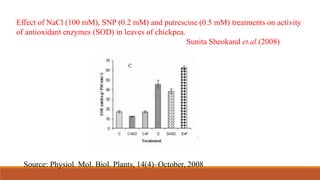
Effect of NaCl (100 mM), SNP (0.2 mM) and putrescine (0.5 mM) treatments on activity
of antioxidant enzymes (SOD) in leaves of chickpea.
Sunita Sheokand et.al.(2008)
Source: Physiol. Mol. Biol. Plants, 14(4)–October, 2008
• A significant increase in SOD activity, indicates the activation of defense system
under short term salt stress.
• Putrescine treatments further increased the activity of SOD under salinity.
• It has been suggested that putrescine could bind to antioxidant enzymes, such as
superoxide dismutase or be conjugated to small antioxidant molecules and allow them
to permeate to the sites of oxidative stress within the cells.
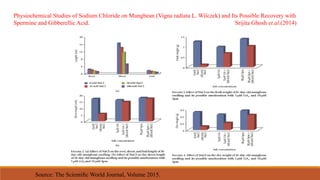
Physiochemical Studies of Sodium Chloride on Mungbean (Vigna radiata L. Wilczek) and Its Possible Recovery with
Spermine and Gibberellic Acid. Srijita Ghosh et.al.(2014)
Source: The Scientific World Journal, Volume 2015.
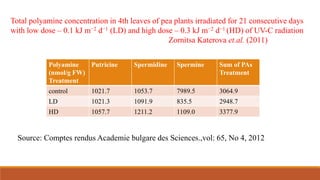
Total polyamine concentration in 4th leaves of pea plants irradiated for 21 consecutive days
with low dose – 0.1 kJ m−2 d−1 (LD) and high dose – 0.3 kJ m−2 d−1 (HD) of UV-C radiation
Zornitsa Katerova et.al. (2011)
Polyamine
(nmol/g FW)
Treatment
Putricine Spermidine Spermine Sum of PAs
Treatment
control 1021.7 1053.7 7989.5 3064.9
LD 1021.3 1091.9 835.5 2948.7
HD 1057.7 1211.2 1109.0 3377.9
Source: Comptes rendus Academie bulgare des Sciences.,vol: 65, No 4, 2012
Conclusion:
Total PAs concentrations demonstrate that only HD regime led to augmentation of PAs
studied (as well as in their sum) as compared to the relative control value. Alterations
were found mainly in Spm and Spd due to the accumulation of bound PAs. PAs
(especially Spm and Spd) bound to cell membranes are involved in plant adaptation
mechanisms to UV-C treatment. Similarly to the results obtained for the older (2nd)
leaves, current data found for MDA and PAs suggest that HD regime provokes
adaptation processes under short pulses of UV-C irradiation in the younger (4th) leaves
as well.
CONCLUSIONS:
PAs are involved in a wide range of plant processes, including adaptation to abiotic
stresses.
However, their precise role in these specific processes remains to be established.
The PA biosynthesis pathways are ubiquitous in living organisms but include only a
limited number of enzymes.
Thus, the PA biosynthesis pathways represent an excellent model to test the hypotheses of
PA involving in plant protection against stresses.
Polyamines in ameliorating stress

Polyamines in ameliorating stress

  • 1.
    Polyamine Biosynthesis ForModulation Of Development And Abiotic Stress Response In Plants Submitted by B.Sai Praharsha BAM-18-07 M.Sc(Ag), First year Dept of Agronomy
  • 2.
    POLYAMINES Polyamines are agroup of polyvalent cationic organic compounds containing two or more amino groups. Ubiquitous bioactive compounds occurring in cells of almost all types of organisms including micro-organisms, plants and animals.  PAs may also function as stress messengers in plant responses to different stress signals Includes spermidine (Spd, a triamine), spermine (Spm, a tetramine), and their obligate precursor putrescine (Put, a diamine)
  • 3.
    PAs are presentin all compartments of the plant cell, including the nucleus, which indicates their participation in diverse fundamental processes in the cell Acid neutralizing,antioxidant properties,membrane stabilizing abilities made them indispensable for normal functioning of cells Considered as plant growth regulators that mediate harmone effects as independent signaling molecules specially under stress conditions
  • 4.
    Occurrence of Polyaminesin Plants The polyamines occur in plant cells in different forms: (i) Soluble forms (ii) Insoluble forms (iii) Conjugated forms (iv) Free forms Polyamines are conjugated with some phenolic compounds such as hydroxycinnamic acid, coumaric acid or caffeic acid. Bound polyamines constitute significant fraction of total polyamines and may also be functionally as important as free polyamines.
  • 6.
    Important Physiological Effectsof Polyamines in Plants: i. In control of flowering (as component of floral stimulus). ii. Regulation of embryogenesis. iii. Delaying senescence of detached leaves. iv. Stabilization of membranes and isolated protoplasts. v. Promotion of development of some fruits. vi. Minimize water stress of many types of cells.
  • 7.
    • The concentrationsof PAs in the plant (10-9 –10-5 M) are much higher than those of endogenous phytohormones (10-13 –10-7M). • Like hormones, polyamines are involved in the processes of replication, transcription, translation, membrane stabilization, enzyme activity modulation, cell division and elongation, plant growth and development (Galston et al. 1997; Walden et al. 1997). • The total PA concentration and the ratios between individual PAs vary markedly depending on the plant species, organ, and tissue, and also on the developmental stage. • Major changes in PA metabolism occur in response to various abiotic stress conditions (Bouchereau et al. 1999).
  • 8.
     Stress-induced PAaccumulation is important in ameliorating plant responses to abiotic stresses.  Due to their cationic nature PAs interact with negatively charged macromolecules, such as nucleic acids, phospholipids, and proteins.  These ionic interactions, which are reversible, lead to the stabilization of DNA, t RNA, membranes, and some proteins (Bachrach 2005).
  • 9.
    POLYAMINE METABOLISM ANDITS REGULATION Biosynthesis of polyamines:  In plants, Put, Spd, and Spm are most abundant PAs, but the PA metabolic pathways are regulated by a limited number of key enzymes (Tiburcio et al. 1997).  Put is produced directly from ornithine by ornithine decarboxylase (ODC, EC 4.1.1.17) or indirectly from arginine by arginine decarboxylase (ADC, EC 4.1.1.19) via agmatine (Agm).
  • 10.
    ADC, arginine decarboxylase; AIH,agmatine iminohydrolase; CPA, N‐carbamoylputrescine amidohydrolase; ODC, ornithine decarboxylase; SPDS, spermidine synthase; SPMS, spermine synthase; SAM, S‐adenosylmethionine; SAMDC, S‐adenosylmethionine decarboxylase; dcSAM, decarboxylated S‐adenosylmethionine; NOS, nitric oxide synthase; ACC, 1‐aminocyclopropane‐1carboxylic acid; CuAO, copper amine oxidase; PAO, polyamine oxidase; PUT, polyamine uptake transporter.
  • 12.
    • Conversion ofAgm into Put requires two distinct enzymes: Agm iminohydrolase (EC 3.5.3.12) and N-carbamoylputrescine amidohydrolase (EC 3.5.1) (Fig. 1). • The formation of Put from arginine with the involvement of ADC is usually associated with the plant responses to stresses, such as drought, salinity, hyperthermia, potassium and sulfur deficits, etc. (Bouchereau et al. 1999; Basu et al. 2006).
  • 13.
     The implicationof PAs in stress responses has also been revealed by genetic approaches, most of them being used in Arabidopsis.  Arabidopsis contains two different genes encoding ADC (ADC1 and ADC2) (Hanzawa et al. 2000; Panicot et al. 2002).  The occurrence of duplicated genes in Arabidopsis seems to be related to differential regulation of gene responsiveness.   Thus, Soyka and Heyer (1999) demonstrated the specific involvement of the ADC2 gene in hyperosmotic stress.  Treatment of Arabidopsis leaves with 0.6 M sorbitol induced ADC2 expression, while ADC1 transcript levels remained unaltered.
  • 14.
    A stress-induced activationof the complete pathway of PA biosynthesis with the accumulation of Spd and Spm is observed relatively infrequently (Tiburcio et al. 1994). Usually, in sensitive plant species, stress induces the selective accumulation of Put. In contrast, in tolerant plant species, for example in the salt-tolerant rice cultivar (Krishnamurthy and Bhagwat 1989) and salt-tolerant tobacco NrEs-1 strain, salinity induced a 10- to 15-fold accumulation of Spd as compared to control cells (Shevyakova et al. 1984).
  • 15.
    It is possiblethat, in sensitive species, stress suppresses the key enzyme of Spd and Spm biosynthesis, SAM decarboxylase (SAMDC). Therefore, the biosynthesis of these two PAs is retarded and their precursor, Put, accumulates actively.
  • 16.
    POLYAMINES AND STRESS POLYAMINESAND PLANT TOLERANCE: Endogenous content of polyamines in plants and tolerance Since the time when an active Put accumulation was observed in plants in response to K+ deficit and salt shock, the investigations of stress-induced changes in PA metabolism and their role in plant responses to abiotic stressors remain to be one of key problems of plant adaptive strategy (KaurSawney et al. 2003). Stress-induced accumulation of PAs often correlates with the improvement of plant tolerance (Bouchereau et al. 1999). In recent years, the abundance of data concerning stress-dependent PA accumulation appeared.
  • 17.
    PAs increase survivalof various plants under salt stress (Chattopadhayay et al. 2002; Roy and Wu 2002; Liu and Moriguchi 2006), chilling stress (Songstad et al. 1990; Shen et al. 2002), osmotic and acidic stresses (Capell et al. 2004), radiation-induced oxidative stress (von Detsch et al. 2005), and other stresses. The application of exogenous PAs (spray of leaves or root treatment with 1-3 mM) has been useful to identify the association of their stress-accumulation with plant tolerance under abiotic stress. If the synthesis of PA is blocked, cell growth is stopped, and treatment with exogenous PA can restore these processes.
  • 18.
    Effect of exogenouspolyamines and polyamine biosynthesis inhibitors on plant tolerance to abiotic stress There were two approaches:  one is the application of exogenous polyamines directly, other is the use of inhibitors of enzymes involved in polyamine biosynthetic pathway indirectly
  • 19.
    Influence of inhibitorson polyamine metabolism and tolerance : Most widely used inhibitors of various enzymes of PA biosynthesis or catabolism are: • difluoromethylornithine (DFMO) for ODC, • difluormethylarginine (DFMA) for ADC, • methylglyoxalbisguanylhydrazine (MGBG) for SAMDC, • cyclohexamine (CHA) for SPMS, • aminoguanidine (AG) for DAO, and others.
  • 20.
    These inhibitors areused for switching off separate stages of PA biosynthesis (Walden et al. 1997; Bouchereau et al. 1999). The application of DFMA and DFMO helped to establish that ADC and ODC pathways operates in the constitutive Put synthesis under normal conditions, whereas under stress conditions, both ADC and seldom ODC pathways could be activated, resulting in Put accumulation. Plant subjected to different type of stresses show in general a rapid and massive increase of Put levels which can inhibit by application of DFMA (Galston et al. 1997).
  • 21.
     Polyamines andoxidative stress:  Stress-induced oxidative stress is one of the early responses to abiotic factors.  Oxidative stress exerts one of the most deleterious effects of environmental stress on plants, which is characterized by the accumulation of harmful reactive oxygen species (ROS) in tissues: •O2-, H2O2, and OH•).  These toxic molecules are capable of causing oxidative damage to proteins, DNA, lipids and other molecules (Apel and Hirt 2004).  ROS are produced in various cellular components, including chloroplasts, mitochondria, peroxisomes, glyoxysomes, cell wall, plasma membrane, and apoplasts.
  • 22.
    • There areseveral antioxidant strategies in plants. • ROS-scavenging enzymes are superoxide dimutase (SOD), catalase (Cat), glutation reductase (GR), and different peroxidases. • Non-enzymatic antioxidants include various plant pigments (carotenoids, tocopherols) • and phenolic acids. • The antioxidative effect of PAs is probably due to a combination of their anionic and cationic-binding properties in radical scavenging, inhibiting properties of lipid peroxidation, metal-catalyzed oxidative reaction, and production of H2O2 by DAO and PAO
  • 23.
    • Numerous reportsappeared about stress-induced accumulation of free and conjugated PAs in various plant species. • Since the 1990s PA participation in oxyradical detoxification was studied predominantly in relation to ozone (O3)-pollution (Bouchereau et al. 1999). • When exogenous PAs were fed to tomato and tobacco plants, there was a significant suppression of O3-induced leaf injury (Ormrod and Beckerson 1986).
  • 24.
    Cadaverine synthesis catalyzedby lysine decarboxylase (LDC), which is induced by the ethylene of accumulating in plants under stress. Stress ethylene, on the other hand, can inhibit activity of spermidine synthase and spermine synthase that leads to the reduction of this polyamine content in leaves. Cold stress: Polyamine biosynthesis in the common ice plants and its possible regulation by ethylene.
  • 25.
    • Thermal Stress: •When exposed to heat stress, plants have the ability to synthesize uncommon long chain PAs (caldine, thermine). • The levels of free and bound PAs, as well as ADC and polyamine oxidases (PAO) activities, were higher in tolerant than in sensitive cultures of different crop. (Kuehn et al. 1990; Philipps and Kuehn 1991 ; Roy and Ghosh 1996; Bouchereau et al. 1999). • • The increased activities of the transglutaminases indicated the high content of the polyamines. • This indicates a correlation between heat-stress tolerance, ADC, PAO and transglutaminase activities (Bouchereau et al. 1999) . •
  • 26.
    PAs and WaterStress Polyamines (Spm, Spd, and Put) can regulate the size of the potassium channel and the size of pores in the plasma membrane of guard cells, thereby strongly regulating pore opening and closing. In this way, PAs can control water loss in plants (Liu et al., 2000). Many studies have shown that foliar application of Put at an appropriate level can trigger physiological processes and induce the biosynthesis of osmotic adjustment substances, such as free amino acids, soluble sugars, and proline. This may compensate for the negative impacts of drought stress on plant biomass and increase the quality and quantity of certain bioactive substances
  • 27.
    • Drought Stress: •Certain plants during water scarcity tend to accumulate putrescine (Put) which is supported by the fact that transcript profiling under these conditions induces the expression of certain genes involved in the biosynthetic pathway. • The expression of some of these genes is also induced by ABA treatment (Perez-Amador et al. 2002; Urano et al. 2003; Alcazar et al. 2010). • This throws light upon the fact that up- regulation of PA-biosynthetic genes and accumulation of Put under water stress are mainly ABA-dependent responses (Alcazar et al. 2010 ) .
  • 29.
  • 30.
    1. Effect ofnitric oxide and putrescine on antioxidative responses under NaCl stress in chickpea plants. Sunita Sheokand et.al.(2008) The plants were supplied with nitrogen free nutrient solution (Wilson and Reisenauer, 1963) at regular intervals. The plants were divided into six groups, 50 days after sowing (DAS). • The first group, irrigated with water alone, served as control. • The second group was treated with 0.5 mM putrescine as foliar spray and
  • 31.
    • The thirdgroup was treated with 0.2 mM Sodium nitroprusside (NO donor) as foliar spray. • The fourth group was treated with 100 mM NaCl through the rooting medium. • The fifth group was treated with 100 mM NaCl through the rooting medium and 0.5 mM putrescine through foliar spray. • The sixth group was treated with 100 mM NaCl through the rooting medium and 0.2 mM SNP through foliar spray. • The plants were sampled 2 DAT (days after treatment).
  • 32.
    Effect of NaCl(100 mM), SNP (0.2 mM) and putrescine (0.5 mM) treatments on activity of antioxidant enzymes (SOD) in leaves of chickpea. Sunita Sheokand et.al.(2008) Source: Physiol. Mol. Biol. Plants, 14(4)–October, 2008
  • 33.
    • A significantincrease in SOD activity, indicates the activation of defense system under short term salt stress. • Putrescine treatments further increased the activity of SOD under salinity. • It has been suggested that putrescine could bind to antioxidant enzymes, such as superoxide dismutase or be conjugated to small antioxidant molecules and allow them to permeate to the sites of oxidative stress within the cells.
  • 34.
    Physiochemical Studies ofSodium Chloride on Mungbean (Vigna radiata L. Wilczek) and Its Possible Recovery with Spermine and Gibberellic Acid. Srijita Ghosh et.al.(2014) Source: The Scientific World Journal, Volume 2015.
  • 35.
    Total polyamine concentrationin 4th leaves of pea plants irradiated for 21 consecutive days with low dose – 0.1 kJ m−2 d−1 (LD) and high dose – 0.3 kJ m−2 d−1 (HD) of UV-C radiation Zornitsa Katerova et.al. (2011) Polyamine (nmol/g FW) Treatment Putricine Spermidine Spermine Sum of PAs Treatment control 1021.7 1053.7 7989.5 3064.9 LD 1021.3 1091.9 835.5 2948.7 HD 1057.7 1211.2 1109.0 3377.9 Source: Comptes rendus Academie bulgare des Sciences.,vol: 65, No 4, 2012
  • 36.
    Conclusion: Total PAs concentrationsdemonstrate that only HD regime led to augmentation of PAs studied (as well as in their sum) as compared to the relative control value. Alterations were found mainly in Spm and Spd due to the accumulation of bound PAs. PAs (especially Spm and Spd) bound to cell membranes are involved in plant adaptation mechanisms to UV-C treatment. Similarly to the results obtained for the older (2nd) leaves, current data found for MDA and PAs suggest that HD regime provokes adaptation processes under short pulses of UV-C irradiation in the younger (4th) leaves as well.
  • 37.
    CONCLUSIONS: PAs are involvedin a wide range of plant processes, including adaptation to abiotic stresses. However, their precise role in these specific processes remains to be established. The PA biosynthesis pathways are ubiquitous in living organisms but include only a limited number of enzymes. Thus, the PA biosynthesis pathways represent an excellent model to test the hypotheses of PA involving in plant protection against stresses.