By: Mridhu Sharma
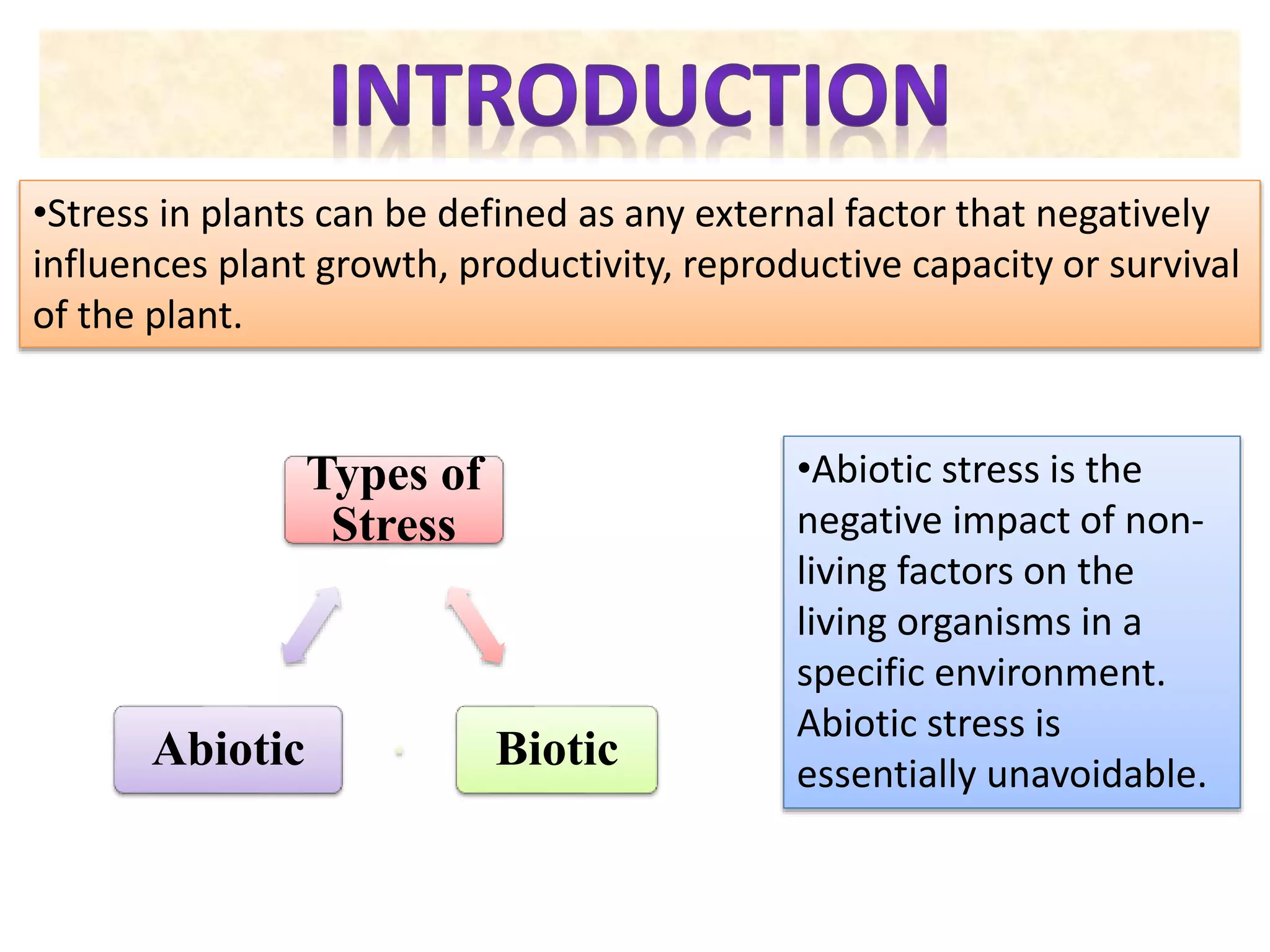
•Stress in plants can be defined as any external factor that negatively
influences plant growth, productivity, reproductive capacity or survival
of the plant.
•Abiotic stress is the
negative impact of non-
living factors on the
living organisms in a
specific environment.
Abiotic stress is
essentially unavoidable.
Types of
Stress
Biotic
Abiotic
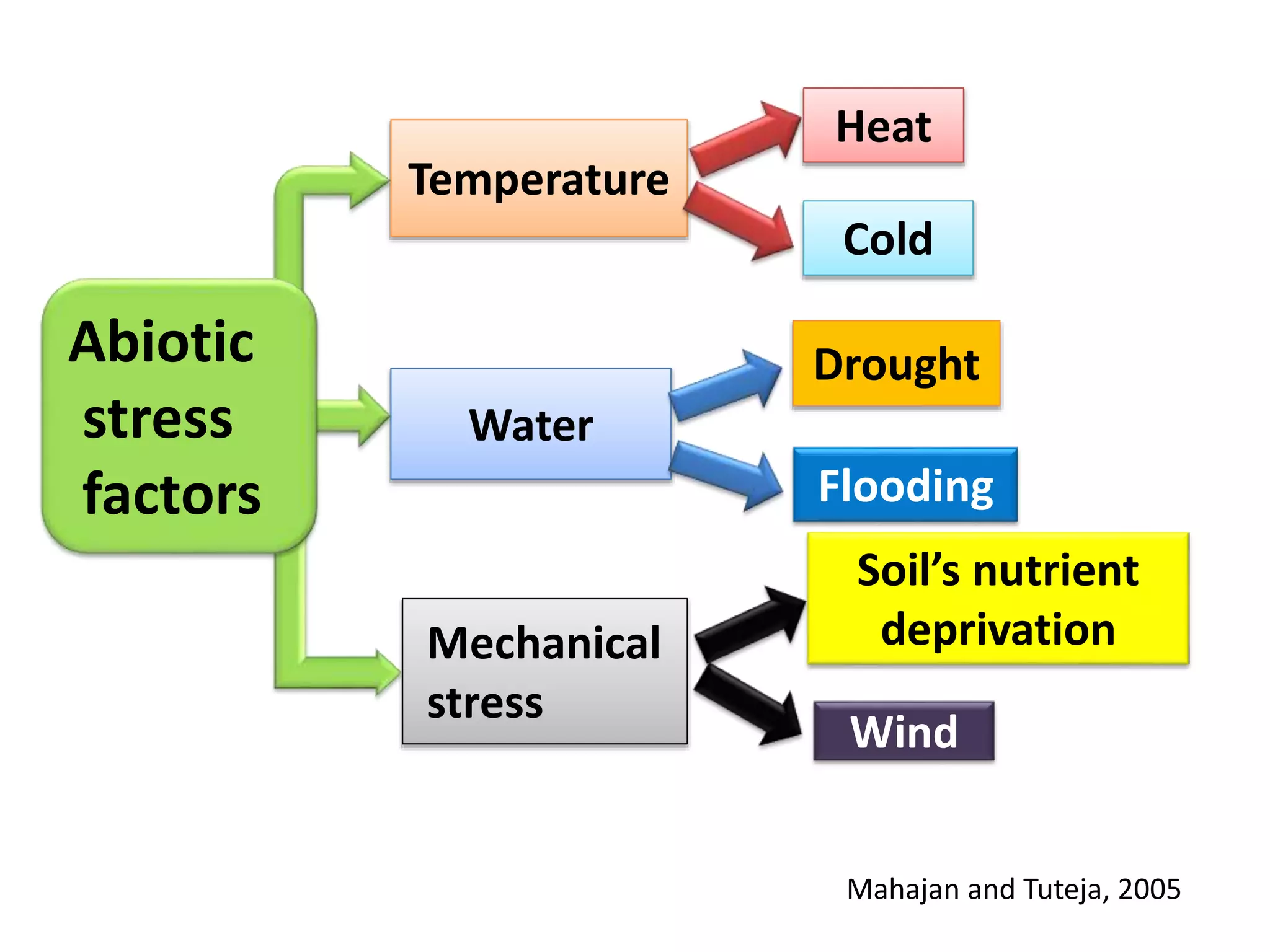
Water
Drought
Flooding
Cold
Heat
Temperature
Soil’s nutrient
deprivation
Wind
Mechanical
stress
Abiotic
stress
factors
Mahajan and Tuteja, 2005
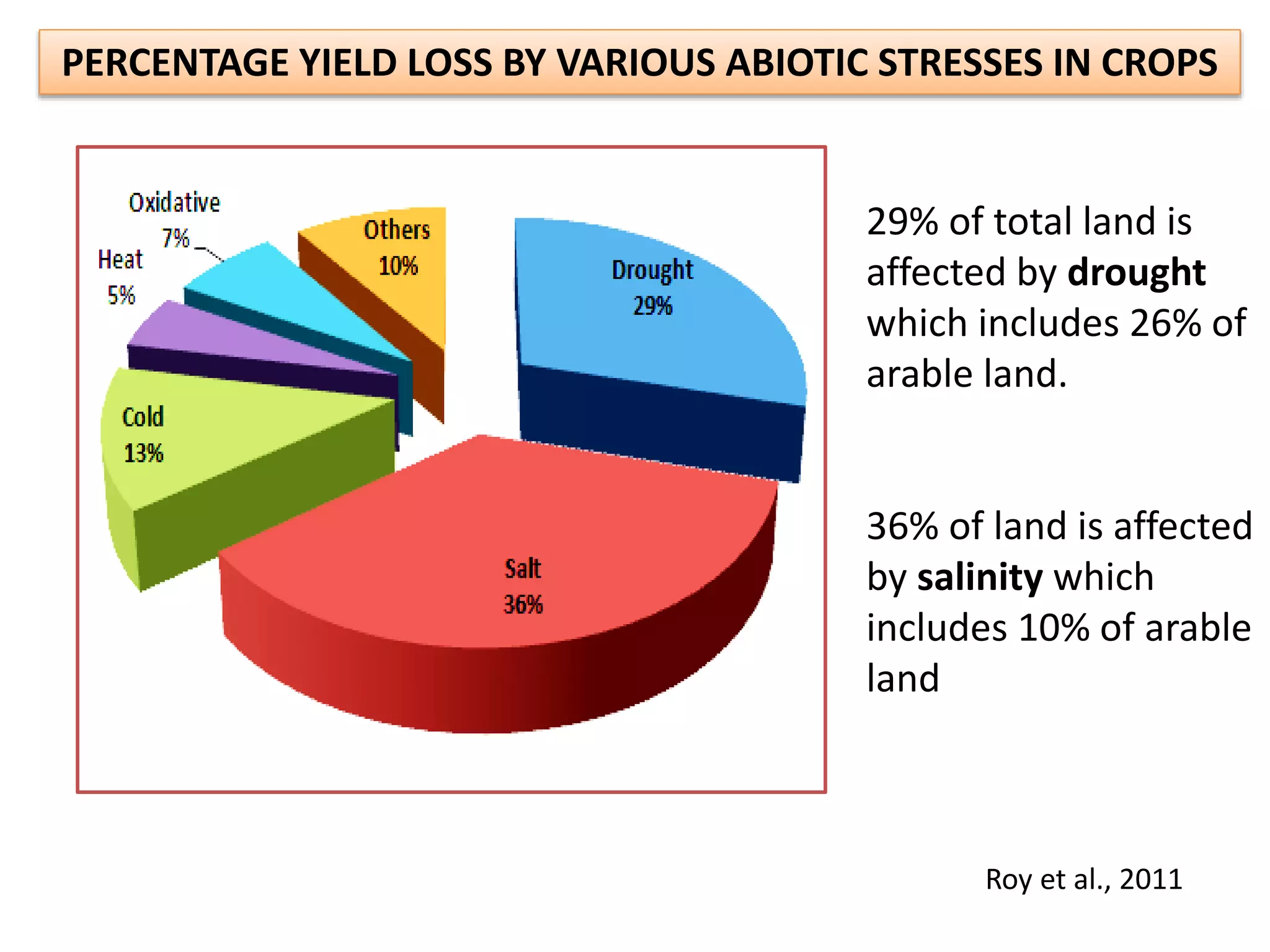
PERCENTAGE YIELD LOSS BY VARIOUS ABIOTIC STRESSES IN CROPS
Roy et al., 2011
29% of total land is
affected by drought
which includes 26% of
arable land.
36% of land is affected
by salinity which
includes 10% of arable
land
In country like India where rice is
stable diet of most of people,
the loss of crop needs to be
reduced.
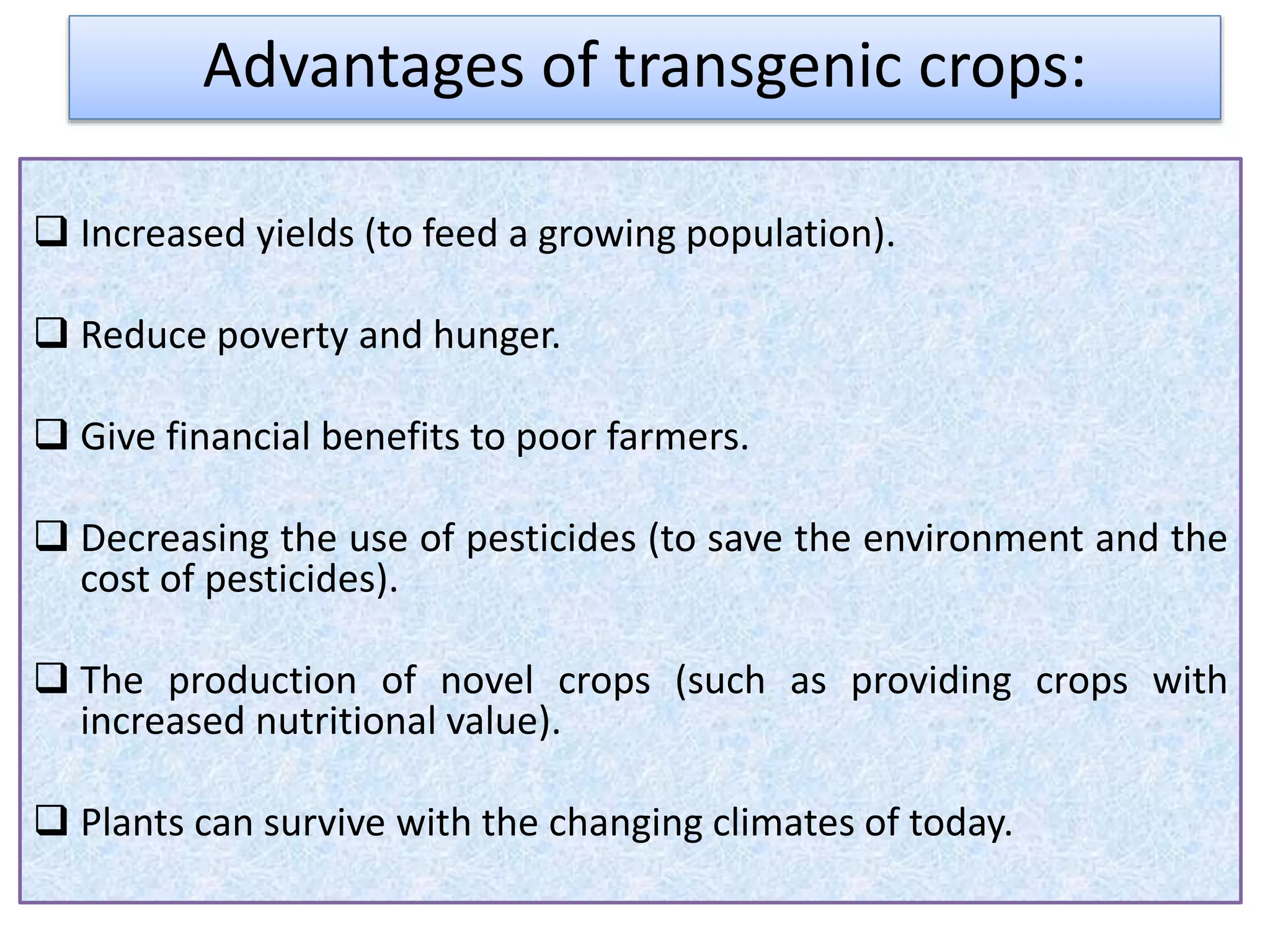
Second main abiotic stress after
drought that affects the crop of
rice is salinity.
These problems can be overcome by preparation of transgenic
plants by recombinant DNA technology
 Increased yields (to feed a growing population).
 Reduce poverty and hunger.
 Give financial benefits to poor farmers.
 Decreasing the use of pesticides (to save the environment and the
cost of pesticides).
 The production of novel crops (such as providing crops with
increased nutritional value).
 Plants can survive with the changing climates of today.
Advantages of transgenic crops:
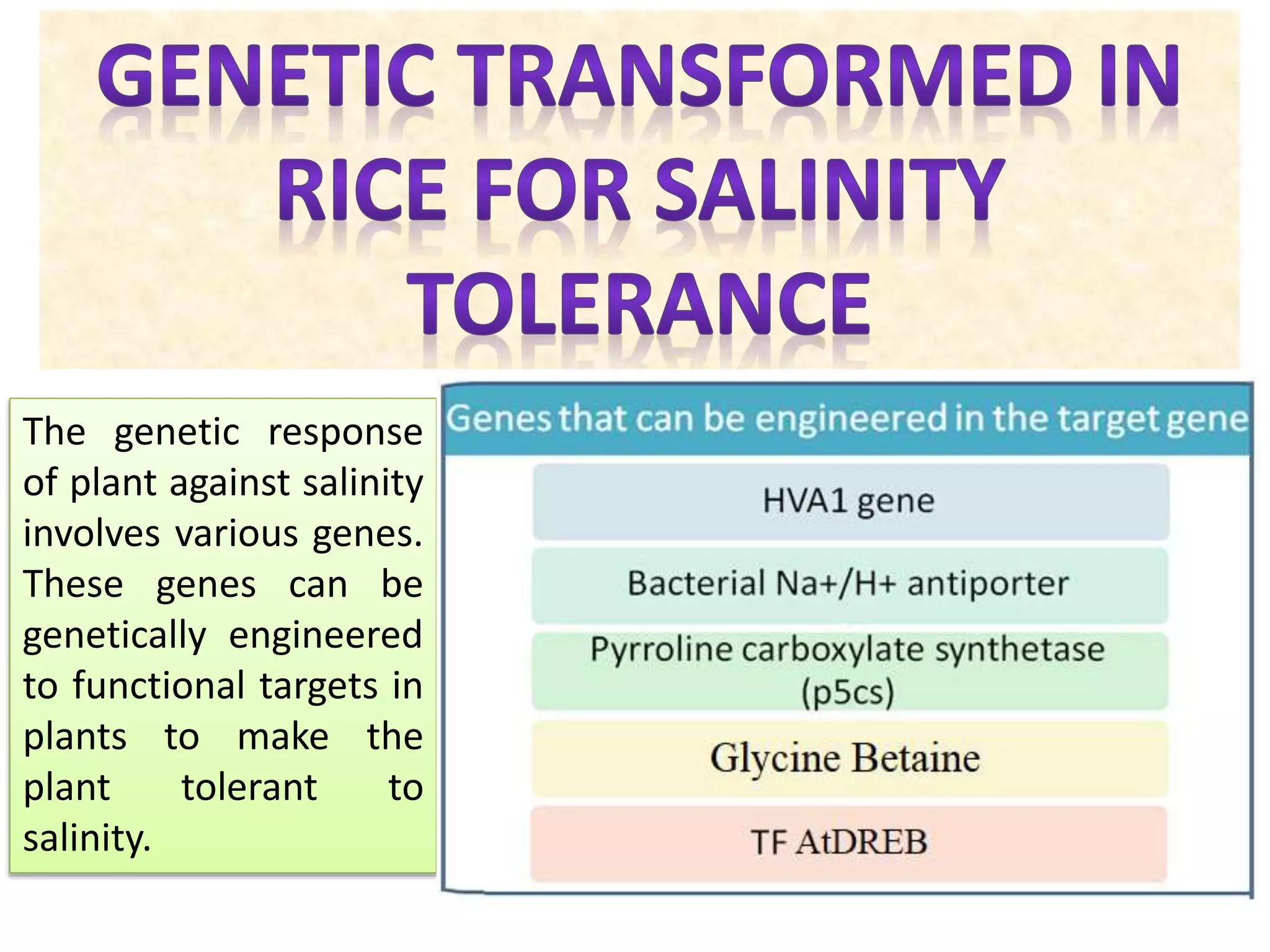
The genetic response
of plant against salinity
involves various genes.
These genes can be
genetically engineered
to functional targets in
plants to make the
plant tolerant to
salinity.
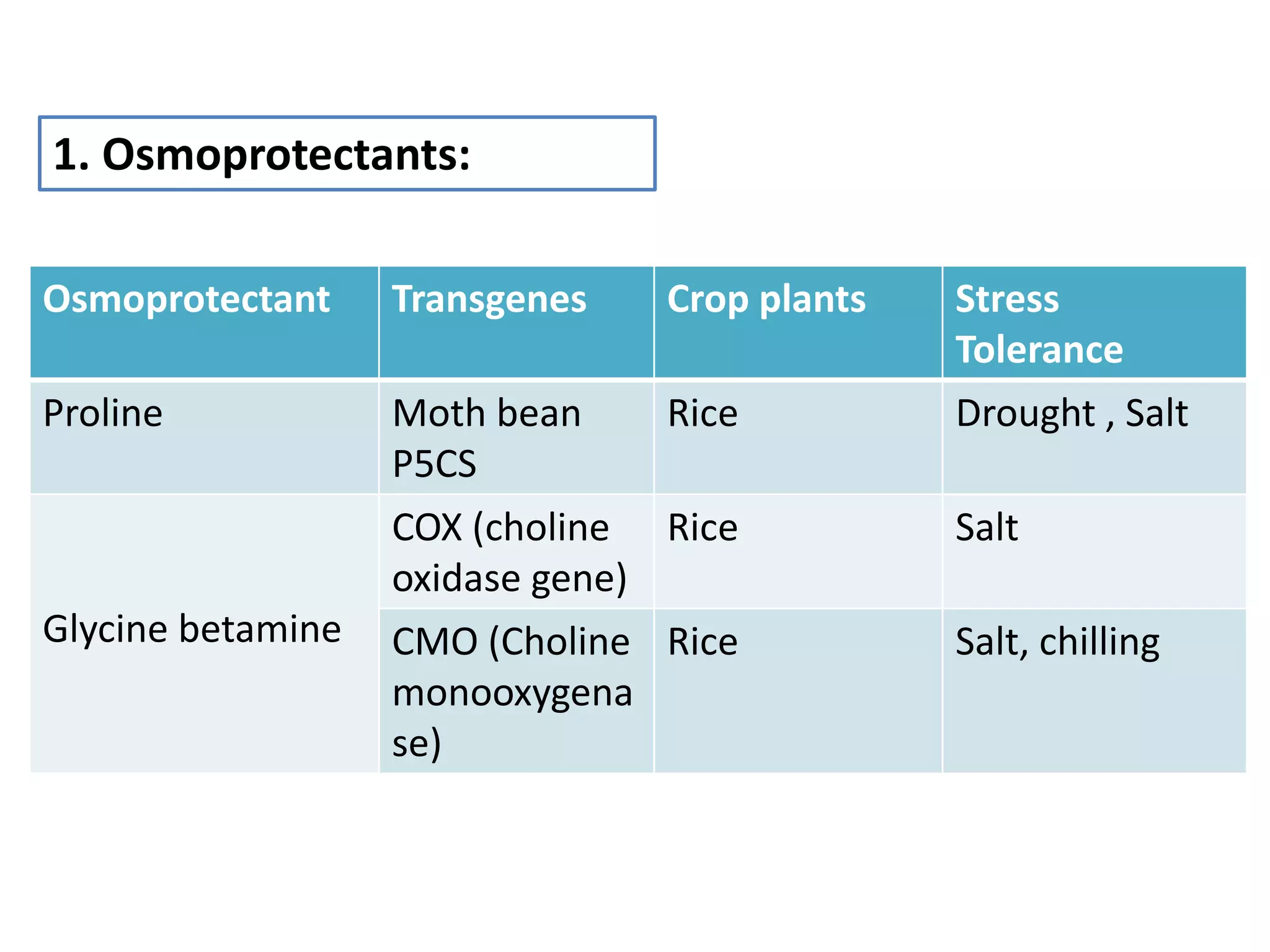
Osmoprotectant Transgenes Crop plants Stress
Tolerance
Proline Moth bean
P5CS
Rice Drought , Salt
Glycine betamine
COX (choline
oxidase gene)
Rice Salt
CMO (Choline
monooxygena
se)
Rice Salt, chilling
1. Osmoprotectants:
1.1 Proline:
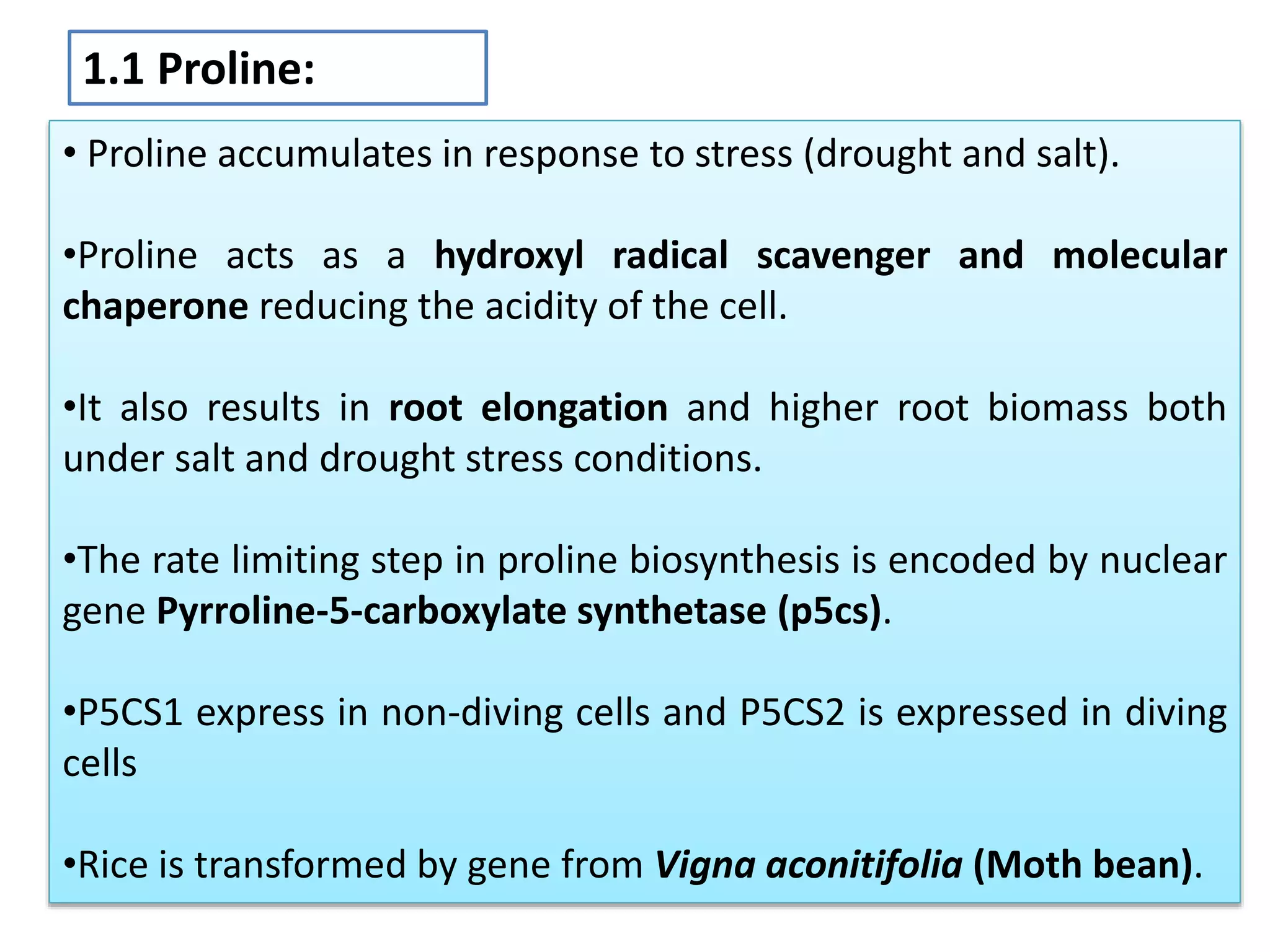
• Proline accumulates in response to stress (drought and salt).
•Proline acts as a hydroxyl radical scavenger and molecular
chaperone reducing the acidity of the cell.
•It also results in root elongation and higher root biomass both
under salt and drought stress conditions.
•The rate limiting step in proline biosynthesis is encoded by nuclear
gene Pyrroline-5-carboxylate synthetase (p5cs).
•P5CS1 express in non-diving cells and P5CS2 is expressed in diving
cells
•Rice is transformed by gene from Vigna aconitifolia (Moth bean).
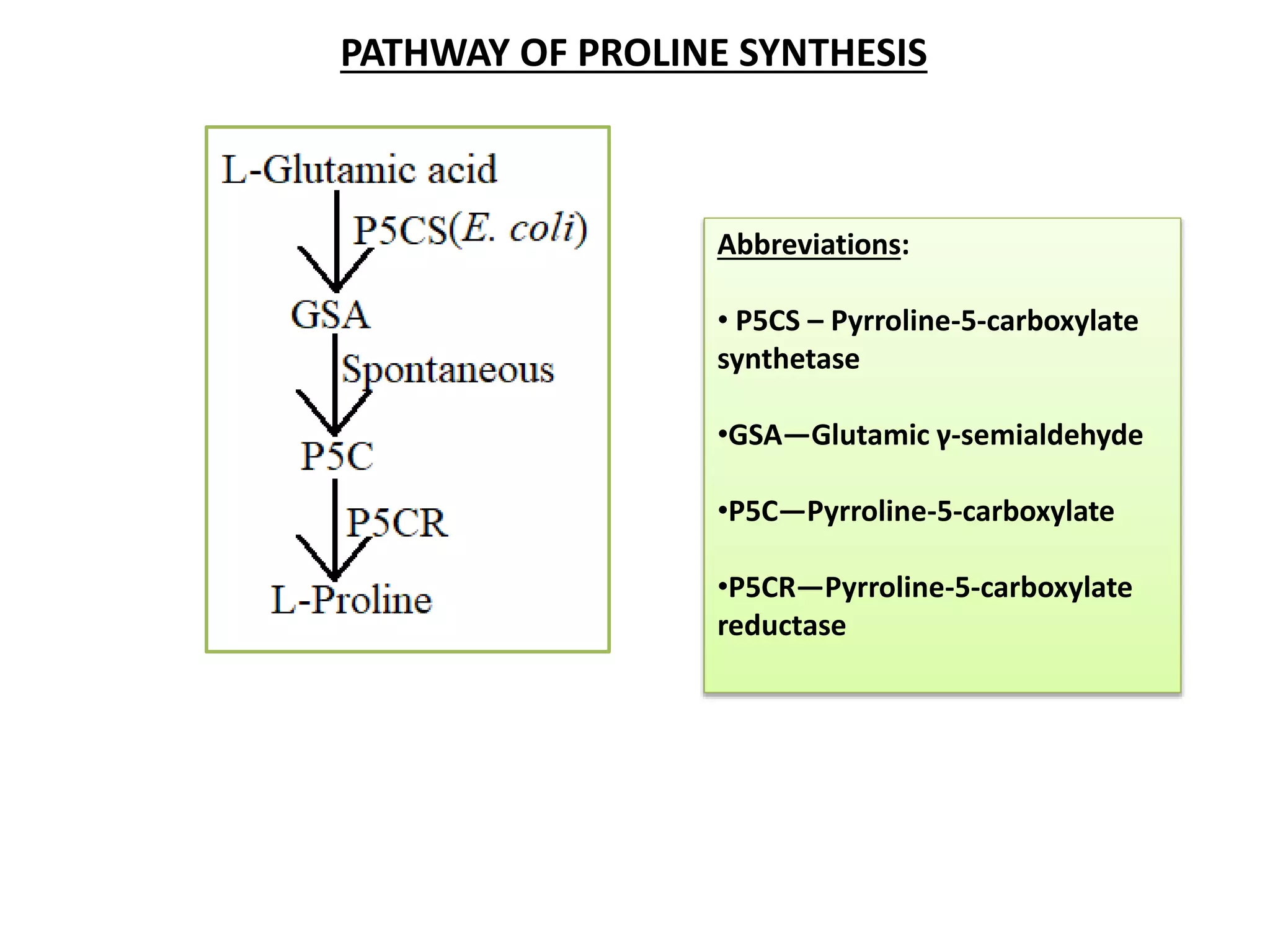
PATHWAY OF PROLINE SYNTHESIS
Abbreviations:
• P5CS – Pyrroline-5-carboxylate
synthetase
•GSA—Glutamic γ-semialdehyde
•P5C—Pyrroline-5-carboxylate
•P5CR—Pyrroline-5-carboxylate
reductase
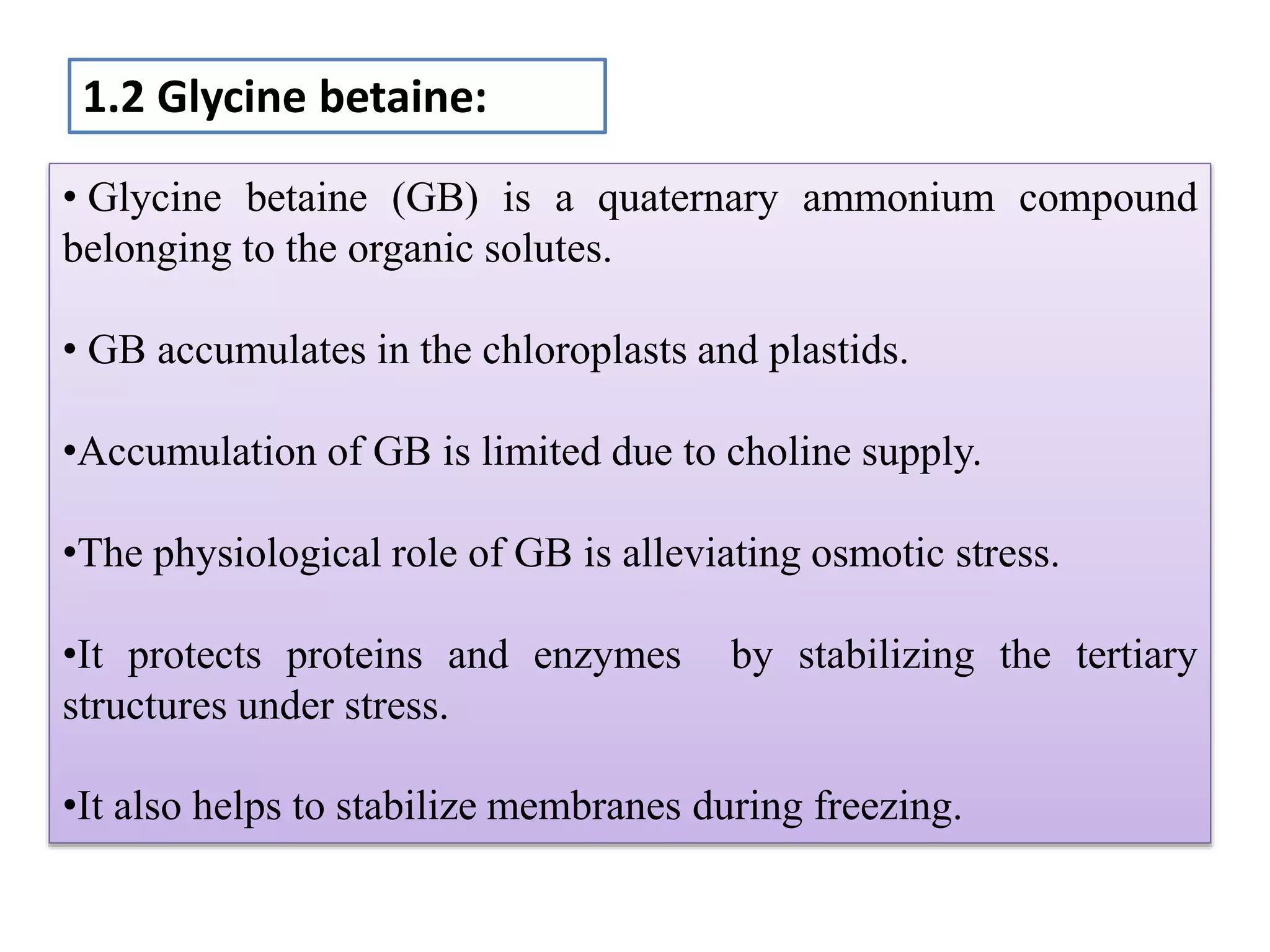
• Glycine betaine (GB) is a quaternary ammonium compound
belonging to the organic solutes.
• GB accumulates in the chloroplasts and plastids.
•Accumulation of GB is limited due to choline supply.
•The physiological role of GB is alleviating osmotic stress.
•It protects proteins and enzymes by stabilizing the tertiary
structures under stress.
•It also helps to stabilize membranes during freezing.
1.2 Glycine betaine:
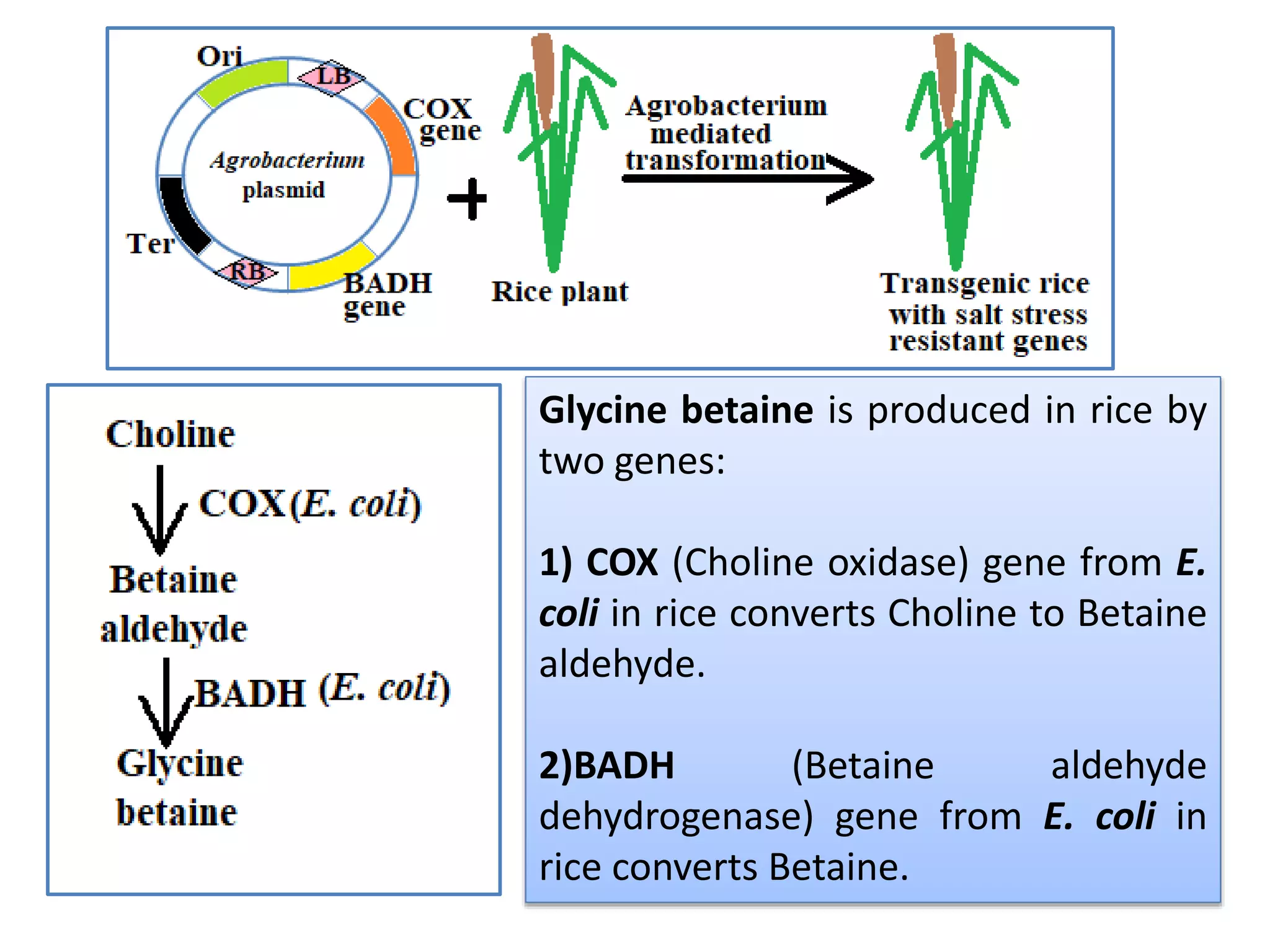
Glycine betaine is produced in rice by
two genes:
1) COX (Choline oxidase) gene from E.
coli in rice converts Choline to Betaine
aldehyde.
2)BADH (Betaine aldehyde
dehydrogenase) gene from E. coli in
rice converts Betaine.
• The Escherchia coli nahA gene encodes Na+/H+ antiporter which
play a role in homeostasis has been transferred to rice.
• High salt concentration inhibits the growth of the plant so the
physiological condition is maintained in homeostatis by ion
transporters.
• The Na+/H+ antiporters catalyze the exchange of Na+ for
cytoplasmic pH, sodium levels and cell turgour.
• High activity of transporters do not affect the growth of the plant.
•The transgenic plants produce heavier and larger grains in saline
condition.
2. Bacterial Na+/H+ antiporter
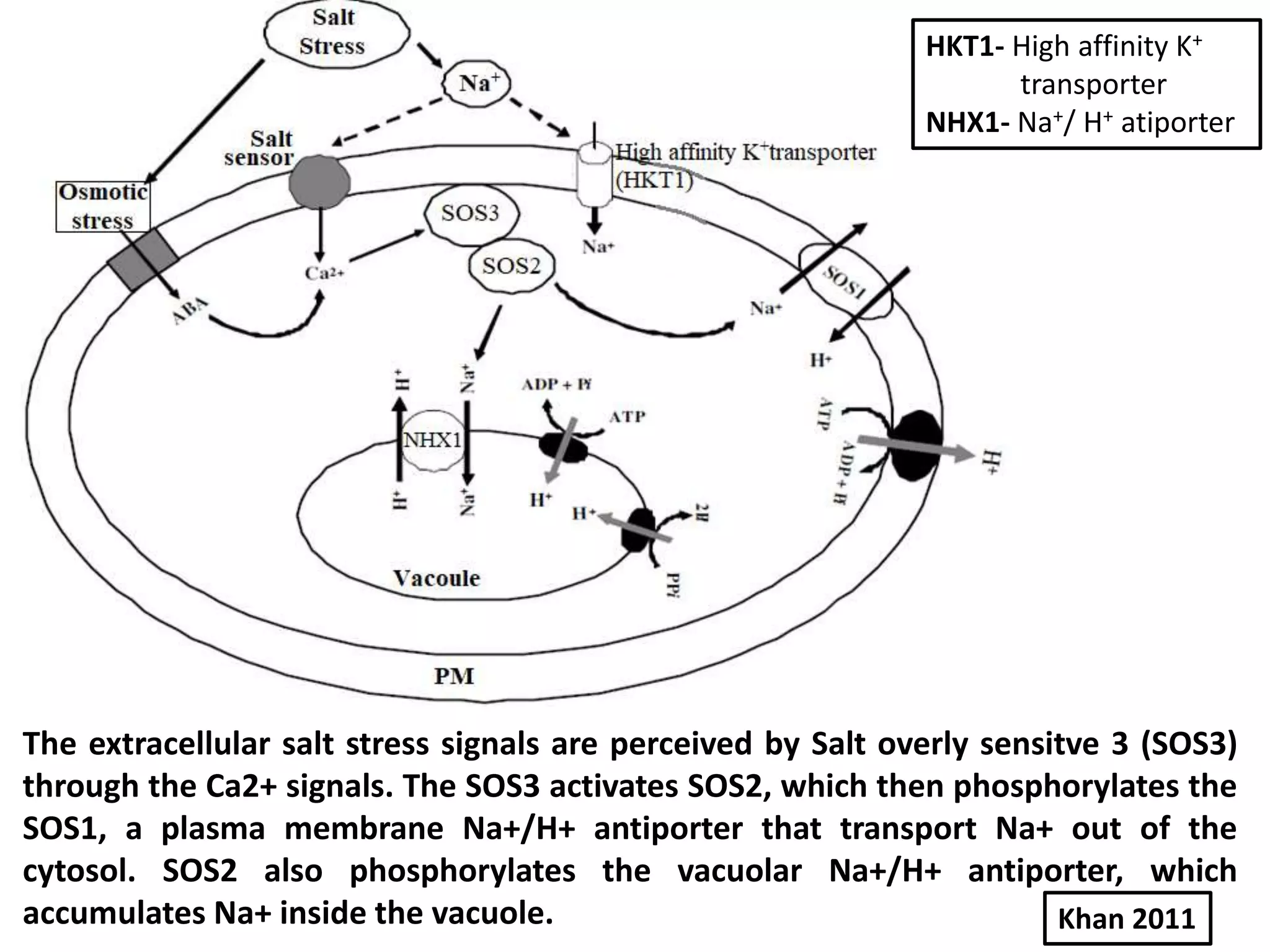
The extracellular salt stress signals are perceived by Salt overly sensitve 3 (SOS3)
through the Ca2+ signals. The SOS3 activates SOS2, which then phosphorylates the
SOS1, a plasma membrane Na+/H+ antiporter that transport Na+ out of the
cytosol. SOS2 also phosphorylates the vacuolar Na+/H+ antiporter, which
accumulates Na+ inside the vacuole. Khan 2011
HKT1- High affinity K+
transporter
NHX1- Na+/ H+ atiporter
• Transcription factors are the proteins that bind DNA
specifically, transcribe and regulate genes.
• Researchers have made continuous efforts to identify,
characterize, clone and transform different transcription factors
involved in regulation of stress related genes.
•Arabidopsis DREB subgroup consists of six genes of which
AtDREB2A and AtDREB2B were induced by dehydration and
salt stress but not by cold stress and exogenous ABA.
•AtDREB2A is accumulated in roots, stems and leaves under
normal growth conditions.
3. Transcription factor (AtDREB)
•A gene Responsive to ABA (RAB) genes called Responsive to
Dehydration (RD) genes code for LEA proteins.
•LEA proteins are activated under osmotic stress.
•LEA proteins play a role in maintenance of protein or
membrane structure.
•LEA proteins play a role in sequestration of ions.
•LEA proteins play a role by operating as molecular chaperons.
•LEA proteins play by binding of water.
4. Late Embryo Abundance(LEA) proteins
•The LEA protein transformed in rice is HVA1 incorporated
from barley.
Properties of HVA1 gene are:
1. It has eleven amino-acid consensus sequence motif
TAQAAKEKAXE is repeated in the protein.
2. It contains apparent amphipathic α helices.
3. It is a Dimeric protein.
• Khan, M.S. 2011. Role of sodium and hydrogen (Na+/ H+)
antiporters in salt tolerance of plants : Present and future
challenges. African Journal of Biotechnology. Vol. 10 (63), pp.
13693-13704.
•Mahajan, S. and Tuteja, N. 2005. Transgenic Crops For Abiotic
Stress Resistance. Plant Molecular Biology.
•Roy, B., Noren, S.K., Mandal, A.B. and Basu, A.K. 2011.Genetic
Engineering for Abiotic Stress Tolerance in Agricultural Crops.
Biotechnology. 10 (1): 1-22.
REFERENCES
Genes for salinity resitance in rice

Genes for salinity resitance in rice

  • 1.
  • 2.
    •Stress in plantscan be defined as any external factor that negatively influences plant growth, productivity, reproductive capacity or survival of the plant. •Abiotic stress is the negative impact of non- living factors on the living organisms in a specific environment. Abiotic stress is essentially unavoidable. Types of Stress Biotic Abiotic
  • 3.
  • 4.
    PERCENTAGE YIELD LOSSBY VARIOUS ABIOTIC STRESSES IN CROPS Roy et al., 2011 29% of total land is affected by drought which includes 26% of arable land. 36% of land is affected by salinity which includes 10% of arable land
  • 5.
    In country likeIndia where rice is stable diet of most of people, the loss of crop needs to be reduced. Second main abiotic stress after drought that affects the crop of rice is salinity. These problems can be overcome by preparation of transgenic plants by recombinant DNA technology
  • 6.
     Increased yields(to feed a growing population).  Reduce poverty and hunger.  Give financial benefits to poor farmers.  Decreasing the use of pesticides (to save the environment and the cost of pesticides).  The production of novel crops (such as providing crops with increased nutritional value).  Plants can survive with the changing climates of today. Advantages of transgenic crops:
  • 7.
    The genetic response ofplant against salinity involves various genes. These genes can be genetically engineered to functional targets in plants to make the plant tolerant to salinity.
  • 8.
    Osmoprotectant Transgenes Cropplants Stress Tolerance Proline Moth bean P5CS Rice Drought , Salt Glycine betamine COX (choline oxidase gene) Rice Salt CMO (Choline monooxygena se) Rice Salt, chilling 1. Osmoprotectants:
  • 9.
    1.1 Proline: • Prolineaccumulates in response to stress (drought and salt). •Proline acts as a hydroxyl radical scavenger and molecular chaperone reducing the acidity of the cell. •It also results in root elongation and higher root biomass both under salt and drought stress conditions. •The rate limiting step in proline biosynthesis is encoded by nuclear gene Pyrroline-5-carboxylate synthetase (p5cs). •P5CS1 express in non-diving cells and P5CS2 is expressed in diving cells •Rice is transformed by gene from Vigna aconitifolia (Moth bean).
  • 10.
    PATHWAY OF PROLINESYNTHESIS Abbreviations: • P5CS – Pyrroline-5-carboxylate synthetase •GSA—Glutamic γ-semialdehyde •P5C—Pyrroline-5-carboxylate •P5CR—Pyrroline-5-carboxylate reductase
  • 11.
    • Glycine betaine(GB) is a quaternary ammonium compound belonging to the organic solutes. • GB accumulates in the chloroplasts and plastids. •Accumulation of GB is limited due to choline supply. •The physiological role of GB is alleviating osmotic stress. •It protects proteins and enzymes by stabilizing the tertiary structures under stress. •It also helps to stabilize membranes during freezing. 1.2 Glycine betaine:
  • 12.
    Glycine betaine isproduced in rice by two genes: 1) COX (Choline oxidase) gene from E. coli in rice converts Choline to Betaine aldehyde. 2)BADH (Betaine aldehyde dehydrogenase) gene from E. coli in rice converts Betaine.
  • 13.
    • The Escherchiacoli nahA gene encodes Na+/H+ antiporter which play a role in homeostasis has been transferred to rice. • High salt concentration inhibits the growth of the plant so the physiological condition is maintained in homeostatis by ion transporters. • The Na+/H+ antiporters catalyze the exchange of Na+ for cytoplasmic pH, sodium levels and cell turgour. • High activity of transporters do not affect the growth of the plant. •The transgenic plants produce heavier and larger grains in saline condition. 2. Bacterial Na+/H+ antiporter
  • 14.
    The extracellular saltstress signals are perceived by Salt overly sensitve 3 (SOS3) through the Ca2+ signals. The SOS3 activates SOS2, which then phosphorylates the SOS1, a plasma membrane Na+/H+ antiporter that transport Na+ out of the cytosol. SOS2 also phosphorylates the vacuolar Na+/H+ antiporter, which accumulates Na+ inside the vacuole. Khan 2011 HKT1- High affinity K+ transporter NHX1- Na+/ H+ atiporter
  • 15.
    • Transcription factorsare the proteins that bind DNA specifically, transcribe and regulate genes. • Researchers have made continuous efforts to identify, characterize, clone and transform different transcription factors involved in regulation of stress related genes. •Arabidopsis DREB subgroup consists of six genes of which AtDREB2A and AtDREB2B were induced by dehydration and salt stress but not by cold stress and exogenous ABA. •AtDREB2A is accumulated in roots, stems and leaves under normal growth conditions. 3. Transcription factor (AtDREB)
  • 16.
    •A gene Responsiveto ABA (RAB) genes called Responsive to Dehydration (RD) genes code for LEA proteins. •LEA proteins are activated under osmotic stress. •LEA proteins play a role in maintenance of protein or membrane structure. •LEA proteins play a role in sequestration of ions. •LEA proteins play a role by operating as molecular chaperons. •LEA proteins play by binding of water. 4. Late Embryo Abundance(LEA) proteins
  • 17.
    •The LEA proteintransformed in rice is HVA1 incorporated from barley. Properties of HVA1 gene are: 1. It has eleven amino-acid consensus sequence motif TAQAAKEKAXE is repeated in the protein. 2. It contains apparent amphipathic α helices. 3. It is a Dimeric protein.
  • 18.
    • Khan, M.S.2011. Role of sodium and hydrogen (Na+/ H+) antiporters in salt tolerance of plants : Present and future challenges. African Journal of Biotechnology. Vol. 10 (63), pp. 13693-13704. •Mahajan, S. and Tuteja, N. 2005. Transgenic Crops For Abiotic Stress Resistance. Plant Molecular Biology. •Roy, B., Noren, S.K., Mandal, A.B. and Basu, A.K. 2011.Genetic Engineering for Abiotic Stress Tolerance in Agricultural Crops. Biotechnology. 10 (1): 1-22. REFERENCES