An Introduction to Wireless Fading Channels Name of the author: Nitin Jain Date Created   : 8 th  Jan 2010
Contents Physical Phenomenon Path loss model Shadow Fading Large and small scale fading Multipath Fading Rayleigh Fading Time dispersion Delay spread Flat and frequency selective fading Time variance  Doppler fading Slow and fast fading Summary of Fading References
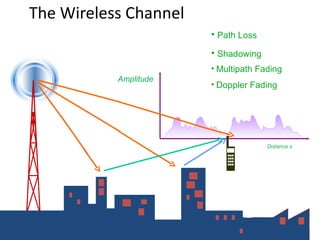
The Wireless Channel Multipath Fading Doppler Fading Shadowing Path Loss Distance x Amplitude
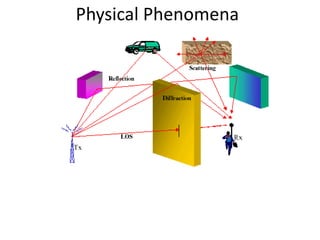
Physical Phenomena
Physical Phenomena Reflection - caused by smooth surface with very large dimensions compared to wavelength Diffraction- Obstruction  caused by a dense body with large dim. > wavelength. EM waves get bend around objects. Reason for shadowing and RF energy being present without LOS Scattering- Large rough surface with dim. ~ wavelength
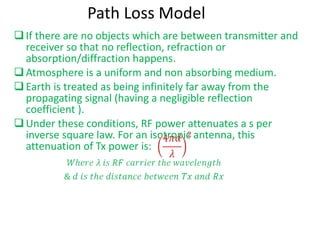
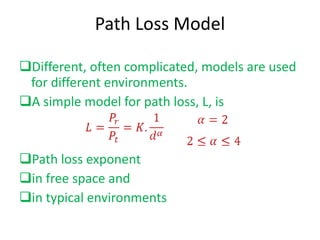
Path Loss Model If there are no objects which are between transmitter and receiver so that no reflection, refraction or absorption/diffraction happens. Atmosphere is a uniform and non absorbing medium. Earth is treated as being infinitely far away from the propagating signal (having a negligible reflection coefficient ). Under these conditions, RF power attenuates a s per inverse square law. For an isotropic antenna, this attenuation of Tx power is:
Wireless Propagation Path loss inversely proportional to 1/d n , n = 2 to 4 for mobile channels: Large scale attenuation in signal strength Shadowing - Terrain dependent, medium scale variation in signal strength, comes because of big obstacles like buildings, hills  Multipath Fading - Small scale or short term variation on the order of   /2
Path Loss Model Different, often complicated, models are used for different environments. A simple model for path loss, L, is  Path loss exponent  in free space and  in typical environments
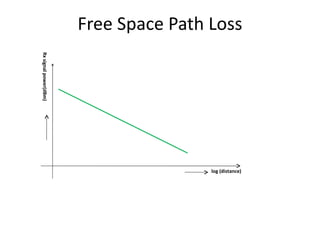
Free Space Path Loss log (distance) Rx signal power(dBm)
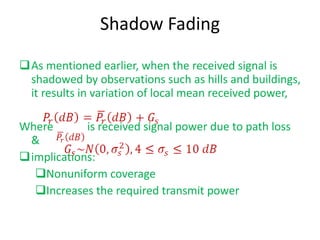
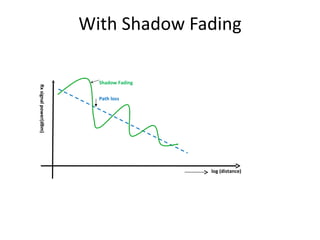
Shadow Fading As mentioned earlier, when the received signal is shadowed by observations such as hills and buildings, it results in variation of local mean received power,  Where  is received signal power due to path loss &  implications: Nonuniform coverage Increases the required transmit power
With Shadow Fading log (distance) Rx signal power(dBm) Shadow Fading Path loss
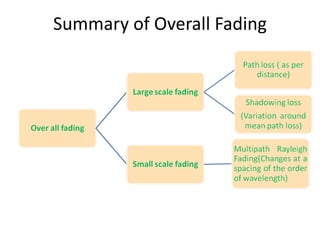
Large, medium and small scale fading Large Scale Fading: Average signal power attenuation/path loss due to motion over large areas.  Medium scale fading: Local variation in the average signal power around mean average power due to shadowing by local obstructions Small scale fading: large variation in the signal power due to small changes in the distance between transmitter and receiver (Also called Rayleigh fading when no LOS available). It is called Rayleigh fading due to the fact that various multipaths at the receiver with random amplitude & delay add up together to render rayleigh PDF for total signal.
Cause of Multipath Fading Fading : Fluctuation in the received signal power due to Variations in the received singal amplitude (Different objects present on radio signal path produce attenuation of it’s power as they can scatter or absorb part of the signal power, thus producing  a variation of the amplitude   Variations in the signal phase  Variations in the received signal angle of arrival (different paths travelling different distances may have different phases & angle of arrival)
Causes of Multipath fading Cont.. Reflections and diffraction from object create many different EM waves which are received in mobile antenna. These waves usually come from many different directions and delay varies. In the receiver, the waves are added either constructively or destructively and create a Rx signal which may very rapidly in phase and amplitude depending on the local objects and how mobile moves
Practical examples of small scale multipath fading Common examples of multipath fading are temporary failure of communication due to a severe drop in the channel signal to noise ratio (You may have also experienced this. And you moved a steps away & noted that reception is better. It is due to small scale fading effects.   ) FM radio transmission experiencing intermittent loss of broadcast when away from station.
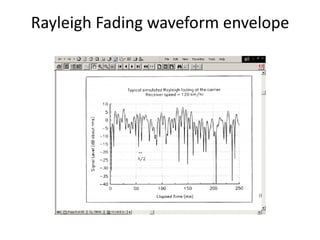
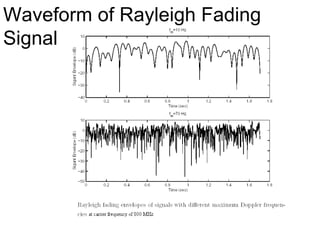
Multipath Fading- Most difficult Fades of 40 dB or more below local average level are frequent, with successive nulls occurring every half  wavelength or so Referred to as Rayleigh Fading
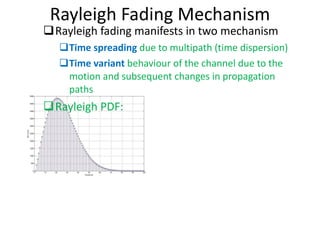
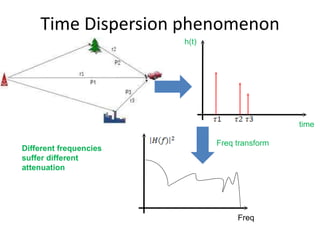
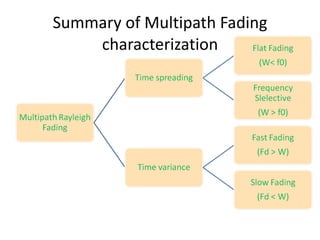
Rayleigh Fading Mechanism Rayleigh fading manifests in two mechanism Time spreading  due to multipath (time dispersion) Time variant  behaviour of the channel due to the motion and subsequent changes in propagation paths Rayleigh PDF:
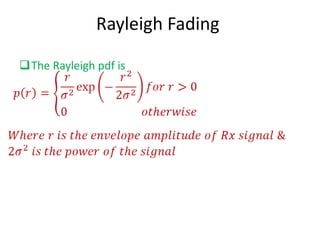
Rayleigh Fading  The Rayleigh pdf is
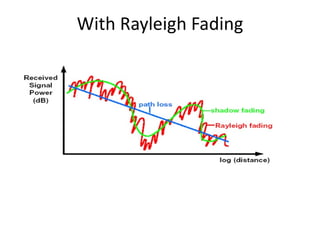
With Rayleigh Fading
Rayleigh Fading waveform envelope
Time Dispersion phenomenon time h(t) Freq Freq transform Different frequencies suffer different attenuation
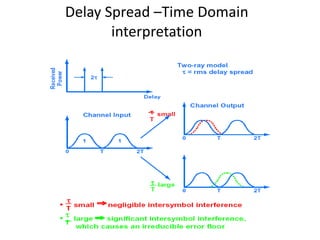
Delay Spread –Time Domain interpretation
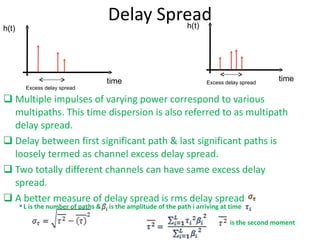
Delay Spread Multiple impulses of varying power correspond to various multipaths. This time dispersion is also referred to as multipath delay spread. Delay between first significant path & last significant paths is loosely termed as channel excess delay spread.  Two totally different channels can have same excess delay spread. A better measure of delay spread is rms delay spread  is the second moment L is the number of paths &  is the amplitude of the path i arriving at time  time h(t) Excess delay spread time h(t) Excess delay spread
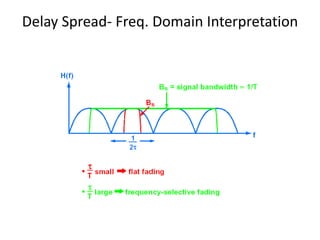
Delay Spread- Freq. Domain Interpretation
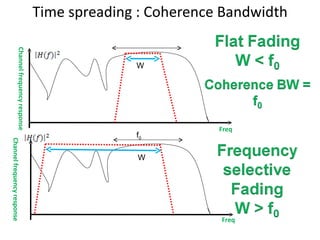
Time spreading : Coherence Bandwidth f 0 Freq Channel frequency   response W Freq W Channel frequency response f 0
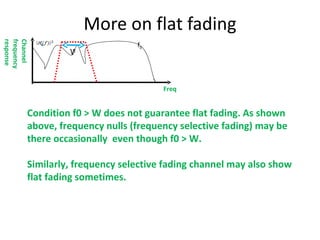
More on flat fading Condition f0 > W does not guarantee flat fading. As shown above, frequency nulls (frequency selective fading) may be there occasionally  even though f0 > W.  Similarly, frequency selective fading channel may also show flat fading sometimes. f 0 Freq Channel frequency   response W
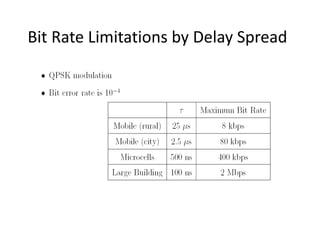
Bit Rate Limitations by Delay Spread
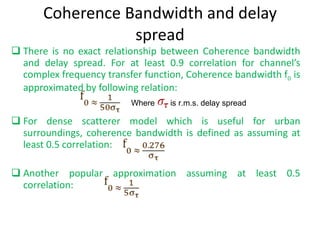
Coherence Bandwidth and delay spread There is no exact relationship between Coherence bandwidth and delay spread. For at least 0.9 correlation for channel’s complex frequency transfer function, Coherence bandwidth f 0  is approximated by following relation: For dense scatterer model which is useful for urban surroundings, coherence bandwidth is defined as assuming at least 0.5 correlation: Another popular approximation assuming at least 0.5 correlation: Where  is r.m.s. delay spread
Effects of Flat & frequency selective fading Flat fading Reduces SNR forcing various mitigation techniques to handle that. Not such a bad thing.  Frequency selecting fading ISI distortion (need equalizer in receiver) Pulse mutilation Irreducible BER
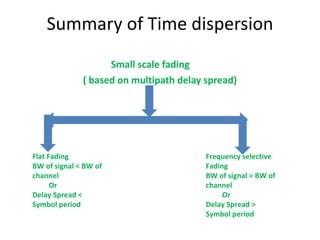
Summary of Time dispersion Small scale fading ( based on multipath delay spread) Flat Fading BW of signal < BW of channel  Or  Delay Spread < Symbol period Frequency selective  Fading BW of signal > BW of channel  Or  Delay Spread > Symbol period
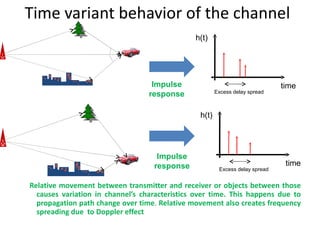
Time variant behavior of the channel Relative movement between transmitter and receiver or objects between those causes variation in channel’s characteristics over time. This happens due to propagation path change over time .  Relative movement also creates frequency spreading due  to Doppler effect  time h(t) Excess delay spread time h(t) Excess delay spread Impulse response Impulse response
Time Variance Variance in channel conditions over time is an important factor when designing a mobile communication system.  If fast variations happen, it can lead to severe pulse distortion and loss of SNR subsequently causing irreducible BER.
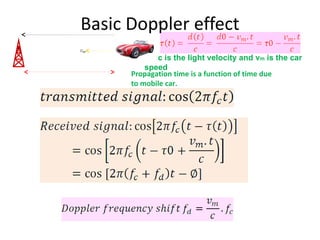
Basic Doppler effect t) Propagation time is a function of time due to mobile car.  c is the light velocity and v m  is the car speed
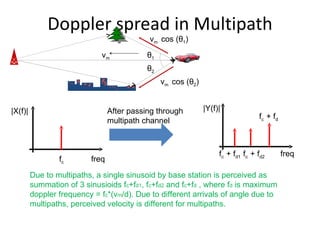
Doppler spread in Multipath freq |X(f)| f c f c  + f d1  f c  + f d2  f c  + f d  |Y(f)| freq Due to multipaths, a single sinusoid by base station is perceived as summation of 3 sinusioids f c +f d1 , f c +f d2  and f c +f d  , where f d  is maximum doppler frequency = f c *(v m /d). Due to different arrivals of angle due to multipaths, perceived velocity is different for multipaths. After passing through multipath channel v m v m  cos ( θ 1 )   v m  cos ( θ 2 )   θ 1 θ 2
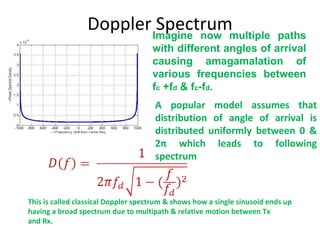
Doppler Spectrum This is called classical Doppler spectrum & shows how a single sinusoid ends up  having a broad spectrum due to multipath & relative motion between Tx and Rx. A popular model assumes that distribution of angle of arrival is distributed uniformly between 0 & 2 π  which leads to following spectrum Imagine now multiple paths with different angles of arrival causing amagamalation of various frequencies between f c  +f d  & f c -f d .
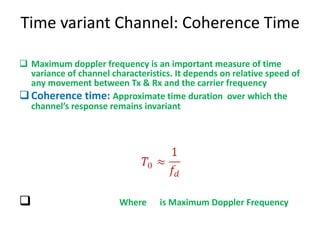
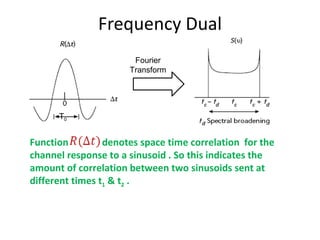
Time variant Channel: Coherence Time Maximum doppler frequency is an important measure of time variance of channel characteristics. It depends on relative speed of any movement between Tx & Rx and the carrier frequency Coherence time:  Approximate time duration  over which the channel’s response remains invariant Where  is Maximum Doppler Frequency
Frequency Dual Fourier Transform T 0 Function  denotes space time correlation  for the channel response to a sinusoid . So this indicates the amount of correlation between two sinusoids sent at different times t 1  & t 2  .
Waveform of Rayleigh Fading Signal
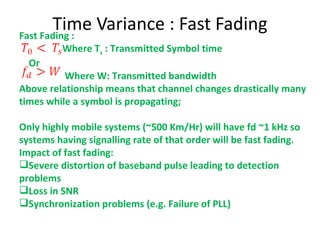
Time Variance : Fast Fading Fast Fading : Where T s  : Transmitted Symbol time Or  Where W: Transmitted bandwidth Above relationship means that channel changes drastically many times while a symbol is propagating; Only highly mobile systems (~500 Km/Hr) will have fd ~1 kHz so systems having signalling rate of that order will be fast fading. Impact of fast fading:  Severe distortion of baseband pulse leading to detection problems Loss in SNR Synchronization problems (e.g. Failure of PLL)
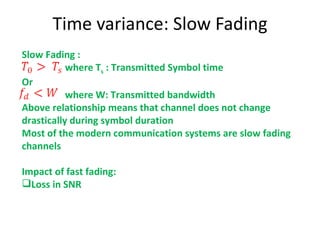
Time variance: Slow Fading Slow Fading : where T s  : Transmitted Symbol time Or  where W: Transmitted bandwidth Above relationship means that channel does not change drastically during symbol duration Most of the modern communication systems are slow fading channels Impact of fast fading:  Loss in SNR
Summary of Overall Fading
Summary of Multipath Fading characterization
References B Skalar. “Rayleigh fading channels in mobile digital communication systems, Part I: characterization”. IEEE communication magazine. July 1997, pp 90-100.

Introduction To Wireless Fading Channels

  • 1.
    An Introduction toWireless Fading Channels Name of the author: Nitin Jain Date Created : 8 th Jan 2010
  • 2.
    Contents Physical PhenomenonPath loss model Shadow Fading Large and small scale fading Multipath Fading Rayleigh Fading Time dispersion Delay spread Flat and frequency selective fading Time variance Doppler fading Slow and fast fading Summary of Fading References
  • 3.
    The Wireless ChannelMultipath Fading Doppler Fading Shadowing Path Loss Distance x Amplitude
  • 4.
  • 5.
    Physical Phenomena Reflection- caused by smooth surface with very large dimensions compared to wavelength Diffraction- Obstruction caused by a dense body with large dim. > wavelength. EM waves get bend around objects. Reason for shadowing and RF energy being present without LOS Scattering- Large rough surface with dim. ~ wavelength
  • 6.
    Path Loss ModelIf there are no objects which are between transmitter and receiver so that no reflection, refraction or absorption/diffraction happens. Atmosphere is a uniform and non absorbing medium. Earth is treated as being infinitely far away from the propagating signal (having a negligible reflection coefficient ). Under these conditions, RF power attenuates a s per inverse square law. For an isotropic antenna, this attenuation of Tx power is:
  • 7.
    Wireless Propagation Pathloss inversely proportional to 1/d n , n = 2 to 4 for mobile channels: Large scale attenuation in signal strength Shadowing - Terrain dependent, medium scale variation in signal strength, comes because of big obstacles like buildings, hills Multipath Fading - Small scale or short term variation on the order of  /2
  • 8.
    Path Loss ModelDifferent, often complicated, models are used for different environments. A simple model for path loss, L, is Path loss exponent in free space and in typical environments
  • 9.
    Free Space PathLoss log (distance) Rx signal power(dBm)
  • 10.
    Shadow Fading Asmentioned earlier, when the received signal is shadowed by observations such as hills and buildings, it results in variation of local mean received power, Where is received signal power due to path loss & implications: Nonuniform coverage Increases the required transmit power
  • 11.
    With Shadow Fadinglog (distance) Rx signal power(dBm) Shadow Fading Path loss
  • 12.
    Large, medium andsmall scale fading Large Scale Fading: Average signal power attenuation/path loss due to motion over large areas. Medium scale fading: Local variation in the average signal power around mean average power due to shadowing by local obstructions Small scale fading: large variation in the signal power due to small changes in the distance between transmitter and receiver (Also called Rayleigh fading when no LOS available). It is called Rayleigh fading due to the fact that various multipaths at the receiver with random amplitude & delay add up together to render rayleigh PDF for total signal.
  • 13.
    Cause of MultipathFading Fading : Fluctuation in the received signal power due to Variations in the received singal amplitude (Different objects present on radio signal path produce attenuation of it’s power as they can scatter or absorb part of the signal power, thus producing a variation of the amplitude Variations in the signal phase Variations in the received signal angle of arrival (different paths travelling different distances may have different phases & angle of arrival)
  • 14.
    Causes of Multipathfading Cont.. Reflections and diffraction from object create many different EM waves which are received in mobile antenna. These waves usually come from many different directions and delay varies. In the receiver, the waves are added either constructively or destructively and create a Rx signal which may very rapidly in phase and amplitude depending on the local objects and how mobile moves
  • 15.
    Practical examples ofsmall scale multipath fading Common examples of multipath fading are temporary failure of communication due to a severe drop in the channel signal to noise ratio (You may have also experienced this. And you moved a steps away & noted that reception is better. It is due to small scale fading effects.  ) FM radio transmission experiencing intermittent loss of broadcast when away from station.
  • 16.
    Multipath Fading- Mostdifficult Fades of 40 dB or more below local average level are frequent, with successive nulls occurring every half wavelength or so Referred to as Rayleigh Fading
  • 17.
    Rayleigh Fading MechanismRayleigh fading manifests in two mechanism Time spreading due to multipath (time dispersion) Time variant behaviour of the channel due to the motion and subsequent changes in propagation paths Rayleigh PDF:
  • 18.
    Rayleigh Fading The Rayleigh pdf is
  • 19.
  • 20.
  • 21.
    Time Dispersion phenomenontime h(t) Freq Freq transform Different frequencies suffer different attenuation
  • 22.
    Delay Spread –TimeDomain interpretation
  • 23.
    Delay Spread Multipleimpulses of varying power correspond to various multipaths. This time dispersion is also referred to as multipath delay spread. Delay between first significant path & last significant paths is loosely termed as channel excess delay spread. Two totally different channels can have same excess delay spread. A better measure of delay spread is rms delay spread is the second moment L is the number of paths & is the amplitude of the path i arriving at time time h(t) Excess delay spread time h(t) Excess delay spread
  • 24.
    Delay Spread- Freq.Domain Interpretation
  • 25.
    Time spreading :Coherence Bandwidth f 0 Freq Channel frequency response W Freq W Channel frequency response f 0
  • 26.
    More on flatfading Condition f0 > W does not guarantee flat fading. As shown above, frequency nulls (frequency selective fading) may be there occasionally even though f0 > W. Similarly, frequency selective fading channel may also show flat fading sometimes. f 0 Freq Channel frequency response W
  • 27.
    Bit Rate Limitationsby Delay Spread
  • 28.
    Coherence Bandwidth anddelay spread There is no exact relationship between Coherence bandwidth and delay spread. For at least 0.9 correlation for channel’s complex frequency transfer function, Coherence bandwidth f 0 is approximated by following relation: For dense scatterer model which is useful for urban surroundings, coherence bandwidth is defined as assuming at least 0.5 correlation: Another popular approximation assuming at least 0.5 correlation: Where is r.m.s. delay spread
  • 29.
    Effects of Flat& frequency selective fading Flat fading Reduces SNR forcing various mitigation techniques to handle that. Not such a bad thing. Frequency selecting fading ISI distortion (need equalizer in receiver) Pulse mutilation Irreducible BER
  • 30.
    Summary of Timedispersion Small scale fading ( based on multipath delay spread) Flat Fading BW of signal < BW of channel Or Delay Spread < Symbol period Frequency selective Fading BW of signal > BW of channel Or Delay Spread > Symbol period
  • 31.
    Time variant behaviorof the channel Relative movement between transmitter and receiver or objects between those causes variation in channel’s characteristics over time. This happens due to propagation path change over time . Relative movement also creates frequency spreading due to Doppler effect time h(t) Excess delay spread time h(t) Excess delay spread Impulse response Impulse response
  • 32.
    Time Variance Variancein channel conditions over time is an important factor when designing a mobile communication system. If fast variations happen, it can lead to severe pulse distortion and loss of SNR subsequently causing irreducible BER.
  • 33.
    Basic Doppler effectt) Propagation time is a function of time due to mobile car. c is the light velocity and v m is the car speed
  • 34.
    Doppler spread inMultipath freq |X(f)| f c f c + f d1 f c + f d2 f c + f d |Y(f)| freq Due to multipaths, a single sinusoid by base station is perceived as summation of 3 sinusioids f c +f d1 , f c +f d2 and f c +f d , where f d is maximum doppler frequency = f c *(v m /d). Due to different arrivals of angle due to multipaths, perceived velocity is different for multipaths. After passing through multipath channel v m v m cos ( θ 1 ) v m cos ( θ 2 ) θ 1 θ 2
  • 35.
    Doppler Spectrum Thisis called classical Doppler spectrum & shows how a single sinusoid ends up having a broad spectrum due to multipath & relative motion between Tx and Rx. A popular model assumes that distribution of angle of arrival is distributed uniformly between 0 & 2 π which leads to following spectrum Imagine now multiple paths with different angles of arrival causing amagamalation of various frequencies between f c +f d & f c -f d .
  • 36.
    Time variant Channel:Coherence Time Maximum doppler frequency is an important measure of time variance of channel characteristics. It depends on relative speed of any movement between Tx & Rx and the carrier frequency Coherence time: Approximate time duration over which the channel’s response remains invariant Where is Maximum Doppler Frequency
  • 37.
    Frequency Dual FourierTransform T 0 Function denotes space time correlation for the channel response to a sinusoid . So this indicates the amount of correlation between two sinusoids sent at different times t 1 & t 2 .
  • 38.
    Waveform of RayleighFading Signal
  • 39.
    Time Variance :Fast Fading Fast Fading : Where T s : Transmitted Symbol time Or Where W: Transmitted bandwidth Above relationship means that channel changes drastically many times while a symbol is propagating; Only highly mobile systems (~500 Km/Hr) will have fd ~1 kHz so systems having signalling rate of that order will be fast fading. Impact of fast fading: Severe distortion of baseband pulse leading to detection problems Loss in SNR Synchronization problems (e.g. Failure of PLL)
  • 40.
    Time variance: SlowFading Slow Fading : where T s : Transmitted Symbol time Or where W: Transmitted bandwidth Above relationship means that channel does not change drastically during symbol duration Most of the modern communication systems are slow fading channels Impact of fast fading: Loss in SNR
  • 41.
  • 42.
    Summary of MultipathFading characterization
  • 43.
    References B Skalar.“Rayleigh fading channels in mobile digital communication systems, Part I: characterization”. IEEE communication magazine. July 1997, pp 90-100.

Editor's Notes

  • #22 Think wireless channel as a FIR filter with a practically finite impulse response. The response of the filter keeps on changing due to time varying coefficients. The taps of the filter are corresponding to multipaths’s amplitude.
  • #26 Coherence bandwidth f0 is a statistical measure of the range of frequencies over which all the signal spectral components are affected in a similar way by the channel i.e. exhibiting fading or no fading. Coherence bandwidth is inversely proportional to excess delay spread. Same channel can show flat fading behaviour depending upon
  • #28 This just illustrates how delay spread puts a limit on maximum achievable data rate without needing an eqaulizer. Of course, various communication standards use various techniques to overcome this limits.
  • #34 Doppler shift will be positive or negative depending upon whether mobile is moving to or going away from base station.
  • #39 Here the effect of time dispersion &amp; time variant behaviour of the model can be seen easily. When Doppler spread is larger, time between two consecutive fades is shortened accordingly.