NATTHU SHRIRAME
M-TECH ENV, ENGG
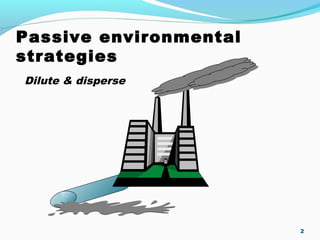
Passive environmental
strategies
Dilute & disperse
2
3
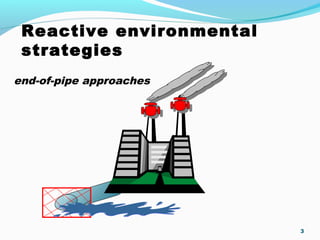
Reactive environmental
strategies
end-of-pipe approaches
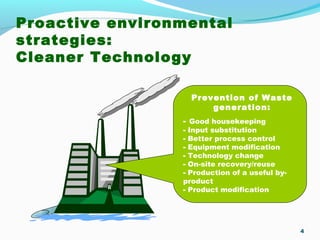
Proactive environmental
strategies:
Cleaner Technology
4
Prevention of Waste
generation:
- Good housekeeping
- Input substitution
- Better process control
- Equipment modification
- Technology change
- On-site recovery/reuse
- Production of a useful by-
product
- Product modification
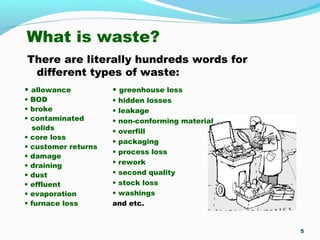
What is waste?
There are literally hundreds words for
different types of waste:
5
• greenhouse loss
• hidden losses
• leakage
• non-conforming material
• overfill
• packaging
• process loss
• rework
• second quality
• stock loss
• washings
and etc.
• allowance
• BOD
• broke
• contaminated
solids
• core loss
• customer returns
• damage
• draining
• dust
• effluent
• evaporation
• furnace loss
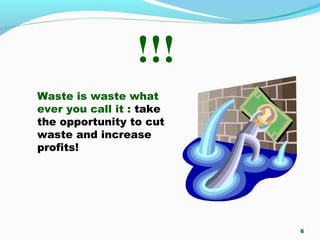
Waste is waste what
ever you call it : take
the opportunity to cut
waste and increase
profits!
6
!!!
Where are you now?
7
• Only a change
in technology
would eliminate
waste
completely
• We are
optimising our
processes and
achieving big
cost reductions
• Waste is
coming down as
we change the
way we work
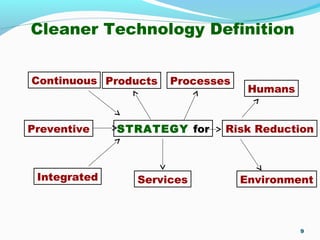
Cleaner Technology Definition
8
“The continuous application of an integrated
preventive environmental strategy applied to
processes, products, and services to increase
overall efficiency and reduce risks to humans
and the environment.”
or
It refer to any technical measures taken in
industries to reduce or eliminate some
product of any nuisance, pollution or waste
and to help saving of raw material, natural
resources and energy
(United Nations Environment Programme)
9
Continuous
Preventive
Integrated
STRATEGY for
Products Processes
Services
Risk Reduction
Humans
Environment
Cleaner Technology Definition
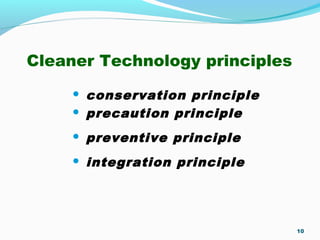
Cleaner Technology principles
 conservation principle
 precaution principle
 preventive principle
 integration principle
10
How CT could be applied in
practice?
11
Cleaner Technology practices
1. Good housekeeping
take appropriate managerial and
operational actions to prevent:
- Leaks
- - to enforce existing
operational
instructions
12
Cleaner Technology practices
2. Input substitution
substitute input materials
- by less toxic
- or by renewable materials
- or by adjunct materials which
have a longer service life-time
in production
13
Cleaner Technology practices
3. Better process control
modify:
- operational procedures
- equipment instructions
and process record keeping in
order to run the processes more
efficiently and at lower waste and
emission generation rates
14
Cleaner Technology practices
4. Equipment modification
modify the existing production
equipment and utilities in order:
- run the processes at higher
efficiency
- lower waste and emission
generation rates
15
Cleaner Technology practices
5. Technology change
replacement of:
- the technology
- processing sequence
- synthesis pathway
in order to minimise waste
and emission generation
during production
16
Cleaner Technology practices
6. On-site recovery/reuse
- reuse of the wasted materials
in the same process for another
useful application within the
company
17
Cleaner Technology practices
7. Production of a useful by-product
consider transforming waste into
a useful by-product, to be sold
as input for companies in
different business sectors.
18
Cleaner Technology practices
8. Product modification
modify the product
characteristics in order:
- to minimise the environmental
impacts of the product during
or after its use (disposal)
- to minimise the environmental
impacts of its production
19
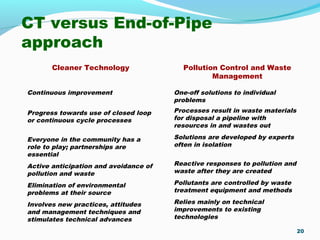
CT versus End-of-Pipe
approach
20
Cleaner Technology
Continuous improvement
Progress towards use of closed loop
or continuous cycle processes
Everyone in the community has a
role to play; partnerships are
essential
Active anticipation and avoidance of
pollution and waste
Elimination of environmental
problems at their source
Involves new practices, attitudes
and management techniques and
stimulates technical advances
Pollution Control and Waste
Management
One-off solutions to individual
problems
Processes result in waste materials
for disposal a pipeline with
resources in and wastes out
Solutions are developed by experts
often in isolation
Reactive responses to pollution and
waste after they are created
Pollutants are controlled by waste
treatment equipment and methods
Relies mainly on technical
improvements to existing
technologies
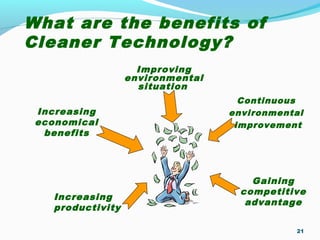
What are the benefits of
Cleaner Technology?
Improving
environmental
situation
21
Increasing
economical
benefits
Increasing
productivity
Gaining
competitive
advantage
Continuous
environmental
improvement
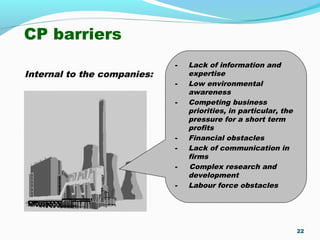
CP barriers
Internal to the companies:
22
- Lack of information and
expertise
- Low environmental
awareness
- Competing business
priorities, in particular, the
pressure for a short term
profits
- Financial obstacles
- Lack of communication in
firms
- Complex research and
development
- Labour force obstacles
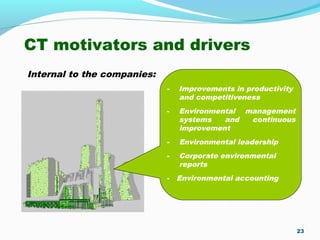
CT motivators and drivers
Internal to the companies:
23
- Improvements in productivity
and competitiveness
- Environmental management
systems and continuous
improvement
- Environmental leadership
- Corporate environmental
reports
- Environmental accounting
The role of
international organizations in CT
development
• United Nations Environment Programme (UNEP)
• United Nations Industrial Development
Organisation (UNIDO)
• Organisation for Economic Co-operation and
Development (OECD)
• World Business Council for Sustainable
Development (WBCSD)
• Development Finance Institutions (DFIs)
24
Team for CT success
 Managers, engineers and finance people in
industry and commerce, in particular those
responsible for business strategy, product
development, plant operations and finance
 Government officials, both central and
regional, who play an important role in
promoting CP
 Media representatives who play an important
role in disseminating information on good
environmental practice
25
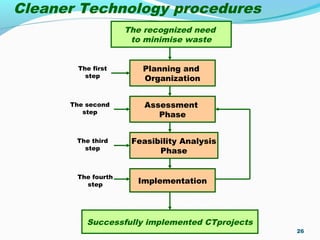
Cleaner Technology procedures
26
The recognized need
to minimise waste
Planning and
Organization
Assessment
Phase
Feasibility Analysis
Phase
Implementation
Successfully implemented CTprojects
The first
step
The second
step
The third
step
The fourth
step
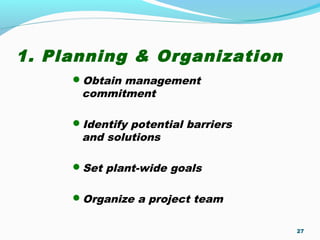
1. Planning & Organization
Obtain management
commitment
Identify potential barriers
and solutions
Set plant-wide goals
Organize a project team
27
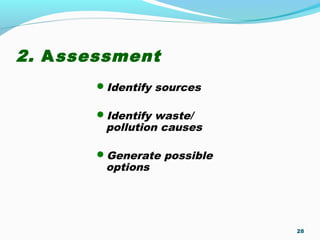
2. Assessment
Identify sources
Identify waste/
pollution causes
Generate possible
options
28
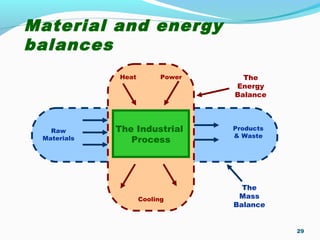
Material and energy
balances
29
The Industrial
Process
Heat Power The
Energy
Balance
Cooling
Raw
Materials
Products
& Waste
The
Mass
Balance
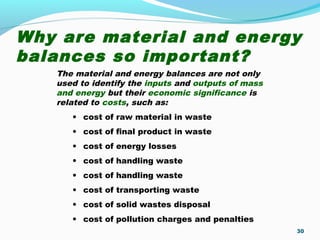
Why are material and energy
balances so important?
30
The material and energy balances are not only
used to identify the inputs and outputs of mass
and energy but their economic significance is
related to costs, such as:
• cost of raw material in waste
• cost of final product in waste
• cost of energy losses
• cost of handling waste
• cost of transporting waste
• cost of solid wastes disposal
• cost of pollution charges and penalties
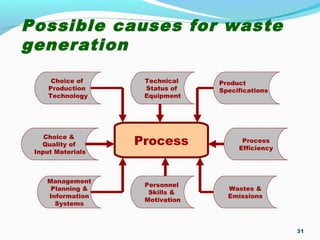
Possible causes for waste
generation
31
Process
Management
Planning &
Information
Systems
Personnel
Skills &
Motivation
Wastes &
Emissions
Choice &
Quality of
Input Materials
Technical
Status of
Equipment
Choice of
Production
Technology
Process
Efficiency
Product
Specifications
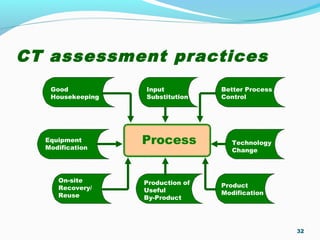
CT assessment practices
32
Process
On-site
Recovery/
Reuse
Production of
Useful
By-Product
Product
Modification
Equipment
Modification
Input
Substitution
Good
Housekeeping
Technology
Change
Better Process
Control
Broader Application of CT
CT is closely linked to:
• Environmental Management
Systems
• Total Quality Management
• Health and Safety
Management
33
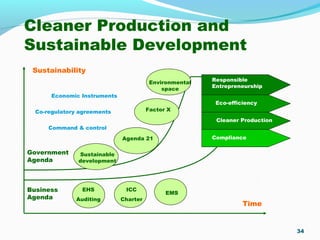
Cleaner Production and
Sustainable Development
34
Responsible
Entrepreneurship
Eco-efficiency
Cleaner Production
Compliance
Government
Agenda
Business
Agenda
ICC
Charter
EMS
EHS
Auditing
Sustainable
development
Agenda 21
Factor X
Environmental
space
Time
Sustainability
Economic Instruments
Co-regulatory agreements
Command & control
!!!
CT is
a journey
not a
destination
35
36
“An understanding of
the business value to be
gained from efficient use
of natural resources is an
important first step
toward sustainability:
toward building a world in which resources
are managed to meet the needs of all
people now and in the future.”
(J. Lash, President of
the World Resources Institute)

Cleaner Technology

  • 1.
  • 2.
  • 3.
  • 4.
    Proactive environmental strategies: Cleaner Technology 4 Preventionof Waste generation: - Good housekeeping - Input substitution - Better process control - Equipment modification - Technology change - On-site recovery/reuse - Production of a useful by- product - Product modification
  • 5.
    What is waste? Thereare literally hundreds words for different types of waste: 5 • greenhouse loss • hidden losses • leakage • non-conforming material • overfill • packaging • process loss • rework • second quality • stock loss • washings and etc. • allowance • BOD • broke • contaminated solids • core loss • customer returns • damage • draining • dust • effluent • evaporation • furnace loss
  • 6.
    Waste is wastewhat ever you call it : take the opportunity to cut waste and increase profits! 6 !!!
  • 7.
    Where are younow? 7 • Only a change in technology would eliminate waste completely • We are optimising our processes and achieving big cost reductions • Waste is coming down as we change the way we work
  • 8.
    Cleaner Technology Definition 8 “Thecontinuous application of an integrated preventive environmental strategy applied to processes, products, and services to increase overall efficiency and reduce risks to humans and the environment.” or It refer to any technical measures taken in industries to reduce or eliminate some product of any nuisance, pollution or waste and to help saving of raw material, natural resources and energy (United Nations Environment Programme)
  • 9.
    9 Continuous Preventive Integrated STRATEGY for Products Processes Services RiskReduction Humans Environment Cleaner Technology Definition
  • 10.
    Cleaner Technology principles conservation principle  precaution principle  preventive principle  integration principle 10
  • 11.
    How CT couldbe applied in practice? 11
  • 12.
    Cleaner Technology practices 1.Good housekeeping take appropriate managerial and operational actions to prevent: - Leaks - - to enforce existing operational instructions 12
  • 13.
    Cleaner Technology practices 2.Input substitution substitute input materials - by less toxic - or by renewable materials - or by adjunct materials which have a longer service life-time in production 13
  • 14.
    Cleaner Technology practices 3.Better process control modify: - operational procedures - equipment instructions and process record keeping in order to run the processes more efficiently and at lower waste and emission generation rates 14
  • 15.
    Cleaner Technology practices 4.Equipment modification modify the existing production equipment and utilities in order: - run the processes at higher efficiency - lower waste and emission generation rates 15
  • 16.
    Cleaner Technology practices 5.Technology change replacement of: - the technology - processing sequence - synthesis pathway in order to minimise waste and emission generation during production 16
  • 17.
    Cleaner Technology practices 6.On-site recovery/reuse - reuse of the wasted materials in the same process for another useful application within the company 17
  • 18.
    Cleaner Technology practices 7.Production of a useful by-product consider transforming waste into a useful by-product, to be sold as input for companies in different business sectors. 18
  • 19.
    Cleaner Technology practices 8.Product modification modify the product characteristics in order: - to minimise the environmental impacts of the product during or after its use (disposal) - to minimise the environmental impacts of its production 19
  • 20.
    CT versus End-of-Pipe approach 20 CleanerTechnology Continuous improvement Progress towards use of closed loop or continuous cycle processes Everyone in the community has a role to play; partnerships are essential Active anticipation and avoidance of pollution and waste Elimination of environmental problems at their source Involves new practices, attitudes and management techniques and stimulates technical advances Pollution Control and Waste Management One-off solutions to individual problems Processes result in waste materials for disposal a pipeline with resources in and wastes out Solutions are developed by experts often in isolation Reactive responses to pollution and waste after they are created Pollutants are controlled by waste treatment equipment and methods Relies mainly on technical improvements to existing technologies
  • 21.
    What are thebenefits of Cleaner Technology? Improving environmental situation 21 Increasing economical benefits Increasing productivity Gaining competitive advantage Continuous environmental improvement
  • 22.
    CP barriers Internal tothe companies: 22 - Lack of information and expertise - Low environmental awareness - Competing business priorities, in particular, the pressure for a short term profits - Financial obstacles - Lack of communication in firms - Complex research and development - Labour force obstacles
  • 23.
    CT motivators anddrivers Internal to the companies: 23 - Improvements in productivity and competitiveness - Environmental management systems and continuous improvement - Environmental leadership - Corporate environmental reports - Environmental accounting
  • 24.
    The role of internationalorganizations in CT development • United Nations Environment Programme (UNEP) • United Nations Industrial Development Organisation (UNIDO) • Organisation for Economic Co-operation and Development (OECD) • World Business Council for Sustainable Development (WBCSD) • Development Finance Institutions (DFIs) 24
  • 25.
    Team for CTsuccess  Managers, engineers and finance people in industry and commerce, in particular those responsible for business strategy, product development, plant operations and finance  Government officials, both central and regional, who play an important role in promoting CP  Media representatives who play an important role in disseminating information on good environmental practice 25
  • 26.
    Cleaner Technology procedures 26 Therecognized need to minimise waste Planning and Organization Assessment Phase Feasibility Analysis Phase Implementation Successfully implemented CTprojects The first step The second step The third step The fourth step
  • 27.
    1. Planning &Organization Obtain management commitment Identify potential barriers and solutions Set plant-wide goals Organize a project team 27
  • 28.
    2. Assessment Identify sources Identifywaste/ pollution causes Generate possible options 28
  • 29.
    Material and energy balances 29 TheIndustrial Process Heat Power The Energy Balance Cooling Raw Materials Products & Waste The Mass Balance
  • 30.
    Why are materialand energy balances so important? 30 The material and energy balances are not only used to identify the inputs and outputs of mass and energy but their economic significance is related to costs, such as: • cost of raw material in waste • cost of final product in waste • cost of energy losses • cost of handling waste • cost of handling waste • cost of transporting waste • cost of solid wastes disposal • cost of pollution charges and penalties
  • 31.
    Possible causes forwaste generation 31 Process Management Planning & Information Systems Personnel Skills & Motivation Wastes & Emissions Choice & Quality of Input Materials Technical Status of Equipment Choice of Production Technology Process Efficiency Product Specifications
  • 32.
    CT assessment practices 32 Process On-site Recovery/ Reuse Productionof Useful By-Product Product Modification Equipment Modification Input Substitution Good Housekeeping Technology Change Better Process Control
  • 33.
    Broader Application ofCT CT is closely linked to: • Environmental Management Systems • Total Quality Management • Health and Safety Management 33
  • 34.
    Cleaner Production and SustainableDevelopment 34 Responsible Entrepreneurship Eco-efficiency Cleaner Production Compliance Government Agenda Business Agenda ICC Charter EMS EHS Auditing Sustainable development Agenda 21 Factor X Environmental space Time Sustainability Economic Instruments Co-regulatory agreements Command & control
  • 35.
    !!! CT is a journey nota destination 35
  • 36.
    36 “An understanding of thebusiness value to be gained from efficient use of natural resources is an important first step toward sustainability: toward building a world in which resources are managed to meet the needs of all people now and in the future.” (J. Lash, President of the World Resources Institute)