Performance ArtPresented byLê Đỗ Đăng Trình
Definition: Performance ArtArt in which the medium is the artist's own body and the artwork takes the form of actions performed by the artist.Art that could not be bought, sold or traded as a commodity.
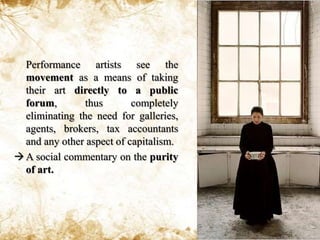
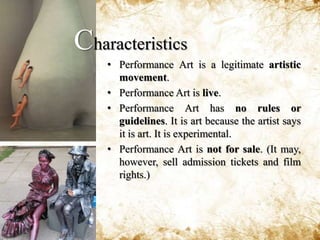
	Performance artists see the movement as a means of taking their art directly to a public forum, thus completely eliminating the need for galleries, agents, brokers, tax accountants and any other aspect of capitalism.A social commentary on the purity of art.CharacteristicsPerformance Art is a legitimate artistic movement.Performance Art is live.Performance Art has no rules or guidelines. It is art because the artist says it is art. It is experimental.Performance Art is not for sale. (It may, however, sell admission tickets and film rights.)
Performance Art may be comprised of painting,sculpture, dialogue, poetry, music, dance, film footage, laserlights, animals, fire, etc.Performance Art may be entertaining, amusing, shocking or horrifying. It is meant to be memorable.
	Cultural theorists often trace performance art activity back to the beginning of the 20th century, to the Russian constructivists, Futurists and Dada. Origins
Constructivist artis committed to complete abstraction with a devotion to modernity, where themes are often geometric, experimental and rarely emotional.Dada provided a significant progenitor with the unconventional performances of poetry by the likes of Richard Huelsenbeck and Tristan Tzara. Futurist artists could be identified as precursors of performance, such as David Burliuk, who painted his face for his actions .
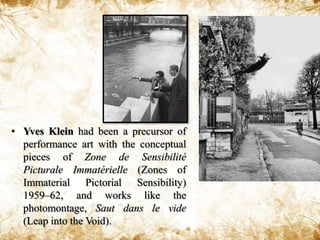
Yves Klein had been a precursor of performance art with the conceptual pieces of Zone de Sensibilité Picturale Immatérielle (Zones of Immaterial Pictorial Sensibility) 1959–62, and works like the photomontage, Saut dans le vide (Leap into the Void).
1960s	Happening is a new art form at the beginning of the 1960s. 	A Happening allows the artist to experiment with body motion, recorded sounds, written and spoken texts, and even smells. Sometimes, the audience members even become performers.
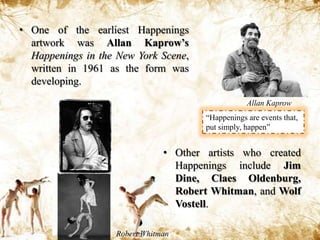
One of the earliest Happenings artwork was AllanKaprow’sHappenings in the New York Scene, written in 1961 as the form was developing.Allan Kaprow“Happenings are events that, put simply, happen”Other artists who created Happenings include JimDine, Claes Oldenburg, Robert Whitman, and Wolf Vostell.Robert Whitman
The work of performance artists after 1968 often showed influences of the cultural and political events of that year. Barbara T. Smith with Ritual Meal (1969) was at the forefront of the feminist body art, among others including: CaroleeSchneemann, and Joan Jonas. Barbara T. SmithJoan JonasCarolee Schneemann
1970s	Artists whose work already before tended to be a performance art, as well as new artists, at the beginning of the 1970s began to present performance art in a stricterform.
New artists with radical piece Shoot, in performances were ChrisBurden, with the 1971 performance which he was shot in his left arm by an assistant from a distance of about five meters, and Vito Acconci in the same year with Seedbed.
To test the limits of the relationship between performer and audience, Marina Abramovic developed one of her most challenging performances, Rhythm 0 (1974).She placed upon a table 72 objects that people were allowed to use in any way they chose. Some could give pleasure; others could inflict pain. For 6 hours she allowed the audience members to manipulate her body.“What I learned was that... if you leave it up to the audience, they can kill you [...] I felt really violated: they cut up my clothes, stuck rose thorns in my stomach, one person aimed the gun at my head, and another took it away [...] After exactly 6 hours, as planned, I stood up and started walking toward the audience. Everyone ran away, to escape an actual confrontation.”
1980s	By the end of the 1980s, performance art had become so widely known; mass culture had come to supply both structure and subject matter for much performance art; and several performance artists, had indeed become crossoverartists in mainstream entertainment.
They spent a whole year in New York City tied to each other with a piece of ropeAmong the performance art most discussed in the art-world of this decade were a performance by Linda Montano and Tehching Hsieh between July 1983 and July 1984, Art/Life: One Year Performance (Rope Piece), and Karen Finley’s I’m an Ass Man (1987).Linda Montano & Tehching HsiehKarenFinley"I'm an Ass Man" is a piece that imagines what is going through a rapist's mind
Hedwig Gorski before 1982 came up with the term performance poetry, a kind of text-based vocal performance. Performance poets relied more on the rhetoricalandphilosophical expression in their poetics than performance artists, who arose from the visual art genres of painting and sculpture.Hedwig Gorski
1990s	In the 1990s, performance art as a complete artform gained admittance into art museums.
Gyorgy GalantaiWhen the Soviet bloc disintegrated, formerly repressed activities of performance artists like Gyorgy Galantai in Hungary, or the Collective Action Group in Russia, became better known. Collective Action Group
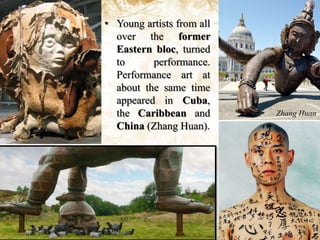
Young artists from all over the former Eastern bloc, turned to performance. Performance art at about the same time appeared in Cuba, the Caribbeanand China (Zhang Huan). Zhang Huan
2000s	From March 14 to May 31, 2010, the Museum of Modern Art held a major retrospective and performance recreation of Marina Abramovic’s work, the biggest exhibition of performance art in MoMA’s history.
	During the run of the exhibition, Marina Abramovic performed “The Artist is Present,” a 736-hour and 30-minute static, silent piece, in which she sat immobile in the museum’s atrium, while spectators were invited to take turns sitting opposite her.
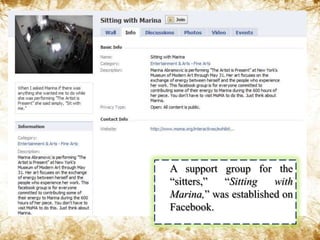
	A support group for the “sitters,” “Sitting with Marina,” was established on Facebook.
2010s
Sourceshttp://mashrabiyya.wordpress.com
http://www.tate.org.uk

Performance art

  • 1.
  • 2.
    Definition: Performance ArtArtin which the medium is the artist's own body and the artwork takes the form of actions performed by the artist.Art that could not be bought, sold or traded as a commodity.
  • 3.
    Performance artists seethe movement as a means of taking their art directly to a public forum, thus completely eliminating the need for galleries, agents, brokers, tax accountants and any other aspect of capitalism.A social commentary on the purity of art.CharacteristicsPerformance Art is a legitimate artistic movement.Performance Art is live.Performance Art has no rules or guidelines. It is art because the artist says it is art. It is experimental.Performance Art is not for sale. (It may, however, sell admission tickets and film rights.)
  • 4.
    Performance Art maybe comprised of painting,sculpture, dialogue, poetry, music, dance, film footage, laserlights, animals, fire, etc.Performance Art may be entertaining, amusing, shocking or horrifying. It is meant to be memorable.
  • 5.
    Cultural theorists oftentrace performance art activity back to the beginning of the 20th century, to the Russian constructivists, Futurists and Dada. Origins
  • 6.
    Constructivist artis committedto complete abstraction with a devotion to modernity, where themes are often geometric, experimental and rarely emotional.Dada provided a significant progenitor with the unconventional performances of poetry by the likes of Richard Huelsenbeck and Tristan Tzara. Futurist artists could be identified as precursors of performance, such as David Burliuk, who painted his face for his actions .
  • 7.
    Yves Klein hadbeen a precursor of performance art with the conceptual pieces of Zone de Sensibilité Picturale Immatérielle (Zones of Immaterial Pictorial Sensibility) 1959–62, and works like the photomontage, Saut dans le vide (Leap into the Void).
  • 8.
    1960s Happening is anew art form at the beginning of the 1960s. A Happening allows the artist to experiment with body motion, recorded sounds, written and spoken texts, and even smells. Sometimes, the audience members even become performers.
  • 9.
    One of theearliest Happenings artwork was AllanKaprow’sHappenings in the New York Scene, written in 1961 as the form was developing.Allan Kaprow“Happenings are events that, put simply, happen”Other artists who created Happenings include JimDine, Claes Oldenburg, Robert Whitman, and Wolf Vostell.Robert Whitman
  • 10.
    The work ofperformance artists after 1968 often showed influences of the cultural and political events of that year. Barbara T. Smith with Ritual Meal (1969) was at the forefront of the feminist body art, among others including: CaroleeSchneemann, and Joan Jonas. Barbara T. SmithJoan JonasCarolee Schneemann
  • 11.
    1970s Artists whose workalready before tended to be a performance art, as well as new artists, at the beginning of the 1970s began to present performance art in a stricterform.
  • 12.
    New artists withradical piece Shoot, in performances were ChrisBurden, with the 1971 performance which he was shot in his left arm by an assistant from a distance of about five meters, and Vito Acconci in the same year with Seedbed.
  • 13.
    To test thelimits of the relationship between performer and audience, Marina Abramovic developed one of her most challenging performances, Rhythm 0 (1974).She placed upon a table 72 objects that people were allowed to use in any way they chose. Some could give pleasure; others could inflict pain. For 6 hours she allowed the audience members to manipulate her body.“What I learned was that... if you leave it up to the audience, they can kill you [...] I felt really violated: they cut up my clothes, stuck rose thorns in my stomach, one person aimed the gun at my head, and another took it away [...] After exactly 6 hours, as planned, I stood up and started walking toward the audience. Everyone ran away, to escape an actual confrontation.”
  • 14.
    1980s By the endof the 1980s, performance art had become so widely known; mass culture had come to supply both structure and subject matter for much performance art; and several performance artists, had indeed become crossoverartists in mainstream entertainment.
  • 15.
    They spent awhole year in New York City tied to each other with a piece of ropeAmong the performance art most discussed in the art-world of this decade were a performance by Linda Montano and Tehching Hsieh between July 1983 and July 1984, Art/Life: One Year Performance (Rope Piece), and Karen Finley’s I’m an Ass Man (1987).Linda Montano & Tehching HsiehKarenFinley"I'm an Ass Man" is a piece that imagines what is going through a rapist's mind
  • 16.
    Hedwig Gorski before1982 came up with the term performance poetry, a kind of text-based vocal performance. Performance poets relied more on the rhetoricalandphilosophical expression in their poetics than performance artists, who arose from the visual art genres of painting and sculpture.Hedwig Gorski
  • 17.
    1990s In the 1990s,performance art as a complete artform gained admittance into art museums.
  • 18.
    Gyorgy GalantaiWhen theSoviet bloc disintegrated, formerly repressed activities of performance artists like Gyorgy Galantai in Hungary, or the Collective Action Group in Russia, became better known. Collective Action Group
  • 19.
    Young artists fromall over the former Eastern bloc, turned to performance. Performance art at about the same time appeared in Cuba, the Caribbeanand China (Zhang Huan). Zhang Huan
  • 20.
    2000s From March 14to May 31, 2010, the Museum of Modern Art held a major retrospective and performance recreation of Marina Abramovic’s work, the biggest exhibition of performance art in MoMA’s history.
  • 21.
    During the runof the exhibition, Marina Abramovic performed “The Artist is Present,” a 736-hour and 30-minute static, silent piece, in which she sat immobile in the museum’s atrium, while spectators were invited to take turns sitting opposite her.
  • 22.
    A support groupfor the “sitters,” “Sitting with Marina,” was established on Facebook.
  • 23.
  • 26.
  • 27.