

ULA FUNG, CAROL MAN, RACHEL WA I 
FROM REPRESENTATION TO 
ABSTRACTION AND THE PERFORMATIVE
REPRESENTATION
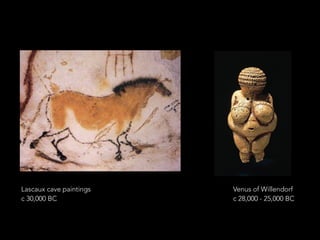
From childhood men have an instinct for 
representation, and in this respect man differs from 
the other animals that he is far more imitative and 
learns his first lessons by representing things. 
-ARISTOTLE
Lascaux cave paintings 
c 30,000 BC 
Venus of Willendorf 
c 28,000 - 25,000 BC
• Aristotle defined all the arts—verbal, visual, and musical—as modes of 
representation, and went even further to make representation the definitively human 
activity. 
• Representation refers to images that are clearly recognizable for what they purport to 
be. “Non-representational art” consists of images that have no clear identity, and 
must be interpreted by the viewer 
• Art is a representational practice and its products are representations 
• E.g. portraits, traditional landscapes, paintings of everyday life, historical or 
mythological scenes, still lifes and various types of figurative… 
• Representational painters typically act as observers and try to reproduce what they 
see 
• Viewers and readers engage with representations
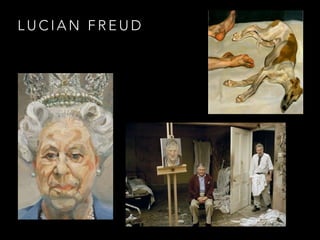
LUCIAN FREUD
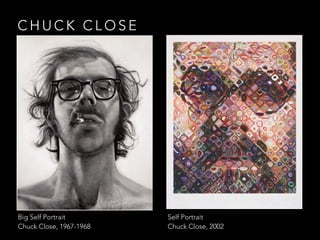
CHUCK CLOSE 
Big Self Portrait 
Chuck Close, 1967-1968 
Self Portrait 
Chuck Close, 2002
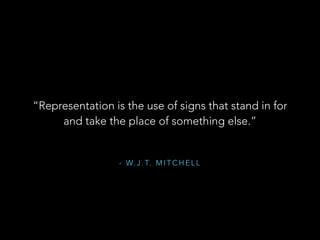
“Representation is the use of signs that stand in for 
and take the place of something else.” 
- W. J . T. MITCHELL
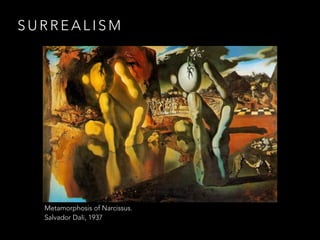
SURREALISM 
Metamorphosis of Narcissus. 
Salvador Dali, 1937
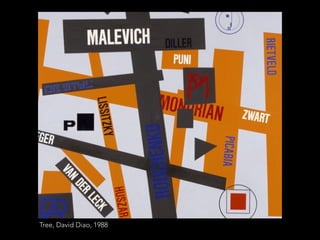
Tree, David Diao, 1988
• In Book X of the Republic, Plato argued that art copies 
particular things. He gives the example of a bed. There is the 
perfect Form of a bed; then, as a kind of copy of that, a 
carpenter makes a bed; a painting of a bed is a copy of the 
carpenter’s bed. 
• Plato’s postulation of an Ideal world of Forms states that Ideal 
Form pre-exists any actually. Representation can only ever be 
an imperfect copy of an Ideal Form. Aristotles interest in 
mimesis, rather than Platos Ideal Forms has come to inform 
the debate on models and copies.
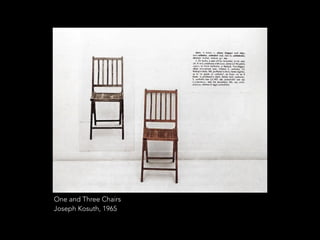
One and Three Chairs 
Joseph Kosuth, 1965
• In the modern world, representation has come to be understood as the 
structure that enables representationalism to dominate our contemporary 
way of thinking. Representationalism is a system of thought that fixes the 
world as an object and resource for human subjects. 
“Set out before oneself and to set forth in relation to oneself. 
Through this, whatever is comes to a stand as object and in 
that way alone receives the seal of Being. That the world 
becomes picture is one and the same event with the event of 
mans becoming subiectum in the midst of that which is.” 
– “MAN AS REPRESENTING SUBJECT” 
MARTIN HEIDEGGER
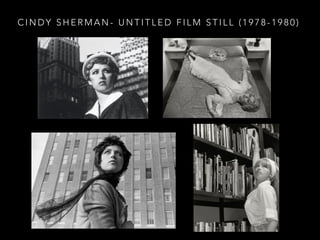
CINDY SHERMAN- UNTITLED FILM STILL (1978-1980)
• In the visual arts, art theorists and historians continue to ground their 
discussions of art on the unquestioned assumption that art is representational. 
Representation provides a standard by which artistic merit can be judged. 
“Among the problems raised by representational practices the most 
fundamental are surely those arising in connection with representations that 
might as well in the unassuming terms of ordinary language be called non-verbal. 
Of these, visible (or visual) representations are prominent, and have 
always served the purposes of discussion in an exemplary way.” - “On Non-verbal 
Representation” (1997) by Donald Brook 
• An important foundation for all visual art, because it depends upon an artist's 
proficiency and skills which underpin numerous forms of visual art 
• Helps to make art accessible to the general public
• Art in modern times has been devoted to overcoming 
the limits of representation. 
“A question of extending representation as far as the 
too large and the too small of difference; of adding a 
hitherto unsuspected perspective to representation it 
is a question of causing a little Dionysian blood to flow 
in the organic veins of Apollo.” - Gilles Deleuze
REPRESENTATION TO 
ABSTRACTION
ABSTRACTION 
• N O N - R E P R E S E N T A T I O N A L ?
W H AT I S R E P R E S E N T A T I O N ? 
! 
• To replace the human activities, thoughts and logic of them 
by the means of art, in other words, representation is the 
imitation of the reality and so as to reflect it. 
• To reflect and re-present the “truth” 
• To imitate the nature 
!
Aristotle discusses representation in three ways— 
The object: The symbol being represented. 
Manner: The way the symbol is represented. 
Means: The material that is used to represent it.
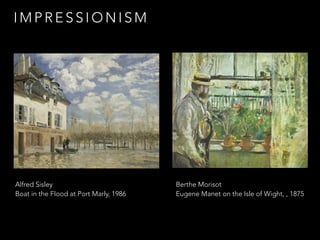
IMPRESSIONISM 
Berthe Morisot 
Eugene Manet on the Isle of Wight, , 1875 
Alfred Sisley 
Boat in the Flood at Port Marly, 1986
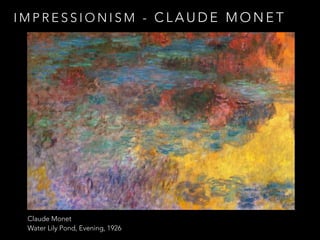
IMPRESSIONISM - CLAUDE MONET 
Claude Monet 
Water Lily Pond, Evening, 1926
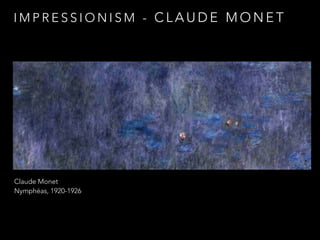
IMPRESSIONISM - CLAUDE MONET 
Claude Monet 
Nymphéas, 1920-1926
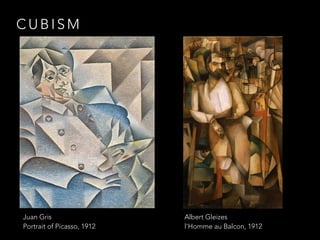
CUBISM 
Albert Gleizes 
l'Homme au Balcon, 1912 
Juan Gris 
Portrait of Picasso, 1912
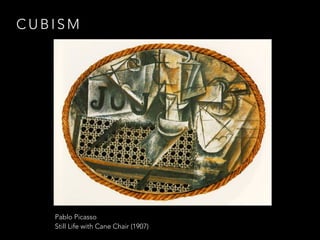
CUBISM 
Pablo Picasso 
Still Life with Cane Chair (1907)
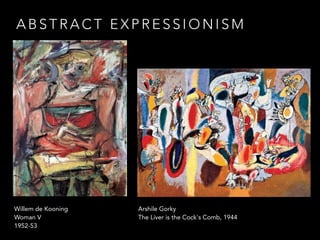
ABSTRACT EXPRESSIONISM 
Willem de Kooning 
Woman V 
1952-53 
Arshile Gorky 
The Liver is the Cock's Comb, 1944
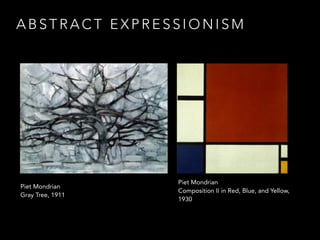
ABSTRACT EXPRESSIONISM 
Piet Mondrian 
Gray Tree, 1911 
Piet Mondrian 
Composition II in Red, Blue, and Yellow, 
1930
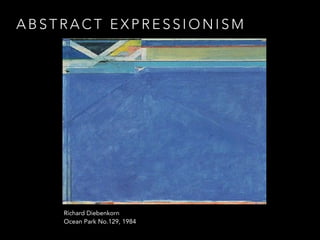
ABSTRACT EXPRESSIONISM 
Richard Diebenkorn 
Ocean Park No.129, 1984
ABSTRACTION 
AFTER 
MODERNISM
SIMULACRA AND SIMULATION 
According to baudrillard: 
What has happened in postmodern culture is that our society has 
become so reliant on models and maps that we have lost all 
contact with the real world that preceded the map. Reality itself 
has begun merely to imitate the model, which now precedes and 
determines the real world.
⾒見⼭山不是⼭山, ⾒見⽔水不是⽔水 
-《指⽉月錄》卷⼆二⼗十⼋八。
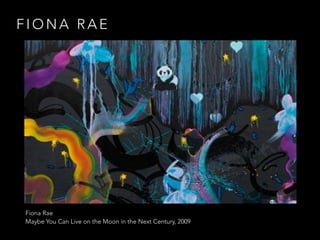
FIONA RAE 
Fiona Rae 
Maybe You Can Live on the Moon in the Next Century, 2009
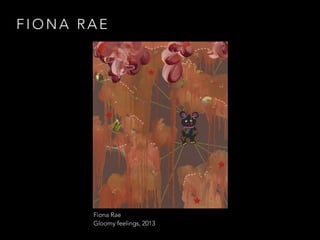
FIONA RAE 
Fiona Rae 
Gloomy feelings, 2013
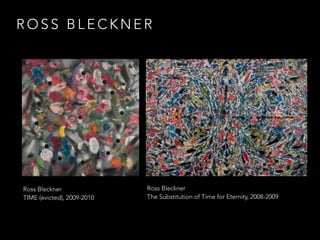
ROSS BLECKNER 
Ross Bleckner 
TIME (evicted), 2009-2010 
Ross Bleckner 
The Substitution of Time for Eternity, 2008-2009
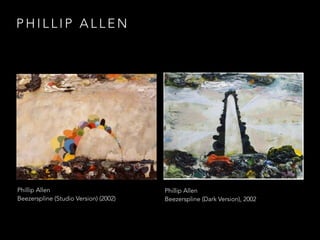
PHILLIP ALLEN 
Phillip Allen 
Beezerspline (Studio Version) (2002) 
Phillip Allen 
Beezerspline (Dark Version), 2002
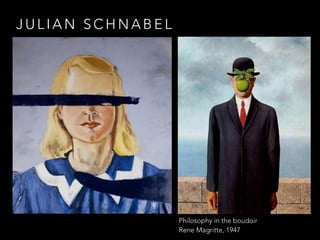
JULIAN SCHNABEL 
Philosophy in the boudoir 
Rene Magritte, 1947
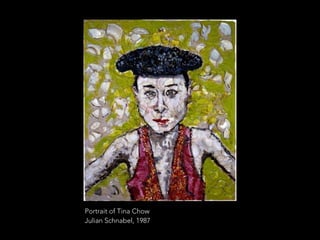
Portrait of Tina Chow 
Julian Schnabel, 1987
REPRESENTATION TO 
THE PERFORMATIVE
ART BEYOND REPRESENTAT I O N : T H E 
PERFORMATIVE POWER OF THE IMAGE 
Bolt, Barber: art is performative, rather than merely a 
representational practice. Through creative practice, a dynamic 
material exchange can occur between objects, bodies and 
images. In the dynamic productivity of material practice, reality 
can get into images. Imaging can produce real material effects 
in the world. The mutual reflection between objects, images 
and bodies, forms the deformational and transformative 
potential of images.
PERFORMATIVE ART 
1 9 4 0 S - 1 9 5 0 S 
Art critic Harold Rosenberg: 
• In the 1940s and 1950s, Action painting gave artists the 
freedom to perform. 
• “What was to go on canvas was not a picture but an event. 
Pollock’s work, in particular, looked forward to the 
performance art and happenings of the 1960s. Look at a 
Pollock and you have a record of his performance.” 
“
PERFORMATIVE ART 
1 9 6 0 S - 1 9 7 0 S 
• Performative art often derived from concepts of visual 
art, with respect to Antonin Artaud, Dada, the 
Situationists, Fluxus, installation art and conceptual art, 
performance art tended to challenge orthodox art forms 
and cultural norms. 
• Adrian Parr, in “The Deleuze Dictionary” gave a 
postmodern philosophical interpretation of Performance 
art: “An authentic experience for performer and 
audience in an event that could not be repeated, 
captured or purchased.” “
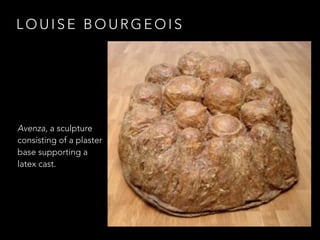
LOUISE BOURGEOIS 
Avenza, a sculpture 
consisting of a plaster 
base supporting a 
latex cast.
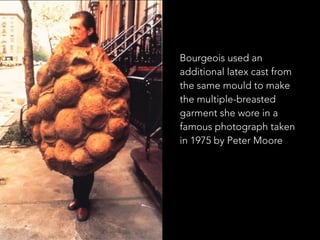
Bourgeois used an 
additional latex cast from 
the same mould to make 
the multiple-breasted 
garment she wore in a 
famous photograph taken 
in 1975 by Peter Moore
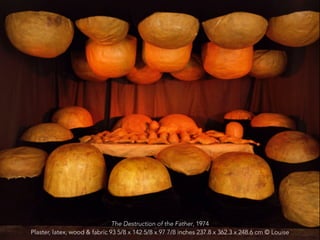
The Destruction of the Father, 1974 
Plaster, latex, wood & fabric 93 5/8 x 142 5/8 x 97 7/8 inches 237.8 x 362.3 x 248.6 cm © Louise
LOUISE BOURGEOIS 
The same piece was used in The Confrontation 1978, an 
installation and event (Solomon R. Guggenheim Museum, 
New York). 
http://www.guggenheim.org/video/louise-bourgeois
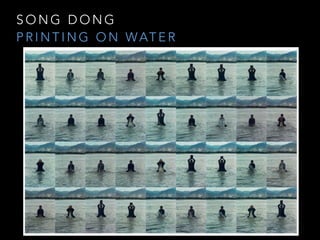
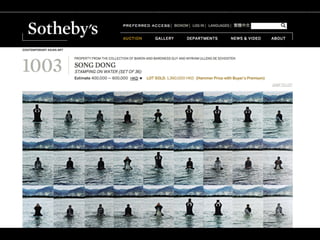
SONG DONG 
PRINTING ON WATER
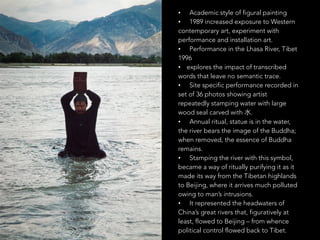
• Academic style of figural painting 
• 1989 increased exposure to Western 
contemporary art, experiment with 
performance and installation art. 
• Performance in the Lhasa River, Tibet 
1996 
• explores the impact of transcribed 
words that leave no semantic trace. 
• Site specific performance recorded in 
set of 36 photos showing artist 
repeatedly stamping water with large 
wood seal carved with ⽔水. 
• Annual ritual, statue is in the water, 
the river bears the image of the Buddha; 
when removed, the essence of Buddha 
remains. 
• Stamping the river with this symbol, 
became a way of ritually purifying it as it 
made its way from the Tibetan highlands 
to Beijing, where it arrives much polluted 
owing to man’s intrusions. 
• It represented the headwaters of 
China’s great rivers that, figuratively at 
least, flowed to Beijing – from whence 
political control flowed back to Tibet.
COLLECTING PERFORMATIVE AT THE 
TATE MUSEUM 
• A Research Network Examining Emerging Practice for Collecting and Conserving 
Performance-based Art 
• Challenging the museum’s remit 
• Identify concept of a work and related notions of authorship, authenticity, autonomy, 
documentation, memory, continuity and liveness. 
• Public and private collections are rapidly beginning to acquire significant 
performance artworks from 1960s and 1970s as well as works by contemporary artists. 
• Changing traditional approaches 
• Museum object is materially bound and fixed. But performance art is non-material. 
Re-perform at the museum through video and internet.

MVA Presentation 3

  • 1.
    ULA FUNG, CAROLMAN, RACHEL WA I FROM REPRESENTATION TO ABSTRACTION AND THE PERFORMATIVE
  • 2.
  • 5.
    From childhood menhave an instinct for representation, and in this respect man differs from the other animals that he is far more imitative and learns his first lessons by representing things. -ARISTOTLE
  • 6.
    Lascaux cave paintings c 30,000 BC Venus of Willendorf c 28,000 - 25,000 BC
  • 7.
    • Aristotle definedall the arts—verbal, visual, and musical—as modes of representation, and went even further to make representation the definitively human activity. • Representation refers to images that are clearly recognizable for what they purport to be. “Non-representational art” consists of images that have no clear identity, and must be interpreted by the viewer • Art is a representational practice and its products are representations • E.g. portraits, traditional landscapes, paintings of everyday life, historical or mythological scenes, still lifes and various types of figurative… • Representational painters typically act as observers and try to reproduce what they see • Viewers and readers engage with representations
  • 8.
  • 9.
    CHUCK CLOSE BigSelf Portrait Chuck Close, 1967-1968 Self Portrait Chuck Close, 2002
  • 10.
    “Representation is theuse of signs that stand in for and take the place of something else.” - W. J . T. MITCHELL
  • 11.
    SURREALISM Metamorphosis ofNarcissus. Salvador Dali, 1937
  • 12.
  • 13.
    • In BookX of the Republic, Plato argued that art copies particular things. He gives the example of a bed. There is the perfect Form of a bed; then, as a kind of copy of that, a carpenter makes a bed; a painting of a bed is a copy of the carpenter’s bed. • Plato’s postulation of an Ideal world of Forms states that Ideal Form pre-exists any actually. Representation can only ever be an imperfect copy of an Ideal Form. Aristotles interest in mimesis, rather than Platos Ideal Forms has come to inform the debate on models and copies.
  • 14.
    One and ThreeChairs Joseph Kosuth, 1965
  • 15.
    • In themodern world, representation has come to be understood as the structure that enables representationalism to dominate our contemporary way of thinking. Representationalism is a system of thought that fixes the world as an object and resource for human subjects. “Set out before oneself and to set forth in relation to oneself. Through this, whatever is comes to a stand as object and in that way alone receives the seal of Being. That the world becomes picture is one and the same event with the event of mans becoming subiectum in the midst of that which is.” – “MAN AS REPRESENTING SUBJECT” MARTIN HEIDEGGER
  • 18.
    CINDY SHERMAN- UNTITLEDFILM STILL (1978-1980)
  • 19.
    • In thevisual arts, art theorists and historians continue to ground their discussions of art on the unquestioned assumption that art is representational. Representation provides a standard by which artistic merit can be judged. “Among the problems raised by representational practices the most fundamental are surely those arising in connection with representations that might as well in the unassuming terms of ordinary language be called non-verbal. Of these, visible (or visual) representations are prominent, and have always served the purposes of discussion in an exemplary way.” - “On Non-verbal Representation” (1997) by Donald Brook • An important foundation for all visual art, because it depends upon an artist's proficiency and skills which underpin numerous forms of visual art • Helps to make art accessible to the general public
  • 20.
    • Art inmodern times has been devoted to overcoming the limits of representation. “A question of extending representation as far as the too large and the too small of difference; of adding a hitherto unsuspected perspective to representation it is a question of causing a little Dionysian blood to flow in the organic veins of Apollo.” - Gilles Deleuze
  • 21.
  • 22.
    ABSTRACTION • NO N - R E P R E S E N T A T I O N A L ?
  • 23.
    W H ATI S R E P R E S E N T A T I O N ? ! • To replace the human activities, thoughts and logic of them by the means of art, in other words, representation is the imitation of the reality and so as to reflect it. • To reflect and re-present the “truth” • To imitate the nature !
  • 24.
    Aristotle discusses representationin three ways— The object: The symbol being represented. Manner: The way the symbol is represented. Means: The material that is used to represent it.
  • 27.
    IMPRESSIONISM Berthe Morisot Eugene Manet on the Isle of Wight, , 1875 Alfred Sisley Boat in the Flood at Port Marly, 1986
  • 28.
    IMPRESSIONISM - CLAUDEMONET Claude Monet Water Lily Pond, Evening, 1926
  • 29.
    IMPRESSIONISM - CLAUDEMONET Claude Monet Nymphéas, 1920-1926
  • 30.
    CUBISM Albert Gleizes l'Homme au Balcon, 1912 Juan Gris Portrait of Picasso, 1912
  • 31.
    CUBISM Pablo Picasso Still Life with Cane Chair (1907)
  • 32.
    ABSTRACT EXPRESSIONISM Willemde Kooning Woman V 1952-53 Arshile Gorky The Liver is the Cock's Comb, 1944
  • 33.
    ABSTRACT EXPRESSIONISM PietMondrian Gray Tree, 1911 Piet Mondrian Composition II in Red, Blue, and Yellow, 1930
  • 34.
    ABSTRACT EXPRESSIONISM RichardDiebenkorn Ocean Park No.129, 1984
  • 35.
  • 36.
    SIMULACRA AND SIMULATION According to baudrillard: What has happened in postmodern culture is that our society has become so reliant on models and maps that we have lost all contact with the real world that preceded the map. Reality itself has begun merely to imitate the model, which now precedes and determines the real world.
  • 37.
  • 38.
    FIONA RAE FionaRae Maybe You Can Live on the Moon in the Next Century, 2009
  • 39.
    FIONA RAE FionaRae Gloomy feelings, 2013
  • 40.
    ROSS BLECKNER RossBleckner TIME (evicted), 2009-2010 Ross Bleckner The Substitution of Time for Eternity, 2008-2009
  • 41.
    PHILLIP ALLEN PhillipAllen Beezerspline (Studio Version) (2002) Phillip Allen Beezerspline (Dark Version), 2002
  • 42.
    JULIAN SCHNABEL Philosophyin the boudoir Rene Magritte, 1947
  • 43.
    Portrait of TinaChow Julian Schnabel, 1987
  • 44.
  • 45.
    ART BEYOND REPRESENTATI O N : T H E PERFORMATIVE POWER OF THE IMAGE Bolt, Barber: art is performative, rather than merely a representational practice. Through creative practice, a dynamic material exchange can occur between objects, bodies and images. In the dynamic productivity of material practice, reality can get into images. Imaging can produce real material effects in the world. The mutual reflection between objects, images and bodies, forms the deformational and transformative potential of images.
  • 46.
    PERFORMATIVE ART 19 4 0 S - 1 9 5 0 S Art critic Harold Rosenberg: • In the 1940s and 1950s, Action painting gave artists the freedom to perform. • “What was to go on canvas was not a picture but an event. Pollock’s work, in particular, looked forward to the performance art and happenings of the 1960s. Look at a Pollock and you have a record of his performance.” “
  • 47.
    PERFORMATIVE ART 19 6 0 S - 1 9 7 0 S • Performative art often derived from concepts of visual art, with respect to Antonin Artaud, Dada, the Situationists, Fluxus, installation art and conceptual art, performance art tended to challenge orthodox art forms and cultural norms. • Adrian Parr, in “The Deleuze Dictionary” gave a postmodern philosophical interpretation of Performance art: “An authentic experience for performer and audience in an event that could not be repeated, captured or purchased.” “
  • 48.
    LOUISE BOURGEOIS Avenza,a sculpture consisting of a plaster base supporting a latex cast.
  • 49.
    Bourgeois used an additional latex cast from the same mould to make the multiple-breasted garment she wore in a famous photograph taken in 1975 by Peter Moore
  • 50.
    The Destruction ofthe Father, 1974 Plaster, latex, wood & fabric 93 5/8 x 142 5/8 x 97 7/8 inches 237.8 x 362.3 x 248.6 cm © Louise
  • 51.
    LOUISE BOURGEOIS Thesame piece was used in The Confrontation 1978, an installation and event (Solomon R. Guggenheim Museum, New York). http://www.guggenheim.org/video/louise-bourgeois
  • 52.
  • 53.
    • Academic styleof figural painting • 1989 increased exposure to Western contemporary art, experiment with performance and installation art. • Performance in the Lhasa River, Tibet 1996 • explores the impact of transcribed words that leave no semantic trace. • Site specific performance recorded in set of 36 photos showing artist repeatedly stamping water with large wood seal carved with ⽔水. • Annual ritual, statue is in the water, the river bears the image of the Buddha; when removed, the essence of Buddha remains. • Stamping the river with this symbol, became a way of ritually purifying it as it made its way from the Tibetan highlands to Beijing, where it arrives much polluted owing to man’s intrusions. • It represented the headwaters of China’s great rivers that, figuratively at least, flowed to Beijing – from whence political control flowed back to Tibet.
  • 55.
    COLLECTING PERFORMATIVE ATTHE TATE MUSEUM • A Research Network Examining Emerging Practice for Collecting and Conserving Performance-based Art • Challenging the museum’s remit • Identify concept of a work and related notions of authorship, authenticity, autonomy, documentation, memory, continuity and liveness. • Public and private collections are rapidly beginning to acquire significant performance artworks from 1960s and 1970s as well as works by contemporary artists. • Changing traditional approaches • Museum object is materially bound and fixed. But performance art is non-material. Re-perform at the museum through video and internet.