Muhammad Anas Sabir
Touqeer Abbas
Asad Khan
DLD presentation
 A binary counter uses 2 or more single clocked flip-flops
depending on the number of bits required
 There are 2 types of counters Synchronous and
Asynchronous
 A asynchronous counter uses a single clock at the first stage
 But in a synchronous counter all flip-flops are clocked
together with a common clock pulse
 Twisted ring is also referred to as Johnsons
counter
 Johnsons or twisted ring counters are just like the
ring counters
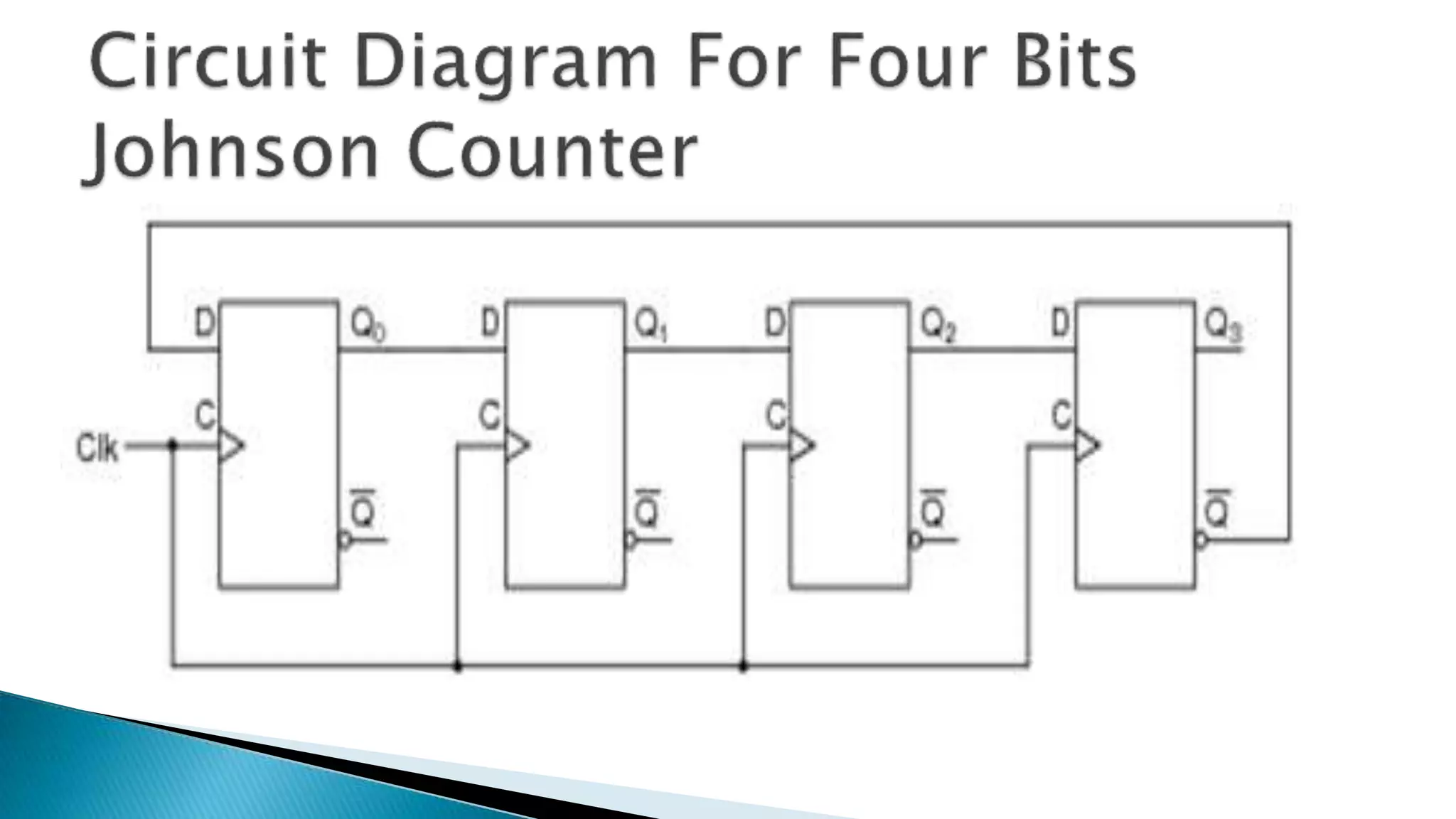
 The only difference is that instead of rotating the
last output (Q) back to the input the ‘not’ of the
last ouput (^Q) is feeded to the first input
 Instead of a single clears a twisted ring counters have multiple
clears.
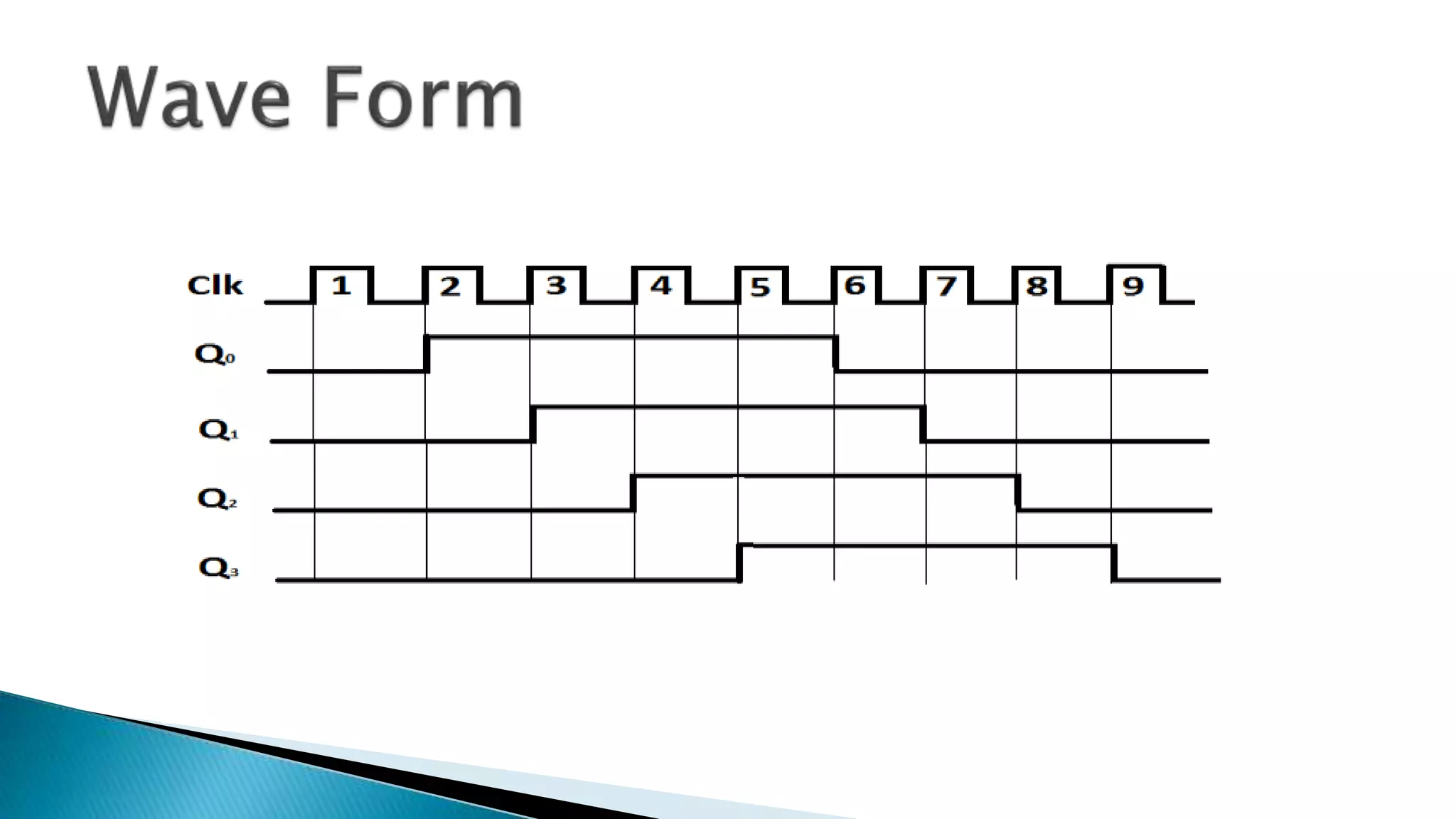
 So to start the twisted counter we give every bit an active low clear
that is 0 and Every bit shifts right on each clock pulse.
 But in the end what we shift in the Q0 position is ^Q.
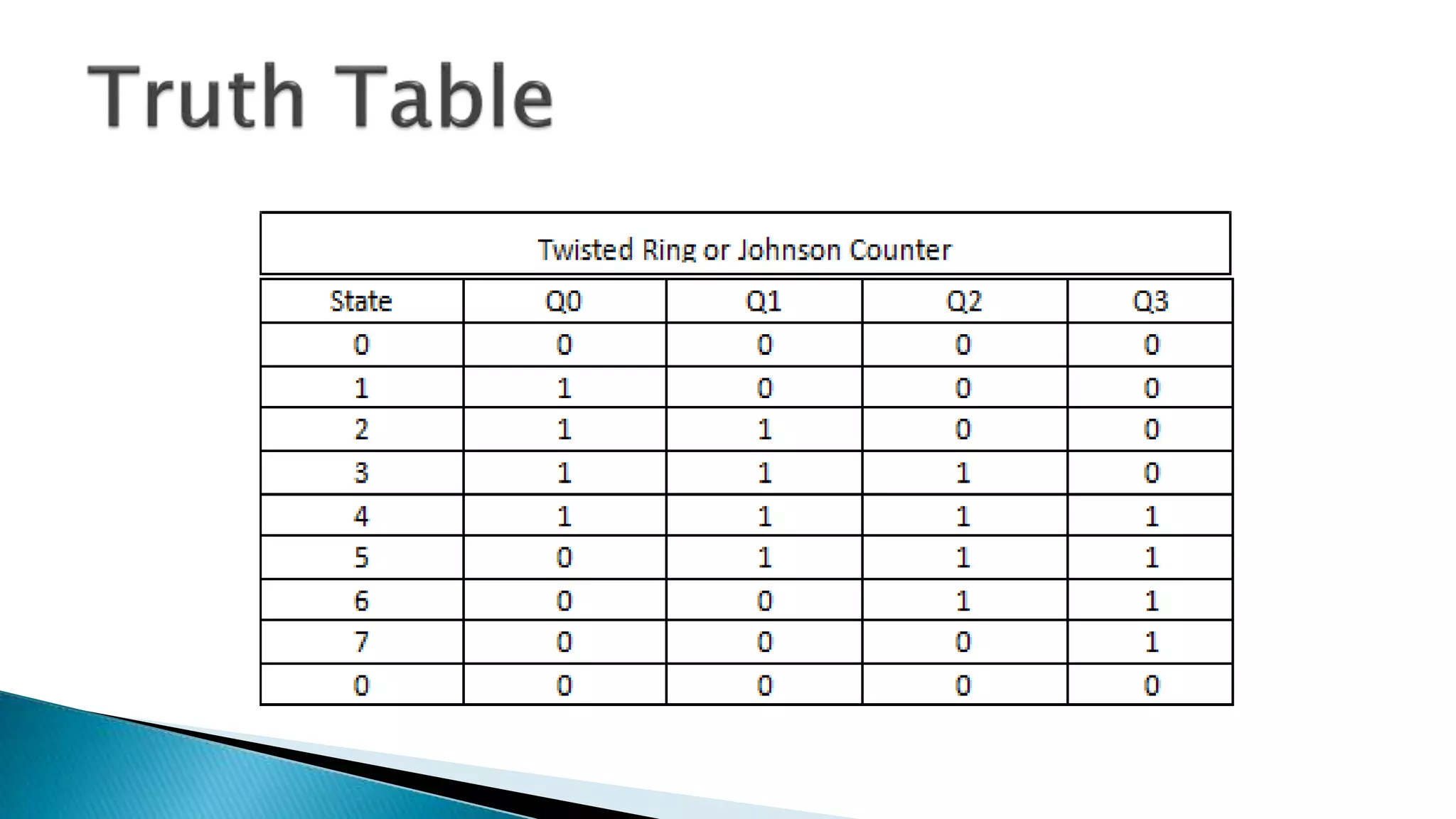
 So a twisted ring counter moves towards all high bits and then it
moves back to all low bits.
 A 3 bit twisted ring counter has 6 states and a 4 bit has 8 active
states.
 So a twisted ring counter has twice as many states as bit positions.
 It is used in walking LEDs.
 It is also used to convert square waves into sine
waves.
 Johnson Counter is a modified Ring Counter, where the
output from the last stage is inverted and fed back as
the input to the first stage.
 Pattern of bits equal in length to twice the length of
shift register thus circulates indefinitely.
 These counters find specialist applications, including
those similar to decade counter, digital to analog
conversions, etc.
Johnson counter

Johnson counter

  • 1.
    Muhammad Anas Sabir TouqeerAbbas Asad Khan DLD presentation
  • 2.
     A binarycounter uses 2 or more single clocked flip-flops depending on the number of bits required  There are 2 types of counters Synchronous and Asynchronous  A asynchronous counter uses a single clock at the first stage  But in a synchronous counter all flip-flops are clocked together with a common clock pulse
  • 3.
     Twisted ringis also referred to as Johnsons counter  Johnsons or twisted ring counters are just like the ring counters  The only difference is that instead of rotating the last output (Q) back to the input the ‘not’ of the last ouput (^Q) is feeded to the first input
  • 5.
     Instead ofa single clears a twisted ring counters have multiple clears.  So to start the twisted counter we give every bit an active low clear that is 0 and Every bit shifts right on each clock pulse.  But in the end what we shift in the Q0 position is ^Q.  So a twisted ring counter moves towards all high bits and then it moves back to all low bits.  A 3 bit twisted ring counter has 6 states and a 4 bit has 8 active states.  So a twisted ring counter has twice as many states as bit positions.
  • 8.
     It isused in walking LEDs.  It is also used to convert square waves into sine waves.
  • 9.
     Johnson Counteris a modified Ring Counter, where the output from the last stage is inverted and fed back as the input to the first stage.  Pattern of bits equal in length to twice the length of shift register thus circulates indefinitely.  These counters find specialist applications, including those similar to decade counter, digital to analog conversions, etc.

Editor's Notes