DATA GATHERING
Santa Rosa Science and Technology High School
Basic Statistics
Class 2011-2012
OBJECTIVES
At the end of the lesson, students are expected to:
1. Familiarize oneself with the various ways of
    collecting or gathering data
2. Determine the sample size from a population
    using the Slovin’s Formula
3. Identify the appropriate data-gathering technique
    in conducting research
4. Revisit their research project and identify the
    sample size and data-gathering technique used.
DATA GATHERING TECHNIQUES
1. The Direct or Interview Method
        The researcher has direct contact with the
    interviewee. The researcher gathers information
    by asking questions to the interviewee.
       Example: Multiliver Company would interview “mallers”
   regarding their favorite brand of toothpaste, soap or
   shampoo.
      Pros: The researcher can get more accurate
   answers since clarifications can be made if the
   respondent does not understand the question.
      Cons: This method is costly and time-
   consuming
DATA GATHERING TECHNIQUES
2. The Indirect or Questionnaire Method

       The researcher makes use of a written questionnaire.
   The researcher gives or distributes the questionnaire to the
   respondents either by personal delivery or by mail.
       Example: Sudoku Sadako would send out questionnaires through
   e-mails regarding people’s view and familiarization on the game of
   sudoku.


        Pros: The researcher can save on time and money in
   gathering the information needed because questionnaires can be
   given to a large number of respondents at the same time.
        Cons: The researcher cannot expect that all distributed
   questionnaires will be retrieved because some respondents simply
   ignore the questionnaires.
                  Clarifications cannot be made if the respondent does
   not understand the question.
DATA GATHERING TECHNIQUES

3. The Registration Method

       This method is governed by laws.
       Example: The number of registered professionals can
   be found at the Professional Regulation Commission (PRC).
   The number of births and death rates are registered in the
   National Statistics Office (NSO).


       Pros: This method is the most reliable since it is
   enforced by laws.
       Cons: Data are limited to what are listed in the
   document.
DATA GATHERING TECHNIQUES

3. The Experimental Method

       This method is utilized to find out cause and
   effect relationships.
       Example: Medical technologists would like to know the
   effect of a new brand of vitamins on the growth of toddlers.
   The new brand will be taken by a set of toddlers, while
   another set will be given the already existing brand. The
   growth of toddlers will then be compared to determine which
   vitamins is better.


       Pros: This method goes beyond plain description of
   data.
       Cons: Care should be taken on making conclusions to
   the result of the experiment.
DETERMINING THE SAMPLE SIZE
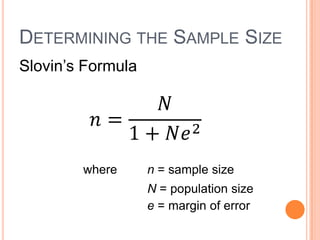
Slovin’s Formula


        where      n = sample size
                   N = population size
                   e = margin of error
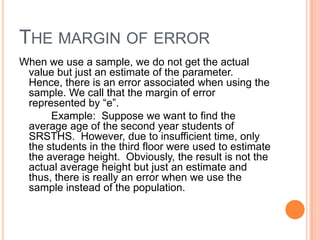
THE MARGIN OF ERROR
When we use a sample, we do not get the actual
 value but just an estimate of the parameter.
 Hence, there is an error associated when using the
 sample. We call that the margin of error
 represented by “e”.
      Example: Suppose we want to find the
 average age of the second year students of
 SRSTHS. However, due to insufficient time, only
 the students in the third floor were used to estimate
 the average height. Obviously, the result is not the
 actual average height but just an estimate and
 thus, there is really an error when we use the
 sample instead of the population.
EXAMPLE IN FINDING THE SAMPLE
SIZE
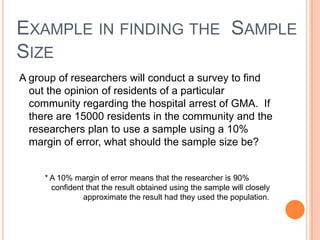
A group of researchers will conduct a survey to find
  out the opinion of residents of a particular
  community regarding the hospital arrest of GMA. If
  there are 15000 residents in the community and the
  researchers plan to use a sample using a 10%
  margin of error, what should the sample size be?


     * A 10% margin of error means that the researcher is 90%
       confident that the result obtained using the sample will closely
                approximate the result had they used the population.
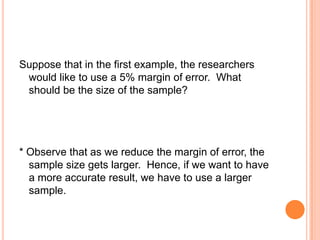
Suppose that in the first example, the researchers
 would like to use a 5% margin of error. What
 should be the size of the sample?


* Observe that as we reduce the margin of error, the
  sample size gets larger. Hence, if we want to have
  a more accurate result, we have to use a larger
  sample.
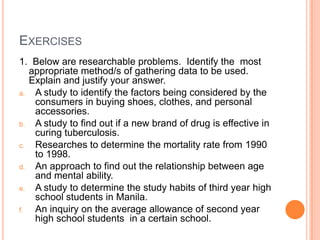
EXERCISES
1. Below are researchable problems. Identify the most
   appropriate method/s of gathering data to be used.
   Explain and justify your answer.
a.  A study to identify the factors being considered by the
    consumers in buying shoes, clothes, and personal
    accessories.
b.  A study to find out if a new brand of drug is effective in
    curing tuberculosis.
c.  Researches to determine the mortality rate from 1990
    to 1998.
d.  An approach to find out the relationship between age
    and mental ability.
e.  A study to determine the study habits of third year high
    school students in Manila.
f.  An inquiry on the average allowance of second year
    high school students in a certain school.
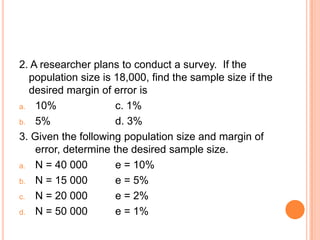
2. A researcher plans to conduct a survey. If the
  population size is 18,000, find the sample size if the
  desired margin of error is
a. 10%                c. 1%
b. 5%                 d. 3%
3. Given the following population size and margin of
    error, determine the desired sample size.
a. N = 40 000         e = 10%
b. N = 15 000         e = 5%
c. N = 20 000         e = 2%
d. N = 50 000         e = 1%

Data gathering

  • 1.
    DATA GATHERING Santa RosaScience and Technology High School Basic Statistics Class 2011-2012
  • 2.
    OBJECTIVES At the endof the lesson, students are expected to: 1. Familiarize oneself with the various ways of collecting or gathering data 2. Determine the sample size from a population using the Slovin’s Formula 3. Identify the appropriate data-gathering technique in conducting research 4. Revisit their research project and identify the sample size and data-gathering technique used.
  • 3.
    DATA GATHERING TECHNIQUES 1.The Direct or Interview Method The researcher has direct contact with the interviewee. The researcher gathers information by asking questions to the interviewee. Example: Multiliver Company would interview “mallers” regarding their favorite brand of toothpaste, soap or shampoo. Pros: The researcher can get more accurate answers since clarifications can be made if the respondent does not understand the question. Cons: This method is costly and time- consuming
  • 4.
    DATA GATHERING TECHNIQUES 2.The Indirect or Questionnaire Method The researcher makes use of a written questionnaire. The researcher gives or distributes the questionnaire to the respondents either by personal delivery or by mail. Example: Sudoku Sadako would send out questionnaires through e-mails regarding people’s view and familiarization on the game of sudoku. Pros: The researcher can save on time and money in gathering the information needed because questionnaires can be given to a large number of respondents at the same time. Cons: The researcher cannot expect that all distributed questionnaires will be retrieved because some respondents simply ignore the questionnaires. Clarifications cannot be made if the respondent does not understand the question.
  • 5.
    DATA GATHERING TECHNIQUES 3.The Registration Method This method is governed by laws. Example: The number of registered professionals can be found at the Professional Regulation Commission (PRC). The number of births and death rates are registered in the National Statistics Office (NSO). Pros: This method is the most reliable since it is enforced by laws. Cons: Data are limited to what are listed in the document.
  • 6.
    DATA GATHERING TECHNIQUES 3.The Experimental Method This method is utilized to find out cause and effect relationships. Example: Medical technologists would like to know the effect of a new brand of vitamins on the growth of toddlers. The new brand will be taken by a set of toddlers, while another set will be given the already existing brand. The growth of toddlers will then be compared to determine which vitamins is better. Pros: This method goes beyond plain description of data. Cons: Care should be taken on making conclusions to the result of the experiment.
  • 7.
    DETERMINING THE SAMPLESIZE Slovin’s Formula where n = sample size N = population size e = margin of error
  • 8.
    THE MARGIN OFERROR When we use a sample, we do not get the actual value but just an estimate of the parameter. Hence, there is an error associated when using the sample. We call that the margin of error represented by “e”. Example: Suppose we want to find the average age of the second year students of SRSTHS. However, due to insufficient time, only the students in the third floor were used to estimate the average height. Obviously, the result is not the actual average height but just an estimate and thus, there is really an error when we use the sample instead of the population.
  • 9.
    EXAMPLE IN FINDINGTHE SAMPLE SIZE A group of researchers will conduct a survey to find out the opinion of residents of a particular community regarding the hospital arrest of GMA. If there are 15000 residents in the community and the researchers plan to use a sample using a 10% margin of error, what should the sample size be? * A 10% margin of error means that the researcher is 90% confident that the result obtained using the sample will closely approximate the result had they used the population.
  • 10.
    Suppose that inthe first example, the researchers would like to use a 5% margin of error. What should be the size of the sample? * Observe that as we reduce the margin of error, the sample size gets larger. Hence, if we want to have a more accurate result, we have to use a larger sample.
  • 11.
    EXERCISES 1. Below areresearchable problems. Identify the most appropriate method/s of gathering data to be used. Explain and justify your answer. a. A study to identify the factors being considered by the consumers in buying shoes, clothes, and personal accessories. b. A study to find out if a new brand of drug is effective in curing tuberculosis. c. Researches to determine the mortality rate from 1990 to 1998. d. An approach to find out the relationship between age and mental ability. e. A study to determine the study habits of third year high school students in Manila. f. An inquiry on the average allowance of second year high school students in a certain school.
  • 12.
    2. A researcherplans to conduct a survey. If the population size is 18,000, find the sample size if the desired margin of error is a. 10% c. 1% b. 5% d. 3% 3. Given the following population size and margin of error, determine the desired sample size. a. N = 40 000 e = 10% b. N = 15 000 e = 5% c. N = 20 000 e = 2% d. N = 50 000 e = 1%