Understanding Data and Ways
to Systematically Collect Data
PRACTICAL RESEARCH 2
Lesson
Quantitative Research
Designs
1
Meaning of Quantitative Research Designs
• When a man decides to build a house, does not he
draw first the blueprint before he will start to do the
work? Same with the conduct of research, the blueprint
for the collection, measurement, and data analysis is
drawn as a pattern to follow. Furthermore, research
designs enable the researcher to obtain a more valid,
objective, reliable, and accurate answers to the research
questions.
Research design
- is defined as the rational and coherent overall strategy
that the researcher uses to incorporate all the vital
components of the research study.
- According to Fraenkel and Wallen (2007, p 15), the
research designs in quantitative research are mostly pre-
established. Hence having an appropriate research
design in quantitative research, the researcher will have a
clearer comprehension of what he is trying to analyze and
interpret.
Types of Quantitative Research Design
Descriptive Research
- It is a design that is exploratory in nature. The
purpose of descriptive research is basically to answer
questions such as who, what, where, when, and how much.
So, this design is best used when the main objective of the
study is just to observe and report a certain phenomenon as
it is happening.
Correlational Research
-The main goal of this design is to determine if variable increases
or decreases as another variable increases or decreases.
- This design seeks to establish an association between variables. It
measures variables as it occurs. It has two major purposes:
1.) to clarify the relationship between variables and;
2.) to predict the magnitude of the association. However, the extent
of the purpose of correlational research depends on the scope and
delimitation of the study.
Ex Post Facto
- If the objective of the study is to measure a cause
from a pre-existing effect, then Ex Post Facto research
design is more appropriate to use. In this design, the
researcher has no control over the variables in the
research study. Thus, one cannot conclude that the
changes measured happen during the actual conduct of
the study.
Quasi-Experimental (kwahz-eye)
-This research design aims to measure the causal
relationship between variables. The effect measured is
considered to have occurred during the conduct of the
current study.
-The partiality of quasi-experimental design comes
from assigning subjects, participants, or respondents into
their groups. The groups are known to be already
established before the study, such as age educational
background and nationality.
Experimental Research
- It is also known as true experimental design since
it applies treatment and manipulation more extensively
compared to quasi-experimental design.
-Random assignment of subjects or participants into
treatment and control group is done increasing the
validity of the study. Experimental research, therefore,
attempts to affect a certain variable by directly
manipulating the independent variable.
Experimental Research
- It is also known as true experimental design since
it applies treatment and manipulation more extensively
compared to quasi-experimental design.
-Random assignment of subjects or participants into
treatment and control group is done increasing the
validity of the study. Experimental research, therefore,
attempts to affect a certain variable by directly
manipulating the independent variable.
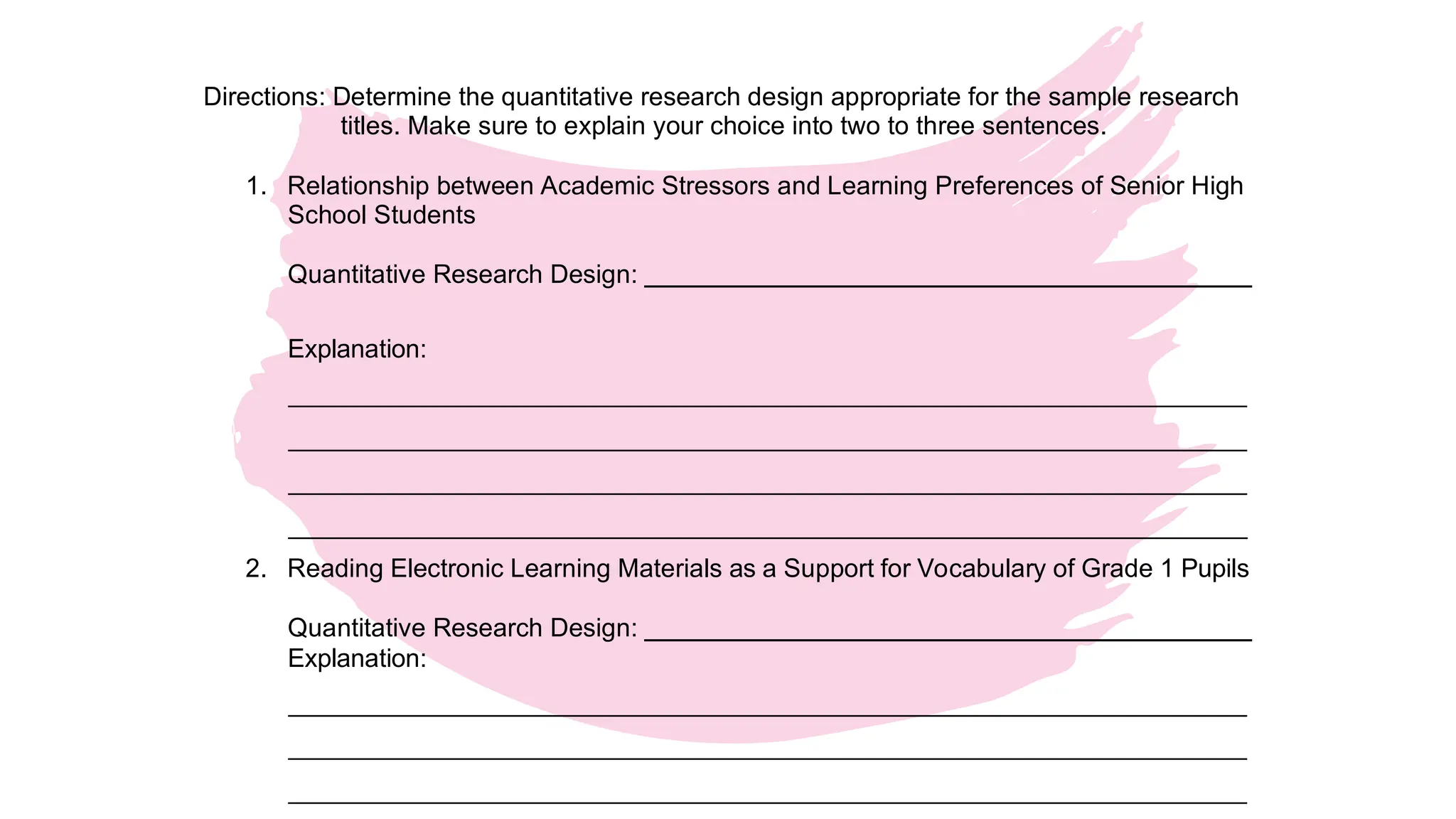
Activity 3. Choose the Appropriate Research Design
Directions: Determine the quantitative research design appropriate for the sample research
titles. Make sure to explain your choice into two to three sentences.
1. Relationship between Academic Stressors and Learning Preferences of Senior High
School Students
Quantitative Research Design:
Explanation:
2. Reading Electronic Learning Materials as a Support for Vocabulary of Grade 1 Pupils
Quantitative Research Design:
Explanation:
3.Impact of the Implementation of COVID – 19 Health Protocols in Supermarkets on
Consumer Behaviors
Quantitative Research Design:
Explanation:
4. Effects of Morning Exercise on the Health Anxiety Level of Senior Citizens
Quantitative Research Design:
Explanation:
5.Measuring the Gadgets Usage of Children at Home during COVID-19 Community
Quarantine
Quantitative Research Design:
Explanation:
6.Level of Academic Achievement of Senior High Schools in Different Learning Modalities
Quantitative Research Design:
Explanation:
7.Effects of Story Telling on Quality of Sleep of Children
Quantitative Research Design:
Explanation:
Population and Sample
1.) The population is the totality of all the objects, elements, persons, and
characteristics under consideration. It is understood that this population
possesses common characteristics about which the research aims to explore.
2 Types of Population
1. The target population, for example, all Senior High School Students enrolled in
Science, Technology, Engineering, and Mathematics (STEM) in the Division of
Iligan City.
2. The accessible population is the portion of the population in which the
researcher has reasonable access, for example all Senior High School enrolled,
STEM strand at Corpus Christi Parochial School of Iligan.
Sampling - pertains to the systematic process of selecting the
group to be analyzed in the research study.
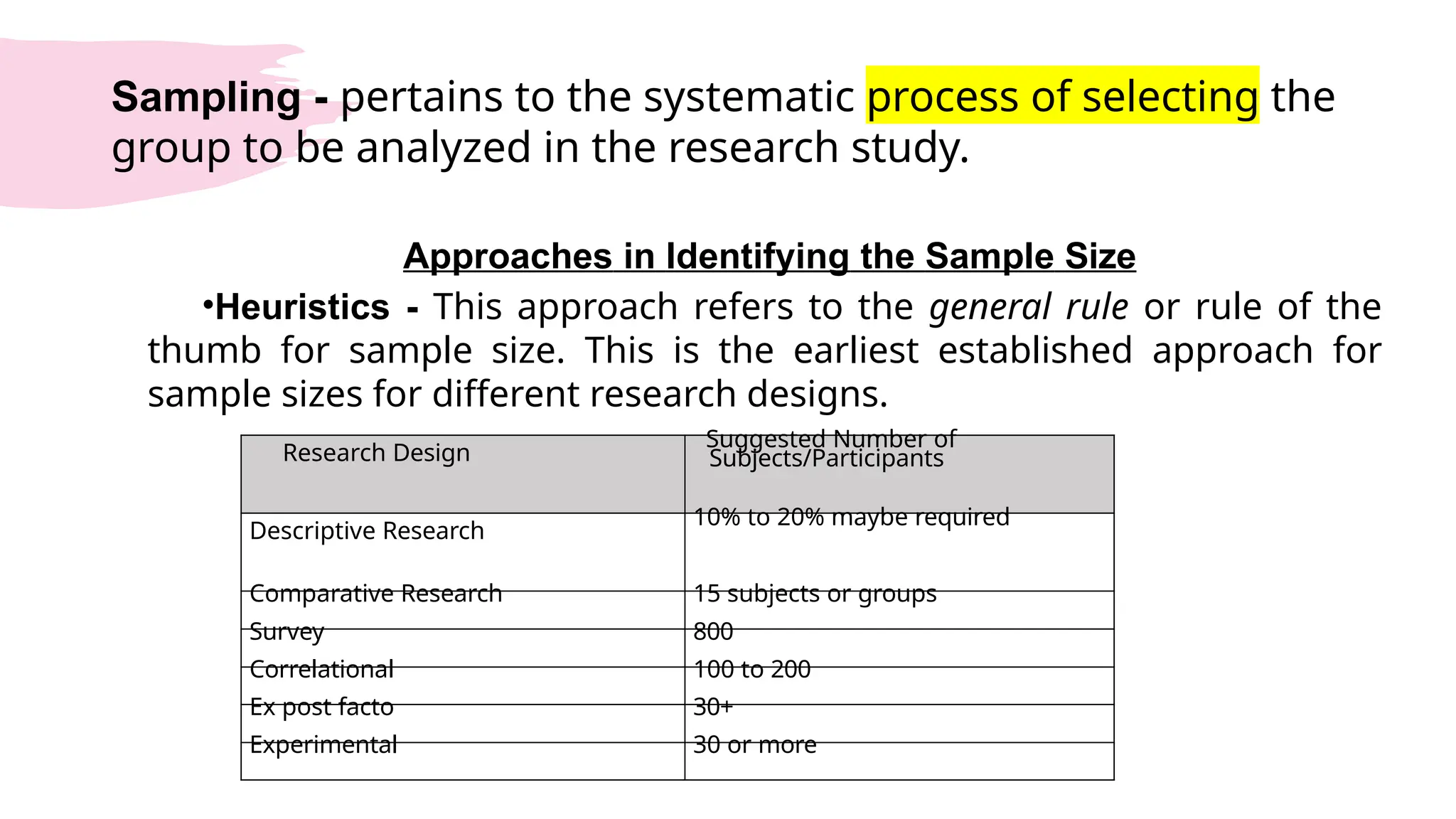
Approaches in Identifying the Sample Size
•Heuristics - This approach refers to the general rule or rule of the
thumb for sample size. This is the earliest established approach for
sample sizes for different research designs.
Research Design
Suggested Number of
Subjects/Participants
Descriptive Research
10% to 20% maybe required
Comparative Research 15 subjects or groups
Survey 800
Correlational 100 to 200
Ex post facto 30+
Experimental 30 or more
• Literature Review - Another approach is by reading
similar or related literature and studies to your current
research study. Since you are done writing your review of
related literature and studies, you might want to recall
how these studies determine sample size. Using this
approach increases the validity of your sampling
procedure.
Formulas. Formulas are also being established for the
computation of an acceptable sample size.
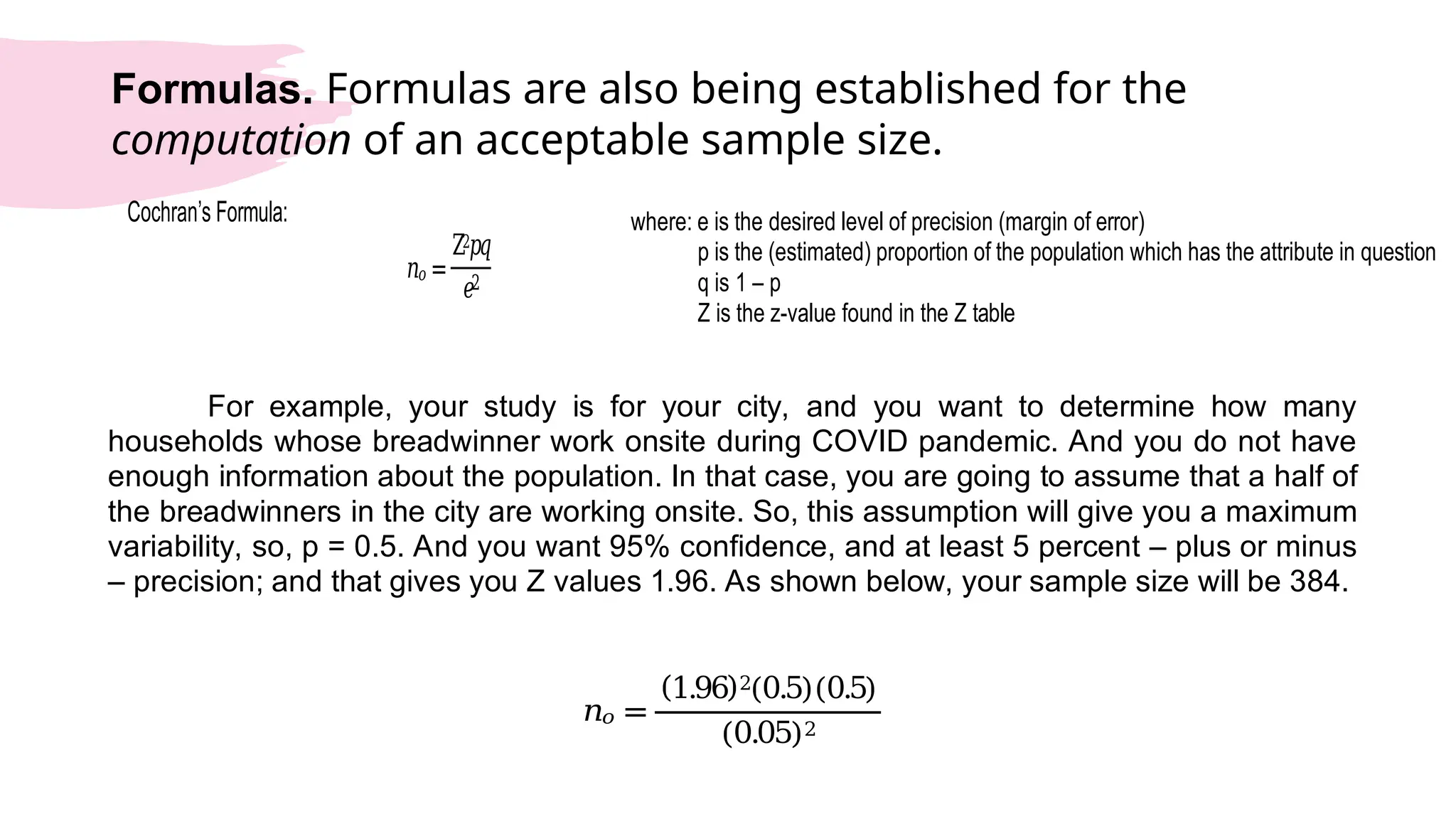
Cochran’s Formula:
𝑛𝑜 =
Z2𝑝𝑞
𝑒2
where: e is the desired level of precision (margin of error)
p is the (estimated) proportion of the population which has the attribute in question
q is 1 – p
Z is the z-value found in the Z table
For example, your study is for your city, and you want to determine how many
households whose breadwinner work onsite during COVID pandemic. And you do not have
enough information about the population. In that case, you are going to assume that a half of
the breadwinners in the city are working onsite. So, this assumption will give you a maximum
variability, so, p = 0.5. And you want 95% confidence, and at least 5 percent – plus or minus
– precision; and that gives you Z values 1.96. As shown below, your sample size will be 384.
𝑛𝑜 =
(1.96)2(0.5)(0.5)
(0.05)2
Power Analysis - This approach is founded on the principle of power
analysis.
2 principles: statistical power and effect size
The probability of rejecting the null hypothesis is called statistical power. It
suggests that indeed there is a relationship between the independent and dependent
variables of the research study. The ideal statistical power of a research study is 80%.
With the statistical power, it will be used to identify the sufficient sample size for
measuring the effect size of a certain treatment. The level of difference between the
experimental group and the control group refers to effect size.
If the statistical power tells that relationship between independent and
dependent variables, the effect size suggests the extent of the relationship between
these two variables. Henceforth, the higher the effect size, means the greater the
level difference between the experimental and control groups. For example, your
research study reveals that there is a difference in the pretest and posttest scores of
the students in the given anxiety test after implementing a psychosocial intervention.
With the effect size, you will have an idea of how small or large the difference is.
Probability Sampling in Quantitative Research
Simple Random Sampling
-It is a way of choosing individuals in which all members of
the accessible population are given an equal chance to be
selected.
Ways of obtaining Samples through (simple random sampling)
fishbowl technique
roulette wheel
table of random numbers
Visit this link https://www.randomizer.org/ to practice.
Stratified Random Sampling - the population is first
divided into strata or groups before selecting the
samples. The samples are chosen from these subgroups
and not directly from the entire population. This
procedure is best used when the variables of the study
are also grouped into classes such as gender and grade
level.
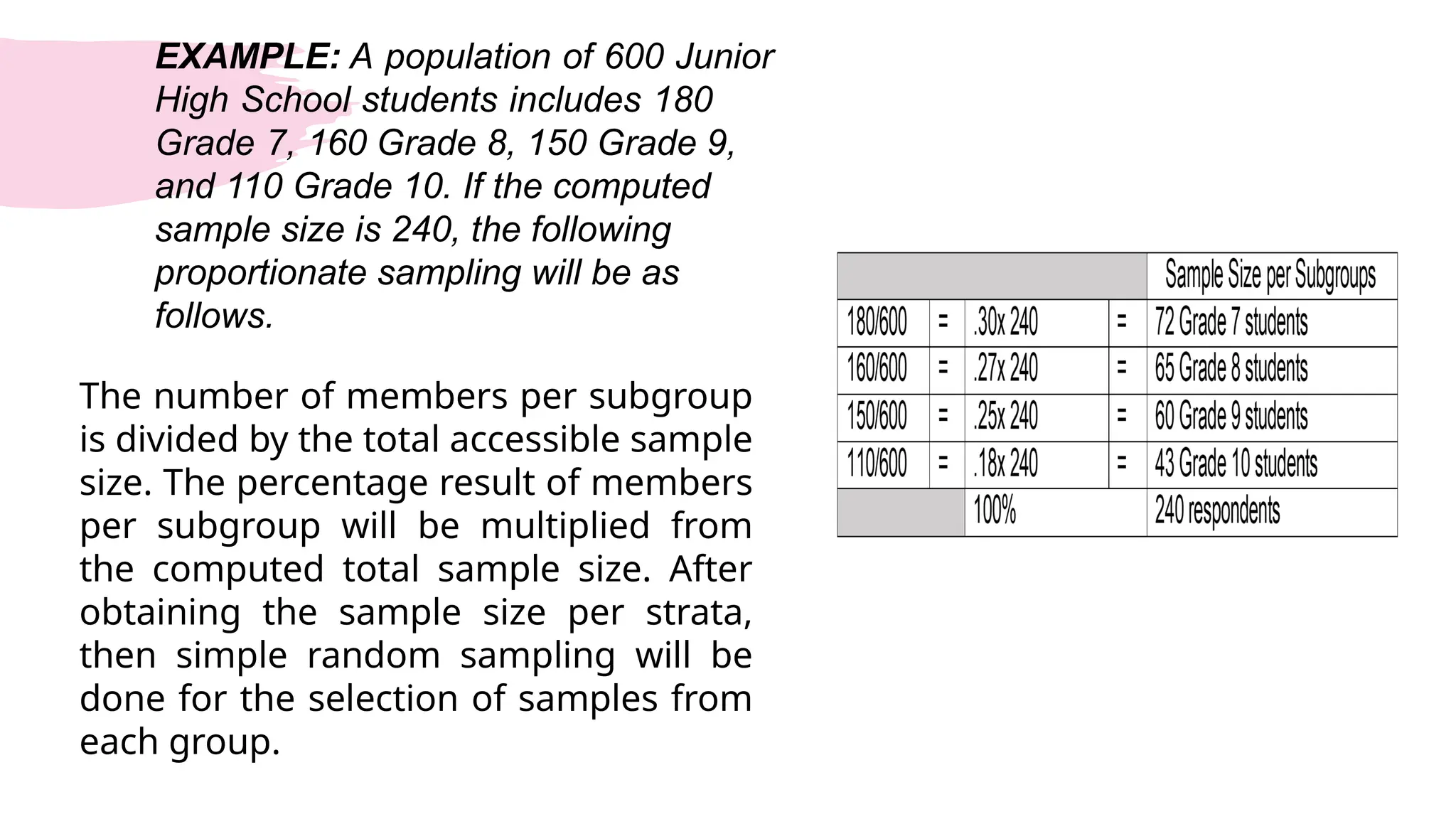
EXAMPLE: A population of 600 Junior
High School students includes 180
Grade 7, 160 Grade 8, 150 Grade 9,
and 110 Grade 10. If the computed
sample size is 240, the following
proportionate sampling will be as
follows.
The number of members per subgroup
is divided by the total accessible sample
size. The percentage result of members
per subgroup will be multiplied from
the computed total sample size. After
obtaining the sample size per strata,
then simple random sampling will be
done for the selection of samples from
each group.
Cluster Sampling - This procedure is usually
applied in large-scale studies, geographical
spread out of the population is a challenge,
and gathering information will be very time-
consuming
For example, a researcher would like to
interview of all public senior high school
students across Mindanao. As a researcher
cluster will be selected to satisfy the plan size.
In the given example, the first cluster can be by
region, the second cluster can be by division,
and the third cluster can be by district.
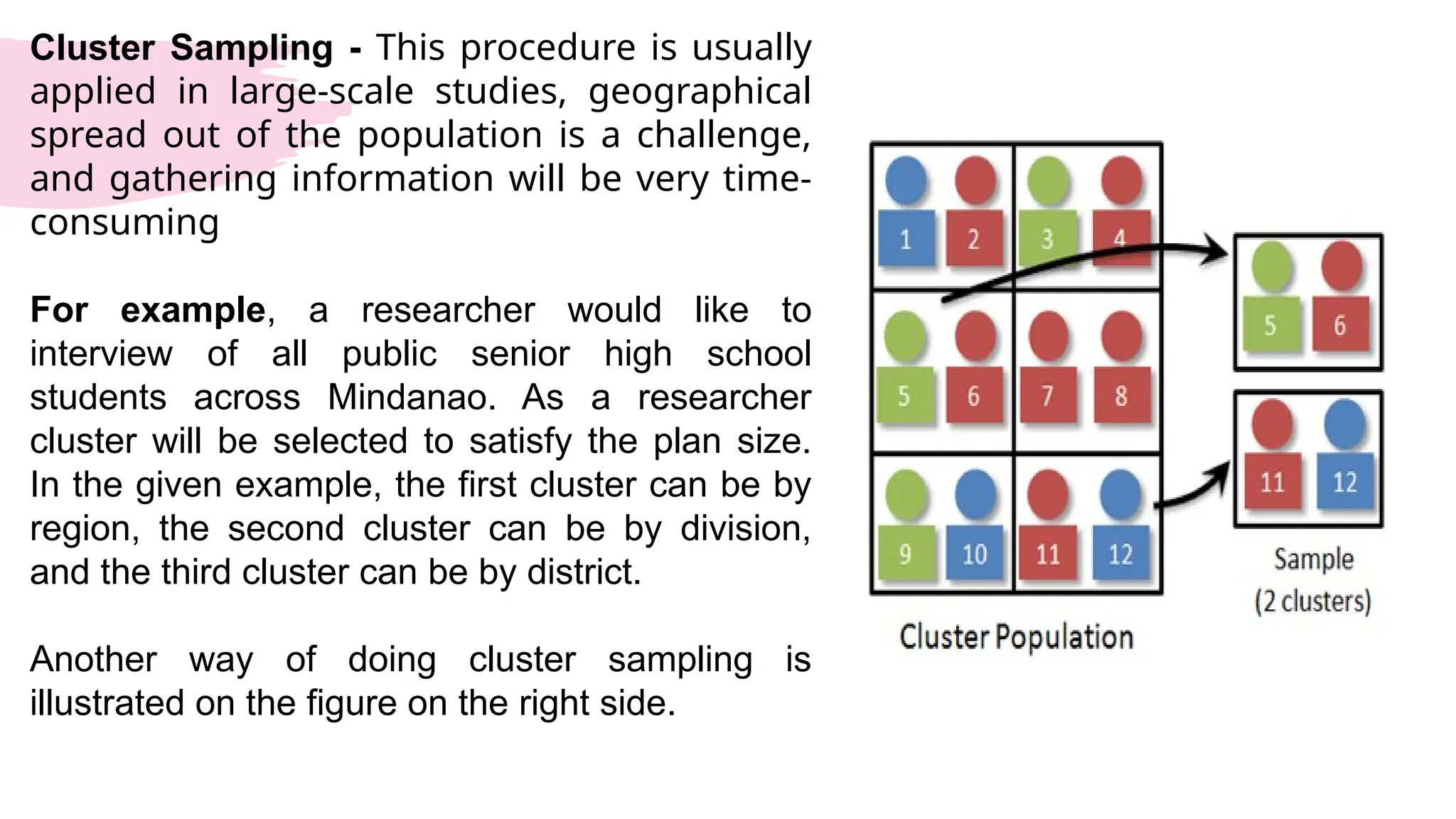
Another way of doing cluster sampling is
illustrated on the figure on the right side.
Systematic Sampling
-This procedure is as simple as selecting
samples every nth (example every 2nd
, 5th
) of the
chosen population until arriving at a desired total
number of sample size. Therefore, the selection is
based on a predetermined interval.
-Dividing the population size by the sample
size, the interval will be obtained. For example,
from a total population of 75, you have 25
samples; using systematic sampling, you will
decide to select every 3rd
person on the list of
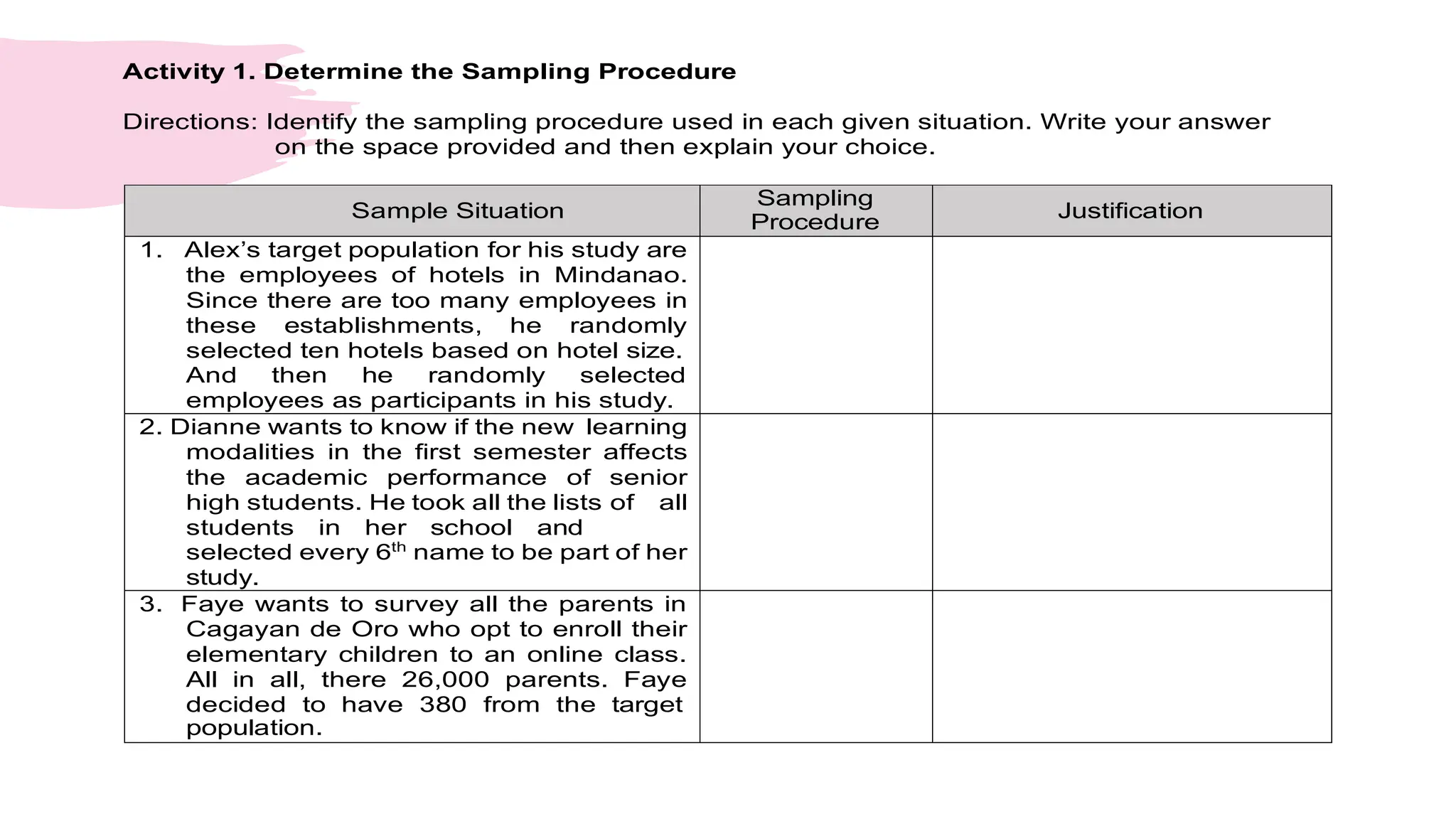
Activity 1. Determine the Sampling Procedure
Directions: Identify the sampling procedure used in each given situation. Write your answer
on the space provided and then explain your choice.
Sample Situation
Sampling
Procedure
Justification
1. Alex’s target population for his study are
the employees of hotels in Mindanao.
Since there are too many employees in
these establishments, he randomly
selected ten hotels based on hotel size.
And then he randomly selected
employees as participants in his study.
2. Dianne wants to know if the new learning
modalities in the first semester affects
the academic performance of senior
high students. He took all the lists of all
students in her school and
selected every 6th
name to be part of her
study.
3. Faye wants to survey all the parents in
Cagayan de Oro who opt to enroll their
elementary children to an online class.
All in all, there 26,000 parents. Faye
decided to have 380 from the target
population.

CHAPTER 3 Understanding Data hhhhhhhhhkk

  • 1.
    Understanding Data andWays to Systematically Collect Data PRACTICAL RESEARCH 2
  • 2.
    Lesson Quantitative Research Designs 1 Meaning ofQuantitative Research Designs • When a man decides to build a house, does not he draw first the blueprint before he will start to do the work? Same with the conduct of research, the blueprint for the collection, measurement, and data analysis is drawn as a pattern to follow. Furthermore, research designs enable the researcher to obtain a more valid, objective, reliable, and accurate answers to the research questions.
  • 3.
    Research design - isdefined as the rational and coherent overall strategy that the researcher uses to incorporate all the vital components of the research study. - According to Fraenkel and Wallen (2007, p 15), the research designs in quantitative research are mostly pre- established. Hence having an appropriate research design in quantitative research, the researcher will have a clearer comprehension of what he is trying to analyze and interpret.
  • 4.
    Types of QuantitativeResearch Design Descriptive Research - It is a design that is exploratory in nature. The purpose of descriptive research is basically to answer questions such as who, what, where, when, and how much. So, this design is best used when the main objective of the study is just to observe and report a certain phenomenon as it is happening.
  • 5.
    Correlational Research -The maingoal of this design is to determine if variable increases or decreases as another variable increases or decreases. - This design seeks to establish an association between variables. It measures variables as it occurs. It has two major purposes: 1.) to clarify the relationship between variables and; 2.) to predict the magnitude of the association. However, the extent of the purpose of correlational research depends on the scope and delimitation of the study.
  • 6.
    Ex Post Facto -If the objective of the study is to measure a cause from a pre-existing effect, then Ex Post Facto research design is more appropriate to use. In this design, the researcher has no control over the variables in the research study. Thus, one cannot conclude that the changes measured happen during the actual conduct of the study.
  • 7.
    Quasi-Experimental (kwahz-eye) -This researchdesign aims to measure the causal relationship between variables. The effect measured is considered to have occurred during the conduct of the current study. -The partiality of quasi-experimental design comes from assigning subjects, participants, or respondents into their groups. The groups are known to be already established before the study, such as age educational background and nationality.
  • 8.
    Experimental Research - Itis also known as true experimental design since it applies treatment and manipulation more extensively compared to quasi-experimental design. -Random assignment of subjects or participants into treatment and control group is done increasing the validity of the study. Experimental research, therefore, attempts to affect a certain variable by directly manipulating the independent variable.
  • 9.
    Experimental Research - Itis also known as true experimental design since it applies treatment and manipulation more extensively compared to quasi-experimental design. -Random assignment of subjects or participants into treatment and control group is done increasing the validity of the study. Experimental research, therefore, attempts to affect a certain variable by directly manipulating the independent variable.
  • 10.
    Activity 3. Choosethe Appropriate Research Design Directions: Determine the quantitative research design appropriate for the sample research titles. Make sure to explain your choice into two to three sentences. 1. Relationship between Academic Stressors and Learning Preferences of Senior High School Students Quantitative Research Design: Explanation: 2. Reading Electronic Learning Materials as a Support for Vocabulary of Grade 1 Pupils Quantitative Research Design: Explanation:
  • 11.
    3.Impact of theImplementation of COVID – 19 Health Protocols in Supermarkets on Consumer Behaviors Quantitative Research Design: Explanation: 4. Effects of Morning Exercise on the Health Anxiety Level of Senior Citizens Quantitative Research Design: Explanation: 5.Measuring the Gadgets Usage of Children at Home during COVID-19 Community Quarantine Quantitative Research Design: Explanation: 6.Level of Academic Achievement of Senior High Schools in Different Learning Modalities Quantitative Research Design: Explanation: 7.Effects of Story Telling on Quality of Sleep of Children Quantitative Research Design: Explanation:
  • 12.
    Population and Sample 1.)The population is the totality of all the objects, elements, persons, and characteristics under consideration. It is understood that this population possesses common characteristics about which the research aims to explore. 2 Types of Population 1. The target population, for example, all Senior High School Students enrolled in Science, Technology, Engineering, and Mathematics (STEM) in the Division of Iligan City. 2. The accessible population is the portion of the population in which the researcher has reasonable access, for example all Senior High School enrolled, STEM strand at Corpus Christi Parochial School of Iligan.
  • 13.
    Sampling - pertainsto the systematic process of selecting the group to be analyzed in the research study. Approaches in Identifying the Sample Size •Heuristics - This approach refers to the general rule or rule of the thumb for sample size. This is the earliest established approach for sample sizes for different research designs. Research Design Suggested Number of Subjects/Participants Descriptive Research 10% to 20% maybe required Comparative Research 15 subjects or groups Survey 800 Correlational 100 to 200 Ex post facto 30+ Experimental 30 or more
  • 14.
    • Literature Review- Another approach is by reading similar or related literature and studies to your current research study. Since you are done writing your review of related literature and studies, you might want to recall how these studies determine sample size. Using this approach increases the validity of your sampling procedure.
  • 15.
    Formulas. Formulas arealso being established for the computation of an acceptable sample size. Cochran’s Formula: 𝑛𝑜 = Z2𝑝𝑞 𝑒2 where: e is the desired level of precision (margin of error) p is the (estimated) proportion of the population which has the attribute in question q is 1 – p Z is the z-value found in the Z table For example, your study is for your city, and you want to determine how many households whose breadwinner work onsite during COVID pandemic. And you do not have enough information about the population. In that case, you are going to assume that a half of the breadwinners in the city are working onsite. So, this assumption will give you a maximum variability, so, p = 0.5. And you want 95% confidence, and at least 5 percent – plus or minus – precision; and that gives you Z values 1.96. As shown below, your sample size will be 384. 𝑛𝑜 = (1.96)2(0.5)(0.5) (0.05)2
  • 16.
    Power Analysis -This approach is founded on the principle of power analysis. 2 principles: statistical power and effect size The probability of rejecting the null hypothesis is called statistical power. It suggests that indeed there is a relationship between the independent and dependent variables of the research study. The ideal statistical power of a research study is 80%. With the statistical power, it will be used to identify the sufficient sample size for measuring the effect size of a certain treatment. The level of difference between the experimental group and the control group refers to effect size. If the statistical power tells that relationship between independent and dependent variables, the effect size suggests the extent of the relationship between these two variables. Henceforth, the higher the effect size, means the greater the level difference between the experimental and control groups. For example, your research study reveals that there is a difference in the pretest and posttest scores of the students in the given anxiety test after implementing a psychosocial intervention. With the effect size, you will have an idea of how small or large the difference is.
  • 17.
    Probability Sampling inQuantitative Research Simple Random Sampling -It is a way of choosing individuals in which all members of the accessible population are given an equal chance to be selected. Ways of obtaining Samples through (simple random sampling) fishbowl technique roulette wheel table of random numbers Visit this link https://www.randomizer.org/ to practice.
  • 18.
    Stratified Random Sampling- the population is first divided into strata or groups before selecting the samples. The samples are chosen from these subgroups and not directly from the entire population. This procedure is best used when the variables of the study are also grouped into classes such as gender and grade level.
  • 19.
    EXAMPLE: A populationof 600 Junior High School students includes 180 Grade 7, 160 Grade 8, 150 Grade 9, and 110 Grade 10. If the computed sample size is 240, the following proportionate sampling will be as follows. The number of members per subgroup is divided by the total accessible sample size. The percentage result of members per subgroup will be multiplied from the computed total sample size. After obtaining the sample size per strata, then simple random sampling will be done for the selection of samples from each group.
  • 20.
    Cluster Sampling -This procedure is usually applied in large-scale studies, geographical spread out of the population is a challenge, and gathering information will be very time- consuming For example, a researcher would like to interview of all public senior high school students across Mindanao. As a researcher cluster will be selected to satisfy the plan size. In the given example, the first cluster can be by region, the second cluster can be by division, and the third cluster can be by district. Another way of doing cluster sampling is illustrated on the figure on the right side.
  • 21.
    Systematic Sampling -This procedureis as simple as selecting samples every nth (example every 2nd , 5th ) of the chosen population until arriving at a desired total number of sample size. Therefore, the selection is based on a predetermined interval. -Dividing the population size by the sample size, the interval will be obtained. For example, from a total population of 75, you have 25 samples; using systematic sampling, you will decide to select every 3rd person on the list of
  • 22.
    Activity 1. Determinethe Sampling Procedure Directions: Identify the sampling procedure used in each given situation. Write your answer on the space provided and then explain your choice. Sample Situation Sampling Procedure Justification 1. Alex’s target population for his study are the employees of hotels in Mindanao. Since there are too many employees in these establishments, he randomly selected ten hotels based on hotel size. And then he randomly selected employees as participants in his study. 2. Dianne wants to know if the new learning modalities in the first semester affects the academic performance of senior high students. He took all the lists of all students in her school and selected every 6th name to be part of her study. 3. Faye wants to survey all the parents in Cagayan de Oro who opt to enroll their elementary children to an online class. All in all, there 26,000 parents. Faye decided to have 380 from the target population.