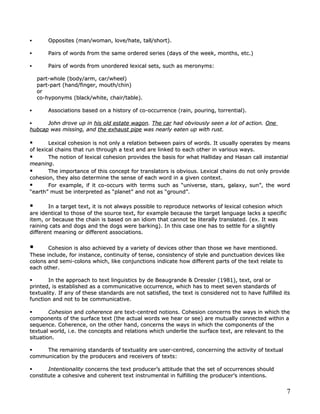
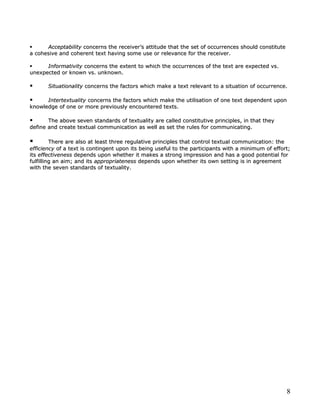
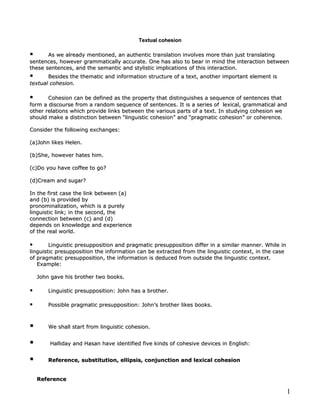
The document discusses textual cohesion and the various linguistic devices that contribute to cohesion in a text. It defines cohesion as the links between different parts of a text that distinguish it from a random sequence. There are five main cohesive devices: reference, substitution, ellipsis, conjunction, and lexical cohesion. Reference involves pronouns and other words that refer back to things mentioned earlier. Substitution and ellipsis involve replacing or omitting words to avoid repetition. Conjunctions link different parts of a text, while lexical cohesion uses repetition of words to create links. Together these devices help create a coherent text by connecting its various parts through linguistic and semantic relationships.
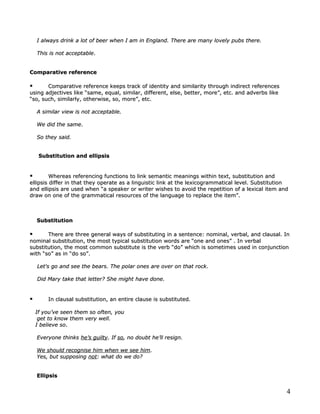
![ Ellipsis (zero substitution) is the omission of elements normally required by the grammar
which the speaker/writer assumes are obvious from the context and therefore need not be raised.
If substitution is replacing one word with another, ellipsis is the absence of that word, "something
left unsaid". Ellipsis requires retrieving specific information that can be found in the preceding
text.
There are three types of ellipsis too: nominal, verbal, and clausal.
(a) Do you want to hear another song? I know twelve more [songs]
(b) Sue brought roses and Jackie [brought] lilies.
(c) I ran 5 miles on the first day and 8 on the second
A translator needs only be aware that there are different devices in different languages for
creating “texture”. This has clear implications in practice. Usually what is required is reworking the
methods of establishing links to suit the textual norms of the target language and of each genre.
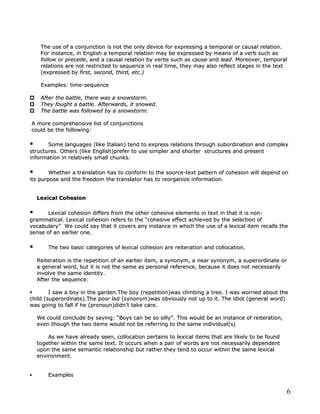
Discourse markers and conjunctions
A third way of creating cohesion is through discourse markers and conjunctions. Discourse
markers are linguistic elements used by the speaker/writer to ease the interpretation of the text,
frequently by signalling a relationship between segments of the discourse, which is the specific
function of conjunctions. They are not a way of simply joining sentences. Their role in the text is
wider that that, because they provide the listener/reader with information for the interpretation of
the utterance; that is why some linguists prefer to describe them as discourse markers.
Conjunction acts as a cohesive tie between clauses or sections of text in such a way as to
demonstrate a meaningful pattern between them, though conjunctive relations are not tied to
any
particular sequence in the expression. Therefore, amongst the cohesion forming
devices within text, conjunction is the least directly identifiable relation.
Conjunctions can be classified according to four main categories: additive, adversative,
causal and temporal.
Additive conjunctions act to structurally coordinate or link by adding to the presupposed
item and are signalled through “and, also, too, furthermore, additionally”, etc. Additive
conjunctions may also act to negate the presupposed item and are signalled by “nor, and...not,
either, neither”, etc.
Adversative conjunctions act to indicate “contrary to expectation” and are signalled by
“yet, though, only, but, in fact, rather”, etc.
Causal conjunction expresses “result, reason and purpose” and is signalled by “so, then, for,
because, for this reason, as a result, in this respect, etc.”.
The last most common conjunctive category is temporal and links by signalling sequence or
time. Some sample temporal conjunctive signals are “then, next, after that, next day, until
then, at the same time, at this point”, etc.
5](https://image.slidesharecdn.com/textualcohesion-130310195113-phpapp02/85/Textual-cohesion-5-320.jpg)