Dalton’s Atomic Thoery


    ByExamify
    Smartest Way To Crack Any Exam
Who Is Dalton?

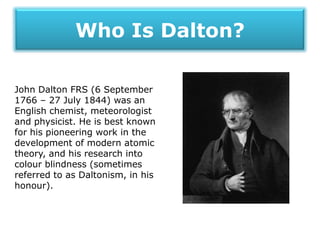
John Dalton FRS (6 September
1766 – 27 July 1844) was an
English chemist, meteorologist
and physicist. He is best known
for his pioneering work in the
development of modern atomic
theory, and his research into
colour blindness (sometimes
referred to as Daltonism, in his
honour).
What Is DALTON'S ATOMIC THEORY?


It was in the early 1800s that John Dalton,
an observer of weather and discoverer of
color blindness among other things, came
up with his atomic theory.

The idea of atoms had been proposed
much earlier. The ancient Greek
philosophers had talked about atoms, but
Dalton's theory was different in that it had
the weight of careful chemical
measurements behind it. It wasn't just a
philosophical statement that there are
atoms because there must be atoms.
The postulates of Dalton's atomic
theory were used to explain
earlier observations of the
behaviour of matter.

Although two centuries old,
Dalton's atomic theory remains
valid in modern chemical thought.
Matter is composed of very tiny or
microscopic particles called
"Atom".
Atom is an indivisible particle.
Atom can neither be created nor it
is destroyed.
Atoms of an element are identical
in size, shape, mass and in other
properties.
Atoms of different elements are
different in their properties.
Atoms combine with each other
in small whole numbers.
All chemical reactions are due
to combination or separation of
atoms.
With the discovery of sub-atomic particles, e.g.,
 electrons, neutrons and protons, the atom can no
 longer be considered indivisible.

 The atoms of same elements are not similar in all
  respect. They may vary in mass and density.
  These are known as Isotopes. For example:
  chlorine has two isotopes having mass numbers
  35 a.m.u and 37 a.m.u.
Atoms of different elements are not different in all
respects. Atoms of different elements that have the same
atomic mass are called Isobar.

Different elements combine in simple whole
 number ratio to form compounds. This is not
 seen in complex organic compounds like sugar
 C12H22O11.

The theory fails to explain the existence of
 Allotropes.
Presented By Examify
 www.examify.com

Dalton's Atomic Theory

  • 1.
    Dalton’s Atomic Thoery ByExamify Smartest Way To Crack Any Exam
  • 2.
    Who Is Dalton? JohnDalton FRS (6 September 1766 – 27 July 1844) was an English chemist, meteorologist and physicist. He is best known for his pioneering work in the development of modern atomic theory, and his research into colour blindness (sometimes referred to as Daltonism, in his honour).
  • 3.
    What Is DALTON'SATOMIC THEORY? It was in the early 1800s that John Dalton, an observer of weather and discoverer of color blindness among other things, came up with his atomic theory. The idea of atoms had been proposed much earlier. The ancient Greek philosophers had talked about atoms, but Dalton's theory was different in that it had the weight of careful chemical measurements behind it. It wasn't just a philosophical statement that there are atoms because there must be atoms.
  • 4.
    The postulates ofDalton's atomic theory were used to explain earlier observations of the behaviour of matter. Although two centuries old, Dalton's atomic theory remains valid in modern chemical thought.
  • 5.
    Matter is composedof very tiny or microscopic particles called "Atom".
  • 6.
    Atom is anindivisible particle.
  • 7.
    Atom can neitherbe created nor it is destroyed.
  • 8.
    Atoms of anelement are identical in size, shape, mass and in other properties.
  • 9.
    Atoms of differentelements are different in their properties.
  • 10.
    Atoms combine witheach other in small whole numbers.
  • 11.
    All chemical reactionsare due to combination or separation of atoms.
  • 12.
    With the discoveryof sub-atomic particles, e.g., electrons, neutrons and protons, the atom can no longer be considered indivisible.  The atoms of same elements are not similar in all respect. They may vary in mass and density. These are known as Isotopes. For example: chlorine has two isotopes having mass numbers 35 a.m.u and 37 a.m.u.
  • 13.
    Atoms of differentelements are not different in all respects. Atoms of different elements that have the same atomic mass are called Isobar. Different elements combine in simple whole number ratio to form compounds. This is not seen in complex organic compounds like sugar C12H22O11. The theory fails to explain the existence of Allotropes.
  • 14.
    Presented By Examify www.examify.com