Introduction
C.a.r.e. public school
Dalton’s atomic theory
SUBMITTED BY: AKASH PATEL
SUBMITTED TO: RAJAT MITTAL SIR
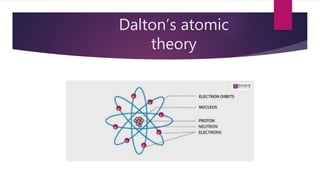
Dalton’s atomic
theory
Who was Dalton
 JOHN DALTON FRS (6 September 1766 – 27 July
1844) was an English chemist, meteorologist and
physicist. He is best known for his pioneering work
in the Development of Modern Atomic.
What is Dalton’s atomic theory?
1.Dalton presented his atomic theory in 1808 which
was a turning point in the study of matter.
2.Dalton’s atomic theory provided an explanation for
the law of conservation of mass and the law of
definite proportions.
Postulates of Dalton's atomic theory
I. Matter is made up of extremely small particles called atoms.
II. Atoms are indivisible particles which can neither be created or
destroyed in a chemical reaction.
III. Atoms of given element are identical in all respects of mass, shape,
size and chemical properties.
IV. Atoms of different elements have different masses and chemical
properties.
V. Atoms of same or different elements combine together to form
compounds.
VI. The relative number and kinds of atoms are constant in a given
compound.

Akash patel

  • 1.
    Introduction C.a.r.e. public school Dalton’satomic theory SUBMITTED BY: AKASH PATEL SUBMITTED TO: RAJAT MITTAL SIR
  • 2.
  • 3.
    Who was Dalton JOHN DALTON FRS (6 September 1766 – 27 July 1844) was an English chemist, meteorologist and physicist. He is best known for his pioneering work in the Development of Modern Atomic.
  • 4.
    What is Dalton’satomic theory? 1.Dalton presented his atomic theory in 1808 which was a turning point in the study of matter. 2.Dalton’s atomic theory provided an explanation for the law of conservation of mass and the law of definite proportions.
  • 5.
    Postulates of Dalton'satomic theory I. Matter is made up of extremely small particles called atoms. II. Atoms are indivisible particles which can neither be created or destroyed in a chemical reaction. III. Atoms of given element are identical in all respects of mass, shape, size and chemical properties. IV. Atoms of different elements have different masses and chemical properties. V. Atoms of same or different elements combine together to form compounds. VI. The relative number and kinds of atoms are constant in a given compound.