Teachers as Agents of Change:  Constructivism, Differentiated Instruction and Multiple Intelligence Group II: Dareshanie Graham Stacie Gida Ian Morris
Constructivism -a philosophy of learning that stresses that individuals understand the world by reflecting on their experiences -each individual has their own framework for making sense of the world
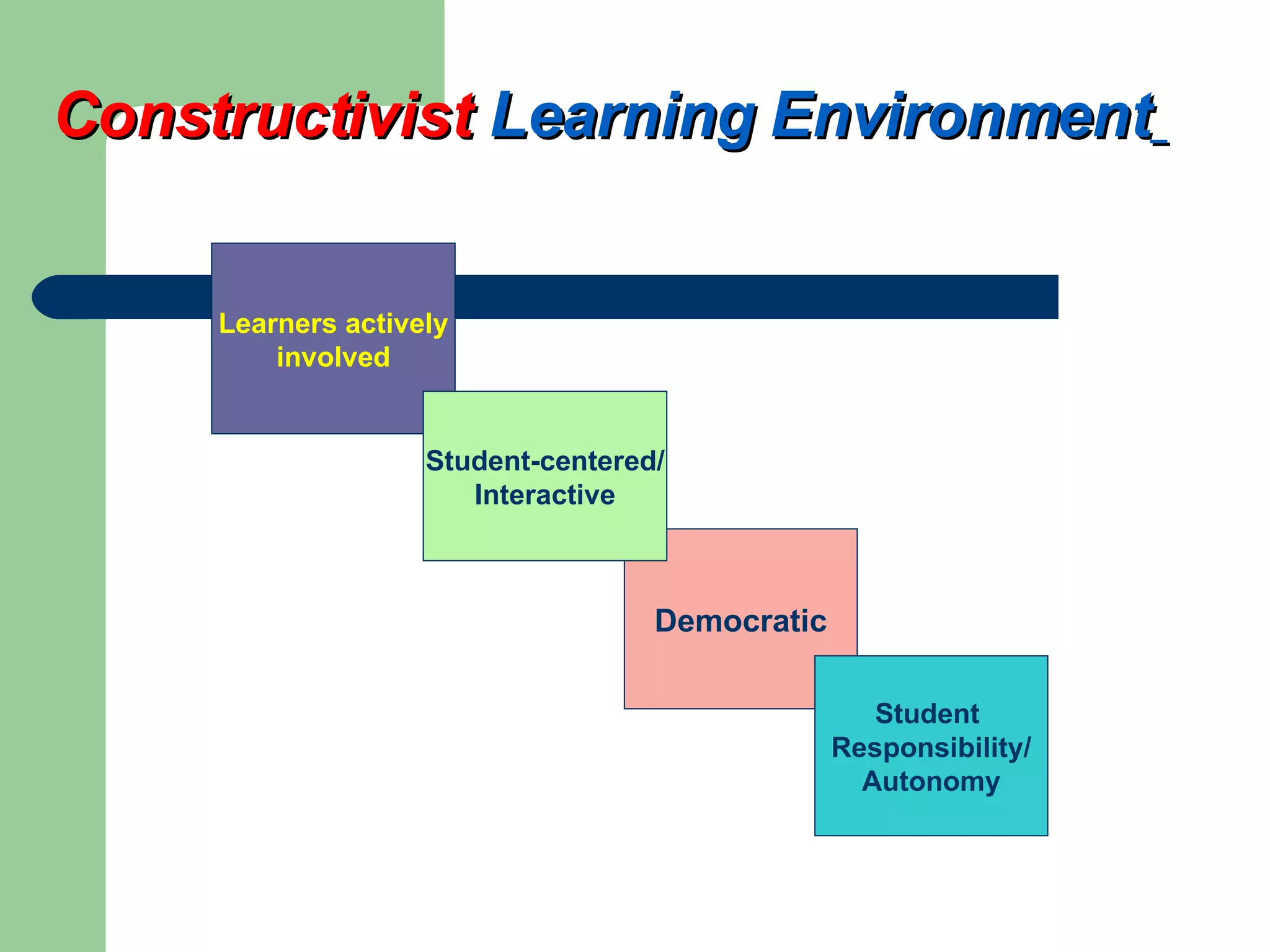
Constructivist   Learning Environment   Learners actively involved Democratic Student-centered/ Interactive Student  Responsibility/ Autonomy
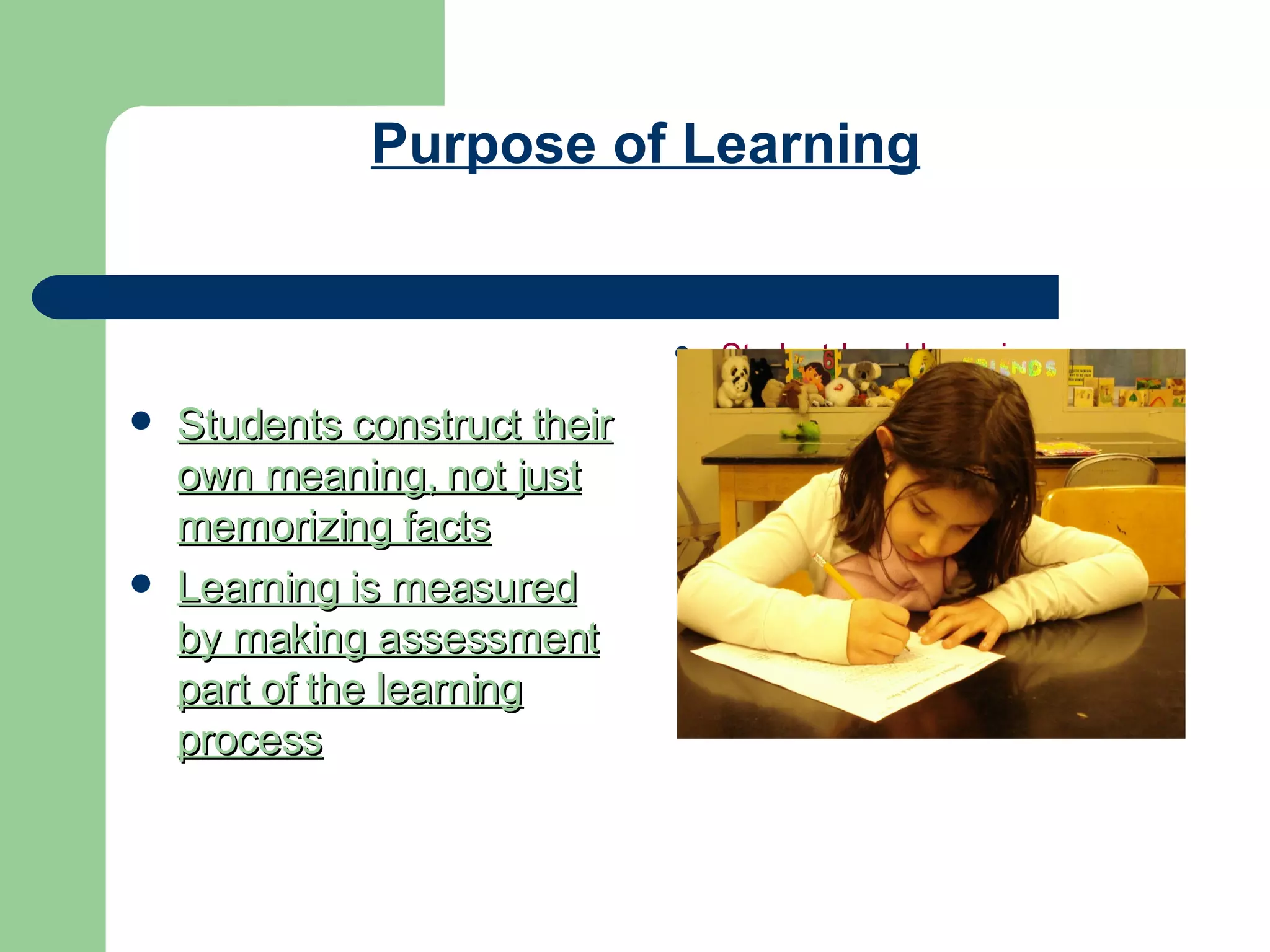
Purpose of Learning Students construct their own meaning, not just memorizing facts Learning is measured by making assessment part of the learning process Student-Lead Learning
How is Constructivism applied in the classroom? Activities Impact on Teaching “Teacher as model/coach ”
No two children are alike No two children learn in an identical way An enriched environment for one student may not be enriching for another In the classroom we should teach children to think for themselves
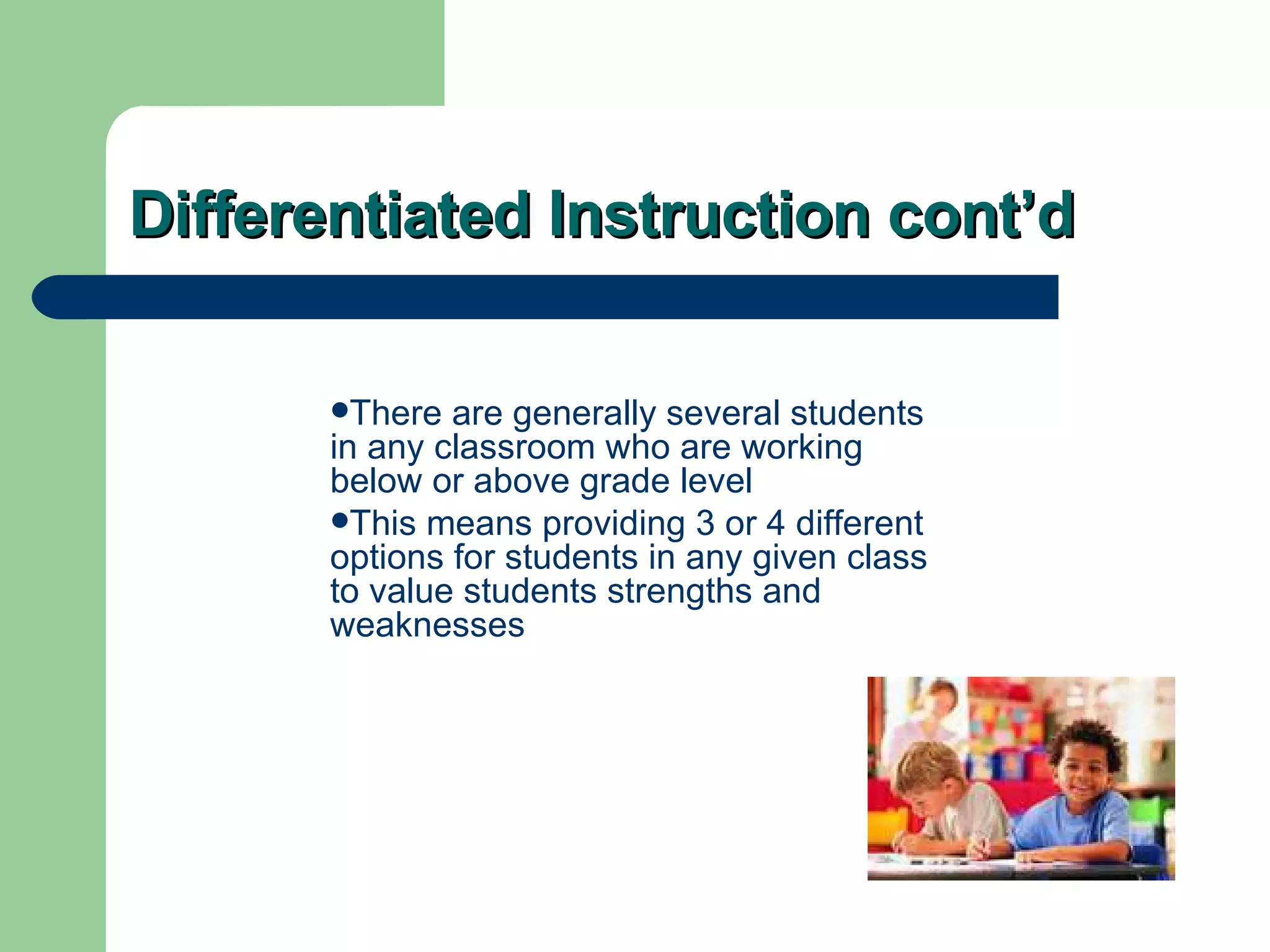
Differentiated Instruction cont’d There are generally several students in any classroom who are working below or above grade level This means providing 3 or 4 different options for students in any given class to value students strengths and weaknesses
Four Ways to Differentiate 1. Differentiate the Content/ Topic * content can be described as the knowledge, skills, and attitudes we want children to learn. * Differentiation in content requires that students are pre-tested so the teacher can identify the students' strengths. * Another way to differentiate content is simply to permit students to accelerate their rate of progress. 2. Differentiate the process/ activities * Differentiating the processes means varying learning activities or strategies to provide appropriate methods for students to explore concepts. * Give students alternate paths to manipulate the ideas embedded within the concept. * Graphic organizers, maps, diagrams, or charts displaying their comprehension of concepts .
Four Ways to Differentiate cont’d 3.  Differentiating the Product * Differentiating the product means varying the complexity of the product that students create to demonstrate mastery of concepts. * Students working below grade level may have reduced performance expectations, while students above grade level may be asked to produce work that requires more advanced thinking. * Sometimes its motivating to offer choice of product. 4.  Differentiating Environment/ Learning style . * Environment--lighting/ posters (or visual distracters)/ technology/ seating/ multiple intelligence. Learning styles should all be utilized to be effective.
Multiple  Intelligences Howard Gardner  *Background of theory*
9  Multiple  Intelligences * Multiple Intelligence offers teachers assistance by fostering deep metacognitive understanding* Verbal-Linguistic Intelligence  Logical/Mathematical Intelligence   Musical Intelligence   Visual-Spatial Intelligence   Bodily-Kinesthetic   Intelligence   Interpersonal Intelligence   Intrapersonal Intelligence   Naturalist Intelligence   Existential Intelligence   Visit this fun/interactive activity to explore your own multiple intelligences : http://www.thirteen.org/edonline/concept2class/mi/w1_interactive1.html
 
Linking Constructivism, Differentiated Instruction and Multiple Intelligence Theory Multiple Intelligence  aids teachers in easily creating more personalized and diversified instructional experiences ( Differentiated Instruction)  Constructivism  says that students have their own framework for understanding the world and  multiple intelligences  sheds light on different ways can understand and interpret that world.
Resources Gardner, H. (1983) Frames of mind: the theory of multiple intelligences. New York: Basic Books.  http://www.chariho.k12.ri.us/curriculum/MISmart/MImapDef.HTM  Accessed: June 8,2008 http://www.thirteen.org/edonline/concept2class/mi/w1_interactive1.html  Accessed June 9 , 2008.

Constructivist Theories Group2

  • 1.
    Teachers as Agentsof Change: Constructivism, Differentiated Instruction and Multiple Intelligence Group II: Dareshanie Graham Stacie Gida Ian Morris
  • 2.
    Constructivism -a philosophyof learning that stresses that individuals understand the world by reflecting on their experiences -each individual has their own framework for making sense of the world
  • 3.
    Constructivist Learning Environment Learners actively involved Democratic Student-centered/ Interactive Student Responsibility/ Autonomy
  • 4.
    Purpose of LearningStudents construct their own meaning, not just memorizing facts Learning is measured by making assessment part of the learning process Student-Lead Learning
  • 5.
    How is Constructivismapplied in the classroom? Activities Impact on Teaching “Teacher as model/coach ”
  • 6.
    No two childrenare alike No two children learn in an identical way An enriched environment for one student may not be enriching for another In the classroom we should teach children to think for themselves
  • 7.
    Differentiated Instruction cont’dThere are generally several students in any classroom who are working below or above grade level This means providing 3 or 4 different options for students in any given class to value students strengths and weaknesses
  • 8.
    Four Ways toDifferentiate 1. Differentiate the Content/ Topic * content can be described as the knowledge, skills, and attitudes we want children to learn. * Differentiation in content requires that students are pre-tested so the teacher can identify the students' strengths. * Another way to differentiate content is simply to permit students to accelerate their rate of progress. 2. Differentiate the process/ activities * Differentiating the processes means varying learning activities or strategies to provide appropriate methods for students to explore concepts. * Give students alternate paths to manipulate the ideas embedded within the concept. * Graphic organizers, maps, diagrams, or charts displaying their comprehension of concepts .
  • 9.
    Four Ways toDifferentiate cont’d 3. Differentiating the Product * Differentiating the product means varying the complexity of the product that students create to demonstrate mastery of concepts. * Students working below grade level may have reduced performance expectations, while students above grade level may be asked to produce work that requires more advanced thinking. * Sometimes its motivating to offer choice of product. 4. Differentiating Environment/ Learning style . * Environment--lighting/ posters (or visual distracters)/ technology/ seating/ multiple intelligence. Learning styles should all be utilized to be effective.
  • 10.
    Multiple IntelligencesHoward Gardner *Background of theory*
  • 11.
    9 Multiple Intelligences * Multiple Intelligence offers teachers assistance by fostering deep metacognitive understanding* Verbal-Linguistic Intelligence Logical/Mathematical Intelligence Musical Intelligence Visual-Spatial Intelligence Bodily-Kinesthetic Intelligence Interpersonal Intelligence Intrapersonal Intelligence Naturalist Intelligence Existential Intelligence Visit this fun/interactive activity to explore your own multiple intelligences : http://www.thirteen.org/edonline/concept2class/mi/w1_interactive1.html
  • 12.
  • 13.
    Linking Constructivism, DifferentiatedInstruction and Multiple Intelligence Theory Multiple Intelligence aids teachers in easily creating more personalized and diversified instructional experiences ( Differentiated Instruction) Constructivism says that students have their own framework for understanding the world and multiple intelligences sheds light on different ways can understand and interpret that world.
  • 14.
    Resources Gardner, H.(1983) Frames of mind: the theory of multiple intelligences. New York: Basic Books. http://www.chariho.k12.ri.us/curriculum/MISmart/MImapDef.HTM Accessed: June 8,2008 http://www.thirteen.org/edonline/concept2class/mi/w1_interactive1.html Accessed June 9 , 2008.