STEPS TO IDENTIFY UNKNOWN
BACTERIAL SAMPLES (PART-1)
Dr C R Meera
Assistant Professor & HOD
Department of Microbiology
St. Mary’s College Thrissur
Steps to identify unknown bacterial samples; Dr C R Meera, St.Mary’s College, TCR
Classification Vs Identification ?
• Classification is the separation of organisms into
distinct groups
• Identification is the determination of correct
place of an organism in a previously established
plan of classification
• Bergey’s Manual has been the internationally
accepted reference for the identification of
bacteria since 1923.
• Bergey’s Manual of Systemic Bacteriology
arranges related bacteria into 33 groups called
sections
• Sections - Morphology, staining reactions,
nutrition, cultural characteristics, physiology,
cellular chemistry and biochemical test
results for specific metabolic end products.
Steps to identify unknown bacterial samples; Dr C R Meera, St.Mary’s College, TCR
Steps involved in the Identification of bacteria
• Morphological
• Cultural characteristics
• Biochemical tests
Steps to identify unknown bacterial samples; Dr C R Meera, St.Mary’s College, TCR
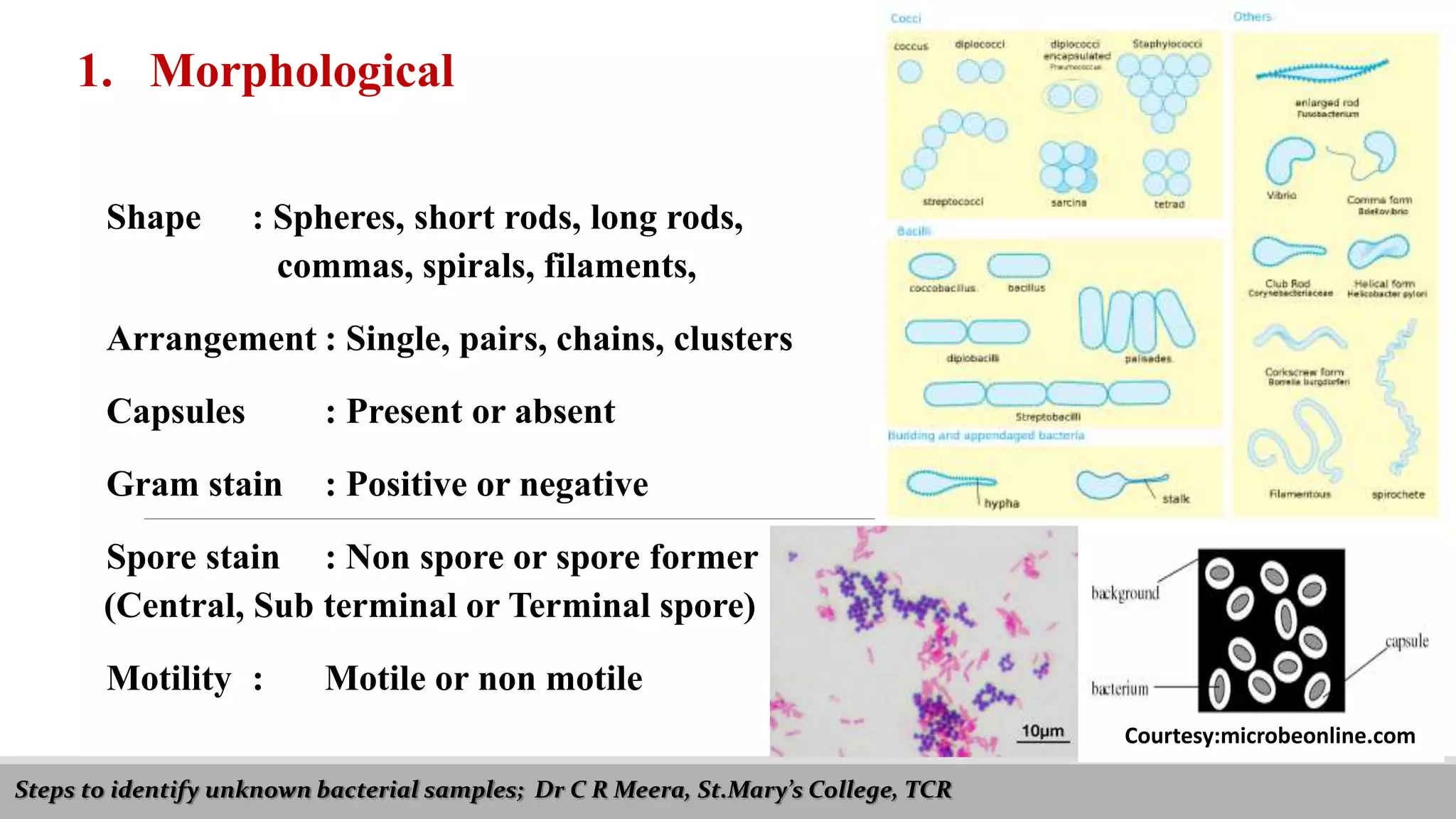
1. Morphological
Shape : Spheres, short rods, long rods,
commas, spirals, filaments,
Arrangement : Single, pairs, chains, clusters
Capsules : Present or absent
Gram stain : Positive or negative
Spore stain : Non spore or spore former
(Central, Sub terminal or Terminal spore)
Motility : Motile or non motile
Courtesy:microbeonline.com
Steps to identify unknown bacterial samples; Dr C R Meera, St.Mary’s College, TCR
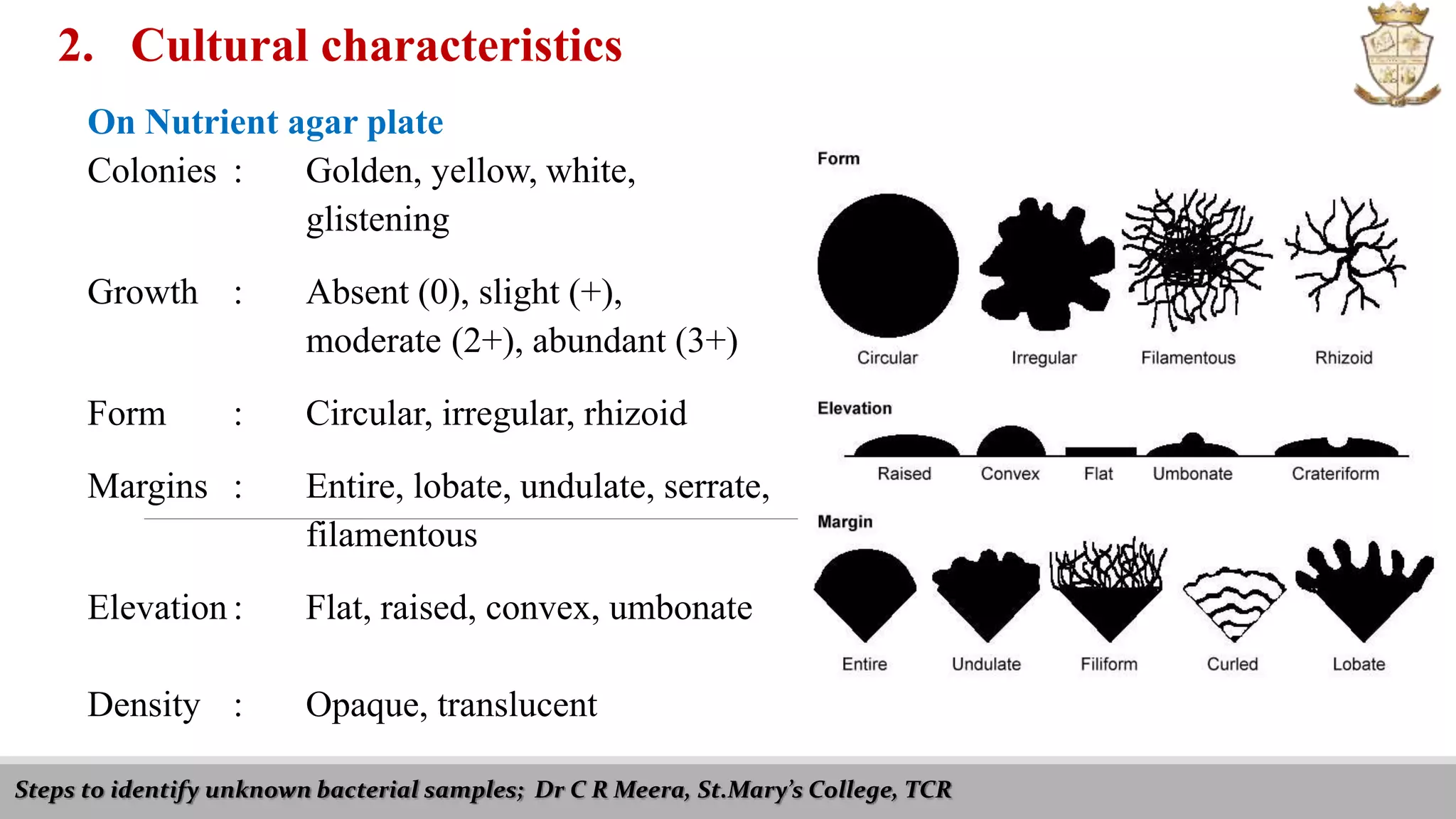
2. Cultural characteristics
On Nutrient agar plate
Colonies : Golden, yellow, white,
glistening
Growth : Absent (0), slight (+),
moderate (2+), abundant (3+)
Form : Circular, irregular, rhizoid
Margins : Entire, lobate, undulate, serrate,
filamentous
Elevation : Flat, raised, convex, umbonate
Density : Opaque, translucent
Steps to identify unknown bacterial samples; Dr C R Meera, St.Mary’s College, TCR
2. Cultural characteristics
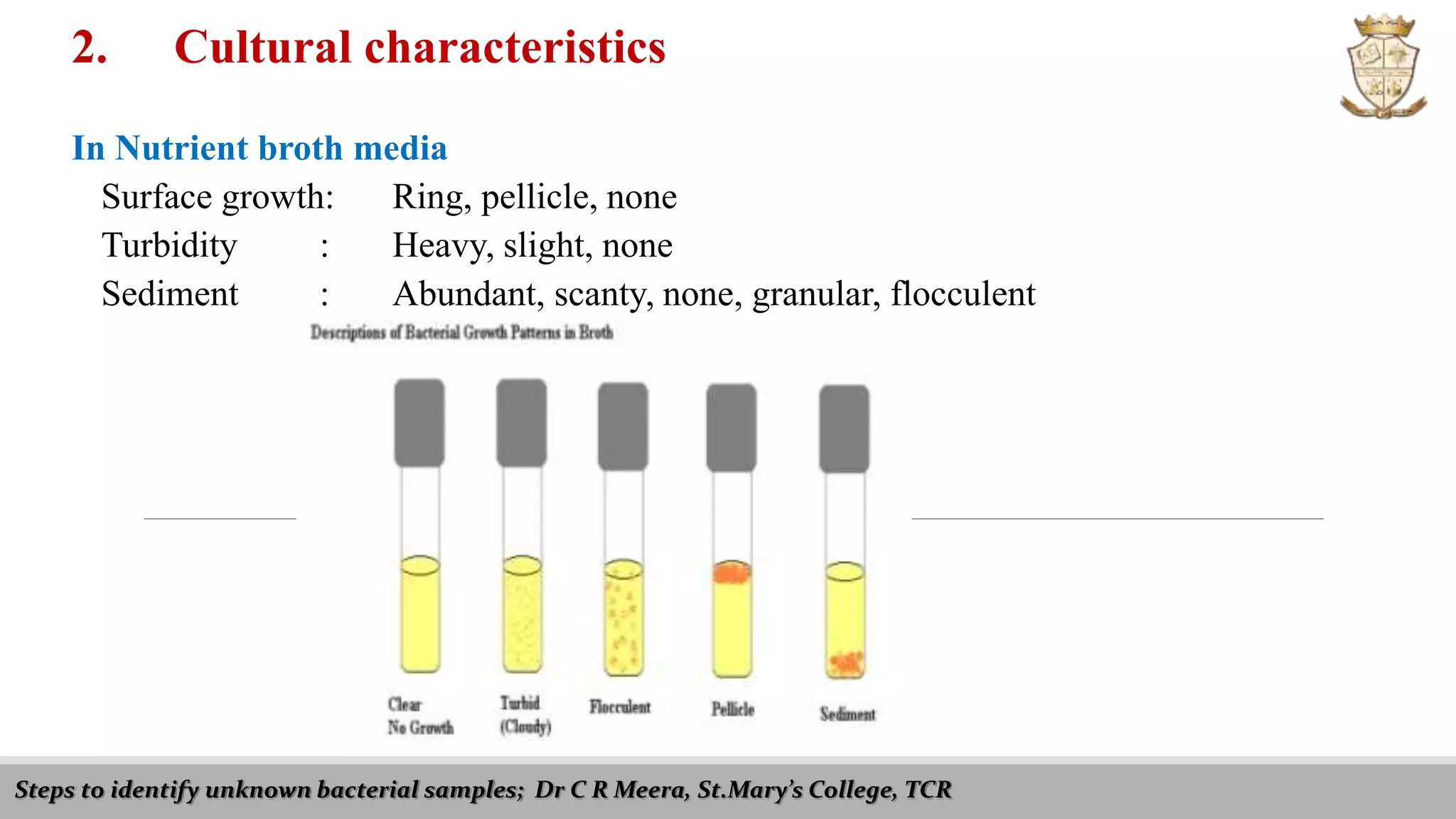
In Nutrient broth media
Surface growth: Ring, pellicle, none
Turbidity : Heavy, slight, none
Sediment : Abundant, scanty, none, granular, flocculent
Steps to identify unknown bacterial samples; Dr C R Meera, St.Mary’s College, TCR
2. Cultural characteristics
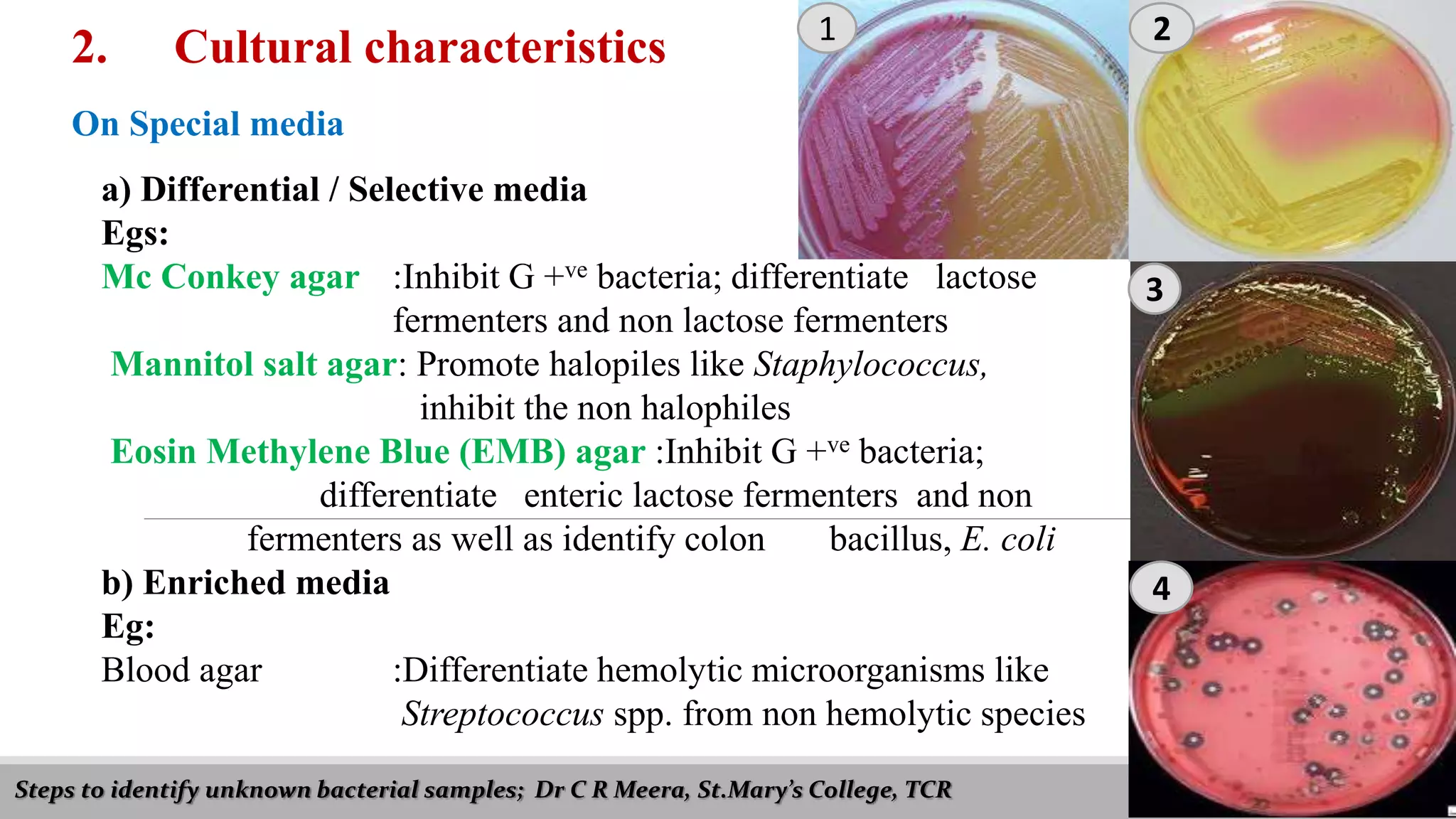
On Special media
a) Differential / Selective media
Egs:
Mc Conkey agar :Inhibit G +ve bacteria; differentiate lactose
fermenters and non lactose fermenters
Mannitol salt agar: Promote halopiles like Staphylococcus,
inhibit the non halophiles
Eosin Methylene Blue (EMB) agar :Inhibit G +ve bacteria;
differentiate enteric lactose fermenters and non
fermenters as well as identify colon bacillus, E. coli
b) Enriched media
Eg:
Blood agar :Differentiate hemolytic microorganisms like
Streptococcus spp. from non hemolytic species
1 2
3
4
Steps to identify unknown bacterial samples; Dr C R Meera, St.Mary’s College, TCR
3. Biochemical Tests
a) Carbohydrate fermentation test: Red to yellow; with or without gas
b) IMViC tests
Indole production test : Formation of red layer
Methyl-red (MR) test : Presence of red color
Voges - Proskauer (VP) test : Deep rose (pink) color
Citrate utilization test : Color change of media from green to blue
c) Urease test : Red to deep pink
d) Nitrate reduction test : Red color
e) Catalase activity : Bubbles on the release of free oxygen gas (O2)
f) Oxidase test : Development of pink, then maroon and finally
black coloration on the bacterial colonies
g) Triple Sugar Iron (TSI) test : Alkaline (red) or/ acidic (yellow) color change
in slant and butt region; with or without gas
production
Steps to identify unknown bacterial samples; Dr C R Meera, St.Mary’s College, TCR

Identification of unknown bacterial samples

  • 1.
    STEPS TO IDENTIFYUNKNOWN BACTERIAL SAMPLES (PART-1) Dr C R Meera Assistant Professor & HOD Department of Microbiology St. Mary’s College Thrissur
  • 2.
    Steps to identifyunknown bacterial samples; Dr C R Meera, St.Mary’s College, TCR Classification Vs Identification ? • Classification is the separation of organisms into distinct groups • Identification is the determination of correct place of an organism in a previously established plan of classification
  • 3.
    • Bergey’s Manualhas been the internationally accepted reference for the identification of bacteria since 1923. • Bergey’s Manual of Systemic Bacteriology arranges related bacteria into 33 groups called sections • Sections - Morphology, staining reactions, nutrition, cultural characteristics, physiology, cellular chemistry and biochemical test results for specific metabolic end products. Steps to identify unknown bacterial samples; Dr C R Meera, St.Mary’s College, TCR
  • 4.
    Steps to identifyunknown bacterial samples; Dr C R Meera, St.Mary’s College, TCR Steps involved in the Identification of bacteria • Morphological • Cultural characteristics • Biochemical tests
  • 5.
    Steps to identifyunknown bacterial samples; Dr C R Meera, St.Mary’s College, TCR 1. Morphological Shape : Spheres, short rods, long rods, commas, spirals, filaments, Arrangement : Single, pairs, chains, clusters Capsules : Present or absent Gram stain : Positive or negative Spore stain : Non spore or spore former (Central, Sub terminal or Terminal spore) Motility : Motile or non motile Courtesy:microbeonline.com
  • 6.
    Steps to identifyunknown bacterial samples; Dr C R Meera, St.Mary’s College, TCR 2. Cultural characteristics On Nutrient agar plate Colonies : Golden, yellow, white, glistening Growth : Absent (0), slight (+), moderate (2+), abundant (3+) Form : Circular, irregular, rhizoid Margins : Entire, lobate, undulate, serrate, filamentous Elevation : Flat, raised, convex, umbonate Density : Opaque, translucent
  • 7.
    Steps to identifyunknown bacterial samples; Dr C R Meera, St.Mary’s College, TCR 2. Cultural characteristics In Nutrient broth media Surface growth: Ring, pellicle, none Turbidity : Heavy, slight, none Sediment : Abundant, scanty, none, granular, flocculent
  • 8.
    Steps to identifyunknown bacterial samples; Dr C R Meera, St.Mary’s College, TCR 2. Cultural characteristics On Special media a) Differential / Selective media Egs: Mc Conkey agar :Inhibit G +ve bacteria; differentiate lactose fermenters and non lactose fermenters Mannitol salt agar: Promote halopiles like Staphylococcus, inhibit the non halophiles Eosin Methylene Blue (EMB) agar :Inhibit G +ve bacteria; differentiate enteric lactose fermenters and non fermenters as well as identify colon bacillus, E. coli b) Enriched media Eg: Blood agar :Differentiate hemolytic microorganisms like Streptococcus spp. from non hemolytic species 1 2 3 4
  • 9.
    Steps to identifyunknown bacterial samples; Dr C R Meera, St.Mary’s College, TCR 3. Biochemical Tests a) Carbohydrate fermentation test: Red to yellow; with or without gas b) IMViC tests Indole production test : Formation of red layer Methyl-red (MR) test : Presence of red color Voges - Proskauer (VP) test : Deep rose (pink) color Citrate utilization test : Color change of media from green to blue c) Urease test : Red to deep pink d) Nitrate reduction test : Red color e) Catalase activity : Bubbles on the release of free oxygen gas (O2) f) Oxidase test : Development of pink, then maroon and finally black coloration on the bacterial colonies g) Triple Sugar Iron (TSI) test : Alkaline (red) or/ acidic (yellow) color change in slant and butt region; with or without gas production
  • 10.
    Steps to identifyunknown bacterial samples; Dr C R Meera, St.Mary’s College, TCR