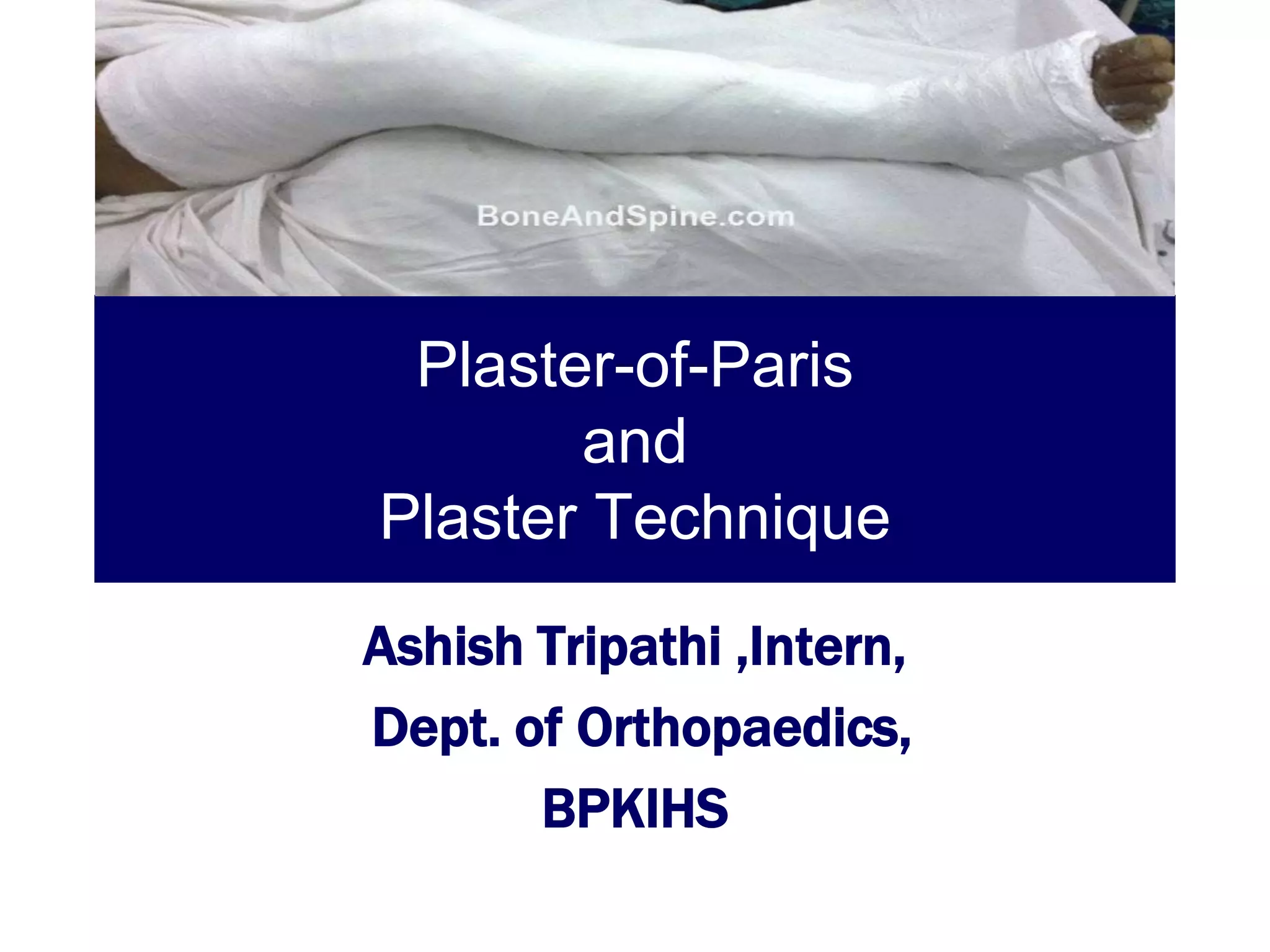
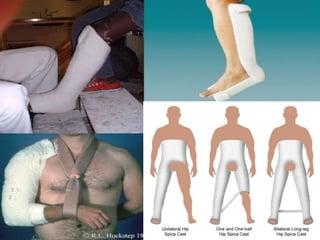
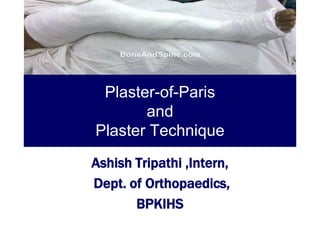
Plaster-of-Paris
       and
Plaster Technique
Ashish Tripathi ,Intern,
Dept. of Orthopaedics,
       BPKIHS
Contents:

   Plaster-of-Paris:
       1) Historical Background
       2) Uses of POP
       3) Types of Plaster Cast
       4) Steps in Application of POP Cast
       5) Common errors in Application of POP Cast
       6) Complications of POP Cast
       7) After Care
Orthopaedic Uses of Cast

1) To support fractured bones, controlling
   movement of the fragments and resting the
   damaged tissues
2) To stabilise and rest joints in ligamentous injury
3) To support and immobilise joints and limbs
   post-operatively until healing has occurred
4) To correct a deformity
5) To ensure rest of infected tissues
6) To make a negative mould of a part of body.
Materials available for casting

 Plaster-of-Paris
 Plaster-of-Paris with melamine resins
 Materials which undergo polymerisation:
        a. water activated
        b. non-water activated
 Low-temperature thermoplastics
PLASTER-OF-PARIS

   The name POP is derived from an accident to
    a house built on a deposit of Gypsum, near
    Paris. The house burnt down. When rain fell
    on baked mud of the floors it was noted that
    footprints in mud set rock-hard.

   Plaster-of-paris bandages were first used by
    Matthysen, a Dutch military surgeon in 1952.
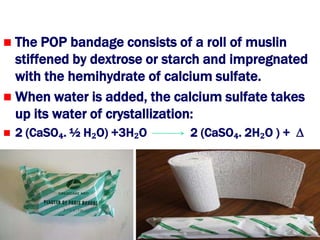
 The POP bandage consists of a roll of muslin
  stiffened by dextrose or starch and impregnated
  with the hemihydrate of calcium sulfate.
 When water is added, the calcium sulfate takes
  up its water of crystallization:
   2 (CaSO₄. ½ H₂O) +3H₂O    2 (CaSO₄. 2H₂O ) + ∆
 Setting time: time taken to change from
  powder form to crystalline form.
 Drying time: time taken to change from
  crystalline form to anhydrous form.
 Average setting time: 3-9 minutes
 Average drying time: 24-72 hours
    Factors decreasing setting time:
        1) Hot water
        2) Salt
       3) Borax
        4) Resin

   Factors increasing setting time:
       1)Cold water
       2)sugar
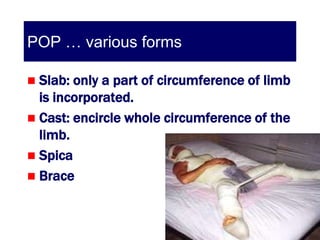
POP … various forms

 Slab: only a part of circumference of limb
  is incorporated.
 Cast: encircle whole circumference of the
  limb.
 Spica
 Brace
Advantages
   Cost-effective
   Non-allergic
   Easily moulded to different forms

Disadvantages:
   1) Radio-opaque so may occlude # lines
   2) Heavy
   3) Easily breaks when comes in contact with water
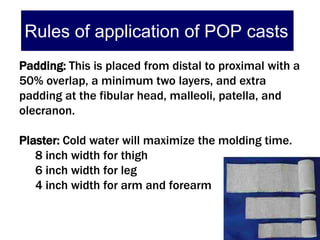
Rules of application of POP casts
Padding: This is placed from distal to proximal with a
50% overlap, a minimum two layers, and extra
padding at the fibular head, malleoli, patella, and
olecranon.

Plaster: Cold water will maximize the molding time.
   8 inch width for thigh
   6 inch width for leg
   4 inch width for arm and forearm
Rules of application of POP casts
   8 inch for thigh,6 inch for leg and 4 inch for forearm.
   One joint above and one joint below.
   Moulded with palm and not with fingers to avoid
    indentation.
   Joints should be immobilized in functional position.
   Not too tight or too loose i.e. adequate padding
   Dip pop vertically in water till air bubble ceases to
    come
   Uniform thickness of plaster is preferred.
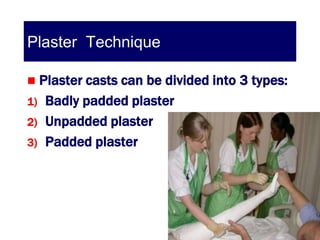
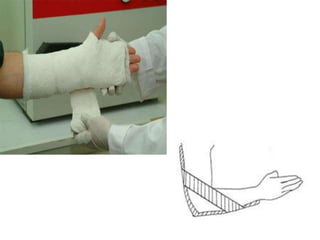
Plaster Technique

 Plaster casts can be divided into 3 types:
1) Badly padded plaster
2) Unpadded plaster
3) Padded plaster
Badly padded plaster

   It is loose on the limb and therefore
    cannot fix the fragments.
Unpadded Plaster


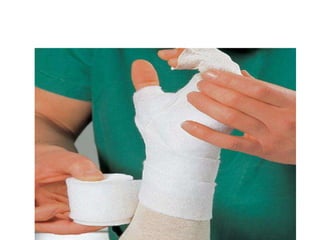
   Made by applying the turns of wet
    bandage directly to the skin without
    using any textile. (used by Böhler)

   For practical purposes, if stockinet is
    used the resulting plaster can still be
    regarded as an unpadded cast.
Unpadded Plaster

 The closeness of its application to the
  limb and actual adhesion to the skin, is
  believed to enhance fixation of a fracture.
 Considerably easier to learn than padded
  plaster technique.
 Bandage should never be pulled tight .
 Bandage should be made to roll itself
  round the limb.
Unpadded Plaster

 Should be applied by laying the wet roll
  of plaster on the skin and pushing it
  round the curves of limb with flat of
  hand.
 The roll of plaster should not be lifted off
  the limb and pulled.
Unpadded Plaster

   Recommonded in 3 condition by sir
    Charnley:
            1) Colles’ fracture
            2) scaphoid fracture
            3) Bennett’s fracture
Padded plaster cast

 A layer of cotton-wool is interposed
  between the skin and plaster, which is
  firmly compressed against the limb by
  applying wet plaster bandage under
  tension.
 The elastic pressure of the cotton
  enhances the fixation of limb by
  compensating for shrinkage in tissues .
Padded plaster cast

 When expertly applied, these plasters grip the
  limb more firmly and keep this grip for longer
  time than unpadded one.
 The care with which cotton is applied is
  essential for success. It must not obscure the
  shape of limb by being put on in careless and
  ugly lumps.
 The cotton if not rolled already, should be
  carefully prepared in rolls before application.
Padded plaster cast

 The roll of bandage remains in contact with
  surface of limb almost continuously.
 Bandage is pressed and pushed round the
  limb by the pressure of thenar eminence
  under a strong pushing force directed in
  length of surgeon’s forearm.
 Pressure is applied at the middle of width of
  bandage so that no excess of pressure can
  fall on either edge .
Padded plaster cast
 Each turn is applied slowly and is settled
  carefully in position.
 At tapering parts of the limb, the turns are
  made to lie evenly by small tucks which are
  made with quick movement of index finger of
  left hand.
 The durability of the cast depend on welding
  together of individual turns by smoothing
  movements of left hand.
 Each layer must be applied with equal
  deliberation.
Padded plaster cast
 The hall-mark of good plaster is that it
  should be of even thickness from end to
  end.
 Never apply two turns in the same place
  except at the ends.
 Have a progressive ‘backward and forward
  rhythm’ from top to bottom.
Triple sequence in Plaster
Application
 Phase 1: examination and rehearsal
 Phase 2: plastering
 Phase 3: reduction and holding
Examination and rehearsal
 Examination of the displacement and
  assessment of the forces required to reduce
  and hold the reduction.
 Need to assess
     •Effect of gravity on the displacement
     •Amount of force needed to correct the displacement
     •Range of excursion from the position of greatest
      deformity to the position of apparent reduction
Plastering

 Limb held by assistant in position of
  approximate reduction
 Surgeon himself should apply
 Quick application more important than
  holding precise reduction
 Plaster should still be completely soft
  after application to allow final touches
Reduction and holding

 After applying sufficient plaster, surgeon
  prepares to apply the rehearsed movement of
  reduction.
 Should be able to clearly recognise sensation
  of reduction.
 After applying rehearsed reduction, surgeon
  holds on, without further movement to allow
  the cast to set.
 In the last few minutes, he should obliterate
  any abrupt impression that might invite
  pressure sore.
Not to forget!!!

Check X Ray should be done after
    application of each cast to
   confirm the acceptability of
            reduction.
Errors in applying Padded Plasters

1.   Attempting to plaster at the same time as
     attempting to hold a precise reduction.
2.   Applying wool carelessly in shapeless
     lumps
3.   Loose bandaging
4.   Wellington boot effect
5.   Failing to recognise sensation of reduction
     through the plaster
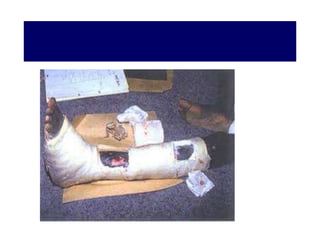
Windowed Plasters

Not usually encouraged
Danger of edematous tissue herniating
 through the window
Indicated in-
Compound fractures discharging copious
 pus
Compound fractures grafted with pinch
 graft or Thiersch graft
After care of POP

 Instructions to be given after applying POP:
1. Come immediately if any of following symptoms
   develops:
    A) Exessive pain,
    B) Exessive swelling,
    C) Bluish or white discolouration of fingers or toes
2. Keep the plaster cast dry.
3. Mobilize all the joints which are not incorporated in
   the plaster to their full range of motion once
   plaster becomes dry.
After care of POP


4. Notice any cracks in the plaster.

5. Graduated weight bearing for lower limb
  fractures.

6. Physiotherapy of muscles within the plaster
  and joints outside the plaster is necessary
  to ensure early rehabilitation.
Complications of POP
   Due to tight cast
     -pain

      -pressure sores

      -compartment syndromes

      -peripheral nerve injuries

      c/o unrelenting pain,stretch pain, swelling over
    fingers, inability to move fingers, hypoaesthesia
    and bluish discolouration of the digits.
Complications of POP

   Due to improper applications
     -joint stiffness
     -plaster blisters and sores
     -breakage

   Due to plaster allergy
     -allergic dermatitis
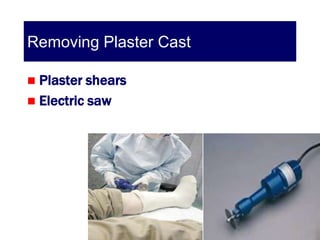
Removing Plaster Cast

 Plaster shears
 Electric saw
Thank You
References

 The Closed Treatment of Common
  Fractures by Sir John Charnley.
 Chapman’s orthopaedis surgery 3rd
  edition.
 Rockwood and Green’s Fracture in
  adults.
 Traction and Orthopaedic Appliances by
  Stewart.
 Essential orthopaedics by J. Maheshwari.
Plaster of Paris and Plaster Technique

  • 1.
    Plaster-of-Paris and Plaster Technique Ashish Tripathi ,Intern, Dept. of Orthopaedics, BPKIHS
  • 2.
    Contents:  Plaster-of-Paris: 1) Historical Background 2) Uses of POP 3) Types of Plaster Cast 4) Steps in Application of POP Cast 5) Common errors in Application of POP Cast 6) Complications of POP Cast 7) After Care
  • 3.
    Orthopaedic Uses ofCast 1) To support fractured bones, controlling movement of the fragments and resting the damaged tissues 2) To stabilise and rest joints in ligamentous injury 3) To support and immobilise joints and limbs post-operatively until healing has occurred 4) To correct a deformity 5) To ensure rest of infected tissues 6) To make a negative mould of a part of body.
  • 4.
    Materials available forcasting  Plaster-of-Paris  Plaster-of-Paris with melamine resins  Materials which undergo polymerisation: a. water activated b. non-water activated  Low-temperature thermoplastics
  • 5.
    PLASTER-OF-PARIS  The name POP is derived from an accident to a house built on a deposit of Gypsum, near Paris. The house burnt down. When rain fell on baked mud of the floors it was noted that footprints in mud set rock-hard.  Plaster-of-paris bandages were first used by Matthysen, a Dutch military surgeon in 1952.
  • 6.
     The POPbandage consists of a roll of muslin stiffened by dextrose or starch and impregnated with the hemihydrate of calcium sulfate.  When water is added, the calcium sulfate takes up its water of crystallization:  2 (CaSO₄. ½ H₂O) +3H₂O 2 (CaSO₄. 2H₂O ) + ∆
  • 7.
     Setting time:time taken to change from powder form to crystalline form.  Drying time: time taken to change from crystalline form to anhydrous form.  Average setting time: 3-9 minutes  Average drying time: 24-72 hours
  • 8.
    Factors decreasing setting time: 1) Hot water 2) Salt 3) Borax 4) Resin  Factors increasing setting time: 1)Cold water 2)sugar
  • 9.
    POP … variousforms  Slab: only a part of circumference of limb is incorporated.  Cast: encircle whole circumference of the limb.  Spica  Brace
  • 11.
    Advantages  Cost-effective  Non-allergic  Easily moulded to different forms Disadvantages: 1) Radio-opaque so may occlude # lines 2) Heavy 3) Easily breaks when comes in contact with water
  • 12.
    Rules of applicationof POP casts Padding: This is placed from distal to proximal with a 50% overlap, a minimum two layers, and extra padding at the fibular head, malleoli, patella, and olecranon. Plaster: Cold water will maximize the molding time. 8 inch width for thigh 6 inch width for leg 4 inch width for arm and forearm
  • 13.
    Rules of applicationof POP casts  8 inch for thigh,6 inch for leg and 4 inch for forearm.  One joint above and one joint below.  Moulded with palm and not with fingers to avoid indentation.  Joints should be immobilized in functional position.  Not too tight or too loose i.e. adequate padding  Dip pop vertically in water till air bubble ceases to come  Uniform thickness of plaster is preferred.
  • 14.
    Plaster Technique  Plastercasts can be divided into 3 types: 1) Badly padded plaster 2) Unpadded plaster 3) Padded plaster
  • 15.
    Badly padded plaster  It is loose on the limb and therefore cannot fix the fragments.
  • 16.
    Unpadded Plaster  Made by applying the turns of wet bandage directly to the skin without using any textile. (used by Böhler)  For practical purposes, if stockinet is used the resulting plaster can still be regarded as an unpadded cast.
  • 17.
    Unpadded Plaster  Thecloseness of its application to the limb and actual adhesion to the skin, is believed to enhance fixation of a fracture.  Considerably easier to learn than padded plaster technique.  Bandage should never be pulled tight .  Bandage should be made to roll itself round the limb.
  • 19.
    Unpadded Plaster  Shouldbe applied by laying the wet roll of plaster on the skin and pushing it round the curves of limb with flat of hand.  The roll of plaster should not be lifted off the limb and pulled.
  • 20.
    Unpadded Plaster  Recommonded in 3 condition by sir Charnley: 1) Colles’ fracture 2) scaphoid fracture 3) Bennett’s fracture
  • 21.
    Padded plaster cast A layer of cotton-wool is interposed between the skin and plaster, which is firmly compressed against the limb by applying wet plaster bandage under tension.  The elastic pressure of the cotton enhances the fixation of limb by compensating for shrinkage in tissues .
  • 22.
    Padded plaster cast When expertly applied, these plasters grip the limb more firmly and keep this grip for longer time than unpadded one.  The care with which cotton is applied is essential for success. It must not obscure the shape of limb by being put on in careless and ugly lumps.  The cotton if not rolled already, should be carefully prepared in rolls before application.
  • 23.
    Padded plaster cast The roll of bandage remains in contact with surface of limb almost continuously.  Bandage is pressed and pushed round the limb by the pressure of thenar eminence under a strong pushing force directed in length of surgeon’s forearm.  Pressure is applied at the middle of width of bandage so that no excess of pressure can fall on either edge .
  • 25.
    Padded plaster cast Each turn is applied slowly and is settled carefully in position.  At tapering parts of the limb, the turns are made to lie evenly by small tucks which are made with quick movement of index finger of left hand.  The durability of the cast depend on welding together of individual turns by smoothing movements of left hand.  Each layer must be applied with equal deliberation.
  • 26.
    Padded plaster cast The hall-mark of good plaster is that it should be of even thickness from end to end.  Never apply two turns in the same place except at the ends.  Have a progressive ‘backward and forward rhythm’ from top to bottom.
  • 27.
    Triple sequence inPlaster Application  Phase 1: examination and rehearsal  Phase 2: plastering  Phase 3: reduction and holding
  • 28.
    Examination and rehearsal Examination of the displacement and assessment of the forces required to reduce and hold the reduction.  Need to assess •Effect of gravity on the displacement •Amount of force needed to correct the displacement •Range of excursion from the position of greatest deformity to the position of apparent reduction
  • 29.
    Plastering  Limb heldby assistant in position of approximate reduction  Surgeon himself should apply  Quick application more important than holding precise reduction  Plaster should still be completely soft after application to allow final touches
  • 31.
    Reduction and holding After applying sufficient plaster, surgeon prepares to apply the rehearsed movement of reduction.  Should be able to clearly recognise sensation of reduction.  After applying rehearsed reduction, surgeon holds on, without further movement to allow the cast to set.  In the last few minutes, he should obliterate any abrupt impression that might invite pressure sore.
  • 32.
    Not to forget!!! CheckX Ray should be done after application of each cast to confirm the acceptability of reduction.
  • 33.
    Errors in applyingPadded Plasters 1. Attempting to plaster at the same time as attempting to hold a precise reduction. 2. Applying wool carelessly in shapeless lumps 3. Loose bandaging 4. Wellington boot effect 5. Failing to recognise sensation of reduction through the plaster
  • 34.
    Windowed Plasters Not usuallyencouraged Danger of edematous tissue herniating through the window Indicated in- Compound fractures discharging copious pus Compound fractures grafted with pinch graft or Thiersch graft
  • 36.
    After care ofPOP  Instructions to be given after applying POP: 1. Come immediately if any of following symptoms develops: A) Exessive pain, B) Exessive swelling, C) Bluish or white discolouration of fingers or toes 2. Keep the plaster cast dry. 3. Mobilize all the joints which are not incorporated in the plaster to their full range of motion once plaster becomes dry.
  • 37.
    After care ofPOP 4. Notice any cracks in the plaster. 5. Graduated weight bearing for lower limb fractures. 6. Physiotherapy of muscles within the plaster and joints outside the plaster is necessary to ensure early rehabilitation.
  • 38.
    Complications of POP  Due to tight cast -pain -pressure sores -compartment syndromes -peripheral nerve injuries c/o unrelenting pain,stretch pain, swelling over fingers, inability to move fingers, hypoaesthesia and bluish discolouration of the digits.
  • 39.
    Complications of POP  Due to improper applications -joint stiffness -plaster blisters and sores -breakage  Due to plaster allergy -allergic dermatitis
  • 40.
    Removing Plaster Cast Plaster shears  Electric saw
  • 41.
  • 42.
    References  The ClosedTreatment of Common Fractures by Sir John Charnley.  Chapman’s orthopaedis surgery 3rd edition.  Rockwood and Green’s Fracture in adults.  Traction and Orthopaedic Appliances by Stewart.  Essential orthopaedics by J. Maheshwari.