Dr. BHOSALE SUMIT
Junior Resident-1
Dept. of Orthopedics
Dr . PRAMOD SARKELWAD DR.DEEPAK AGRAWAL
ASSO. Professor and HOU PROF. and HOD
Dept. of Orthopaedics Dept. Of Orthopaedics
DUPMC & H DUPMC & H
PLASTERING – MATERIALS , TECHNIQUES
AND COMPLICATIONS
INTRODUCTION
POP – Plaster of Paris
 First applied in the treatment of fractures over 150 years ago
 Proven indispensable in the non-operative management of not only
musculoskeletal injuries but other ailments requiring immobilization
as well.
 Its use however isn’t without risk.
 Sound knowledge and properly-honed skills in its application and care
are necessary to maximize outcome.
 Casting properties of POP were first observed when a house
built on gypsum burnt down in Paris. It was found after rain
fall, that the footprints in the mud were caked upon
drying.
 First used in fracture care by Antonius Mathijsen, A Dutch
army surgeon in 1852.
PHYSIOCHEMICAL PROPERTIES OF
POP
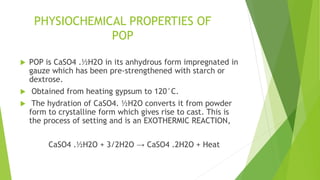
 POP is CaSO4 .½H2O in its anhydrous form impregnated in
gauze which has been pre-strengthened with starch or
dextrose.
 Obtained from heating gypsum to 120°C.
 The hydration of CaSO4. ½H2O converts it from powder
form to crystalline form which gives rise to cast. This is
the process of setting and is an EXOTHERMIC REACTION,
CaSO4 .½H2O + 3/2H2O → CaSO4 .2H2O + Heat
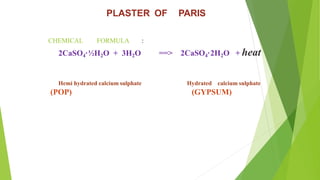
CHEMICAL FORMULA :
2CaSO4·½H2O + 3H2O ==> 2CaSO4·2H2O + heat
Hemi hydrated calcium sulphate
(POP)
Hydrated calcium sulphate
(GYPSUM)
PLASTER OF PARIS
Setting time : Time taken to change from powder form to
crystalline form.
Drying time : Time taken to change from crystalline form to
anhydrous form.
 Average setting time : 3-9 minutes.
 Average drying time : 24-72 hours.
Indications
 Fractures
 Ligament injuries
 Reduced dislocations
 Musculoskeletal infections
 Deformity correction
 Severe soft tissue injuries esp. across joints
 Post tendon repair
 Post-operatively to augment internal fixation
 Inflammatory conditions – arthritis, tenosynovitis
RULES GUIDING POP USE
 POP should be applied by the surgeon
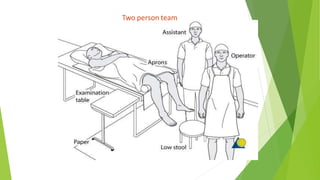
 Procedure requires an assistant
 A guide to appropriate size:
• Arm & forearm – 4”
• Wrist – 4”
• Thigh & leg – 8”
• Ankle & foot – 6”
RULES GUIDING POP USE
 Apply POP one joint above and below
 Joint should be immobilized in functional position
 Padding should be adequate esp. over bony prominences
e.g. olecranon, ulnar styloid, patella, fibular head,
malleoli, heel.
 POP shouldn’t be too tight or too loose
 The plaster should be of uniform thickness throughout
 Check neurovascular status after cast application
 Do check x-ray for acceptability of reduction
Two person team
TECHNIQUE
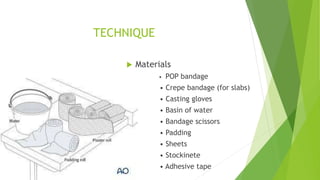
 Materials
• POP bandage
• Crepe bandage (for slabs)
• Casting gloves
• Basin of water
• Bandage scissors
• Padding
• Sheets
• Stockinete
• Adhesive tape
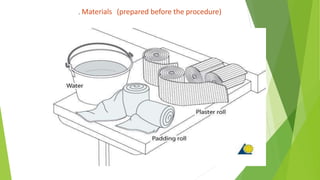
. Materials (prepared before the procedure)
TECHNIQUE
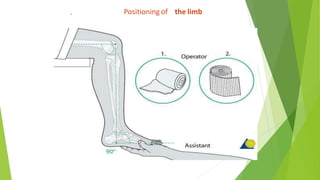
 Prepare injured site
• Fracture is reduced and assistant holds limb in
position of function, in a manner that is unobtrusive to the
application of cast
• Stockinete is measured, extending 10cm beyond
determined limits of cast, and threaded over limb.
. Positioning of the limb
TECHNIQUE
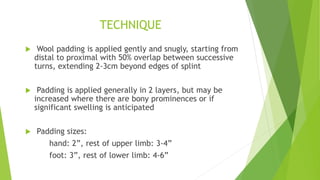
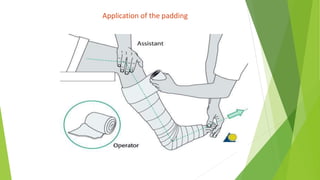
 Wool padding is applied gently and snugly, starting from
distal to proximal with 50% overlap between successive
turns, extending 2-3cm beyond edges of splint
 Padding is applied generally in 2 layers, but may be
increased where there are bony prominences or if
significant swelling is anticipated
 Padding sizes:
hand: 2”, rest of upper limb: 3-4”
foot: 3”, rest of lower limb: 4-6”
Application of the padding
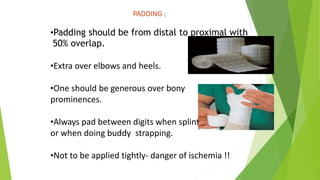
PADDING :
•Padding should be from distal to proximal with
50% overlap.
•Extra over elbows and heels.
•One should be generous over bony
prominences.
•Always pad between digits when splinting hands/ feet
or when doing buddy strapping.
•Not to be applied tightly- danger of ischemia !!
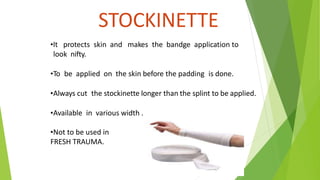
STOCKINETTE
•It protects skin and makes the bandge application to
look nifty.
•To be applied on the skin before the padding is done.
•Always cut the stockinette longer than the splint to be applied.
•Available in various width .
•Not to be used in
FRESH TRAUMA.
POP APPLICATION
 POP to be used is dipped completely with both hands into tepid
or slightly warm water and held there till bubbling stops
 Prior to this, for slabs, the required length is measured and
layered.
 It is then brought out and lightly squeezed to get rid of excess
water
 If a slab is to be created, the wet plaster is kept on flat surface
and the hand is run from one end to another to get rid of air
bubbles which may cause slab to be brittle and the layers to
separate when dry.
 12-14 layers for upper limb and 14-16 layers for lower limb
would suffice
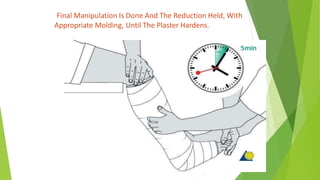
Final Manipulation Is Done And The Reduction Held, With
Appropriate Molding, Until The Plaster Hardens.
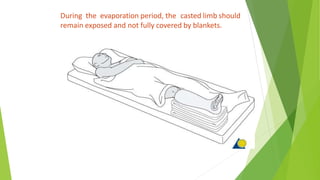
During the evaporation period, the casted limb should
remain exposed and not fully covered by blankets.
 For slabs
• POP slab is applied and molded onto the limb contours
• Molding is only with palms
• Stockinette & padding are rolled over the edge of slab and
crepe bandage is applied from distal to proximal
• Slabs may be used alone or to reinforce casts
 For cast
• POP is applied in distal to proximal with 50% overlap
• POP is applied snugly, compressing padding thickness by 50%
• The padding is rolled over and the final turns of POP are
rolled over it
AN IDEAL CAST
 Suitable for direct application
 Easy to mould
 Non toxic
 Unaffected by water
 Transparent to x-rays
 Quick setting
 Able to transmit air
 Strong but light weight
 Non-inflammable
 Non-messy
 Long shelf life
 Cheap
CLASSIFICATION
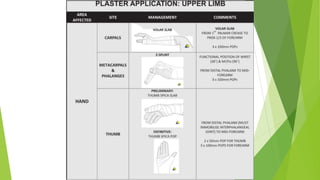
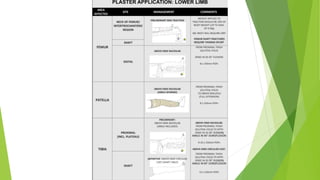
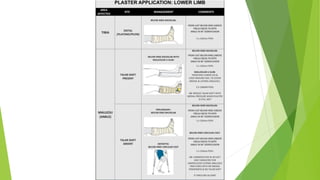
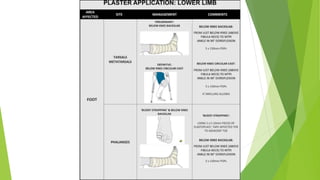
 Based on pattern of application:
• Slab: POP encloses partial circumference
• Cast: POP encloses full circumference
• Spica: Bandage that is applied in successive V-shaped
crossings, includes trunk and one or more limbs
(Hip spica)
• Brace: Splintage which can allow motion at adjacent
joints
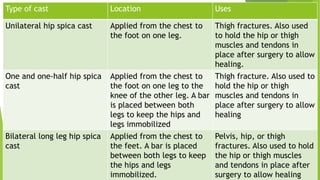
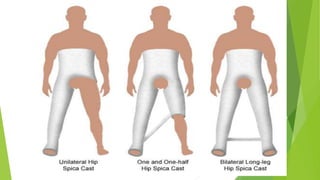
Type of cast Location Uses
Unilateral hip spica cast Applied from the chest to
the foot on one leg.
Thigh fractures. Also used
to hold the hip or thigh
muscles and tendons in
place after surgery to allow
healing.
One and one-half hip spica
cast
Applied from the chest to
the foot on one leg to the
knee of the other leg. A bar
is placed between both
legs to keep the hips and
legs immobilized
Thigh fracture. Also used to
hold the hip or thigh
muscles and tendons in
place after surgery to allow
healing
Bilateral long leg hip spica
cast
Applied from the chest to
the feet. A bar is placed
between both legs to keep
the hips and legs
immobilized.
Pelvis, hip, or thigh
fractures. Also used to hold
the hip or thigh muscles
and tendons in place after
surgery to allow healing
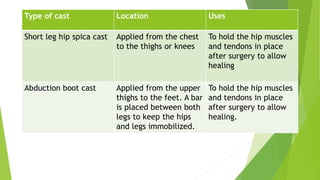
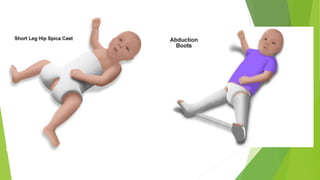
Type of cast Location Uses
Short leg hip spica cast Applied from the chest
to the thighs or knees
To hold the hip muscles
and tendons in place
after surgery to allow
healing
Abduction boot cast Applied from the upper
thighs to the feet. A bar
is placed between both
legs to keep the hips
and legs immobilized.
To hold the hip muscles
and tendons in place
after surgery to allow
healing.
POP PRECAUTIONS
 Where swelling is anticipated use a slab instead of cast, if
a cast must be used then it should be well-padded
 POP applied postoperatively may have to be split as
swelling may be significant (e.g post-tourniquet release,
inflammatory edema)
POP REMOVAL
 Slabs are removed by cutting the bandage, carefully avoiding nicking
the skin
 For casts
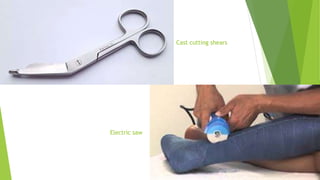
– Using shears
» Heel of the shears must lie between plaster and skin, avoiding bony
prominences
» Avoid cutting over concavities
» The route of the shears should lie over compressible soft tissue
» The lower handle should be parallel to the plaster
– Using electric saw
» Do not use unless there’s wool padding
» Do not use over bony prominences
» The cutting mov’t should be up and down not lateral
» Do not use blade if bent, broken or blunt
Cast cutting shears
Electric saw
AFTERCARE
 Following POP application, check neurovascular status and check
reduction by x-rays.
 Counsel the patient on signs of neurovascular compromise – excessive
pain, excessive swelling, bluish or whitish discoloration of digits
 Reinforce all cracks and weak areas with more POP locally
 Limb elevation reduces swelling, pain and risk of too tight cast
 Check if the POP is restricting movement
 Ensure that all joints not immobilized by cast have full range of
motion
 Any area of localized pain should be windowed as it may be a
developing pressure sore
 The patient should be reviewed in 1 – 2 weeks and x-rays done to
reaffirm maintenance of reduction
CAST CARE INSTRUCTIONS
 Keep the cast clean & dry
 Routinely check the cast for cracks or breaks
 Do not scratch the skin under the cast by inserting objects
inside the cast
 Do not put powder or lotion inside the cast
 Encourage the patient to move his fingers or toes to
promote circulation
 In case of itching, apply ice packs or place hair dryer (cool
air) against one end to draw air in through it
 Any area of localized pain should be windowed as it may
be a developing pressure sore
WHEN TO COME BACK TO HOSPITAL
 Cast is too tight
 Develops fever
 Increased pain
 Increased swelling above or below the cast
 Complaints of numbness or tingling
 Drainage or foul odour from the cast
 Cold fingers/toes
 Cant move fingers/toes
COMPLICATIONS OF POP
Due to tight cast
•Pain
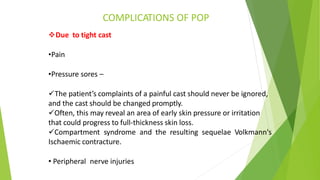
•Pressure sores –
The patient’s complaints of a painful cast should never be ignored,
and the cast should be changed promptly.
Often, this may reveal an area of early skin pressure or irritation
that could progress to full-thickness skin loss.
Compartment syndrome and the resulting sequelae Volkmann's
Ischaemic contracture.
• Peripheral nerve injuries
 Due to improper applications :
• Joint stiffness and malposition of limb.
• Plaster blisters and sores.
 Due to plaster allergy :
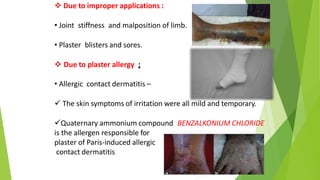
• Allergic contact dermatitis –
 The skin symptoms of irritation were all mild and temporary.
Quaternary ammonium compound BENZALKONIUM CHLORIDE
is the allergen responsible for
plaster of Paris-induced allergic
contact dermatitis
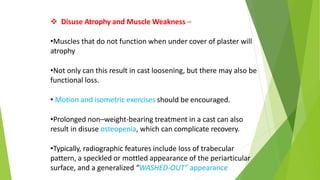
 Disuse Atrophy and Muscle Weakness –
•Muscles that do not function when under cover of plaster will
atrophy
•Not only can this result in cast loosening, but there may also be
functional loss.
• Motion and isometric exercises should be encouraged.
•Prolonged non–weight-bearing treatment in a cast can also
result in disuse osteopenia, which can complicate recovery.
•Typically, radiographic features include loss of trabecular
pattern, a speckled or mottled appearance of the periarticular
surface, and a generalized “WASHED-OUT” appearance
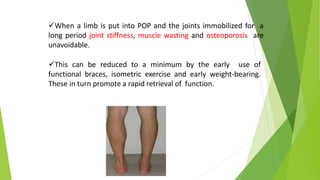
When a limb is put into POP and the joints immobilized for a
long period joint stiffness, muscle wasting and osteoporosis are
unavoidable.
This can be reduced to a minimum by the early use of
functional braces, isometric exercise and early weight-bearing.
These in turn promote a rapid retrieval of function.
 FRACTURE DISEASE :
•A constellation of symptoms and physical changes has been
called “fracture disease.”
• Prolonged immobilization, especially in a nonfunctional cast, can
lead to a vicious cycle of pain, swelling, and unresolved edema.
•Edema fluid is a proteinaceous exudate that will congeal and
gets converted to a gelatinous material and deposited as a scar
tissue around joints and tendons causing joint stiffness,
contracture and tendon adhesions.
• Muscle atrophy, brawny skin /induration, and osteoporosis
follow
•Reflex sympathetic dystrophy may sometimes occur and
further complicate the picture
PLASTER DISEASE
 When a limb is put into plaster and the joints are
immobilized for a long period of time, joint stiffness,
muscle wasting and osteoporosis are unavoidable.
 This syndrome can be reduced to a minimum by the early
use of functional braces, isometric exercises and early
weight bearing, which in turn promote early retrieval of
function.
CAST SYNDROME :
•Cast syndrome is a rare complication that is seen related to hip spica cast
•The syndrome occurs due to arteriomesenteric duodenal obstruction, and it is a
result of excessive abdomen and chest coverage.
• Symptoms are severe, and if left untreated, can be potentially lethal.
•Compression of the third part of the duodenum between the lumbar spine
and the aorta posteriorly and the mesentry and vessels anteriorly.
• This syndrome is precipitated by recumbency and increased lumbar lordosis.
•Avoiding constrictive body casts that increase lumbar lordosis prevents cast
syndrome.
• Nausea, epigastric fullness, and regurgitation should be carefully evaluated.
CONTRAINDICATIONS
 Open fractures
 Impending compartment syndrome
 Neurovascular compromise
 Reflex sympathetic dystrophy
 Skin infection or ulcers
 Swelling of the limb
 Allergy to cast material
 Comminuted fractures
ALTERNATIVES TO POP
 POP with melamine resin
 Fiber glass
FIBER GLASS CAST
 A plaster made from reinforced polymer of a plastic
matrix reinforced by fine fiber of glass.
 Also called Glass-reinforced plastic (GRP) or Glass fiber
reinforced plastic (GFRP)
 Fiberglass bandages are usually impregnated with
polyurethane
 Mostly used in those cases where healing process has
already begun
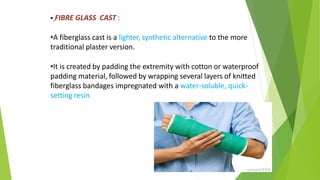
 FIBRE GLASS CAST :
•A fiberglass cast is a lighter, synthetic alternative to the more
traditional plaster version.
•It is created by padding the extremity with cotton or waterproof
padding material, followed by wrapping several layers of knitted
fiberglass bandages impregnated with a water-soluble, quick-
setting resin
Advantages :
•Short setting time
•Immediate weight bearing
•Strong but weighs light
• Radiolucent
•Water resistance
•Wicks moisture better.
Disadvantages :
• High cost
• Can’t be applied over wet wounds or immediately after trauma
• Difficult to remove
• Leaves sharp edges
• Less mouldable
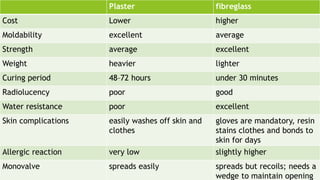
Plaster fibreglass
Cost Lower higher
Moldability excellent average
Strength average excellent
Weight heavier lighter
Curing period 48–72 hours under 30 minutes
Radiolucency poor good
Water resistance poor excellent
Skin complications easily washes off skin and
clothes
gloves are mandatory, resin
stains clothes and bonds to
skin for days
Allergic reaction very low slightly higher
Monovalve spreads easily spreads but recoils; needs a
wedge to maintain opening
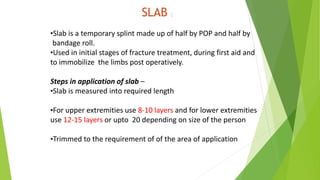
SLAB :
•Slab is a temporary splint made up of half by POP and half by
bandage roll.
•Used in initial stages of fracture treatment, during first aid and
to immobilize the limbs post operatively.
Steps in application of slab –
•Slab is measured into required length
•For upper extremities use 8-10 layers and for lower extremities
use 12-15 layers or upto 20 depending on size of the person
•Trimmed to the requirement of of the area of application
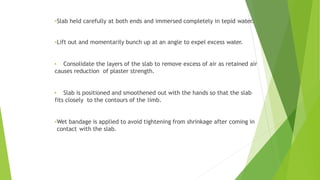
•Slab held carefully at both ends and immersed completely in tepid water.
•Lift out and momentarily bunch up at an angle to expel excess water.
• Consolidate the layers of the slab to remove excess of air as retained air
causes reduction of plaster strength.
• Slab is positioned and smoothened out with the hands so that the slab
fits closely to the contours of the limb.
•Wet bandage is applied to avoid tightening from shrinkage after coming in
contact with the slab.
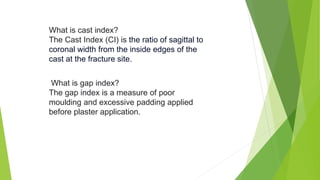
What is cast index?
The Cast Index (CI) is the ratio of sagittal to
coronal width from the inside edges of the
cast at the fracture site.
What is gap index?
The gap index is a measure of poor
moulding and excessive padding applied
before plaster application.
REFERENCES
• Campbell’s Operative Orthopedics
• Stewart –Traction and Orthopedic Appliances
• Bedside clinics in orthopedics-Upendra Kumar
THANK YOU

POP-MATERIALS,TECHNIQUES AND COMPLICATIONS.pptx

  • 1.
    Dr. BHOSALE SUMIT JuniorResident-1 Dept. of Orthopedics Dr . PRAMOD SARKELWAD DR.DEEPAK AGRAWAL ASSO. Professor and HOU PROF. and HOD Dept. of Orthopaedics Dept. Of Orthopaedics DUPMC & H DUPMC & H
  • 2.
    PLASTERING – MATERIALS, TECHNIQUES AND COMPLICATIONS
  • 3.
    INTRODUCTION POP – Plasterof Paris  First applied in the treatment of fractures over 150 years ago  Proven indispensable in the non-operative management of not only musculoskeletal injuries but other ailments requiring immobilization as well.  Its use however isn’t without risk.  Sound knowledge and properly-honed skills in its application and care are necessary to maximize outcome.
  • 4.
     Casting propertiesof POP were first observed when a house built on gypsum burnt down in Paris. It was found after rain fall, that the footprints in the mud were caked upon drying.  First used in fracture care by Antonius Mathijsen, A Dutch army surgeon in 1852.
  • 5.
    PHYSIOCHEMICAL PROPERTIES OF POP POP is CaSO4 .½H2O in its anhydrous form impregnated in gauze which has been pre-strengthened with starch or dextrose.  Obtained from heating gypsum to 120°C.  The hydration of CaSO4. ½H2O converts it from powder form to crystalline form which gives rise to cast. This is the process of setting and is an EXOTHERMIC REACTION, CaSO4 .½H2O + 3/2H2O → CaSO4 .2H2O + Heat
  • 6.
    CHEMICAL FORMULA : 2CaSO4·½H2O+ 3H2O ==> 2CaSO4·2H2O + heat Hemi hydrated calcium sulphate (POP) Hydrated calcium sulphate (GYPSUM) PLASTER OF PARIS
  • 7.
    Setting time :Time taken to change from powder form to crystalline form. Drying time : Time taken to change from crystalline form to anhydrous form.  Average setting time : 3-9 minutes.  Average drying time : 24-72 hours.
  • 8.
    Indications  Fractures  Ligamentinjuries  Reduced dislocations  Musculoskeletal infections  Deformity correction  Severe soft tissue injuries esp. across joints  Post tendon repair  Post-operatively to augment internal fixation  Inflammatory conditions – arthritis, tenosynovitis
  • 9.
    RULES GUIDING POPUSE  POP should be applied by the surgeon  Procedure requires an assistant  A guide to appropriate size: • Arm & forearm – 4” • Wrist – 4” • Thigh & leg – 8” • Ankle & foot – 6”
  • 10.
    RULES GUIDING POPUSE  Apply POP one joint above and below  Joint should be immobilized in functional position  Padding should be adequate esp. over bony prominences e.g. olecranon, ulnar styloid, patella, fibular head, malleoli, heel.  POP shouldn’t be too tight or too loose  The plaster should be of uniform thickness throughout  Check neurovascular status after cast application  Do check x-ray for acceptability of reduction
  • 11.
  • 12.
    TECHNIQUE  Materials • POPbandage • Crepe bandage (for slabs) • Casting gloves • Basin of water • Bandage scissors • Padding • Sheets • Stockinete • Adhesive tape
  • 13.
    . Materials (preparedbefore the procedure)
  • 14.
    TECHNIQUE  Prepare injuredsite • Fracture is reduced and assistant holds limb in position of function, in a manner that is unobtrusive to the application of cast • Stockinete is measured, extending 10cm beyond determined limits of cast, and threaded over limb.
  • 15.
  • 16.
    TECHNIQUE  Wool paddingis applied gently and snugly, starting from distal to proximal with 50% overlap between successive turns, extending 2-3cm beyond edges of splint  Padding is applied generally in 2 layers, but may be increased where there are bony prominences or if significant swelling is anticipated  Padding sizes: hand: 2”, rest of upper limb: 3-4” foot: 3”, rest of lower limb: 4-6”
  • 17.
  • 18.
    PADDING : •Padding shouldbe from distal to proximal with 50% overlap. •Extra over elbows and heels. •One should be generous over bony prominences. •Always pad between digits when splinting hands/ feet or when doing buddy strapping. •Not to be applied tightly- danger of ischemia !!
  • 19.
    STOCKINETTE •It protects skinand makes the bandge application to look nifty. •To be applied on the skin before the padding is done. •Always cut the stockinette longer than the splint to be applied. •Available in various width . •Not to be used in FRESH TRAUMA.
  • 20.
    POP APPLICATION  POPto be used is dipped completely with both hands into tepid or slightly warm water and held there till bubbling stops  Prior to this, for slabs, the required length is measured and layered.  It is then brought out and lightly squeezed to get rid of excess water  If a slab is to be created, the wet plaster is kept on flat surface and the hand is run from one end to another to get rid of air bubbles which may cause slab to be brittle and the layers to separate when dry.  12-14 layers for upper limb and 14-16 layers for lower limb would suffice
  • 21.
    Final Manipulation IsDone And The Reduction Held, With Appropriate Molding, Until The Plaster Hardens.
  • 22.
    During the evaporationperiod, the casted limb should remain exposed and not fully covered by blankets.
  • 23.
     For slabs •POP slab is applied and molded onto the limb contours • Molding is only with palms • Stockinette & padding are rolled over the edge of slab and crepe bandage is applied from distal to proximal • Slabs may be used alone or to reinforce casts  For cast • POP is applied in distal to proximal with 50% overlap • POP is applied snugly, compressing padding thickness by 50% • The padding is rolled over and the final turns of POP are rolled over it
  • 24.
    AN IDEAL CAST Suitable for direct application  Easy to mould  Non toxic  Unaffected by water  Transparent to x-rays  Quick setting  Able to transmit air  Strong but light weight  Non-inflammable  Non-messy  Long shelf life  Cheap
  • 25.
    CLASSIFICATION  Based onpattern of application: • Slab: POP encloses partial circumference • Cast: POP encloses full circumference • Spica: Bandage that is applied in successive V-shaped crossings, includes trunk and one or more limbs (Hip spica) • Brace: Splintage which can allow motion at adjacent joints
  • 31.
    Type of castLocation Uses Unilateral hip spica cast Applied from the chest to the foot on one leg. Thigh fractures. Also used to hold the hip or thigh muscles and tendons in place after surgery to allow healing. One and one-half hip spica cast Applied from the chest to the foot on one leg to the knee of the other leg. A bar is placed between both legs to keep the hips and legs immobilized Thigh fracture. Also used to hold the hip or thigh muscles and tendons in place after surgery to allow healing Bilateral long leg hip spica cast Applied from the chest to the feet. A bar is placed between both legs to keep the hips and legs immobilized. Pelvis, hip, or thigh fractures. Also used to hold the hip or thigh muscles and tendons in place after surgery to allow healing
  • 33.
    Type of castLocation Uses Short leg hip spica cast Applied from the chest to the thighs or knees To hold the hip muscles and tendons in place after surgery to allow healing Abduction boot cast Applied from the upper thighs to the feet. A bar is placed between both legs to keep the hips and legs immobilized. To hold the hip muscles and tendons in place after surgery to allow healing.
  • 35.
    POP PRECAUTIONS  Whereswelling is anticipated use a slab instead of cast, if a cast must be used then it should be well-padded  POP applied postoperatively may have to be split as swelling may be significant (e.g post-tourniquet release, inflammatory edema)
  • 36.
    POP REMOVAL  Slabsare removed by cutting the bandage, carefully avoiding nicking the skin  For casts – Using shears » Heel of the shears must lie between plaster and skin, avoiding bony prominences » Avoid cutting over concavities » The route of the shears should lie over compressible soft tissue » The lower handle should be parallel to the plaster – Using electric saw » Do not use unless there’s wool padding » Do not use over bony prominences » The cutting mov’t should be up and down not lateral » Do not use blade if bent, broken or blunt
  • 37.
  • 38.
    AFTERCARE  Following POPapplication, check neurovascular status and check reduction by x-rays.  Counsel the patient on signs of neurovascular compromise – excessive pain, excessive swelling, bluish or whitish discoloration of digits  Reinforce all cracks and weak areas with more POP locally  Limb elevation reduces swelling, pain and risk of too tight cast  Check if the POP is restricting movement  Ensure that all joints not immobilized by cast have full range of motion  Any area of localized pain should be windowed as it may be a developing pressure sore  The patient should be reviewed in 1 – 2 weeks and x-rays done to reaffirm maintenance of reduction
  • 39.
    CAST CARE INSTRUCTIONS Keep the cast clean & dry  Routinely check the cast for cracks or breaks  Do not scratch the skin under the cast by inserting objects inside the cast  Do not put powder or lotion inside the cast  Encourage the patient to move his fingers or toes to promote circulation  In case of itching, apply ice packs or place hair dryer (cool air) against one end to draw air in through it  Any area of localized pain should be windowed as it may be a developing pressure sore
  • 40.
    WHEN TO COMEBACK TO HOSPITAL  Cast is too tight  Develops fever  Increased pain  Increased swelling above or below the cast  Complaints of numbness or tingling  Drainage or foul odour from the cast  Cold fingers/toes  Cant move fingers/toes
  • 41.
    COMPLICATIONS OF POP Dueto tight cast •Pain •Pressure sores – The patient’s complaints of a painful cast should never be ignored, and the cast should be changed promptly. Often, this may reveal an area of early skin pressure or irritation that could progress to full-thickness skin loss. Compartment syndrome and the resulting sequelae Volkmann's Ischaemic contracture. • Peripheral nerve injuries
  • 42.
     Due toimproper applications : • Joint stiffness and malposition of limb. • Plaster blisters and sores.  Due to plaster allergy : • Allergic contact dermatitis –  The skin symptoms of irritation were all mild and temporary. Quaternary ammonium compound BENZALKONIUM CHLORIDE is the allergen responsible for plaster of Paris-induced allergic contact dermatitis
  • 43.
     Disuse Atrophyand Muscle Weakness – •Muscles that do not function when under cover of plaster will atrophy •Not only can this result in cast loosening, but there may also be functional loss. • Motion and isometric exercises should be encouraged. •Prolonged non–weight-bearing treatment in a cast can also result in disuse osteopenia, which can complicate recovery. •Typically, radiographic features include loss of trabecular pattern, a speckled or mottled appearance of the periarticular surface, and a generalized “WASHED-OUT” appearance
  • 44.
    When a limbis put into POP and the joints immobilized for a long period joint stiffness, muscle wasting and osteoporosis are unavoidable. This can be reduced to a minimum by the early use of functional braces, isometric exercise and early weight-bearing. These in turn promote a rapid retrieval of function.
  • 45.
     FRACTURE DISEASE: •A constellation of symptoms and physical changes has been called “fracture disease.” • Prolonged immobilization, especially in a nonfunctional cast, can lead to a vicious cycle of pain, swelling, and unresolved edema. •Edema fluid is a proteinaceous exudate that will congeal and gets converted to a gelatinous material and deposited as a scar tissue around joints and tendons causing joint stiffness, contracture and tendon adhesions. • Muscle atrophy, brawny skin /induration, and osteoporosis follow •Reflex sympathetic dystrophy may sometimes occur and further complicate the picture
  • 46.
    PLASTER DISEASE  Whena limb is put into plaster and the joints are immobilized for a long period of time, joint stiffness, muscle wasting and osteoporosis are unavoidable.  This syndrome can be reduced to a minimum by the early use of functional braces, isometric exercises and early weight bearing, which in turn promote early retrieval of function.
  • 47.
    CAST SYNDROME : •Castsyndrome is a rare complication that is seen related to hip spica cast •The syndrome occurs due to arteriomesenteric duodenal obstruction, and it is a result of excessive abdomen and chest coverage. • Symptoms are severe, and if left untreated, can be potentially lethal. •Compression of the third part of the duodenum between the lumbar spine and the aorta posteriorly and the mesentry and vessels anteriorly. • This syndrome is precipitated by recumbency and increased lumbar lordosis. •Avoiding constrictive body casts that increase lumbar lordosis prevents cast syndrome. • Nausea, epigastric fullness, and regurgitation should be carefully evaluated.
  • 48.
    CONTRAINDICATIONS  Open fractures Impending compartment syndrome  Neurovascular compromise  Reflex sympathetic dystrophy  Skin infection or ulcers  Swelling of the limb  Allergy to cast material  Comminuted fractures
  • 49.
    ALTERNATIVES TO POP POP with melamine resin  Fiber glass
  • 50.
    FIBER GLASS CAST A plaster made from reinforced polymer of a plastic matrix reinforced by fine fiber of glass.  Also called Glass-reinforced plastic (GRP) or Glass fiber reinforced plastic (GFRP)  Fiberglass bandages are usually impregnated with polyurethane  Mostly used in those cases where healing process has already begun
  • 51.
     FIBRE GLASSCAST : •A fiberglass cast is a lighter, synthetic alternative to the more traditional plaster version. •It is created by padding the extremity with cotton or waterproof padding material, followed by wrapping several layers of knitted fiberglass bandages impregnated with a water-soluble, quick- setting resin
  • 52.
    Advantages : •Short settingtime •Immediate weight bearing •Strong but weighs light • Radiolucent •Water resistance •Wicks moisture better. Disadvantages : • High cost • Can’t be applied over wet wounds or immediately after trauma • Difficult to remove • Leaves sharp edges • Less mouldable
  • 53.
    Plaster fibreglass Cost Lowerhigher Moldability excellent average Strength average excellent Weight heavier lighter Curing period 48–72 hours under 30 minutes Radiolucency poor good Water resistance poor excellent Skin complications easily washes off skin and clothes gloves are mandatory, resin stains clothes and bonds to skin for days Allergic reaction very low slightly higher Monovalve spreads easily spreads but recoils; needs a wedge to maintain opening
  • 54.
    SLAB : •Slab isa temporary splint made up of half by POP and half by bandage roll. •Used in initial stages of fracture treatment, during first aid and to immobilize the limbs post operatively. Steps in application of slab – •Slab is measured into required length •For upper extremities use 8-10 layers and for lower extremities use 12-15 layers or upto 20 depending on size of the person •Trimmed to the requirement of of the area of application
  • 55.
    •Slab held carefullyat both ends and immersed completely in tepid water. •Lift out and momentarily bunch up at an angle to expel excess water. • Consolidate the layers of the slab to remove excess of air as retained air causes reduction of plaster strength. • Slab is positioned and smoothened out with the hands so that the slab fits closely to the contours of the limb. •Wet bandage is applied to avoid tightening from shrinkage after coming in contact with the slab.
  • 56.
    What is castindex? The Cast Index (CI) is the ratio of sagittal to coronal width from the inside edges of the cast at the fracture site. What is gap index? The gap index is a measure of poor moulding and excessive padding applied before plaster application.
  • 57.
    REFERENCES • Campbell’s OperativeOrthopedics • Stewart –Traction and Orthopedic Appliances • Bedside clinics in orthopedics-Upendra Kumar
  • 58.