OVERVIEW ON CSF
PREPARED
BY
Mai Ghazy AL- Sarraj
Lumbar puncture indications:
• Suspicion of meningitis
• Suspicion of subarachnoid haemorrhage (SAH)
• Suspicion of central nervous system (CNS)
diseases such as Guillain-Barré syndrome
• Therapeutic relief of pseudotumor cerebri
Contraindications of LP
1. elevated ICP owing to a suspected mass lesion of the
brain or spinal cord
2. symptoms and signs of pending cerebral herniation in a
child with probable meningitis symptoms and signs include
decerebrate or decorticate posture, a generalized tonic seizure, and
abnormalities of pupil size and reaction, with absence of the oculocephalic
response and fixed oculomotor deviation of the eyes. Pending herniation is
also associated with respiratory abnormalities, including hyperventilation,
Cheyne-Stokes respiration, ataxic breathing, apnea, and respiratory arrest,(
3. critical illness (on rare occasions)
4. skin infection at the site of the LP
5. thrombocytopenia.
Indications for performing brain CT
scanning before lumbar puncture
• in patients with suspected meningitis include the following[8] :
immunocompromised
with known CNS lesions
had a seizure within 1 week
abnormal level of consciousness
patients with focal findings on neurologic examination
papilledema &suspicion of an elevated ICP
• Cranial CT scanning should be obtained before lumbar puncture in
all patients with suspected SAH in order to diagnose obvious
intracranial bleeding or any significant intracranial mass effect that
might be present in awake and alert SAH patients with a normal
neurologic examination
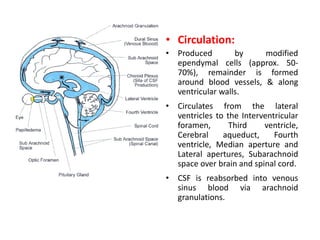
• Circulation:
• Produced by modified
ependymal cells (approx. 50-
70%), remainder is formed
around blood vessels, & along
ventricular walls.
• Circulates from the lateral
ventricles to the Interventricular
foramen, Third ventricle,
Cerebral aqueduct, Fourth
ventricle, Median aperture and
Lateral apertures, Subarachnoid
space over brain and spinal cord.
• CSF is reabsorbed into venous
sinus blood via arachnoid
granulations.
Amount of csf :
•The CSF is produced at a rate of 500 ml/day.
•The brain can contain only 135 to 150 ml
•The CSF turn over is about 3.7 times a day.
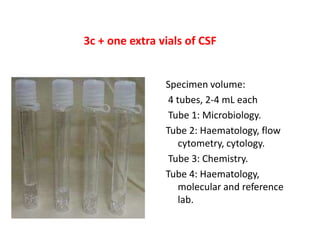
3c + one extra vials of CSF
Specimen volume:
4 tubes, 2-4 mL each
Tube 1: Microbiology.
Tube 2: Haematology, flow
cytometry, cytology.
Tube 3: Chemistry.
Tube 4: Haematology,
molecular and reference
lab.
The reference range for cerebrospinal fluid
analysis
• Opening pressure : 40-80 mm H2 O (with patient lying in lateral position)
• Appearance and color : Clear, colorless
• Blood cell count and differential –
• White blood cells: < 5 (all mononuclear) neonates up to 15
• PMN always abnormal ……………………….. Neonate 1-2
• Red blood cells: 0
• Cancerous cells - None
• Chloride - 110-125 mEq/L
• Glucose : greater than two-thirds of blood glucose)
• pH - 7.28-7.32
• Total protein - 10-40 mg/dL..................... In neonates up to 120 & falls at age
of 3 month
•
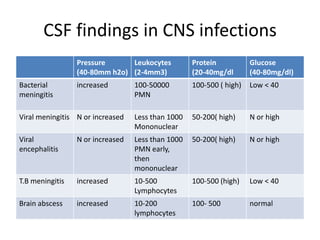
CSF findings in CNS infections
Pressure
(40-80mm h2o)
Leukocytes
(2-4mm3)
Protein
(20-40mg/dl
Glucose
(40-80mg/dl)
Bacterial
meningitis
increased 100-50000
PMN
100-500 ( high) Low < 40
Viral meningitis N or increased Less than 1000
Mononuclear
50-200( high) N or high
Viral
encephalitis
N or increased Less than 1000
PMN early,
then
mononuclear
50-200( high) N or high
T.B meningitis increased 10-500
Lymphocytes
100-500 (high) Low < 40
Brain abscess increased 10-200
lymphocytes
100- 500 normal
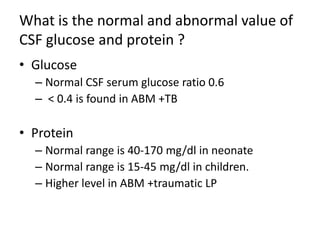
What is the normal and abnormal value of
CSF glucose and protein ?
• Glucose
– Normal CSF serum glucose ratio 0.6
– < 0.4 is found in ABM +TB
• Protein
– Normal range is 40-170 mg/dl in neonate
– Normal range is 15-45 mg/dl in children.
– Higher level in ABM +traumatic LP
• http://www.fpnotebook.com/neuro/lab/Crbrs
pnlFldExmntn.htm
• http://www.rch.org.au/clinicalguide/guideline
_index/CSF_Interpretation/
• http://www.osceskills.com/e-
learning/subjects/cerebrospinal-fluid-results-
interpretation/
• http://emedicine.medscape.com/article/2093
316-overview
Thank you

Csf

  • 1.
  • 2.
    Lumbar puncture indications: •Suspicion of meningitis • Suspicion of subarachnoid haemorrhage (SAH) • Suspicion of central nervous system (CNS) diseases such as Guillain-Barré syndrome • Therapeutic relief of pseudotumor cerebri
  • 3.
    Contraindications of LP 1.elevated ICP owing to a suspected mass lesion of the brain or spinal cord 2. symptoms and signs of pending cerebral herniation in a child with probable meningitis symptoms and signs include decerebrate or decorticate posture, a generalized tonic seizure, and abnormalities of pupil size and reaction, with absence of the oculocephalic response and fixed oculomotor deviation of the eyes. Pending herniation is also associated with respiratory abnormalities, including hyperventilation, Cheyne-Stokes respiration, ataxic breathing, apnea, and respiratory arrest,( 3. critical illness (on rare occasions) 4. skin infection at the site of the LP 5. thrombocytopenia.
  • 4.
    Indications for performingbrain CT scanning before lumbar puncture • in patients with suspected meningitis include the following[8] : immunocompromised with known CNS lesions had a seizure within 1 week abnormal level of consciousness patients with focal findings on neurologic examination papilledema &suspicion of an elevated ICP • Cranial CT scanning should be obtained before lumbar puncture in all patients with suspected SAH in order to diagnose obvious intracranial bleeding or any significant intracranial mass effect that might be present in awake and alert SAH patients with a normal neurologic examination
  • 5.
    • Circulation: • Producedby modified ependymal cells (approx. 50- 70%), remainder is formed around blood vessels, & along ventricular walls. • Circulates from the lateral ventricles to the Interventricular foramen, Third ventricle, Cerebral aqueduct, Fourth ventricle, Median aperture and Lateral apertures, Subarachnoid space over brain and spinal cord. • CSF is reabsorbed into venous sinus blood via arachnoid granulations.
  • 6.
    Amount of csf: •The CSF is produced at a rate of 500 ml/day. •The brain can contain only 135 to 150 ml •The CSF turn over is about 3.7 times a day.
  • 7.
    3c + oneextra vials of CSF Specimen volume: 4 tubes, 2-4 mL each Tube 1: Microbiology. Tube 2: Haematology, flow cytometry, cytology. Tube 3: Chemistry. Tube 4: Haematology, molecular and reference lab.
  • 8.
    The reference rangefor cerebrospinal fluid analysis • Opening pressure : 40-80 mm H2 O (with patient lying in lateral position) • Appearance and color : Clear, colorless • Blood cell count and differential – • White blood cells: < 5 (all mononuclear) neonates up to 15 • PMN always abnormal ……………………….. Neonate 1-2 • Red blood cells: 0 • Cancerous cells - None • Chloride - 110-125 mEq/L • Glucose : greater than two-thirds of blood glucose) • pH - 7.28-7.32 • Total protein - 10-40 mg/dL..................... In neonates up to 120 & falls at age of 3 month •
  • 9.
    CSF findings inCNS infections Pressure (40-80mm h2o) Leukocytes (2-4mm3) Protein (20-40mg/dl Glucose (40-80mg/dl) Bacterial meningitis increased 100-50000 PMN 100-500 ( high) Low < 40 Viral meningitis N or increased Less than 1000 Mononuclear 50-200( high) N or high Viral encephalitis N or increased Less than 1000 PMN early, then mononuclear 50-200( high) N or high T.B meningitis increased 10-500 Lymphocytes 100-500 (high) Low < 40 Brain abscess increased 10-200 lymphocytes 100- 500 normal
  • 10.
    What is thenormal and abnormal value of CSF glucose and protein ? • Glucose – Normal CSF serum glucose ratio 0.6 – < 0.4 is found in ABM +TB • Protein – Normal range is 40-170 mg/dl in neonate – Normal range is 15-45 mg/dl in children. – Higher level in ABM +traumatic LP
  • 11.
    • http://www.fpnotebook.com/neuro/lab/Crbrs pnlFldExmntn.htm • http://www.rch.org.au/clinicalguide/guideline _index/CSF_Interpretation/ •http://www.osceskills.com/e- learning/subjects/cerebrospinal-fluid-results- interpretation/ • http://emedicine.medscape.com/article/2093 316-overview
  • 12.