INTRODUCTION TO XR
COMP 4010 Lecture One
Mark Billinghurst
July 27th 2021
mark.billinghurst@unisa.edu.au
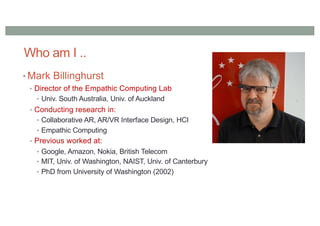
Who am I ..
• Mark Billinghurst
• Director of the Empathic Computing Lab
• Univ. South Australia, Univ. of Auckland
• Conducting research in:
• Collaborative AR, AR/VR Interface Design, HCI
• Empathic Computing
• Previous worked at:
• Google, Amazon, Nokia, British Telecom
• MIT, Univ. of Washington, NAIST, Univ. of Canterbury
• PhD from University of Washington (2002)
UniSA IVE - https://unisa.edu.au/research/IVE/
Class Logistics
• Weekly lecture (2 hrs)
• Thursday 9 am – 11am [Adelaide time]
• Room: Online
• Weekly Lab (1 hr) [UniSA Students]
• Thursday 11-12
• Assessment [UniSA Students]
• 3 projects @ 20%, 30%, 40%
• Class participation @ 10%
• What you will need
• iOS or Android phone/tablet
• Access to laptop/PC for development
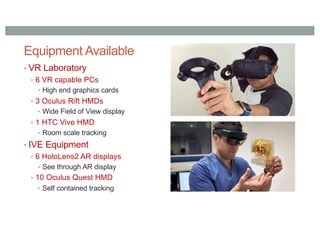
Equipment Available
• VR Laboratory
• 6 VR capable PCs
• High end graphics cards
• 3 Oculus Rift HMDs
• Wide Field of View display
• 1 HTC Vive HMD
• Room scale tracking
• IVE Equipment
• 6 HoloLens2 AR displays
• See through AR display
• 10 Oculus Quest HMD
• Self contained tracking
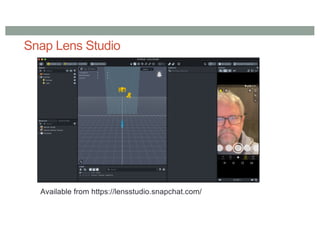
Snap Lens Studio
Available from https://lensstudio.snapchat.com/
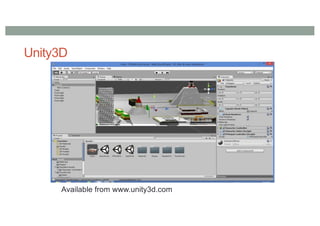
Unity3D
Available from www.unity3d.com
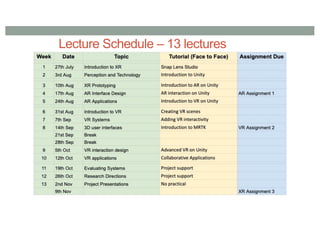
Lecture Schedule – 13 lectures
Assessment
• Assignment 1: Mobile AR (20%)
• Develop a Snap Lens
• AR Tracking and Interaction
• Assignment 2: Interactive VR (30%)
• Create an interactive VR scene
• Oculus Quest, HTC Vive, Rift
• Assignment 3: HMD Experience (40%)
• Develop either AR/VR HMD experience
• Oculus Quest, Microsoft Hololens2
• Class Participation (10%)
• Watch at least one short YouTube AR/VR video each week
• Be prepared to present video each week
• Submit at least one comment on Slack channel each week
• ARVRClass Slack channel – will send invites
WHAT IS AR/VR/MR/XR?
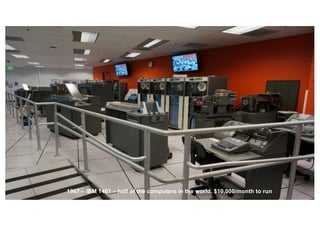
1967 – IBM 1401 – half of the computers in the world, $10,000/month to run
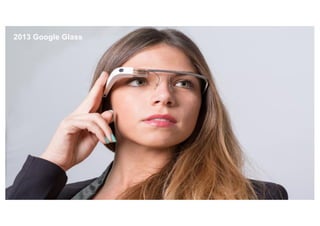
2013 Google Glass
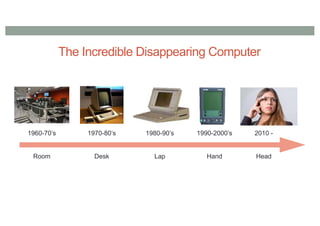
The Incredible Disappearing Computer
1960-70’s
Room
1970-80’s
Desk
1980-90’s
Lap
1990-2000’s
Hand
2010 -
Head
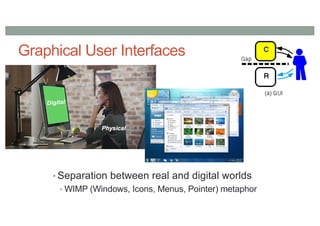
Graphical User Interfaces
• Separation between real and digital worlds
• WIMP (Windows, Icons, Menus, Pointer) metaphor
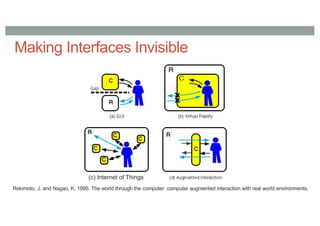
Rekimoto, J. and Nagao, K. 1995. The world through the computer: computer augmented interaction with real world environments.
Making Interfaces Invisible
(c) Internet of Things
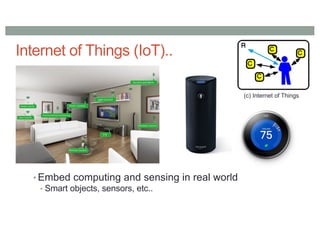
Internet of Things (IoT)..
• Embed computing and sensing in real world
• Smart objects, sensors, etc..
(c) Internet of Things
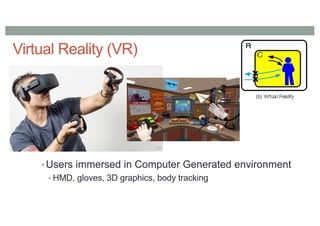
Virtual Reality (VR)
• Users immersed in Computer Generated environment
• HMD, gloves, 3D graphics, body tracking
The First VR Experience …
https://www.youtube.com/watch?v=pAC5SeNH8jw
Virtual Reality Definition
•Defining Characteristics
• Sense of Immersion
• User feels immersed in computer generated space
• Interactive in real-time
• The virtual content can be interacted with
• Independence
• User can have independent view and reaction to environment
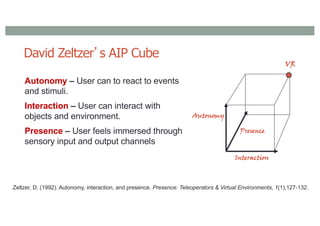
David Zeltzer’s AIP Cube
Autonomy – User can to react to events
and stimuli.
Interaction – User can interact with
objects and environment.
Presence – User feels immersed through
sensory input and output channels
Interaction
Autonomy
Presence
VR
Zeltzer, D. (1992). Autonomy, interaction, and presence. Presence: Teleoperators & Virtual Environments, 1(1),127-132.
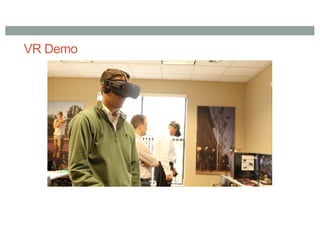
VR Demo
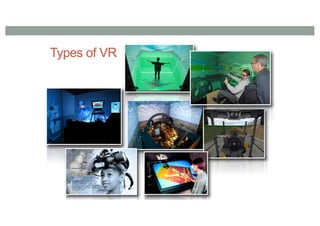
Types of VR
2
3
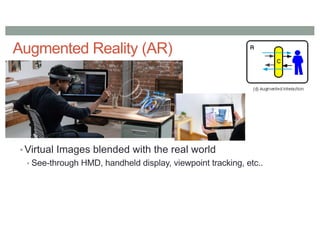
Augmented Reality (AR)
• Virtual Images blended with the real world
• See-through HMD, handheld display, viewpoint tracking, etc..
Augmented Reality Definition
•Defining Characteristics [Azuma 97]
• Combines Real and Virtual Images
• Both can be seen at the same time
• Interactive in real-time
• The virtual content can be interacted with
• Registered in 3D
• Virtual objects appear fixed in space
Azuma, R. T. (1997). A survey of augmented reality. Presence, 6(4), 355-385.
https://www.youtube.com/watch?v=cCL3bFuC4IA
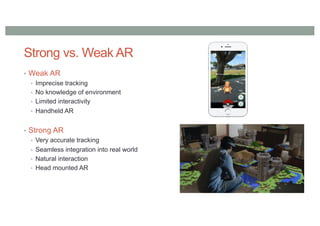
• Weak AR
• Imprecise tracking
• No knowledge of environment
• Limited interactivity
• Handheld AR
• Strong AR
• Very accurate tracking
• Seamless integration into real world
• Natural interaction
• Head mounted AR
Strong vs. Weak AR
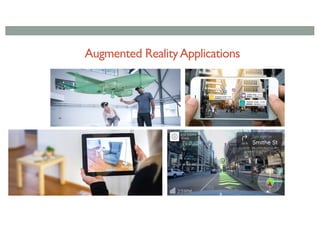
Augmented RealityApplications
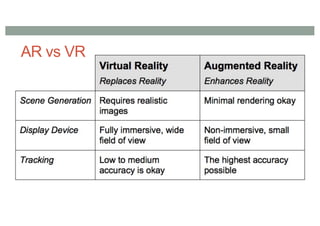
AR vs VR
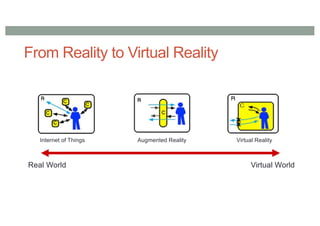
From Reality to Virtual Reality
Internet of Things Augmented Reality Virtual Reality
Real World Virtual World
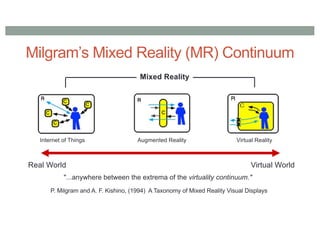
Milgram’s Mixed Reality (MR) Continuum
Augmented Reality Virtual Reality
Real World Virtual World
Mixed Reality
"...anywhere between the extrema of the virtuality continuum."
P. Milgram and A. F. Kishino, (1994) A Taxonomy of Mixed Reality Visual Displays
Internet of Things
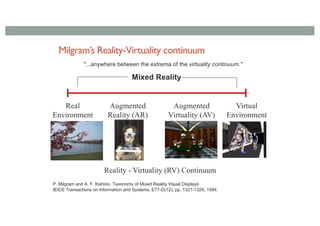
Milgram’s Reality-Virtuality continuum
Mixed Reality
Reality - Virtuality (RV) Continuum
Real
Environment
Augmented
Reality (AR)
Augmented
Virtuality (AV)
Virtual
Environment
"...anywhere between the extrema of the virtuality continuum."
P. Milgram and A. F. Kishino, Taxonomy of Mixed Reality Visual Displays
IEICE Transactions on Information and Systems, E77-D(12), pp. 1321-1329, 1994.
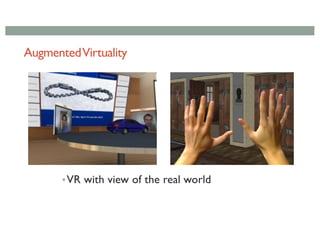
AugmentedVirtuality
•VR with view of the real world
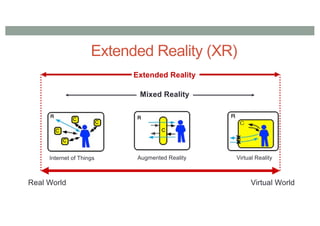
Extended Reality (XR)
Augmented Reality Virtual Reality
Real World Virtual World
Mixed Reality
Extended Reality
Internet of Things
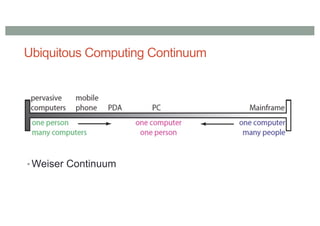
Ubiquitous Computing Continuum
• Weiser Continuum
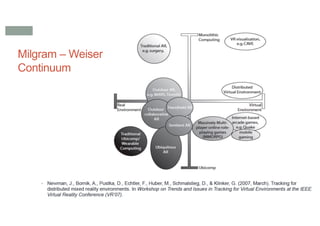
Milgram – Weiser
Continuum
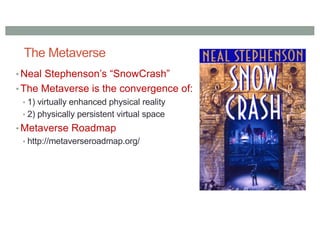
The Metaverse
• Neal Stephenson’s “SnowCrash”
• The Metaverse is the convergence of:
• 1) virtually enhanced physical reality
• 2) physically persistent virtual space
• Metaverse Roadmap
• http://metaverseroadmap.org/
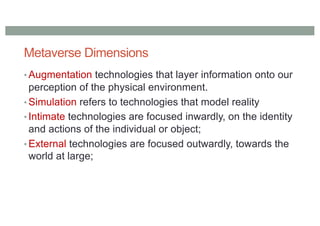
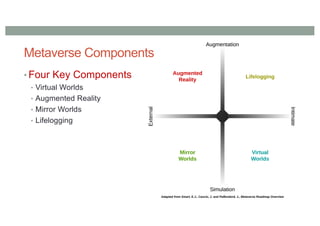
Metaverse Dimensions
• Augmentation technologies that layer information onto our
perception of the physical environment.
• Simulation refers to technologies that model reality
• Intimate technologies are focused inwardly, on the identity
and actions of the individual or object;
• External technologies are focused outwardly, towards the
world at large;
Metaverse Components
• Four Key Components
• Virtual Worlds
• Augmented Reality
• Mirror Worlds
• Lifelogging
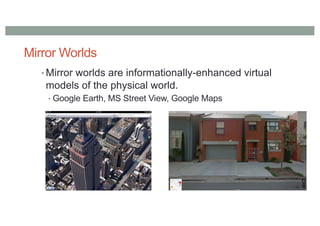
Mirror Worlds
• Mirror worlds are informationally-enhanced virtual
models of the physical world.
• Google Earth, MS Street View, Google Maps
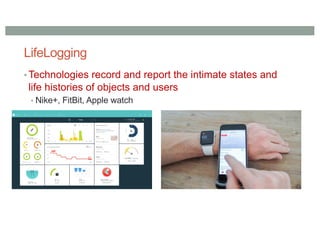
LifeLogging
• Technologies record and report the intimate states and
life histories of objects and users
• Nike+, FitBit, Apple watch
HISTORY OF AR/VR
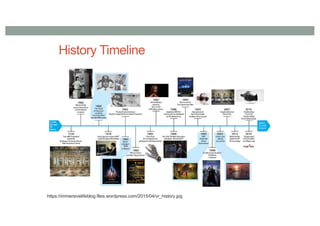
History Timeline
https://immersivelifeblog.files.wordpress.com/2015/04/vr_history.jpg
When anything new comes along, everyone, like a child
discovering the world thinks that they’ve invented it, but you
scratch a little and you find a caveman scratching on a wall
is creating virtual reality in a sense.
Morton Helig (Hammit 1993)
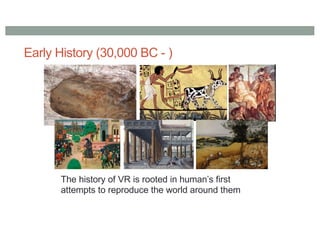
Early History (30,000 BC - )
The history of VR is rooted in human’s first
attempts to reproduce the world around them
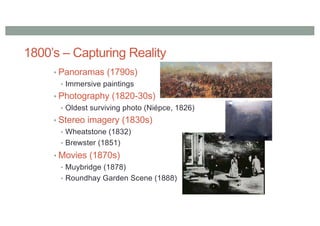
1800’s – Capturing Reality
• Panoramas (1790s)
• Immersive paintings
• Photography (1820-30s)
• Oldest surviving photo (Niépce, 1826)
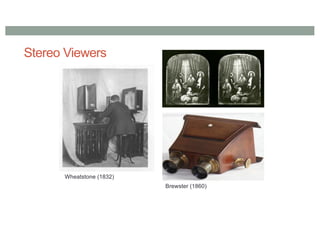
• Stereo imagery (1830s)
• Wheatstone (1832)
• Brewster (1851)
• Movies (1870s)
• Muybridge (1878)
• Roundhay Garden Scene (1888)
Stereo Viewers
Wheatstone (1832)
Brewster (1860)
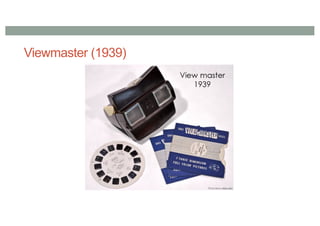
Viewmaster (1939)
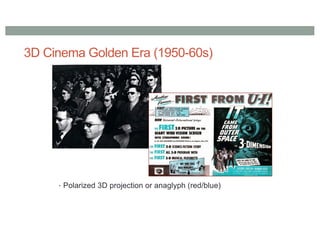
3D Cinema Golden Era (1950-60s)
• Polarized 3D projection or anaglyph (red/blue)
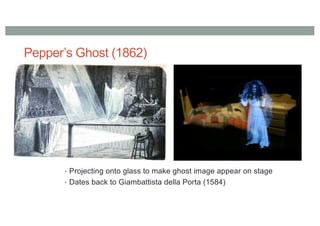
Pepper’s Ghost (1862)
• Projecting onto glass to make ghost image appear on stage
• Dates back to Giambattista della Porta (1584)
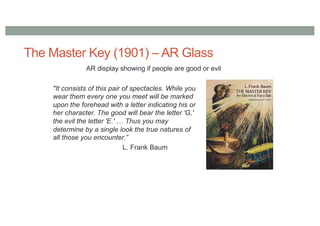
The Master Key (1901) – AR Glass
"It consists of this pair of spectacles. While you
wear them every one you meet will be marked
upon the forehead with a letter indicating his or
her character. The good will bear the letter 'G,'
the evil the letter 'E.' … Thus you may
determine by a single look the true natures of
all those you encounter.”
L. Frank Baum
AR display showing if people are good or evil
1900s – Interactive Experiences
• Early Simulators (<1960s)
• Flight simulation
• Sensorama (1955)
• Early HMDs (1960s)
• Philco, Ivan Sutherland
• Military + University Research (1970-80s)
• US Airforce, NASA, MIT, UNC
• First Commercial Wave (1980-90s)
• VPL, Virtual i-O, Division, Virtuality
• VR Arcades, Virtual Boy
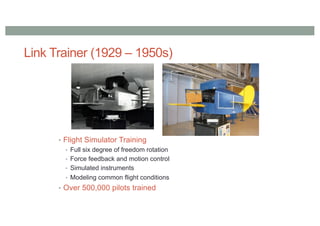
Link Trainer (1929 – 1950s)
• Flight Simulator Training
• Full six degree of freedom rotation
• Force feedback and motion control
• Simulated instruments
• Modeling common flight conditions
• Over 500,000 pilots trained
Link Trainer Video (1966)
• https://www.youtube.com/watch?v=MEKkVg9NqGM
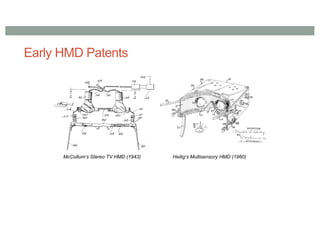
Early HMD Patents
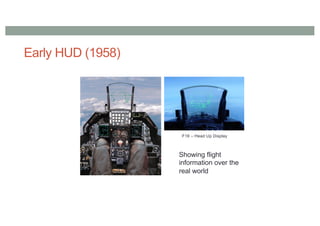
Early HUD (1958)
F16 – Head Up Display
Showing flight
information over the
real world
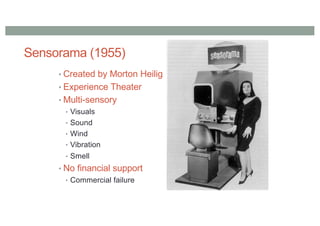
Sensorama (1955)
• Created by Morton Heilig
• Experience Theater
• Multi-sensory
• Visuals
• Sound
• Wind
• Vibration
• Smell
• No financial support
• Commercial failure
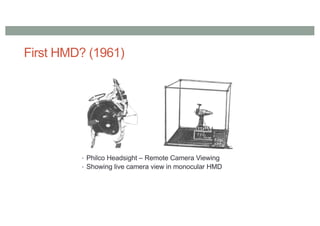
First HMD? (1961)
• Philco Headsight – Remote Camera Viewing
• Showing live camera view in monocular HMD
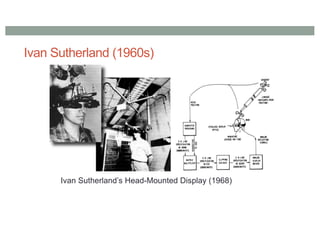
Ivan Sutherland (1960s)
6
1
Ivan Sutherland’s Head-Mounted Display (1968)
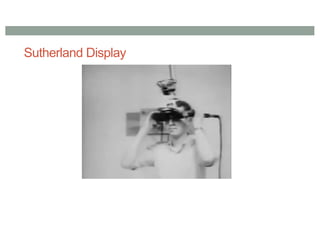
Sutherland Display
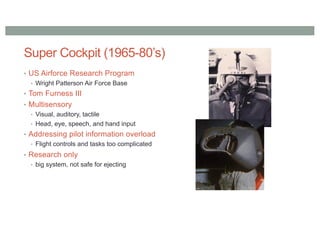
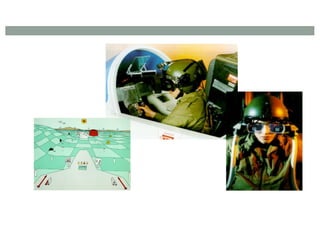
Super Cockpit (1965-80’s)
• US Airforce Research Program
• Wright Patterson Air Force Base
• Tom Furness III
• Multisensory
• Visual, auditory, tactile
• Head, eye, speech, and hand input
• Addressing pilot information overload
• Flight controls and tasks too complicated
• Research only
• big system, not safe for ejecting
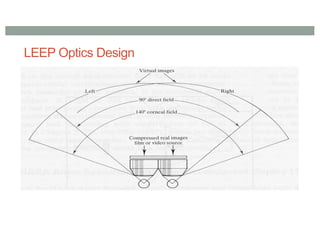
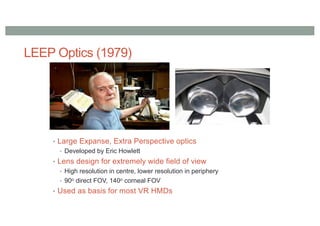
LEEP Optics (1979)
• Large Expanse, Extra Perspective optics
• Developed by Eric Howlett
• Lens design for extremely wide field of view
• High resolution in centre, lower resolution in periphery
• 90o direct FOV, 140o corneal FOV
• Used as basis for most VR HMDs
LEEP Optics Design
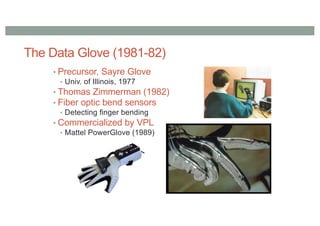
The Data Glove (1981-82)
• Precursor, Sayre Glove
• Univ. of Illinois, 1977
• Thomas Zimmerman (1982)
• Fiber optic bend sensors
• Detecting finger bending
• Commercialized by VPL
• Mattel PowerGlove (1989)
VPL DataGlove Demo
• https://www.youtube.com/watch?v=fs3AhNr5o6o
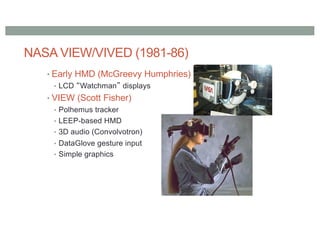
NASA VIEW/VIVED (1981-86)
• Early HMD (McGreevy Humphries)
• LCD “Watchman” displays
• VIEW (Scott Fisher)
• Polhemus tracker
• LEEP-based HMD
• 3D audio (Convolvotron)
• DataGlove gesture input
• Simple graphics
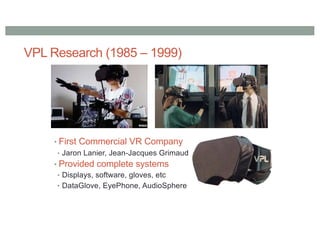
VPL Research (1985 – 1999)
• First Commercial VR Company
• Jaron Lanier, Jean-Jacques Grimaud
• Provided complete systems
• Displays, software, gloves, etc
• DataGlove, EyePhone, AudioSphere
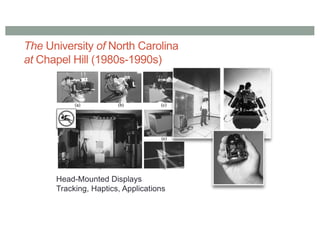
The University of North Carolina
at Chapel Hill (1980s-1990s)
7
1
Head-Mounted Displays
Tracking, Haptics, Applications
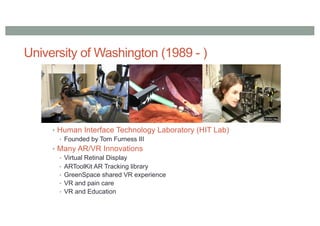
University of Washington (1989 - )
• Human Interface Technology Laboratory (HIT Lab)
• Founded by Tom Furness III
• Many AR/VR Innovations
• Virtual Retinal Display
• ARToolKit AR Tracking library
• GreenSpace shared VR experience
• VR and pain care
• VR and Education
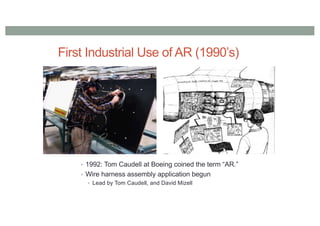
First Industrial Use of AR (1990’s)
• 1992: Tom Caudell at Boeing coined the term “AR.”
• Wire harness assembly application begun
• Lead by Tom Caudell, and David Mizell
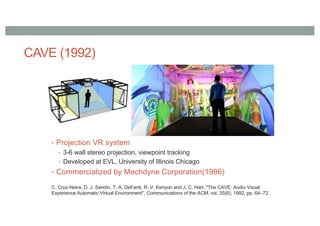
CAVE (1992)
• Projection VR system
• 3-6 wall stereo projection, viewpoint tracking
• Developed at EVL, University of Illinois Chicago
• Commercialized by Mechdyne Corporation(1996)
C. Cruz-Neira, D. J. Sandin, T. A. DeFanti, R. V. Kenyon and J. C. Hart. "The CAVE: Audio Visual
Experience Automatic Virtual Environment", Communications of the ACM, vol. 35(6), 1992, pp. 64–72.
CAVE Demo Video
• https://www.youtube.com/watch?v=aKL0urEdtPU
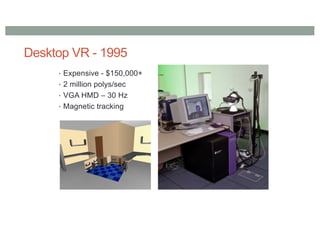
Desktop VR - 1995
• Expensive - $150,000+
• 2 million polys/sec
• VGA HMD – 30 Hz
• Magnetic tracking
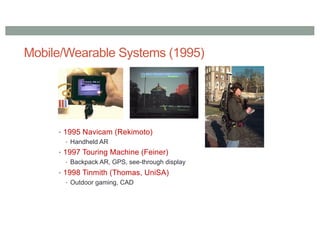
Mobile/Wearable Systems (1995)
• 1995 Navicam (Rekimoto)
• Handheld AR
• 1997 Touring Machine (Feiner)
• Backpack AR, GPS, see-through display
• 1998 Tinmith (Thomas, UniSA)
• Outdoor gaming, CAD
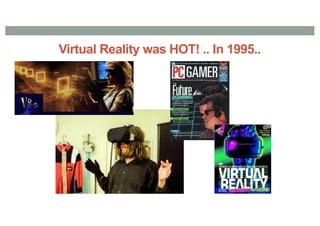
Virtual Reality was HOT! .. In 1995..
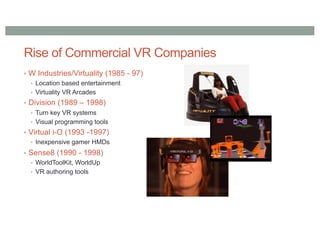
Rise of Commercial VR Companies
• W Industries/Virtuality (1985 - 97)
• Location based entertainment
• Virtuality VR Arcades
• Division (1989 – 1998)
• Turn key VR systems
• Visual programming tools
• Virtual i-O (1993 -1997)
• Inexpensive gamer HMDs
• Sense8 (1990 - 1998)
• WorldToolKit, WorldUp
• VR authoring tools
Dactyl Nightmare
• https://www.youtube.com/watch?v=L60wgPuuDpE
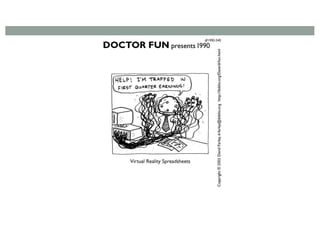
Overview of VR in the 1990’s
Development of AR Tools
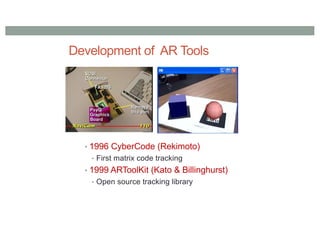
• 1996 CyberCode (Rekimoto)
• First matrix code tracking
• 1999 ARToolKit (Kato & Billinghurst)
• Open source tracking library
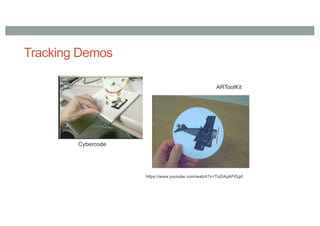
Tracking Demos
https://www.youtube.com/watch?v=TqGAqAFlGg0
ARToolKit
Cybercode
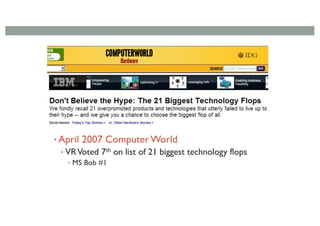
• April 2007 Computer World
• VRVoted 7th on list of 21 biggest technology flops
• MS Bob #1
Lessons Learned
• Don’t believe the hype
• Not everything is better inVR
• Many factors determine technology acceptance
• Human Centered Design/Design for users
• Need to move from Demo to Production
• Profitable niche markets first
• Follow the money
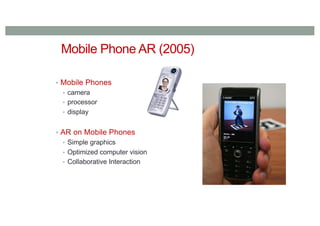
Mobile Phone AR (2005)
• Mobile Phones
• camera
• processor
• display
• AR on Mobile Phones
• Simple graphics
• Optimized computer vision
• Collaborative Interaction
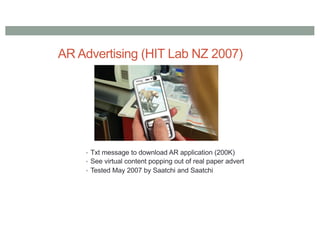
AR Advertising (HIT Lab NZ 2007)
• Txt message to download AR application (200K)
• See virtual content popping out of real paper advert
• Tested May 2007 by Saatchi and Saatchi
Wellington Zoo Demo
https://www.youtube.com/watch?v=edTjuXcce_c
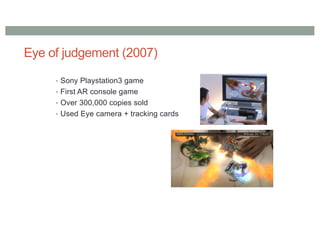
Eye of judgement (2007)
• Sony Playstation3 game
• First AR console game
• Over 300,000 copies sold
• Used Eye camera + tracking cards
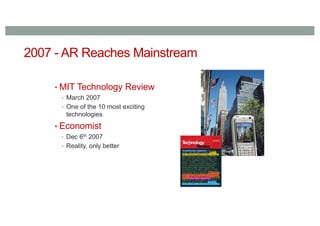
2007 - AR Reaches Mainstream
• MIT Technology Review
• March 2007
• One of the 10 most exciting
technologies
• Economist
• Dec 6th 2007
• Reality, only better
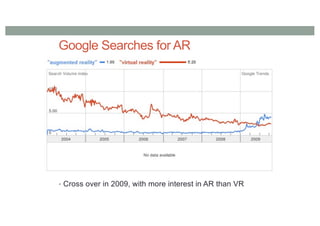
Google Searches for AR
• Cross over in 2009, with more interest in AR than VR
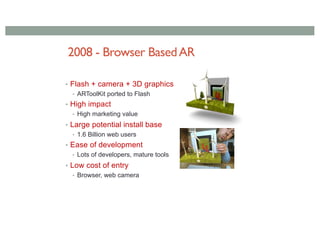
2008 - Browser BasedAR
• Flash + camera + 3D graphics
• ARToolKit ported to Flash
• High impact
• High marketing value
• Large potential install base
• 1.6 Billion web users
• Ease of development
• Lots of developers, mature tools
• Low cost of entry
• Browser, web camera
Demo: GE Smart Grid
• https://www.youtube.com/watch?v=vJO_AZkCL9U
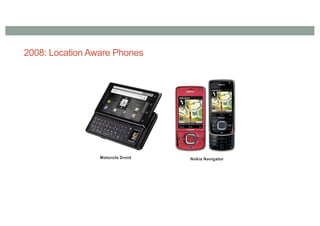
2008: Location Aware Phones
Nokia Navigator
Motorola Droid
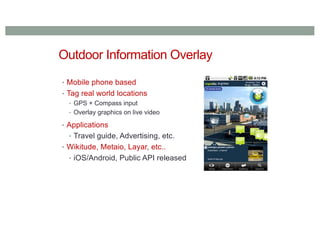
Outdoor Information Overlay
• Mobile phone based
• Tag real world locations
• GPS + Compass input
• Overlay graphics on live video
• Applications
• Travel guide, Advertising, etc.
• Wikitude, Metaio, Layar, etc..
• iOS/Android, Public API released
Layar Demo (2008)
• https://www.youtube.com/watch?v=b64_16K2e08
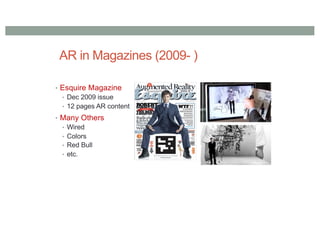
AR in Magazines (2009- )
• Esquire Magazine
• Dec 2009 issue
• 12 pages AR content
• Many Others
• Wired
• Colors
• Red Bull
• etc.
Esquire Demo
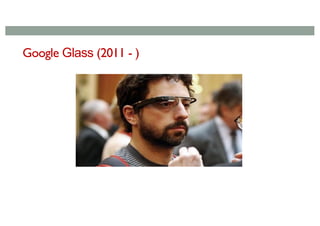
Google Glass (2011 - )
Google Glass Demo
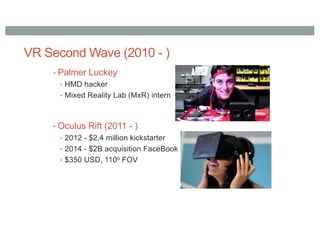
VR Second Wave (2010 - )
• Palmer Luckey
• HMD hacker
• Mixed Reality Lab (MxR) intern
• Oculus Rift (2011 - )
• 2012 - $2.4 million kickstarter
• 2014 - $2B acquisition FaceBook
• $350 USD, 110o FOV
The Oculus Kickstarter Video
• https://www.youtube.com/watch?v=aNSYscbxFAw
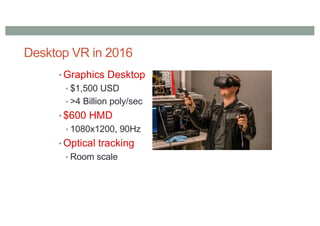
Desktop VR in 2016
• Graphics Desktop
• $1,500 USD
• >4 Billion poly/sec
• $600 HMD
• 1080x1200, 90Hz
• Optical tracking
• Room scale
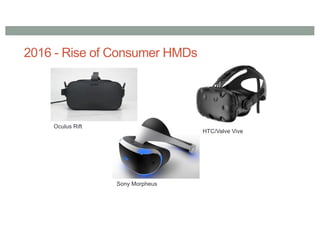
Oculus Rift
Sony Morpheus
HTC/Valve Vive
2016 - Rise of Consumer HMDs
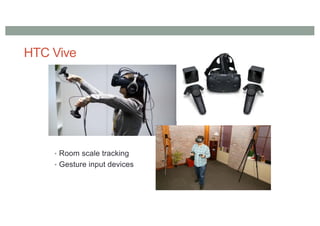
HTC Vive
• Room scale tracking
• Gesture input devices
Example Vive App – Tilt Brush
• https://www.youtube.com/watch?v=ijukZmYFX-0
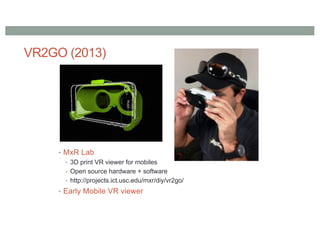
VR2GO (2013)
• MxR Lab
• 3D print VR viewer for mobiles
• Open source hardware + software
• http://projects.ict.usc.edu/mxr/diy/vr2go/
• Early Mobile VR viewer
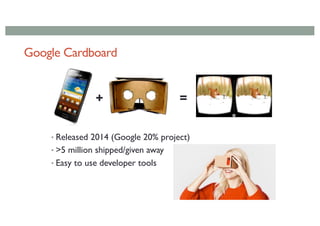
Google Cardboard
• Released 2014 (Google 20% project)
• >5 million shipped/given away
• Easy to use developer tools
+ =
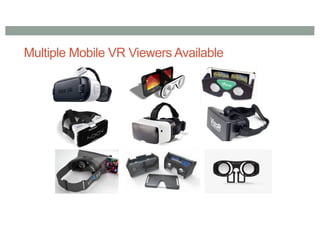
Multiple Mobile VR Viewers Available
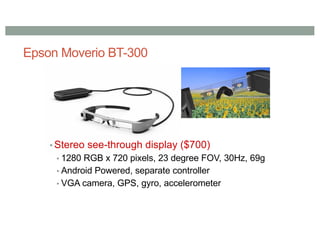
Epson Moverio BT-300
▪ Stereo see-through display ($700)
▪ 1280 RGB x 720 pixels, 23 degree FOV, 30Hz, 69g
▪ Android Powered, separate controller
▪ VGA camera, GPS, gyro, accelerometer
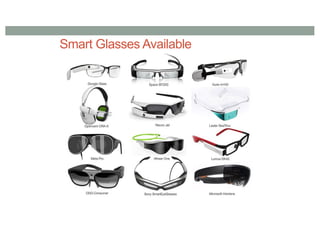
Smart Glasses Available
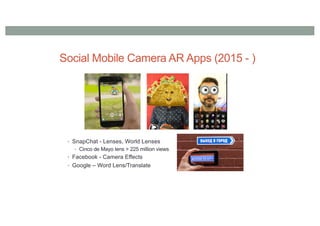
Social Mobile Camera AR Apps (2015 - )
• SnapChat - Lenses, World Lenses
• Cinco de Mayo lens > 225 million views
• Facebook - Camera Effects
• Google – Word Lens/Translate
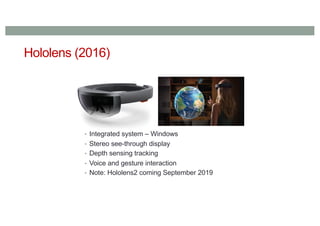
Hololens (2016)
• Integrated system – Windows
• Stereo see-through display
• Depth sensing tracking
• Voice and gesture interaction
• Note: Hololens2 coming September 2019
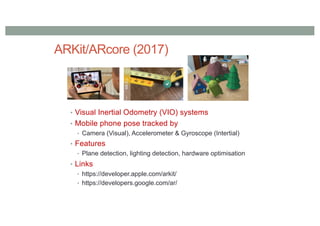
ARKit/ARcore (2017)
• Visual Inertial Odometry (VIO) systems
• Mobile phone pose tracked by
• Camera (Visual), Accelerometer & Gyroscope (Intertial)
• Features
• Plane detection, lighting detection, hardware optimisation
• Links
• https://developer.apple.com/arkit/
• https://developers.google.com/ar/
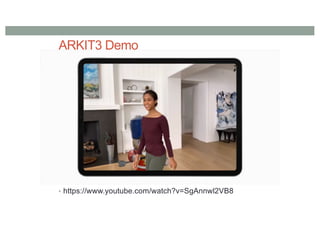
• https://www.youtube.com/watch?v=SgAnnwl2VB8
ARKIT3 Demo
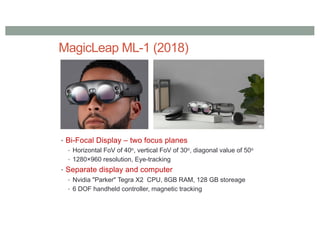
MagicLeap ML-1 (2018)
• Bi-Focal Display – two focus planes
• Horizontal FoV of 40o, vertical FoV of 30o, diagonal value of 50o
• 1280×960 resolution, Eye-tracking
• Separate display and computer
• Nvidia "Parker" Tegra X2 CPU, 8GB RAM, 128 GB storeage
• 6 DOF handheld controller, magnetic tracking
History Summary
• 1960’s – 80’s: Early Experimentation
• 1980’s – 90’s: Basic Research
• Tracking, displays
• 1995 – 2005: Tools/Applications
• Interaction, usability, theory
• 2005 - : Commercial Applications
• Mobile, Games, Medical, Industry
QUESTIONS
www.empathiccomputing.org
@marknb00
mark.billinghurst@auckland.ac.nz

Comp 4010 2021 Lecture1-Introduction to XR

  • 1.
    INTRODUCTION TO XR COMP4010 Lecture One Mark Billinghurst July 27th 2021 mark.billinghurst@unisa.edu.au
  • 2.
    Who am I.. • Mark Billinghurst • Director of the Empathic Computing Lab • Univ. South Australia, Univ. of Auckland • Conducting research in: • Collaborative AR, AR/VR Interface Design, HCI • Empathic Computing • Previous worked at: • Google, Amazon, Nokia, British Telecom • MIT, Univ. of Washington, NAIST, Univ. of Canterbury • PhD from University of Washington (2002)
  • 3.
    UniSA IVE -https://unisa.edu.au/research/IVE/
  • 4.
    Class Logistics • Weeklylecture (2 hrs) • Thursday 9 am – 11am [Adelaide time] • Room: Online • Weekly Lab (1 hr) [UniSA Students] • Thursday 11-12 • Assessment [UniSA Students] • 3 projects @ 20%, 30%, 40% • Class participation @ 10% • What you will need • iOS or Android phone/tablet • Access to laptop/PC for development
  • 5.
    Equipment Available • VRLaboratory • 6 VR capable PCs • High end graphics cards • 3 Oculus Rift HMDs • Wide Field of View display • 1 HTC Vive HMD • Room scale tracking • IVE Equipment • 6 HoloLens2 AR displays • See through AR display • 10 Oculus Quest HMD • Self contained tracking
  • 6.
    Snap Lens Studio Availablefrom https://lensstudio.snapchat.com/
  • 7.
  • 8.
  • 9.
    Assessment • Assignment 1:Mobile AR (20%) • Develop a Snap Lens • AR Tracking and Interaction • Assignment 2: Interactive VR (30%) • Create an interactive VR scene • Oculus Quest, HTC Vive, Rift • Assignment 3: HMD Experience (40%) • Develop either AR/VR HMD experience • Oculus Quest, Microsoft Hololens2 • Class Participation (10%) • Watch at least one short YouTube AR/VR video each week • Be prepared to present video each week • Submit at least one comment on Slack channel each week
  • 10.
    • ARVRClass Slackchannel – will send invites
  • 11.
  • 12.
    1967 – IBM1401 – half of the computers in the world, $10,000/month to run
  • 13.
  • 14.
    The Incredible DisappearingComputer 1960-70’s Room 1970-80’s Desk 1980-90’s Lap 1990-2000’s Hand 2010 - Head
  • 15.
    Graphical User Interfaces •Separation between real and digital worlds • WIMP (Windows, Icons, Menus, Pointer) metaphor
  • 16.
    Rekimoto, J. andNagao, K. 1995. The world through the computer: computer augmented interaction with real world environments. Making Interfaces Invisible (c) Internet of Things
  • 17.
    Internet of Things(IoT).. • Embed computing and sensing in real world • Smart objects, sensors, etc.. (c) Internet of Things
  • 18.
    Virtual Reality (VR) •Users immersed in Computer Generated environment • HMD, gloves, 3D graphics, body tracking
  • 19.
    The First VRExperience … https://www.youtube.com/watch?v=pAC5SeNH8jw
  • 20.
    Virtual Reality Definition •DefiningCharacteristics • Sense of Immersion • User feels immersed in computer generated space • Interactive in real-time • The virtual content can be interacted with • Independence • User can have independent view and reaction to environment
  • 21.
    David Zeltzer’s AIPCube Autonomy – User can to react to events and stimuli. Interaction – User can interact with objects and environment. Presence – User feels immersed through sensory input and output channels Interaction Autonomy Presence VR Zeltzer, D. (1992). Autonomy, interaction, and presence. Presence: Teleoperators & Virtual Environments, 1(1),127-132.
  • 22.
  • 23.
  • 24.
    Augmented Reality (AR) •Virtual Images blended with the real world • See-through HMD, handheld display, viewpoint tracking, etc..
  • 25.
    Augmented Reality Definition •DefiningCharacteristics [Azuma 97] • Combines Real and Virtual Images • Both can be seen at the same time • Interactive in real-time • The virtual content can be interacted with • Registered in 3D • Virtual objects appear fixed in space Azuma, R. T. (1997). A survey of augmented reality. Presence, 6(4), 355-385.
  • 27.
  • 28.
    • Weak AR •Imprecise tracking • No knowledge of environment • Limited interactivity • Handheld AR • Strong AR • Very accurate tracking • Seamless integration into real world • Natural interaction • Head mounted AR Strong vs. Weak AR
  • 29.
  • 30.
  • 31.
    From Reality toVirtual Reality Internet of Things Augmented Reality Virtual Reality Real World Virtual World
  • 32.
    Milgram’s Mixed Reality(MR) Continuum Augmented Reality Virtual Reality Real World Virtual World Mixed Reality "...anywhere between the extrema of the virtuality continuum." P. Milgram and A. F. Kishino, (1994) A Taxonomy of Mixed Reality Visual Displays Internet of Things
  • 33.
    Milgram’s Reality-Virtuality continuum MixedReality Reality - Virtuality (RV) Continuum Real Environment Augmented Reality (AR) Augmented Virtuality (AV) Virtual Environment "...anywhere between the extrema of the virtuality continuum." P. Milgram and A. F. Kishino, Taxonomy of Mixed Reality Visual Displays IEICE Transactions on Information and Systems, E77-D(12), pp. 1321-1329, 1994.
  • 34.
  • 35.
    Extended Reality (XR) AugmentedReality Virtual Reality Real World Virtual World Mixed Reality Extended Reality Internet of Things
  • 36.
  • 37.
  • 38.
    The Metaverse • NealStephenson’s “SnowCrash” • The Metaverse is the convergence of: • 1) virtually enhanced physical reality • 2) physically persistent virtual space • Metaverse Roadmap • http://metaverseroadmap.org/
  • 39.
    Metaverse Dimensions • Augmentationtechnologies that layer information onto our perception of the physical environment. • Simulation refers to technologies that model reality • Intimate technologies are focused inwardly, on the identity and actions of the individual or object; • External technologies are focused outwardly, towards the world at large;
  • 40.
    Metaverse Components • FourKey Components • Virtual Worlds • Augmented Reality • Mirror Worlds • Lifelogging
  • 41.
    Mirror Worlds • Mirrorworlds are informationally-enhanced virtual models of the physical world. • Google Earth, MS Street View, Google Maps
  • 42.
    LifeLogging • Technologies recordand report the intimate states and life histories of objects and users • Nike+, FitBit, Apple watch
  • 43.
  • 44.
  • 45.
    When anything newcomes along, everyone, like a child discovering the world thinks that they’ve invented it, but you scratch a little and you find a caveman scratching on a wall is creating virtual reality in a sense. Morton Helig (Hammit 1993)
  • 46.
    Early History (30,000BC - ) The history of VR is rooted in human’s first attempts to reproduce the world around them
  • 47.
    1800’s – CapturingReality • Panoramas (1790s) • Immersive paintings • Photography (1820-30s) • Oldest surviving photo (Niépce, 1826) • Stereo imagery (1830s) • Wheatstone (1832) • Brewster (1851) • Movies (1870s) • Muybridge (1878) • Roundhay Garden Scene (1888)
  • 48.
  • 49.
  • 50.
    3D Cinema GoldenEra (1950-60s) • Polarized 3D projection or anaglyph (red/blue)
  • 51.
    Pepper’s Ghost (1862) •Projecting onto glass to make ghost image appear on stage • Dates back to Giambattista della Porta (1584)
  • 52.
    The Master Key(1901) – AR Glass "It consists of this pair of spectacles. While you wear them every one you meet will be marked upon the forehead with a letter indicating his or her character. The good will bear the letter 'G,' the evil the letter 'E.' … Thus you may determine by a single look the true natures of all those you encounter.” L. Frank Baum AR display showing if people are good or evil
  • 53.
    1900s – InteractiveExperiences • Early Simulators (<1960s) • Flight simulation • Sensorama (1955) • Early HMDs (1960s) • Philco, Ivan Sutherland • Military + University Research (1970-80s) • US Airforce, NASA, MIT, UNC • First Commercial Wave (1980-90s) • VPL, Virtual i-O, Division, Virtuality • VR Arcades, Virtual Boy
  • 54.
    Link Trainer (1929– 1950s) • Flight Simulator Training • Full six degree of freedom rotation • Force feedback and motion control • Simulated instruments • Modeling common flight conditions • Over 500,000 pilots trained
  • 55.
    Link Trainer Video(1966) • https://www.youtube.com/watch?v=MEKkVg9NqGM
  • 56.
  • 57.
    Early HUD (1958) F16– Head Up Display Showing flight information over the real world
  • 58.
    Sensorama (1955) • Createdby Morton Heilig • Experience Theater • Multi-sensory • Visuals • Sound • Wind • Vibration • Smell • No financial support • Commercial failure
  • 59.
    First HMD? (1961) •Philco Headsight – Remote Camera Viewing • Showing live camera view in monocular HMD
  • 60.
    Ivan Sutherland (1960s) 6 1 IvanSutherland’s Head-Mounted Display (1968)
  • 61.
  • 62.
    Super Cockpit (1965-80’s) •US Airforce Research Program • Wright Patterson Air Force Base • Tom Furness III • Multisensory • Visual, auditory, tactile • Head, eye, speech, and hand input • Addressing pilot information overload • Flight controls and tasks too complicated • Research only • big system, not safe for ejecting
  • 64.
    LEEP Optics (1979) •Large Expanse, Extra Perspective optics • Developed by Eric Howlett • Lens design for extremely wide field of view • High resolution in centre, lower resolution in periphery • 90o direct FOV, 140o corneal FOV • Used as basis for most VR HMDs
  • 65.
  • 66.
    The Data Glove(1981-82) • Precursor, Sayre Glove • Univ. of Illinois, 1977 • Thomas Zimmerman (1982) • Fiber optic bend sensors • Detecting finger bending • Commercialized by VPL • Mattel PowerGlove (1989)
  • 67.
    VPL DataGlove Demo •https://www.youtube.com/watch?v=fs3AhNr5o6o
  • 68.
    NASA VIEW/VIVED (1981-86) •Early HMD (McGreevy Humphries) • LCD “Watchman” displays • VIEW (Scott Fisher) • Polhemus tracker • LEEP-based HMD • 3D audio (Convolvotron) • DataGlove gesture input • Simple graphics
  • 69.
    VPL Research (1985– 1999) • First Commercial VR Company • Jaron Lanier, Jean-Jacques Grimaud • Provided complete systems • Displays, software, gloves, etc • DataGlove, EyePhone, AudioSphere
  • 70.
    The University ofNorth Carolina at Chapel Hill (1980s-1990s) 7 1 Head-Mounted Displays Tracking, Haptics, Applications
  • 71.
    University of Washington(1989 - ) • Human Interface Technology Laboratory (HIT Lab) • Founded by Tom Furness III • Many AR/VR Innovations • Virtual Retinal Display • ARToolKit AR Tracking library • GreenSpace shared VR experience • VR and pain care • VR and Education
  • 72.
    First Industrial Useof AR (1990’s) • 1992: Tom Caudell at Boeing coined the term “AR.” • Wire harness assembly application begun • Lead by Tom Caudell, and David Mizell
  • 73.
    CAVE (1992) • ProjectionVR system • 3-6 wall stereo projection, viewpoint tracking • Developed at EVL, University of Illinois Chicago • Commercialized by Mechdyne Corporation(1996) C. Cruz-Neira, D. J. Sandin, T. A. DeFanti, R. V. Kenyon and J. C. Hart. "The CAVE: Audio Visual Experience Automatic Virtual Environment", Communications of the ACM, vol. 35(6), 1992, pp. 64–72.
  • 74.
    CAVE Demo Video •https://www.youtube.com/watch?v=aKL0urEdtPU
  • 75.
    Desktop VR -1995 • Expensive - $150,000+ • 2 million polys/sec • VGA HMD – 30 Hz • Magnetic tracking
  • 76.
    Mobile/Wearable Systems (1995) •1995 Navicam (Rekimoto) • Handheld AR • 1997 Touring Machine (Feiner) • Backpack AR, GPS, see-through display • 1998 Tinmith (Thomas, UniSA) • Outdoor gaming, CAD
  • 77.
    Virtual Reality wasHOT! .. In 1995..
  • 78.
    Rise of CommercialVR Companies • W Industries/Virtuality (1985 - 97) • Location based entertainment • Virtuality VR Arcades • Division (1989 – 1998) • Turn key VR systems • Visual programming tools • Virtual i-O (1993 -1997) • Inexpensive gamer HMDs • Sense8 (1990 - 1998) • WorldToolKit, WorldUp • VR authoring tools
  • 79.
  • 80.
    Overview of VRin the 1990’s
  • 81.
    Development of ARTools • 1996 CyberCode (Rekimoto) • First matrix code tracking • 1999 ARToolKit (Kato & Billinghurst) • Open source tracking library
  • 82.
  • 84.
    • April 2007Computer World • VRVoted 7th on list of 21 biggest technology flops • MS Bob #1
  • 85.
    Lessons Learned • Don’tbelieve the hype • Not everything is better inVR • Many factors determine technology acceptance • Human Centered Design/Design for users • Need to move from Demo to Production • Profitable niche markets first • Follow the money
  • 86.
    Mobile Phone AR(2005) • Mobile Phones • camera • processor • display • AR on Mobile Phones • Simple graphics • Optimized computer vision • Collaborative Interaction
  • 87.
    AR Advertising (HITLab NZ 2007) • Txt message to download AR application (200K) • See virtual content popping out of real paper advert • Tested May 2007 by Saatchi and Saatchi
  • 88.
  • 89.
    Eye of judgement(2007) • Sony Playstation3 game • First AR console game • Over 300,000 copies sold • Used Eye camera + tracking cards
  • 90.
    2007 - ARReaches Mainstream • MIT Technology Review • March 2007 • One of the 10 most exciting technologies • Economist • Dec 6th 2007 • Reality, only better
  • 91.
    Google Searches forAR • Cross over in 2009, with more interest in AR than VR
  • 92.
    2008 - BrowserBasedAR • Flash + camera + 3D graphics • ARToolKit ported to Flash • High impact • High marketing value • Large potential install base • 1.6 Billion web users • Ease of development • Lots of developers, mature tools • Low cost of entry • Browser, web camera
  • 93.
    Demo: GE SmartGrid • https://www.youtube.com/watch?v=vJO_AZkCL9U
  • 94.
    2008: Location AwarePhones Nokia Navigator Motorola Droid
  • 95.
    Outdoor Information Overlay •Mobile phone based • Tag real world locations • GPS + Compass input • Overlay graphics on live video • Applications • Travel guide, Advertising, etc. • Wikitude, Metaio, Layar, etc.. • iOS/Android, Public API released
  • 96.
    Layar Demo (2008) •https://www.youtube.com/watch?v=b64_16K2e08
  • 97.
    AR in Magazines(2009- ) • Esquire Magazine • Dec 2009 issue • 12 pages AR content • Many Others • Wired • Colors • Red Bull • etc.
  • 98.
  • 99.
  • 100.
  • 101.
    VR Second Wave(2010 - ) • Palmer Luckey • HMD hacker • Mixed Reality Lab (MxR) intern • Oculus Rift (2011 - ) • 2012 - $2.4 million kickstarter • 2014 - $2B acquisition FaceBook • $350 USD, 110o FOV
  • 102.
    The Oculus KickstarterVideo • https://www.youtube.com/watch?v=aNSYscbxFAw
  • 103.
    Desktop VR in2016 • Graphics Desktop • $1,500 USD • >4 Billion poly/sec • $600 HMD • 1080x1200, 90Hz • Optical tracking • Room scale
  • 104.
    Oculus Rift Sony Morpheus HTC/ValveVive 2016 - Rise of Consumer HMDs
  • 105.
    HTC Vive • Roomscale tracking • Gesture input devices
  • 106.
    Example Vive App– Tilt Brush • https://www.youtube.com/watch?v=ijukZmYFX-0
  • 107.
    VR2GO (2013) • MxRLab • 3D print VR viewer for mobiles • Open source hardware + software • http://projects.ict.usc.edu/mxr/diy/vr2go/ • Early Mobile VR viewer
  • 108.
    Google Cardboard • Released2014 (Google 20% project) • >5 million shipped/given away • Easy to use developer tools + =
  • 109.
    Multiple Mobile VRViewers Available
  • 110.
    Epson Moverio BT-300 ▪Stereo see-through display ($700) ▪ 1280 RGB x 720 pixels, 23 degree FOV, 30Hz, 69g ▪ Android Powered, separate controller ▪ VGA camera, GPS, gyro, accelerometer
  • 111.
  • 112.
    Social Mobile CameraAR Apps (2015 - ) • SnapChat - Lenses, World Lenses • Cinco de Mayo lens > 225 million views • Facebook - Camera Effects • Google – Word Lens/Translate
  • 113.
    Hololens (2016) • Integratedsystem – Windows • Stereo see-through display • Depth sensing tracking • Voice and gesture interaction • Note: Hololens2 coming September 2019
  • 114.
    ARKit/ARcore (2017) • VisualInertial Odometry (VIO) systems • Mobile phone pose tracked by • Camera (Visual), Accelerometer & Gyroscope (Intertial) • Features • Plane detection, lighting detection, hardware optimisation • Links • https://developer.apple.com/arkit/ • https://developers.google.com/ar/
  • 115.
  • 116.
    MagicLeap ML-1 (2018) •Bi-Focal Display – two focus planes • Horizontal FoV of 40o, vertical FoV of 30o, diagonal value of 50o • 1280×960 resolution, Eye-tracking • Separate display and computer • Nvidia "Parker" Tegra X2 CPU, 8GB RAM, 128 GB storeage • 6 DOF handheld controller, magnetic tracking
  • 117.
    History Summary • 1960’s– 80’s: Early Experimentation • 1980’s – 90’s: Basic Research • Tracking, displays • 1995 – 2005: Tools/Applications • Interaction, usability, theory • 2005 - : Commercial Applications • Mobile, Games, Medical, Industry
  • 118.
  • 119.