Continuum™ for Sueding Textiles,
Marc Poirier, Sales & PDAE
CONCLUSION – In a rush, here is the bottom line -
LONG TERM
Mills are faced with the continuous need to process other than pure cotton material. Synthetic fi-
bers have the nasty habit of melting whenever they are exposed to heat even slightest amounts.
That is why; the next challenges will be the processing of synthetic blends with the same ease as
with pure cotton. We know it is doable and have ideas to propose to users and machinery manu-
facturer that will entice them into exploring this new venue.
All of which is making the name Abrasive Technology visible once again around the world as a
company that provides the very best and innovative solutions for a specialized and demanding in-
dustry, as well as reinforce AT as a dominant player in the finishing of textiles.
Our next task is to address the sueding of sysnthetics and blends which are currently difficult to
process with the current technology.
---------------------------------------
SUEDING
In the late 1980’s, a small Canadian start-up company called Diabrasive Int'l pioneered the use of
flexible diamonds tools. Their concept was simple; in replacing traditional abrasives on the surface
of emery paper with the more durable diamonds. The goal was to replace sandpaper throughout
industry wherever application demands were severe with this newly devised concept material. Di-
amonds being much harder than any other abrasive crystal, they outlast their traditional counter-
part by a significant margin and are a natural for converting industrial applications.
One of the lesser known uses of abrasives in industrial environments is for abrading textiles. The
abrasion process gives their surface a much more pleasant finish to the touch. And, both knit and
woven material is processed by this means and benefit from this finishing procedure. In 1988, Dia-
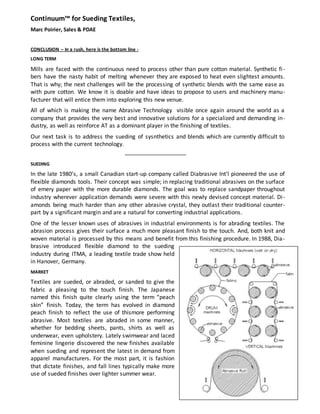
brasive introduced flexible diamond to the sueding
industry during ITMA, a leading textile trade show held
in Hanover, Germany.
MARKET
Textiles are sueded, or abraded, or sanded to give the
fabric a pleasing to the touch finish. The Japanese
named this finish quite clearly using the term “peach
skin” finish. Today, the term has evolved in diamond
peach finish to reflect the use of thismore performing
abrasive. Most textiles are abraded in some manner,
whether for bedding sheets, pants, shirts as well as
underwear, even upholstery. Lately swimwear and laced
feminine lingerie discovered the new finishes available
when sueding and represent the latest in demand from
apparel manufacturers. For the most part, it is fashion
that dictate finishes, and fall lines typically make more
use of sueded finishes over lighter summer wear.
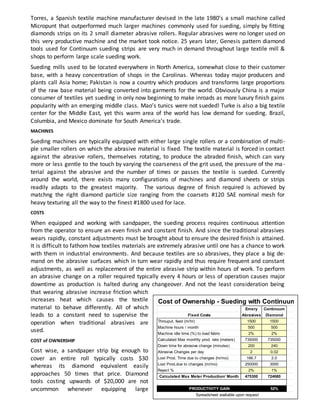
Cost of Ownership - Sueding with Continuum
Emery Continuum
Fixed Costs Abrasives Diamond
Throuput, feed (m/hr) 1500 1500
Machine hours / month 500 500
Machine idle time (%) to load fabric 2% 2%
Calculated Max monthly prod. rate (meters) 735000 735000
Down time for abrasive change (minutes) 200 240
Abrasive Changes per day 2 0.02
Lost Prod. Time due to changes (hr/mo) 166.7 2.0
Lost Prod.due to changes (m/mo) 250000 3000
Reject % 2% 1%
Calculated Max Meter Production/ Month 475300 724680
52%
Spreadsheet avaliable upon request
PRODUCTIVITY GAIN
Torres, a Spanish textile machine manufacturer devised in the late 1980’s a small machine called
Micropunt that outperformed much larger machines commonly used for sueding, simply by fitting
diamonds strips on its 2 small diameter abrasive rollers. Regular abrasives were no longer used on
this very productive machine and the market took notice. 25 years later, Genesis pattern diamond
tools used for Continuum sueding strips are very much in demand throughout large textile mill &
shops to perform large scale sueding work.
Sueding mills used to be located everywhere in North America, somewhat close to their customer
base, with a heavy concentration of shops in the Carolinas. Whereas today major producers and
plants call Asia home; Pakistan is now a country which produces and transforms large proportions
of the raw base material being converted into garments for the world. Obviously China is a major
consumer of textiles yet sueding in only now beginning to make inroads as more luxury finish gains
popularity with an emerging middle class. Mao’s tunics were not sueded! Turke is also a big textile
center for the Middle East, yet this warm area of the world has low demand for sueding. Brazil,
Columbia, and Mexico dominate for South America’s trade.
MACHINES
Sueding machines are typically equipped with either large single rollers or a combination of multi-
ple smaller rollers on which the abrasive material is fixed. The textile material is forced in contact
against the abrasive rollers, themselves rotating, to produce the abraded finish, which can vary
more or less gentle to the touch by varying the coarseness of the grit used, the pressure of the ma-
terial against the abrasive and the number of times or passes the textile is sueded. Currently
around the world, there exists many configurations of machines and diamond sheets or strips
readily adapts to the greatest majority. The various degree of finish required is achieved by
matchng the right diamond particle size ranging from the coarsets #120 SAE nominal mesh for
heavy texturing all the way to the finest #1800 used for lace.
COSTS
When equipped and working with sandpaper, the sueding process requires continuous attention
from the operator to ensure an even finish and constant finish. And since the traditional abrasives
wears rapidly, constant adjustments must be brought about to ensure the desired finish is attained.
It is difficult to fathom how textiles materials are extremely abrasive until one has a chance to work
with them in industrial environments. And because textiles are so abrasives, they place a big de-
mand on the abrasive surfaces which in turn wear rapidly and thus require frequent and constant
adjustments, as well as replacement of the entire abrasive strip within hours of work. To perform
an abrasive change on a roller required typically every 4 hours or less of operation causes major
downtime as production is halted during any changeover. And not the least consideration being
that wearing abrasive increase friction which
increases heat which causes the textile
material to behave differently. All of which
leads to a constant need to supervise the
operation when traditional abrasives are
used.
COST of OWNERSHIP
Cost wise, a sandpaper strip big enough to
cover an entire roll typically costs $30
whereas its diamond equivalent easily
approaches 50 times that price. Diamond
tools costing upwards of $20,000 are not
uncommon whenever equipping large
machines. Yet, the return on investment is easy to calculate for shop floor supervisors who readily
see the benefits on their productivity first hand, as changeover downtime is eliminated, production
increase. This can and does represent a significant amount of work that now gets done without any
additional costs as overheads remain steady, or even lowered because of reduced manpower
requirements. Whereas for managers and owners concerned with their cost structure, calculators
developed to assist them in calculating their savings and get past the initial sticker shock show the
tremendous payback of switching to diamonds. Overall, the benefits of switching to diamonds can
represent as much as 40% of overall productivity for a finishing mill.
The sueding market potential hovers between $5-10 million annually, for diamond strips alone. The
market is larger for abrasive in general because many small shops simply do not have the demand
to justify spending large sums on diamond tools that are seldom used or if they customers require
many grits sizes to satisfy their needs which require constant machines grit changes to satisfy their
needs. Diamonds is limited to the large shops producing huge quantities of the same material, day
in and day out.
INSTALATION
Yet, when the abrasive on those rollers is replaced with a diamond strip,
their performance characteristics change dramatically. Obviously a
diamond will significantly outlast it traditional counter part, typically
millions of meters. Consider that at a production speed of 10 meters per
minute, a machine will work continuously for months, 24/7, without
interruption. Downtime due to abrasive changes is eliminated during this
entire period and resulting production increased by a significant margin
of 25% or more. The fabric processed with diamonds has exactly the
same finish characteristics from the beginning to the end of each run.
And importantly, this is achieved with imperceptible operator intervention as the wear factor
normally encountered is effectively eliminated, and there is no further need to perform frequent
adjustments to ensure an even finish.
Quality and quantity is immensely improved when using diamonds.
Installing a diamond strips onto machinery no special tools. The long strip is wound helicoidally
onto the entire surface on the drum to fully cover its surface. The installation is finalized by
fastening securely at both ends by mechanical means, such as adhesive tape and zip ties.
CONTINUUM
Diamonds strips can be jointed to make endless belts. And, they can also be
jointed to produce very long strips. Yet, certain climates with high humidity
and temperature generate difficult conditions for jointed strips. In Asia,
particularly during monsoon season, conditions affected joints to come
apart, causing a catastrophic failure. Hence, we eliminated the joints
altogether and now offer a continuous seamless strip free of any possible
defect due to prevalent environmental conditions.
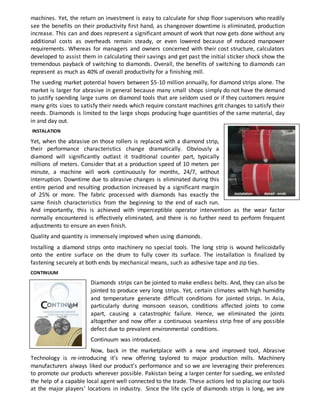
Continuum was introduced.
Now, back in the marketplace with a new and improved tool, Abrasive
Technology is re-introducing it’s new offering taylored to major production mills. Machinery
manufacturers always liked our product’s performance and so we are leveraging their preferences
to promote our products wherever possible. Pakistan being a larger center for sueding, we enlisted
the help of a capable local agent well connected to the trade. These actions led to placing our tools
at the major players’ locations in industry. Since the life cycle of diamonds strips is long, we are
now in evaluating mode for the short-term and fully expect our tools to become the tool of choice
once again within the trade. To this effect reorders have started so we know we are on the right
track. We are also attending major trade shows to promote new ideas.

Continuum™ for Sueding Textiles

  • 1.
    Continuum™ for SuedingTextiles, Marc Poirier, Sales & PDAE CONCLUSION – In a rush, here is the bottom line - LONG TERM Mills are faced with the continuous need to process other than pure cotton material. Synthetic fi- bers have the nasty habit of melting whenever they are exposed to heat even slightest amounts. That is why; the next challenges will be the processing of synthetic blends with the same ease as with pure cotton. We know it is doable and have ideas to propose to users and machinery manu- facturer that will entice them into exploring this new venue. All of which is making the name Abrasive Technology visible once again around the world as a company that provides the very best and innovative solutions for a specialized and demanding in- dustry, as well as reinforce AT as a dominant player in the finishing of textiles. Our next task is to address the sueding of sysnthetics and blends which are currently difficult to process with the current technology. --------------------------------------- SUEDING In the late 1980’s, a small Canadian start-up company called Diabrasive Int'l pioneered the use of flexible diamonds tools. Their concept was simple; in replacing traditional abrasives on the surface of emery paper with the more durable diamonds. The goal was to replace sandpaper throughout industry wherever application demands were severe with this newly devised concept material. Di- amonds being much harder than any other abrasive crystal, they outlast their traditional counter- part by a significant margin and are a natural for converting industrial applications. One of the lesser known uses of abrasives in industrial environments is for abrading textiles. The abrasion process gives their surface a much more pleasant finish to the touch. And, both knit and woven material is processed by this means and benefit from this finishing procedure. In 1988, Dia- brasive introduced flexible diamond to the sueding industry during ITMA, a leading textile trade show held in Hanover, Germany. MARKET Textiles are sueded, or abraded, or sanded to give the fabric a pleasing to the touch finish. The Japanese named this finish quite clearly using the term “peach skin” finish. Today, the term has evolved in diamond peach finish to reflect the use of thismore performing abrasive. Most textiles are abraded in some manner, whether for bedding sheets, pants, shirts as well as underwear, even upholstery. Lately swimwear and laced feminine lingerie discovered the new finishes available when sueding and represent the latest in demand from apparel manufacturers. For the most part, it is fashion that dictate finishes, and fall lines typically make more use of sueded finishes over lighter summer wear.
  • 2.
    Cost of Ownership- Sueding with Continuum Emery Continuum Fixed Costs Abrasives Diamond Throuput, feed (m/hr) 1500 1500 Machine hours / month 500 500 Machine idle time (%) to load fabric 2% 2% Calculated Max monthly prod. rate (meters) 735000 735000 Down time for abrasive change (minutes) 200 240 Abrasive Changes per day 2 0.02 Lost Prod. Time due to changes (hr/mo) 166.7 2.0 Lost Prod.due to changes (m/mo) 250000 3000 Reject % 2% 1% Calculated Max Meter Production/ Month 475300 724680 52% Spreadsheet avaliable upon request PRODUCTIVITY GAIN Torres, a Spanish textile machine manufacturer devised in the late 1980’s a small machine called Micropunt that outperformed much larger machines commonly used for sueding, simply by fitting diamonds strips on its 2 small diameter abrasive rollers. Regular abrasives were no longer used on this very productive machine and the market took notice. 25 years later, Genesis pattern diamond tools used for Continuum sueding strips are very much in demand throughout large textile mill & shops to perform large scale sueding work. Sueding mills used to be located everywhere in North America, somewhat close to their customer base, with a heavy concentration of shops in the Carolinas. Whereas today major producers and plants call Asia home; Pakistan is now a country which produces and transforms large proportions of the raw base material being converted into garments for the world. Obviously China is a major consumer of textiles yet sueding in only now beginning to make inroads as more luxury finish gains popularity with an emerging middle class. Mao’s tunics were not sueded! Turke is also a big textile center for the Middle East, yet this warm area of the world has low demand for sueding. Brazil, Columbia, and Mexico dominate for South America’s trade. MACHINES Sueding machines are typically equipped with either large single rollers or a combination of multi- ple smaller rollers on which the abrasive material is fixed. The textile material is forced in contact against the abrasive rollers, themselves rotating, to produce the abraded finish, which can vary more or less gentle to the touch by varying the coarseness of the grit used, the pressure of the ma- terial against the abrasive and the number of times or passes the textile is sueded. Currently around the world, there exists many configurations of machines and diamond sheets or strips readily adapts to the greatest majority. The various degree of finish required is achieved by matchng the right diamond particle size ranging from the coarsets #120 SAE nominal mesh for heavy texturing all the way to the finest #1800 used for lace. COSTS When equipped and working with sandpaper, the sueding process requires continuous attention from the operator to ensure an even finish and constant finish. And since the traditional abrasives wears rapidly, constant adjustments must be brought about to ensure the desired finish is attained. It is difficult to fathom how textiles materials are extremely abrasive until one has a chance to work with them in industrial environments. And because textiles are so abrasives, they place a big de- mand on the abrasive surfaces which in turn wear rapidly and thus require frequent and constant adjustments, as well as replacement of the entire abrasive strip within hours of work. To perform an abrasive change on a roller required typically every 4 hours or less of operation causes major downtime as production is halted during any changeover. And not the least consideration being that wearing abrasive increase friction which increases heat which causes the textile material to behave differently. All of which leads to a constant need to supervise the operation when traditional abrasives are used. COST of OWNERSHIP Cost wise, a sandpaper strip big enough to cover an entire roll typically costs $30 whereas its diamond equivalent easily approaches 50 times that price. Diamond tools costing upwards of $20,000 are not uncommon whenever equipping large
  • 3.
    machines. Yet, thereturn on investment is easy to calculate for shop floor supervisors who readily see the benefits on their productivity first hand, as changeover downtime is eliminated, production increase. This can and does represent a significant amount of work that now gets done without any additional costs as overheads remain steady, or even lowered because of reduced manpower requirements. Whereas for managers and owners concerned with their cost structure, calculators developed to assist them in calculating their savings and get past the initial sticker shock show the tremendous payback of switching to diamonds. Overall, the benefits of switching to diamonds can represent as much as 40% of overall productivity for a finishing mill. The sueding market potential hovers between $5-10 million annually, for diamond strips alone. The market is larger for abrasive in general because many small shops simply do not have the demand to justify spending large sums on diamond tools that are seldom used or if they customers require many grits sizes to satisfy their needs which require constant machines grit changes to satisfy their needs. Diamonds is limited to the large shops producing huge quantities of the same material, day in and day out. INSTALATION Yet, when the abrasive on those rollers is replaced with a diamond strip, their performance characteristics change dramatically. Obviously a diamond will significantly outlast it traditional counter part, typically millions of meters. Consider that at a production speed of 10 meters per minute, a machine will work continuously for months, 24/7, without interruption. Downtime due to abrasive changes is eliminated during this entire period and resulting production increased by a significant margin of 25% or more. The fabric processed with diamonds has exactly the same finish characteristics from the beginning to the end of each run. And importantly, this is achieved with imperceptible operator intervention as the wear factor normally encountered is effectively eliminated, and there is no further need to perform frequent adjustments to ensure an even finish. Quality and quantity is immensely improved when using diamonds. Installing a diamond strips onto machinery no special tools. The long strip is wound helicoidally onto the entire surface on the drum to fully cover its surface. The installation is finalized by fastening securely at both ends by mechanical means, such as adhesive tape and zip ties. CONTINUUM Diamonds strips can be jointed to make endless belts. And, they can also be jointed to produce very long strips. Yet, certain climates with high humidity and temperature generate difficult conditions for jointed strips. In Asia, particularly during monsoon season, conditions affected joints to come apart, causing a catastrophic failure. Hence, we eliminated the joints altogether and now offer a continuous seamless strip free of any possible defect due to prevalent environmental conditions. Continuum was introduced. Now, back in the marketplace with a new and improved tool, Abrasive Technology is re-introducing it’s new offering taylored to major production mills. Machinery manufacturers always liked our product’s performance and so we are leveraging their preferences to promote our products wherever possible. Pakistan being a larger center for sueding, we enlisted the help of a capable local agent well connected to the trade. These actions led to placing our tools at the major players’ locations in industry. Since the life cycle of diamonds strips is long, we are
  • 4.
    now in evaluatingmode for the short-term and fully expect our tools to become the tool of choice once again within the trade. To this effect reorders have started so we know we are on the right track. We are also attending major trade shows to promote new ideas.