WORKSHOP ON HEAVY-DUTY FUEL
EFFICIENCY REGULATIONS
April 29th, 2015.
K. SRINIVAS
CONTENT
 Brief Overview of ARAI.
 Emission test facility at ARAI ECL.
 Fuel Economy India status.
 Global Fuel Economy Regulation Status.
 Highlights of IS 11921
 Propose road map for HDV fuel economy norms in
INDIA
 Existing test facility in India for HDV testing
An Overview
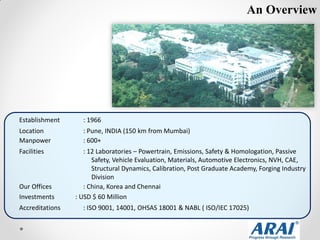
Establishment : 1966
Location : Pune, INDIA (150 km from Mumbai)
Manpower : 600+
Facilities : 12 Laboratories – Powertrain, Emissions, Safety & Homologation, Passive
Safety, Vehicle Evaluation, Materials, Automotive Electronics, NVH, CAE,
Structural Dynamics, Calibration, Post Graduate Academy, Forging Industry
Division
Our Offices : China, Korea and Chennai
Investments : USD $ 60 Million
Accreditations : ISO 9001, 14001, OHSAS 18001 & NABL ( ISO/IEC 17025)
Pune,
India
China
South
Korea
Chennai,
India
Chakan, India
Upcoming Facilities at Chakan
Facilities
Regional Office
Representative
Upcoming Facilities
Capabilities Emission Lab
Emission
Certification
Laboratory
2-Wheelers
3-Wheelers
Passenger Car/Utility
Vehicles
LCV/HCV
Engines (Automotive,
Tractor, Construction
Equipment, Genset
Emission Measurement
CO,HC,Nox,CO2 PM
Gasoline/Diesel/CNG/LP
G/Biodiesel/Ethanol/
Methanol
PM Size, Number
Distribution
Fuel Consumption/
Performance/
Continuous data
Certification
and R&D
Special Assignment:
Oil Fuel analysis,
Emission Inventory,
AQM
Emission Facilities & Overview
6
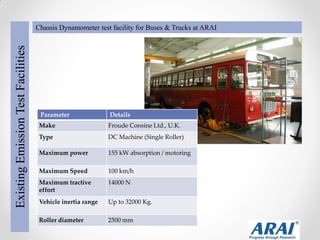
ExistingEmissionTestFacilities
Parameter Details
Make Froude Consine Ltd., U.K.
Type DC Machine (Single Roller)
Maximum power 155 kW absorption / motoring
Maximum Speed 100 km/h
Maximum tractive
effort
14000 N
Vehicle inertia range Up to 32000 Kg.
Roller diameter 2500 mm
Chassis Dynamometer test facility for Buses & Trucks at ARAI
7
NewEmissionEngineTestFacilities
Transient Engine Dynamometers
with Full Flow Dilution Tunnel
(220 kW & 500 kW)
• Broad Specifications :
– Heavy Duty Transient Dynamometer : 500kW @ 1600 to
3200rm, 3000 Nm @ 800 to 1600 rpm.
– Heavy Duty Transient Dynamometer : 220kW @ 2200 to
4500rm, 960 Nm @ 1000 to 2200 rpm.
– Emission Analyser : Suitable for measurement up to Euro V.
Useful for :
• Automotive BSIV, BSIII
• Tractor Trem IIIA
• CEV BSIII
• Export Homologation
• High Altitude Simulation
• Friction Mapping testing
• Vehicle Simulation
8
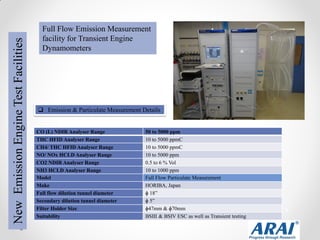
Full Flow Emission Measurement
facility for Transient Engine
Dynamometers
 Emission & Particulate Measurement Details
CO (L) NDIR Analyser Range 50 to 5000 ppm
THC HFID Analyser Range 10 to 5000 ppmC
CH4/ THC HFID Analyser Range 10 to 5000 ppmC
NO/ NOx HCLD Analyser Range 10 to 5000 ppm
CO2 NDIR Analyser Range 0.5 to 6 % Vol
NH3 HCLD Analyser Range 10 to 1000 ppm
Model Full Flow Particulate Measurement
Make HORIBA, Japan
Full flow dilution tunnel diameter ɸ 18”
Secondary dilution tunnel diameter ɸ 5”
Filter Holder Size ɸ47mm & ɸ70mm
Suitability BSIII & BSIV ESC as well as Transient testing
NewEmissionEngineTestFacilities
9
• Weighing Balance
Make :- Saurtourius
Model MSU 2.7S-000-DF
Range = 0-2100 mg
Resolution = 0.1 µg
Precision = 20 mg
Buoyancy correction for 40CFR1065 requirement
Weighing Chamber
Make Horiba
Model CHAM 1000
Accuracy :
Temperature 22 +/- 1 Deg. C
Dew Point 9.5 +/- 1 Deg. C
NewEmissionEngineTestFacilities
10
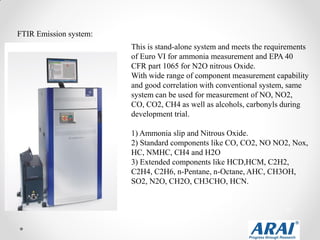
FTIR Emission system:
This is stand-alone system and meets the requirements
of Euro VI for ammonia measurement and EPA 40
CFR part 1065 for N2O nitrous Oxide.
With wide range of component measurement capability
and good correlation with conventional system, same
system can be used for measurement of NO, NO2,
CO, CO2, CH4 as well as alcohols, carbonyls during
development trial.
1) Ammonia slip and Nitrous Oxide.
2) Standard components like CO, CO2, NO NO2, Nox,
HC, NMHC, CH4 and H2O
3) Extended components like HCD,HCM, C2H2,
C2H4, C2H6, n-Pentane, n-Octane, AHC, CH3OH,
SO2, N2O, CH2O, CH3CHO, HCN.
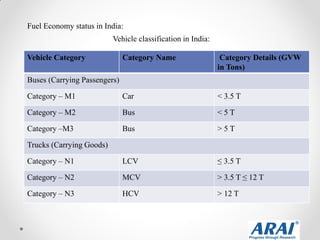
Vehicle classification in India:
Vehicle Category Category Name Category Details (GVW
in Tons)
Buses (Carrying Passengers)
Category – M1 Car < 3.5 T
Category – M2 Bus < 5 T
Category –M3 Bus > 5 T
Trucks (Carrying Goods)
Category – N1 LCV ≤ 3.5 T
Category – N2 MCV > 3.5 T ≤ 12 T
Category – N3 HCV > 12 T
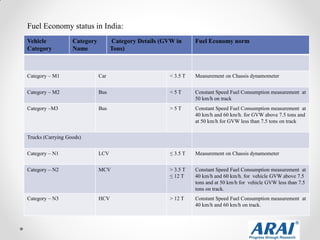
Fuel Economy status in India:
Vehicle
Category
Category
Name
Category Details (GVW in
Tons)
Fuel Economy norm
Category – M1 Car < 3.5 T Measurement on Chassis dynamometer
Category – M2 Bus < 5 T Constant Speed Fuel Consumption measurement at
50 km/h on track
Category –M3 Bus > 5 T Constant Speed Fuel Consumption measurement at
40 km/h and 60 km/h. for GVW above 7.5 tons and
at 50 km/h for GVW less than 7.5 tons on track
Trucks (Carrying Goods)
Category – N1 LCV ≤ 3.5 T Measurement on Chassis dynamometer
Category – N2 MCV > 3.5 T
≤ 12 T
Constant Speed Fuel Consumption measurement at
40 km/h and 60 km/h. for vehicle GVW above 7.5
tons and at 50 km/h for vehicle GVW less than 7.5
tons on track.
Category – N3 HCV > 12 T Constant Speed Fuel Consumption measurement at
40 km/h and 60 km/h on track.
Fuel Economy status in India:
Global FE regulation status
Proposed
schedule
Regulatory Categories Certification Test
Procedures
Metric
Japan The FC
standards for
commercial
vehicles to be
effective from
2015
Other Truck (11 subcategories)
Tractor (2 subcategories)
Route Bus (5 subcategories)
Other Bus (8 subcategories)
Simulation modelling
+engine
dynamometer testing
Fuel economy
(km/L)
N. America CO2 and FC
standards begin
in 2015.
Tractors
Vocational vehicles
HD pickup trucks and vans
Engines (tractors, voc. vehicles)
Vehicles
simulation model
Engines
dynamometer testing
Tractors,
Vocation
al
HD
Pickups
Engines
gal/1,000
ton-mi
gal/100
mi
gal/100
bhp-hr
g/ton-mi g/mi g/kWh
China The FC standard
has been
implemented
from 2014.
Tractors, dump trucks, rigid
trucks, city
buses, other buses
“Base” vehicles
chassis dynamometer
Variant” vehicles
simulation modelling
Fuel consumption
(L/100 km)
European Union Development of simulation method on going.
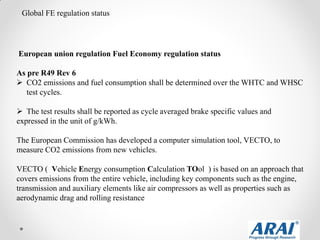
European union regulation Fuel Economy regulation status
As pre R49 Rev 6
 CO2 emissions and fuel consumption shall be determined over the WHTC and WHSC
test cycles.
 The test results shall be reported as cycle averaged brake specific values and
expressed in the unit of g/kWh.
The European Commission has developed a computer simulation tool, VECTO, to
measure CO2 emissions from new vehicles.
VECTO ( Vehicle Energy consumption Calculation TOol ) is based on an approach that
covers emissions from the entire vehicle, including key components such as the engine,
transmission and auxiliary elements like air compressors as well as properties such as
aerodynamic drag and rolling resistance
Global FE regulation status
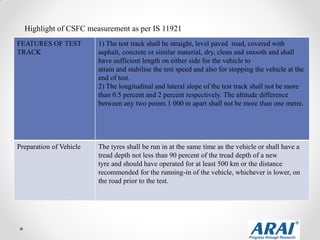
Highlight of CSFC measurement as per IS 11921
FEATURES OF TEST
TRACK
1) The test track shall be straight, level paved road, covered with
asphalt, concrete or similar material, dry, clean and smooth and shall
have sufficient length on either side for the vehicle to
attain and stabilise the test speed and also for stopping the vehicle at the
end of test.
2) The longitudinal and lateral slope of the test track shall not be more
than 0.5 percent and 2 percent respectively. The altitude difference
between any two points 1 000 m apart shall not be more than one metre.
Preparation of Vehicle The tyres shall be run in at the same time as the vehicle or shall have a
tread depth not less than 90 percent of the tread depth of a new
tyre and should have operated for at least 500 km or the distance
recommended for the running-in of the vehicle, whichever is lower, on
the road prior to the test.
Accessories All power consuming accessories and equipments such as lighting and
illuminating devices, windshield wiper and washing system, record
player, air climatizer, etc, shall be switched off. However, the drive for
the air climatizer compressor shall not be disconnected.
WEIGHTS The unladen weight shall be the complete vehicle kerb weight as per IS
9211 : 1979, where applicable.
The vehicle shall be loaded to a gross weight required for that particular
test and shall be recorded in the test report
Highlight of CSFC measurement as per IS 11921
AMBIENT
CONDITIONS
Standard reference conditions.
a) Temperature : 300 K ( 27°C ) b) Pressure : 100 kPa
The ambient conditions at the test site shall be:
Temperature : 288 to 308 K ( 15 to 35°C)
Relative humidity : Not more than 75 Percent Air density when calculated as described
below shall not differ by more than 7.5 percent from the air density under the reference
conditions:
The wind velocity in any direction shall not exceed 3 m/set. The measurement of wind
velocity shall be done at a height of 1 to l-5 m above road surface.
TEST The vehicle shall be tested at the constant speed/speeds required for the test. The
vehicle shall be run in top gear or in the gear as recommended by the manufacturer.
The test shall be conducted over a distance of not less than 1000 m. Two consecutive
test runs in the opposite directions shall constitute a pass..
The test shall be conducted sufficient number of times such that the readings for at
least 5 passes ( one pass comprising consecutive
readings in the opposite directions ), whose variation of S ( Fuel consumption) for that
pass in not more than +/- 2.5 percent of mean and the average speed not varying by
more than +/- 1 km/h from the specified speed can be selected. These readings shall be
selected such that the variation S and Fuel consumption is minimum.
National Centre for Automotive Testing
(NCAT, Ahmednagar)
Highlight of CSFC measurement as per IS 11921
For following changes CSFC test needs to be perform.
 For change in GVW in excess of 10%
 Change in swept volume in excess of 10,number and arrangement of
cylinder.
 Change in engine power or torque in excess of 5%.
 Change in fuel system.
 Change in type of transmission.
 Change in radial ply to cross ply or vice versa.
 Change in overall transmission ratio.
 Change in body shape with increases the frontal area.
 Change of fuel type ( petrol/diesel etc)
 no. of axles
 Change in injection / injection timing in excess of 2 deg.
 No. of tyres
 Change in tyre size
 Air intake system ( NA, TC etc)
 Change in Engine Control Unit, including calibration
The above criteria may be reviewed
1) Sub-categorization of vehicle classification for FE norm.
2) Development of test methodology for entire vehicle FE measurement.
3) Development of simulation tool for CO2 and fuel measurement from the entire
vehicle, including key components such as the engine, transmission and
auxiliary elements like air compressors as well as properties such as
aerodynamic drag and rolling resistance .
4) Till development of simulation tool measurement of
 Constant speed fuel consumption as per IS 11921:1993 i.e. ‘’Automotive
Vehicles - Method of evaluation & fuel consumption’’ to be continued.
 CO2 emissions and fuel consumption shall be determined over the ESC and
ETC test cycles for all BSIV engine.
 The test results shall be reported as cycle averaged brake specific values and
expressed in the unit of g/kWh.
Propose road map for HDV fuel economy norms in INDIA
Existing test facility in India for HDV testing
Facility for Engine
Dynamometer( Transient)
Facility for Chassis
Dynamometer (HDV vehicle)
ARAI YES YES
VRDE YES NO
ICAT YES NO
M/s. Tata Motors Ltd. YES YES
M/s. Ashok Leyland Ltd. YES NO
M/s. VE Commercial Vehicles Ltd.
(A Volvo Group & Eicher Motors Joint Venture)
YES NO
M/s Mahindra & Mahindra Limited.
Truck and Bus Division
YES NO
M/s. Daimler India Commercial Vehicles Pvt. Ltd.
NO ( Available at overseas) NO ( Available at overseas)
M/s. Mahindra Navistar Automotives Ltd. NO NO
M/s. MAN Trucks India Pvt. Ltd. NO ( Available at overseas) NO ( Available at overseas)
M/s. Scania Commercial Vehicles India Pvt. Ltd.
NO ( Available at overseas) NO ( Available at overseas)
M/s. SML ISUZU LTD. YES NO
M/s. Force Motors Ltd. YES NO
M/s. AMW Motors Ltd. NO NO
22
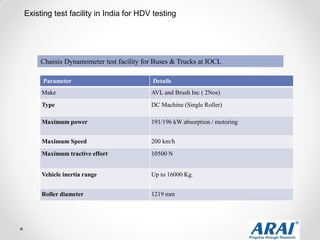
Parameter Details
Make AVL and Brush Inc ( 2Nos)
Type DC Machine (Single Roller)
Maximum power 191/196 kW absorption / motoring
Maximum Speed 200 km/h
Maximum tractive effort 10500 N
Vehicle inertia range Up to 16000 Kg.
Roller diameter 1219 mm
Chassis Dynamometer test facility for Buses & Trucks at IOCL
Existing test facility in India for HDV testing
Parameter Pune Pune Jamshedpur
Make BEP,USA BEP,USA BEP,USA
Type DC Machine (Single
Roller)
DC Machine (Single
Roller)
DC Machine (Single
Roller)
Maximum Speed 130 km/h 130 km/h 130 km/h
Maximum
tractive effort
32,388 N 140,428 N 270,280 N
Vehicle inertia
range
3.5-25 T 3.5-50 T 3.5-50 T
Roller diameter 1905 mm 1905 mm 1905 mm
Chassis Dynamometer test facility for Buses & Trucks at TML
Existing test facility in India for HDV testing
Vehicle inertia
simulation
Fuel consumption
measurement
Emission
measurement
capability
ARAI 32 tons Yes Yes
TML Pune 25 tons / 50 tons Yes No
TML
Jamshedpur
50 tons Yes No
IOCL 16 tons Yes Yes
Existing test facility in India for HDV testing
Thanks

Arai emission testing

  • 1.
    WORKSHOP ON HEAVY-DUTYFUEL EFFICIENCY REGULATIONS April 29th, 2015. K. SRINIVAS
  • 2.
    CONTENT  Brief Overviewof ARAI.  Emission test facility at ARAI ECL.  Fuel Economy India status.  Global Fuel Economy Regulation Status.  Highlights of IS 11921  Propose road map for HDV fuel economy norms in INDIA  Existing test facility in India for HDV testing
  • 3.
    An Overview Establishment :1966 Location : Pune, INDIA (150 km from Mumbai) Manpower : 600+ Facilities : 12 Laboratories – Powertrain, Emissions, Safety & Homologation, Passive Safety, Vehicle Evaluation, Materials, Automotive Electronics, NVH, CAE, Structural Dynamics, Calibration, Post Graduate Academy, Forging Industry Division Our Offices : China, Korea and Chennai Investments : USD $ 60 Million Accreditations : ISO 9001, 14001, OHSAS 18001 & NABL ( ISO/IEC 17025)
  • 4.
    Pune, India China South Korea Chennai, India Chakan, India Upcoming Facilitiesat Chakan Facilities Regional Office Representative Upcoming Facilities
  • 5.
    Capabilities Emission Lab Emission Certification Laboratory 2-Wheelers 3-Wheelers PassengerCar/Utility Vehicles LCV/HCV Engines (Automotive, Tractor, Construction Equipment, Genset Emission Measurement CO,HC,Nox,CO2 PM Gasoline/Diesel/CNG/LP G/Biodiesel/Ethanol/ Methanol PM Size, Number Distribution Fuel Consumption/ Performance/ Continuous data Certification and R&D Special Assignment: Oil Fuel analysis, Emission Inventory, AQM Emission Facilities & Overview
  • 6.
    6 ExistingEmissionTestFacilities Parameter Details Make FroudeConsine Ltd., U.K. Type DC Machine (Single Roller) Maximum power 155 kW absorption / motoring Maximum Speed 100 km/h Maximum tractive effort 14000 N Vehicle inertia range Up to 32000 Kg. Roller diameter 2500 mm Chassis Dynamometer test facility for Buses & Trucks at ARAI
  • 7.
    7 NewEmissionEngineTestFacilities Transient Engine Dynamometers withFull Flow Dilution Tunnel (220 kW & 500 kW) • Broad Specifications : – Heavy Duty Transient Dynamometer : 500kW @ 1600 to 3200rm, 3000 Nm @ 800 to 1600 rpm. – Heavy Duty Transient Dynamometer : 220kW @ 2200 to 4500rm, 960 Nm @ 1000 to 2200 rpm. – Emission Analyser : Suitable for measurement up to Euro V. Useful for : • Automotive BSIV, BSIII • Tractor Trem IIIA • CEV BSIII • Export Homologation • High Altitude Simulation • Friction Mapping testing • Vehicle Simulation
  • 8.
    8 Full Flow EmissionMeasurement facility for Transient Engine Dynamometers  Emission & Particulate Measurement Details CO (L) NDIR Analyser Range 50 to 5000 ppm THC HFID Analyser Range 10 to 5000 ppmC CH4/ THC HFID Analyser Range 10 to 5000 ppmC NO/ NOx HCLD Analyser Range 10 to 5000 ppm CO2 NDIR Analyser Range 0.5 to 6 % Vol NH3 HCLD Analyser Range 10 to 1000 ppm Model Full Flow Particulate Measurement Make HORIBA, Japan Full flow dilution tunnel diameter ɸ 18” Secondary dilution tunnel diameter ɸ 5” Filter Holder Size ɸ47mm & ɸ70mm Suitability BSIII & BSIV ESC as well as Transient testing NewEmissionEngineTestFacilities
  • 9.
    9 • Weighing Balance Make:- Saurtourius Model MSU 2.7S-000-DF Range = 0-2100 mg Resolution = 0.1 µg Precision = 20 mg Buoyancy correction for 40CFR1065 requirement Weighing Chamber Make Horiba Model CHAM 1000 Accuracy : Temperature 22 +/- 1 Deg. C Dew Point 9.5 +/- 1 Deg. C NewEmissionEngineTestFacilities
  • 10.
    10 FTIR Emission system: Thisis stand-alone system and meets the requirements of Euro VI for ammonia measurement and EPA 40 CFR part 1065 for N2O nitrous Oxide. With wide range of component measurement capability and good correlation with conventional system, same system can be used for measurement of NO, NO2, CO, CO2, CH4 as well as alcohols, carbonyls during development trial. 1) Ammonia slip and Nitrous Oxide. 2) Standard components like CO, CO2, NO NO2, Nox, HC, NMHC, CH4 and H2O 3) Extended components like HCD,HCM, C2H2, C2H4, C2H6, n-Pentane, n-Octane, AHC, CH3OH, SO2, N2O, CH2O, CH3CHO, HCN.
  • 11.
    Vehicle classification inIndia: Vehicle Category Category Name Category Details (GVW in Tons) Buses (Carrying Passengers) Category – M1 Car < 3.5 T Category – M2 Bus < 5 T Category –M3 Bus > 5 T Trucks (Carrying Goods) Category – N1 LCV ≤ 3.5 T Category – N2 MCV > 3.5 T ≤ 12 T Category – N3 HCV > 12 T Fuel Economy status in India:
  • 12.
    Vehicle Category Category Name Category Details (GVWin Tons) Fuel Economy norm Category – M1 Car < 3.5 T Measurement on Chassis dynamometer Category – M2 Bus < 5 T Constant Speed Fuel Consumption measurement at 50 km/h on track Category –M3 Bus > 5 T Constant Speed Fuel Consumption measurement at 40 km/h and 60 km/h. for GVW above 7.5 tons and at 50 km/h for GVW less than 7.5 tons on track Trucks (Carrying Goods) Category – N1 LCV ≤ 3.5 T Measurement on Chassis dynamometer Category – N2 MCV > 3.5 T ≤ 12 T Constant Speed Fuel Consumption measurement at 40 km/h and 60 km/h. for vehicle GVW above 7.5 tons and at 50 km/h for vehicle GVW less than 7.5 tons on track. Category – N3 HCV > 12 T Constant Speed Fuel Consumption measurement at 40 km/h and 60 km/h on track. Fuel Economy status in India:
  • 13.
    Global FE regulationstatus Proposed schedule Regulatory Categories Certification Test Procedures Metric Japan The FC standards for commercial vehicles to be effective from 2015 Other Truck (11 subcategories) Tractor (2 subcategories) Route Bus (5 subcategories) Other Bus (8 subcategories) Simulation modelling +engine dynamometer testing Fuel economy (km/L) N. America CO2 and FC standards begin in 2015. Tractors Vocational vehicles HD pickup trucks and vans Engines (tractors, voc. vehicles) Vehicles simulation model Engines dynamometer testing Tractors, Vocation al HD Pickups Engines gal/1,000 ton-mi gal/100 mi gal/100 bhp-hr g/ton-mi g/mi g/kWh China The FC standard has been implemented from 2014. Tractors, dump trucks, rigid trucks, city buses, other buses “Base” vehicles chassis dynamometer Variant” vehicles simulation modelling Fuel consumption (L/100 km) European Union Development of simulation method on going.
  • 14.
    European union regulationFuel Economy regulation status As pre R49 Rev 6  CO2 emissions and fuel consumption shall be determined over the WHTC and WHSC test cycles.  The test results shall be reported as cycle averaged brake specific values and expressed in the unit of g/kWh. The European Commission has developed a computer simulation tool, VECTO, to measure CO2 emissions from new vehicles. VECTO ( Vehicle Energy consumption Calculation TOol ) is based on an approach that covers emissions from the entire vehicle, including key components such as the engine, transmission and auxiliary elements like air compressors as well as properties such as aerodynamic drag and rolling resistance Global FE regulation status
  • 15.
    Highlight of CSFCmeasurement as per IS 11921 FEATURES OF TEST TRACK 1) The test track shall be straight, level paved road, covered with asphalt, concrete or similar material, dry, clean and smooth and shall have sufficient length on either side for the vehicle to attain and stabilise the test speed and also for stopping the vehicle at the end of test. 2) The longitudinal and lateral slope of the test track shall not be more than 0.5 percent and 2 percent respectively. The altitude difference between any two points 1 000 m apart shall not be more than one metre. Preparation of Vehicle The tyres shall be run in at the same time as the vehicle or shall have a tread depth not less than 90 percent of the tread depth of a new tyre and should have operated for at least 500 km or the distance recommended for the running-in of the vehicle, whichever is lower, on the road prior to the test.
  • 16.
    Accessories All powerconsuming accessories and equipments such as lighting and illuminating devices, windshield wiper and washing system, record player, air climatizer, etc, shall be switched off. However, the drive for the air climatizer compressor shall not be disconnected. WEIGHTS The unladen weight shall be the complete vehicle kerb weight as per IS 9211 : 1979, where applicable. The vehicle shall be loaded to a gross weight required for that particular test and shall be recorded in the test report Highlight of CSFC measurement as per IS 11921
  • 17.
    Highlight of CSFCmeasurement as per IS 11921 AMBIENT CONDITIONS Standard reference conditions. a) Temperature : 300 K ( 27°C ) b) Pressure : 100 kPa The ambient conditions at the test site shall be: Temperature : 288 to 308 K ( 15 to 35°C) Relative humidity : Not more than 75 Percent Air density when calculated as described below shall not differ by more than 7.5 percent from the air density under the reference conditions: The wind velocity in any direction shall not exceed 3 m/set. The measurement of wind velocity shall be done at a height of 1 to l-5 m above road surface. TEST The vehicle shall be tested at the constant speed/speeds required for the test. The vehicle shall be run in top gear or in the gear as recommended by the manufacturer. The test shall be conducted over a distance of not less than 1000 m. Two consecutive test runs in the opposite directions shall constitute a pass.. The test shall be conducted sufficient number of times such that the readings for at least 5 passes ( one pass comprising consecutive readings in the opposite directions ), whose variation of S ( Fuel consumption) for that pass in not more than +/- 2.5 percent of mean and the average speed not varying by more than +/- 1 km/h from the specified speed can be selected. These readings shall be selected such that the variation S and Fuel consumption is minimum.
  • 18.
    National Centre forAutomotive Testing (NCAT, Ahmednagar)
  • 19.
    Highlight of CSFCmeasurement as per IS 11921 For following changes CSFC test needs to be perform.  For change in GVW in excess of 10%  Change in swept volume in excess of 10,number and arrangement of cylinder.  Change in engine power or torque in excess of 5%.  Change in fuel system.  Change in type of transmission.  Change in radial ply to cross ply or vice versa.  Change in overall transmission ratio.  Change in body shape with increases the frontal area.  Change of fuel type ( petrol/diesel etc)  no. of axles  Change in injection / injection timing in excess of 2 deg.  No. of tyres  Change in tyre size  Air intake system ( NA, TC etc)  Change in Engine Control Unit, including calibration The above criteria may be reviewed
  • 20.
    1) Sub-categorization ofvehicle classification for FE norm. 2) Development of test methodology for entire vehicle FE measurement. 3) Development of simulation tool for CO2 and fuel measurement from the entire vehicle, including key components such as the engine, transmission and auxiliary elements like air compressors as well as properties such as aerodynamic drag and rolling resistance . 4) Till development of simulation tool measurement of  Constant speed fuel consumption as per IS 11921:1993 i.e. ‘’Automotive Vehicles - Method of evaluation & fuel consumption’’ to be continued.  CO2 emissions and fuel consumption shall be determined over the ESC and ETC test cycles for all BSIV engine.  The test results shall be reported as cycle averaged brake specific values and expressed in the unit of g/kWh. Propose road map for HDV fuel economy norms in INDIA
  • 21.
    Existing test facilityin India for HDV testing Facility for Engine Dynamometer( Transient) Facility for Chassis Dynamometer (HDV vehicle) ARAI YES YES VRDE YES NO ICAT YES NO M/s. Tata Motors Ltd. YES YES M/s. Ashok Leyland Ltd. YES NO M/s. VE Commercial Vehicles Ltd. (A Volvo Group & Eicher Motors Joint Venture) YES NO M/s Mahindra & Mahindra Limited. Truck and Bus Division YES NO M/s. Daimler India Commercial Vehicles Pvt. Ltd. NO ( Available at overseas) NO ( Available at overseas) M/s. Mahindra Navistar Automotives Ltd. NO NO M/s. MAN Trucks India Pvt. Ltd. NO ( Available at overseas) NO ( Available at overseas) M/s. Scania Commercial Vehicles India Pvt. Ltd. NO ( Available at overseas) NO ( Available at overseas) M/s. SML ISUZU LTD. YES NO M/s. Force Motors Ltd. YES NO M/s. AMW Motors Ltd. NO NO
  • 22.
    22 Parameter Details Make AVLand Brush Inc ( 2Nos) Type DC Machine (Single Roller) Maximum power 191/196 kW absorption / motoring Maximum Speed 200 km/h Maximum tractive effort 10500 N Vehicle inertia range Up to 16000 Kg. Roller diameter 1219 mm Chassis Dynamometer test facility for Buses & Trucks at IOCL Existing test facility in India for HDV testing
  • 23.
    Parameter Pune PuneJamshedpur Make BEP,USA BEP,USA BEP,USA Type DC Machine (Single Roller) DC Machine (Single Roller) DC Machine (Single Roller) Maximum Speed 130 km/h 130 km/h 130 km/h Maximum tractive effort 32,388 N 140,428 N 270,280 N Vehicle inertia range 3.5-25 T 3.5-50 T 3.5-50 T Roller diameter 1905 mm 1905 mm 1905 mm Chassis Dynamometer test facility for Buses & Trucks at TML Existing test facility in India for HDV testing
  • 24.
    Vehicle inertia simulation Fuel consumption measurement Emission measurement capability ARAI32 tons Yes Yes TML Pune 25 tons / 50 tons Yes No TML Jamshedpur 50 tons Yes No IOCL 16 tons Yes Yes Existing test facility in India for HDV testing
  • 25.