CARDIAC AMYLOIDOSIS
DR MAHENDRA
CARDIOLOGY, JIPMER
Amyloidosis
• Systemic process
• Extracellular tissue infiltration of aberrantly folded
insoluble β-pleated sheets of protein aggregates
• Apple-green birefringence in Congo red stain
• Deposition - parenchymal stiffening and dysfunction of
affected organs
2
• Myocardial amyloid deposition - cardiomyocyte distortion,
cardiomyocyte separation, tissue stiffening, and organ
dysfunction
• Disruption of mechanical and electrochemical cardiac
function
• Most apparent in the ventricles –
* Progressive myocardial thickening,
* Restrictive cardiomyopathy, and
* Diastolic dysfunction
• Conduction abnormalities, valvular malfunction, and
vascular infiltration
3
Cardiac specimen exhibiting amyloid deposition. Amyloid deposits
show as light-pink infiltrative material with concentric left ventricular
and interventricular septal thickening. Right ventricular amyloid
deposition is also apparent
4
Precursors that may affect the heart
• Light-chain (LC) immunoglobulin
• Mutant hereditary transthyretin (TTR)
• Wild-type TTR
• Mutant apolipoprotein AI
• Amyloid atrial natriuretic peptide localized to the atrium
• Fibrinogen alpha type
• Serum amyloid A protein
Organs involved
• Liver, kidney, gastrointestinal tract,nervous tissue and
heart
5
Heart involvement
• AL amyloidosis – 50 %
• Systemic senile amyloidosis (SSA) and some forms of
hereditary TTR-related amyloidosis (ATTR) affect the
heart almost invariably
• Secondary amyloidosis - Cardiac involvement is rare or
minimal or clinically non-significant
6
Key “red flags” to possible systemic
amyloidosis
• Nephrotic syndrome
• Autonomic neuropathy (eg postural
hypotension, diarrhea)
• Soft-tissue infiltrations (eg
macroglossia, carpal tunnel syndrome,
respiratory disease),
• Bleeding (eg cutaneous, such as
periorbital, gastrointestinal)
• Malnutrition/cachexia and
• Genetic predisposition (eg, family
history, ethnicity).
7
• Secondary amyloidosis- consequence of chronic
inflammatory conditions
* Rheumatoid arthritis
* Crohn’s disease
* Chronic inflammatory/infectious diseases
* Familial Mediterranean fever
* Idiopathic amyloid A amyloidosis
8
Survival
• AL amyloidosis- Median survival of <1 year without
treatment
• Median survival 6-9 months in those with heart failure
• 1.1 years in those with any sign of cardiac involvement
• Transthyretin amyloidosis (familial or wild-type) and
secondary amyloidosis –
Myocardial infiltration can be severe with
minimal symptoms and a median survival of several
years, even if untreated
9
10
11
Monoclonal Paraprotein
• SPEP
• Monoclonal Lambda or Kappa
Light chain spike
• Free serum light chains
• The presence of a serum or
urine monoclonal paraprotein
is suggestive of AL
amyloidosis, but it alone does
not firmly establish the
diagnosis.
• Pt may have senile cardiac
amyloid and unrelated MGUS
with these clinical findings
12
Light-chain amyloidosis
• Extracellular deposition of fibril-forming monoclonal
immunoglobulin LCs, secreted by a small plasma cell clone
• Detectable by Immunofixation and/or immunoelectrophoresis in
80—90% of patients
• Non-invasive biopsies of abdominal fat and minor salivary
glands should be performed initially (usually positive in 80% of
patients)
• If necessary, biopsy of a clinically affected organ (kidney,
gastrointestinal tract or endomyocardial tissue) should be
considered
• Electron microscopy : ultrastructural appearance of randomly
arranged fibrils (7—10 nm in external diameter)
13
14
Diagnostic criteria for cardiac involvement
• An increase in mean wall thickness in end-ventricular
diastole of ≥ 12 mm by echocardiography, with no other
obvious cardiac cause,
• An increase in the concentrationof NT-proBNP to > 332
ng/L (in absence of renal failure). (may fall dramatically
within weeks after chemotherapy
15
The Mayo Clinic staging
• A current staging system—the Mayo Clinic staging (based
on NT-proBNP (cut-offvalue = 332 ng/L; BNP = 100 ng/L)
and cardiac troponin (cut-off value = 0.035 g/L)
• High risk (stage III: both biomarkers are increased)
• Intermediate risk (stage II: at least one biomarker is
abovethe cut-off value)
• Low risk (stage I: both biomarkers are below the cut-
offvalues).
16
ECG
• Abnormal in 90% of cases with cardiac involvement
• Low voltage QRS complex (defined as all limb leads < 5 mm in
height) and a pseudoinfarct pattern on the precordial leads (50%
of patients with cardiac AL amyloidosis)
17
Echo
• Infiltrative/restrictive cardiomyopathy
• Increased LV wall thickness ≥ 12 mm with ‘brilliant’ speck-
led appearance of the myocardium (amyloid fibrils
deposits are more echogenic than normal myocardium)
• Sparkling pattern is not sensitive because only a minority
(26%) has it
• Normal or small LV cavity
• Preserved LVEF > 50% (at least in the early stage of the
disease), but reduced S and E’ waves Abnormal mitral
filling pattern
18
Absent A wave in setting of NSR (Atrial arrest)
19
20
• Typical echo findings in cardiac amyloidosis: thickened
and sparkled LV walls, thickened inter-atrial septum, mitral
and tricuspid valves, thickened right ventricular free wall,
small pericardial effusion, normal LV cavity size and atrial
enlargement
21
Other echo findings
• LAE (diameter > 23 mm/m2,area > 20 cm2 or maximal volume
> 28 mL/m2)
• RAE and dilated IVC reflecting elevated RV filling pressure
• Increased interatrial septal thickness
• Increased RV free wall thickness (> 7 mm) with RV systolic and
diastolic dysfunctions
• Left and right valve thickening
• Reduced aortic ejection time (< 273 ms), described as a
prognostic factor
• Small pericardial effusion in 50% of cases
• Atrial thrombi may be seen, despite the presence of
sinusrhythm
22
Buss et al, JAm Coll Cardiol 2012;60:1067—76.
Longitudinal strain (LS) and
2D global LS (2D-GLS)
* Strongly correlates with NT-proBNP in patients with AL
* Independently associated with prognosis in AL, including
overall survival
* Incremental value over NT-proBNP, cardiac troponin and
all otherclinical variables assessed
23
2D speckle-tracking
• Differentiating cardiac amyloidosis from othercauses of LV
hypertrophy
• Reduced basal strain and regional variations inLS from
base to apex
• A relative ‘apical sparing’ (average apical LS/[average
basal LS + mid LS]) pattern of LS is an easily
recognizable, accurate and reproducible means of
differentiating cardiac amyloidosis from other causes of
LVH
Phelan D, Collier P, Thavendiranathan P, et al.. Heart
2012;98:1442—8.
24
• TTE with speckle tracking.The red and yellow lines represent
longitudinal motion in the basal segments, whereas the purple and
green lines represent apical motion. This shows loss of longitudinal
ventricular contraction at the base compared to apex
25
Cardiac magnetic resonance imaging
• Excellent spatial resolution for tissue characterization
• Very sensitive for detecting the presence of infiltrative
cardiomyopathy, even in cases of normal LV wall
thickness
• Precise measurement of the LV walls, the inter atrial and
RV free walls, biatrial enlargement and pericardial
effusion
• Transmural late gadolinium enhancement(LGE) or patchy
LGE.
26
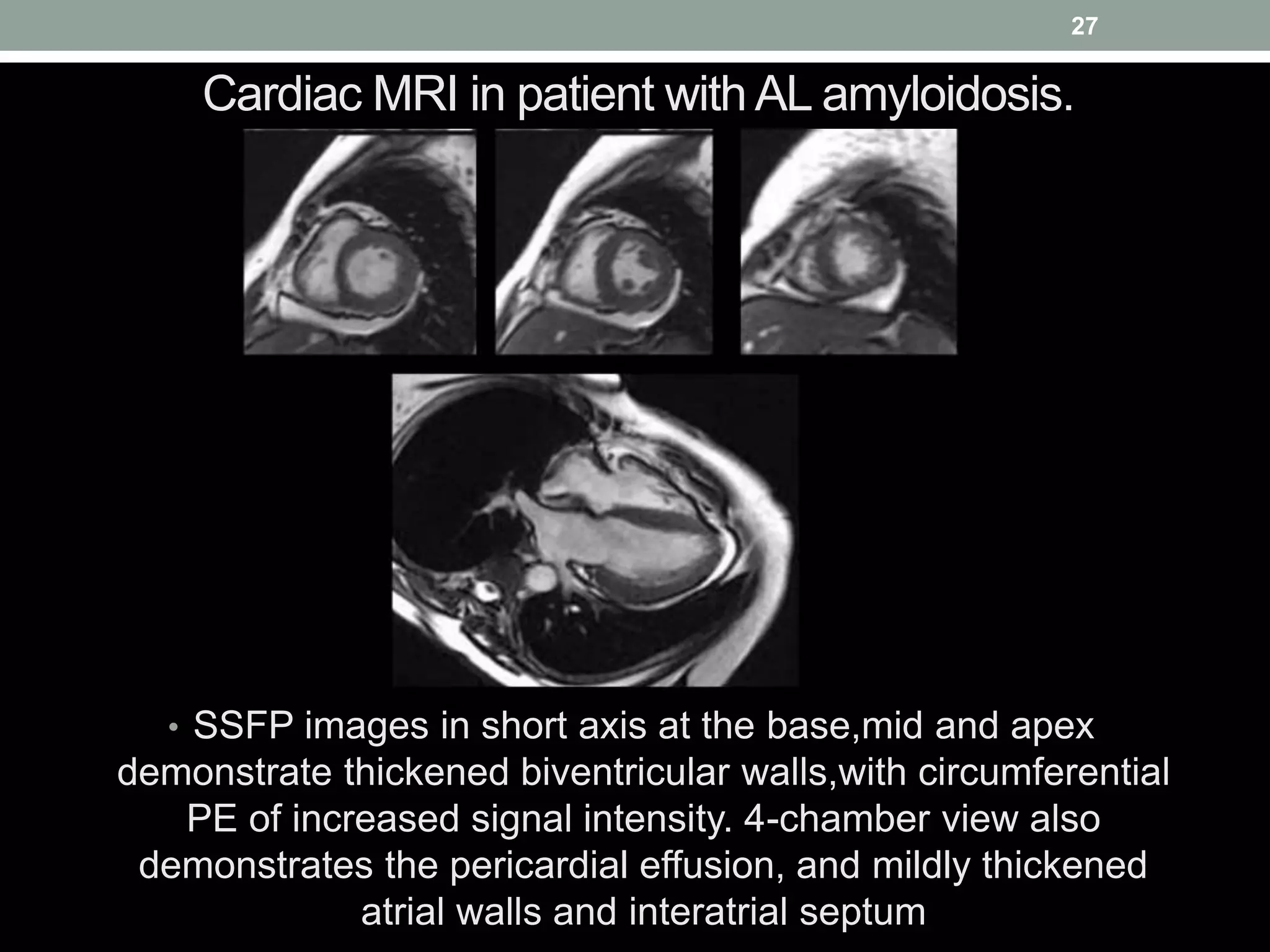
Cardiac MRI in patient with AL amyloidosis.
• SSFP images in short axis at the base,mid and apex
demonstrate thickened biventricular walls,with circumferential
PE of increased signal intensity. 4-chamber view also
demonstrates the pericardial effusion, and mildly thickened
atrial walls and interatrial septum
27
• CMR with the classic amyloid global,subendocardial LGE
pattern in the LV with blood and mid-epi myocardium
nulling together
28
Nuclear imaging
29
99mTC-PYP imaging in TTR cardiac amyloidosis. A positive
99mTc-PYP SPECT-only ,fused SPECT/CT and maximal
intensity projection image are illustrated demonstrating
increased cardiac uptake in a patient with familial TTR cardiac
amyloidosis.
30
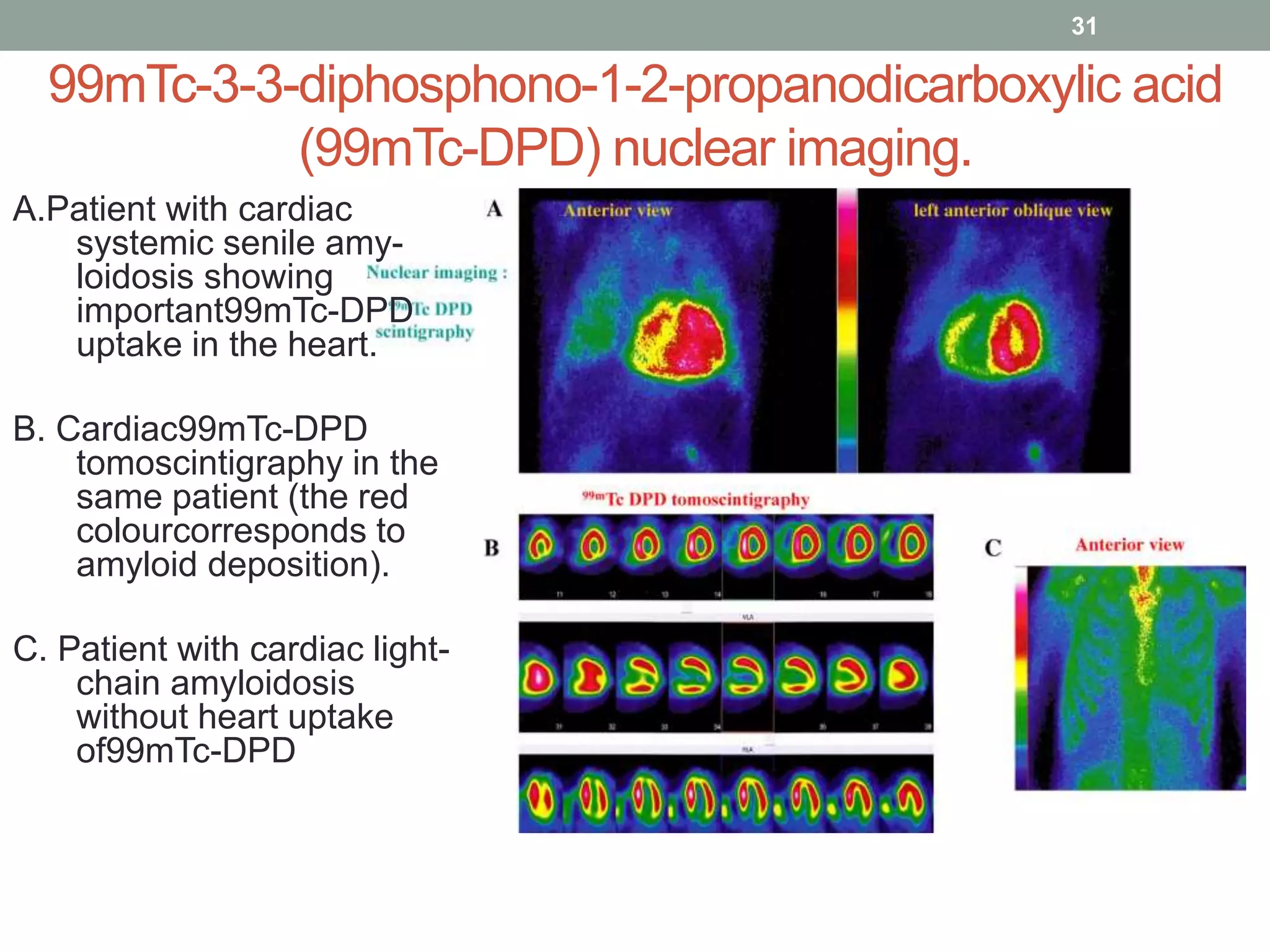
99mTc-3-3-diphosphono-1-2-propanodicarboxylic acid
(99mTc-DPD) nuclear imaging.
A.Patient with cardiac
systemic senile amy-
loidosis showing
important99mTc-DPD
uptake in the heart.
B. Cardiac99mTc-DPD
tomoscintigraphy in the
same patient (the red
colourcorresponds to
amyloid deposition).
C. Patient with cardiac light-
chain amyloidosis
without heart uptake
of99mTc-DPD
31
Endomyocardial Biopsy
• Gold standard for demonstrating cardiac amyloid
deposition
• In practice endomyocardial biopsies are most commonly
required to differentiate between AL and ATTR in older
patients, some 5% of whom have a MGUS
• Should be considered in patients with a thickened left
ventricle by echocardiography where hypertension,
valvular disease, and a family history of hypertrophic
cardiomyopathy have been excluded, particularly if the
patient is young
• Perforation remain a small but real risk and may not be
well tolerated in restrictive cardiomyopathy
32
Light microscopy :
33
Cardiac complications of myocardial
amyloid fibril deposition
• Severe CHF ,initially preserved LVEF and decreased LV
compliance  advanced diastolic dysfunction
• Decreased LVEF may follow diastolic dysfunction  terminal
and fatal heart failure
• Chronic elevated LV filling pressure  LAA  AF  atrial
thrombi (frequent in cardiac amyloidosis,even in patients with
sinus rhythm)  systemic embolic events
• Non-sustained or sustained ventricular arrhythmias
• Conduction disturbances (cardiac ATTR)
• Autonomic dysfunction  orthostatic hypotensive episodes
• Amyloid deposits  microcoronary circulation  chest pain
(The macrocoronary vessels are usually free of
significantstenosis )
34
Management and treatment of light-chain
amyloidosis
• Chemotherapy directed against the underlying B-cell
clone secreting amyloid forming LCs
• Supportive measures to sustain organ function.
• Goal of treatment  achievement of a haematological
response
35
Conventional chemotherapy
• Melphalan-dexamethasone
• Impressive efficacy with > 60% haematological response
has been reported
• ASCT remains restricted to selected patients who are
generally without advanced cardiac amyloidosis
• Compared with ASCT, melphalan-dexamethasone had
similar efficacy with less toxicity
Jaccard A, Moreau P, Leblond V, et al , NEngl J Med
2007;357:1083—93
36
Novel agents
• Thalidomide, lenalidomide & bortezomib
• Melphalan + bortezomib + dexamethasone
• Bortezomib + cyclophosphamide + dexamethasone
37
Cardiac supportive treatment
• Most drugs commonly used for the treatment of CHF are
inefficient or appear to be dangerous in patients with AL,
ATTR or SSA
• Digitalis has been shown to accumulate in cardiac
amyloid deposits
• Beta-blockers- decrease heart rate, which is the only
mechanism that can maintain cardiac output in
amyloidosis, also aggravate autonomic dysfunction like
ACEI.
• Loop diuretics,given at high dosage in patients with
severe fluid retention,are the mainstay of management
38
• Amiodarone - first-line therapy for arrhythmia
• Anticoagulation therapy is mandatory in patients with
supraventricular arrhythmia
• Pacemaker implantation may be indicated in patients who
develop symptoms of bradycardia or conduction disorders
• A heart transplant should be considered in selected young
patientswith advanced amyloid cardiomyopathy free from
other comorbidities.
39
Hereditary transthyretin-related amyloidosis
• Specific treatment of ATTR is a liver transplant with or
without a heart transplant
• Tafamidis
Systemic senile amyloidosis
• Similar to ATTR; however because patients don’t have
symptomatic neuropathy, as seen in ATTR, ACEI and beta
blockers are better tolerated than in other types of
amyloidosis
40
There are three main questions that the
clinician should be aware of:
1) How to detect cardiac amyloidosis
2) When to think about it
3) Whom to refer the patient?
41
• A patient with dyspnoea, unexplained fatigue and LVH on
TTE contrasting with the microvoltage of QRS amplitude
should alert the clinician to an infiltrative process rather
than a classical sarcomeric hypertrophic or hypertensive
cardiomyopathy
• It is important to refer the patient to a specialist in internal
medicine and/or a haematologist to perform more specific
biological and/or genetic testing
42
43
Take home :
• Cardiac involvement in amyloidosis remains difficult
todiagnose and treat
• Extracardiac signs, in addition to unex-plained LV
thickening on echocardiography in the absence
ofincreased voltage on ECG, favour amyloid
cardiomyopathy
• Confirmation of amyloid type is possible in most cases
• The cMRI pattern of LGE appears to be very
characteristic.
• Unlike other causes of heart failure, supportive treatment
is usually very limited and can be dangerous
44
THANK YOU !!
45

Cardiac amyloidosis

  • 1.
  • 2.
    Amyloidosis • Systemic process •Extracellular tissue infiltration of aberrantly folded insoluble β-pleated sheets of protein aggregates • Apple-green birefringence in Congo red stain • Deposition - parenchymal stiffening and dysfunction of affected organs 2
  • 3.
    • Myocardial amyloiddeposition - cardiomyocyte distortion, cardiomyocyte separation, tissue stiffening, and organ dysfunction • Disruption of mechanical and electrochemical cardiac function • Most apparent in the ventricles – * Progressive myocardial thickening, * Restrictive cardiomyopathy, and * Diastolic dysfunction • Conduction abnormalities, valvular malfunction, and vascular infiltration 3
  • 4.
    Cardiac specimen exhibitingamyloid deposition. Amyloid deposits show as light-pink infiltrative material with concentric left ventricular and interventricular septal thickening. Right ventricular amyloid deposition is also apparent 4
  • 5.
    Precursors that mayaffect the heart • Light-chain (LC) immunoglobulin • Mutant hereditary transthyretin (TTR) • Wild-type TTR • Mutant apolipoprotein AI • Amyloid atrial natriuretic peptide localized to the atrium • Fibrinogen alpha type • Serum amyloid A protein Organs involved • Liver, kidney, gastrointestinal tract,nervous tissue and heart 5
  • 6.
    Heart involvement • ALamyloidosis – 50 % • Systemic senile amyloidosis (SSA) and some forms of hereditary TTR-related amyloidosis (ATTR) affect the heart almost invariably • Secondary amyloidosis - Cardiac involvement is rare or minimal or clinically non-significant 6
  • 7.
    Key “red flags”to possible systemic amyloidosis • Nephrotic syndrome • Autonomic neuropathy (eg postural hypotension, diarrhea) • Soft-tissue infiltrations (eg macroglossia, carpal tunnel syndrome, respiratory disease), • Bleeding (eg cutaneous, such as periorbital, gastrointestinal) • Malnutrition/cachexia and • Genetic predisposition (eg, family history, ethnicity). 7
  • 8.
    • Secondary amyloidosis-consequence of chronic inflammatory conditions * Rheumatoid arthritis * Crohn’s disease * Chronic inflammatory/infectious diseases * Familial Mediterranean fever * Idiopathic amyloid A amyloidosis 8
  • 9.
    Survival • AL amyloidosis-Median survival of <1 year without treatment • Median survival 6-9 months in those with heart failure • 1.1 years in those with any sign of cardiac involvement • Transthyretin amyloidosis (familial or wild-type) and secondary amyloidosis – Myocardial infiltration can be severe with minimal symptoms and a median survival of several years, even if untreated 9
  • 10.
  • 11.
  • 12.
    Monoclonal Paraprotein • SPEP •Monoclonal Lambda or Kappa Light chain spike • Free serum light chains • The presence of a serum or urine monoclonal paraprotein is suggestive of AL amyloidosis, but it alone does not firmly establish the diagnosis. • Pt may have senile cardiac amyloid and unrelated MGUS with these clinical findings 12
  • 13.
    Light-chain amyloidosis • Extracellulardeposition of fibril-forming monoclonal immunoglobulin LCs, secreted by a small plasma cell clone • Detectable by Immunofixation and/or immunoelectrophoresis in 80—90% of patients • Non-invasive biopsies of abdominal fat and minor salivary glands should be performed initially (usually positive in 80% of patients) • If necessary, biopsy of a clinically affected organ (kidney, gastrointestinal tract or endomyocardial tissue) should be considered • Electron microscopy : ultrastructural appearance of randomly arranged fibrils (7—10 nm in external diameter) 13
  • 14.
  • 15.
    Diagnostic criteria forcardiac involvement • An increase in mean wall thickness in end-ventricular diastole of ≥ 12 mm by echocardiography, with no other obvious cardiac cause, • An increase in the concentrationof NT-proBNP to > 332 ng/L (in absence of renal failure). (may fall dramatically within weeks after chemotherapy 15
  • 16.
    The Mayo Clinicstaging • A current staging system—the Mayo Clinic staging (based on NT-proBNP (cut-offvalue = 332 ng/L; BNP = 100 ng/L) and cardiac troponin (cut-off value = 0.035 g/L) • High risk (stage III: both biomarkers are increased) • Intermediate risk (stage II: at least one biomarker is abovethe cut-off value) • Low risk (stage I: both biomarkers are below the cut- offvalues). 16
  • 17.
    ECG • Abnormal in90% of cases with cardiac involvement • Low voltage QRS complex (defined as all limb leads < 5 mm in height) and a pseudoinfarct pattern on the precordial leads (50% of patients with cardiac AL amyloidosis) 17
  • 18.
    Echo • Infiltrative/restrictive cardiomyopathy •Increased LV wall thickness ≥ 12 mm with ‘brilliant’ speck- led appearance of the myocardium (amyloid fibrils deposits are more echogenic than normal myocardium) • Sparkling pattern is not sensitive because only a minority (26%) has it • Normal or small LV cavity • Preserved LVEF > 50% (at least in the early stage of the disease), but reduced S and E’ waves Abnormal mitral filling pattern 18
  • 19.
    Absent A wavein setting of NSR (Atrial arrest) 19
  • 20.
  • 21.
    • Typical echofindings in cardiac amyloidosis: thickened and sparkled LV walls, thickened inter-atrial septum, mitral and tricuspid valves, thickened right ventricular free wall, small pericardial effusion, normal LV cavity size and atrial enlargement 21
  • 22.
    Other echo findings •LAE (diameter > 23 mm/m2,area > 20 cm2 or maximal volume > 28 mL/m2) • RAE and dilated IVC reflecting elevated RV filling pressure • Increased interatrial septal thickness • Increased RV free wall thickness (> 7 mm) with RV systolic and diastolic dysfunctions • Left and right valve thickening • Reduced aortic ejection time (< 273 ms), described as a prognostic factor • Small pericardial effusion in 50% of cases • Atrial thrombi may be seen, despite the presence of sinusrhythm 22
  • 23.
    Buss et al,JAm Coll Cardiol 2012;60:1067—76. Longitudinal strain (LS) and 2D global LS (2D-GLS) * Strongly correlates with NT-proBNP in patients with AL * Independently associated with prognosis in AL, including overall survival * Incremental value over NT-proBNP, cardiac troponin and all otherclinical variables assessed 23
  • 24.
    2D speckle-tracking • Differentiatingcardiac amyloidosis from othercauses of LV hypertrophy • Reduced basal strain and regional variations inLS from base to apex • A relative ‘apical sparing’ (average apical LS/[average basal LS + mid LS]) pattern of LS is an easily recognizable, accurate and reproducible means of differentiating cardiac amyloidosis from other causes of LVH Phelan D, Collier P, Thavendiranathan P, et al.. Heart 2012;98:1442—8. 24
  • 25.
    • TTE withspeckle tracking.The red and yellow lines represent longitudinal motion in the basal segments, whereas the purple and green lines represent apical motion. This shows loss of longitudinal ventricular contraction at the base compared to apex 25
  • 26.
    Cardiac magnetic resonanceimaging • Excellent spatial resolution for tissue characterization • Very sensitive for detecting the presence of infiltrative cardiomyopathy, even in cases of normal LV wall thickness • Precise measurement of the LV walls, the inter atrial and RV free walls, biatrial enlargement and pericardial effusion • Transmural late gadolinium enhancement(LGE) or patchy LGE. 26
  • 27.
    Cardiac MRI inpatient with AL amyloidosis. • SSFP images in short axis at the base,mid and apex demonstrate thickened biventricular walls,with circumferential PE of increased signal intensity. 4-chamber view also demonstrates the pericardial effusion, and mildly thickened atrial walls and interatrial septum 27
  • 28.
    • CMR withthe classic amyloid global,subendocardial LGE pattern in the LV with blood and mid-epi myocardium nulling together 28
  • 29.
  • 30.
    99mTC-PYP imaging inTTR cardiac amyloidosis. A positive 99mTc-PYP SPECT-only ,fused SPECT/CT and maximal intensity projection image are illustrated demonstrating increased cardiac uptake in a patient with familial TTR cardiac amyloidosis. 30
  • 31.
    99mTc-3-3-diphosphono-1-2-propanodicarboxylic acid (99mTc-DPD) nuclearimaging. A.Patient with cardiac systemic senile amy- loidosis showing important99mTc-DPD uptake in the heart. B. Cardiac99mTc-DPD tomoscintigraphy in the same patient (the red colourcorresponds to amyloid deposition). C. Patient with cardiac light- chain amyloidosis without heart uptake of99mTc-DPD 31
  • 32.
    Endomyocardial Biopsy • Goldstandard for demonstrating cardiac amyloid deposition • In practice endomyocardial biopsies are most commonly required to differentiate between AL and ATTR in older patients, some 5% of whom have a MGUS • Should be considered in patients with a thickened left ventricle by echocardiography where hypertension, valvular disease, and a family history of hypertrophic cardiomyopathy have been excluded, particularly if the patient is young • Perforation remain a small but real risk and may not be well tolerated in restrictive cardiomyopathy 32
  • 33.
  • 34.
    Cardiac complications ofmyocardial amyloid fibril deposition • Severe CHF ,initially preserved LVEF and decreased LV compliance  advanced diastolic dysfunction • Decreased LVEF may follow diastolic dysfunction  terminal and fatal heart failure • Chronic elevated LV filling pressure  LAA  AF  atrial thrombi (frequent in cardiac amyloidosis,even in patients with sinus rhythm)  systemic embolic events • Non-sustained or sustained ventricular arrhythmias • Conduction disturbances (cardiac ATTR) • Autonomic dysfunction  orthostatic hypotensive episodes • Amyloid deposits  microcoronary circulation  chest pain (The macrocoronary vessels are usually free of significantstenosis ) 34
  • 35.
    Management and treatmentof light-chain amyloidosis • Chemotherapy directed against the underlying B-cell clone secreting amyloid forming LCs • Supportive measures to sustain organ function. • Goal of treatment  achievement of a haematological response 35
  • 36.
    Conventional chemotherapy • Melphalan-dexamethasone •Impressive efficacy with > 60% haematological response has been reported • ASCT remains restricted to selected patients who are generally without advanced cardiac amyloidosis • Compared with ASCT, melphalan-dexamethasone had similar efficacy with less toxicity Jaccard A, Moreau P, Leblond V, et al , NEngl J Med 2007;357:1083—93 36
  • 37.
    Novel agents • Thalidomide,lenalidomide & bortezomib • Melphalan + bortezomib + dexamethasone • Bortezomib + cyclophosphamide + dexamethasone 37
  • 38.
    Cardiac supportive treatment •Most drugs commonly used for the treatment of CHF are inefficient or appear to be dangerous in patients with AL, ATTR or SSA • Digitalis has been shown to accumulate in cardiac amyloid deposits • Beta-blockers- decrease heart rate, which is the only mechanism that can maintain cardiac output in amyloidosis, also aggravate autonomic dysfunction like ACEI. • Loop diuretics,given at high dosage in patients with severe fluid retention,are the mainstay of management 38
  • 39.
    • Amiodarone -first-line therapy for arrhythmia • Anticoagulation therapy is mandatory in patients with supraventricular arrhythmia • Pacemaker implantation may be indicated in patients who develop symptoms of bradycardia or conduction disorders • A heart transplant should be considered in selected young patientswith advanced amyloid cardiomyopathy free from other comorbidities. 39
  • 40.
    Hereditary transthyretin-related amyloidosis •Specific treatment of ATTR is a liver transplant with or without a heart transplant • Tafamidis Systemic senile amyloidosis • Similar to ATTR; however because patients don’t have symptomatic neuropathy, as seen in ATTR, ACEI and beta blockers are better tolerated than in other types of amyloidosis 40
  • 41.
    There are threemain questions that the clinician should be aware of: 1) How to detect cardiac amyloidosis 2) When to think about it 3) Whom to refer the patient? 41
  • 42.
    • A patientwith dyspnoea, unexplained fatigue and LVH on TTE contrasting with the microvoltage of QRS amplitude should alert the clinician to an infiltrative process rather than a classical sarcomeric hypertrophic or hypertensive cardiomyopathy • It is important to refer the patient to a specialist in internal medicine and/or a haematologist to perform more specific biological and/or genetic testing 42
  • 43.
  • 44.
    Take home : •Cardiac involvement in amyloidosis remains difficult todiagnose and treat • Extracardiac signs, in addition to unex-plained LV thickening on echocardiography in the absence ofincreased voltage on ECG, favour amyloid cardiomyopathy • Confirmation of amyloid type is possible in most cases • The cMRI pattern of LGE appears to be very characteristic. • Unlike other causes of heart failure, supportive treatment is usually very limited and can be dangerous 44
  • 45.