DOMOTICS:
AN OPEN APPROACH

         Luigi De Russis
    luigi.derussis@polito.it
OUTLINE

• What     is “domotics”?

• Commercial     technologies and their problems

• What     if we want to build an “open” automated home?

• Dog: a   domotic free and open source gateway


                     Domotics: an “open” approach          2
WHAT IS “DOMOTICS”?
• Composite      word: domus + informatics
• Investigates
           how to realize an intelligent home
 environment
• Various   naming: Smart Home, Ambient Intelligence, ...
• Nowaday, mainly     viewed as Home Automation
  • i.e., the
          automation of the home, housework or
    household activities
• Home   automation, as a technology, is mature enough
 for “real world” applications

                     Domotics: an “open” approach           3
FUNDAMENTALS
• To   automate an house, you need a domotic plant

• Tipically, a   domotic plant is composed by:

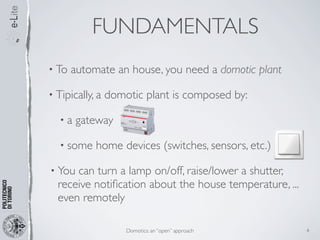
  •a    gateway

  • some    home devices (switches, sensors, etc.)

• You can turn a lamp on/off, raise/lower a shutter,
  receive notification about the house temperature, ...
  even remotely

                     Domotics: an “open” approach        4
ARCHITECTURE (1/4)
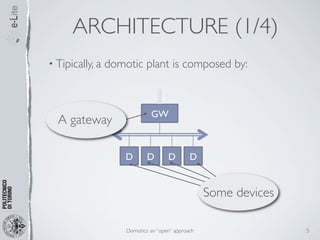
• Tipically, a   domotic plant is composed by:


                               GW
  A gateway

                     D       D        D        D


                                                    Some devices

                     Domotics: an “open” approach                  5
ARCHITECTURE (2/4)
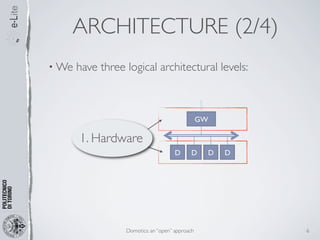
• We   have three logical architectural levels:


                                                 GW

       1. Hardware
                                      D      D    D   D


                  Domotics: an “open” approach            6
ARCHITECTURE (3/4)
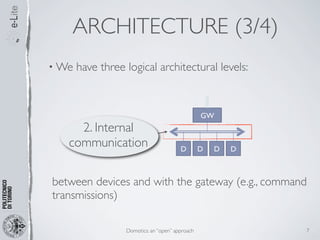
• We   have three logical architectural levels:


                                                 GW
     2. Internal
   communication                        D        D   D   D


between devices and with the gateway (e.g., command
transmissions)

                  Domotics: an “open” approach               7
ARCHITECTURE (4/4)
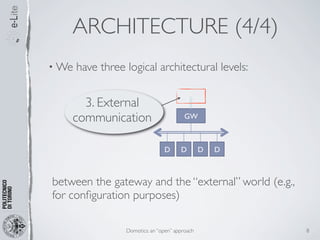
• We   have three logical architectural levels:


      3. External
    communication                         GW


                                 D      D        D   D


between the gateway and the “external” world (e.g.,
for configuration purposes)

                  Domotics: an “open” approach           8
COMMERCIAL VS. DIY
              SYSTEMS
• For
   the sake of this presentation, we speak about
 commercial and complete systems:
  • available   on the market, now
  • distributed   with hardware + software
• DIY   systems exist, but typically they:
  • strongly   depend on the single developer capabilities
  • are   not spread enough
  • are   not interoperable and well-supported

                   Domotics: an “open” approach              9
COMMERCIAL DOMOTIC
          TECHNOLOGIES
•A   large and growing set

• The   most popular:
 • Konnex                                 • Z-Wave

 • BTicino   MyHome                       • LonWorks

 • X10                                    • EnOcean

 • INSTEON                                • Universal   Powerline Bus

 • Zigbee    HA
                   Domotics: an “open” approach                         10
PROBLEMS
• They suffer three main problems, from an home
 inhabitant viewpoint:

 1. they do, more or less, the same things of
   “traditional” plants

 2. they are vertical systems (i.e., they do not
   interoperate, since the gateways are not able to speak
   to each other)

 3. they are quite expensive

• As   a result, few automated houses exist!
                    Domotics: an “open” approach        11
POSSIBLE SOLUTIONS
1. they do, more or less, the same things of “traditional”
  plants
    •   new software applications can increase the set of
        functionalities
2. they are vertical systems (i.e., they do not interoperate)
    •   they need some “high level” (software) gateway to
        communicate
3. they are quite expensive
    •   perceivable benefits and cheap technologies will
        help spreading over wider communities

                   Domotics: an “open” approach                 12
WHAT IF WE WANT TO BUILD
AN “OPEN” AUTOMATED HOME?
• We    speak about open domotics

• We    want to add the automation to an existing home:

 • by using commercial domotic systems, possibly a
  “killer” technology

 • available   in Europe

 • by   using as more open technologies as possible


                    Domotics: an “open” approach          13
COMMERCIAL SYSTEMS WE
            CONSIDER...
• We  consider only the most popular commercial
 systems available in Europe:
  • Konnex

  • BTicino   MyHome
  • X10

  • Zigbee    HA
  • Z-Wave

• byanalyzing their “openess” for hardware, internal and
 external communication layers
                   Domotics: an “open” approach            14
KONNEX (1/3)
• Konnex (KNX) systems are based on the homonymous
 protocol that is:
 • an OSI-based network communication protocol for
   intelligent buildings
 • an   open standard
        • International   standard (ISO/IEC 14543-3)
        • Canadian   standard (CSA-ISO/IEC 14543-3)
        • European
                 standard (CENELEC EN 50090 and
         CEN EN 13321-1)
        • China   Guo Biao (GB/Z 20965)
                     Domotics: an “open” approach      15
KONNEX (2/3)

• used   by nearly 220 manufacturers, worldwide
• supporting   several physical communication media
   • the most used for the internal communication is
     twisted pair
   • the most used for the external communication is
     Ethernet (also known as EIBnet/IP or KNXnet/IP)


                  Domotics: an “open” approach         16
KONNEX (3/3)

• Konnex   is a nice candidate for our use case:
 • externaland internal communications are based on
   open protocols
     • but   to use them you have to register (and pay!)
         to the KNX Alliance
 • the hardware is not open hardware and depends
   from the manufacturers policies, since the protocol is
   hardware-independent


                   Domotics: an “open” approach             17
BTICINO MYHOME
• BTicino, a
           traditional electric plant manufacturer, has a
 domotic line named MyHome
• BTicino   MyHome is a bad candidate for our use case:
  • theinternal communication protocol is proprietary, and
   the physical communication media is a twisted pair
  • the
      external communication protocol, named
   OpenWebNet, is open, and the physical
   communication media used is Ethernet
  • thehardware is proprietary and the only manufacturer
   is BTicino itself
                   Domotics: an “open” approach             18
X10 (1/2)
• X10    systems are based on the homonymous protocol
 that:
 • is   an international and open standard
 • is   used by several manufacturers, especially in the U.S.
 • definestwo communication medias for the internal
   communication
         • power    line
         • radio   frequence
 • Ethernet  or a Virtual Serial Port (through a USB
   dongle, typically) is used for the external
   communication
                           Domotics: an “open” approach     19
X10 (2/2)
• X10   is a good candidate for our use case:
 • theexternal and the internal communications are
   open protocols
 • thehardware is not open and depends on the
   manufacturers’ policies
• However, from the user point of view, it suffers of
 various problems, such as:
 • commands     getting lost
 • unresponsive    system
 • various   interferences
                   Domotics: an “open” approach         20
ZIGBEE HA (1/3)
• ZigBee
       HA systems are based on the Home
 Automation profile of the Zigbee protocol, that:
 • isa standard, low-cost, low-power, wireless mesh
   network
 • isused only by few manufacturers, for what concern
   the Home Automation profile
 • the internal communication uses the wireless
   communication medium defined by the IEEE 802.15.4
   standard
 • a VirtualSerial Port (through a USB dongle, typically)
   is mostly used for the external communication
                  Domotics: an “open” approach              21
ZIGBEE HA (2/3)

• ZigBee   HA is a nice candidate for our use case:
 • the external and the internal communication
   protocols are open, with more details available after
   registering (and paying) to the ZigBee Alliance
 • thehardware is not open and depends from the
   manufacturers’ policies


                   Domotics: an “open” approach            22
ZIGBEE HA (3/3)

• ZigBeeHA, hovewer, has some problems for open-
 source developers since, for example, it is impossible:
 • to combine a ZigBee implementation with GPL
  licensed code
 • to   implement a GPL licensed ZigBee stack


                   Domotics: an “open” approach            23
Z-WAVE
• Z-Wave is, similarly to ZigBee, a wireless network
 protocol for home automation system
• Z-Wave   is the worst candidate for our use case since:
 • the internal communication protocol is strongly
   proprietary (you need to sign a NDA and pay to see
   it)
 • the external communication protocol is proprietary
   and a Virtual Serial Port (through a USB dongle,
   typically) is mostly used
     • not   authorized open implementations exist
 • the   hardware is proprietary
                   Domotics: an “open” approach         24
CONCLUSIONS (1/3)

• Forour use case, we could use three systems with their
 protocols:
  • Konnex

  • X10

  • ZigBee   HA
• Konnex and X10 have an higher presence on the
 market, right now


                  Domotics: an “open” approach         25
CONCLUSIONS (2/3)

• None   of them completely fits our requirements:
 • Konnex   requires to build a totally new electric plant
  and it is quite expensive
 • X10 suffers from different problems but it is more
  flexible since it can exploit either power line or
  wireless connection (no masonry work)
 • ZigBee HA is a wireless protocol with some licensing
  troubles and few devices are available on the market


                  Domotics: an “open” approach               26
CONCLUSIONS (3/3)

• None   of them is a killer technology. Then:
 • many    different installations
 • different   plants possibly coexist
• Native   interoperability cannot be achieved
• Thesolution: use an higher level gateway, possibly open
 source, like Dog


                    Domotics: an “open” approach            27
DOG (1/2)
• Dog   (Domotic OSGi Gateway) is
 •a software gateway for controlling domotic
   environments
 • based    on the Java OSGi (Open Services Gateway
   initiative) framework
 • with   an high-level semantic device modeling
 • supporting   different domotic plant technologies


                   Domotics: an “open” approach        28
DOG (2/2)
• expandable     (also by you!):
    • to   support new domotic plants
    • to have more (sophisticated) features through
      standard OSGi components
• works
      also with simulated enviroments (i.e., no “real”
 automated home is needed)
• freely   available on the Internet
• released   under the Apache v2.0 license


                   Domotics: an “open” approach          29
DO YOU WANT TO TRY?


Dog (source code and compiled version) with some
example applications is available on:


               http://domoticdog.sf.net


                Domotics: an “open” approach       30
OTHER USEFUL LINKS (AND
            REFERENCES)
1. Home automation page on Wikipedia: http://en.wikipedia.org/wiki/Home_automation

2. Konnex: http://www.knx.org/

3. BTicino MyHome: http://www.bticino.com/

4. X10 page on Wikipedia: http://en.wikipedia.org/wiki/X10_(industry_standard)

5. Z-Wave: http://www.z-wave.com/

6. ZigBee HA: http://www.zigbee.org/Standards/ZigBeeHomeAutomation/Overview.aspx

7. Publications about Dog: http://elite.polito.it/dog-tools-72/publications

8. OSGi Alliance: http://www.osgi.org/Main/HomePage


                              Domotics: an “open” approach                           31

Domotics: an open approach

  • 1.
    DOMOTICS: AN OPEN APPROACH Luigi De Russis luigi.derussis@polito.it
  • 2.
    OUTLINE • What is “domotics”? • Commercial technologies and their problems • What if we want to build an “open” automated home? • Dog: a domotic free and open source gateway Domotics: an “open” approach 2
  • 3.
    WHAT IS “DOMOTICS”? •Composite word: domus + informatics • Investigates how to realize an intelligent home environment • Various naming: Smart Home, Ambient Intelligence, ... • Nowaday, mainly viewed as Home Automation • i.e., the automation of the home, housework or household activities • Home automation, as a technology, is mature enough for “real world” applications Domotics: an “open” approach 3
  • 4.
    FUNDAMENTALS • To automate an house, you need a domotic plant • Tipically, a domotic plant is composed by: •a gateway • some home devices (switches, sensors, etc.) • You can turn a lamp on/off, raise/lower a shutter, receive notification about the house temperature, ... even remotely Domotics: an “open” approach 4
  • 5.
    ARCHITECTURE (1/4) • Tipically,a domotic plant is composed by: GW A gateway D D D D Some devices Domotics: an “open” approach 5
  • 6.
    ARCHITECTURE (2/4) • We have three logical architectural levels: GW 1. Hardware D D D D Domotics: an “open” approach 6
  • 7.
    ARCHITECTURE (3/4) • We have three logical architectural levels: GW 2. Internal communication D D D D between devices and with the gateway (e.g., command transmissions) Domotics: an “open” approach 7
  • 8.
    ARCHITECTURE (4/4) • We have three logical architectural levels: 3. External communication GW D D D D between the gateway and the “external” world (e.g., for configuration purposes) Domotics: an “open” approach 8
  • 9.
    COMMERCIAL VS. DIY SYSTEMS • For the sake of this presentation, we speak about commercial and complete systems: • available on the market, now • distributed with hardware + software • DIY systems exist, but typically they: • strongly depend on the single developer capabilities • are not spread enough • are not interoperable and well-supported Domotics: an “open” approach 9
  • 10.
    COMMERCIAL DOMOTIC TECHNOLOGIES •A large and growing set • The most popular: • Konnex • Z-Wave • BTicino MyHome • LonWorks • X10 • EnOcean • INSTEON • Universal Powerline Bus • Zigbee HA Domotics: an “open” approach 10
  • 11.
    PROBLEMS • They sufferthree main problems, from an home inhabitant viewpoint: 1. they do, more or less, the same things of “traditional” plants 2. they are vertical systems (i.e., they do not interoperate, since the gateways are not able to speak to each other) 3. they are quite expensive • As a result, few automated houses exist! Domotics: an “open” approach 11
  • 12.
    POSSIBLE SOLUTIONS 1. theydo, more or less, the same things of “traditional” plants • new software applications can increase the set of functionalities 2. they are vertical systems (i.e., they do not interoperate) • they need some “high level” (software) gateway to communicate 3. they are quite expensive • perceivable benefits and cheap technologies will help spreading over wider communities Domotics: an “open” approach 12
  • 13.
    WHAT IF WEWANT TO BUILD AN “OPEN” AUTOMATED HOME? • We speak about open domotics • We want to add the automation to an existing home: • by using commercial domotic systems, possibly a “killer” technology • available in Europe • by using as more open technologies as possible Domotics: an “open” approach 13
  • 14.
    COMMERCIAL SYSTEMS WE CONSIDER... • We consider only the most popular commercial systems available in Europe: • Konnex • BTicino MyHome • X10 • Zigbee HA • Z-Wave • byanalyzing their “openess” for hardware, internal and external communication layers Domotics: an “open” approach 14
  • 15.
    KONNEX (1/3) • Konnex(KNX) systems are based on the homonymous protocol that is: • an OSI-based network communication protocol for intelligent buildings • an open standard • International standard (ISO/IEC 14543-3) • Canadian standard (CSA-ISO/IEC 14543-3) • European standard (CENELEC EN 50090 and CEN EN 13321-1) • China Guo Biao (GB/Z 20965) Domotics: an “open” approach 15
  • 16.
    KONNEX (2/3) • used by nearly 220 manufacturers, worldwide • supporting several physical communication media • the most used for the internal communication is twisted pair • the most used for the external communication is Ethernet (also known as EIBnet/IP or KNXnet/IP) Domotics: an “open” approach 16
  • 17.
    KONNEX (3/3) • Konnex is a nice candidate for our use case: • externaland internal communications are based on open protocols • but to use them you have to register (and pay!) to the KNX Alliance • the hardware is not open hardware and depends from the manufacturers policies, since the protocol is hardware-independent Domotics: an “open” approach 17
  • 18.
    BTICINO MYHOME • BTicino,a traditional electric plant manufacturer, has a domotic line named MyHome • BTicino MyHome is a bad candidate for our use case: • theinternal communication protocol is proprietary, and the physical communication media is a twisted pair • the external communication protocol, named OpenWebNet, is open, and the physical communication media used is Ethernet • thehardware is proprietary and the only manufacturer is BTicino itself Domotics: an “open” approach 18
  • 19.
    X10 (1/2) • X10 systems are based on the homonymous protocol that: • is an international and open standard • is used by several manufacturers, especially in the U.S. • definestwo communication medias for the internal communication • power line • radio frequence • Ethernet or a Virtual Serial Port (through a USB dongle, typically) is used for the external communication Domotics: an “open” approach 19
  • 20.
    X10 (2/2) • X10 is a good candidate for our use case: • theexternal and the internal communications are open protocols • thehardware is not open and depends on the manufacturers’ policies • However, from the user point of view, it suffers of various problems, such as: • commands getting lost • unresponsive system • various interferences Domotics: an “open” approach 20
  • 21.
    ZIGBEE HA (1/3) •ZigBee HA systems are based on the Home Automation profile of the Zigbee protocol, that: • isa standard, low-cost, low-power, wireless mesh network • isused only by few manufacturers, for what concern the Home Automation profile • the internal communication uses the wireless communication medium defined by the IEEE 802.15.4 standard • a VirtualSerial Port (through a USB dongle, typically) is mostly used for the external communication Domotics: an “open” approach 21
  • 22.
    ZIGBEE HA (2/3) •ZigBee HA is a nice candidate for our use case: • the external and the internal communication protocols are open, with more details available after registering (and paying) to the ZigBee Alliance • thehardware is not open and depends from the manufacturers’ policies Domotics: an “open” approach 22
  • 23.
    ZIGBEE HA (3/3) •ZigBeeHA, hovewer, has some problems for open- source developers since, for example, it is impossible: • to combine a ZigBee implementation with GPL licensed code • to implement a GPL licensed ZigBee stack Domotics: an “open” approach 23
  • 24.
    Z-WAVE • Z-Wave is,similarly to ZigBee, a wireless network protocol for home automation system • Z-Wave is the worst candidate for our use case since: • the internal communication protocol is strongly proprietary (you need to sign a NDA and pay to see it) • the external communication protocol is proprietary and a Virtual Serial Port (through a USB dongle, typically) is mostly used • not authorized open implementations exist • the hardware is proprietary Domotics: an “open” approach 24
  • 25.
    CONCLUSIONS (1/3) • Forouruse case, we could use three systems with their protocols: • Konnex • X10 • ZigBee HA • Konnex and X10 have an higher presence on the market, right now Domotics: an “open” approach 25
  • 26.
    CONCLUSIONS (2/3) • None of them completely fits our requirements: • Konnex requires to build a totally new electric plant and it is quite expensive • X10 suffers from different problems but it is more flexible since it can exploit either power line or wireless connection (no masonry work) • ZigBee HA is a wireless protocol with some licensing troubles and few devices are available on the market Domotics: an “open” approach 26
  • 27.
    CONCLUSIONS (3/3) • None of them is a killer technology. Then: • many different installations • different plants possibly coexist • Native interoperability cannot be achieved • Thesolution: use an higher level gateway, possibly open source, like Dog Domotics: an “open” approach 27
  • 28.
    DOG (1/2) • Dog (Domotic OSGi Gateway) is •a software gateway for controlling domotic environments • based on the Java OSGi (Open Services Gateway initiative) framework • with an high-level semantic device modeling • supporting different domotic plant technologies Domotics: an “open” approach 28
  • 29.
    DOG (2/2) • expandable (also by you!): • to support new domotic plants • to have more (sophisticated) features through standard OSGi components • works also with simulated enviroments (i.e., no “real” automated home is needed) • freely available on the Internet • released under the Apache v2.0 license Domotics: an “open” approach 29
  • 30.
    DO YOU WANTTO TRY? Dog (source code and compiled version) with some example applications is available on: http://domoticdog.sf.net Domotics: an “open” approach 30
  • 31.
    OTHER USEFUL LINKS(AND REFERENCES) 1. Home automation page on Wikipedia: http://en.wikipedia.org/wiki/Home_automation 2. Konnex: http://www.knx.org/ 3. BTicino MyHome: http://www.bticino.com/ 4. X10 page on Wikipedia: http://en.wikipedia.org/wiki/X10_(industry_standard) 5. Z-Wave: http://www.z-wave.com/ 6. ZigBee HA: http://www.zigbee.org/Standards/ZigBeeHomeAutomation/Overview.aspx 7. Publications about Dog: http://elite.polito.it/dog-tools-72/publications 8. OSGi Alliance: http://www.osgi.org/Main/HomePage Domotics: an “open” approach 31