
Social Network
Technologies
An overview Luigi De Russis
Prerequisite
11/03/2015Social Networks Technologies
2
Did you know…
 what is a data center?
 the difference between a logical server and
a physical server?
 the difference between cache and
database access?
Let’s think!
11/03/2015
3
Social Networks Technologies
Social network
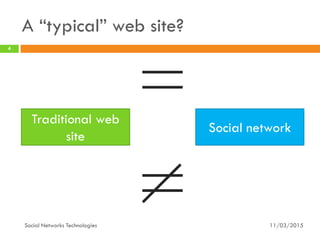
A “typical” web site?
11/03/2015
4
Social Networks Technologies
Traditional web
site
Social network
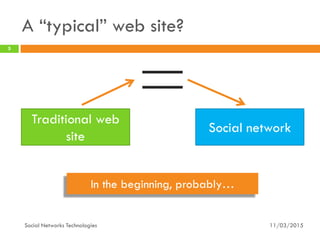
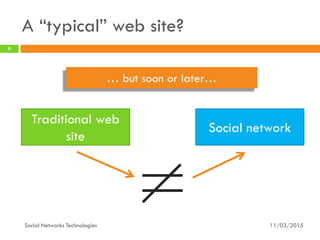
A “typical” web site?
11/03/2015
5
Social Networks Technologies
Traditional web
site
In the beginning, probably…
Social network
A “typical” web site?
11/03/2015
6
Social Networks Technologies
Traditional web
site
… but soon or later…
Why?
11/03/2015Social Networks Technologies
8
What tools and technologies are we
using for building a website?
Web site: tools and technologies
 JVM + JDK + J2EE
 Tomcat (or similar)
 MySQL (or similar)
 PHP
 Apache
 MySQL (or similar)
11/03/2015
9
Social Networks Technologies
Java/JSP PHP
For example…
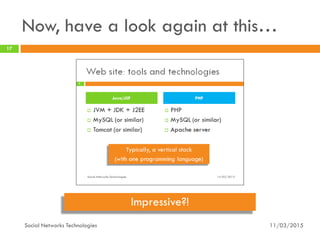
Web site: tools and technologies
 JVM + JDK + J2EE
 MySQL (or similar)
 Tomcat (or similar)
 PHP
 MySQL (or similar)
 Apache server
11/03/2015
10
Social Networks Technologies
Java/JSP PHP
Typically, a vertical stack
(with one programming language)
Now let’s try with these sites…
11/03/2015Social Networks Technologies
11
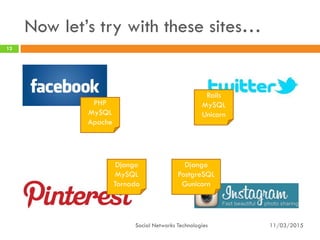
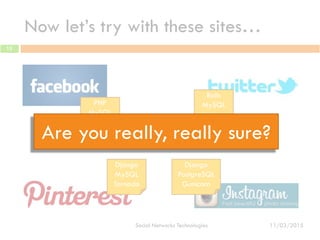
Now let’s try with these sites…
11/03/2015Social Networks Technologies
12
PHP
MySQL
Apache
Rails
MySQL
Unicorn
Django
MySQL
Tornado
Django
PostgreSQL
Gunicorn
Now let’s try with these sites…
11/03/2015Social Networks Technologies
13
PHP
MySQL
Apache
Rails
MySQL
Unicorn
Django
MySQL
Tornado
Django
PostgreSQL
Gunicorn
Are you really, really sure?
Not so sure?!
11/03/2015
14
Social Networks Technologies
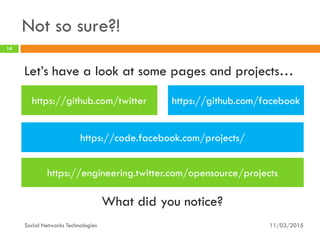
https://github.com/twitter https://github.com/facebook
Let’s have a look at some pages and projects…
https://engineering.twitter.com/opensource/projects
What did you notice?
https://code.facebook.com/projects/
What did you notice?
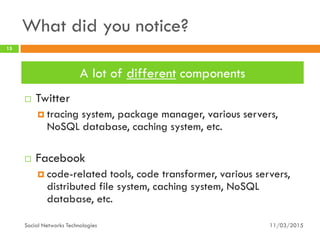
 Twitter
 tracing system, package manager, various servers,
NoSQL database, caching system, etc.
 Facebook
 code-related tools, code transformer, various servers,
distributed file system, caching system, NoSQL
database, etc.
11/03/2015
15
Social Networks Technologies
A lot of different components
What did you notice?
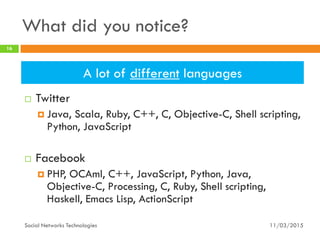
 Twitter
 Java, Scala, Ruby, C++, C, Objective-C, Shell scripting,
Python, JavaScript
 Facebook
 PHP, OCAml, C++, JavaScript, Python, Java,
Objective-C, Processing, C, Ruby, Shell scripting,
Haskell, Emacs Lisp, ActionScript
11/03/2015
16
Social Networks Technologies
A lot of different languages
Now, have a look again at this…
11/03/2015
17
Social Networks Technologies
Impressive?!
This is ONLY the tip of the iceberg…
Social Network Characteristics
11/03/2015Social Networks Technologies
19
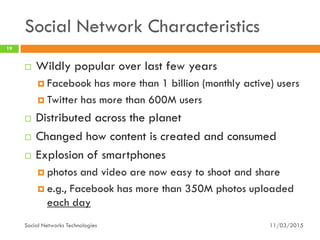
 Wildly popular over last few years
 Facebook has more than 1 billion (monthly active) users
 Twitter has more than 600M users
 Distributed across the planet
 Changed how content is created and consumed
 Explosion of smartphones
 photos and video are now easy to shoot and share
 e.g., Facebook has more than 350M photos uploaded
each day
Facebook as an example…
11/03/2015
20
Social Networks Technologies
On December 2014…
11/03/2015Social Networks Technologies
21
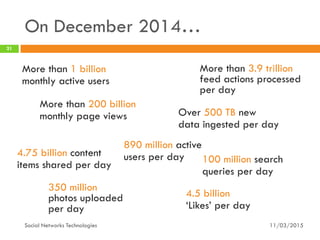
More than 3.9 trillion
feed actions processed
per day
More than 1 billion
monthly active users
100 million search
queries per day
More than 200 billion
monthly page views
4.75 billion content
items shared per day
4.5 billion
‘Likes’ per day
350 million
photos uploaded
per day
Over 500 TB new
data ingested per day
890 million active
users per day
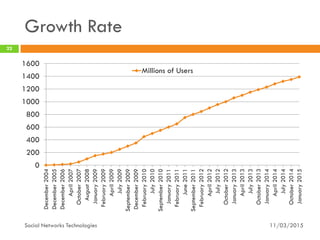
Growth Rate
11/03/2015Social Networks Technologies
22
0
200
400
600
800
1000
1200
1400
1600
December2004
December2005
December2006
April2007
October2007
August2008
January2009
February2009
April2009
July2009
September2009
December2009
February2010
July2010
September2010
January2011
February2011
June2011
September2011
February2012
April2012
July2012
October2012
January2013
April2013
July2013
October2013
January2014
April2014
July2014
October2014
January2015
Millions of Users
11/03/2015
23
Social Networks Technologies
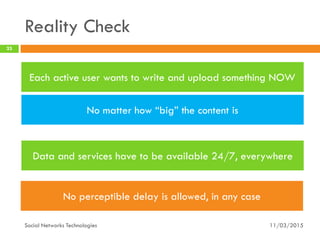
Each active user wants to write and upload something NOW
No perceptible delay is allowed, in any case
No matter how “big” the content is
Reality Check
Data and services have to be available 24/7, everywhere
11/03/2015
24
Social Networks Technologies
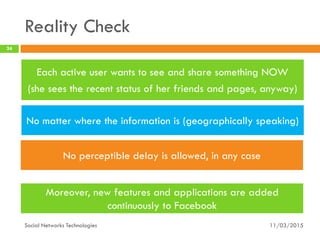
Moreover, new features and applications are added
continuously to Facebook
Reality Check
No perceptible delay is allowed, in any case
Each active user wants to see and share something NOW
(she sees the recent status of her friends and pages, anyway)
No matter where the information is (geographically speaking)
Reality Check
11/03/2015Social Networks Technologies
25
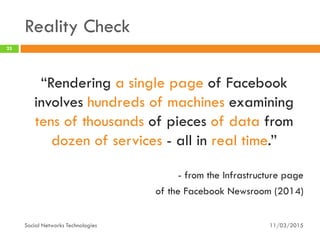
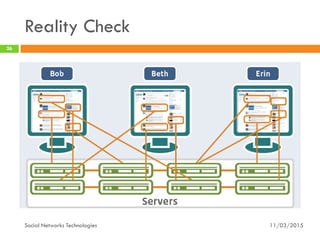
“Rendering a single page of Facebook
involves hundreds of machines examining
tens of thousands of pieces of data from
dozen of services - all in real time.”
- from the Infrastructure page
of the Facebook Newsroom (2014)
Reality Check
11/03/2015Social Networks Technologies
26
The main problem
11/03/2015Social Networks Technologies
27
Scalability
The ability of a system, network or process to handle a growing
amount of work in a capable manner or its ability to be enlarged
to accommodate that growth.
The main problem
11/03/2015Social Networks Technologies
28
Scalability
The ability of a system, network or process to handle a growing
amount of work in a capable manner or its ability to be enlarged
to accommodate that growth.
Affected by
several factors
How to handle such situations?
11/03/2015
29
Social Networks Technologies
Solution
11/03/2015Social Networks Technologies
30
 No standard solutions…
 … each social network made different choices
 strongly dependent from the original core
 We are in the Cloud Computing realm
 We are going to analyze briefly the Facebook
and the Pinterest cases
Facebook architecture at 100 feet
How to handle such situations?
11/03/2015
31
Social Networks Technologies
Servers and Data Centers
11/03/2015Social Networks Technologies
32
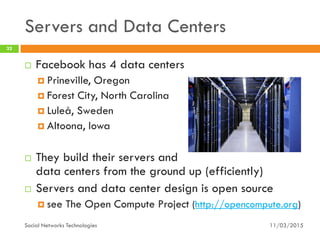
 Facebook has 4 data centers
 Prineville, Oregon
 Forest City, North Carolina
 Luleå, Sweden
 Altoona, Iowa
 They build their servers and
data centers from the ground up (efficiently)
 Servers and data center design is open source
 see The Open Compute Project (http://opencompute.org)
Complex Infrastructure
11/03/2015Social Networks Technologies
33
 Large number of software components
 Multiple storage systems
 Multiple caching systems
 Hundreds of specialized services
 Failure is routine!
Keep things as simple as possible!
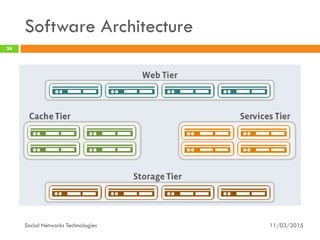
Software Architecture
11/03/2015Social Networks Technologies
34
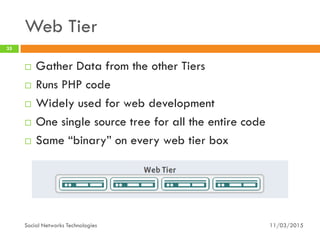
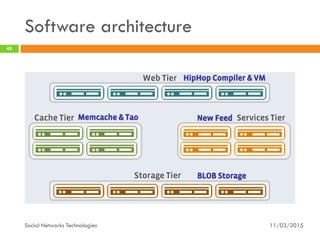
Web Tier
11/03/2015Social Networks Technologies
35
 Gather Data from the other Tiers
 Runs PHP code
 Widely used for web development
 One single source tree for all the entire code
 Same “binary” on every web tier box
Web Tier
11/03/2015Social Networks Technologies
36
 At the beginning: Zend Interpreter for PHP
 reasonably fast (for an interpreter)
 rapid development
 no recompiling
 but, at scale, performance matters!
 Then: HipHop compiler for PHP
 400% faster
 but slow down development
 they add an HipHop interpreter
 but compiler and interpreter sometime disagree
Web Tier
11/03/2015Social Networks Technologies
37
 Now: HipHop Virtual Machine
 The best of both worlds
 9x increase in web request throughput
 5x reduction in memory consumption
 All this is open source
 e.g., you can find HipHop Virtual Machine at
http://hhvm.com
Storage Tier
11/03/2015Social Networks Technologies
38
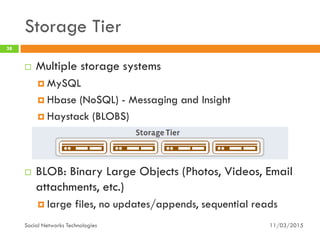
 Multiple storage systems
 MySQL
 Hbase (NoSQL) - Messaging and Insight
 Haystack (BLOBS)
 BLOB: Binary Large Objects (Photos, Videos, Email
attachments, etc.)
 large files, no updates/appends, sequential reads
Cache Tier
11/03/2015Social Networks Technologies
39
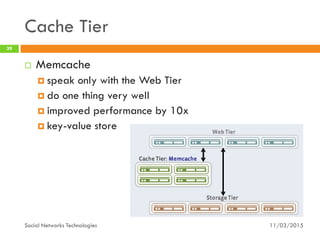
 Memcache
 speak only with the Web Tier
 do one thing very well
 improved performance by 10x
 key-value store
Cache Tier
11/03/2015Social Networks Technologies
40
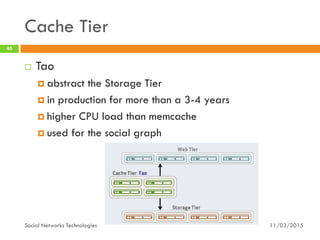
 Tao
 abstract the Storage Tier
 in production for more than a 3-4 years
 higher CPU load than memcache
 used for the social graph
Service Tier
11/03/2015Social Networks Technologies
41
Service Tier
11/03/2015Social Networks Technologies
42
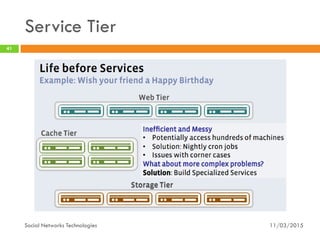
 Example: News Feed
 one of the hundreds of services at Facebook
 Characteristics
 real-time distribution
 writers can potentially broadcast to very large
audience
 readers wants (and have) different and dynamic ways
to filter data
 The service should maintain an index and rank the
data (in multiple ways)
News Feed Service
11/03/2015Social Networks Technologies
43
- write one location
News Feed Service
11/03/2015Social Networks Technologies
44
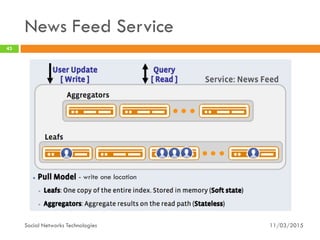
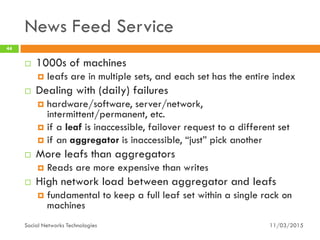
 1000s of machines
 leafs are in multiple sets, and each set has the entire index
 Dealing with (daily) failures
 hardware/software, server/network,
intermittent/permanent, etc.
 if a leaf is inaccessible, failover request to a different set
 if an aggregator is inaccessible, “just” pick another
 More leafs than aggregators
 Reads are more expensive than writes
 High network load between aggregator and leafs
 fundamental to keep a full leaf set within a single rack on
machines
Software architecture
11/03/2015Social Networks Technologies
45
Pinterest architecture at 100 feet
How to handle such situations?
11/03/2015
46
Social Networks Technologies
Infrastructure
11/03/2015Social Networks Technologies
47
 Pinterest follows some core principles when choosing
a system:
 keep it very simple
 don’t re-invent the wheel
 go with proven and solid technologies when you can
 It runs on Amazon EC2
Software Architecture
11/03/2015Social Networks Technologies
48
 Web Tier
 Heavily-modified Django (Python)
 Tornado is the chosen Web Server
 Storage Tier
 MySQL
 Amazon S3 for photos
 Cache Tier
 Redis (key-value storage)
 memcache
Conclusions
11/03/2015
49
Social Networks Technologies
Conclusions
11/03/2015Social Networks Technologies
50
 Most Social Networks starts like “traditional”
website
 They change and/or evolve their hardware and
software infrastructure when:
 users grow
 some functionalities are added/revised
 Scalability is a relevant problem…
 They are complex entities and, sometimes, required
complex or innovative solutions
References
11/03/2015Social Networks Technologies
51
 Facebook Newsroom, http://newsroom.fb.com
 Facebook Investor Relations, http://investor.fb.com
 HPCA 2012 Facebook Keynote,
http://www.ece.lsu.edu/hpca-
18/files/HPCA2012_Facebook_Keynote.pdf
 Scaling Pinterest,
http://highscalability.com/blog/2013/4/15/scalin
g-pinterest-from-0-to-10s-of-billions-of-page-
views-a.html
License
11/03/2015Tips for Working Successfully in a Group
52
 This work is licensed under the Creative Commons “Attribution-
NonCommercial-ShareAlike Unported (CC BY-NC-SA 3,0)” License.
 You are free:
 to Share - to copy, distribute and transmit the work
 to Remix - to adapt the work
 Under the following conditions:
 Attribution - You must attribute the work in the manner specified by the
author or licensor (but not in any way that suggests that they endorse
you or your use of the work).
 Noncommercial - You may not use this work for commercial purposes.
 Share Alike - If you alter, transform, or build upon this work, you may
distribute the resulting work only under the same or similar license to this
one.
 To view a copy of this license, visit
http://creativecommons.org/licenses/by-nc-sa/3.0/

LAM 2015 - Social Networks Technologies

  • 1.
  • 2.
    Prerequisite 11/03/2015Social Networks Technologies 2 Didyou know…  what is a data center?  the difference between a logical server and a physical server?  the difference between cache and database access?
  • 3.
  • 4.
    Social network A “typical”web site? 11/03/2015 4 Social Networks Technologies Traditional web site
  • 5.
    Social network A “typical”web site? 11/03/2015 5 Social Networks Technologies Traditional web site In the beginning, probably…
  • 6.
    Social network A “typical”web site? 11/03/2015 6 Social Networks Technologies Traditional web site … but soon or later…
  • 7.
  • 8.
    11/03/2015Social Networks Technologies 8 Whattools and technologies are we using for building a website? Web site: tools and technologies
  • 9.
    Web site: toolsand technologies  JVM + JDK + J2EE  Tomcat (or similar)  MySQL (or similar)  PHP  Apache  MySQL (or similar) 11/03/2015 9 Social Networks Technologies Java/JSP PHP For example…
  • 10.
    Web site: toolsand technologies  JVM + JDK + J2EE  MySQL (or similar)  Tomcat (or similar)  PHP  MySQL (or similar)  Apache server 11/03/2015 10 Social Networks Technologies Java/JSP PHP Typically, a vertical stack (with one programming language)
  • 11.
    Now let’s trywith these sites… 11/03/2015Social Networks Technologies 11
  • 12.
    Now let’s trywith these sites… 11/03/2015Social Networks Technologies 12 PHP MySQL Apache Rails MySQL Unicorn Django MySQL Tornado Django PostgreSQL Gunicorn
  • 13.
    Now let’s trywith these sites… 11/03/2015Social Networks Technologies 13 PHP MySQL Apache Rails MySQL Unicorn Django MySQL Tornado Django PostgreSQL Gunicorn Are you really, really sure?
  • 14.
    Not so sure?! 11/03/2015 14 SocialNetworks Technologies https://github.com/twitter https://github.com/facebook Let’s have a look at some pages and projects… https://engineering.twitter.com/opensource/projects What did you notice? https://code.facebook.com/projects/
  • 15.
    What did younotice?  Twitter  tracing system, package manager, various servers, NoSQL database, caching system, etc.  Facebook  code-related tools, code transformer, various servers, distributed file system, caching system, NoSQL database, etc. 11/03/2015 15 Social Networks Technologies A lot of different components
  • 16.
    What did younotice?  Twitter  Java, Scala, Ruby, C++, C, Objective-C, Shell scripting, Python, JavaScript  Facebook  PHP, OCAml, C++, JavaScript, Python, Java, Objective-C, Processing, C, Ruby, Shell scripting, Haskell, Emacs Lisp, ActionScript 11/03/2015 16 Social Networks Technologies A lot of different languages
  • 17.
    Now, have alook again at this… 11/03/2015 17 Social Networks Technologies Impressive?!
  • 18.
    This is ONLYthe tip of the iceberg…
  • 19.
    Social Network Characteristics 11/03/2015SocialNetworks Technologies 19  Wildly popular over last few years  Facebook has more than 1 billion (monthly active) users  Twitter has more than 600M users  Distributed across the planet  Changed how content is created and consumed  Explosion of smartphones  photos and video are now easy to shoot and share  e.g., Facebook has more than 350M photos uploaded each day
  • 20.
    Facebook as anexample… 11/03/2015 20 Social Networks Technologies
  • 21.
    On December 2014… 11/03/2015SocialNetworks Technologies 21 More than 3.9 trillion feed actions processed per day More than 1 billion monthly active users 100 million search queries per day More than 200 billion monthly page views 4.75 billion content items shared per day 4.5 billion ‘Likes’ per day 350 million photos uploaded per day Over 500 TB new data ingested per day 890 million active users per day
  • 22.
    Growth Rate 11/03/2015Social NetworksTechnologies 22 0 200 400 600 800 1000 1200 1400 1600 December2004 December2005 December2006 April2007 October2007 August2008 January2009 February2009 April2009 July2009 September2009 December2009 February2010 July2010 September2010 January2011 February2011 June2011 September2011 February2012 April2012 July2012 October2012 January2013 April2013 July2013 October2013 January2014 April2014 July2014 October2014 January2015 Millions of Users
  • 23.
    11/03/2015 23 Social Networks Technologies Eachactive user wants to write and upload something NOW No perceptible delay is allowed, in any case No matter how “big” the content is Reality Check Data and services have to be available 24/7, everywhere
  • 24.
    11/03/2015 24 Social Networks Technologies Moreover,new features and applications are added continuously to Facebook Reality Check No perceptible delay is allowed, in any case Each active user wants to see and share something NOW (she sees the recent status of her friends and pages, anyway) No matter where the information is (geographically speaking)
  • 25.
    Reality Check 11/03/2015Social NetworksTechnologies 25 “Rendering a single page of Facebook involves hundreds of machines examining tens of thousands of pieces of data from dozen of services - all in real time.” - from the Infrastructure page of the Facebook Newsroom (2014)
  • 26.
  • 27.
    The main problem 11/03/2015SocialNetworks Technologies 27 Scalability The ability of a system, network or process to handle a growing amount of work in a capable manner or its ability to be enlarged to accommodate that growth.
  • 28.
    The main problem 11/03/2015SocialNetworks Technologies 28 Scalability The ability of a system, network or process to handle a growing amount of work in a capable manner or its ability to be enlarged to accommodate that growth. Affected by several factors
  • 29.
    How to handlesuch situations? 11/03/2015 29 Social Networks Technologies
  • 30.
    Solution 11/03/2015Social Networks Technologies 30 No standard solutions…  … each social network made different choices  strongly dependent from the original core  We are in the Cloud Computing realm  We are going to analyze briefly the Facebook and the Pinterest cases
  • 31.
    Facebook architecture at100 feet How to handle such situations? 11/03/2015 31 Social Networks Technologies
  • 32.
    Servers and DataCenters 11/03/2015Social Networks Technologies 32  Facebook has 4 data centers  Prineville, Oregon  Forest City, North Carolina  Luleå, Sweden  Altoona, Iowa  They build their servers and data centers from the ground up (efficiently)  Servers and data center design is open source  see The Open Compute Project (http://opencompute.org)
  • 33.
    Complex Infrastructure 11/03/2015Social NetworksTechnologies 33  Large number of software components  Multiple storage systems  Multiple caching systems  Hundreds of specialized services  Failure is routine! Keep things as simple as possible!
  • 34.
  • 35.
    Web Tier 11/03/2015Social NetworksTechnologies 35  Gather Data from the other Tiers  Runs PHP code  Widely used for web development  One single source tree for all the entire code  Same “binary” on every web tier box
  • 36.
    Web Tier 11/03/2015Social NetworksTechnologies 36  At the beginning: Zend Interpreter for PHP  reasonably fast (for an interpreter)  rapid development  no recompiling  but, at scale, performance matters!  Then: HipHop compiler for PHP  400% faster  but slow down development  they add an HipHop interpreter  but compiler and interpreter sometime disagree
  • 37.
    Web Tier 11/03/2015Social NetworksTechnologies 37  Now: HipHop Virtual Machine  The best of both worlds  9x increase in web request throughput  5x reduction in memory consumption  All this is open source  e.g., you can find HipHop Virtual Machine at http://hhvm.com
  • 38.
    Storage Tier 11/03/2015Social NetworksTechnologies 38  Multiple storage systems  MySQL  Hbase (NoSQL) - Messaging and Insight  Haystack (BLOBS)  BLOB: Binary Large Objects (Photos, Videos, Email attachments, etc.)  large files, no updates/appends, sequential reads
  • 39.
    Cache Tier 11/03/2015Social NetworksTechnologies 39  Memcache  speak only with the Web Tier  do one thing very well  improved performance by 10x  key-value store
  • 40.
    Cache Tier 11/03/2015Social NetworksTechnologies 40  Tao  abstract the Storage Tier  in production for more than a 3-4 years  higher CPU load than memcache  used for the social graph
  • 41.
  • 42.
    Service Tier 11/03/2015Social NetworksTechnologies 42  Example: News Feed  one of the hundreds of services at Facebook  Characteristics  real-time distribution  writers can potentially broadcast to very large audience  readers wants (and have) different and dynamic ways to filter data  The service should maintain an index and rank the data (in multiple ways)
  • 43.
    News Feed Service 11/03/2015SocialNetworks Technologies 43 - write one location
  • 44.
    News Feed Service 11/03/2015SocialNetworks Technologies 44  1000s of machines  leafs are in multiple sets, and each set has the entire index  Dealing with (daily) failures  hardware/software, server/network, intermittent/permanent, etc.  if a leaf is inaccessible, failover request to a different set  if an aggregator is inaccessible, “just” pick another  More leafs than aggregators  Reads are more expensive than writes  High network load between aggregator and leafs  fundamental to keep a full leaf set within a single rack on machines
  • 45.
  • 46.
    Pinterest architecture at100 feet How to handle such situations? 11/03/2015 46 Social Networks Technologies
  • 47.
    Infrastructure 11/03/2015Social Networks Technologies 47 Pinterest follows some core principles when choosing a system:  keep it very simple  don’t re-invent the wheel  go with proven and solid technologies when you can  It runs on Amazon EC2
  • 48.
    Software Architecture 11/03/2015Social NetworksTechnologies 48  Web Tier  Heavily-modified Django (Python)  Tornado is the chosen Web Server  Storage Tier  MySQL  Amazon S3 for photos  Cache Tier  Redis (key-value storage)  memcache
  • 49.
  • 50.
    Conclusions 11/03/2015Social Networks Technologies 50 Most Social Networks starts like “traditional” website  They change and/or evolve their hardware and software infrastructure when:  users grow  some functionalities are added/revised  Scalability is a relevant problem…  They are complex entities and, sometimes, required complex or innovative solutions
  • 51.
    References 11/03/2015Social Networks Technologies 51 Facebook Newsroom, http://newsroom.fb.com  Facebook Investor Relations, http://investor.fb.com  HPCA 2012 Facebook Keynote, http://www.ece.lsu.edu/hpca- 18/files/HPCA2012_Facebook_Keynote.pdf  Scaling Pinterest, http://highscalability.com/blog/2013/4/15/scalin g-pinterest-from-0-to-10s-of-billions-of-page- views-a.html
  • 52.
    License 11/03/2015Tips for WorkingSuccessfully in a Group 52  This work is licensed under the Creative Commons “Attribution- NonCommercial-ShareAlike Unported (CC BY-NC-SA 3,0)” License.  You are free:  to Share - to copy, distribute and transmit the work  to Remix - to adapt the work  Under the following conditions:  Attribution - You must attribute the work in the manner specified by the author or licensor (but not in any way that suggests that they endorse you or your use of the work).  Noncommercial - You may not use this work for commercial purposes.  Share Alike - If you alter, transform, or build upon this work, you may distribute the resulting work only under the same or similar license to this one.  To view a copy of this license, visit http://creativecommons.org/licenses/by-nc-sa/3.0/