
BURN
Definition
• Damange to the skin caused by excessive
heat or caustic chemicals
CONTENT
• Anatomy
• Etiology
• Pathophysiology
• Burn severity
• Body response to burn
• Treatment
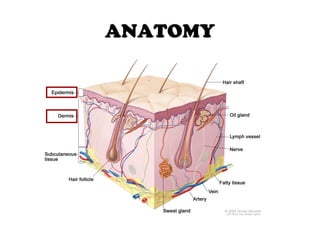
ANATOMY
ETIOLOGY
• Flame
• Scald
• Electrical
• Flash
• Chemical
• Contact
• Radiation
PATHOPHYSIOLOGY
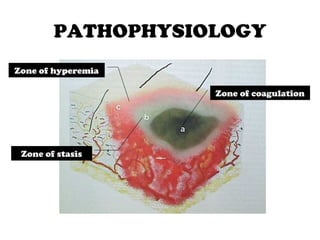
Zone of coagulation
Zone of stasis
Zone of hyperemia
PATHOPHYSIOLOGY
• Zone of coagulation (central)
– The most intimate contact with heat
source
– Dead or dying cells: coagulation necrosis
and absent blood flow
– Depth of tissue destruction determines
the degree of the burn
– White or charred
PATHOPHYSIOLOGY
• Zone of stasis (intermediate)
– Usually is red and may blanch on pressure,
appearing to have an intact circulation
– After 24 hours: petechial hemorrhages may be
present
– 3rd
day, becomes white because its superficial
dermis is avascular and necrosis
– Transformation of the zone of stasis 
coagulation
– Progressive dermal ischemia
– Edema
PATHOPHYSIOLOGY
• Zone of hyperemia (outer)
– A red zone that blanches on pressure,
indicating that it has intact circulation
– 4th
day, deeper red color
Burn wound depth
Depends on
• Temperature of the agent
• Duration of contact with the agent
• Skin thickness
– Globrous skin of the palms and soles is
more resistant to full-thickness injury
than is the thinner skin
– Infant skin is also thinner than adult
skin
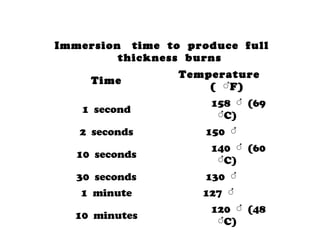
Immersion time to produce full
thickness burns
Time
Temperature
( ํํF)
1 second
158 ํํ (69
ํํC)
2 seconds 150 ํํ
10 seconds
140 ํํ (60
ํํC)
30 seconds 130 ํํ
1 minute 127 ํํ
10 minutes
120 ํํ (48
ํํC)
SEVERITY
• Etiology
• Time contact
• Extent or %burn area
• Depth
• Age
• Part of body burned
• Concurrent injuries
Determination of burn
EXTENT
• TBSA: partial + full thickness dermal
injury (2rd
+3nd
burn)
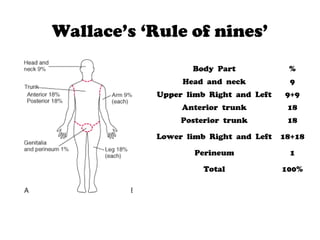
– Rule of 9
– Patient’s hand = 1%
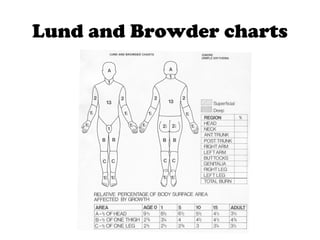
– Lund and browder charts
Wallace’s ‘Rule of nines’
Body Part %
Head and neck 9
Upper limb Right and Left 9+9
Anterior trunk 18
Posterior trunk 18
Lower limb Right and Left 18+18
Perineum 1
Total 100%
Lund and Browder charts
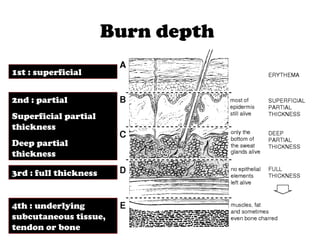
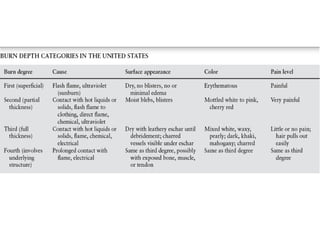
Burn depth
1st : superficial
2nd : partial
Superficial partial
thickness
Deep partial
thickness
3rd : full thickness
4th : underlying
subcutaneous tissue,
tendon or bone
Superficial burns
• Involve the epidermis only
• Erythematous and painful
• Heal within 3-5 days
• Best treated with topical agents such as
aloe lotion: accelerate re-epithelialization
and soothe the patient
• Oral analgesics
• Sunburns
Superficial partial-
thickness burns
• Pink, moist, blister and painful to the
touch
• Heal within 2 weeks
• Generally do not result in scarring, but
could result in alteration of pigmentation
• Treated with greasy gauze with antibiotic
ointment
• Water scald burns
Deep partial-thickness burns
• Extend into the reticular portion of the
dermis
• Dry and mottled pink and white, variable
sensation
• Heal within 3-8 weeds, depending on the
number of viable adnexal structures
• Heal with contraction, scarring, and
possible contractures
• Not be completely re-epithelialized in 3
weeks, operative excision and grafting is
recommended
Full-thickness burns
• Involve the epidermis and the entirety of
the dermis
• Brown-black (eschar), leathery, and
insensate
• Fixed carboxyhemoglobin in the wound 
cherry-red color
• Treated by excision and grafting, unless
they are quite small
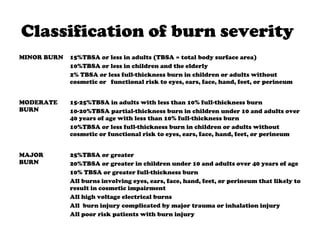
Classification of burn severity
MINOR BURN 15%TBSA or less in adults (TBSA = total body surface area)
10%TBSA or less in children and the elderly
2% TBSA or less full-thickness burn in children or adults without
cosmetic or functional risk to eyes, ears, face, hand, feet, or perineum
MODERATE
BURN
15-25%TBSA in adults with less than 10% full-thickness burn
10-20%TBSA partial-thickness burn in children under 10 and adults over
40 years of age with less than 10% full-thickness burn
10%TBSA or less full-thickness burn in children or adults without
cosmetic or functional risk to eyes, ears, face, hand, feet, or perineum
MAJOR
BURN
25%TBSA or greater
20%TBSA or greater in children under 10 and adults over 40 years of age
10% TBSA or greater full-thickness burn
All burns involving eyes, ears, face, hand, feet, or perineum that likely to
result in cosmetic impairment
All high voltage electrical burns
All burn injury complicated by major trauma or inhalation injury
All poor risk patients with burn injury
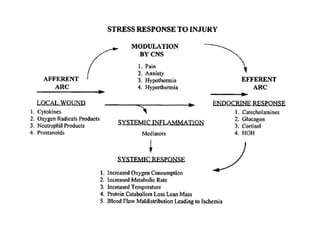
Body response to burn injury
• Physiologic response and burn shock
• Metabolic response
• Neuroendocrine response
• Immune response
Physiologic response and burn
shock
• Systemic inflammatory response
syndrome (SIRS)
– Arteriolar vasodilatation
– Increase venular membrane
permeability  intravascular fluid
leakage  tissue edema
Metabolic response
• Hypermetabolism
– Increase gluconeogenesis
– Increase proteolysis
– Increase energy expenditure
Neuroendocrine response
• Hematologic changes
– Hemolysis VS Hemoconcentration in
early phase
– Leukocytosis
– Mild hypercoagulable state
Immune response
• Dysfunction of immune system
– Cell-mediated immunity
– Humoral immunity
– Increase infection, sepsis, death
Treatment
• Initial evaluation and management
• Fluid resuscitation
• Wound care
• Nutrition
• Complication
Initial evaluation and
management
• Primary survey
– ATLS: ABCs
• Airway
– Early recognition of impending airway
compromise
– Prompt intubations
• Fluid resuscitation
– Warmed fluid
Initial evaluation and
management
• Secondary survey
– Mechanism of injury
– Inhalation injury
– Assessment of burn wound
• Cooling of burned tissue
– No benefit if delayed >30 minutes
– Do not use ice water
• Major burn
– NG tube
– Foley’s catheter
Initial evaluation and
management
• Analgesic drugs
• Tetanus immunization
Fluid resuscitation
• Early and adequate
• Extent of burn and size, and fluid
replacement should proceed at the same
rate as the loss
• Constant rate, boluses are avoided
• Both peripheral and central lines can be
placed through burned tissue when
required
Fluid resuscitation
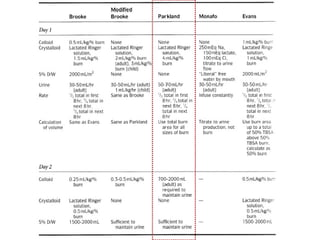
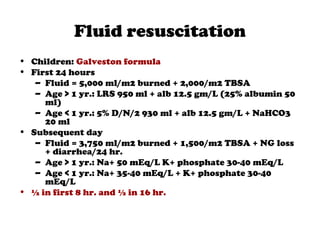
• Children: Galveston formula
• First 24 hours
– Fluid = 5,000 ml/m2 burned + 2,000/m2 TBSA
– Age > 1 yr.: LRS 950 ml + alb 12.5 gm/L (25% albumin 50
ml)
– Age < 1 yr.: 5% D/N/2 930 ml + alb 12.5 gm/L + NaHCO3
20 ml
• Subsequent day
– Fluid = 3,750 ml/m2 burned + 1,500/m2 TBSA + NG loss
+ diarrhea/24 hr.
– Age > 1 yr.: Na+ 50 mEq/L K+ phosphate 30-40 mEq/L
– Age < 1 yr.: Na+ 35-40 mEq/L + K+ phosphate 30-40
mEq/L
• ½ in first 8 hr. and ½ in 16 hr.
Wound management
• Prevent infection
• Prevent tissue ischemia
• Adequate nutritional
Wound management
• Conventional or Conservative treatment
– Open dressing
– Close dressing
• Early excision and grafting
Wound management
• Dressings with a moist, antibacterial
covering to minimize microbial growth,
fluid loss, and painful stimuli and to
maximize skin regeneration
Topical antimicrobial dressing
• Silver sulfadiazine (Silvadene)
• Mafenide acetate
• Dakin solution (0.25% sodium
hypochlorite)
• Silver nitrate
Biological dressing
• Xenograft
• Human amnion membrane (amniotic
membrane)
• Allograft
Synthetic dressing
• Hydrocolloid: Duoderm
• Hydro active: Cutinova
• Calcium alginate: Kaltostat, Sorbsan,
Urgosorb
• Polyurethane foam: Allevyn, Lyofoam
• Silver based dressing: Acticoat, Urgotul
SSD, Tegaderm Ag, Aquacel Ag
Early excision and grafting
• Surgical procedures
– In adults, blood loss reaches 100 ml for
every 1% TBSA
– Limit each operative session to
debridement of 10-20% TBSA
– Tangential debridement involves
cutting the skin tissue at the depth of
the dermal and subcutaneous capillary
network
• 1 cm2 of burn causes 1 ml of blood loss
Early excision and grafting
• Autologous split-thickness skin grafts
– Gold standard for burn wounds if
enough donor sites are available
Nutrition
• Increase basal metabolic rate 50-100% of the
normal resting rate
– Increase glucose production, insulin
resistance, lipolysis, and muscle protein
catabolism. Without adequate nutritional
support
– Delayed wound healing, decreased immune
function, and generalized weight loss.
• Increase intake of both total calories and protein
(1.5-3 of protein/kg/day)
Nutrition
• Measuring weight loss and gain during treatment
is not useful because of the large fluid shifts
• Carbohydrate 65-80%
• Protein 15-20%
• Lipid 5-15%
Modification of the Harris-
Benedict Equation
Men
BMR = [66.47 + (13.75 x W) + (5.0 x H) - (6.76 x A) ] x (Activity
factor) x (injury factor)
Women
BMR = [665.1 + (9.56 x W) + (1.85 x H) - (4.68 x A) ] x (Activity
factor) x (injury factor)
BMR = basal metabolic rate W = weight in kg, M = height in cm, A =
age in years
Activity factor
Confined to bed = 1.2
Out of bed = 1.3
Injury factor
Minor operation = 1.2
Skeletal trauma = 1.35
Major sepsis = 1.6
Severe thermal burn = 1.5
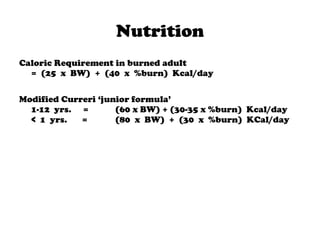
Nutrition
Caloric Requirement in burned adult
= (25 x BW) + (40 x %burn) Kcal/day
Modified Curreri ‘junior formula’
1-12 yrs. = (60 x BW) + (30-35 x %burn) Kcal/day
< 1 yrs. = (80 x BW) + (30 x %burn) KCal/day
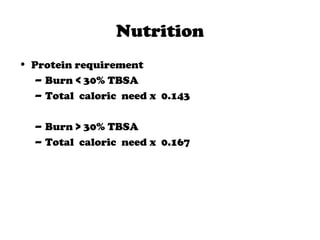
Nutrition
• Protein requirement
– Burn < 30% TBSA
– Total caloric need x 0.143
– Burn > 30% TBSA
– Total caloric need x 0.167
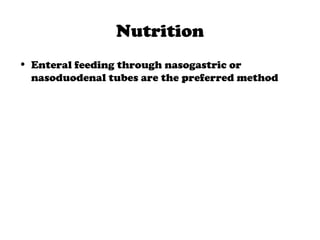
Nutrition
• Enteral feeding through nasogastric or
nasoduodenal tubes are the preferred method

Burn

  • 1.
  • 2.
    Definition • Damange tothe skin caused by excessive heat or caustic chemicals
  • 3.
    CONTENT • Anatomy • Etiology •Pathophysiology • Burn severity • Body response to burn • Treatment
  • 4.
  • 5.
    ETIOLOGY • Flame • Scald •Electrical • Flash • Chemical • Contact • Radiation
  • 6.
    PATHOPHYSIOLOGY Zone of coagulation Zoneof stasis Zone of hyperemia
  • 7.
    PATHOPHYSIOLOGY • Zone ofcoagulation (central) – The most intimate contact with heat source – Dead or dying cells: coagulation necrosis and absent blood flow – Depth of tissue destruction determines the degree of the burn – White or charred
  • 8.
    PATHOPHYSIOLOGY • Zone ofstasis (intermediate) – Usually is red and may blanch on pressure, appearing to have an intact circulation – After 24 hours: petechial hemorrhages may be present – 3rd day, becomes white because its superficial dermis is avascular and necrosis – Transformation of the zone of stasis  coagulation – Progressive dermal ischemia – Edema
  • 9.
    PATHOPHYSIOLOGY • Zone ofhyperemia (outer) – A red zone that blanches on pressure, indicating that it has intact circulation – 4th day, deeper red color
  • 10.
    Burn wound depth Dependson • Temperature of the agent • Duration of contact with the agent • Skin thickness – Globrous skin of the palms and soles is more resistant to full-thickness injury than is the thinner skin – Infant skin is also thinner than adult skin
  • 11.
    Immersion time toproduce full thickness burns Time Temperature ( ํํF) 1 second 158 ํํ (69 ํํC) 2 seconds 150 ํํ 10 seconds 140 ํํ (60 ํํC) 30 seconds 130 ํํ 1 minute 127 ํํ 10 minutes 120 ํํ (48 ํํC)
  • 12.
    SEVERITY • Etiology • Timecontact • Extent or %burn area • Depth • Age • Part of body burned • Concurrent injuries
  • 13.
    Determination of burn EXTENT •TBSA: partial + full thickness dermal injury (2rd +3nd burn) – Rule of 9 – Patient’s hand = 1% – Lund and browder charts
  • 14.
    Wallace’s ‘Rule ofnines’ Body Part % Head and neck 9 Upper limb Right and Left 9+9 Anterior trunk 18 Posterior trunk 18 Lower limb Right and Left 18+18 Perineum 1 Total 100%
  • 15.
  • 16.
    Burn depth 1st :superficial 2nd : partial Superficial partial thickness Deep partial thickness 3rd : full thickness 4th : underlying subcutaneous tissue, tendon or bone
  • 17.
    Superficial burns • Involvethe epidermis only • Erythematous and painful • Heal within 3-5 days • Best treated with topical agents such as aloe lotion: accelerate re-epithelialization and soothe the patient • Oral analgesics • Sunburns
  • 18.
    Superficial partial- thickness burns •Pink, moist, blister and painful to the touch • Heal within 2 weeks • Generally do not result in scarring, but could result in alteration of pigmentation • Treated with greasy gauze with antibiotic ointment • Water scald burns
  • 19.
    Deep partial-thickness burns •Extend into the reticular portion of the dermis • Dry and mottled pink and white, variable sensation • Heal within 3-8 weeds, depending on the number of viable adnexal structures • Heal with contraction, scarring, and possible contractures • Not be completely re-epithelialized in 3 weeks, operative excision and grafting is recommended
  • 20.
    Full-thickness burns • Involvethe epidermis and the entirety of the dermis • Brown-black (eschar), leathery, and insensate • Fixed carboxyhemoglobin in the wound  cherry-red color • Treated by excision and grafting, unless they are quite small
  • 22.
    Classification of burnseverity MINOR BURN 15%TBSA or less in adults (TBSA = total body surface area) 10%TBSA or less in children and the elderly 2% TBSA or less full-thickness burn in children or adults without cosmetic or functional risk to eyes, ears, face, hand, feet, or perineum MODERATE BURN 15-25%TBSA in adults with less than 10% full-thickness burn 10-20%TBSA partial-thickness burn in children under 10 and adults over 40 years of age with less than 10% full-thickness burn 10%TBSA or less full-thickness burn in children or adults without cosmetic or functional risk to eyes, ears, face, hand, feet, or perineum MAJOR BURN 25%TBSA or greater 20%TBSA or greater in children under 10 and adults over 40 years of age 10% TBSA or greater full-thickness burn All burns involving eyes, ears, face, hand, feet, or perineum that likely to result in cosmetic impairment All high voltage electrical burns All burn injury complicated by major trauma or inhalation injury All poor risk patients with burn injury
  • 23.
    Body response toburn injury • Physiologic response and burn shock • Metabolic response • Neuroendocrine response • Immune response
  • 24.
    Physiologic response andburn shock • Systemic inflammatory response syndrome (SIRS) – Arteriolar vasodilatation – Increase venular membrane permeability  intravascular fluid leakage  tissue edema
  • 25.
    Metabolic response • Hypermetabolism –Increase gluconeogenesis – Increase proteolysis – Increase energy expenditure
  • 26.
    Neuroendocrine response • Hematologicchanges – Hemolysis VS Hemoconcentration in early phase – Leukocytosis – Mild hypercoagulable state
  • 27.
    Immune response • Dysfunctionof immune system – Cell-mediated immunity – Humoral immunity – Increase infection, sepsis, death
  • 29.
    Treatment • Initial evaluationand management • Fluid resuscitation • Wound care • Nutrition • Complication
  • 30.
    Initial evaluation and management •Primary survey – ATLS: ABCs • Airway – Early recognition of impending airway compromise – Prompt intubations • Fluid resuscitation – Warmed fluid
  • 31.
    Initial evaluation and management •Secondary survey – Mechanism of injury – Inhalation injury – Assessment of burn wound • Cooling of burned tissue – No benefit if delayed >30 minutes – Do not use ice water • Major burn – NG tube – Foley’s catheter
  • 32.
    Initial evaluation and management •Analgesic drugs • Tetanus immunization
  • 33.
    Fluid resuscitation • Earlyand adequate • Extent of burn and size, and fluid replacement should proceed at the same rate as the loss • Constant rate, boluses are avoided • Both peripheral and central lines can be placed through burned tissue when required
  • 35.
    Fluid resuscitation • Children:Galveston formula • First 24 hours – Fluid = 5,000 ml/m2 burned + 2,000/m2 TBSA – Age > 1 yr.: LRS 950 ml + alb 12.5 gm/L (25% albumin 50 ml) – Age < 1 yr.: 5% D/N/2 930 ml + alb 12.5 gm/L + NaHCO3 20 ml • Subsequent day – Fluid = 3,750 ml/m2 burned + 1,500/m2 TBSA + NG loss + diarrhea/24 hr. – Age > 1 yr.: Na+ 50 mEq/L K+ phosphate 30-40 mEq/L – Age < 1 yr.: Na+ 35-40 mEq/L + K+ phosphate 30-40 mEq/L • ½ in first 8 hr. and ½ in 16 hr.
  • 36.
    Wound management • Preventinfection • Prevent tissue ischemia • Adequate nutritional
  • 37.
    Wound management • Conventionalor Conservative treatment – Open dressing – Close dressing • Early excision and grafting
  • 38.
    Wound management • Dressingswith a moist, antibacterial covering to minimize microbial growth, fluid loss, and painful stimuli and to maximize skin regeneration
  • 39.
    Topical antimicrobial dressing •Silver sulfadiazine (Silvadene) • Mafenide acetate • Dakin solution (0.25% sodium hypochlorite) • Silver nitrate
  • 40.
    Biological dressing • Xenograft •Human amnion membrane (amniotic membrane) • Allograft
  • 41.
    Synthetic dressing • Hydrocolloid:Duoderm • Hydro active: Cutinova • Calcium alginate: Kaltostat, Sorbsan, Urgosorb • Polyurethane foam: Allevyn, Lyofoam • Silver based dressing: Acticoat, Urgotul SSD, Tegaderm Ag, Aquacel Ag
  • 42.
    Early excision andgrafting • Surgical procedures – In adults, blood loss reaches 100 ml for every 1% TBSA – Limit each operative session to debridement of 10-20% TBSA – Tangential debridement involves cutting the skin tissue at the depth of the dermal and subcutaneous capillary network • 1 cm2 of burn causes 1 ml of blood loss
  • 43.
    Early excision andgrafting • Autologous split-thickness skin grafts – Gold standard for burn wounds if enough donor sites are available
  • 44.
    Nutrition • Increase basalmetabolic rate 50-100% of the normal resting rate – Increase glucose production, insulin resistance, lipolysis, and muscle protein catabolism. Without adequate nutritional support – Delayed wound healing, decreased immune function, and generalized weight loss. • Increase intake of both total calories and protein (1.5-3 of protein/kg/day)
  • 45.
    Nutrition • Measuring weightloss and gain during treatment is not useful because of the large fluid shifts • Carbohydrate 65-80% • Protein 15-20% • Lipid 5-15%
  • 46.
    Modification of theHarris- Benedict Equation Men BMR = [66.47 + (13.75 x W) + (5.0 x H) - (6.76 x A) ] x (Activity factor) x (injury factor) Women BMR = [665.1 + (9.56 x W) + (1.85 x H) - (4.68 x A) ] x (Activity factor) x (injury factor) BMR = basal metabolic rate W = weight in kg, M = height in cm, A = age in years Activity factor Confined to bed = 1.2 Out of bed = 1.3 Injury factor Minor operation = 1.2 Skeletal trauma = 1.35 Major sepsis = 1.6 Severe thermal burn = 1.5
  • 47.
    Nutrition Caloric Requirement inburned adult = (25 x BW) + (40 x %burn) Kcal/day Modified Curreri ‘junior formula’ 1-12 yrs. = (60 x BW) + (30-35 x %burn) Kcal/day < 1 yrs. = (80 x BW) + (30 x %burn) KCal/day
  • 48.
    Nutrition • Protein requirement –Burn < 30% TBSA – Total caloric need x 0.143 – Burn > 30% TBSA – Total caloric need x 0.167
  • 49.
    Nutrition • Enteral feedingthrough nasogastric or nasoduodenal tubes are the preferred method