PRESENTED BY
KHINYARAM
CHOUDHARY &
KISHOR TETARWAL
Social networks are the most
means of communication used by a
large number of people especially
the youth. Nowadays, no one can
live without having an account on
twitter or on facebook or on an
other kinds of social network, in
order to be connected to the whole
environnement.
INTRODUCTION
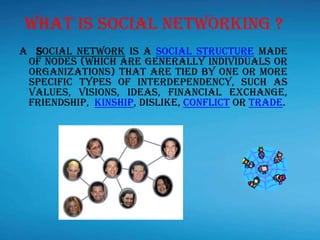
A Social network is a social structure made
of nodes (which are generally individuals or
organizations) that are tied by one or more
specific types of interdependency, such as
values, visions, ideas, financial exchange,
friendship, kinship, dislike, conflict or trade.
WHAT IS SOCIAL NETWORKING ?
Online
Communities
Facebook
WeChat
Meetme
Myspace.com
(a place for frds)
Business
Networks
Linked in
Viadeo
XING
Online
Matchmaking
Shaadi.com
Adult Friend
Finder.com
Bharatmatrimo
ny.com
Alumini
Networks
Facebook
Classmates.co
m
Orkut
Goal:
Socializing
Goal: carrier
and business
opprtunities
Goal:
matchmaking,
soulmate
Goal: getting
back in touch
Types of Social Networks
Some social networking sites
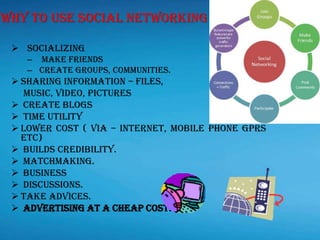
 Socializing
– Make friends
– Create groups, communities.
 Sharing information – files,
MUSIC, VIDEO, pictures
 Create blogs
 Time utility
 Lower cost ( via – internet, mobile phone GPRS
etc)
 Builds credibility.
 Matchmaking.
 Business
 Discussions.
 Take advices.
 Advertising at a cheap cost.
Why to use Social Networking
Messaging
News
Communities
Like buttons
Games
Audio and Video uploads
Features in social networking
Twitter
Founded: 2006
No. of users: 490 million
Revenue: US $367 million (projected
2013)
Alexa Rank: 3
Revenue from: verified accounts,
advertisements (promoted trends)
Key Players
Twitter is a real-time information network
that connects you to the latest stories, ideas,
opinions and news about what you find
interesting. Simply find the accounts you find
most compelling and follow the
conversations.
At the heart of Twitter are small bursts of
information called Tweets. Each Tweet is 140
characters long, but don’t let the small size
fool you—you can discover a lot in a little
space. You can see photos, videos and
conversations directly in Tweets to get the
whole story at a glance, and all in one place.
Key Players
Facebook
Founded: 2004
No. of users: 635 million
Revenue: US$858 million
Alexa Rank: 1
Revenue from: Banner ads, referral
marketing, partnerships, branding
elements, virtual currency
 Social Network launched in February 2004
by Mark Zuckerberg
 Mission:
To connect people on an innovate platform
that fosters increasing interaction. It
should have an emotional connection.
 Vision:
To provide users with value beyond
interaction. They should look to Facebook
to find answers to questions like, ―which
car should i buy?‖ – all this based on the
power of social recommendations.
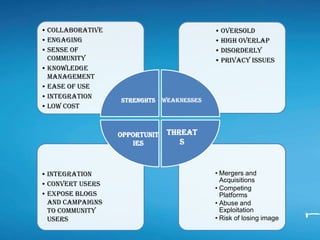
• Mergers and
Acquisitions
• Competing
Platforms
• Abuse and
Exploitation
• Risk of losing image
• Integration
• Convert users
• Expose blogs
and campaigns
to community
users
• Oversold
• High overlap
• Disorderly
• Privacy Issues
• Collaborative
• Engaging
• Sense of
Community
• Knowledge
Management
• Ease of Use
• Integration
• Low Cost
Strenghts
Threat
s
Opportunit
ies
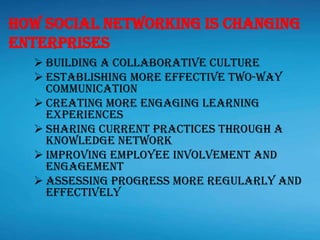
 Building a Collaborative Culture
 Establishing more effective two-way
communication
 Creating more engaging learning
experiences
 Sharing current practices through a
knowledge network
 Improving Employee involvement and
engagement
 Assessing progress more regularly and
effectively
How Social Networking is changing
Enterprises
•Advantages:
 Facilitates open communication,
leading to enhanced information
discovery and delivery.
 Allows employees to discuss ideas,
post news, ask questions and share
links.
 Provides an opportunity to widen
business contacts.
 Targets a wide audience, making it a
useful and effective recruitment
tool.
 Improves business reputation and
client base with minimal use of
advertising.
 Expands market research,
implements marketing campaigns,
delivers communications and directs
interested people to specific web
sites.
Disadvantages Of Social
Networking Sites
 Opens up the possibility for hackers to commit
fraud and launch spam and virus attacks.
 Increases the risk of people falling prey to
online scams that seem genuine, resulting in data
or identity theft.
 May result in negative comments from employees
about the company or potential legal
consequences if employees use these sites to view
objectionable, illicit or offensive material.
 Potentially results in lost productivity,
especially if employees are busy updating
profiles, etc.
 Part of almost everyone’s life.
 Every thing is this world has some +ve & -
ve’s.
 Teenagers are the one’s you use these
sites the most.
 These sites are useful to users, owners
and third party.
 Huge platform for data & information
sharing.
 Growing increasingly.
 Scope for improvement (weak regulatory
role)
Conclusion
Thanks for
watching
Khinyaram choudhary kishor tetarwal

Social networking ppt

  • 1.
  • 2.
    Social networks arethe most means of communication used by a large number of people especially the youth. Nowadays, no one can live without having an account on twitter or on facebook or on an other kinds of social network, in order to be connected to the whole environnement. INTRODUCTION
  • 3.
    A Social networkis a social structure made of nodes (which are generally individuals or organizations) that are tied by one or more specific types of interdependency, such as values, visions, ideas, financial exchange, friendship, kinship, dislike, conflict or trade. WHAT IS SOCIAL NETWORKING ?
  • 4.
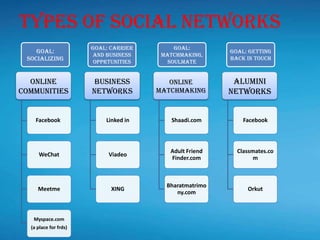
    Online Communities Facebook WeChat Meetme Myspace.com (a place forfrds) Business Networks Linked in Viadeo XING Online Matchmaking Shaadi.com Adult Friend Finder.com Bharatmatrimo ny.com Alumini Networks Facebook Classmates.co m Orkut Goal: Socializing Goal: carrier and business opprtunities Goal: matchmaking, soulmate Goal: getting back in touch Types of Social Networks
  • 5.
  • 6.
     Socializing – Makefriends – Create groups, communities.  Sharing information – files, MUSIC, VIDEO, pictures  Create blogs  Time utility  Lower cost ( via – internet, mobile phone GPRS etc)  Builds credibility.  Matchmaking.  Business  Discussions.  Take advices.  Advertising at a cheap cost. Why to use Social Networking
  • 7.
  • 9.
    Twitter Founded: 2006 No. ofusers: 490 million Revenue: US $367 million (projected 2013) Alexa Rank: 3 Revenue from: verified accounts, advertisements (promoted trends) Key Players
  • 10.
    Twitter is areal-time information network that connects you to the latest stories, ideas, opinions and news about what you find interesting. Simply find the accounts you find most compelling and follow the conversations. At the heart of Twitter are small bursts of information called Tweets. Each Tweet is 140 characters long, but don’t let the small size fool you—you can discover a lot in a little space. You can see photos, videos and conversations directly in Tweets to get the whole story at a glance, and all in one place.
  • 11.
    Key Players Facebook Founded: 2004 No.of users: 635 million Revenue: US$858 million Alexa Rank: 1 Revenue from: Banner ads, referral marketing, partnerships, branding elements, virtual currency
  • 12.
     Social Networklaunched in February 2004 by Mark Zuckerberg  Mission: To connect people on an innovate platform that fosters increasing interaction. It should have an emotional connection.  Vision: To provide users with value beyond interaction. They should look to Facebook to find answers to questions like, ―which car should i buy?‖ – all this based on the power of social recommendations.
  • 13.
    • Mergers and Acquisitions •Competing Platforms • Abuse and Exploitation • Risk of losing image • Integration • Convert users • Expose blogs and campaigns to community users • Oversold • High overlap • Disorderly • Privacy Issues • Collaborative • Engaging • Sense of Community • Knowledge Management • Ease of Use • Integration • Low Cost Strenghts Threat s Opportunit ies
  • 14.
     Building aCollaborative Culture  Establishing more effective two-way communication  Creating more engaging learning experiences  Sharing current practices through a knowledge network  Improving Employee involvement and engagement  Assessing progress more regularly and effectively How Social Networking is changing Enterprises
  • 15.
    •Advantages:  Facilitates opencommunication, leading to enhanced information discovery and delivery.  Allows employees to discuss ideas, post news, ask questions and share links.  Provides an opportunity to widen business contacts.  Targets a wide audience, making it a useful and effective recruitment tool.  Improves business reputation and client base with minimal use of advertising.  Expands market research, implements marketing campaigns, delivers communications and directs interested people to specific web sites.
  • 16.
    Disadvantages Of Social NetworkingSites  Opens up the possibility for hackers to commit fraud and launch spam and virus attacks.  Increases the risk of people falling prey to online scams that seem genuine, resulting in data or identity theft.  May result in negative comments from employees about the company or potential legal consequences if employees use these sites to view objectionable, illicit or offensive material.  Potentially results in lost productivity, especially if employees are busy updating profiles, etc.
  • 17.
     Part ofalmost everyone’s life.  Every thing is this world has some +ve & - ve’s.  Teenagers are the one’s you use these sites the most.  These sites are useful to users, owners and third party.  Huge platform for data & information sharing.  Growing increasingly.  Scope for improvement (weak regulatory role) Conclusion
  • 18.