Introduction
• Human beings by and large are social animals and
Social networks have existed since humans being
existed on this Earth. Social networking has always been
prevalent; it is just that in these times the face of social
networking has changed. Social networking groups like
Orkut, Facebook, Twitter, LinkedIn etc. Helps an
individual to get in touch with people they have lost
touch with. The growing popularity of these networking
sites proves the simple truth – Social networking has
arrived!
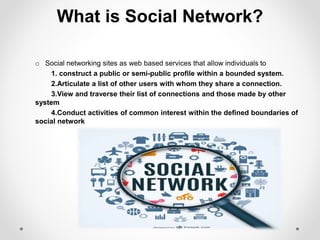
What is Social Network?
o Social networking sites as web based services that allow individuals to
1. construct a public or semi-public profile within a bounded system.
2.Articulate a list of other users with whom they share a connection.
3.View and traverse their list of connections and those made by other
system
4.Conduct activities of common interest within the defined boundaries of
social network
EXAMPLES
Whatsapp
Twitter
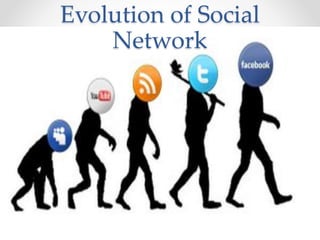
Evolution of Social
Network
Evolution of Social Network
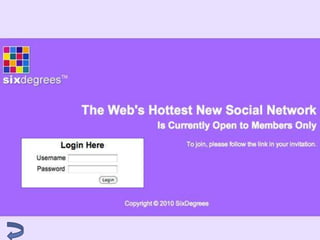
• SixDegrees.com
It is the first social network site launched in the year
1997 that allowed users to create profiles, list their
Friends and surf the Friends lists.
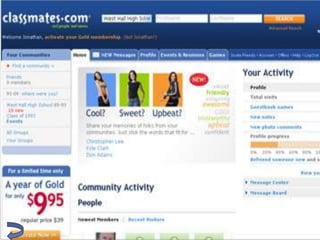
• Classmates.com
It allowed people to affiliate with their high
school or college and surf the network for others
who were also affiliated but users could not
create profiles.
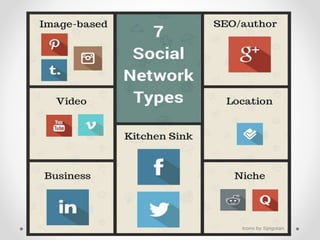
Social network - Types• Communication and content sharing Networks
Social Networking Services were originally created for the sole purpose of two way
communication and content sharing, e.g. videos, picture and information.
• Bookmarking Sites
Services that allow you to save, organize and manage links to various websites and
resources around the internet. Most allow you to “tag” your links to make them easy to
search and share.
• Social News and views
Services that allow people to post various news items or links to outside articles and
then allows it’s users to ”vote” on the items. Eg: Digg, Mouthshut, Reddit
• Media Sharing
Social media sharing services are based around posting content e.g. Youtube, Picasa,
Podcast
• Microblogging
Services that focus on short updates that are pushed out to anyone subscribed to
receive the updates. Eg; Twitter
• Blog Comments and Forums
Online forums allow members to hold conversations by posting
messages. e.g:Blogger, TED and Buzzfeed
• Location Based Networking
Location based networking is something users have to help bring them close together
and explore their local area, e.g: Foursquare, Gowalla and Loopt.
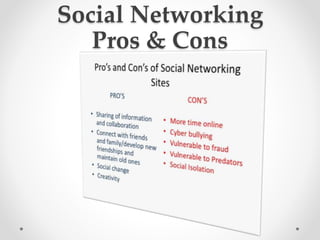
Social Networking
Pros & Cons
Social Networking
Pros & Cons
Social network & privacy
Points to consider while reading a privacy policy:
1.Start at the end.
2. Note the location and language of the privacy
policy.
3. Canceling your account.
4. How long is personal information stored?
5. Who owns the data that a user posts?
6. How can a user complain?
7. How will a social network notify users about
changes to the privacy policy?
Protect From Threat of
Using Social Network
• The following tips help protect from the threats of using social networks:
• 1.Use caution when you click links
• 2.Know what you've posted about yourself
• 3.Don't trust that a message is really from who it says it's from
• 4.To avoid giving away email addresses of your friends, do not allow social
networking services to scan your email address book.
• 5.Type the address of your social networking site directly into your browser
or use your personal bookmarks.
• 6.Be selective about who you accept as a friend on a social network.
• 7.Choose your social network carefully
• 8.Assume that everything you put on a social networking site is permanent
• 9.Be careful about installing extras on your site
• 10.Think twice before you use social networking sites at work.
• Developer(s) : whatsapp Inc.
• Release Year: 2009
• Type: social networking app
• Founder: Koum, Brian Acton
Facebook
• Founder: Mark Zuckerberg
• Founded: February 4, 2004
• Type : Social Networking site & app
• Website: www.facebook.com
Twitter
• Founders: Jack Dorsey
• CEO : Jack Dorsey
• Founded: March 21, 2006
• website : www.twitter.com
• Type : social networking site & App
Google+
• Founder : Larry Page
• Founded: June 28, 2011
• Type : social Networking Site & App
• Website: plus.google.com
You tube
Pinterest
Linkedin
• Founder : Reid Hoffman
• Founded: Dec 2002
• Type : Social Networking site & App
• Website : www.linkedin.com
Tumblr
Instagram
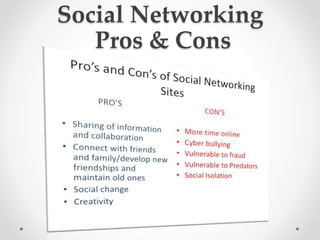
• Pros:
• Facilitates open communication, leading to enhanced information, discovery and
delivery.
• Use in Business analytics for the business research.
• Allows Individual to discuss ideas, post news, ask questions and share links.
• Provides an opportunity to widen business contacts and attract new customers.
• Targets a wide audience, making it a useful and effective recruitment tool.
• Improves business reputation and client base with minimal use of advertising.
• Expands market research, implements marketing campaigns, delivers
communications and directs interested people to specific web sites.
• Almost all social networking sites are free and they put business in direct contact
with potential customers without paying any direct charges.
Social Networking Pros
Social Networking Cons
• Cons:
• Opens up the possibility for hackers to commit fraud and launch spam and virus attacks.
• Increases the risk of people falling prey to online scams that seems genuine, resulting in data or
identity theft.
• Adverse comments from customers or competitors pretending as customers may result in to loss
of reputation and business.
• May result in negative comments from employees about the company or potential legal
consequences if employees use these sites to view objectionable, illicit or offensive material.
• Potentially results in loss of productivity, especially if employees are buCons:
• Opens up the possibility for hackers to commit fraud and launch spam and virus attacks.
• Increases the risk of people falling prey to online scams that seems genuine, resulting in data or
identity theft.
• Adverse comments from customers or competitors pretending as customers may result in to loss
of reputation and business.
• May result in negative comments from employees about the company or potential legal
consequences if employees use these sites to view objectionable, illicit or offensive material.
• Potentially results in loss of productivity, especially if employees are busy updating profiles and
spending unreasonable time in social networking activities.
• sy updating profiles and spending unreasonable time in social networking activities.

Presentation social networking service

  • 2.
    Introduction • Human beingsby and large are social animals and Social networks have existed since humans being existed on this Earth. Social networking has always been prevalent; it is just that in these times the face of social networking has changed. Social networking groups like Orkut, Facebook, Twitter, LinkedIn etc. Helps an individual to get in touch with people they have lost touch with. The growing popularity of these networking sites proves the simple truth – Social networking has arrived!
  • 3.
    What is SocialNetwork? o Social networking sites as web based services that allow individuals to 1. construct a public or semi-public profile within a bounded system. 2.Articulate a list of other users with whom they share a connection. 3.View and traverse their list of connections and those made by other system 4.Conduct activities of common interest within the defined boundaries of social network
  • 4.
  • 5.
  • 6.
    Evolution of SocialNetwork • SixDegrees.com It is the first social network site launched in the year 1997 that allowed users to create profiles, list their Friends and surf the Friends lists. • Classmates.com It allowed people to affiliate with their high school or college and surf the network for others who were also affiliated but users could not create profiles.
  • 7.
    Social network -Types• Communication and content sharing Networks Social Networking Services were originally created for the sole purpose of two way communication and content sharing, e.g. videos, picture and information. • Bookmarking Sites Services that allow you to save, organize and manage links to various websites and resources around the internet. Most allow you to “tag” your links to make them easy to search and share. • Social News and views Services that allow people to post various news items or links to outside articles and then allows it’s users to ”vote” on the items. Eg: Digg, Mouthshut, Reddit • Media Sharing Social media sharing services are based around posting content e.g. Youtube, Picasa, Podcast • Microblogging Services that focus on short updates that are pushed out to anyone subscribed to receive the updates. Eg; Twitter • Blog Comments and Forums Online forums allow members to hold conversations by posting messages. e.g:Blogger, TED and Buzzfeed • Location Based Networking Location based networking is something users have to help bring them close together and explore their local area, e.g: Foursquare, Gowalla and Loopt.
  • 9.
  • 10.
  • 11.
    Social network &privacy Points to consider while reading a privacy policy: 1.Start at the end. 2. Note the location and language of the privacy policy. 3. Canceling your account. 4. How long is personal information stored? 5. Who owns the data that a user posts? 6. How can a user complain? 7. How will a social network notify users about changes to the privacy policy?
  • 12.
    Protect From Threatof Using Social Network • The following tips help protect from the threats of using social networks: • 1.Use caution when you click links • 2.Know what you've posted about yourself • 3.Don't trust that a message is really from who it says it's from • 4.To avoid giving away email addresses of your friends, do not allow social networking services to scan your email address book. • 5.Type the address of your social networking site directly into your browser or use your personal bookmarks. • 6.Be selective about who you accept as a friend on a social network. • 7.Choose your social network carefully • 8.Assume that everything you put on a social networking site is permanent • 9.Be careful about installing extras on your site • 10.Think twice before you use social networking sites at work.
  • 14.
    • Developer(s) :whatsapp Inc. • Release Year: 2009 • Type: social networking app • Founder: Koum, Brian Acton
  • 15.
    Facebook • Founder: MarkZuckerberg • Founded: February 4, 2004 • Type : Social Networking site & app • Website: www.facebook.com
  • 16.
    Twitter • Founders: JackDorsey • CEO : Jack Dorsey • Founded: March 21, 2006 • website : www.twitter.com • Type : social networking site & App
  • 17.
    Google+ • Founder :Larry Page • Founded: June 28, 2011 • Type : social Networking Site & App • Website: plus.google.com
  • 18.
  • 19.
  • 20.
    Linkedin • Founder :Reid Hoffman • Founded: Dec 2002 • Type : Social Networking site & App • Website : www.linkedin.com
  • 21.
  • 22.
  • 25.
    • Pros: • Facilitatesopen communication, leading to enhanced information, discovery and delivery. • Use in Business analytics for the business research. • Allows Individual to discuss ideas, post news, ask questions and share links. • Provides an opportunity to widen business contacts and attract new customers. • Targets a wide audience, making it a useful and effective recruitment tool. • Improves business reputation and client base with minimal use of advertising. • Expands market research, implements marketing campaigns, delivers communications and directs interested people to specific web sites. • Almost all social networking sites are free and they put business in direct contact with potential customers without paying any direct charges. Social Networking Pros
  • 26.
    Social Networking Cons •Cons: • Opens up the possibility for hackers to commit fraud and launch spam and virus attacks. • Increases the risk of people falling prey to online scams that seems genuine, resulting in data or identity theft. • Adverse comments from customers or competitors pretending as customers may result in to loss of reputation and business. • May result in negative comments from employees about the company or potential legal consequences if employees use these sites to view objectionable, illicit or offensive material. • Potentially results in loss of productivity, especially if employees are buCons: • Opens up the possibility for hackers to commit fraud and launch spam and virus attacks. • Increases the risk of people falling prey to online scams that seems genuine, resulting in data or identity theft. • Adverse comments from customers or competitors pretending as customers may result in to loss of reputation and business. • May result in negative comments from employees about the company or potential legal consequences if employees use these sites to view objectionable, illicit or offensive material. • Potentially results in loss of productivity, especially if employees are busy updating profiles and spending unreasonable time in social networking activities. • sy updating profiles and spending unreasonable time in social networking activities.