MOTION ANALYSER USING IMAGE
PROCESSING
SUBMITTED TO- SUBMITTED BY-
MR. HEMANT MEENA TOSHIM KUMAR(2013UEE1593)
ASSIT. PROFESSOR KHINYA RAM(2013UEE1597)
ELECT. ENGG DEPT. BANKESH MEHTA(2013UEE1614)
MNIT JAIPUR MANISH GUPTA(2013UEE1762)
CONTENT
• INTRODUCTION
• OBJECT REPRESENTATION
• WORKING
• APPLICATION
• MATLAB DEMONSTRATION
INTRODUCTION
 Here in this project our main focus is in
determining the positions, speed and
other relevant information of moving
objects in image sequence.
 To track an object over a sequence of
image.
 It is a method of following an object
through successive image frame to
determine its relative movement with
respect to other object.
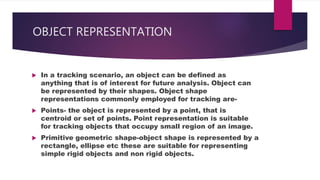
OBJECT REPRESENTATION
 In a tracking scenario, an object can be defined as
anything that is of interest for future analysis. Object can
be represented by their shapes. Object shape
representations commonly employed for tracking are-
 Points- the object is represented by a point, that is
centroid or set of points. Point representation is suitable
for tracking objects that occupy small region of an image.
 Primitive geometric shape-object shape is represented by a
rectangle, ellipse etc these are suitable for representing
simple rigid objects and non rigid objects.
WORKING-
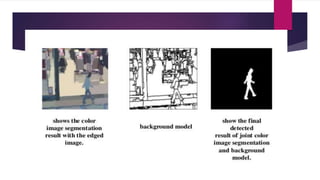
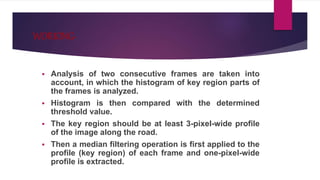
 Analysis of two consecutive frames are taken into
account, in which the histogram of key region parts of
the frames is analyzed.
 Histogram is then compared with the determined
threshold value.
 The key region should be at least 3-pixel-wide profile
of the image along the road.
 Then a median filtering operation is first applied to the
profile (key region) of each frame and one-pixel-wide
profile is extracted.
 The Difference of two profiles is then compared to
detect whether there is any displacement or motion.
 When there is motion, the differences of the profiles
are greater than the case when there is no motion.
 Thus motion can be detected by selecting an
appropriate threshold value. The size of the profile
plays an essential role and hence is an important
parameter.
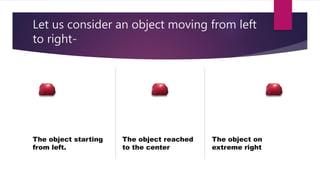
Let us consider an object moving from left
to right-
The object starting
from left.
The object reached
to the center
The object on
extreme right
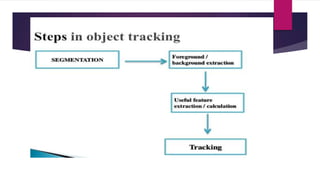
 First we click the picture of moving object and it is stored
in matlab in the form of matrix of appropriate resolution.
 Then again we take the image of the moving object and
that is also stored in matlab in the form of matrix.
 Then further both the matrices are compared with
appropriate matlab program .
 And finally the result is obtained i.e. object is moving in
which direction and what is its speed.
APPLICATION-
The first most important application is in radar to
find velocity range and position of the object.
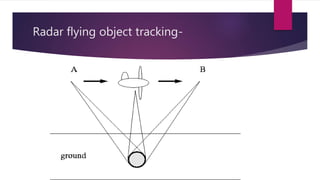
Synthetic aperture radar (SAR) is a technique for
taking extremely high- resolution radar images,
typically of ground features from an airplane. In
spotlight mode, the radar beam is focused on one
patch of ground as the aircraft flies from point A to
point B. Returned signals are collected
continuously to create a high-resolution image
integrated over a very large aperture.
Radar flying object tracking-
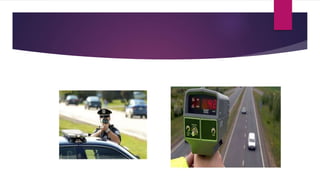
Another use is in speed limit enforcement by traffic police.
Speed limit enforcement is the action taken by appropriately
empowered authorities to check that road vehicles are
complying with the speed limit in force on roads and
highways. Methods used include roadside speed traps set up
and operated by the police and automated roadside 'speed
camera' systems which may incorporate the use of
an automatic number plate recognition system. Traditionally,
the police would have used stopwatches to measure the time
taken for a vehicle to cover a known distance, but more
recently, they have had speed guns and automated in-
vehicle systems at their disposal.
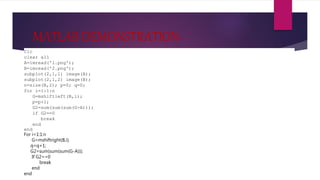
MATLAB DEMONSTRATION-
Clc
clear all
A=imread('1.png');
B=imread('2.png');
subplot(2,1,1) image(A);
subplot(2,1,2) image(B);
n=size(B,2); p=0; q=0;
for i=1:1:n
G=mshiftleft(B,i);
p=p+1;
G2=sum(sum(sum(G-A)));
if G2==0
break
end
end
For i=1:1:n
G=mshiftright(B,i);
q=q+1;
G2=sum(sum(sum(G-A)));
If G2==0
break
end
end
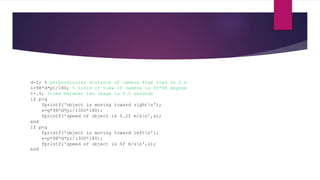
d=2; % perpendicular distance of camera from road is 2 m
l=98*d*pi/180; % field of view of camera is 65*98 degree
t=.5; %time between two image is 0.5 seconds
if p>q
fprintf('object is moving toward rightn');
s=q*98*d*pi/(300*180);
fprintf('speed of object is %.2f m/sn',s);
end
if p<q
fprintf('object is moving toward leftn');
s=p*98*d*pi/(300*180);
fprintf('speed of object is %f m/sn',s);
end
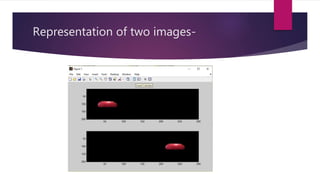
Representation of two images-
Motion analyser using image processing

Motion analyser using image processing

  • 1.
    MOTION ANALYSER USINGIMAGE PROCESSING SUBMITTED TO- SUBMITTED BY- MR. HEMANT MEENA TOSHIM KUMAR(2013UEE1593) ASSIT. PROFESSOR KHINYA RAM(2013UEE1597) ELECT. ENGG DEPT. BANKESH MEHTA(2013UEE1614) MNIT JAIPUR MANISH GUPTA(2013UEE1762)
  • 2.
    CONTENT • INTRODUCTION • OBJECTREPRESENTATION • WORKING • APPLICATION • MATLAB DEMONSTRATION
  • 3.
    INTRODUCTION  Here inthis project our main focus is in determining the positions, speed and other relevant information of moving objects in image sequence.  To track an object over a sequence of image.  It is a method of following an object through successive image frame to determine its relative movement with respect to other object.
  • 4.
    OBJECT REPRESENTATION  Ina tracking scenario, an object can be defined as anything that is of interest for future analysis. Object can be represented by their shapes. Object shape representations commonly employed for tracking are-  Points- the object is represented by a point, that is centroid or set of points. Point representation is suitable for tracking objects that occupy small region of an image.  Primitive geometric shape-object shape is represented by a rectangle, ellipse etc these are suitable for representing simple rigid objects and non rigid objects.
  • 7.
    WORKING-  Analysis oftwo consecutive frames are taken into account, in which the histogram of key region parts of the frames is analyzed.  Histogram is then compared with the determined threshold value.  The key region should be at least 3-pixel-wide profile of the image along the road.  Then a median filtering operation is first applied to the profile (key region) of each frame and one-pixel-wide profile is extracted.
  • 8.
     The Differenceof two profiles is then compared to detect whether there is any displacement or motion.  When there is motion, the differences of the profiles are greater than the case when there is no motion.  Thus motion can be detected by selecting an appropriate threshold value. The size of the profile plays an essential role and hence is an important parameter.
  • 9.
    Let us consideran object moving from left to right- The object starting from left. The object reached to the center The object on extreme right
  • 10.
     First weclick the picture of moving object and it is stored in matlab in the form of matrix of appropriate resolution.  Then again we take the image of the moving object and that is also stored in matlab in the form of matrix.  Then further both the matrices are compared with appropriate matlab program .  And finally the result is obtained i.e. object is moving in which direction and what is its speed.
  • 11.
    APPLICATION- The first mostimportant application is in radar to find velocity range and position of the object. Synthetic aperture radar (SAR) is a technique for taking extremely high- resolution radar images, typically of ground features from an airplane. In spotlight mode, the radar beam is focused on one patch of ground as the aircraft flies from point A to point B. Returned signals are collected continuously to create a high-resolution image integrated over a very large aperture.
  • 12.
  • 13.
    Another use isin speed limit enforcement by traffic police. Speed limit enforcement is the action taken by appropriately empowered authorities to check that road vehicles are complying with the speed limit in force on roads and highways. Methods used include roadside speed traps set up and operated by the police and automated roadside 'speed camera' systems which may incorporate the use of an automatic number plate recognition system. Traditionally, the police would have used stopwatches to measure the time taken for a vehicle to cover a known distance, but more recently, they have had speed guns and automated in- vehicle systems at their disposal.
  • 15.
    MATLAB DEMONSTRATION- Clc clear all A=imread('1.png'); B=imread('2.png'); subplot(2,1,1)image(A); subplot(2,1,2) image(B); n=size(B,2); p=0; q=0; for i=1:1:n G=mshiftleft(B,i); p=p+1; G2=sum(sum(sum(G-A))); if G2==0 break end end For i=1:1:n G=mshiftright(B,i); q=q+1; G2=sum(sum(sum(G-A))); If G2==0 break end end
  • 16.
    d=2; % perpendiculardistance of camera from road is 2 m l=98*d*pi/180; % field of view of camera is 65*98 degree t=.5; %time between two image is 0.5 seconds if p>q fprintf('object is moving toward rightn'); s=q*98*d*pi/(300*180); fprintf('speed of object is %.2f m/sn',s); end if p<q fprintf('object is moving toward leftn'); s=p*98*d*pi/(300*180); fprintf('speed of object is %f m/sn',s); end
  • 17.