CONTINGENCY APPRAOACH
OF
MANAGEMENT
G.KRISHNA VAMSY
Contingency approach states that there
is “no one best way” to manage an
organisation.
It is also known as situational approach.
In 1970s, it is recognized as a key to effective
management.
CONTRIBUTORS:
 L.W. Lorsch
 Joan Woodward
 Burns
 George Stalker
 Paul R.Lawrence
Joan Woodward (1916-1971)
– “Management and Technology”, 1958,
”Industrial
Organization”, 1965
– Studied a large number of firms (100) in the
South Essex area
of England in the 1950s
– Found that organizational form varied, and
correlated with
production technology
– Concluded that there was not ”one best way”
to organize – the
nature of the production process would
determine which form
that would be most suitable.
Tom Burns (1913-2001) and G. M. Stalker
– “The Management of Innovation” (1961)
– Studied the introduction of electronics in Scottish
industry
– Described two ideal types of organization on each
side of a
continuum – the mechanistic and the organismic
(organic)
organization
– The organization as a result of the simultaneous
working of (at
least) three different social systems:
• Formal authority: aims, technology, relations with
the environment
• Cooperative systems of people with different
aspirations
•The political system – the competition and
cooperation for power
Paul R. Lawrence (1922-2011) and Jay W. Lorsch (1932 )
– “Organization and Environment: Managing Differentiation and Integration” (1967)
– Question: Why do people seek to build organizations?
Answer: In order to find better solutions to the environmental problems faced by
them.
– Therefore:
• It is people who have purposes, not organizations
• People come together to coordinate their different activities into an organization
structure
• The organization’s effectiveness is judged from the extent to which the members’
needs are satisfied
through the planned transactions with the environment
– In order to cope with the environment, organizations develop units and formal
structures
suited to the particular environment(s) they operate in.
What you do “depends” on the
“situation”.
-internal contingency factors
-external contingency factors
Internal Contingency Factors
Purpose
TasksPeople
Technology
Structure
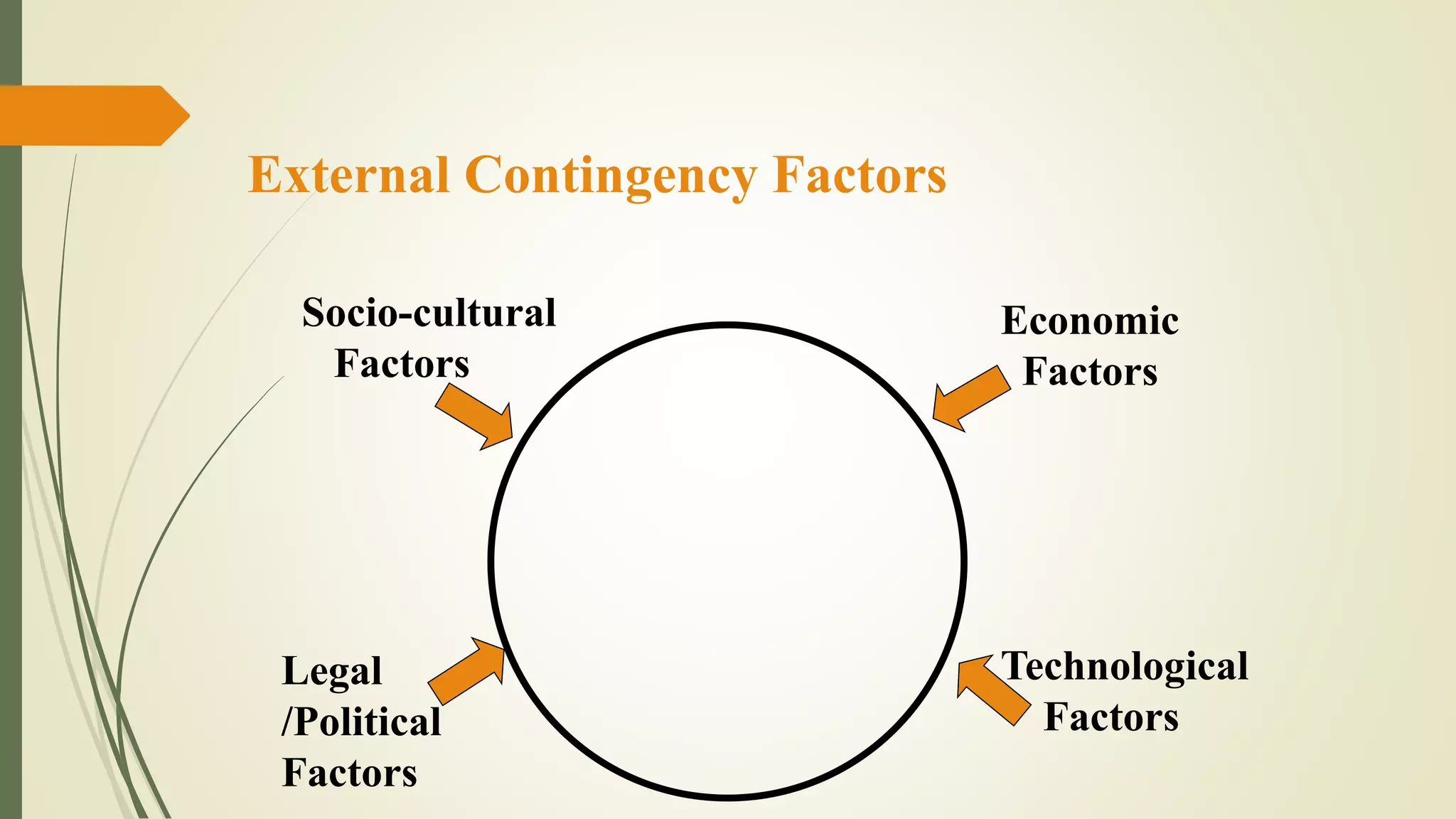
External Contingency Factors
Socio-cultural
Factors
Legal
/Political
Factors
Economic
Factors
Technological
Factors
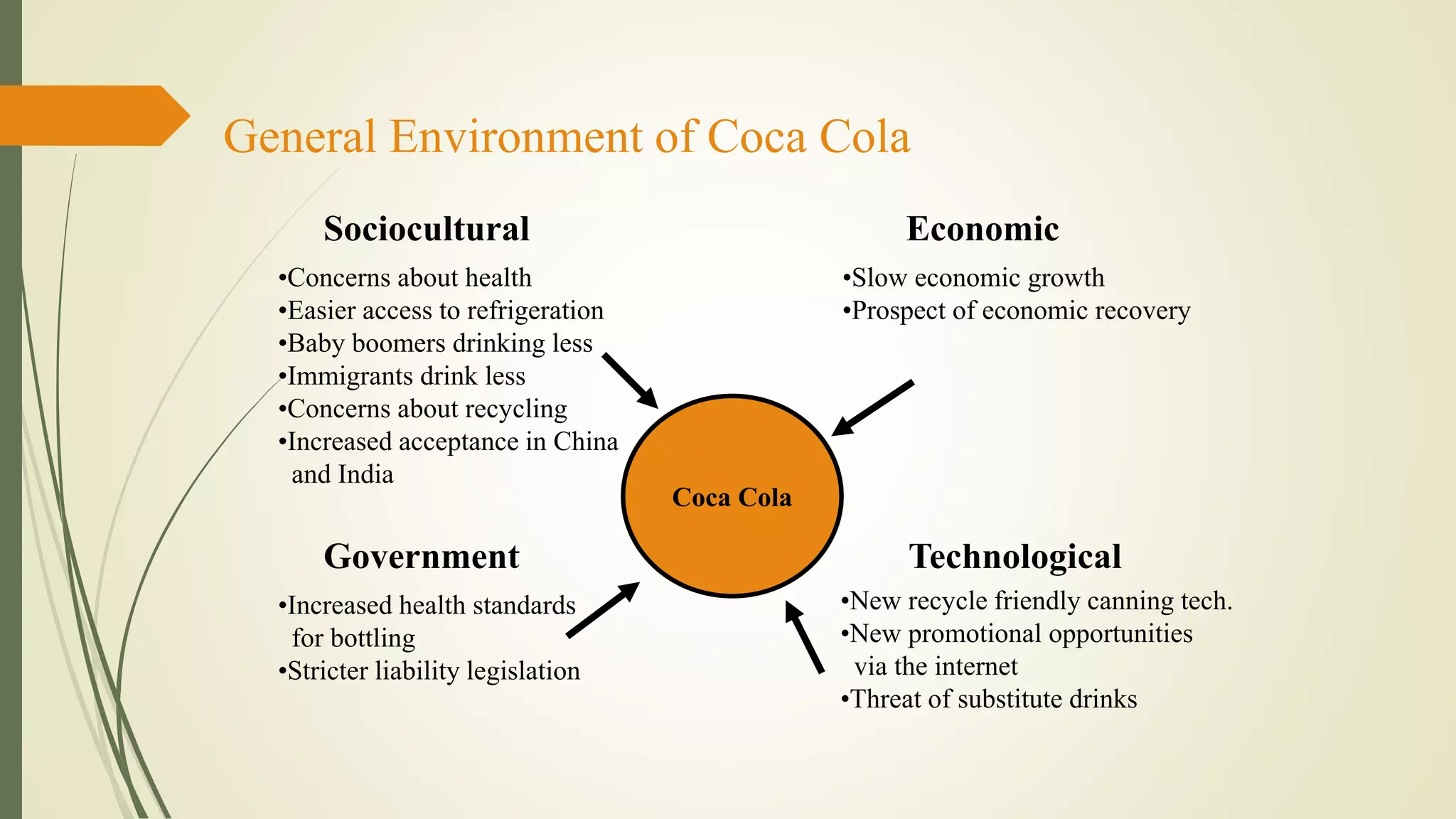
General Environment of Coca Cola
Sociocultural
•Concerns about health
•Easier access to refrigeration
•Baby boomers drinking less
•Immigrants drink less
•Concerns about recycling
•Increased acceptance in China
and India
Government
•Increased health standards
for bottling
•Stricter liability legislation
Economic
•Slow economic growth
•Prospect of economic recovery
Technological
•New recycle friendly canning tech.
•New promotional opportunities
via the internet
•Threat of substitute drinks
Coca Cola
Instead of propagating universally applicable
organisation-management principles, this theory tries
to demonstrate that different circumstances require
different organisational structures
What works for one organisation may not work for the
other.
Managers need to understand the key contingencies
that effect the management practice for a given
situation.
EXAMPLE OF A SHOE MANUFACTURING COMPANY:
A shoe manufacturing company is faced with the problem of decreasing
profits;
Solution can be:
May establish a committee of sales and production personnel to
coordinate the production and distribution of goods under the assumption
that large inventories are responsible for the decline in profits
- (Systems theory)
By application of a contingency perspective:
Would enable to examine the situation and to determine the cause of
decreased profits before a new procedure or program is implemented.
Example of a super market manager:
Problem:
Customers Are complaining that queing lines and time for billing are high.
Solution:
Manager identifies that,
1)The waiting times and queue lengths are always changing.
2)So a flexible approach is required.
Then he observes the customers and assings duty to the workers according to
the changing situation.
Studies show that companies that operate in less structured
environments are more successful with a flexible approach to
management, while companies in a more stable environment
do better with a more rigid and structured management style
of operations.
When the uncertainity of environment is high, an organic
structure(more flexible one) is suitable and when uncertainity
is low a mechanistic structure is suited.
Contingency theory is designed to provide the manager with the
capabilities to examine numerous possible solutions to a
problem.
Adapting to changing circumstances- No two situations are
absolutely identical, therefore each situation requires its own
unique solution.
To adopt this approach managers must sample all the past and
present ideas, some refer this to the ‘smorgasbord approach’.
 The way you manage should change depending on the
circumstances.
 Sometimes a bureaucratic organization is most effective,
sometimes a more loosely structured one; sometimes a
more classical approach is best, sometimes a more modern
one.
 The most effective management style will vary depending
on the type of organization, its size, its environment, and
the particular situation/problem it faces at the time.
Limitations of Contingency Approach:
 Difficulty in determining all relevant contingency
factors and showing relationship between them may be
complex.
 It is totally practical approach without support of
theoretical and conceptual frame work.
 Sometimes manager finds difficulties in analyzing the
situation and discovering appropriate management
technique in absence of proper research and lack of
proper understanding of the situation.
THANK YOU

Contingecy approach to management

  • 1.
  • 2.
    Contingency approach statesthat there is “no one best way” to manage an organisation. It is also known as situational approach.
  • 3.
    In 1970s, itis recognized as a key to effective management. CONTRIBUTORS:  L.W. Lorsch  Joan Woodward  Burns  George Stalker  Paul R.Lawrence
  • 4.
    Joan Woodward (1916-1971) –“Management and Technology”, 1958, ”Industrial Organization”, 1965 – Studied a large number of firms (100) in the South Essex area of England in the 1950s – Found that organizational form varied, and correlated with production technology – Concluded that there was not ”one best way” to organize – the nature of the production process would determine which form that would be most suitable.
  • 5.
    Tom Burns (1913-2001)and G. M. Stalker – “The Management of Innovation” (1961) – Studied the introduction of electronics in Scottish industry – Described two ideal types of organization on each side of a continuum – the mechanistic and the organismic (organic) organization – The organization as a result of the simultaneous working of (at least) three different social systems: • Formal authority: aims, technology, relations with the environment • Cooperative systems of people with different aspirations •The political system – the competition and cooperation for power
  • 6.
    Paul R. Lawrence(1922-2011) and Jay W. Lorsch (1932 ) – “Organization and Environment: Managing Differentiation and Integration” (1967) – Question: Why do people seek to build organizations? Answer: In order to find better solutions to the environmental problems faced by them. – Therefore: • It is people who have purposes, not organizations • People come together to coordinate their different activities into an organization structure • The organization’s effectiveness is judged from the extent to which the members’ needs are satisfied through the planned transactions with the environment – In order to cope with the environment, organizations develop units and formal structures suited to the particular environment(s) they operate in.
  • 8.
    What you do“depends” on the “situation”. -internal contingency factors -external contingency factors
  • 9.
  • 10.
  • 11.
    General Environment ofCoca Cola Sociocultural •Concerns about health •Easier access to refrigeration •Baby boomers drinking less •Immigrants drink less •Concerns about recycling •Increased acceptance in China and India Government •Increased health standards for bottling •Stricter liability legislation Economic •Slow economic growth •Prospect of economic recovery Technological •New recycle friendly canning tech. •New promotional opportunities via the internet •Threat of substitute drinks Coca Cola
  • 12.
    Instead of propagatinguniversally applicable organisation-management principles, this theory tries to demonstrate that different circumstances require different organisational structures What works for one organisation may not work for the other. Managers need to understand the key contingencies that effect the management practice for a given situation.
  • 13.
    EXAMPLE OF ASHOE MANUFACTURING COMPANY: A shoe manufacturing company is faced with the problem of decreasing profits; Solution can be: May establish a committee of sales and production personnel to coordinate the production and distribution of goods under the assumption that large inventories are responsible for the decline in profits - (Systems theory) By application of a contingency perspective: Would enable to examine the situation and to determine the cause of decreased profits before a new procedure or program is implemented.
  • 14.
    Example of asuper market manager: Problem: Customers Are complaining that queing lines and time for billing are high. Solution: Manager identifies that, 1)The waiting times and queue lengths are always changing. 2)So a flexible approach is required. Then he observes the customers and assings duty to the workers according to the changing situation.
  • 15.
    Studies show thatcompanies that operate in less structured environments are more successful with a flexible approach to management, while companies in a more stable environment do better with a more rigid and structured management style of operations. When the uncertainity of environment is high, an organic structure(more flexible one) is suitable and when uncertainity is low a mechanistic structure is suited.
  • 16.
    Contingency theory isdesigned to provide the manager with the capabilities to examine numerous possible solutions to a problem. Adapting to changing circumstances- No two situations are absolutely identical, therefore each situation requires its own unique solution. To adopt this approach managers must sample all the past and present ideas, some refer this to the ‘smorgasbord approach’.
  • 17.
     The wayyou manage should change depending on the circumstances.  Sometimes a bureaucratic organization is most effective, sometimes a more loosely structured one; sometimes a more classical approach is best, sometimes a more modern one.  The most effective management style will vary depending on the type of organization, its size, its environment, and the particular situation/problem it faces at the time.
  • 18.
    Limitations of ContingencyApproach:  Difficulty in determining all relevant contingency factors and showing relationship between them may be complex.  It is totally practical approach without support of theoretical and conceptual frame work.  Sometimes manager finds difficulties in analyzing the situation and discovering appropriate management technique in absence of proper research and lack of proper understanding of the situation.
  • 19.