CONTINGENCY
MANAGEMENT
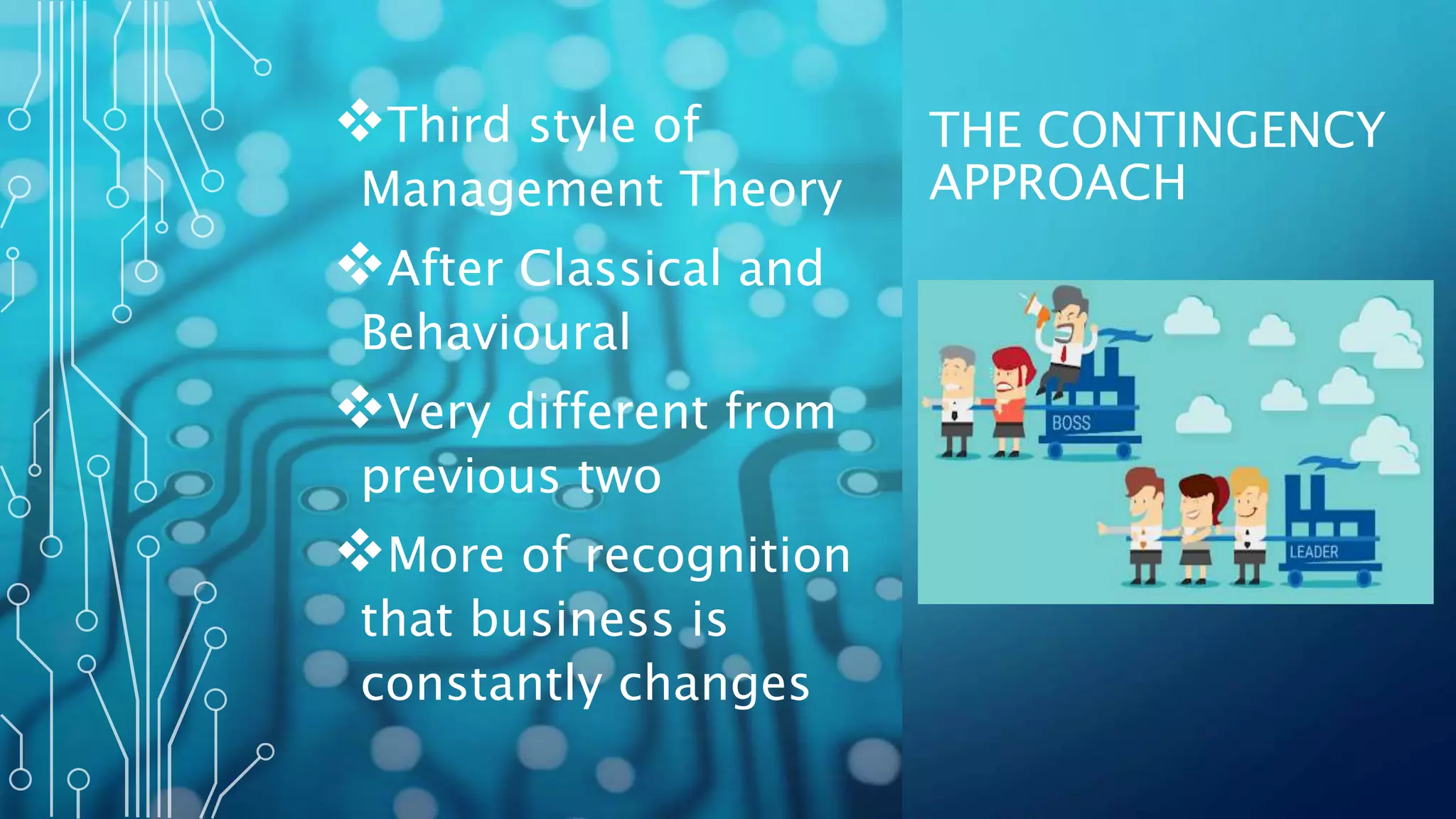
THE CONTINGENCY
APPROACH
Third style of
Management Theory
After Classical and
Behavioural
Very different from
previous two
More of recognition
that business is
constantly changes
THIRD STYLE OF MANAGEMENT THEORY
• Management consists of the planning, prioritizing, and organizing
work efforts to accomplish objectives within a business organization.
• A management style is the particular way managers go about
accomplishing these objectives. It encompasses the way they make
decisions, how they plan and organize work, and how they exercise
authority.
AFTER CLASSICAL AND BEHAVIOURAL
• Management has been as old as the human beings and with the
evolvement of humans management has also evolved.
• The history of management and its theories can be traced back to
thousands of years. Also, Shafritz makes an interesting observation
about the contribution of William Shakespeare to the management
theories as most of his plays deals with the issues like personnel
management and organizational behavior.
WHAT IS A CONTINGENCY ?
• A contingency is an event that might happen
• It’s not certain that it will happen, but there is a possibility
that it might
• Good managers need to consider contingencies when
making a plans
• (Fiedler, 1964). there is no one best way of organizing /
leading and that an organizational / leadership style that
is effective in some situations may not be successful in
others.
WILLIAM RICHARD SCOTT
• "The best way to organize depends on the nature of the
environment to which the organization must relate".
• The work of other researchers including Paul Lawrence, Jay
Lorsch, and James D. Thompson complements this statement.
They are more interested in the impact of contingency factors
on organizational structure. Their structural contingency
theory was the dominant paradigm of organizational structural
theories for most of the 1970s.
SO THE CONTINGENCY MANAGEMENT
APPROACH
•The contingency approach to management says there is no single
good way of managing a business
Instead, a manager must be ready to change, to fit in with what’s
best with the environment.
In other words, the organisational structure and the management
style should depend on the type tasks that are done in the business
Wide range of external and internal factors must be considered and
the focus should be on the action that best fits the given situation
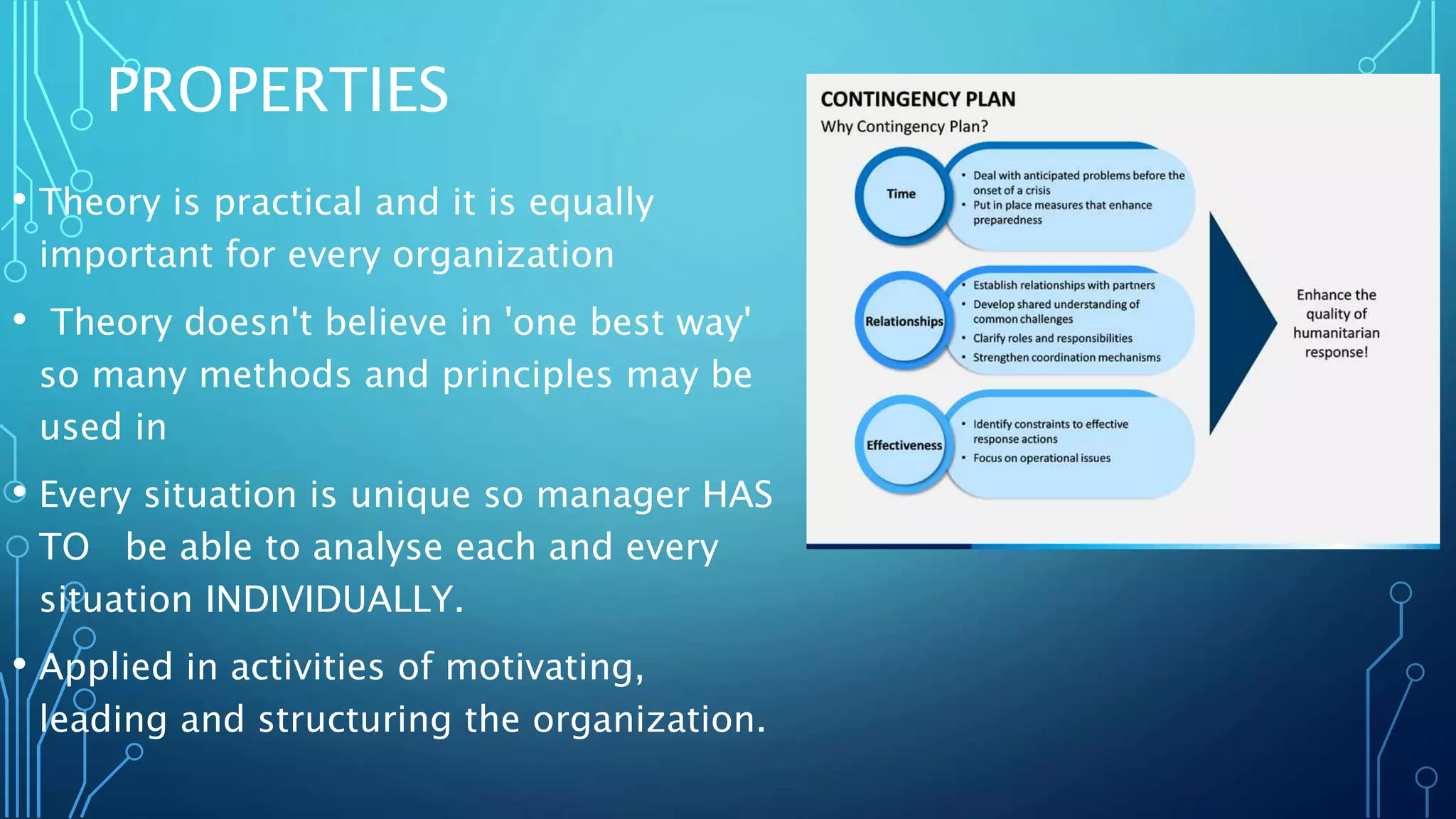
PROPERTIES
• Theory is practical and it is equally
important for every organization
• Theory doesn't believe in 'one best way'
so many methods and principles may be
used in
• Every situation is unique so manager HAS
TO be able to analyse each and every
situation INDIVIDUALLY.
• Applied in activities of motivating,
leading and structuring the organization.
EFFECT ON MANAGER
• By applying contingency theory to the study of management, you will
be able to identify and to solve problems under different situations.
• You will recognize that the successful application of a technique in one
situation does not guarantee success in another.
• Rather, you will be able to examine each situation in terms of how it is
affected by the contextual, organizational, and human dimensions.
• As a result, your overall ability to correct problems and to become more
effective as a manager will increase.
• Contingency theory is designed to provide the manager with the
capabilities to examine numerous possible solutions to a problem
REFERENCE :
• https://en.wikipedia.org/wiki/Contingency_management
• https://www.treehouserehab.org/treatment-
programs/contingency-management-therapy/
• https://www.ncbi.nlm.nih.gov/pmc/articles/PMC3083448/#:~:t
ext=Contingency%20management%20refers%20to%20a,evidenc
e%20of%20positive%20behavioural%20change.
• https://drugabuse.com/contingency-management/

Contingency management

  • 1.
  • 2.
    THE CONTINGENCY APPROACH Third styleof Management Theory After Classical and Behavioural Very different from previous two More of recognition that business is constantly changes
  • 3.
    THIRD STYLE OFMANAGEMENT THEORY • Management consists of the planning, prioritizing, and organizing work efforts to accomplish objectives within a business organization. • A management style is the particular way managers go about accomplishing these objectives. It encompasses the way they make decisions, how they plan and organize work, and how they exercise authority.
  • 4.
    AFTER CLASSICAL ANDBEHAVIOURAL • Management has been as old as the human beings and with the evolvement of humans management has also evolved. • The history of management and its theories can be traced back to thousands of years. Also, Shafritz makes an interesting observation about the contribution of William Shakespeare to the management theories as most of his plays deals with the issues like personnel management and organizational behavior.
  • 5.
    WHAT IS ACONTINGENCY ? • A contingency is an event that might happen • It’s not certain that it will happen, but there is a possibility that it might • Good managers need to consider contingencies when making a plans • (Fiedler, 1964). there is no one best way of organizing / leading and that an organizational / leadership style that is effective in some situations may not be successful in others.
  • 6.
    WILLIAM RICHARD SCOTT •"The best way to organize depends on the nature of the environment to which the organization must relate". • The work of other researchers including Paul Lawrence, Jay Lorsch, and James D. Thompson complements this statement. They are more interested in the impact of contingency factors on organizational structure. Their structural contingency theory was the dominant paradigm of organizational structural theories for most of the 1970s.
  • 7.
    SO THE CONTINGENCYMANAGEMENT APPROACH •The contingency approach to management says there is no single good way of managing a business Instead, a manager must be ready to change, to fit in with what’s best with the environment. In other words, the organisational structure and the management style should depend on the type tasks that are done in the business Wide range of external and internal factors must be considered and the focus should be on the action that best fits the given situation
  • 8.
    PROPERTIES • Theory ispractical and it is equally important for every organization • Theory doesn't believe in 'one best way' so many methods and principles may be used in • Every situation is unique so manager HAS TO be able to analyse each and every situation INDIVIDUALLY. • Applied in activities of motivating, leading and structuring the organization.
  • 9.
    EFFECT ON MANAGER •By applying contingency theory to the study of management, you will be able to identify and to solve problems under different situations. • You will recognize that the successful application of a technique in one situation does not guarantee success in another. • Rather, you will be able to examine each situation in terms of how it is affected by the contextual, organizational, and human dimensions. • As a result, your overall ability to correct problems and to become more effective as a manager will increase. • Contingency theory is designed to provide the manager with the capabilities to examine numerous possible solutions to a problem
  • 10.
    REFERENCE : • https://en.wikipedia.org/wiki/Contingency_management •https://www.treehouserehab.org/treatment- programs/contingency-management-therapy/ • https://www.ncbi.nlm.nih.gov/pmc/articles/PMC3083448/#:~:t ext=Contingency%20management%20refers%20to%20a,evidenc e%20of%20positive%20behavioural%20change. • https://drugabuse.com/contingency-management/