Compiled and prepared
By
K.P. Senthil Kumar.,M.Sc.,M.Phil.,ADAB.,
senthilkps@vsc.edu.in
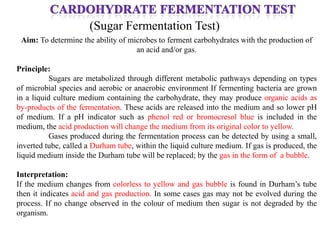
(Sugar Fermentation Test)
 Aim: To determine the ability of microbes to ferment carbohydrates with the production of
                                    an acid and/or gas.

Principle:
           Sugars are metabolized through different metabolic pathways depending on types
of microbial species and aerobic or anaerobic environment .If fermenting bacteria are grown
in a liquid culture medium containing the carbohydrate, they may produce organic acids as
by-products of the fermentation. These acids are released into the medium and so lower pH
of medium. If a pH indicator such as phenol red or bromocresol blue is included in the
medium, the acid production will change the medium from its original color to yellow.
           Gases produced during the fermentation process can be detected by using a small,
inverted tube, called a Durham tube, within the liquid culture medium. If gas is produced, the
liquid medium inside the Durham tube will be replaced; by the gas in the form of a bubble.

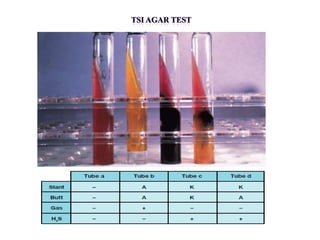
Interpretation:
If the medium changes from colorless to yellow and gas bubble is found in Durham’s tube
then it indicates acid and gas production. In some cases gas may not be evolved during the
process. If no change observed in the colour of medium then sugar is not degraded by the
organism.
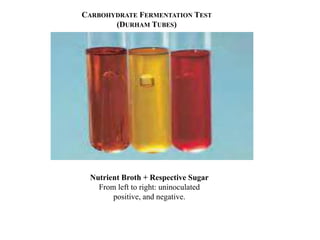
CARBOHYDRATE FERMENTATION TEST
       (DURHAM TUBES)


 Nutrient Broth + Respective Sugar
   From left to right: uninoculated
       positive, and negative.
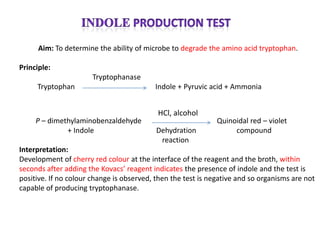
Aim: To determine the ability of microbe to degrade the amino acid tryptophan.

Principle:
                       Tryptophanase
     Tryptophan                           Indole + Pyruvic acid + Ammonia


                                           HCl, alcohol
     P – dimethylaminobenzaldehyde                            Quinoidal red – violet
              + Indole                     Dehydration             compound
                                            reaction
Interpretation:
Development of cherry red colour at the interface of the reagent and the broth, within
seconds after adding the Kovacs’ reagent indicates the presence of indole and the test is
positive. If no colour change is observed, then the test is negative and so organisms are not
capable of producing tryptophanase.
INDOLE TEST


         TRYPTONE BROTH
Tube on the left is positive (E. coli);
   tube on the right is negative.
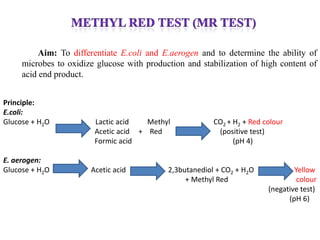
Aim: To differentiate E.coli and E.aerogen and to determine the ability of
     microbes to oxidize glucose with production and stabilization of high content of
     acid end product.


Principle:
E.coli:
Glucose + H2O           Lactic acid   Methyl             CO2 + H2 + Red colour
                        Acetic acid + Red                 (positive test)
                        Formic acid                            (pH 4)

E. aerogen:
Glucose + H2O          Acetic acid          2,3butanediol + CO2 + H2O            Yellow
                                                 + Methyl Red                     colour
                                                                         (negative test)
                                                                               (pH 6)
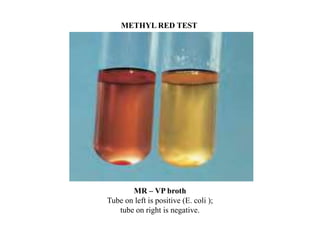
METHYL RED TEST


       MR – VP broth
Tube on left is positive (E. coli );
   tube on right is negative.
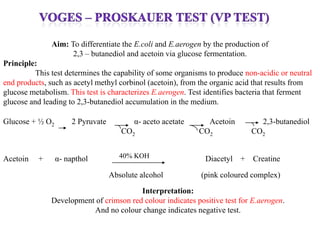
Aim: To differentiate the E.coli and E.aerogen by the production of
                     2,3 – butanediol and acetoin via glucose fermentation.
Principle:
          This test determines the capability of some organisms to produce non-acidic or neutral
end products, such as acetyl methyl corbinol (acetoin), from the organic acid that results from
glucose metabolism. This test is characterizes E.aerogen. Test identifies bacteria that ferment
glucose and leading to 2,3-butanediol accumulation in the medium.

Glucose + ½ O2        2 Pyruvate          α- aceto acetate     Acetoin          2,3-butanediol
                                      CO2                    CO2             CO2


Acetoin   +      α- napthol           40% KOH                 Diacetyl +     Creatine

                                   Absolute alcohol          (pink coloured complex)
                                        Interpretation:
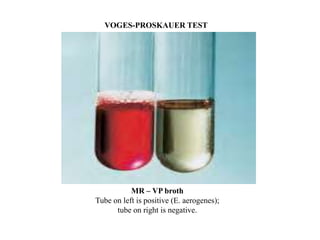
              Development of crimson red colour indicates positive test for E.aerogen.
                         And no colour change indicates negative test.
VOGES-PROSKAUER TEST


           MR – VP broth
Tube on left is positive (E. aerogenes);
      tube on right is negative.
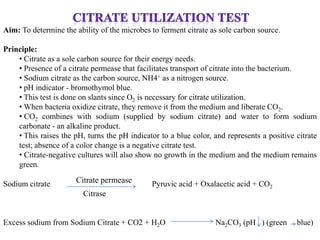
Aim: To determine the ability of the microbes to ferment citrate as sole carbon source.

Principle:
    • Citrate as a sole carbon source for their energy needs.
    • Presence of a citrate permease that facilitates transport of citrate into the bacterium.
    • Sodium citrate as the carbon source, NH4+ as a nitrogen source.
    • pH indicator - bromothymol blue.
    • This test is done on slants since O2 is necessary for citrate utilization.
    • When bacteria oxidize citrate, they remove it from the medium and liberate CO2.
    • CO2 combines with sodium (supplied by sodium citrate) and water to form sodium
    carbonate - an alkaline product.
    • This raises the pH, turns the pH indicator to a blue color, and represents a positive citrate
    test; absence of a color change is a negative citrate test.
    • Citrate-negative cultures will also show no growth in the medium and the medium remains
    green.

Sodium citrate        Citrate permease        Pyruvic acid + Oxalacetic acid + CO2
                         Citrase


Excess sodium from Sodium Citrate + CO2 + H2O                      Na2CO3 (pH ) (green      blue)
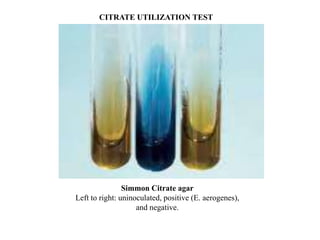
CITRATE UTILIZATION TEST


                Simmon Citrate agar
Left to right: uninoculated, positive (E. aerogenes),
                    and negative.
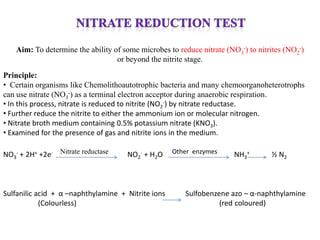
Aim: To determine the ability of some microbes to reduce nitrate (NO3-) to nitrites (NO2-)
                                   or beyond the nitrite stage.

Principle:
• Certain organisms like Chemolithoautotrophic bacteria and many chemoorganoheterotrophs
can use nitrate (NO3-) as a terminal electron acceptor during anaerobic respiration.
• In this process, nitrate is reduced to nitrite (NO2-) by nitrate reductase.
• Further reduce the nitrite to either the ammonium ion or molecular nitrogen.
• Nitrate broth medium containing 0.5% potassium nitrate (KNO3).
• Examined for the presence of gas and nitrite ions in the medium.

NO3- + 2H+ +2e- Nitrate reductase     NO2- + H2O    Other enzymes       NH3+       ½ N2


Sulfanilic acid + α –naphthylamine + Nitrite ions       Sulfobenzene azo – α-naphthylamine
            (Colourless)                                          (red coloured)
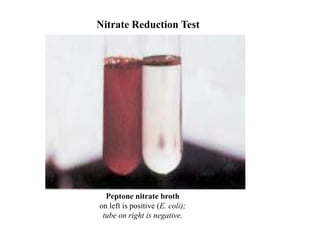
Nitrate Reduction Test


  Peptone nitrate broth
on left is positive (E. coli);
 tube on right is negative.
Aim: To determine the ability of microbes to degrade urea by urease.
Principle:
• Urea is diamide carbonic acid often referred as carbamide.
• The hydrolysis of urea is catalysed by specific enzyme urease to yield
2 moles of ammonia.
• Urease attacks the nitrogen and carbon bond in urea and forms
ammonia.
• The presence of urease is detected, when the organisms are grown in
urea broth.
• Medium containing the pH indicator phenol red.
• Splitting of urea creates the alkaline condition which turns phenol red
to deep pink in colour.
• Mainly used for identification of Proteus spp. from other genus of
lactose nonfermenting enteric organisms.
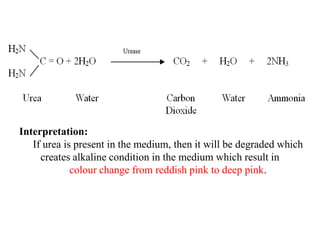
Interpretation:
   If urea is present in the medium, then it will be degraded which
     creates alkaline condition in the medium which result in
             colour change from reddish pink to deep pink.
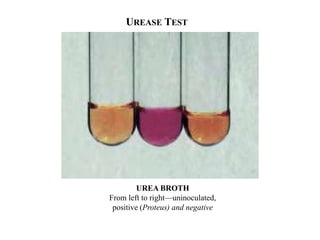
UREASE TEST


         UREA BROTH
From left to right—uninoculated,
 positive (Proteus) and negative
Aim: To differentiate among and between the members of
Enterobacteraceae family.
Principle:
• Study and identify the organisms belonging to Enterobacteraceae
family.
• It is also used to distinguish the Enterobacteriaceae from other gram-
negative intestinal bacilli (by their ability to catabolize glucose, lactose,
or sucrose, and to liberate sulfides from ferrous ammonium sulfate or
sodium thiosulfate. )
• TSI agar slants contain a 1% concentration of lactose and sucrose, and
0.1% glucose.
• The pH indicator, phenol red, is also incorporated into the medium to
detect acid production from carbohydrate fermentation.
• The uninoculated medium is red in colour due to presence of phenol red
dye.
•Yeast extract, beef extract and peptone provides nitrogen,
sulphur, trace elements and vitamin B complex etc.
• NaCl maintains osmotic equilibrium.
• Lactose, Sucrose and Dextrose are the fermentable
carbohydrates.
• Sodium thiosulfate and ferrous sulfate make H2S indicator
system.
• Thiosulfate is reduced to H2S by several species of bacteria
and H2S combines with and form insoluble black precipitates.
FeSO4 present in the medium
• Blackening usually occurs in butt of tube.
• Incubation is for 18 to 24 hours in order to detect the
presence of sugar fermentation, gas production, and H2S
production.
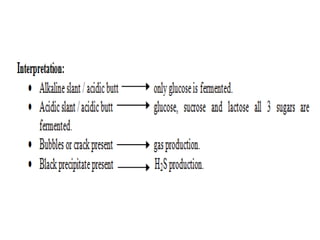
The indicator is pink at alkaline pH and yellow at acidic pH, at neutral
pH it remains red.

The following reactions may occur in the TSI tube:
•Yellow butt (A) and red slant (K) due to the fermentation of glucose
(phenol red indicator turns yellow due to the persisting acid formation in
the butt). The slant remains red (alkaline) (K) because of the limited
glucose in the medium and, therefore, limited acid formation, which does
not persist.
•A yellow butt (A) and slant (A) due to the fermentation of lactose
and/or sucrose (yellow slant and butt due to the high concentration of
these sugars) leading to excessive acid formation in the entire medium.
•Gas formation noted by splitting of the agar.
•Gas formation (H2S) seen by blackening of the agar.
•Red butt (K) and slant (K) indicates that none of the sugars were
fermented and neither gas nor H2S were produced.
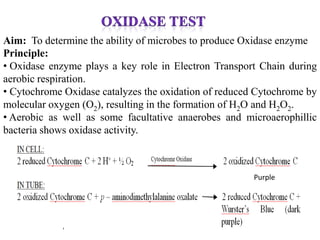
Aim: To determine the ability of microbes to produce Oxidase enzyme
Principle:
• Oxidase enzyme plays a key role in Electron Transport Chain during
aerobic respiration.
• Cytochrome Oxidase catalyzes the oxidation of reduced Cytochrome by
molecular oxygen (O2), resulting in the formation of H2O and H2O2.
• Aerobic as well as some facultative anaerobes and microaerophillic
bacteria shows oxidase activity.


                                                       Purple
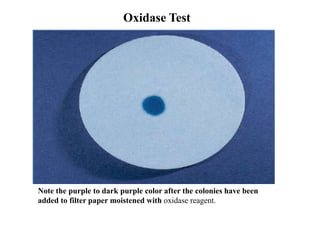
Oxidase Test


Note the purple to dark purple color after the colonies have been
added to filter paper moistened with oxidase reagent.
Aim: To determine the ability of an organism to produce catalase.

Principle:
• Certain organisms produce hydrogen peroxide during aerobic
respiration and sometimes extremely toxic superoxide
radicals.
• These are extremely toxic because they are powerful
oxidizing agents and destroy cellular constituents very rapidly.
• A bacterium must be able to protect itself against such O2
products or it will be killed.
• Many bacteria possess enzymes that afford protection against
toxic O2 products.
• Obligate aerobes and facultative anaerobes usually contain
the enzymes superoxide dismutase, which catalyzes the
destruction of superoxide
• And either catalase or peroxidase, catalyze the destruction of
hydrogen peroxide.
• Catalase production and activity can be detected by adding
the substrate H2O2 to an appropriately incubated (18- to 24-
hour) tryptic soy agar slant culture.
• If catalase was produced by the bacteria, they will liberate
free O2 gas on reaction.
• Bubbles of O2 represent a positive catalase test; the absence
of bubble formation is a negative catalase test.
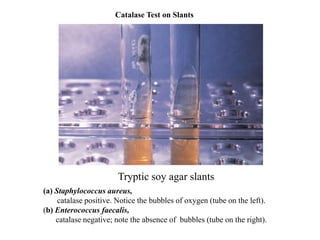
Catalase Test on Slants


                        Tryptic soy agar slants
(a) Staphylococcus aureus,
     catalase positive. Notice the bubbles of oxygen (tube on the left).
(b) Enterococcus faecalis,
    catalase negative; note the absence of bubbles (tube on the right).
Principles:
Many bacteria produce enzymes called hydrolases.
Hydrolases catalyze the splitting of organic molecules into smaller
molecules in the presence of water.
The starch molecule consists of two constituents:
   • Amylose, an unbranched glucose polymer (200 to 300 units)
   • Amylopectin, a large branched polymer.
Both amylopectin and amylose are rapidly hydrolyzed by certain
bacteria,
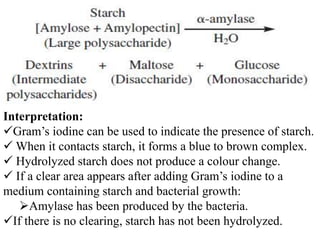
 Using their α-amylases, to yield dextrins, maltose, and glucose.
Interpretation:
Gram’s iodine can be used to indicate the presence of starch.
 When it contacts starch, it forms a blue to brown complex.
 Hydrolyzed starch does not produce a colour change.
 If a clear area appears after adding Gram’s iodine to a
medium containing starch and bacterial growth:
   Amylase has been produced by the bacteria.
If there is no clearing, starch has not been hydrolyzed.
Learning Objectives
1. Understand the biochemical process of lipid
hydrolysis
2. Determine the ability of bacteria to hydrolyze lipids
by producing specific lipases
3. Perform a lipid hydrolysis test
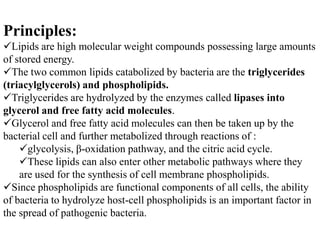
Principles:
Lipids are high molecular weight compounds possessing large amounts
of stored energy.
The two common lipids catabolized by bacteria are the triglycerides
(triacylglycerols) and phospholipids.
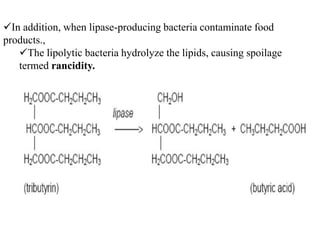
Triglycerides are hydrolyzed by the enzymes called lipases into
glycerol and free fatty acid molecules.
Glycerol and free fatty acid molecules can then be taken up by the
bacterial cell and further metabolized through reactions of :
    glycolysis, β-oxidation pathway, and the citric acid cycle.
    These lipids can also enter other metabolic pathways where they
    are used for the synthesis of cell membrane phospholipids.
Since phospholipids are functional components of all cells, the ability
of bacteria to hydrolyze host-cell phospholipids is an important factor in
the spread of pathogenic bacteria.
In addition, when lipase-producing bacteria contaminate food
products.,
   The lipolytic bacteria hydrolyze the lipids, causing spoilage
   termed rancidity.
The culture medium contains tributyrin as a reactant;
degradation of this compound gives rise to clear zones
surrounding the lipolytic colonies in the otherwise turbid
culture medium.
Reference:
   •James. G, Cappuccino, Natalie Sherman, Microbiology. A
   Laboratory Manual, 4th edition. Pg.No : 129 – 175.
   •John P. Harley, Lansing M. Prescott, Laboratory exercises in
   Microbiology, 5th edition. Pg.No. : 125 – 175.
   •Patel. R.J; Patel.K.R; Experimental Microbiology, volume – I,
   Aditya Publication. Pg.No : 110 – 127.
   • Web resources

Acknowledgemet:
      All the scientific contributors I would like to thank, without their
hardwork, support for student community, it is not possible.

Biochemical test of bacteria

  • 1.
    Compiled and prepared By K.P.Senthil Kumar.,M.Sc.,M.Phil.,ADAB., senthilkps@vsc.edu.in
  • 2.
    (Sugar Fermentation Test) Aim: To determine the ability of microbes to ferment carbohydrates with the production of an acid and/or gas. Principle: Sugars are metabolized through different metabolic pathways depending on types of microbial species and aerobic or anaerobic environment .If fermenting bacteria are grown in a liquid culture medium containing the carbohydrate, they may produce organic acids as by-products of the fermentation. These acids are released into the medium and so lower pH of medium. If a pH indicator such as phenol red or bromocresol blue is included in the medium, the acid production will change the medium from its original color to yellow. Gases produced during the fermentation process can be detected by using a small, inverted tube, called a Durham tube, within the liquid culture medium. If gas is produced, the liquid medium inside the Durham tube will be replaced; by the gas in the form of a bubble. Interpretation: If the medium changes from colorless to yellow and gas bubble is found in Durham’s tube then it indicates acid and gas production. In some cases gas may not be evolved during the process. If no change observed in the colour of medium then sugar is not degraded by the organism.
  • 3.
    CARBOHYDRATE FERMENTATION TEST (DURHAM TUBES) Nutrient Broth + Respective Sugar From left to right: uninoculated positive, and negative.
  • 4.
    Aim: To determinethe ability of microbe to degrade the amino acid tryptophan. Principle: Tryptophanase Tryptophan Indole + Pyruvic acid + Ammonia HCl, alcohol P – dimethylaminobenzaldehyde Quinoidal red – violet + Indole Dehydration compound reaction Interpretation: Development of cherry red colour at the interface of the reagent and the broth, within seconds after adding the Kovacs’ reagent indicates the presence of indole and the test is positive. If no colour change is observed, then the test is negative and so organisms are not capable of producing tryptophanase.
  • 5.
    INDOLE TEST TRYPTONE BROTH Tube on the left is positive (E. coli); tube on the right is negative.
  • 6.
    Aim: To differentiateE.coli and E.aerogen and to determine the ability of microbes to oxidize glucose with production and stabilization of high content of acid end product. Principle: E.coli: Glucose + H2O Lactic acid Methyl CO2 + H2 + Red colour Acetic acid + Red (positive test) Formic acid (pH 4) E. aerogen: Glucose + H2O Acetic acid 2,3butanediol + CO2 + H2O Yellow + Methyl Red colour (negative test) (pH 6)
  • 7.
    METHYL RED TEST MR – VP broth Tube on left is positive (E. coli ); tube on right is negative.
  • 8.
    Aim: To differentiatethe E.coli and E.aerogen by the production of 2,3 – butanediol and acetoin via glucose fermentation. Principle: This test determines the capability of some organisms to produce non-acidic or neutral end products, such as acetyl methyl corbinol (acetoin), from the organic acid that results from glucose metabolism. This test is characterizes E.aerogen. Test identifies bacteria that ferment glucose and leading to 2,3-butanediol accumulation in the medium. Glucose + ½ O2 2 Pyruvate α- aceto acetate Acetoin 2,3-butanediol CO2 CO2 CO2 Acetoin + α- napthol 40% KOH Diacetyl + Creatine Absolute alcohol (pink coloured complex) Interpretation: Development of crimson red colour indicates positive test for E.aerogen. And no colour change indicates negative test.
  • 9.
    VOGES-PROSKAUER TEST MR – VP broth Tube on left is positive (E. aerogenes); tube on right is negative.
  • 10.
    Aim: To determinethe ability of the microbes to ferment citrate as sole carbon source. Principle: • Citrate as a sole carbon source for their energy needs. • Presence of a citrate permease that facilitates transport of citrate into the bacterium. • Sodium citrate as the carbon source, NH4+ as a nitrogen source. • pH indicator - bromothymol blue. • This test is done on slants since O2 is necessary for citrate utilization. • When bacteria oxidize citrate, they remove it from the medium and liberate CO2. • CO2 combines with sodium (supplied by sodium citrate) and water to form sodium carbonate - an alkaline product. • This raises the pH, turns the pH indicator to a blue color, and represents a positive citrate test; absence of a color change is a negative citrate test. • Citrate-negative cultures will also show no growth in the medium and the medium remains green. Sodium citrate Citrate permease Pyruvic acid + Oxalacetic acid + CO2 Citrase Excess sodium from Sodium Citrate + CO2 + H2O Na2CO3 (pH ) (green blue)
  • 11.
    CITRATE UTILIZATION TEST Simmon Citrate agar Left to right: uninoculated, positive (E. aerogenes), and negative.
  • 12.
    Aim: To determinethe ability of some microbes to reduce nitrate (NO3-) to nitrites (NO2-) or beyond the nitrite stage. Principle: • Certain organisms like Chemolithoautotrophic bacteria and many chemoorganoheterotrophs can use nitrate (NO3-) as a terminal electron acceptor during anaerobic respiration. • In this process, nitrate is reduced to nitrite (NO2-) by nitrate reductase. • Further reduce the nitrite to either the ammonium ion or molecular nitrogen. • Nitrate broth medium containing 0.5% potassium nitrate (KNO3). • Examined for the presence of gas and nitrite ions in the medium. NO3- + 2H+ +2e- Nitrate reductase NO2- + H2O Other enzymes NH3+ ½ N2 Sulfanilic acid + α –naphthylamine + Nitrite ions Sulfobenzene azo – α-naphthylamine (Colourless) (red coloured)
  • 13.
    Nitrate Reduction Test Peptone nitrate broth on left is positive (E. coli); tube on right is negative.
  • 14.
    Aim: To determinethe ability of microbes to degrade urea by urease. Principle: • Urea is diamide carbonic acid often referred as carbamide. • The hydrolysis of urea is catalysed by specific enzyme urease to yield 2 moles of ammonia. • Urease attacks the nitrogen and carbon bond in urea and forms ammonia. • The presence of urease is detected, when the organisms are grown in urea broth. • Medium containing the pH indicator phenol red. • Splitting of urea creates the alkaline condition which turns phenol red to deep pink in colour. • Mainly used for identification of Proteus spp. from other genus of lactose nonfermenting enteric organisms.
  • 15.
    Interpretation: If urea is present in the medium, then it will be degraded which creates alkaline condition in the medium which result in colour change from reddish pink to deep pink.
  • 16.
    UREASE TEST UREA BROTH From left to right—uninoculated, positive (Proteus) and negative
  • 17.
    Aim: To differentiateamong and between the members of Enterobacteraceae family. Principle: • Study and identify the organisms belonging to Enterobacteraceae family. • It is also used to distinguish the Enterobacteriaceae from other gram- negative intestinal bacilli (by their ability to catabolize glucose, lactose, or sucrose, and to liberate sulfides from ferrous ammonium sulfate or sodium thiosulfate. ) • TSI agar slants contain a 1% concentration of lactose and sucrose, and 0.1% glucose. • The pH indicator, phenol red, is also incorporated into the medium to detect acid production from carbohydrate fermentation. • The uninoculated medium is red in colour due to presence of phenol red dye.
  • 18.
    •Yeast extract, beefextract and peptone provides nitrogen, sulphur, trace elements and vitamin B complex etc. • NaCl maintains osmotic equilibrium. • Lactose, Sucrose and Dextrose are the fermentable carbohydrates. • Sodium thiosulfate and ferrous sulfate make H2S indicator system. • Thiosulfate is reduced to H2S by several species of bacteria and H2S combines with and form insoluble black precipitates. FeSO4 present in the medium • Blackening usually occurs in butt of tube. • Incubation is for 18 to 24 hours in order to detect the presence of sugar fermentation, gas production, and H2S production.
  • 19.
    The indicator ispink at alkaline pH and yellow at acidic pH, at neutral pH it remains red. The following reactions may occur in the TSI tube: •Yellow butt (A) and red slant (K) due to the fermentation of glucose (phenol red indicator turns yellow due to the persisting acid formation in the butt). The slant remains red (alkaline) (K) because of the limited glucose in the medium and, therefore, limited acid formation, which does not persist. •A yellow butt (A) and slant (A) due to the fermentation of lactose and/or sucrose (yellow slant and butt due to the high concentration of these sugars) leading to excessive acid formation in the entire medium. •Gas formation noted by splitting of the agar. •Gas formation (H2S) seen by blackening of the agar. •Red butt (K) and slant (K) indicates that none of the sugars were fermented and neither gas nor H2S were produced.
  • 22.
    Aim: To determinethe ability of microbes to produce Oxidase enzyme Principle: • Oxidase enzyme plays a key role in Electron Transport Chain during aerobic respiration. • Cytochrome Oxidase catalyzes the oxidation of reduced Cytochrome by molecular oxygen (O2), resulting in the formation of H2O and H2O2. • Aerobic as well as some facultative anaerobes and microaerophillic bacteria shows oxidase activity. Purple
  • 23.
    Oxidase Test Note thepurple to dark purple color after the colonies have been added to filter paper moistened with oxidase reagent.
  • 24.
    Aim: To determinethe ability of an organism to produce catalase. Principle: • Certain organisms produce hydrogen peroxide during aerobic respiration and sometimes extremely toxic superoxide radicals. • These are extremely toxic because they are powerful oxidizing agents and destroy cellular constituents very rapidly. • A bacterium must be able to protect itself against such O2 products or it will be killed. • Many bacteria possess enzymes that afford protection against toxic O2 products.
  • 25.
    • Obligate aerobesand facultative anaerobes usually contain the enzymes superoxide dismutase, which catalyzes the destruction of superoxide • And either catalase or peroxidase, catalyze the destruction of hydrogen peroxide. • Catalase production and activity can be detected by adding the substrate H2O2 to an appropriately incubated (18- to 24- hour) tryptic soy agar slant culture. • If catalase was produced by the bacteria, they will liberate free O2 gas on reaction. • Bubbles of O2 represent a positive catalase test; the absence of bubble formation is a negative catalase test.
  • 26.
    Catalase Test onSlants Tryptic soy agar slants (a) Staphylococcus aureus, catalase positive. Notice the bubbles of oxygen (tube on the left). (b) Enterococcus faecalis, catalase negative; note the absence of bubbles (tube on the right).
  • 27.
    Principles: Many bacteria produceenzymes called hydrolases. Hydrolases catalyze the splitting of organic molecules into smaller molecules in the presence of water. The starch molecule consists of two constituents: • Amylose, an unbranched glucose polymer (200 to 300 units) • Amylopectin, a large branched polymer. Both amylopectin and amylose are rapidly hydrolyzed by certain bacteria,  Using their α-amylases, to yield dextrins, maltose, and glucose.
  • 28.
    Interpretation: Gram’s iodine canbe used to indicate the presence of starch.  When it contacts starch, it forms a blue to brown complex.  Hydrolyzed starch does not produce a colour change.  If a clear area appears after adding Gram’s iodine to a medium containing starch and bacterial growth: Amylase has been produced by the bacteria. If there is no clearing, starch has not been hydrolyzed.
  • 29.
    Learning Objectives 1. Understandthe biochemical process of lipid hydrolysis 2. Determine the ability of bacteria to hydrolyze lipids by producing specific lipases 3. Perform a lipid hydrolysis test
  • 30.
    Principles: Lipids are highmolecular weight compounds possessing large amounts of stored energy. The two common lipids catabolized by bacteria are the triglycerides (triacylglycerols) and phospholipids. Triglycerides are hydrolyzed by the enzymes called lipases into glycerol and free fatty acid molecules. Glycerol and free fatty acid molecules can then be taken up by the bacterial cell and further metabolized through reactions of : glycolysis, β-oxidation pathway, and the citric acid cycle. These lipids can also enter other metabolic pathways where they are used for the synthesis of cell membrane phospholipids. Since phospholipids are functional components of all cells, the ability of bacteria to hydrolyze host-cell phospholipids is an important factor in the spread of pathogenic bacteria.
  • 31.
    In addition, whenlipase-producing bacteria contaminate food products., The lipolytic bacteria hydrolyze the lipids, causing spoilage termed rancidity.
  • 32.
    The culture mediumcontains tributyrin as a reactant; degradation of this compound gives rise to clear zones surrounding the lipolytic colonies in the otherwise turbid culture medium.
  • 33.
    Reference: •James. G, Cappuccino, Natalie Sherman, Microbiology. A Laboratory Manual, 4th edition. Pg.No : 129 – 175. •John P. Harley, Lansing M. Prescott, Laboratory exercises in Microbiology, 5th edition. Pg.No. : 125 – 175. •Patel. R.J; Patel.K.R; Experimental Microbiology, volume – I, Aditya Publication. Pg.No : 110 – 127. • Web resources Acknowledgemet: All the scientific contributors I would like to thank, without their hardwork, support for student community, it is not possible.