Parametric versus Nonparametric
Statistics – When to use them and
     which is more powerful?

      By Rama Krishna Kompella
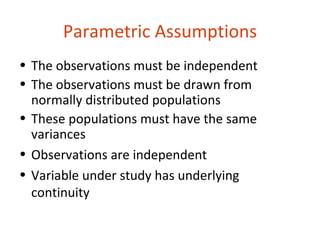
Parametric Assumptions
• The observations must be independent
• The observations must be drawn from
  normally distributed populations
• These populations must have the same
  variances
• Observations are independent
• Variable under study has underlying
  continuity
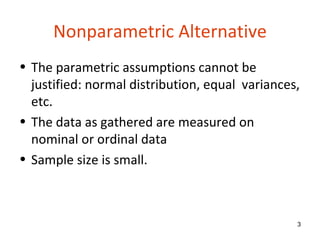
Nonparametric Alternative
• The parametric assumptions cannot be
  justified: normal distribution, equal variances,
  etc.
• The data as gathered are measured on
  nominal or ordinal data
• Sample size is small.


                                                 3
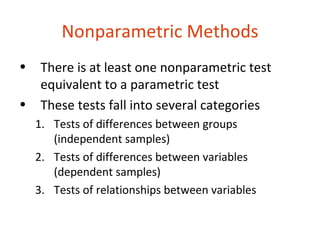
Nonparametric Methods
•    There is at least one nonparametric test
     equivalent to a parametric test
•    These tests fall into several categories
    1. Tests of differences between groups
       (independent samples)
    2. Tests of differences between variables
       (dependent samples)
    3. Tests of relationships between variables
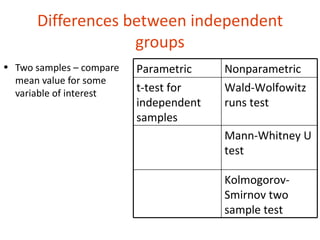
Differences between independent
                   groups
• Two samples – compare   Parametric    Nonparametric
  mean value for some
  variable of interest    t-test for    Wald-Wolfowitz
                          independent   runs test
                          samples
                                        Mann-Whitney U
                                        test

                                        Kolmogorov-
                                        Smirnov two
                                        sample test
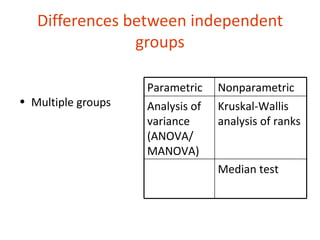
Differences between independent
                groups

                    Parametric    Nonparametric
• Multiple groups   Analysis of   Kruskal-Wallis
                    variance      analysis of ranks
                    (ANOVA/
                    MANOVA)
                                  Median test
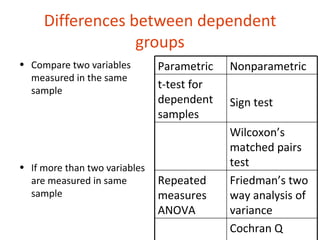
Differences between dependent
                  groups
• Compare two variables        Parametric   Nonparametric
  measured in the same
  sample
                               t-test for
                               dependent    Sign test
                               samples
                                            Wilcoxon’s
                                            matched pairs
• If more than two variables                test
  are measured in same         Repeated     Friedman’s two
  sample                       measures     way analysis of
                               ANOVA        variance
                                            Cochran Q
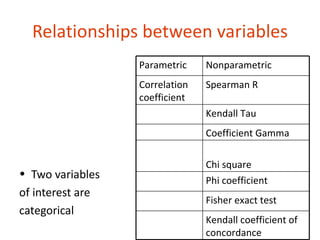
Relationships between variables
                  Parametric    Nonparametric
                  Correlation   Spearman R
                  coefficient
                                Kendall Tau
                                Coefficient Gamma

                                Chi square
• Two variables
                                Phi coefficient
of interest are
                                Fisher exact test
categorical
                                Kendall coefficient of
                                concordance
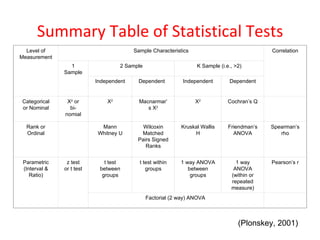
Summary Table of Statistical Tests
  Level of                               Sample Characteristics                              Correlation
Measurement
                 1                  2 Sample                      K Sample (i.e., >2)
               Sample
                           Independent     Dependent         Independent       Dependent


Categorical     Χ2 or          Χ2          Macnarmar’             Χ2           Cochran’s Q
or Nominal       bi-                          s Χ2
               nomial

  Rank or                   Mann            Wilcoxin        Kruskal Wallis     Friendman’s   Spearman’s
  Ordinal                  Whitney U       Matched               H               ANOVA          rho
                                          Pairs Signed
                                             Ranks


 Parametric     z test        t test       t test within    1 way ANOVA           1 way      Pearson’s r
 (Interval &   or t test    between           groups           between           ANOVA
    Ratio)                   groups                             groups          (within or
                                                                                repeated
                                                                                measure)
                                               Factorial (2 way) ANOVA


                                                                                   (Plonskey, 2001)
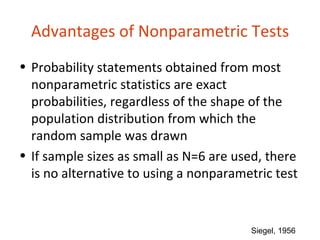
Advantages of Nonparametric Tests
• Probability statements obtained from most
  nonparametric statistics are exact
  probabilities, regardless of the shape of the
  population distribution from which the
  random sample was drawn
• If sample sizes as small as N=6 are used, there
  is no alternative to using a nonparametric test


                                        Siegel, 1956
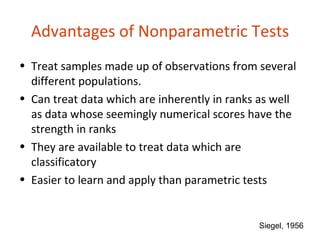
Advantages of Nonparametric Tests
• Treat samples made up of observations from several
  different populations.
• Can treat data which are inherently in ranks as well
  as data whose seemingly numerical scores have the
  strength in ranks
• They are available to treat data which are
  classificatory
• Easier to learn and apply than parametric tests


                                              Siegel, 1956
Criticisms of Nonparametric
                 Procedures
•   Losing precision/wasteful of data
•   Low power
•   False sense of security
•   Lack of software
•   Testing distributions only
•   Higher-ordered interactions not dealt with
Questions?

T11 types of tests

  • 1.
    Parametric versus Nonparametric Statistics– When to use them and which is more powerful? By Rama Krishna Kompella
  • 2.
    Parametric Assumptions • Theobservations must be independent • The observations must be drawn from normally distributed populations • These populations must have the same variances • Observations are independent • Variable under study has underlying continuity
  • 3.
    Nonparametric Alternative • Theparametric assumptions cannot be justified: normal distribution, equal variances, etc. • The data as gathered are measured on nominal or ordinal data • Sample size is small. 3
  • 4.
    Nonparametric Methods • There is at least one nonparametric test equivalent to a parametric test • These tests fall into several categories 1. Tests of differences between groups (independent samples) 2. Tests of differences between variables (dependent samples) 3. Tests of relationships between variables
  • 5.
    Differences between independent groups • Two samples – compare Parametric Nonparametric mean value for some variable of interest t-test for Wald-Wolfowitz independent runs test samples Mann-Whitney U test Kolmogorov- Smirnov two sample test
  • 6.
    Differences between independent groups Parametric Nonparametric • Multiple groups Analysis of Kruskal-Wallis variance analysis of ranks (ANOVA/ MANOVA) Median test
  • 7.
    Differences between dependent groups • Compare two variables Parametric Nonparametric measured in the same sample t-test for dependent Sign test samples Wilcoxon’s matched pairs • If more than two variables test are measured in same Repeated Friedman’s two sample measures way analysis of ANOVA variance Cochran Q
  • 8.
    Relationships between variables Parametric Nonparametric Correlation Spearman R coefficient Kendall Tau Coefficient Gamma Chi square • Two variables Phi coefficient of interest are Fisher exact test categorical Kendall coefficient of concordance
  • 9.
    Summary Table ofStatistical Tests Level of Sample Characteristics Correlation Measurement 1 2 Sample K Sample (i.e., >2) Sample Independent Dependent Independent Dependent Categorical Χ2 or Χ2 Macnarmar’ Χ2 Cochran’s Q or Nominal bi- s Χ2 nomial Rank or Mann Wilcoxin Kruskal Wallis Friendman’s Spearman’s Ordinal Whitney U Matched H ANOVA rho Pairs Signed Ranks Parametric z test t test t test within 1 way ANOVA 1 way Pearson’s r (Interval & or t test between groups between ANOVA Ratio) groups groups (within or repeated measure) Factorial (2 way) ANOVA (Plonskey, 2001)
  • 10.
    Advantages of NonparametricTests • Probability statements obtained from most nonparametric statistics are exact probabilities, regardless of the shape of the population distribution from which the random sample was drawn • If sample sizes as small as N=6 are used, there is no alternative to using a nonparametric test Siegel, 1956
  • 11.
    Advantages of NonparametricTests • Treat samples made up of observations from several different populations. • Can treat data which are inherently in ranks as well as data whose seemingly numerical scores have the strength in ranks • They are available to treat data which are classificatory • Easier to learn and apply than parametric tests Siegel, 1956
  • 12.
    Criticisms of Nonparametric Procedures • Losing precision/wasteful of data • Low power • False sense of security • Lack of software • Testing distributions only • Higher-ordered interactions not dealt with
  • 13.