Atomic Energy
Authority of Egypt
RECENT TRENDS IN
RADIOACTIVE WASTE
DISPOSAL
R. O. Abdel Rahman
Associate Prof. chemical nuclear eng.
AEAE
Atomic Energy
Authority of Egypt
Table of Content
• Radioactive wastes and their management
• Early radioactive waste disposal approaches
• Lessons learned form early disposal practices
• Recent approaches for safe radioactive waste
disposal
Atomic Energy
Authority of Egypt
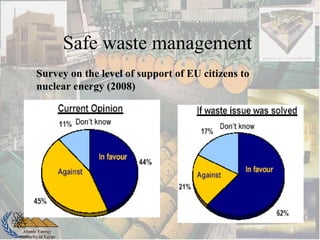
Safe waste management
Survey on the level of support of EU citizens to
nuclear energy (2008)
Atomic Energy
Authority of Egypt
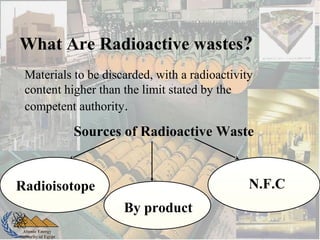
What Are Radioactive wastes?
Materials to be discarded, with a radioactivity
content higher than the limit stated by the
competent authority.
Sources of Radioactive Waste
Radioisotope N.F.C
By product
Atomic Energy
Authority of Egypt
Classification of Radioactive
Waste
Based on the activity of the waste
High level waste (HLW),
Intermediate level waste (ILW),
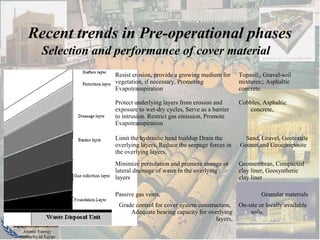
Low level waste (LLW),
Based on half-life
Short lived
Long lived
Atomic Energy
Authority of Egypt
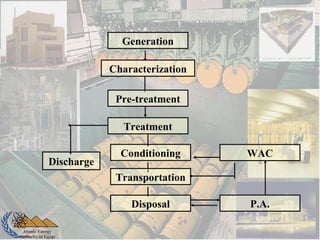
Discharge
Generation
Characterization
Pre-treatment
Conditioning
Transportation
Disposal
Treatment
P.A.
WAC
Atomic Energy
Authority of Egypt
Early Approaches
• Marine disposal
• Land and shallow land disposal
• Deep well injections
• Radon system
• Underground disposal
Atomic Energy
Authority of Egypt
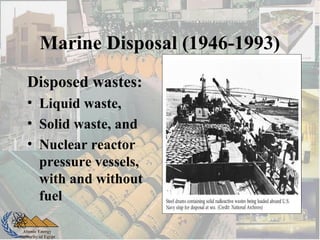
Marine Disposal (1946-1993)
Disposed wastes:
• Liquid waste,
• Solid waste, and
• Nuclear reactor
pressure vessels,
with and without
fuel
Atomic Energy
Authority of Egypt
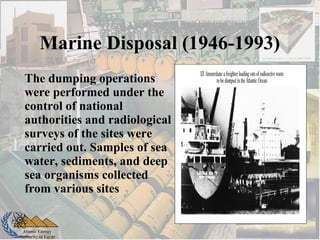
The dumping operations
were performed under the
control of national
authorities and radiological
surveys of the sites were
carried out. Samples of sea
water, sediments, and deep
sea organisms collected
from various sites
Marine Disposal (1946-1993)
Atomic Energy
Authority of Egypt
• Chronological sequence of major marine disposal
events
Year Event
1946 First sea dumping operation
1958 First Untied nation conference on the Law of Sea (UNCLOS I)
1972 Adoption of the convention on the Prevention of Marine Pollution
by Dumping at Wastes and Other Matter
1985 Resolution calling of a voluntary moratorium on radioactive waste
Dumping (LCD)
1993 Resolution on Disposal at Sea Disposal of Radioactive wastes and
other radioactive matter LC.51
1994 Total prohibition on radioactive waste disposal at ea came into
force
Marine Disposal (1946-1993)
Atomic Energy
Authority of Egypt
Land and shallow land disposal
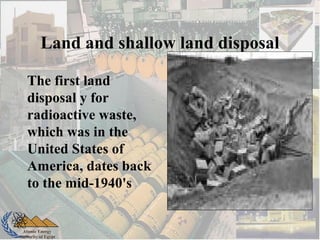
The first land
disposal y for
radioactive waste,
which was in the
United States of
America, dates back
to the mid-1940's
Atomic Energy
Authority of Egypt
Land and Shallow Land Disposal
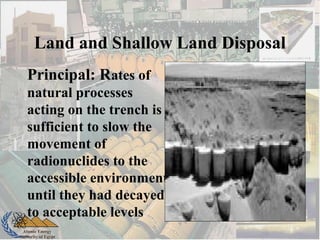
Principal: Rates of
natural processes
acting on the trench is
sufficient to slow the
movement of
radionuclides to the
accessible environment
until they had decayed
to acceptable levels
Atomic Energy
Authority of Egypt
Deep Well Injections
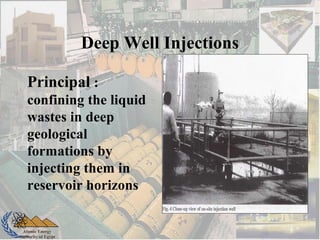
Principal :
confining the liquid
wastes in deep
geological
formations by
injecting them in
reservoir horizons
Atomic Energy
Authority of Egypt
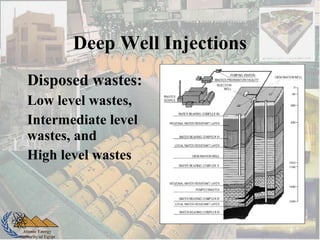
Disposed wastes:
Low level wastes,
Intermediate level
wastes, and
High level wastes
Deep Well Injections
Atomic Energy
Authority of Egypt
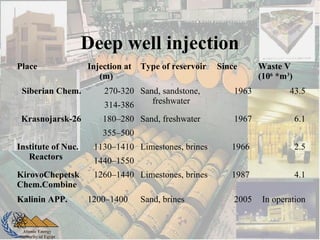
Deep well injection
Place Injection at
(m)
Type of reservoir Since Waste V
(106
*m3
)
Siberian Chem. 270-320 Sand, sandstone,
freshwater
1963 43.5
314-386
Krasnojarsk-26 180–280 Sand, freshwater 1967 6.1
355–500
Institute of Nuc.
Reactors
1130–1410 Limestones, brines 1966 2.5
1440–1550
KirovoChepetsk
Chem.Combine
1260–1440 Limestones, brines 1987 4.1
Kalinin APP. 1200–1400 Sand, brines 2005 In operation
Atomic Energy
Authority of Egypt
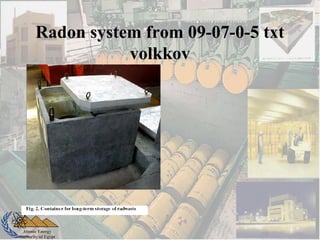
Radon system
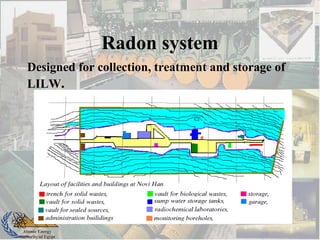
Designed for collection, treatment and storage of
LILW.
Atomic Energy
Authority of Egypt
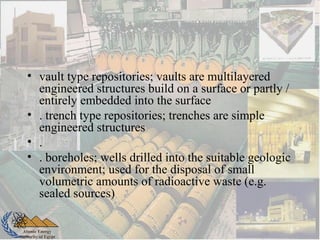
• vault type repositories; vaults are multilayered
engineered structures build on a surface or partly /
entirely embedded into the surface
• . trench type repositories; trenches are simple
engineered structures
• .
• . boreholes; wells drilled into the suitable geologic
environment; used for the disposal of small
volumetric amounts of radioactive waste (e.g.
sealed sources)
Atomic Energy
Authority of Egypt
Radon system from 09-07-0-5 txt
volkkov
Atomic Energy
Authority of Egypt
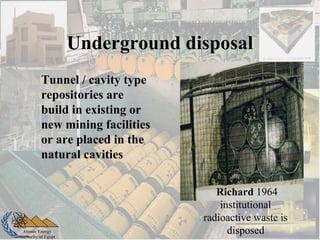
Underground disposal
Tunnel / cavity type
repositories are
build in existing or
new mining facilities
or are placed in the
natural cavities
Richard 1964
institutional
radioactive waste is
disposed
Atomic Energy
Authority of Egypt
Underground disposal
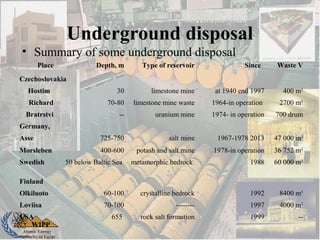
• Summary of some underground disposal
Place Depth, m Type of reservoir Since Waste V
Czechoslovakia
Hostim 30 limestone mine at 1940 end 1997 400 m3
Richard 70-80 limestone mine waste 1964-in operation 2700 m3
Bratrstvi -- uranium mine 1974- in operation 700 drum
Germany,
Asse 725-750 salt mine 1967-1978 2013 47 000 m3
Morsleben 400-600 potash and salt mine 1978-in operation 36 752 m3
Swedish 50 below Baltic Sea metamorphic bedrock 1988 60 000 m3
Finland
Olkiluoto 60-100 crystalline bedrock 1992 8400 m3
Loviisa 70-100 -------- 1997 4000 m3
USA
WIPP
655 rock salt formation 1999 --
Atomic Energy
Authority of Egypt
Waste Pits Remedial Action Project
Atomic Energy
Authority of Egypt
Waste Pits Remedial Action Project
Atomic Energy
Authority of Egypt
Waste Pits Remedial Action Project
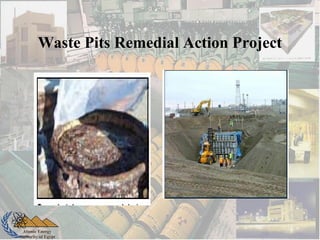
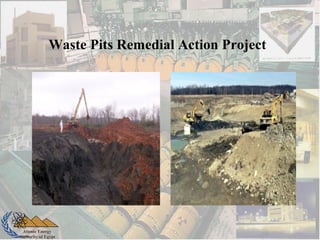
More than, 1 million tons of contaminated materials
are associated with the cleanup project.
Material Handling Building, where excavated
wastes from the pit area will be sorted, blended and
treated,
Gas Control System/Water Treatment System
(GCS/WTS) Building, and
the Railcar Load out Building, where material is
loaded into Railcars for Shipment to Enviro-care
Atomic Energy
Authority of Egypt
Lessons learned form early disposal
practices
• these practices need some actions to meet the
modified regulatory requirements, correct an
existing unsafe condition, prevent any unsafe
condition from occurring in the future, and
respond to societal demands. Based on these
lessons, recent disposal practices have been
developed with greater consideration for the waste
isolation, control the release, reduce the release
impacts if occurs, and avoid or minimize the
maintenance of the facility.
Atomic Energy
Authority of Egypt
Recent trends
• Multibarrier concept: using engineered
barriers to augment natural barriers.
• This concept helps in avoiding over-reliance on
one component of the disposal system (i.e.
natural barriers) to provide the necessary
safety and allow for certain component to fail
without compromising the overall safety of the
disposal system.
Atomic Energy
Authority of Egypt
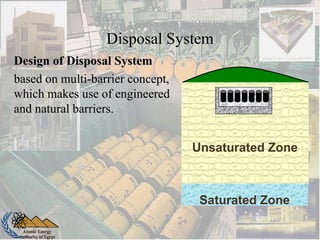
Unsaturated Zone
Saturated Zone
Disposal System
Atomic Energy
Authority of Egypt
Design of Disposal SystemDesign of Disposal System
based on multi-barrier concept,based on multi-barrier concept,
which makes use of engineeredwhich makes use of engineered
and natural barriersand natural barriers.
Atomic Energy
Authority of Egypt
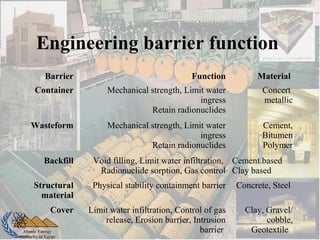
Engineering barrier function
Barrier Function Material
Container Mechanical strength, Limit water
ingress
Retain radionuclides
Concert
metallic
Wasteform Mechanical strength, Limit water
ingress
Retain radionuclides
Cement,
Bitumen
Polymer
Backfill Void filling, Limit water infiltration,
Radionuclide sorption, Gas control
Cement based
Clay based
Structural
material
Physical stability containment barrier Concrete, Steel
Cover Limit water infiltration, Control of gas
release, Erosion barrier, Intrusion
barrier
Clay, Gravel/
cobble,
Geotextile
Atomic Energy
Authority of Egypt
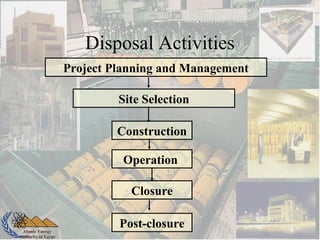
Disposal Activities
Project Planning and Management
Site Selection
Construction
Closure
Post-closure
Operation
Atomic Energy
Authority of Egypt
Recent trends in Pre-operational
phases
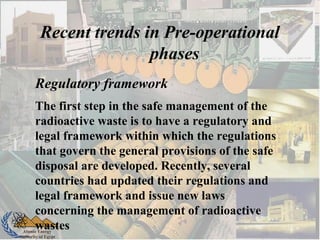
Regulatory framework
The first step in the safe management of the
radioactive waste is to have a regulatory and
legal framework within which the regulations
that govern the general provisions of the safe
disposal are developed. Recently, several
countries had updated their regulations and
legal framework and issue new laws
concerning the management of radioactive
wastes
Atomic Energy
Authority of Egypt
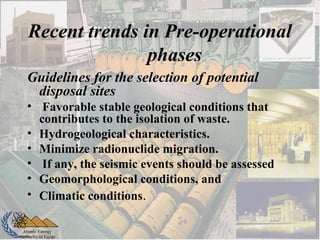
Guidelines for the selection of potential
disposal sites
• Favorable stable geological conditions that
contributes to the isolation of waste.
• Hydrogeological characteristics.
• Minimize radionuclide migration.
• If any, the seismic events should be assessed
• Geomorphological conditions, and
• Climatic conditions.
Recent trends in Pre-operational
phases
Atomic Energy
Authority of Egypt
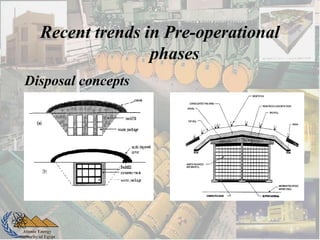
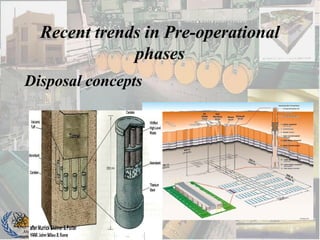
Disposal concepts
Recent trends in Pre-operational
phases
Atomic Energy
Authority of Egypt
Recent trends in Pre-operational
phases
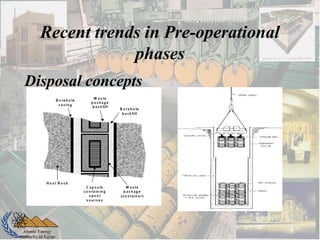
Disposal concepts
Atomic Energy
Authority of Egypt
Recent trends in Pre-operational
phases
Disposal concepts
Atomic Energy
Authority of Egypt
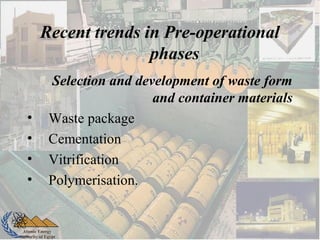
Selection and development of waste form
and container materials
• Waste package
• Cementation
• Vitrification
• Polymerisation.
Recent trends in Pre-operational
phases
Atomic Energy
Authority of Egypt
Recent trends in Pre-operational
phases
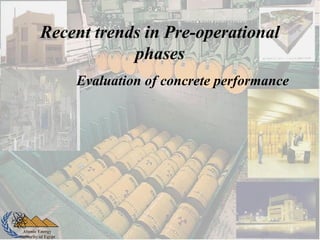
Evaluation of concrete performance
Atomic Energy
Authority of Egypt
Recent trends in Pre-operational
phases
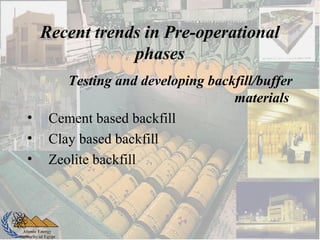
Testing and developing backfill/buffer
materials
• Cement based backfill
• Clay based backfill
• Zeolite backfill
Atomic Energy
Authority of Egypt
Recent trends in Pre-operational phases
Selection and performance of cover material
Resist erosion, provide a growing medium for
vegetation, if necessary, Promoting
Evapotranspiration
Topsoil;, Gravel-soil
mixtures;; Asphaltic
concrete.
Protect underlying layers from erosion and
exposure to wet-dry cycles, Serve as a barrier
to intrusion. Restrict gas emission, Promote
Evapotranspiration
Cobbles, Asphaltic
concrete,
Limit the hydraulic head buildup Drain the
overlying layers, Reduce the seepage forces in
the overlying layers,
Sand, Gravel, Geotextile
Geonet,and Geocomposite
Minimize percolation and promote storage or
lateral drainage of water in the overlying
layers
Geomembran, Compacted
clay liner, Geosynthetic
clay liner
Passive gas vents, Granular materials
Grade control for cover system construction,
Adequate bearing capacity for overlying
layers,
On-site or locally available
soils.
Atomic Energy
Authority of Egypt
Recent trends in operational phases
Atomic Energy
Authority of Egypt
Recent trends in Post-closure
phases
Atomic Energy
Authority of Egypt
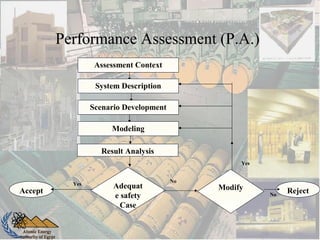
Performance Assessment (P.A.)Performance Assessment (P.A.)
Adequat
e safety
Case
Assessment Context
System Description
Scenario Development
Modeling
Result Analysis
Accept
Yes
Modify
No
Yes
RejectNo
Atomic Energy
Authority of Egypt
Atomic Energy
Authority of Egypt
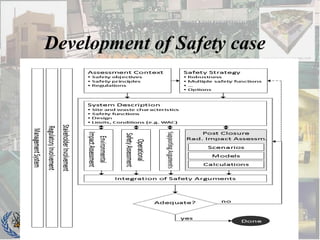
Development of Safety case

RECENT TRENDS IN RADIOACTIVE WASTE DISPOSAL

  • 1.
    Atomic Energy Authority ofEgypt RECENT TRENDS IN RADIOACTIVE WASTE DISPOSAL R. O. Abdel Rahman Associate Prof. chemical nuclear eng. AEAE
  • 2.
    Atomic Energy Authority ofEgypt Table of Content • Radioactive wastes and their management • Early radioactive waste disposal approaches • Lessons learned form early disposal practices • Recent approaches for safe radioactive waste disposal
  • 3.
    Atomic Energy Authority ofEgypt Safe waste management Survey on the level of support of EU citizens to nuclear energy (2008)
  • 4.
    Atomic Energy Authority ofEgypt What Are Radioactive wastes? Materials to be discarded, with a radioactivity content higher than the limit stated by the competent authority. Sources of Radioactive Waste Radioisotope N.F.C By product
  • 5.
    Atomic Energy Authority ofEgypt Classification of Radioactive Waste Based on the activity of the waste High level waste (HLW), Intermediate level waste (ILW), Low level waste (LLW), Based on half-life Short lived Long lived
  • 6.
    Atomic Energy Authority ofEgypt Discharge Generation Characterization Pre-treatment Conditioning Transportation Disposal Treatment P.A. WAC
  • 7.
    Atomic Energy Authority ofEgypt Early Approaches • Marine disposal • Land and shallow land disposal • Deep well injections • Radon system • Underground disposal
  • 8.
    Atomic Energy Authority ofEgypt Marine Disposal (1946-1993) Disposed wastes: • Liquid waste, • Solid waste, and • Nuclear reactor pressure vessels, with and without fuel
  • 9.
    Atomic Energy Authority ofEgypt The dumping operations were performed under the control of national authorities and radiological surveys of the sites were carried out. Samples of sea water, sediments, and deep sea organisms collected from various sites Marine Disposal (1946-1993)
  • 10.
    Atomic Energy Authority ofEgypt • Chronological sequence of major marine disposal events Year Event 1946 First sea dumping operation 1958 First Untied nation conference on the Law of Sea (UNCLOS I) 1972 Adoption of the convention on the Prevention of Marine Pollution by Dumping at Wastes and Other Matter 1985 Resolution calling of a voluntary moratorium on radioactive waste Dumping (LCD) 1993 Resolution on Disposal at Sea Disposal of Radioactive wastes and other radioactive matter LC.51 1994 Total prohibition on radioactive waste disposal at ea came into force Marine Disposal (1946-1993)
  • 11.
    Atomic Energy Authority ofEgypt Land and shallow land disposal The first land disposal y for radioactive waste, which was in the United States of America, dates back to the mid-1940's
  • 12.
    Atomic Energy Authority ofEgypt Land and Shallow Land Disposal Principal: Rates of natural processes acting on the trench is sufficient to slow the movement of radionuclides to the accessible environment until they had decayed to acceptable levels
  • 13.
    Atomic Energy Authority ofEgypt Deep Well Injections Principal : confining the liquid wastes in deep geological formations by injecting them in reservoir horizons
  • 14.
    Atomic Energy Authority ofEgypt Disposed wastes: Low level wastes, Intermediate level wastes, and High level wastes Deep Well Injections
  • 15.
    Atomic Energy Authority ofEgypt Deep well injection Place Injection at (m) Type of reservoir Since Waste V (106 *m3 ) Siberian Chem. 270-320 Sand, sandstone, freshwater 1963 43.5 314-386 Krasnojarsk-26 180–280 Sand, freshwater 1967 6.1 355–500 Institute of Nuc. Reactors 1130–1410 Limestones, brines 1966 2.5 1440–1550 KirovoChepetsk Chem.Combine 1260–1440 Limestones, brines 1987 4.1 Kalinin APP. 1200–1400 Sand, brines 2005 In operation
  • 16.
    Atomic Energy Authority ofEgypt Radon system Designed for collection, treatment and storage of LILW.
  • 17.
    Atomic Energy Authority ofEgypt • vault type repositories; vaults are multilayered engineered structures build on a surface or partly / entirely embedded into the surface • . trench type repositories; trenches are simple engineered structures • . • . boreholes; wells drilled into the suitable geologic environment; used for the disposal of small volumetric amounts of radioactive waste (e.g. sealed sources)
  • 18.
    Atomic Energy Authority ofEgypt Radon system from 09-07-0-5 txt volkkov
  • 19.
    Atomic Energy Authority ofEgypt Underground disposal Tunnel / cavity type repositories are build in existing or new mining facilities or are placed in the natural cavities Richard 1964 institutional radioactive waste is disposed
  • 20.
    Atomic Energy Authority ofEgypt Underground disposal • Summary of some underground disposal Place Depth, m Type of reservoir Since Waste V Czechoslovakia Hostim 30 limestone mine at 1940 end 1997 400 m3 Richard 70-80 limestone mine waste 1964-in operation 2700 m3 Bratrstvi -- uranium mine 1974- in operation 700 drum Germany, Asse 725-750 salt mine 1967-1978 2013 47 000 m3 Morsleben 400-600 potash and salt mine 1978-in operation 36 752 m3 Swedish 50 below Baltic Sea metamorphic bedrock 1988 60 000 m3 Finland Olkiluoto 60-100 crystalline bedrock 1992 8400 m3 Loviisa 70-100 -------- 1997 4000 m3 USA WIPP 655 rock salt formation 1999 --
  • 21.
    Atomic Energy Authority ofEgypt Waste Pits Remedial Action Project
  • 22.
    Atomic Energy Authority ofEgypt Waste Pits Remedial Action Project
  • 23.
    Atomic Energy Authority ofEgypt Waste Pits Remedial Action Project More than, 1 million tons of contaminated materials are associated with the cleanup project. Material Handling Building, where excavated wastes from the pit area will be sorted, blended and treated, Gas Control System/Water Treatment System (GCS/WTS) Building, and the Railcar Load out Building, where material is loaded into Railcars for Shipment to Enviro-care
  • 24.
    Atomic Energy Authority ofEgypt Lessons learned form early disposal practices • these practices need some actions to meet the modified regulatory requirements, correct an existing unsafe condition, prevent any unsafe condition from occurring in the future, and respond to societal demands. Based on these lessons, recent disposal practices have been developed with greater consideration for the waste isolation, control the release, reduce the release impacts if occurs, and avoid or minimize the maintenance of the facility.
  • 25.
    Atomic Energy Authority ofEgypt Recent trends • Multibarrier concept: using engineered barriers to augment natural barriers. • This concept helps in avoiding over-reliance on one component of the disposal system (i.e. natural barriers) to provide the necessary safety and allow for certain component to fail without compromising the overall safety of the disposal system.
  • 26.
    Atomic Energy Authority ofEgypt Unsaturated Zone Saturated Zone Disposal System Atomic Energy Authority of Egypt Design of Disposal SystemDesign of Disposal System based on multi-barrier concept,based on multi-barrier concept, which makes use of engineeredwhich makes use of engineered and natural barriersand natural barriers.
  • 27.
    Atomic Energy Authority ofEgypt Engineering barrier function Barrier Function Material Container Mechanical strength, Limit water ingress Retain radionuclides Concert metallic Wasteform Mechanical strength, Limit water ingress Retain radionuclides Cement, Bitumen Polymer Backfill Void filling, Limit water infiltration, Radionuclide sorption, Gas control Cement based Clay based Structural material Physical stability containment barrier Concrete, Steel Cover Limit water infiltration, Control of gas release, Erosion barrier, Intrusion barrier Clay, Gravel/ cobble, Geotextile
  • 28.
    Atomic Energy Authority ofEgypt Disposal Activities Project Planning and Management Site Selection Construction Closure Post-closure Operation
  • 29.
    Atomic Energy Authority ofEgypt Recent trends in Pre-operational phases Regulatory framework The first step in the safe management of the radioactive waste is to have a regulatory and legal framework within which the regulations that govern the general provisions of the safe disposal are developed. Recently, several countries had updated their regulations and legal framework and issue new laws concerning the management of radioactive wastes
  • 30.
    Atomic Energy Authority ofEgypt Guidelines for the selection of potential disposal sites • Favorable stable geological conditions that contributes to the isolation of waste. • Hydrogeological characteristics. • Minimize radionuclide migration. • If any, the seismic events should be assessed • Geomorphological conditions, and • Climatic conditions. Recent trends in Pre-operational phases
  • 31.
    Atomic Energy Authority ofEgypt Disposal concepts Recent trends in Pre-operational phases
  • 32.
    Atomic Energy Authority ofEgypt Recent trends in Pre-operational phases Disposal concepts
  • 33.
    Atomic Energy Authority ofEgypt Recent trends in Pre-operational phases Disposal concepts
  • 34.
    Atomic Energy Authority ofEgypt Selection and development of waste form and container materials • Waste package • Cementation • Vitrification • Polymerisation. Recent trends in Pre-operational phases
  • 35.
    Atomic Energy Authority ofEgypt Recent trends in Pre-operational phases Evaluation of concrete performance
  • 36.
    Atomic Energy Authority ofEgypt Recent trends in Pre-operational phases Testing and developing backfill/buffer materials • Cement based backfill • Clay based backfill • Zeolite backfill
  • 37.
    Atomic Energy Authority ofEgypt Recent trends in Pre-operational phases Selection and performance of cover material Resist erosion, provide a growing medium for vegetation, if necessary, Promoting Evapotranspiration Topsoil;, Gravel-soil mixtures;; Asphaltic concrete. Protect underlying layers from erosion and exposure to wet-dry cycles, Serve as a barrier to intrusion. Restrict gas emission, Promote Evapotranspiration Cobbles, Asphaltic concrete, Limit the hydraulic head buildup Drain the overlying layers, Reduce the seepage forces in the overlying layers, Sand, Gravel, Geotextile Geonet,and Geocomposite Minimize percolation and promote storage or lateral drainage of water in the overlying layers Geomembran, Compacted clay liner, Geosynthetic clay liner Passive gas vents, Granular materials Grade control for cover system construction, Adequate bearing capacity for overlying layers, On-site or locally available soils.
  • 38.
    Atomic Energy Authority ofEgypt Recent trends in operational phases
  • 39.
    Atomic Energy Authority ofEgypt Recent trends in Post-closure phases
  • 40.
    Atomic Energy Authority ofEgypt Performance Assessment (P.A.)Performance Assessment (P.A.) Adequat e safety Case Assessment Context System Description Scenario Development Modeling Result Analysis Accept Yes Modify No Yes RejectNo Atomic Energy Authority of Egypt
  • 41.
    Atomic Energy Authority ofEgypt Development of Safety case

Editor's Notes

  • #4 62% of EU citizens interviewed would favour nuclear energy if safe solutions for waste are implemented 93% of EU citizens want urgent implementation of long term management of highly radioactive waste 43% believe that deep underground disposal presents the most appropriate solution If waste issue was solved
  • #5 Generation of radioactive wastes accompanied all these applications and also accompanied other human activities associated to natural resource exploitation, which includes mining and processing of ores, combustion of fossil fuels, and production of natural gas and oil.
  • #6 Radioactive wastes have a wide range of radio-concentrations and a variety of physical and chemical forms, this lead to the need for different predisposal technologies and disposal options. To simplify the management of these wastes, a number of schemes have evolved for classifying radioactive waste according to the physical, chemical and radiological properties of significance to the facilities that manage these wastes. These schemes have led to a variety of terminologies, differing from country to country and even between facilities in the same country
  • #7 The development of a safe radioactive waste management system is one of the critical issues for the future of radioactive applications and nuclear industry The handling, transportation, treatment, conditioning, storage, and disposal of radioactive waste are the elements of this system. They should be performed with the above listed environmental and ethical foundation recommended by IAEA. To achieve the overall goal of safety in waste management, the elements of the system should be complementary and compatible with each other [5].
  • #8 In the early days of the nuclear era, the efforts focused on the development of nuclear reactor technologies and their application in related fields where the management of the associated radioactive waste was not considered as a significant problem. Some countries had developed and implemented permanent disposal repositories for radioactive waste and other countries placed radioactive waste into on-site or off-site storage facilities. The intention was to retrieve and process such stored waste only at the end of the facility life as part of dismantling and decommissioning activities
  • #9 . The liquid wastes were disposed either as unpackaged and diluted in surface waters at designated sites or disposed as contained, but unconditioned to the sea bottom at designated sites. For solid radioactive wastes, two subcategories were disposed of at sea. The first LLW such as paper and textiles from decontamination processes, resins and filters, etc., were solidified in cement or bitumen and packaged in metal containers. The second solid radioactive waste subcategory were unpackaged solids mainly large parts of nuclear installations such as steam generators, main circuit pumps, lids of reactor pressure vessels, etc. And finally the former Soviet Union disposed reactor vessels containing damaged spent nuclear fuel and rector vessels without nuclear fuel, where USA disposed reactor vessels without nuclear fuel. These pressure vessels were usually filled with a polymer-based solidification agent (furfural) to provide an additional protective barrier. In most cases reactor pressure vessels with damaged fuel were further contained in a reactor compartment
  • #10 Samples of sea water, sediments, and deep sea organisms collected from various sites have not shown any increase in radionuclides levels above those due to nuclear weapons fallout, except on certain occasions where cesium and plutonium were detected at higher levels in samples taken close to packages at the dumping site. T
  • #12 land repositories followed in many other countries in the 1950's and 1960's (in the United Kingdom, India, the Russian Federation, the Czech Republic, Hungary, Poland, Bulgaria, Norway, South Africa, and others). These disposal practices were constructed using at-surface designs (mounds) or near surface designs (shallow trenches).
  • #13 In these practices, there were no systematic site selection criteria or design requirements that could be used to establish the best mix of features necessary to contain and isolate the wastes. The disposal generally involved clearing and grading the land and excavating shallow unlined trenches generally less than 15 meter deep that would be used to receive the waste. There was no specific packaging requirements existed for the waste, it was packaged in a variety of container types that were randomly dumped or stacked into the trenches. The waste was generally placed into the trenches on a first-come, first-served basis. Trenches were then backfilled using materials removed during trench excavation, compacted, and graded to create an earthen mound cap necessary to prevent rain water ponding and to promote runoff
  • #14 Russian Research Institute of Atomic Reactors (RRIAR) had proposed this option to deal with the problem of large generated volumes of liquid radioactive wastes
  • #15 In 1958, the decision was made to undertake research and a geological survey by creating a disposal system to inject drainage water, wash water, and decontamination water The site was named the Experimental-Industrial Test Site (EITS), at which two sand reservoir horizons were used at a depth of 270–320 m and 314–386 m. Preliminary geological investigation was conducted near the Siberian Chemical Combine, the observation from this experimental site confirmed the prediction and data from the earlier geological investigation. Positive results from these experimental activities and additional investigations led to the creation of a deep-well injection facility (at an industrial scale) for three categories of waste: LLW, ILW, and HLW
  • #17 from the application of radioactive technology in medicine, research institutions, and various branches of industry
  • #20 Limestone was mined here in the end of the last and in the beginning of this century during the 2nd World War mined spaces were transformed into an underground factory, in which prisoners from the neighbouring TerezĂ­n concentration camp worked and produced parts of transport vehicles for the German army. after the war limestone was mined for a short period since 1964 institutional radioactive waste is disposed here
  • #26 Previously this concept viewed as a set of independent individual barriers working sequentially, but this concept is now viewed in a more integrated manner, with
  • #31 Favorable stable geological conditions that contributes to the isolation of waste. Hydrogeological characteristics of the site should limit the contact between waste and groundwater, and thus minimize transport of radionuclides. The site should minimize the potential for radionuclide migration and its chemical conditions should not adversely affect the durability and performance of the engineered barriers. If any, the seismic events should be assessed to ensure that the structures of the facility are designed and built in such a way that their performance will not be compromised. Geomorphological conditions of the site should lead to minimum erosion and flooding rates and intensities, Climatic conditions of the site should ensure that the isolation barriers will perform as designed for the required period of time, and The implications of human activities in the area need to be considered