i SPIN Questions
Situation1
Problem2
Implication3
Needs-payoff4
Ch. 7 - Probing:
Identifying Beliefs,
Goals & Needs
Learning Objectives
• Understand five specific types of customer
information needed to work effectively with
customers.
• Develop and use a progression of questions that
will help you communicate with and understand
your prospect or customer.
i
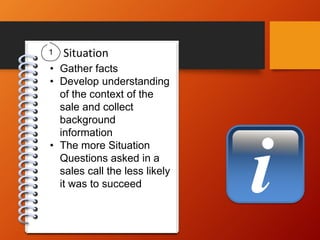
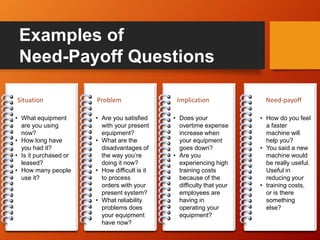
Situation
• Gather facts
• Develop understanding
of the context of the
sale and collect
background
information
• The more Situation
Questions asked in a
sales call the less likely
it was to succeed
1
#
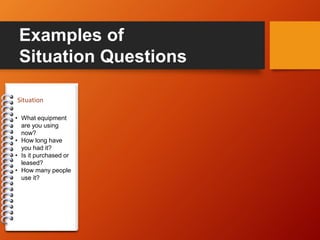
1Situation
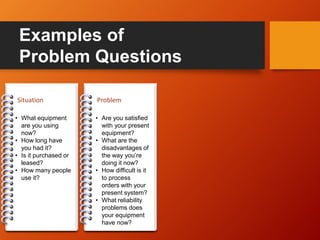
• What equipment
are you using
now?
• How long have
you had it?
• Is it purchased or
leased?
• How many people
use it?
Examples of
Situation Questions
Rackman, Neil, SPIN selling
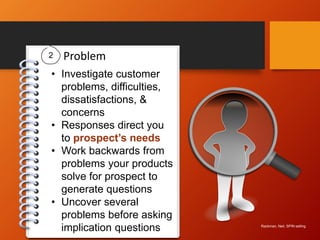
• Investigate customer
problems, difficulties,
dissatisfactions, &
concerns
• Responses direct you
to prospect’s needs
• Work backwards from
problems your products
solve for prospect to
generate questions
• Uncover several
problems before asking
implication questions
Problem2
#
1Situation
#
2Problem
• Are you satisfied
with your present
equipment?
• What are the
disadvantages of
the way you’re
doing it now?
• How difficult is it
to process
orders with your
present system?
• What reliability
problems does
your equipment
have now?
• What equipment
are you using
now?
• How long have
you had it?
• Is it purchased or
leased?
• How many people
use it?
Examples of
Problem Questions
#
Implication
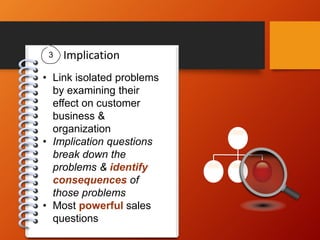
• Link isolated problems
by examining their
effect on customer
business &
organization
• Implication questions
break down the
problems & identify
consequences of
those problems
• Most powerful sales
questions
3
#
1Situation
#
2Problem
#
2Implication
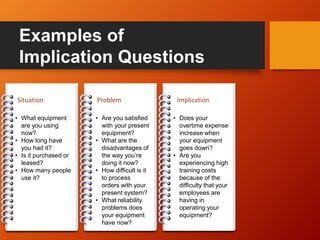
• Does your
overtime expense
increase when
your equipment
goes down?
• Are you
experiencing high
training costs
because of the
difficulty that your
employees are
having in
operating your
equipment??
• Are you satisfied
with your present
equipment?
• What are the
disadvantages of
the way you’re
doing it now?
• How difficult is it
to process
orders with your
present system?
• What reliability
problems does
your equipment
have now?
• What equipment
are you using
now?
• How long have
you had it?
• Is it purchased or
leased?
• How many people
use it?
Examples of
Implication Questions
#
Need-payoff
• Help customers see
value and benefits of
the solution for the
need
4
#
1Situation
#
2Problem
#
2Implication
#
2 Need-payoff
• How do you feel
a faster
machine will
help you?
• You said a new
machine would
be really useful.
Useful in
reducing your
• training costs,
or is there
something
else?
• Does your
overtime expense
increase when
your equipment
goes down?
• Are you
experiencing high
training costs
because of the
difficulty that your
employees are
having in
operating your
equipment??
• Are you satisfied
with your present
equipment?
• What are the
disadvantages of
the way you’re
doing it now?
• How difficult is it
to process
orders with your
present system?
• What reliability
problems does
your equipment
have now?
• What equipment
are you using
now?
• How long have
you had it?
• Is it purchased or
leased?
• How many people
use it?
Examples of
Need-Payoff Questions
SPIN Questioning Example
• Scenario: ________________________
One-Minute Paper
• In concise, well-planned sentences, please answer the
questions below. Place your paper at the back of the
room
1. What are the two most useful things you have learned
during this session?
2. What question remains uppermost in your mind?
3. Is there anything you did not understand?
Shiffman’s Habits #11 & 12
• Habit #11 – Pretend You’re a Consultant
(Because You Are)
• Habit #12 – Ask for the next appointment while
you’re on the first visit
Critiquing Sales Call
Plans
Instructions
• In this sales call, You will watch how the salesperson’s use of
the SPIN QUESTIONING technique. Use the Think-Share-Pair
strategy to discuss these questions:
• Did you see a natural conversation rather than a Q&A
session?
• How well did the salesperson use the SPIN strategy to
learn about the prospect’s problem?
• What were the consequences of the problems that the
salesperson uncovered?
• How well did the salesperson help the prospect identify
the benefits of using the new product?
• With your partner, identify one well asked question.
With your partner, identify one poorly asked question.
Re-word the poorly written question to be better. Be
prepared to share your edits.
Mock Sales Call Video (start at
1:45)
• You can access this video on Canvas’s Chapter
7 module.

Spin Questioning Used in Sales Calls

  • 1.
    i SPIN Questions Situation1 Problem2 Implication3 Needs-payoff4 Ch.7 - Probing: Identifying Beliefs, Goals & Needs
  • 2.
    Learning Objectives • Understandfive specific types of customer information needed to work effectively with customers. • Develop and use a progression of questions that will help you communicate with and understand your prospect or customer.
  • 3.
    i Situation • Gather facts •Develop understanding of the context of the sale and collect background information • The more Situation Questions asked in a sales call the less likely it was to succeed 1
  • 4.
    # 1Situation • What equipment areyou using now? • How long have you had it? • Is it purchased or leased? • How many people use it? Examples of Situation Questions
  • 5.
    Rackman, Neil, SPINselling • Investigate customer problems, difficulties, dissatisfactions, & concerns • Responses direct you to prospect’s needs • Work backwards from problems your products solve for prospect to generate questions • Uncover several problems before asking implication questions Problem2
  • 6.
    # 1Situation # 2Problem • Are yousatisfied with your present equipment? • What are the disadvantages of the way you’re doing it now? • How difficult is it to process orders with your present system? • What reliability problems does your equipment have now? • What equipment are you using now? • How long have you had it? • Is it purchased or leased? • How many people use it? Examples of Problem Questions
  • 7.
    # Implication • Link isolatedproblems by examining their effect on customer business & organization • Implication questions break down the problems & identify consequences of those problems • Most powerful sales questions 3
  • 8.
    # 1Situation # 2Problem # 2Implication • Does your overtimeexpense increase when your equipment goes down? • Are you experiencing high training costs because of the difficulty that your employees are having in operating your equipment?? • Are you satisfied with your present equipment? • What are the disadvantages of the way you’re doing it now? • How difficult is it to process orders with your present system? • What reliability problems does your equipment have now? • What equipment are you using now? • How long have you had it? • Is it purchased or leased? • How many people use it? Examples of Implication Questions
  • 9.
    # Need-payoff • Help customerssee value and benefits of the solution for the need 4
  • 10.
    # 1Situation # 2Problem # 2Implication # 2 Need-payoff • Howdo you feel a faster machine will help you? • You said a new machine would be really useful. Useful in reducing your • training costs, or is there something else? • Does your overtime expense increase when your equipment goes down? • Are you experiencing high training costs because of the difficulty that your employees are having in operating your equipment?? • Are you satisfied with your present equipment? • What are the disadvantages of the way you’re doing it now? • How difficult is it to process orders with your present system? • What reliability problems does your equipment have now? • What equipment are you using now? • How long have you had it? • Is it purchased or leased? • How many people use it? Examples of Need-Payoff Questions
  • 11.
    SPIN Questioning Example •Scenario: ________________________
  • 12.
    One-Minute Paper • Inconcise, well-planned sentences, please answer the questions below. Place your paper at the back of the room 1. What are the two most useful things you have learned during this session? 2. What question remains uppermost in your mind? 3. Is there anything you did not understand?
  • 13.
    Shiffman’s Habits #11& 12 • Habit #11 – Pretend You’re a Consultant (Because You Are) • Habit #12 – Ask for the next appointment while you’re on the first visit
  • 14.
  • 15.
    Instructions • In thissales call, You will watch how the salesperson’s use of the SPIN QUESTIONING technique. Use the Think-Share-Pair strategy to discuss these questions: • Did you see a natural conversation rather than a Q&A session? • How well did the salesperson use the SPIN strategy to learn about the prospect’s problem? • What were the consequences of the problems that the salesperson uncovered? • How well did the salesperson help the prospect identify the benefits of using the new product? • With your partner, identify one well asked question. With your partner, identify one poorly asked question. Re-word the poorly written question to be better. Be prepared to share your edits.
  • 16.
    Mock Sales CallVideo (start at 1:45) • You can access this video on Canvas’s Chapter 7 module.

Editor's Notes

  • #2 The selling process must match the customer’s buying process. Probing uncovers how the buying process works for the customer, particularly the customer’s personal and professional goals. Recommendations, product bundles and services are selected and structured to give each customer maximum momentum toward achieving his or her goals.
  • #4 Situation Questions are an essential part of most sales calls, particularly those calls made early in the selling cycle. At the start of the call, successful people tend to ask data-gathering questions about facts and background. Typical Situation Questions would be “How long have you had your present equipment?” or “Could you tell me about your company’s growth plans?” Although Situation Questions have an important fact-finding role, successful people don’t overuse them because too many can bore or irritate the buyer. Presumably it’s because Situation Questions are easy to ask and they feel safe. When Neil Rackham didn’t know much about selling, his main concern in the call was to be sure he didn’t offend the buyer. And because Situation Questions seemed so inoffensive, he asked a lot too many of them. The fault with Situation Questions is that, from the buyer’s point of view, they are likely to be boring. Rackham, Neil. SPIN Selling. McGraw-Hill Education, 19880522. VitalBook file.
  • #6 Once sufficient information has been established about the customer’s situation, successful salespeople tend to move to a second type of question. They ask, for example, “Is this operation difficult to perform?” or “Are you worried about the quality you get from your old machine?” Questions like these, which we call Problem Questions, explore problems, difficulties, and dissatisfactions in areas where the seller’s product can help. Inexperienced people generally don’t ask enough Problem Questions. Rackham, Neil. SPIN Selling. McGraw-Hill Education, 19880522. VitalBook file.
  • #8 In smaller sales, sellers can be very successful if they just know how to ask good Situation and Problem Questions. In larger sales this is not enough; successful people need to ask a third type of question. This third type is more complex and sophisticated. It’s called an Implication Question, and typical examples would be “How will this problem affect your future profitability?” or “What effect does this reject rate have on customer satisfaction?” Implication Questions take a customer problem and explore its effects or consequences. As we’ll see, by asking Implication Questions successful people help the customer understand a problem’s seriousness or urgency. Implication Questions are particularly important in large sales, and even very experienced salespeople rarely ask them well. (Rackham) Rackham, Neil. SPIN Selling. McGraw-Hill Education, 19880522. VitalBook file.
  • #10 Finally, we found that very successful salespeople ask a fourth type of question during the Investigating stage. It’s called a Need-payoff Question, and typical examples would be “Would it be useful to speed this operation by 10 percent?” or “If we could improve the quality of this operation, how would that help you?” For now, perhaps the most important use of need-payoff questions is that they get the customer to tell you the benefits that your solution could offer. Need-payoff Questions have a very strong relationship to sales success. Rackham, Neil. SPIN Selling. McGraw-Hill Education, 19880522. VitalBook file.
  • #14 Habit #11: Pretend You're a Consultant (Because You Are)
 How is a salesperson a problem solver. How does the word “consult” encapsulate the relationship between a qualified prospect and a salesperson? Habit #12 (Ask for the Next Appointment While You’re on the First Visit) Please summarize the main point the author presented in Habit #12. Question 1: What is one excuse salespeople have provided as reasons for not asking for their next appointment while they’re on their first visit? “I can't ask for the appointment; I don't know when I'll be back in the area.” “I can't ask for the appointment; I don't know how long it will take me to write the proposal.” “I can't ask for the appointment; I don't have a quote ready for the prospect yet.” “I can't ask for the appointment; he may not want to give it to me.” Question 2: Why is it appropriate for you to suggest the next appointment? You met with the prospect because you had an objective: helping to solve the prospect's problem with your product or service. You still have that objective at the conclusion of your initial visit. Therefore, it is altogether appropriate for you to ask to move the process along to the next stage before the meeting adjourns. Question 3: How would you ask for the appointment? “Okay, Mr. Jones; I think we've gone about as far with this as we can today. What I'd like to do is meet with you a couple of weeks from now to show you exactly what we can do for your company. How's Friday the fifteenth?”