The Key to Technical Selling First Installment A PAF Production
Sun Tzu Wu & The Art of War Sun Tzu = Sun Tzu-Wu War v. Sales Sun Tzu-Wu & You
The Art of Sales –  Engagement He will win who knows when to fight and when not to fight. By prospecting well, you’ll know when to engage, and when to disengage . There are five essentials for victory:
The Art of Sales –  Resource Control He will win who knows how to handle both superior and inferior forces. By knowing your resources, and knowing your opponents resources, you’ll  (know how to)  win There are five essentials for victory:
The Art of Sales –  Vision of Success He will win whose army is animated by the same spirit throughout all its ranks. Be driven,  but   be driven with visions of  success , and ensure that fellow Coradiantites share & demonstrate those visions of success, and you will win . There are five essentials for victory:
The Art of Sales –  Preparation He will win who, prepared himself, waits to take the enemy unprepared. You’ll win when you’re prepared, and your preparation takes the enemy unprepared. There are five essentials for victory:
The Art of Sales –  Capacity He will win who has military capacity and is not interfered with by the sovereign. In battle, he who has the  ability , and is not interfered with by management, will win. There are five essentials for victory:
Know your Enemy  Know Yourself If you know the enemy and know yourself, you need not fear the result of a hundred battles.  If you know yourself but not the enemy, for every victory gained you will also suffer a defeat.  If you know neither the enemy nor yourself, you will succumb in every battle.
S P I N Selling   by Neil Rackham Who is Neil Rachham? Why do I care? What is SPIN?
Neil Rackham Some dude with a lot of experience in:  Research Psych Sales Analyzed over 35,000 sales calls as a consultant on Sales Organizations
Why you care Grow your commission check Increase in value of Coradiant’s stock options Increase your skill at handling others (customers or not)
What is SPIN? ahh, the meat of the sandwich… Situation questions Problem questions Implication questions Need-payoff questions
Situation questions Data gathering questions used to get an understanding of the customer’s current situation. Don’t just ask in a rote manner! Too many for no reason bother people  Fewer = > % of success Speedy Situational Recognition
Situation questions - examples What is your network topology? How many webservers / appservers / database servers do you have? How do you monitor your servers? How many people work in Web Ops? How much web traffic do you have? How’s the economy affecting you?
Problem questions Used to explore the customer’s  Problems Difficulties Pain points Dissatisfactions  IN AREAS RELATED to our expertise and services Focus in on the main issues as rapidly as possible
Problem questions – examples Are you satisfied with your current set up? What are your major pain points in Web Ops? NOC related questions Monitoring related questions Staffing related questions
Demonstrating the Need Start as small imperfections  (Implied Needs) Evolve into clear problems, difficulties, dissatisfactions Become wants, desires, or intentions to act  (Explicit Needs)
Wacky Implied Needs As your Problem questioning ability improves, you will quickly draw out many Implied needs By palpating, you’ll be able to feel around the edges until you get through the Implication period
Less wacky, clear problems With Problem & Implication questions, the customer’s implied problems will appear less implied, and more clear. Evolve into clear problems, difficulties, dissatisfactions
Leading a Horse to Drink Investigating is akin to Archery, the more skilled you are, the higher your chance of success
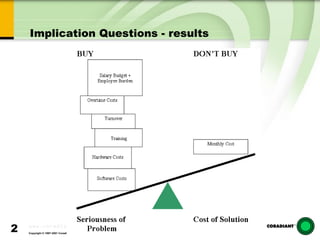
Implication questions Decision makers DEAL in implications Ask about the implications of their problems/issues that we can SOLVE/IMPROVE This is done to help THEM see the impact that the PROBLEM is having on them Your greater skill with implication questions will equate to greater success
Implication questions - examples Does your fear of hackers have any unintended side effects? Are you budgetary limits impacting your site/uptime/purchase of accurate hardware/software? Are your lack of a redundant systems causing uptime issues?
Implication Questions & Tangents Having all the data, but not seeing the relationships Transforming the tangents into causal linkages Equating linkages into: Financial cost Performance cost Departmental success
Implication Questions - results
Need-payoff questions Customer verbalization of  benefits  of  IMPLEMENTING our solution  Increase the acceptability of our solution A great way to REHEARSE  their  reselling of our sales pitch (when we’re not around) It also focuses the customer on the SOLUTION not the problems
Need-payoff questions- examples And off loading the SSL processing would be beneficial? Therefore you believe that global load balancing would relieve your partners apprehension? And if you were to outsource your ‘pain’ would your managers continue to need  additional personnel?
Explicitly Explicit By walking them thru SPIN, we’ve allowed them to prove our value add Additionally, we allow them the joy of verbalizing their Explicit Needs
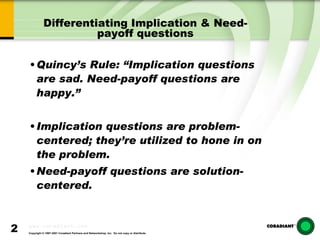
Differentiating Implication & Need-payoff questions Quincy’s Rule: “Implication questions are sad. Need-payoff questions are happy.” Implication questions are problem-centered; they’re utilized to hone in on the problem. Need-payoff questions are solution-centered.
 
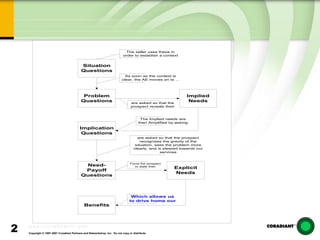
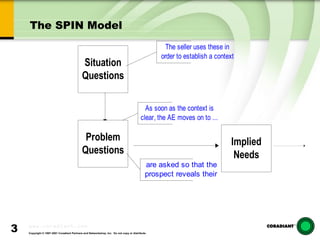
The SPIN Model
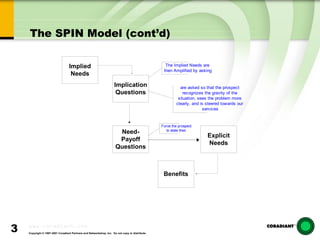
The SPIN Model (cont’d)
Recap of SPIN Selling Having the Customer describe their current situation Probing the Customer’s perception of their problems  that we can solve Having the Customer verbalize the implications of their problems  that we can solve Having the Customer describe the benefits of  a solution that we could provide
Taking Full Advantage  of the Ambush Having walked them to where we want to be, we need to take advantage of the data we have.  As Sun Tzu-Wu said, “If you know the enemy and know yourself, you need not fear the result of a hundred battles.”
So, you’ve utilized SPIN Now that you’ve gotten them to describe our rack as the answer to their problems… Before you whip out a proposal….
Data Oriented versus  Feeling Oriented People Data Oriented  Fact oriented (like to balance their checkbooks to the penny) Process Driven Seek data allowing them to derive ‘an answer’ on their own Will initially reject the ‘opinion’ of others until the analysis has been done The “Hard Sell” is a terrible approach as they abhor the idea of blindly following a stranger’s analysis.
Data Oriented versus  Feeling Oriented People Feeling Oriented  Frequently run from technicalities (often have ‘an extra’ $200 in their checking account so that they don’t get overdrawn) Easily trust ‘experts,’ allowing them to ‘do the smart thing’  May feel threatened if asked to analyze technical data
A Couple o’ Things Sun Tzu-Wu said, “He will win who knows how to handle both superior and inferior forces.” He could have said “He will win who knows his Audience” Don’t pitch a technical superiority pitch to the CFO. Don’t pitch penny-pinching to the CTO
Objections Don’t Counter Objections, but attempt to Avoid Objections By correctly utilizing SPIN, attempt to steer away from potential objections and towards benefits
Proposing Commitments Every agreed upon commitment advances the sale Suggest the biggest commitment that the customer will AGREE to NEVER push for more

The Key To Technical Selling

  • 1.
    The Key toTechnical Selling First Installment A PAF Production
  • 2.
    Sun Tzu Wu& The Art of War Sun Tzu = Sun Tzu-Wu War v. Sales Sun Tzu-Wu & You
  • 3.
    The Art ofSales – Engagement He will win who knows when to fight and when not to fight. By prospecting well, you’ll know when to engage, and when to disengage . There are five essentials for victory:
  • 4.
    The Art ofSales – Resource Control He will win who knows how to handle both superior and inferior forces. By knowing your resources, and knowing your opponents resources, you’ll (know how to) win There are five essentials for victory:
  • 5.
    The Art ofSales – Vision of Success He will win whose army is animated by the same spirit throughout all its ranks. Be driven, but be driven with visions of success , and ensure that fellow Coradiantites share & demonstrate those visions of success, and you will win . There are five essentials for victory:
  • 6.
    The Art ofSales – Preparation He will win who, prepared himself, waits to take the enemy unprepared. You’ll win when you’re prepared, and your preparation takes the enemy unprepared. There are five essentials for victory:
  • 7.
    The Art ofSales – Capacity He will win who has military capacity and is not interfered with by the sovereign. In battle, he who has the ability , and is not interfered with by management, will win. There are five essentials for victory:
  • 8.
    Know your Enemy Know Yourself If you know the enemy and know yourself, you need not fear the result of a hundred battles. If you know yourself but not the enemy, for every victory gained you will also suffer a defeat. If you know neither the enemy nor yourself, you will succumb in every battle.
  • 9.
    S P IN Selling by Neil Rackham Who is Neil Rachham? Why do I care? What is SPIN?
  • 10.
    Neil Rackham Somedude with a lot of experience in: Research Psych Sales Analyzed over 35,000 sales calls as a consultant on Sales Organizations
  • 11.
    Why you careGrow your commission check Increase in value of Coradiant’s stock options Increase your skill at handling others (customers or not)
  • 12.
    What is SPIN?ahh, the meat of the sandwich… Situation questions Problem questions Implication questions Need-payoff questions
  • 13.
    Situation questions Datagathering questions used to get an understanding of the customer’s current situation. Don’t just ask in a rote manner! Too many for no reason bother people Fewer = > % of success Speedy Situational Recognition
  • 14.
    Situation questions -examples What is your network topology? How many webservers / appservers / database servers do you have? How do you monitor your servers? How many people work in Web Ops? How much web traffic do you have? How’s the economy affecting you?
  • 15.
    Problem questions Usedto explore the customer’s Problems Difficulties Pain points Dissatisfactions IN AREAS RELATED to our expertise and services Focus in on the main issues as rapidly as possible
  • 16.
    Problem questions –examples Are you satisfied with your current set up? What are your major pain points in Web Ops? NOC related questions Monitoring related questions Staffing related questions
  • 17.
    Demonstrating the NeedStart as small imperfections (Implied Needs) Evolve into clear problems, difficulties, dissatisfactions Become wants, desires, or intentions to act (Explicit Needs)
  • 18.
    Wacky Implied NeedsAs your Problem questioning ability improves, you will quickly draw out many Implied needs By palpating, you’ll be able to feel around the edges until you get through the Implication period
  • 19.
    Less wacky, clearproblems With Problem & Implication questions, the customer’s implied problems will appear less implied, and more clear. Evolve into clear problems, difficulties, dissatisfactions
  • 20.
    Leading a Horseto Drink Investigating is akin to Archery, the more skilled you are, the higher your chance of success
  • 21.
    Implication questions Decisionmakers DEAL in implications Ask about the implications of their problems/issues that we can SOLVE/IMPROVE This is done to help THEM see the impact that the PROBLEM is having on them Your greater skill with implication questions will equate to greater success
  • 22.
    Implication questions -examples Does your fear of hackers have any unintended side effects? Are you budgetary limits impacting your site/uptime/purchase of accurate hardware/software? Are your lack of a redundant systems causing uptime issues?
  • 23.
    Implication Questions &Tangents Having all the data, but not seeing the relationships Transforming the tangents into causal linkages Equating linkages into: Financial cost Performance cost Departmental success
  • 24.
  • 25.
    Need-payoff questions Customerverbalization of benefits of IMPLEMENTING our solution Increase the acceptability of our solution A great way to REHEARSE their reselling of our sales pitch (when we’re not around) It also focuses the customer on the SOLUTION not the problems
  • 26.
    Need-payoff questions- examplesAnd off loading the SSL processing would be beneficial? Therefore you believe that global load balancing would relieve your partners apprehension? And if you were to outsource your ‘pain’ would your managers continue to need additional personnel?
  • 27.
    Explicitly Explicit Bywalking them thru SPIN, we’ve allowed them to prove our value add Additionally, we allow them the joy of verbalizing their Explicit Needs
  • 28.
    Differentiating Implication &Need-payoff questions Quincy’s Rule: “Implication questions are sad. Need-payoff questions are happy.” Implication questions are problem-centered; they’re utilized to hone in on the problem. Need-payoff questions are solution-centered.
  • 29.
  • 30.
  • 31.
    The SPIN Model(cont’d)
  • 32.
    Recap of SPINSelling Having the Customer describe their current situation Probing the Customer’s perception of their problems that we can solve Having the Customer verbalize the implications of their problems that we can solve Having the Customer describe the benefits of a solution that we could provide
  • 33.
    Taking Full Advantage of the Ambush Having walked them to where we want to be, we need to take advantage of the data we have. As Sun Tzu-Wu said, “If you know the enemy and know yourself, you need not fear the result of a hundred battles.”
  • 34.
    So, you’ve utilizedSPIN Now that you’ve gotten them to describe our rack as the answer to their problems… Before you whip out a proposal….
  • 35.
    Data Oriented versus Feeling Oriented People Data Oriented Fact oriented (like to balance their checkbooks to the penny) Process Driven Seek data allowing them to derive ‘an answer’ on their own Will initially reject the ‘opinion’ of others until the analysis has been done The “Hard Sell” is a terrible approach as they abhor the idea of blindly following a stranger’s analysis.
  • 36.
    Data Oriented versus Feeling Oriented People Feeling Oriented Frequently run from technicalities (often have ‘an extra’ $200 in their checking account so that they don’t get overdrawn) Easily trust ‘experts,’ allowing them to ‘do the smart thing’ May feel threatened if asked to analyze technical data
  • 37.
    A Couple o’Things Sun Tzu-Wu said, “He will win who knows how to handle both superior and inferior forces.” He could have said “He will win who knows his Audience” Don’t pitch a technical superiority pitch to the CFO. Don’t pitch penny-pinching to the CTO
  • 38.
    Objections Don’t CounterObjections, but attempt to Avoid Objections By correctly utilizing SPIN, attempt to steer away from potential objections and towards benefits
  • 39.
    Proposing Commitments Everyagreed upon commitment advances the sale Suggest the biggest commitment that the customer will AGREE to NEVER push for more