LLOYD LOFTON
Phone: 865-776-7632
Email – lloyd@lloydlofton.com
http://lloydlofton.com/
LET’S DEFINE SELLING
In it’s broadest sense Selling is the process that
brings about a desired change in the behavior of
prospects using needs based techniques.
THE SALESPERSON'S ROLE
The primary function of sales person is to:
Disturb
Remove complacency
Uncover sources of dissatisfaction
Instill a desire for changing the status quo
Offer an intelligent and acceptable solution
Effect a decision to buy
WIIFM RADIO
Prospects tune into WIIFM radio
“WHAT”S IN IT FOR ME”
Thinking from the perspective of the prospect helps to uncover
the
information that triggers prospect’s buying motivation.
Understanding the way prospects buy helps you to succeed.
However, simply understanding the prospect’s buying motive
doesn’t
accomplish anything.
Figuring out the buying motives and then using these motives to
help your
prospect buy is the skill that needs to be developed
HUMAN RELATIONS
Prospects will do business with someone they like
Be yourself. If you try to be someone you are not, you will be
regarded as insincere
Know your products. This is a sales strength. It promotes
confidence
Expect the best from your prospect
FOUNDATION
Do not answer questions in such a manner as to create new
ones
Reinforce the prospect’s emotional decision to buy from you
with logic
Develop positive emotions without arousing negative ones
EMPATHY/SYMPATHY
Empathy means trying to see, hear and think like the other
person
Empathy is understanding a person, looking from the inside
out,
as he or she does
Listening is the key skill for acquiring this kind of
understanding
QUESTIONS
TYPES OF QUESTIONS
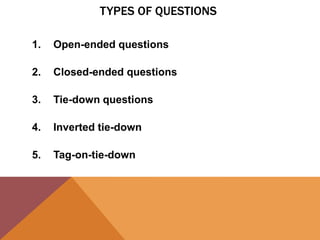
1. Open-ended questions
2. Closed-ended questions
3. Tie-down questions
4. Inverted tie-down
5. Tag-on-tie-down
OPEN-ENDED QUESTIONS
1. Open-ended question –
A question that requires more than a “yes” or “no”
answer.
“How have you used your current plan in the last year?”
“Which feature have you received the most benefit from
in your
current plan?”
OPEN-ENDED QUESTIONS
Words that initiate open ended questions:
Tell me… Describe… How… Explain… What… Why…
Remember questions “gather” information.
CLOSED-ENDED QUESTIONS
2. Close-end questions –
Closed ended questions generally require a “yes” or “no”
(or a one/two word) response.
Too many closed ended questions make the interaction feel
like an
interrogation.
CLOSED-ENDED QUESTIONS
Closed ended questions help break the ice and loosen up a
resistant
prospect.
Words that initiate closed-ended questions:
Is… Does… Which… Are… Will… Which…
TIE-DOWN QUESTIONS
3. Tie-down question are generally used at the end of a
sentence. You normally already know the answer.
They are most commonly used to:
1. Get agreement of small points
2. Ask when you know the answer to be yes
3. Get and give acknowledgement from prospect that
they understand and agree with solutions
discussed.
TIE-DOWN QUESTIONS
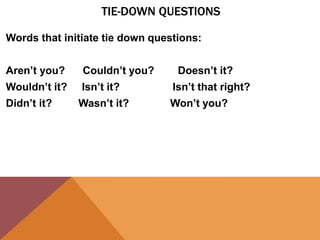
Words that initiate tie down questions:
Aren’t you? Couldn’t you? Doesn’t it?
Wouldn’t it? Isn’t it? Isn’t that right?
Didn’t it? Wasn’t it? Won’t you?
TIE-DOWN QUESTIONS
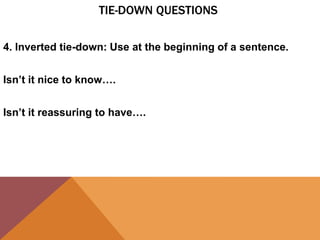
4. Inverted tie-down: Use at the beginning of a sentence.
Isn’t it nice to know….
Isn’t it reassuring to have….
TIE-DOWN QUESTIONS
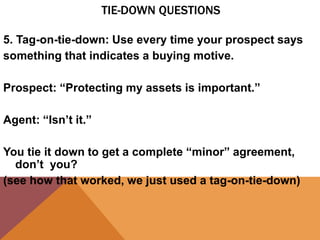
5. Tag-on-tie-down: Use every time your prospect says
something that indicates a buying motive.
Prospect: “Protecting my assets is important.”
Agent: “Isn’t it.”
You tie it down to get a complete “minor” agreement,
don’t you?
(see how that worked, we just used a tag-on-tie-down)
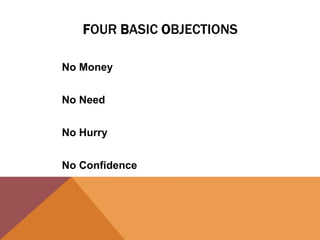
FOUR BASIC OBJECTIONS
No Money
No Need
No Hurry
No Confidence
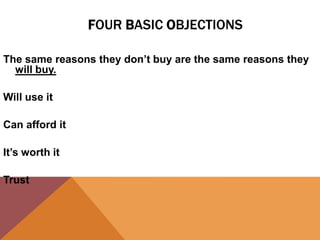
FOUR BASIC OBJECTIONS
The same reasons they don’t buy are the same reasons they
will buy.
Will use it
Can afford it
It’s worth it
Trust
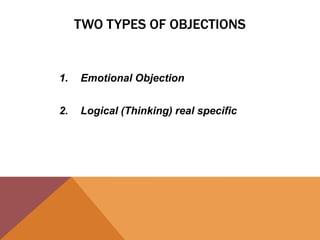
TWO TYPES OF OBJECTIONS
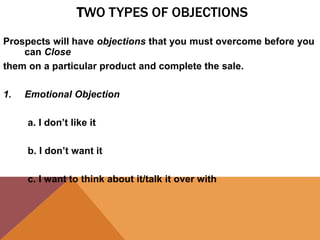
1. Emotional Objection
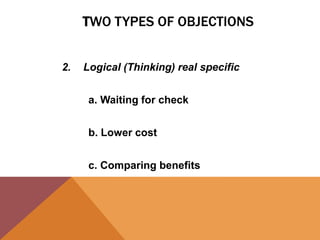
2. Logical (Thinking) real specific
TWO TYPES OF OBJECTIONS
Prospects will have objections that you must overcome before you
can Close
them on a particular product and complete the sale.
1. Emotional Objection
a. I don’t like it
b. I don’t want it
c. I want to think about it/talk it over with
TWO TYPES OF OBJECTIONS
Example:
Emotional Objection: “I don’t like it.”
TWO TYPES OF OBJECTIONS
2. Logical (Thinking) real specific
a. Waiting for check
b. Lower cost
c. Comparing benefits
PROACTIVE LISTENING
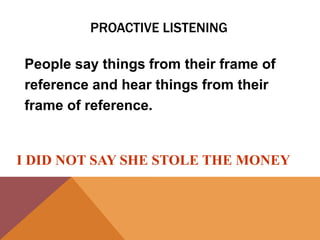
People say things from their frame of
reference and hear things from their
frame of reference.
I DID NOT SAY SHE STOLE THE MONEY
STATEMENTS, QUESTIONS, AND OBJECTIONS
STATEMENT
Reporting of a fact or opinion
QUESTION
A statement that attempts to gain information
OBJECTION
A statement based on fact or feeling of disapproval
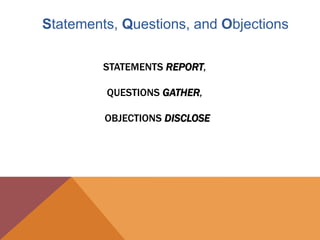
STATEMENTS REPORT,
QUESTIONS GATHER,
OBJECTIONS DISCLOSE
Statements, Questions, and Objections
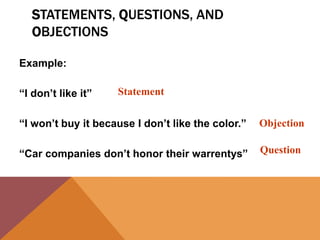
STATEMENTS, QUESTIONS, AND
OBJECTIONS
Example:
“I don’t like it”
“I won’t buy it because I don’t like the color.”
“Car companies don’t honor their warrentys”
Statement
Objection
Question
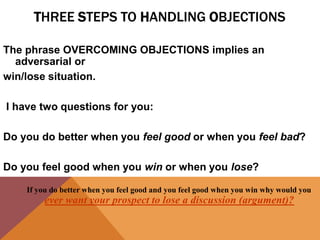
THREE STEPS TO HANDLING OBJECTIONS
The phrase OVERCOMING OBJECTIONS implies an
adversarial or
win/lose situation.
I have two questions for you:
Do you do better when you feel good or when you feel bad?
Do you feel good when you win or when you lose?
If you do better when you feel good and you feel good when you win why would you
ever want your prospect to lose a discussion (argument)?
THREE STEPS TO HANDLING OBJECTIONS
If you do better when you feel good and
you feel good when you win why would you
ever want your prospect to lose a discussion (argument)?
THREE STEPS TO HANDLING OBJECTIONS
One of the biggest mistakes sales people make is to try and fight
their
prospects objection.
When you fight an objection, your prospect’s sales resistance
goes up, and
the buying process becomes much more difficult.
Instead of battling with your prospect, you want to align yourself
with them
and reinforce you are on their side.
By aligning with your prospect, you validate their concerns,
thereby
lowering their sales resistance and making their objection much
easier to handle.
THREE STEPS TO HANDLING OBJECTIONS
Once you determine the prospects Specific Objection you
must
handle the objection immediately.
1. Validate the concern
2. Restate /Isolate the concern
3. Begin effective questioning
THREE STEPS TO HANDLING OBJECTIONS
Repeat or rephrase the prospects concerns.
It is important to repeat or rephrase the prospects
concern:
1. Make sure it is a final concern
2. Make sure you are at the end of the road
3. Demonstrate you are listening
END OF THE ROAD
The idea of answering objections is to:
Provide enough information for the prospect to make a
buying
decision TODAY
The idea is not to “educate” or “consult”
Rebuttals are designed to provide you with enough
information to
assist the prospect in making a buying decision TODAY
TWO TYPE OF QUESTIONS
High Trust Question
Low Trust Question
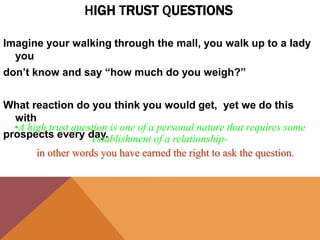
HIGH TRUST QUESTIONS
Imagine your walking through the mall, you walk up to a lady
you
don’t know and say “how much do you weigh?”
What reaction do you think you would get, yet we do this
with
prospects every day.
•A high trust question is one of a personal nature that requires some
establishment of a relationship-
in other words you have earned the right to ask the question.
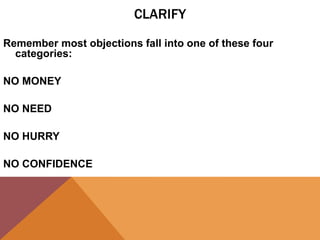
CLARIFY
Remember most objections fall into one of these four
categories:
NO MONEY
NO NEED
NO HURRY
NO CONFIDENCE
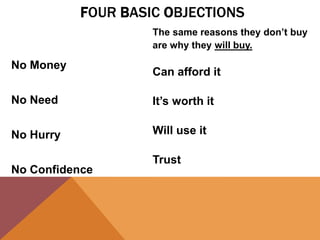
FOUR BASIC OBJECTIONS
No Money
No Need
No Hurry
No Confidence
The same reasons they don’t buy
are why they will buy.
Can afford it
It’s worth it
Will use it
Trust
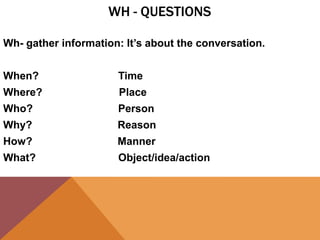
WH - QUESTIONS
WH - QUESTIONS
Wh- gather information: It’s about the conversation.
When? Time
Where? Place
Who? Person
Why? Reason
How? Manner
What? Object/idea/action
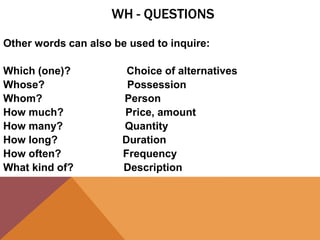
WH - QUESTIONS
Other words can also be used to inquire:
Which (one)? Choice of alternatives
Whose? Possession
Whom? Person
How much? Price, amount
How many? Quantity
How long? Duration
How often? Frequency
What kind of? Description
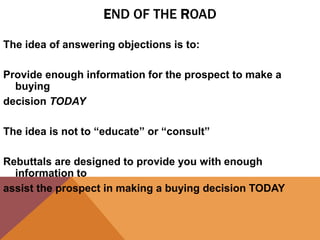
END OF THE ROAD
The idea of answering objections is to:
Provide enough information for the prospect to make a
buying
decision TODAY
The idea is not to “educate” or “consult”
Rebuttals are designed to provide you with enough
information to
assist the prospect in making a buying decision TODAY
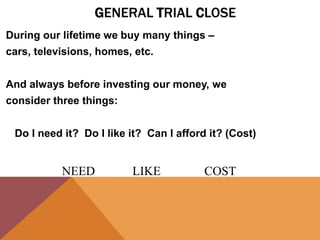
GENERAL TRIAL CLOSE
During our lifetime we buy many things –
cars, televisions, homes, etc.
And always before investing our money, we
consider three things:
Do I need it? Do I like it? Can I afford it? (Cost)
NEED LIKE COST
GENERAL TRIAL CLOSE
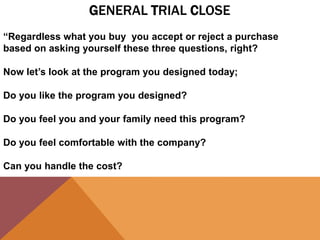
“Regardless what you buy you accept or reject a purchase
based on asking yourself these three questions, right?
Now let’s look at the program you designed today;
Do you like the program you designed?
Do you feel you and your family need this program?
Do you feel comfortable with the company?
Can you handle the cost?
WANT TO SHOP AROUND
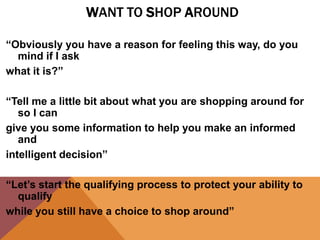
“Obviously you have a reason for feeling this way, do you
mind if I ask
what it is?”
“Tell me a little bit about what you are shopping around for
so I can
give you some information to help you make an informed
and
intelligent decision”
“Let’s start the qualifying process to protect your ability to
qualify
while you still have a choice to shop around”
PROBLEM QUESTIONS
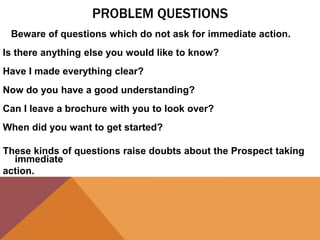
Beware of questions which do not ask for immediate action.
Is there anything else you would like to know?
Have I made everything clear?
Now do you have a good understanding?
Can I leave a brochure with you to look over?
When did you want to get started?
These kinds of questions raise doubts about the Prospect taking
immediate
action.
EXPECTATION
EXPECT
EXPECT TO WIN
EXPECT TO LIKE YOUR POSPECT
EXPECT POSITIVE RESPONSES FROM THOSE YOU
MEET
TRUEISMS
It’s hard to justify the cost of something if you
don’t see the value in it.
What does the prospect have to do when the value
exceeds the cost?
BUY
LLOYD LOFTON
Phone: 865-776-7632
Email – lloyd@lloydlofton.com
http://lloydlofton.com/